
1
Introduction
The National Academies was asked by the National Institute for Occupational Safety and Health (NIOSH) to conduct a review of up to 15 of its research programs. The Mining Safety and Health Research Program is one of the first to be reviewed under this arrangement. The Committee to Review the NIOSH Mining Safety and Health Research Program was constituted to review the program (hereafter referred to as the Mining Program) with respect to its impact, relevance, and future directions. In particular, the committee addressed the following:
-
Progress in reducing workplace illness and injuries through occupational safety and health research by analyzing relevant data about workplace illness and injury and evaluating the effect that Mining Program research has had in reducing illness and injuries;
-
Progress in targeting new research to the areas of occupational safety and health most relevant to future improvements in workplace protection; and
-
Significant emerging research areas that appear especially important in terms of their relevance to the NIOSH mission.
The committee used the assessment framework developed by the National Research Council-Institute of Medicine Committee to Review the NIOSH Research Programs (hereafter referred to as the Framework Committee). For cases in which impact is difficult to measure, the committee measured performance using existing intermediate outcomes (e.g., changes in stakeholder behavior) to estimate impact.
The committee considered not only what the Mining Program is producing but also whether NIOSH research can reasonably be credited with changes in workplace practices or whether such changes are the result of factors unrelated to NIOSH. At the request of NIOSH, the performance of externally funded research and training programs was not evaluated. This report presents the results of the committee’s review. Committee recommendations are made to facilitate the Mining Program’s ability to conduct the most relevant research, resulting in the greatest positive workplace impact.
FRAMEWORK COMMITTEE EVALUATION GUIDELINES
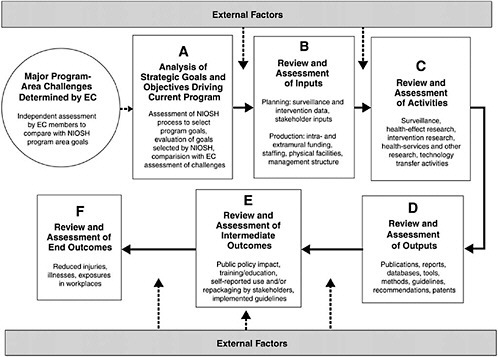
The Framework Committee developed guidelines for the evaluation of NIOSH research programs. The resulting Framework Document (Appendix A) is a working document subject to revisions on the basis of input from the various evaluation committees and input from the interested public. The Framework Committee developed a flow chart (Figure 1-1) to guide the evaluation committees. The Framework Document provides the rationale to be used by the evaluation committees in determining final scores for impact and relevance. A final report outline was also suggested. This committee closely followed the suggested guidelines.
INFORMATION GATHERING
To conduct its evaluation, the committee reviewed a substantial amount of material submitted by the Mining Program in the form of the Mining Program Briefing Book (NIOSH, 2005a). This book contains more than 900 descriptive pages of Mining Program goals, activities, and impacts. NIOSH and the Mining Program made 17 presentations to the committee during open session meetings, and the committee interacted with more than 40 Mining Program employees during site visits. The Mining Program also responded to additional written requests for information from the committee. Appendix B lists written and electronic materials received from NIOSH during the course of this review.
In addition to information from the Mining Program, the committee heard nine stakeholder presentations during an open session meeting, including from the acting director of the Mine Safety and Health Administration (MSHA), labor union representatives, equipment manufacturers, and training consultants. Additional input was received in written response to a broad call for input sent to stakeholders identified by the Mining Program, as well as to professional organizations, state regulatory entities and associations, and other individuals recommended by committee members.
Summary statements in this report are based on the synthesis of this informa-
tion, previously published reports, and the combined expertise of the committee members.
REPORT ORGANIZATION
The Mining Program makes an essential contribution to the mining industry. The critique and recommendations in this report are derived from the need for more of the kind of research it does. The report is relevant to MSHA, policy makers, industry, engineers, scientists, miners and their representatives, and anyone concerned with the health and safety of miners and the economic well-being of the mining industry.
The report is divided into two parts. Part I (Chapters 2 through 7) reviews the Mining Program as a whole. An overview of the Mining Program, with major subheadings parallel to the flow diagram of Figure 1-1, is provided in Chapter 2. Factors that affect the relevance of program research are discussed. The committee presents its assessment of the “ideal” mining program for comparison to the NIOSH Mining Program in Chapter 3. Chapter 4 specifically addresses charge 1 and provides an assessment of relevance and impact. Chapters 5 and 6, respectively, provide the committee’s assessment of program progress in targeting new ideas (charge 2) and identifies emerging health and safety issues in the mining industry (charge 3). The committee synthesizes recommendations made throughout the report that are pertinent program-wide to the Mining Program and includes them in Chapter 7.
Part II (Chapters 8-14) provides detailed assessments of each of the Mining Program’s seven strategic research areas. The chapters are each organized to parallel the flow diagram in Figure 1-1. Recommendations specific to each program area are provided in Part II.
THE U.S. MINING INDUSTRY
Mining can be divided into two categories, underground and surface, and further classified based on the commodity mined—coal or metallic-nonmetallic. The United States is the second-largest producer of coal in the world, with an annual output of approximately 1.1 billion tons (Energy Information Administration, 2006). Surface mining accounts for approximately two-thirds of the production of U.S. coal. More than 97 percent of metallic and nonmetallic mining is done in surface mines.
The U.S. mining sector employs approximately 331,000 people. Table 1-1 shows the breakdown of the mining workforce by commodity, and includes contractors to show the prevalence of that population in the mining sector. Figure 1-2 shows
TABLE 1-1 Distribution of Mining Workforce by Commodity and Number of Contractors Employed in 2005
|
Mining Commodity |
No. Employed |
|
Coal |
81,891 |
|
Sand and gravel |
45,240 |
|
Stone |
81,005 |
|
Nonmetallic minerals |
23,039 |
|
Metallic minerals |
30,395 |
|
Contractors |
72,269 |
|
Total |
333,839 |
|
SOURCES: NMA, 2006; contractor data from MSHA, 2005. |
|
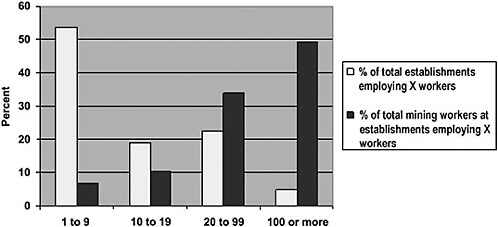
FIGURE 1-2 Chart showing distribution of U.S. mining establishments by worker population, and distribution of mining workforce by size of mining establishment as of March 2004. SOURCE: BLS, 2005a.
the percentage of mining operations employing certain numbers of workers, and the percentage of the total mining workforce employed at mines of certain sizes, as of March 2004. Nearly three-fourths of mining establishments employ fewer than 20 workers. Table 1-2, based on MSHA data,1 compares the number of mines
|
1 |
See http://www.msha.gov/stats/PART50/wq/2005/table7.pdf [accessed March 22, 2007]. |
TABLE 1-2 Number of Mines by Commodity and Employment, 1996 and 2005
|
Employment Range |
Coal |
Metal |
Nonmetal |
Stone |
Sand and Gravel |
Total |
% of Total |
|||||||
|
1996 |
2005 |
1996 |
2005 |
1996 |
2005 |
1996 |
2005 |
1996 |
2005 |
1996 |
2005 |
1996 |
2005 |
|
|
1-19 |
1,633 |
1,152 |
188 |
148 |
521 |
514 |
2,771 |
3,563 |
5,773 |
6,803 |
10,886 |
12,180 |
81 |
83 |
|
20-49 |
639 |
535 |
54 |
24 |
131 |
115 |
619 |
635 |
200 |
223 |
1,643 |
1,532 |
12 |
11 |
|
50-99 |
208 |
199 |
51 |
18 |
65 |
50 |
144 |
158 |
17 |
19 |
485 |
444 |
4 |
3 |
|
100-249 |
118 |
100 |
48 |
36 |
37 |
32 |
102 |
98 |
0 |
0 |
305 |
266 |
2 |
2 |
|
250+ |
63 |
56 |
36 |
33 |
20 |
11 |
3 |
2 |
0 |
0 |
122 |
102 |
1 |
1 |
|
Total |
2,661 |
2,042 |
377 |
259 |
774 |
722 |
3,639 |
4,456 |
5,990 |
7,045 |
13,441 |
14,524 |
100 |
100 |
|
% of total |
20 |
14 |
3 |
2 |
6 |
5 |
27 |
31 |
44 |
48 |
100 |
100 |
|
|
|
SOURCE: Phillip H. Nicks, MSHA, personal communication to Raja Ramani, June 2, 2006. |
||||||||||||||
by commodity and employment for the years 1996 and 2005. Approximately 94 percent of all mines employ fewer than 50 people.
HISTORICAL PERSPECTIVES
Mining Safety and Health
Mining has historically been regarded as a dangerous industry due to the unenviable record of frequent disasters and accidents in its early years. Though mining has one of the highest fatality rates of any U.S. industry (BLS, 2006), it is important to recognize the great improvements in mining technology, equipment, processes and procedures, and workforce education and training that have resulted in greater safety. Major decreases in mine fatalities, fatality rates, and incidence of non-fatal days lost are evident when comparing past and present statistics. Figure 1-3 shows the dramatic decrease in the incidence of fatalities in the mining sector from 1910 through 2004. Fatalities, injuries, and disasters, although less frequent, continue to occur in the industry.
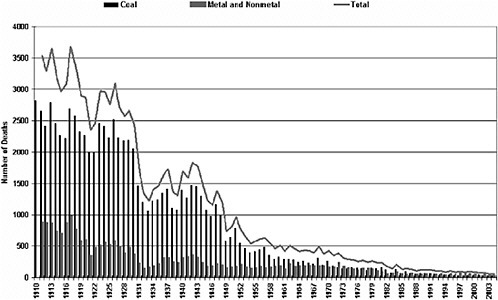
FIGURE 1-3 Mining deaths in the United States, 1910-2004. SOURCE: http://www.msha.gov/stats/charts/chartshome.htm [accessed July 19, 2007].
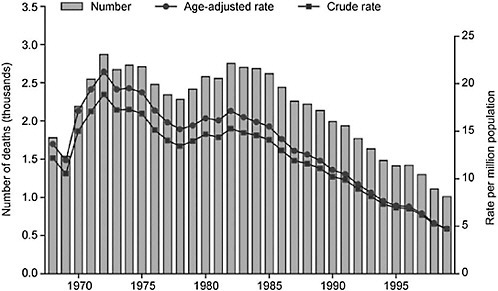
FIGURE 1-4 Numbers of deaths, crude mortality rates, and age-adjusted mortality rates for U.S. residents aged 15 or older, with coal worker’s pneumoconiosis recorded as an underlying or contributing cause on the death certificate, 1968-1999. SOURCES: NCHS, 2002; NIOSH, 2002. Available online at http://www2.cdc.gov/niosh-Chartbook/imagedetail.asp?imgid=322 [accessed October 5, 2006].
Health concerns are also a major issue in the mining industry. Health hazards posed by gases, dusts, chemicals, noise, extreme temperatures, and other physical conditions have been apparent to miners and the industry for a long time, resulting in numerous chronic and sometimes fatal illnesses. Considerable progress has been made in hazard control through improved mine engineering and operation by developing better indices of exposure, by better control of working conditions, and by exposure reduction (i.e., removing the hazard from the worker or the worker from the hazard). Figure 1-4 shows the mortality rate for the period 1968 to 1999 due to coal worker’s pneumoconiosis, a fatal lung disease acquired through exposure to respirable coal mine dust.
Mining Safety and Health Research
The story of mining research in the United States is tied inextricably to the creation of the U.S. Bureau of Mines (USBM) by the Organic Act of 1910. The charge to the USBM was to investigate methods of mining, including specifically
-
safety of mines and the appliances best adapted to prevent accidents;
-
possible improvement of conditions under which mining operations are carried on;
-
treatment of ores and other mineral substances;
-
use of explosives and electricity; and
-
prevention of accidents.
Over the years, USBM activity increased in many areas due to the passage of enabling and industry-specific health and safety legislation. Health and safety research was conducted by the USBM from its inception. From 1941 through 1966 the USBM, within the Department of the Interior, had programs for health and safety inspection, research, and education and training. The inspection program had the authority to enforce regulations in coal mines related to fires, explosions, travel, and inundations. In 1966 the USBM gained similar authority over metal and nonmetal mines. In 1969 the USBM combined its health and safety and mining research programs. In 1973, health and safety enforcement authority was transferred from the USBM to the newly created Mine Enforcement and Safety Administration (MESA) within the Department of the Interior, and reorganized again in 1977 as the Mine Safety and Health Administration (MSHA) in the Department of Labor, where it remains today. The contributions of the USBM to mining, materials processing, metal beneficiation, waste treatment and handling, and mineral statistics, among other areas, is a testimony to its diverse functions.
Complementary to work at the USBM, mining-related health research began in the 1930s within the Division of Industrial Hygiene of the U.S. Public Health Service. A series of epidemiologic studies was started to determine the pathologic effects of various types of dust, including silica, nonsiliceous, and coal dust. These resulted in the development and application of engineering and medical controls at the workplace (Doyle, 1979; Weeks, 1993). In 1969, the Federal Coal Mine Health Act identified an important role for the Secretary of Health, Education and Welfare (now the Department of Health and Human Services, DHHS) in the development and promulgation of health and safety standards and the conduct of studies, research, experiments, and demonstrations on various mine health topics. These provisions remained essentially unchanged until the Federal Mine Safety and Health Act of 1977 was enacted. Meanwhile, the Occupational Safety and Health Act of 1970 created the Occupational Safety and Health Administration (OSHA), within the Department of Labor, and the National Institute for Occupational Safety and Health in DHHS.
The USBM was closed in 1995 by congressional order. The health and safety research programs of the USBM were transferred to the Department of Energy on an interim basis in 1995 and permanently to NIOSH in the Centers for Disease
Control and Prevention (CDC) in 1997. The USBM’s work in mining productivity improvement, also responsible for the saving of many lives, was discontinued.
Since becoming part of the CDC, the Mining Program has continued to build on the USBM’s excellent foundation for improving mine health and safety. The contributions of the USBM to improved safety in mines are unquestioned in a number of areas including fire and explosion control, ventilation practices, rock dusting, explosives, methane control, airborne dust control, and miner training (NRC, 1990). Consistent with the vision and mission of NIOSH, the Mining Program now works to improve safety and health at mining sites through research and prevention and to eliminate occupational diseases, injuries, and fatalities from mining.
Since 2000, the Mining Program began transitioning into what it describes as a “program-based” approach (NIOSH, 2005a). The Mining Program currently conducts research in seven strategic priorities to direct its research activities and resources: (1) respiratory disease prevention; (2) noise-induced hearing loss prevention; (3) cumulative musculoskeletal injury prevention; (4) traumatic injury prevention; (5) mine disaster prevention and control; (6) ground failure prevention; and (7) potential adverse outcomes from changing conditions in the industry.


