
Part II
Evaluation of Strategic Research Areas
In this part of the report, the committee provides a detailed analysis of each of the Mining Program’s seven strategic research areas. The format of each chapter corresponds with the evaluation flow diagram presented in Figure 1-1. A qualitative assessment of relevance and impact of each of the research areas is provided, but no scores are given. Recommendations specific to each program area are provided.
8
Review of Respiratory Disease Prevention Research
|
Key Findings and Recommendations for Respiratory Disease Prevention Research
|
RESEARCH IN MINING RESPIRATORY DISEASE REDUCTION
Respiratory diseases have always been a health risk for mine workers. All mining processes create fine dusts, some of which is respirable. Prolonged exposure to high levels of respirable dust can lead to the development of respiratory diseases such as coal worker’s pneumoconiosis (CWP), silicosis, and chronic obstructive lung disease (Morgan, 1984; Christiani, 2005a, b). The Mining Program and the former U.S. Bureau of Mines (USBM) developed appropriate strategies to control and eliminate these diseases. Other divisions of the National Institute for Occupational Safety and Health (NIOSH), such as the Division of Respiratory Disease Studies (DRDS), the National Personal Protective Technology Laboratory (NPPTL), and the Health Hazard Evaluation Program (HHE), are also involved in the development of strategies for preventing mining-related respiratory disease.
CWP, silicosis, and lung cancer are chronic, irreversible, disabling, and sometimes fatal. With the exception of exposure to very high levels of silica, which can cause acute silicosis, the occurrence of these disease outcomes typically depends on cumulative exposure over decades. Monitoring the prevalence and progression of respiratory diseases, and measuring exposures and the many disease confounders, must occur over equally long periods.
Diesel particulate matter (DPM) and radon gas represent other hazards to miners’ lungs. The major components of DPM are solid carbon (including elemental and organic carbon), liquid and solid hydrocarbons (including polyaromatic hydrocarbons), sulfate, and moisture. High concentrations of DPM add to the risk of CWP and may also increase the risk of lung cancer. Radon gas and its radioactive decay products are present in uranium and other mines, and exposure increases the risk of lung cancer.
STRATEGIC GOALS AND OBJECTIVES
The strategic goal of the Mining Program’s respiratory disease prevention research (NIOSH, 2005a) is to “reduce respiratory diseases in miners by reducing health hazards in the workplace associated with coal worker pneumoconiosis, silicosis, and diesel emissions.” The performance measure of this goal (NIOSH, 2005a) is the reduction of
… respirable coal dust overexposures of operators of longwall and continuous mining machines, roof bolters, and surface drills by 50% and the overall silica exposure of crusher operators and stone cutters by 50% within 10 years. The goal will also be achieved by reducing coal miner exposure to DPM by 80% and metal and nonmetal miner DPM overexposure rates by 50% within 10 years.
The baseline for this performance measure is not immediately discernible from materials provided to the committee by the Mining Program.
Three problems come to mind in reviewing the strategic goal and performance measures: (1) Limiting attention to respirable dust exposure in specific mining occupations obscures exposure that occurs to miners in other occupations. It is appropriate, for example, to focus attention on exposure of all workers on longwall sections, not simply shearer operators. (2) The most troublesome exposure of roof bolters and surface drill operators is to silica, not respirable coal mine dust. Additionally, it is respirable coal mine dust—a mixed dust—not respirable coal dust, that is the measured etiologic agent. (3) In coal mines, ambient exposure to DPM is not measured by NIOSH or by the Mine Safety and Health Administration (MSHA), and it is currently not clear how best to measure reduction of exposure to DPM. Therefore it is difficult to see how to measure progress toward this goal.
Table 8-1 summarizes the Mining Program’s six intermediate goals and performance measures associated with respiratory disease prevention research. Committee comments are also provided.
The considerable reduction of airborne respirable dust concentrations in coal mining and the decrease in the prevalence rates of disease indicate control strategies have been effective. Respirable dust sample data collected by MSHA and mine operators also indicate a significant reduction in exposure.
The strategic goal for well-recognized diseases such as silicosis and CWP is to eliminate disease incidence. Health risks associated with exposure to DPM should also be reduced. This means the Mining Program needs to develop a complete understanding of the incidence rate of diseases such as silicosis and CWP, as well as control measures that will further reduce exposure to respirable coal mine dust, silica, and diesel engine emissions.
REVIEW OF INPUTS
Inputs to the Mining Program include Recommended Exposure Limits (RELs) for respirable dust in coal mines and for silica in all mines established by others. The coal mine workers medical surveillance program of the DRDS also provides valuable input to the mining program by documenting trends and clusters in the occurrence of CWP.1 Primary and secondary prevention of CWP and silicosis require reduction of exposure for all miners and additional reduction for miners with early signs of disease (e.g., positive chest X-ray for CWP).2 The primary source of worker dust exposure data is sampling data collected by MSHA and mine operators, per the 1969 Coal Mine Act and then the 1977 Mine Act. Despite their limitations, these data collectively represent some of the best available information on exposure, epidemiologic, and toxicological findings. Though MSHA data indicate a general reduction in exposure to respirable coal mine dust since the 1980s, MSHA informed the committee of a cluster of CWP cases in one region of the country—a good reason for the development of a program to determine CWP causes and control measures. Exposure to silica remains a problem in metal and non-metal mines (Weeks and Rose, 2006).
TABLE 8-1 Intermediate Goals and Performance Measures of the Respiratory Disease Prevention Program and Committee Comments
|
Intermediate Goala |
Performance Measurea |
Committee Comments |
|
|
1. |
Develop real-time, person-wearable monitoring technology for respirable coal dust |
This goal will be achieved if a real-time, person-wearable dust monitor (PDM) is commercially available and in use by 2009 |
The intermediate goal as stated is an activity. Use of the PDM may allow workers to immediately respond to exposure, enable mining companies to monitor concentrations versus production, and enable regulators to detect excursions above mandated levels—all possible once the PDM is widely in use for specified purposes. The Mining Program should be prepared to make appropriate recommendations to MSHA and individual operators as decisions are being made about the use of the PDM |
|
2. |
Reduce exposure of longwall miners to coal dust |
This goal will be achieved if the frequency of overexposure is reduced by 50% over the next 6 years (baseline is 2003) |
Feasible, but not very ambitious in view of past accomplishments in this area. Overexposures may be site specific and may require site-specific approaches. The relationship between occasional overexposure and disease occurrence is not clear. A more appropriate approach may be to develop technologies to reduce ambient levels, making overexposure occurrence a rare event |
|
3. |
Reduce coal miner exposure to silica and coal dust |
This goal will be achieved if improved control technologies reduce the frequency of overexposure of continuous miner operators, roof bolter operators, and surface drill operators by 50% within 5 years (baseline is 2003) |
Same as above |
The current Mining Program budget for respirable dust research is $4.5 million per year with only about $1 million for the discretionary budget. The total staff is 34. The laboratory facilities at both Pittsburgh Research Laboratory (PRL) and Lake Lynn Laboratory (LLL) are excellent and world class; however, staffing and budget allocations will have to be increased if mining-related respiratory diseases are to be eliminated.
Input from major stakeholder groups is strong and substantial in many areas resulting in, for example, the successful PDM and Diesel Partnerships. However, creative working relationships with other divisions in NIOSH (e.g., DRDS; NPPTL; the Division of Surveillance, Hazard Evaluations, and Field Studies [DSHEFS]), with MSHA, or with mine operators and unions are not always obvious in NIOSH mining respiratory disease prevention research. There is no apparent input from small mine operators or workers, yet workers at these mines are at high risk. In the opinion of the committee, based on members’ knowledge of the research conducted within NIOSH programs, dust and diesel exhaust control efforts should be better integrated with surveillance work at DRDS or other health effects research conducted at DSHEFS to ensure the best use of developed monitoring technologies and surveillance.
Although there seems to be limited interaction between the Mining Program and other NIOSH programs with respect to respiratory disease prevention, and little input from small mine operators, the Mining Program is exceptionally receptive to major stakeholder input.
REVIEW OF ACTIVITIES
The Mining Program describes 14 current projects in mining respiratory disease reduction in materials submitted to the committee (NIOSH, 2005a). These projects are summarized and briefly evaluated in Table 8-2. There is no distinction made by the Mining Program regarding to what extent the work is carried out within other NIOSH research programs.
Surveillance of disease occurrence and monitoring of exposure and control effectiveness are important elements of an effective disease control program. Screening and surveillance are conducted by other divisions within NIOSH and are essential aspects of prevention. In any case, both aspects are part of the Mining Program and provide a model for prevention of any occupational disease because they link assessment of both exposure and outcome.
TABLE 8-2 Respiratory Disease Prevention Projects and Committee Assessment of Relevance and Impact
|
Project Titlea |
Intermediate Goal |
Descriptiona |
Relevance |
Impact |
|
|
Projects Related to Personal Exposure Measurements |
|||||
|
1. |
Assessment of Personal Particulate Exposure |
All |
Development of two devices: |
Development of a PDM is a good start, enabling the measurement of daily and cumulative dust doses of designated operations |
Depending on implementation by MSHA, this device could be very useful for identifying dust sources and reducing miner’s expected. The prevention of overexposure is expected |
|
|
|
1. A PDM providing real-time measurement of silica and coal dust exposure of miners |
|||
|
|
|
|
2. A method to measure diesel exhaust particulate from engine tailpipes |
A relevant, practical, and effective means of controlling exposure to DPM |
A feasible way to measure and control exposure to DPM and simultaneously identify its source (e.g., the engine being measured) |
|
2. |
Response to Personal Dust Monitor Feedback |
1 |
Systematically document how workers react to and use PDMs by conducting one-on-one interviews with 20 miners at each of five mines. Outputs will be training materials for future users of the PDM |
The PDM introduces new information to miners and mine operators, and their reactions are basically unknown. The PDM is a good start but a larger resource base is needed to cover all mine workers |
Timely and accurate information about exposure is most important for controlling exposure and preventing disease |
|
Project Titlea |
Intermediate Goal |
Descriptiona |
Relevance |
Impact |
|
|
Projects Related to Personal Exposure Measurements |
|||||
|
3. |
Advance Spray Dust Capture Principles for Mine Dust Control |
2, 3, 4 |
Reduce mine worker exposure to coal and/or silica dust by increasing dust capture efficiency of mine water spray systems |
Marginal relevance |
Past research in this area has been very successful, but the committee’s opinion is that the reduction in dust concentrations due to additional research on spray pressures and orientation is likely to be marginal |
|
4. |
Dust Control for Longwall Mining |
2 |
Reduce respirable dust at longwall operations by optimizing control parameters that impact dust generated by the shearer, evaluate shield dust entrainment in high-velocity airstreams up to 2,000 feet per minute, conduct benchmarking surveys on longwall faces to quantify dust levels from various sources, define current operating practices, and determine the relative effectiveness of control technologies |
Since exposure on longwall sections is highest and most troublesome, this emphasis is appropriate and the relevance of this work is high |
Impact is expected to be high, but generic dust control methods may have to be adapted to section-specific characteristics such as coal friability, moisture, seam height, etc. |
|
5. |
Improving Ventilation Technology in Large-Opening Mines |
4, 6 |
Methods developed and evaluated to (1) identify proper fans to use in large-opening mines; (2) integrate ventilation needs into mine planning process to aid use of efficient generic ventilation designs; (3) develop computer program to determine air flow volume to meet statutory DPM requirements based on equipment used at individual mine sites; and (4) improve construction methods and materials used for stoppings that direct air to critical areas of large-opening mines to reduce exposure to airborne contaminants |
Moderately relevant |
Impact is expected to be low to moderate. Improved ventilation should be complemented by better dust and DPM controls |
|
6. |
Reducing Underground Miners’ Exposure to Diesel Emissions |
5 |
In-mine evaluations of DPM control technologies and development of a research facility employing a mobile engine dynamometer used in operating-like conditions, but resulting in near-laboratory-quality data. |
Very relevant. Based on presentations at NIOSH workshops, controlling DPM exposure should use integrated, multifaceted, mine-specific methods, and each method has to be evaluated with this integrated approach in mind |
Low to moderate impact expected. If the new technology can be developed, it will improve health and cut the cost of control equipment |
|
7. |
Selection and Evaluation of Diesel Emission Controls for Outby Underground Coal Mine Equipment |
5 |
In-mine and laboratory evaluation of DPM control technologies involving (1) selection of potentially viable emission controls, (2) resolution of issues related to their use, and (3) information dissemination and education to facilitate implementation |
Highly relevant. See comments above |
Control technologies will be more efficient, cost-effective, and affordable |
|
Project Titlea |
Intermediate Goal |
Descriptiona |
Relevance |
Impact |
|
|
8. |
Silica Dust Control in Metal and Nonmetal Mining |
4 |
Research to (1) develop optimized pressurization and filtration systems and implementation guidelines for enclosed cabs; (2) develop cost-effective method and instructional video for cleaning work clothes in an enclosed booth; (3) evaluate existing dust controls and develop improved ventilation controls for iron ore processing plants; and (4) demonstrate effectiveness of improved mine-wide and localized ventilation systems in limestone mines for diluting dust and reducing residence time |
Highly relevant. Based on Mining Program descriptions of the work to date, the committee has some concern that underground gold mines, having highest exposure, are being overlooked |
Though the program will be effective in reducing the dangers from silica dust in specific circumstances, the approach does not appear to address silica dust problems comprehensively and has the appearance of being unsystematic and ad hoc |
|
9. |
Control of Silica Dust Exposure in Underground Coal Mining |
3 |
Development of controls to reduce silica dust exposure of operators of continuous mining and roof bolting machines. This includes the evaluation of wet-head continuous miners, introducing water sprays behind cutting bits of continuous miners, and development of canopy air curtain for roof bolters |
The approach seems appropriate for underground coal mines. On the other hand, these control methods are not unique to silica. Controls for silica would include developing methods for reducing the frequency of cutting into silica-bearing roof and for analyzing roof rock for its silica content |
This could have the greatest impact on reducing silica concentrations if the technology can be developed and implemented |
|
10. |
Surface Mine Dust Control |
4 |
Improving understanding of dust generation principles, evaluation and improvement of current control technologies, and development of new technologies to reduce silica exposure of surface miners, including the use of air spray nozzles to maximize dust capture, wet drilling technology to minimize dust liberation, and determination of optimum drilling parameters to minimize dust generation |
Relevant |
Expected to ultimately reduce the generation of surface mine dust |
|
Projects Related to Characterization of Respirable Mine Dust |
|||||
|
11. |
Characterizing Diesel Emissions in Underground Mines |
5 |
Correlation of DPM concentration to actual elemental carbon or total carbon content of the sample |
Relevant. More effort is required to develop a means of measuring DPM in metal and nonmetal mines |
A moderate impact is expected |
|
12. |
Ultrafine Aerosols from Diesel-Powered Equipment |
5 |
In-mine and laboratory evaluation of control technologies on physical and chemical properties and toxicity of nanometer and ultrafine diesel aerosols. Measurement of size distribution and number, chemical composition, and genotoxicity of nanometer and ultrafine aerosols will be conducted to provide better understanding, and relevant metrics for monitoring worker exposure to DPM as well as industry acceptance of control technologies |
It may be worthwhile to determine what mass fraction of respirable dust is associated with “ultrafine” particles. It may also be worthwhile to determine if the relevant measure of the toxic effects of nanoparticles could be something other than mass, such as particle surface area or count. Toxicity other than genotoxicity should be assessed, including cardiovascular effects |
Impact cannot be ascertained at this time; the work is exploratory in nature |
|
Project Titlea |
Intermediate Goal |
Descriptiona |
Relevance |
Impact |
|
|
Projects Related to Lifestyle Intervention Programs Including Cessation of Smoking and Medical Surveillance |
|||||
|
13. |
Coal Workers’ Health Surveillance Program (CWHSP) |
3 (indirectly) |
Early detection and prevention of CWP |
Highly relevant |
Limited impact without substantial increase of effort in this area |
|
14. |
A Cohort Mortality Study with a Nested Case-Control Study of Lung Cancer and Diesel Exhaust Among Nonmetal Miners |
5 (indirectly) |
Investigation of the risk of lung cancer in relation to quantitative measures of DPM and determination if there is an elevated risk of mortality from other causes among miners exposed to DPM |
Highly relevant; this is an important study because it provides better information about exposure to DPM and confounders and it is based on a large population |
Impact is expected to be high |
|
aSOURCE: NIOSH, 2005a. |
|||||
The committee makes the following observations regarding respiratory disease prevention activities within the Mining Program:
-
Current activities are directed at meeting the permissible exposure limit (PEL) standards in the 1977 Mine Health and Safety Act. The committee is aware of recommendations in the NIOSH Criteria Document (NIOSH, 1995) and the report of the Advisory Committee of the Secretary of Labor on coal mine dust and silica standards (U.S. Department of Labor, 1996). Both of these reports recommend reducing the PELs for respirable dust and silica.
-
Routine monitoring for exposure to mineral dusts and diesel engine exhaust is conducted almost entirely by MSHA as part of its efforts to ensure compliance with applicable established exposure limits. Development of measurement methods, however, is largely a Mining Program activity. NIOSH has a statutory mandate to evaluate and certify devices for measuring exposure to respirable dust (30 CFR Part 74) and in this capacity, since 1970, has evaluated and refined the performance of the personal dust sampler unit.
-
NIOSH has made, and continues to make, important contributions to measurement and control of DPM. The Mining Program also manages quality assurance for these instrument methods and for analytic methods to measure silica concentration.
-
NIOSH is working on the means to measure miners’ exposure to DPM. Since DPM is mostly carbon, coal dust and other carbon sources in mines present significant confounding impediments to measuring ambient DPM levels in mines. NIOSH has made progress addressing these sampling issues, but has yet to determine if it is pertinent or feasible to measure the concentration of total carbon (including organic and elemental carbon) or only of elemental carbon in metal and nonmetal mines.
-
Activities designed to control exposure to silica have been more diffuse and difficult to evaluate. Activities have been devoted to specific occupations in the coal industry and in metal and nonmetal mining. Specifically, exposure to silica has been high for bagging operations, but with the development of less dusty methods, exposure has been reduced. Similarly, exposure of drill operators (present in coal, metal, and nonmetal mines, and in highway and other types of construction) has been reduced with the development of wet drilling methods and collaring methods developed by the Mining Program and mandated by MSHA (e.g., 30 CFR 58.620, 30 CFR 72.620).
-
Between 2001 and 2005, the respirable coal dust samples in underground coal mines exceeding the 2.00 mg/m3 standard ranged from 10 to 16 percent with a mean of 12.7 percent. The percentage of samples that exceeded the statutory silica concentration over the same period ranged from 28 to 36 percent with a mean of 32 percent—a valid cause for concern. These problems may be associated with site-specific factors needing mine-specific solutions.
-
Extensive and effective model and demonstration studies have resulted in new equipment and procedures.
-
The most successful research activities conducted in respiratory disease prevention are those that involve substantial interaction with stakeholders; for example, research that led to a rapid decrease in airborne respirable coal mine dust concentrations in continuous and longwall sections was conducted with substantial input from mine operators and equipment manufacturers. Specific examples of research outputs are scrubbers for continuous miners, spray fans on continuous miners, and shearer-clearer system for longwall shearers.
-
Vulnerable working populations, including workers at small mines and young or inexperienced miners, have received limited attention. Given the age distribution of the current mining population and the increased demand for coal, many new miners may be hired soon, some of whom may not be fluent in English. Limited attention has been paid to training these populations.
-
The committee is not clear about the extent to which internal or external peer reviews are conducted, and quality assurance procedures appear to be ad hoc for each project, rather than following program-wide criteria.
Overall, the committee believes Mining Program activities in respiratory disease prevention research address the most common and serious issues.
REVIEW OF RESEARCH OUTPUTS
The Mining Program has continued the USBM tradition of quality publications regarding respiratory disease prevention in professional journals and proceedings, technical reports, and handbooks. Much of this work has recently been compiled into a useful document entitled Handbook for Dust Control in Mining (Kissell, 2003). Extensive and effective model and demonstration studies have resulted in new equipment and procedures. Outputs are generally user-friendly in terms of design and are relevant to all mine workers. At least some are reports of “breakthrough” research findings with very positive intermediate and end outcomes. Many outputs address high-priority areas, have generated important new knowledge, and serve the mining industry well. Such outputs include the longwall shearer clearer, a wet scrubber for continuous mining machines (in collaboration with Peabody Energy), and a protocol for sampling and analyzing respirable silica (in collaboration with CONSOL Energy).
REVIEW OF TRANSFER ACTIVITIES
Transfer of knowledge, procedures, equipment, and methods of controlling respirable dust in coal mines has accelerated and persisted in response to man-
dates in the Coal Mine Act of 1969 (carried over to the Mine Safety Act of 1977) and due to the activities of the former USBM and the NIOSH Mining Program. Transfer of technology by the Mining Program, in partnership with stakeholders, has been very efficient, and technology transfer seminars on dust control research and development have also been very well attended.
Transfer activities associated with the development of the PDM have occurred along with technology development. Development of the PDM involved numerous meetings of all stakeholders in the PDM partnership, through all phases of developing this instrument (concept, design, development, in-mine evaluation, and modifications). This project can serve as an unprecedented illustration that both development and technology transfer benefit from strategic and well-organized partnerships between NIOSH, industry, instrument manufacturers, unions, and regulatory agencies.
Research on DPM exposure control has shown it to be a complex problem, solvable with the appropriate choice and maintenance of engines, fuel quality, emission controls, and mine ventilation. The Mining Program has held several technology transfer seminars related to DPM control for coal, metal, and nonmetal operators, recruiting engineers from other countries.
In general, there appears to be a coherent planned program to transfer technology related to respiratory disease prevention. Information is reaching the relevant stakeholders and workplaces throughout the industry. Less is known about the adoption and sustained implementation of Mining Program recommendations in the workplace.
REVIEW OF INTERMEDIATE OUTCOMES AND CAUSAL IMPACT
In the opinion of the committee, the development of the personal dust monitor (PDM), and methods to control exposure to diesel particulate matter are examples of success. The PDM provides the most important innovation for measuring dust since the conversion to gravimetric dust measurement. Diesel exhaust is a widespread hazard. Control of diesel exposure is important for miners and could be applied in other industry sectors.
Since CWP is caused by exposure to respirable dust, reduction of exposure is the principal means of preventing disease. Furthermore, since CWP is a chronic disease typically occurring only after many years of exposure, it is important to take a historical view of the effects of exposure reduction and to evaluate the prevalence of disease by the duration of mining experience. The effects of recent reductions in dust exposure will not be manifest for many years.
While there has recently been an increase in CWP in some coal mines in Virginia and West Virginia (Attfield et al., 2004; Antao et al., 2005, 2006), CWP rates
have decreased by more than 70 percent in U.S. coal mines during the last 35 years, from 11 percent in 1970 to 2.6 percent in 2003-2005 (Pon et al., 2003). During the same period, the average respirable dust exposure for continuous miners was reduced from 6 to 1 mg/m3, while longwall face dust exposure was reduced from 4 to 2 mg/m3. The rate of reduction in recent years has not been as dramatic as in earlier years, but the downward trends persist nevertheless.
Methods have been developed for controlling exposure in selected mining operations, such as drilling and bagging of sand. Detailed data for silicosis reduction are not available.
REVIEW OF END OUTCOMES
The ultimate goal of any mining respiratory disease prevention program should be complete elimination of all mining-related respiratory diseases. Epidemiologic research of CWP has been conducted by DRDS for more than 30 years. Given the chronic and insidious nature of this disease, a similar time span for determining and developing control measures is appropriate. There has been a significant decline in CWP rates, taking into account the age and exposure duration of individual miners, shown in Figure 8-1. This chart demonstrates that the prevalence of CWP (≥ Category 1/0), stratified by years of experience as a miner, declined significantly from 1987 to 2002. This indicates success in respiratory disease prevention.
Since there is no surveillance of silicosis occurrence, aside from monitoring its appearance on death certificates (a method with limited reliability), the effects of measures to reduce exposure to silica dust cannot be evaluated. Also, since DPM is currently defined as a “potential carcinogen” and lung cancer has several prominent causes, it is difficult to organize surveillance to specifically measure DPM control effectiveness. NIOSH, however, in collaboration with the National Cancer Institute, is studying the link between lung cancer and exposure to DPM in a group of miners exposed neither to silica nor to radon and its progeny. Although this project is conducted by DRDS, the Mining Program has played an important role in recruiting operators to participate in characterizing exposure.
The Mining Program (and before 1996, the USBM), with the collaboration of mine operators, miners, and their unions, played a critical role in achieving reductions in respiratory diseases by developing feasible and effective means of reducing exposure to respirable dust.3 Results of respiratory disease research within the
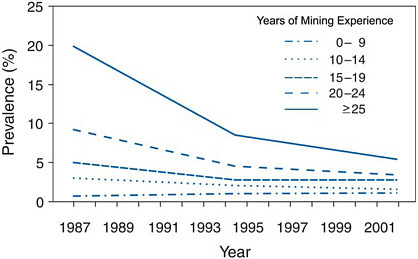
FIGURE 8-1 Trends in prevalence of CWP (≥ Category 1/0) over time (1987-2001). Data are stratified by years of mining experience—U.S. National Coal Workers’ X-Ray Surveillance Program, 1987-2002. SOURCE: Adapted from Pon et al., 2003.
Mining Program are applicable to other industries and have already been applied in tunnel driving and dust control at the nuclear waste repository in Nevada.
ASSESSMENT OF RELEVANCE AND IMPACT
Mining Program efforts in respiratory disease prevention have made at least a moderate contribution on the basis of end outcomes or well-accepted intermediate outcomes and have had impact on the worker. In some areas, such as the effort to reduce CWP, the research program has made a major contribution to worker health and safety. In general, the research program has generated important new knowledge and is well engaged in transfer activities. End outcomes are not always documented. Research is generally in high-priority subject areas and adequately connected to improvements in workplace protection.
PROGRESS IN TARGETING NEW RESEARCH
On the basis of the review of current projects, the committee believes there is a need for the Mining Program to redirect its efforts in several projects toward issues more relevant to the industry in coming years. The scope of the work needs to be expanded in a number of areas. Reference has already been made to expanding the
scope of research in silica and dust control to larger occupational work groups than now addressed. A more effective and appropriate approach to control workplace overexposure is to develop technologies to reduce ambient concentrations that would make overexposure a rare event. Research on measurement and control of diesel exhaust should be conducted by the Mining Program to enhance the impact and relevance of its work. Issues related to methods of DPM control need to be addressed, as made evident from differing state and MSHA requirements.
The Mining Program should devote more time and attention to several aspects of miners’ exposure to silica dust. Specifically, the Mining Program should identify those occupations and tasks that result in chronic overexposure (e.g., exposure above the MSHA PEL) and instances of short-duration exposure to high concentrations (acute overexposure). Once those occupations and tasks are identified, the development of engineering controls should follow. In collaboration with DRDS, the Mining Program needs to develop methods for evaluating exposure conditions associated with cases of acute or accelerated silicosis. The Mining Program should also develop methods for measurement of miners’ exposure to freshly fractured silica on the job and, collaborating with DRDS, for evaluating the health risks to humans of exposure to freshly fractured silica.
The Mining Program should develop alternative uses of the PDM for surveillance and research purposes. The PDM has increased the capacity to monitor exposure with significantly greater depth and breadth. Given this capacity—to measure exposure for extended shifts, to measure exposure on a daily basis, to measure inter- and intra-shift variability in exposure, and to project exposure to the end of a work shift—the ways in which this instrument can be used to enhance health and safety at the workplace should be explored.
|
Signature Accomplishments: Development of the Personal Dust Monitor and Reduction of the Prevalence of CWP Since about 1978, the USBM, and later the Mining Program, have worked, intermittently, on the development of a direct-reading dust sampler that would provide miners and mine operators real-time information about dust exposure using an instrument more resistant to spurious readings than the previous sampling technology. Over the past decade, this work has intensified in a very productive partnership involving mine operators, mine worker unions, MSHA, and the device manufacturer. This work has resulted most recently in the personal dust monitor, now shown to be accurate, feasible, and otherwise suitable for use in underground coal mines. The PDM could provide a powerful tool to help reduce dust exposure and could result in the most significant change in dust sampling methodology in more than 50 years. This instrument was developed specifically for use in under |
|
ground coal mines. It can also be used at surface and metal or nonmetal mines and in other industries where there is exposure to airborne particles. Another signal accomplishment is a significant reduction in exposure to respirable coal mine dust with consequent reduction in the prevalence of CWP. In 1970, exposure to dust was about 6 mg/m3 for continuous miner operators. Now, exposure at most continuous mining sections is about 1 mg/m3. Reductions have been achieved on longwall sections, though not on a similarly dramatic scale (Weeks, 1993). As a consequence, the prevalence of CWP among experienced coal miners was 11 percent in 1970a and, according to the most recent data, is now 2.6 percent (Pon et al., 2003). This improvement was accomplished through the combined efforts of many including the Mining Program, which developed and made information available on many practical, feasible, and effective means of reducing exposure to dust in coal mines. This is a noteworthy and unqualified success story. |


