
1
Introduction
The Colorado River basin (Figure 1-1) is renowned for its breathtaking canyons, panoramic natural landscapes, and widespread aridity, as much of the basin lies within the driest region of the continental United States (Figure 1-2). The Colorado River has long intrigued explorers, writers, rafters, and hikers, and the canyons and landscapes shaped by the Colorado and its tributaries have for centuries provided important cultural, social, and spiritual values for many people. The Colorado River’s Grand Canyon is one of the nation’s great environmental icons and one of the world’s favorite tourist destination sites. Place names and sites across the Colorado Plateau—such as Fort Bridger, Disaster Rapids, Crossing of the Waters, Lees Ferry, Monument Valley, Joseph City, Goosenecks of the San Juan, Four Corners, and Mexican Hat—all evoke images of the region’s rich history and legend.
With an annual average flow rate of roughly 15 million acre-feet, the Colorado River is not particularly large, especially when compared to U.S. rivers like the Columbia or Mississippi. But the Colorado River is the most important source of water in the vast, arid southwestern United States, providing water for tens of millions of people from San Diego to Denver and a multitude of communities in between. The river thus has been of great interest to hydrologists, water lawyers, municipal water managers, geographers, and civil engineers, and it has been the subject of numerous studies in the fields of physical, natural, and social sciences.
Variations in the Colorado River’s flow have long been of interest to water users and managers, and the record of the river’s flows based on flow data gathered at Lees Ferry, Arizona, is one of the nation’s best-known stream gaging sites. Another noteworthy feature of the Colorado River basin is its large amount of storage capacity relative
to the river’s flow. The Colorado River system reservoirs have a total of roughly 60 million acre-feet of storage capacity, approximately four times the Colorado’s average annual flow. Although the basin’s major storage reservoirs have dampened the effects of climate and hydrologic variability, the amount of water in storage remains sensitive to climate fluctuations. Given the strong reliance that steadily increasing populations are placing on the river and its water storage system, variations in Colorado River flows and climate across the basin are as important as they have ever been.
The substantial economic value of Colorado River water has fostered competition—and at times intense animosity—among states and prospective water users. Over the decades, negotiations and legislation involving the Colorado’s water resources have added to a considerable body of laws, compacts, treaties, and agreements that partition and allocate its waters; significantly, much of this legal corpus has been designed to accommodate hydrologic and climate variations. Collectively known as the Law of the River, key components of this legal and institutional framework include the 1922 Colorado River Compact, the 1928 Boulder Canyon Project Act, the 1944 Mexico-United States Treaty, the 1948 Upper Colorado River Basin Compact, the Colorado River Storage Project Act of 1956, the 1963 U.S. Supreme Court decision in Arizona v. California, the 1968 Colorado River Basin Project Act, the 1973 Minute 242 agreement between Mexico and the United States, the 1992 Grand Canyon Protection Act, and other statutes, court decisions and decrees, contracts, and administrative decisions.
The Law of the River’s legal structure is complemented by an elaborate physical infrastructure of dams, reservoirs, levees, canals, aqueducts, tunnels, pumping stations, penstocks, pipes, and ditches. Most of the larger water control structures on the Colorado River and its tributary streams were constructed and today are operated by the U.S. Bureau of Reclamation. The two largest dams across the Colorado River are Hoover Dam, located near Las Vegas, Nevada, and Glen Canyon Dam, located 15 miles south of the Arizona-Utah border. Respectively, these dams impound Lake Mead and Lake Powell, the basin’s two primary storage reservoirs. With storage
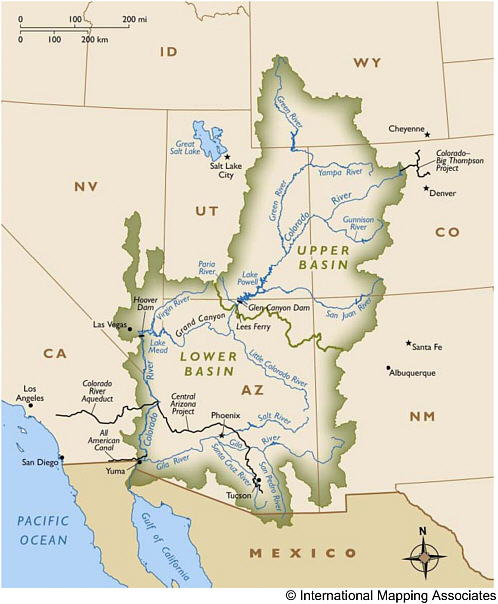
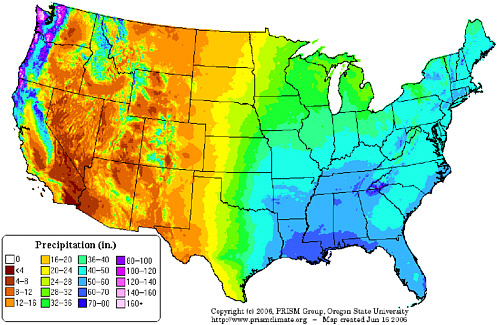
FIGURE 1-2 Average annual precipitation in the United States, 1971-2000.
SOURCE: http://www.ocs.orst.edu/prism/products/matrix.phtml?vartype=ppt&view=maps.
capacities of roughly 28 and 27 million acre-feet, including dead storage, each of these reservoirs is capable of storing roughly 2 years of the river’s annual mean flow. Storage levels and available capacity of Lake Mead and Lake Powell are particularly important in guiding how the Bureau of Reclamation releases flow through the Colorado River system. Other major facilities and projects within the basin include Flaming Gorge Dam in Wyoming, the Colorado-Big Thompson Project, the Central Utah Project, the Aspinall Unit (which includes Blue Mesa, Crystal, and Morrow Point dams) on the Gunnison River in Colorado, Navajo Dam in New Mexico, the Central Arizona Project’s Hayden-Rhodes Aqueduct, the Salt River Project in Arizona, Parker Dam and the Metropolitan Water District of Southern California’s Colorado River Aqueduct, Imperial Dam and the All-American Canal serving the Imperial Valley in southern California, and Morelos Dam immediately south of the Mexico-U.S. border. These projects are designed to provide water to users both within and beyond the Colorado River basin, including much of southern California, Colorado’s Front Range cities, and the City of Albuquerque.
Some of the projects also provide important flood control and re-regulation functions (e.g., storage of water downstream of a dam for additional uses or to further regulate flow).
A prevailing theme in the history of western U.S. water development has been conflict among different users for limited water supplies—especially during drought periods. The legal and physical infrastructure for managing Colorado River water resources was designed to help address or ameliorate conflicts, in part by creating systems to store water during wet periods so that demands during drought can be reliably met. Over much of the 20th century, this system and this water development paradigm generally proved effective at delivering reliable water supplies. Although there have been periods of pronounced drought across the Colorado River basin that caused anxiety (such as during a regional drought in the late 1970s), the large water storage capacity in the basin and the eventual return of wetter conditions heretofore have allowed water delivery obligations to be reliably met.
WATER SUPPLY CONDITIONS AND HYDROCLIMATIC STUDIES
Multiple factors converged across the Colorado River basin during the 1990s and early 2000s that prompted serious concerns among water managers and elected officials regarding long-term water delivery prospects. One of these factors is rapid population growth in urban areas dependent on Colorado River supplies; in particular, Albuquerque, Denver, Las Vegas, Phoenix, Tucson, Los Angeles, and San Diego have all experienced marked increases in population and aggregate water demand since the early 1990s. Beyond fundamental municipal and household uses, these growing urban areas also seek an array of water-related services that includes recreation and instream flow to sustain riparian ecosystems. There have also been settlements of significant tribal water claims, especially in Arizona. This rapidly increasing demand for water poses challenges for water storage systems that are unable to increase supplies by constructing new large-scale storage dams, as was done in the 1950s and 1960s.
Drought conditions that have afflicted much of the Colorado River basin in the late 1990s and early 2000s constitute a second fac-
tor driving water supply-and-demand concerns. In the upper Colorado River basin states, the years 2002 and 2004 were among the 10 driest years of hydrologic record. Storage levels in most of the basin’s reservoirs dropped markedly during this period—total reservoir system storage in spring 2005 was estimated at roughly 50 percent of average values. Reduced reservoir storage levels, coupled with increasing water demands, have raised the issue of long-term viability of Colorado River water supplies to national-level prominence.
A third factor driving these water supply-and-demand concerns relates to a set of studies from the hydroclimatic sciences community. Hydrologic and climate factors play an important part in Colorado River water supply-and-demand dynamics, and the river’s mean annual flow has long been of interest to federal, state, and municipal water managers, tribes, lawyers, users, and scientists. Means for estimating flows are broadly divided into instrumental and pre-instrumental (or “proxy”) methods. Colorado River flows are estimated based on data collected by a network of streamflow gages. These instrumental records date back to the late 19th century in some parts of the Colorado River basin. Through the years, gages have been added at other locations, providing a broader picture of the basin’s hydrologic flow patterns.
The instrumental record covers roughly one century of Colorado River flow data and is not fully representative of the climatic and hydrologic variability that will occur in the future. Water resources planners thus are interested in other information that might provide a more complete picture of long-term Colorado River flows. A key means of extending the instrumental stream gage record back in time is through proxy techniques that estimate hydrologic data from periods before instrumental techniques were available. Across the western United States and the Colorado River basin, the most prominent proxy technique for investigating past climate involves the study of tree rings, formally known as the science of dendrochronology. The cross sections of coniferous trees exhibit annual growth rings that vary in their thickness, in large part, according to climate variables such as temperature and precipitation. Paleoclimate scientists have long studied tree-ring growth patterns to help deduce past climate conditions. Dendrochronological analyses undertaken over the past 30 years document that severe and extended droughts, significantly impacting Colorado River flows, have occurred many times across the region over the past several centuries. Several of these studies
provide estimates of Colorado River streamflows that extend back four to five centuries. An important implication of these studies is that the drought of the late 1990s and early 2000s is hardly unprecedented and that it can readily be understood as part of natural climate variability. Admittedly, in using any proxy methods—including tree-ring reconstructions—one cannot be certain that climate conditions pertaining to proxy indicators represent future (or even current) climate conditions. Nevertheless, these reconstructions identify drought as a recurrent phenomenon, inherent to the region’s long-term climate, and that is almost certain to continue to recur in some form in the future. It would be short-sighted to ignore the evidence these proxy methods provide.
In addition to tree-ring-based reconstructions of Colorado River flows, another related body of hydroclimatic studies points out the impacts of increasing temperature on the hydrologic systems of the western United States, the Colorado River basin in particular. Warmer conditions have led to decreased winter snow accumulations and the peak of spring snowmelt runoff is occurring earlier in the year. There is strong evidence that evapotranspiration rates are increasing. Global climate models that project warmer future temperatures—and, in turn, increased rates of evapotranspiration—have important implications for runoff, water storage, and water planning decisions.
STATEMENT OF TASK AND SCOPE OF REPORT
These water supply and demand issues prompted the National Research Council (NRC) in 2005 to undertake this study of the Scientific Bases of Colorado River Basin Water Management (see Box 1-1). The study was carried out by a committee charged to review existing climate and hydrologic studies, methods of data collection and analysis, organizations for managing scientific information, and implications of scientific knowledge for long-term water deliveries and other provisions of the Law of the River. Thus, in addition to reviewing hydrologic and climatic sciences as they pertain to the Colorado River, this study examines linkages between hydroclimatic sciences, and water system operations and management.
|
BOX 1-1 Committee on the Scientific Bases of Colorado River Basin Water Management Statement of Task This activity will assess the extant body of scientific data and studies regarding Colorado River hydrology, including paleohydrological and dendrochronological studies. In addition to paleoscience, the study will also consider other hydroclimatic trends that might influence future hydrologic variability across the river basin. The study's overarching objective will be to help produce an improved hydrologic baseline to be used in support of water project operations and water resources management decisions (e.g., storage operations and diversions) across the Colorado River basin, and other regions of the western United States, especially during periods of extended drought. These issues will be explored in multiple workshops, to be convened in the region, that will explore the scientific basis of Colorado River hydrology and the strengthening of institutional and related means for gathering and evaluating scientific information. The committee is also likely to convene a meeting, which would be closed to the public, to focus on finalizing its draft report. There are two components to the statement of task for this activity: science and technology, and science institutions and water management practices. |
Given the many dimensions of Colorado River scientific and water management issues and the broad statement of task assigned to this committee, a few comments about the scope of this report are in order. The statement of task defines a study that conceivably could cover a vast intellectual area, as it not only calls for a review of existing hydroclimatic studies and data but also mentions modeling techniques and capabilities, decision support systems, institutional arrangements for information gathering and processing, systems operations, water management practices, and water delivery obligations and other relevant dimensions of the Law of the River. Adequate treatment of any of these topics would pose significant challenges to any study group.
|
Any study of the future of Colorado River water supplies must necessarily be bounded. The need to do so starts with the geographic limits of the Colorado River basin, along with areas beyond the basin served by Colorado River water supplies. The committee recognized and appreciated the numerous water-related issues within and beyond the basin that conceivably could have been addressed in this study; for example, restoration of the Colorado River Delta region, or the potential of offline dams and reservoirs in California to improve water management. In its meetings and discussions, the committee noted a wide variety of important water-related topics—many of which are mentioned in this report—that could have merited more detailed investigation:
-
the economics of developing and using alternative water sources; for example, desalination for urban water supplies and wastewater reuse for land applications;
-
third-party impacts of water transfers;
-
improved agriculture irrigation efficiencies and shifting to higher value crops;
-
demand forecasting and management options and demand/price sensitivities;
-
more detailed analysis of impacts of temperature increases throughout the basin;
-
new technologies for increasing water use efficiencies and their potential impacts;
-
impact of droughts on water management decision making in the basin;
-
institutional changes needed for more effective integrated water management, adaptive management, real-time monitoring and management, sustainable water development, and so on;
-
ways of improving groundwater basin management; and
-
offstream water banking.
All these topics are important and conceivably merit a separate volume on their own. Within the scope of its statement of task and its available resources, however, the committee chose to focus on reviewing existing scientific knowledge of hydroclimatic variability and on discussing the implications of hydroclimatic variability in the context of key water management challenges in the Colorado River basin.
With regard to the science and technology portion of its task statement, the committee discussed how to interpret and comment on the phrase an “improved hydrologic baseline.” The committee decided that, given its interdisciplinary membership and time and resource limitations, the most appropriate way to approach this phrase (and its statement of task) would be to broadly assess key Colorado River scientific issues as they relate to water supply, demand, management, and drought preparedness. Given the interests in the impli-
cations of tree-ring-based reconstructions of Colorado River flows, hydrologic and climate issues in general, and the scientific expertise of the committee membership, it was decided to place some emphasis on these scientific issues (Chapter 3 of this report). The committee also felt it was important to discuss options that might be used to extend water supplies (Chapter 4), and organizations and strategies for improving drought preparedness (Chapter 5).
With regard to the topics of hydrologic models, decision support systems, and institutional arrangements for evaluating hydroclimatic information, the study committee visited with several experts from federal agencies with responsibilities in these areas—namely the Bureau of Reclamation, the National Oceanic and Atmospheric Administration (NOAA), NOAA’s National Weather Service, and the U.S. Geological Survey (USGS; the committee included members with experience working within NOAA and the USGS). We spoke with representatives and experts from the seven basin states, from the U.S.-Mexico International Boundary and Water Commission, and with private-sector consultants (Appendix B lists all speakers who visited with this committee). These experts provided an abundance of valuable information, sharing both research findings and personal points of view on Colorado River water and climate issues. In speaking with these experts and in considering current institutional resources and arrangements devoted to evaluating hydroclimate information, it was not clear that any specific new institution, new interagency program, or computer model would represent a notable breakthrough in managing the Colorado River. It also was not clear that significant shortcomings exist within the current arrangements for evaluating Colorado River region hydroclimatic information. A new institution or new arrangement of institutional responsibilities could conceivably lead to greater efficiencies; the institutional analysis required to arrive at such a conclusion, however, was beyond this committee’s resources and not consistent with its inclination to focus on science-based topics. Regarding the clause in its charge that refers to the Law of the River, this committee interpreted this as providing latitude to comment on a broad spectrum of water availability and delivery issues as it saw fit. The committee, however, did not evaluate the Law of the River to determine if, for example, laws or treaties might be added or adjusted to better cope with changes in river discharge and new hydroclimatic information. Finally, regarding development and use of a “common scientific knowledge base,” this report’s final rec-
ommendation offers advice on how to strengthen this knowledge base and promote a more systematic basis for water planning across the region.
This report represents the most recent chapter in a series of NRC reviews of Colorado River water management issues that date back to the 1960s. A 1968 report from the NRC Committee on Water, entitled Water and Choice in the Colorado River Basin: An Example of Alternatives in Water Management, considered water management approaches and alternatives in the face of growing population and increasing affluence (NRC, 1968). Colorado River water management topics examined in that report, even though it was published nearly 40 years before this report was issued, exhibit some parallels with today’s pressing issues. That 1968 report, for example, noted that “in the United States a growing population, increasing affluence, and expanding industry have put new demands on water resources” (NRC, 1968). It asserted the importance of having better information for planning for extended periods of low flow. It also considered prospects for weather modification, desalination technologies, and the use of recycled waste water. Since that 1968 study, the NRC has issued several reports reviewing the operations and downstream environmental impacts at Glen Canyon Dam (NRC, 1987; 1991a; 1996; 1999). These latter reports focus on plans of the U.S Bureau of Reclamation and its efforts to operate the dam to reduce impacts on downstream resources. These NRC reports have been important, for example, in encouraging a more adaptive management regime for Glen Canyon Dam and the Colorado River (e.g., NRC, 1996). The NRC also convened workshops and issued proceedings on the issues of climate change in the western United States (NRC, 1991b) and Colorado River ecology and dam management (NRC, 1991a).
This report should be of interest to a broad audience within the Colorado River basin and to water managers, scientists, scholars, and analysts in other parts of the United States. This audience includes congressional representatives, state legislatures and public officials, and state engineers and water resources and economic planners in the seven Colorado River basin states; federal- and state-level scientists, including hydrologists and climatologists; academic experts with interests in water-related fields; Colorado River basin tribal groups and their representatives; land and natural resources managers; municipalities, farmers, and ranchers that receive deliveries of Colorado River water; environmental groups; hydroelectric power generation
organizations and their respective power distributors; and recreational groups such as anglers, kayakers, and rafters that depend on Colorado River water.
This report is organized into six chapters. Following this introductory chapter, Chapter 2 reviews historical events as well as laws, agreements, compacts, and judicial rulings affecting the use of Colorado River water. Chapter 3 discusses important climatic and hydrologic features, data, and methods that underlie the scientific bases of Colorado River water management decisions. Chapter 4 reviews the prospects for extending water supplies via several possible technical and other means. Chapter 5 reviews prominent organizations and programs in the Colorado River region focused on drought detection, response, and mitigation. Chapter 6 offers final reflections on the contents of this report and on adjusting to aridity in the western United States.


