
2
Historical and Contemporary Aspects of Colorado River Development
Draining an area of over 240,000 square miles, the Colorado River and its main tributary streams originate high within the mountains of western Wyoming, central Colorado, and northeastern Utah. With snowpack accumulating as high as 14,000 feet above sea level, the mainstem of the upper Colorado River receives large amounts of snowmelt from several major tributaries: the Green River flowing south out of Wyoming; the Duchesne River in northern Utah; the Dolores, Gunnison, White, and Yampa rivers in Colorado; and the San Juan River flowing northwest through New Mexico. When it reaches the Canyonlands region of southern Utah (site of Lake Powell), the Colorado’s streambed lies hundreds of feet below the surrounding mesas and plateaus. After crossing the Utah-Arizona border and passing Lees Ferry, the river flows westward through Grand Canyon National Park. A further 160 miles downstream—after receiving flows from the Virgin River that drains southwestern Utah and parts of southern Nevada—the Colorado reaches Boulder and Black canyons (which rim much of Lake Mead) and forms the Arizona-Nevada border. Turning southward, the center of the streambed forms the 200-mile-long border between California and Arizona. Near the southern edge of this border, the Gila River (which, along with its tributary the Salt River, drains most of central and southern Arizona) enters the lower Colorado from the east. Just below its confluence with the Gila, the Colorado River enters the state of Sonora, Mexico. There, most of the Colorado’s remaining flow is consumed by irrigated agriculture, leaving little water to reach the Gulf of California through the Colorado’s historically expansive delta (USBR, 1947; Waters, 1946).
With an annual mean discharge of about 15 million acre-feet, the Colorado River is not a giant among the world’s rivers. The Colorado River traverses one of North America’s driest regions, however, thus offering opportunities for economic development and growth unmatched by any other water source in this arid region. For the past 100 years these possibilities have spurred myriad political contests among irrigators, businesses, civic boosters, politicians, tribes, ranchers, government officials, engineers, and, more recently, environmental groups and recreational users, all seeking a voice in Colorado River allocation decisions. A root cause of these conflicts is the hydrologic reality that, although roughly 90 percent of the river’s flow originates in the upper basin states of Colorado, New Mexico, Utah, and Wyoming, much of the demand for the river’s water emanates from the lower basin states of Arizona, California, and Nevada (Hundley, 1966, 1975; Martin, 1989; Moeller, 1971; Pearson, 2002; USBR, 1947).
The story of the development, management, and use of the Colorado River was initially one where concerns over unreliable water supplies were resolved by technological advances, accompanied by legal and administrative arrangements. More recently, this story reflects the concerns of the federal government, the basin states, tribes, municipalities, and other major water users adapting to conditions not fully anticipated when the legal regime and the major dams were put in place.
In the early 20th century, the sparsely populated and largely rural upper basin states watched Southern California’s rapid agricultural and urban growth with trepidation. Trepidation turned to fear in 1922 when the Supreme Court held that the western doctrine of prior appropriation could govern apportionment of interstate streams in the arid West. Soon thereafter, the upper basin states succeeded in negotiating the first interstate compact to allocate flows in an interstate stream. The 1922 Colorado River Compact divided the river between the upper and lower basins and reserved unused water for future development in the four upper basin states. Beginning in 1922, California led the fight for the construction of a multipurpose dam on the lower Colorado (decades later they found that the price for having Hoover Dam constructed was a federal apportionment of the river among the three lower basin states). During World War II, political considerations led to a treaty that guaranteed Mexico a supply and in 1948 the upper basin states agreed to an allocation formula among
themselves. Once a legal regime (often referred to as “The Law of the River”) was in place governing Colorado River water allocations, Congress supported construction of dams on the mainstem and tributaries to support the states’ compact rights and delivery obligations. This regime has permitted the basin and major, nearby urban centers—such as Albuquerque, Denver, Los Angeles, Salt Lake City, and San Diego—to grow, but in recent decades it has become stressed by several factors. These include the accommodation of Indian claims, rapid population growth (especially in Arizona and in southern Nevada), the need to control downstream salinity caused by irrigation runoff, disturbances to the Grand Canyon ecosystem caused by the operation of Glen Canyon Dam, and interests in restoring a remnant of the Colorado River Delta in Mexico. These stresses are occurring in the face of the long-standing recognition that the flow estimates on which allocations were negotiated in the 1920 were based upon data drawn from a relatively short and very wet period, and thus turned out to be overly optimistic. Moreover, changes in regional climate conditions may further reduce net available water supplies.
Variations in climate and river flows have been an integral part of this history of Colorado River development. The gathering and analysis of hydroclimatic data assume economic significance because, across the basin, hydrology and climate are linked to larger legal constructs and water development projects. Moreover, the implications of climate and hydrologic studies are related to demographic, water use, and other social and management trends. In reviewing key Colorado River legal agreements and treaties, the history of dam and water storage projects, and demographic and other trends affecting the basin, this chapter does not seek to present an exhaustive discourse; rather, it provides a demographic and legal context for appreciating the significance of subsequent discussions involving climate studies, hydrologic records, water use technologies and practices, and adjustments to drought. This chapter explores this history of the past 150 years or so of Colorado River water development in greater detail. It divides this period into four broad phases: (1) the 1860s through 1920, (2) 1920 to 1965, (3) 1965 to the mid-1980s, and (4) the mid-1980s to the present.
EARLY EXPLORATION AND INITIAL FORAYS IN COLORADO RIVER DEVELOPMENT: 1860s TO 1920
This report focuses on Colorado River development from roughly the middle of the 19th century until the present. Prior to this period there was a rich and extensive history of exploration, irrigated agriculture, and related means for coping with drought and aridity. Spanish explorers led by Coronado in 1540, as well as other expeditions and individuals, referred to the river as the “Colorado” in reference to the reddish silt that—before construction of storage dams—was suspended in the stream’s lower reaches. Irrigation in the southwestern United States dates back several centuries to the Hohokam of southern Arizona, who cultivated fields in what is now the greater Phoenix metropolitan region. Spanish settlers, especially in present-day northern New Mexico, later established acequia (ditch) systems for irrigation in the 1700s; many of these are still in use. For purposes of this report, discussions of contemporary water management and scientific issues related to the Colorado River basin date back to the 19th-century origins of Anglo-American irrigated agriculture, and to the growth of urban water demand initiated by Los Angeles in the early 20th century. Well before this period, there was an extensive prehistory of water use in the basin, which is chronicled in a substantial body of archaeological and ethnohistorical research (see Brooks, 1974; Dart, 1989; Fish and Fish, 1994; Meyer, 1984). Although a review of long-term social processes dating back several centuries is beyond this report’s scope, this body of knowledge could be a valuable resource in helping water managers better cope with hydroclimatic variability. It could be used, for example, in scenario construction, water conservation practices (e.g., reviewing past water harvesting techniques), and forecasting by analogy (see Glantz, 1988).
From the mid-19th century through 1920, the Colorado River basin saw both Anglo-American exploration and the inception of large-scale irrigated agriculture. In the 1860s the upper Colorado River basin constituted one of the last great unexplored regions of North America. Explorer and scientist John Wesley Powell led two important expeditions through this region, the first in 1869 down the Colorado River through Grand Canyon, and the second 2 years later. Boosted by a popular self-penned account of Powell’s expeditions, by
the late 19th century the Colorado watershed—or at least that encompassing the Grand Canyon and Utah’s Canyonlands—had attained almost mythic status in the minds of many Americans (Powell, 1895; Stegner, 1954; Worster, 2000).
The period from the mid-1860s to 1920 witnessed the diffusion of many new irrigation systems throughout the Colorado River basin. In the 1860s Mormon farmers were cultivating fields with water from the Virgin River and, in central Arizona, major irrigation diversions from the Salt and Gila rivers were under way by the end of the decade. In the 1870s farmers began diverting lower Colorado River water for irrigation near Blythe, California, and in the 1880s farmers near Grand Junction, Colorado, were using upper Colorado River flows to nourish crops. These early diversions were relatively minor compared with later development but they established an important precedent that demonstrated future economic and agricultural possibilities (Hundley, 1975; Kleinsorge, 1941; Raley, 2001; Zarbin, 1984, 1997).
Plans for the first major diversion of the Colorado River began in the late 1890s. During this period the California Development Company launched an ambitious plan to divert Colorado River water from near the Mexico-U.S. border and convey it more than 50 miles west to a remote part of Southern California known to 19th-century geographers as the “Colorado Desert.” Company boosters changed the region’s name to the more inviting “Imperial Valley” and set out to create an agricultural empire encompassing several hundred thousand acres. Imperial Valley irrigation offered enormous possibilities because (1) much of the valley was below sea level, (2) as much as 3 million acre-feet of water could be taken annually from the Colorado River to support irrigation, and (3) in ancient times a channel of the Colorado River—the “Alamo River”—had carried water into the valley. This latter factor proved particularly important because the Alamo Canal of the California Development Company largely followed the ancient channel formed by the Alamo River—thus necessitating little new (and expensive) excavation. A downside to the project (at least in the eyes of many investors and farmers) was that the company’s Alamo canal extended through Mexican territory for 50 miles before crossing the international border back into the United States (De Stanley, 1966; Hundley, 1992; Starr, 1990).
By 1900 the California Development Company was delivering water to the Imperial Valley and thousands of settlers were flocking to the region. In 1904 the upper end of the Alamo Canal was reconfigured to counter problems with silt accumulation; unfortunately for the company, in 1905 this canal’s newly built wooden headgate was overwhelmed by heavy floods. For the next 2 years the entire flow of the Colorado River descended into the Imperial Valley, drowning crop land and creating a large new waterbody—the Salton Sea—which still exists today. In 1907 the canal heading was finally closed off through laborious efforts of the Southern Pacific Railroad and the flooding stopped, but not before the California Development Company lay in financial ruin. After the company’s remaining assets passed to the newly formed Imperial Irrigation District in 1911, local farmers began soliciting federal government support for (1) a flood control dam across the Colorado River to prevent a recurrence of the 1905-1907 disaster, and (2) construction of an “all-American” canal that could deliver Colorado River water to the Imperial Valley without passing through Mexico. Intense lobbying for what eventually became the Boulder Canyon Project Act was under way by 1920 (De Stanley, 1966; Hundley, 1975; 1992; Starr, 1990).
LARGE-SCALE COLORADO RIVER WATER DEVELOPMENT: 1920 TO 1965
Planning for Boulder (later Hoover) Dam in the early 1920s marked the beginning of the second period of Colorado River development; the completion of Glen Canyon Dam in 1964 signaled its end. These two dams comprise the centerpiece of the U.S. federal Colorado River water storage infrastructure. The years 1920-1965 saw a dramatic rise in the influence and prestige of the U.S. Bureau of Reclamation, and most of the basin’s large dams were either planned or constructed during this period. Termed the “Go-Go Years” by writer Mark Reisner, the post-World War II era was the most active period of large dam construction in U.S. history. Glen Canyon Dam represents one of the last large western water storage projects, and no comparable water project has been built since in the Colorado River basin. It was also completed at a time when many U.S. citizens were beginning to express concerns about the environmental impacts of
large storage dams (Billington and Jackson, 2006; Reisner, 1986; Worster, 1985).
Complementing the growth of the basin’s water storage infrastructure, the 1920-1965 period also witnessed the creation of a complex legal structure governing allocations of river flow. Collectively, this legal framework is known as the Law of the River and it consists of interstate compacts, international agreements, water delivery contracts, and myriad other legal obligations. Milestones within this body of agreements, legislation, and court rulings (many of which were forged in the 1920-1965 period) are the 1922 Colorado River Compact, the 1928 Boulder Canyon Project Act, 1944 and 1973 international agreements with Mexico, the 1948 Upper Colorado River Basin Compact, the 1956 Colorado River Storage Project (CRSP) Act, the landmark Supreme Court decision (1963) and decree (1964) in Arizona v. California, the 1968 Colorado River Basin Project Act, the 1992 Grand Canyon Protection Act.
Colorado River Water Storage and Delivery Infrastructure
Hoover Dam and Lake Mead
Through the late 19th and early 20th centuries, the Colorado River’s hydroelectric power potential attracted little attention because of a paucity of local demand. Similarly, the Colorado River was remote from any urban settlement that might seek to tap its flows (Figure 2-1). But by the 1920s economic conditions in the southwestern United States—especially in the greater Los Angeles region of Southern California—were changing rapidly, and earlier doubts about the economic viability of exploiting the river for municipal growth had largely disappeared. In this light, the driving force behind Boulder Dam can be traced to Southern California political and economic interests that were tied to both the Imperial Valley and to rapidly urbanizing Los Angeles. In addition, the U.S. Reclamation Service (renamed the Bureau of Reclamation in 1923) had long advocated the need for a dam on the lower Colorado in the name of comprehensive river development. After the 1905 flood that damaged existing water control infrastructure along the river in California, the
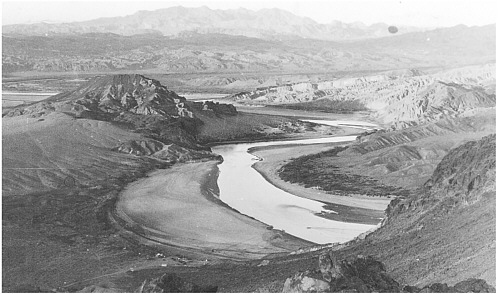
FIGURE 2-1 Colorado River upstream of the site of Boulder/Hoover Dam, ca. 1925. This stretch of the river today lies inundated by Lake Mead (impounded by Hoover Dam).
SOURCE: Postcard ca. 1925, no publisher.
need for greater river control became more pressing. The Bureau of Reclamation eventually merged its vision with the more immediate interests of Imperial Valley farmers and the City of Los Angeles for a significant flood control and water storage project on the river (Billington and Jackson, 2006; Hundley, 1992; Kleinsorge, 1941; Moeller, 1971).
Owing to a combination of geologic and climatic factors, the desert lands of southeastern California discharge only a minuscule amount of water into the Colorado River. Nevertheless, irrigators and civic boosters in Southern California were well positioned to lay claim to—and withdraw—huge quantities of water from the Colorado before any other states in the watershed could develop projects of comparable scale (Figure 2-2). By the early 1920s California legislators (with support from the Reclamation Service) were actively promoting federal construction of Boulder Dam. This, in turn, raised concerns among other Colorado basin states that feared completion of the dam would allow California to divert a large portion, perhaps most, of the river’s flow. In addition, the huge storage project could
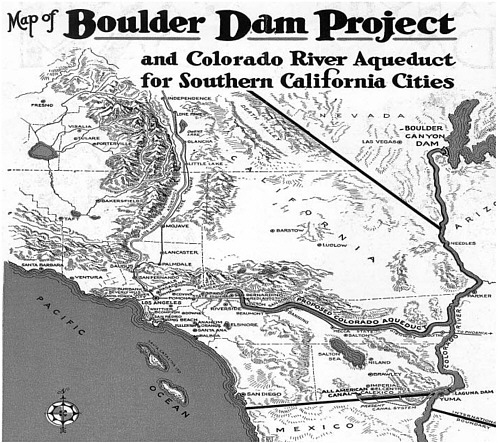
FIGURE 2-2 Map of proposed Boulder Dam Project and Colorado River Aqueduct, ca. 1930.
SOURCE: Metropolitan Water District of Southern California.
only be justified economically if financing was guaranteed by the sale of hydroelectric power, something that the privately financed electric power industry opposed. Taking all these factors into account, Senate approval of the Boulder Canyon Project Act required significant (although not necessarily unanimous) support from the same western states that feared California’s monopolization of the Colorado River. The result of various sets of state and federal negotiations was the Colorado River Compact (described more fully below), a politically driven agreement between the upper basin and lower basin states dividing rights to Colorado River flows (Billington and Jackson, 2006; Brigham, 1998; Hundley, 1975, 1992; Kleinsorge, 1941; Moeller, 1971).
Following passage of the Boulder Canyon Project Act in 1928, construction of the 726-foot-high Boulder/Hoover Dam was started in 1931 under authority of the Bureau of Reclamation. Completed in 1935, Hoover Dam today impounds Lake Mead, a reservoir with a storage capacity of more than 28 million acre-feet1 (Figure 2-3). By 1937 hydroelectric power from the dam was being transmitted to Southern California, and by 1940 power was used to pump water through the Metropolitan Water District of Southern California’s Colorado River Aqueduct, a major water conduit serving domestic and industrial water supply needs in Los Angeles and surrounding cities (Bissell, 1939; Kleinsorge, 1941; Stevens, 1988).
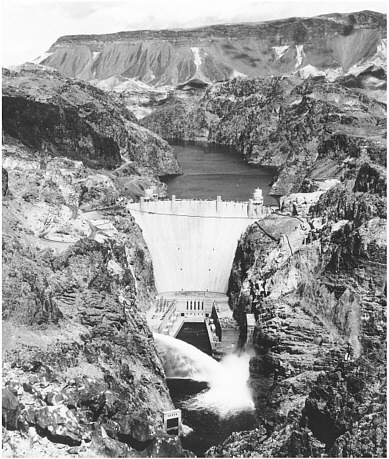
FIGURE 2-3 Hoover Dam, ca. 1940.
SOURCE: U.S. Bureau of Reclamation.
Glen Canyon Dam and Lake Powell
Glen Canyon Dam was authorized as part of the 1956 CRSP Act, which authorized other water projects for the upper Colorado River basin (see following section). Following passage of the CRSP in April 1956, engineers and surveyors were at the dam site in July, and in October 1956 the first ceremonial blast was set off on the canyon wall (Rusho, unpublished manuscript). Construction of the dam was staged from the construction town of Page, Arizona, and, although a labor strike shut down construction of the dam for a short period in 1959, the dam and its power plant were completed on schedule (Figure 2-4 shows Glen Canyon Dam under construction). Construction of Glen Canyon Dam neared completion in 1963, at which time its diversion tunnels were closed and Lake Powell began to rise (and eventually was filled in 1980). Officially dedicated in 1966, Glen Canyon Dam stands over 700 feet high and impounds Lake Powell, which has a storage capacity of 27 million acre-feet. The dam is located 15 miles downstream from the Arizona-Utah border and 11 miles upstream from Lees Ferry. With a reservoir comparable in size to Lake Mead, storage provided by Lake Powell helps ensure that the upper basin states meet their water delivery obligations to the lower basin. Glen Canyon Dam feeds water into a large hydroelectric power plant, and power revenues were used to help finance construction costs (see Martin [1989] for more details on the construction of Glen Canyon Dam).
Colorado River Legal Framework: The Law of the River
The term “Law of the River” refers not to a single law, but rather to a complex array of agreements, legislation, court decisions and decrees, contracts, and regulatory schedules relating to the Colorado River, including a treaty with Mexico, two major multistate agreements (or compacts), Supreme Court rulings, and myriad other federal and state laws, acts, and regulations. In many ways, the foundation of the Law of the River was defined in the 1920s by the Colorado River Compact and the Boulder Canyon Project Act; over the ensuing decades, it expanded and evolved in numerous ways to incorporate new demands and shifting social and economic trends.
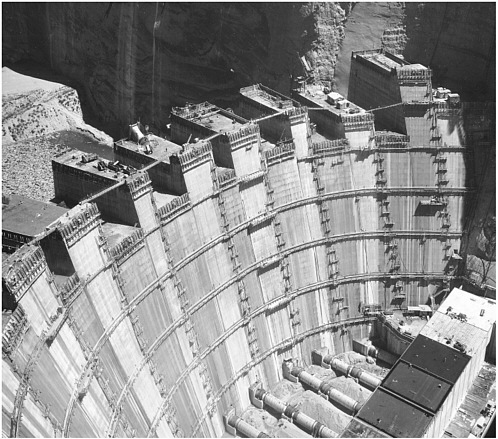
FIGURE 2-4 Glen Canyon Dam, nearing the end of its construction and prior to the beginning of water storage in 1963.
SOURCE: U.S. Bureau of Reclamation.
The Colorado River Compact (1922)
Signed in 1922 at Bishop’s Lodge near Santa Fe, the Colorado River Compact is a cornerstone of the Law of the River. In terms of water law, a key impetus for negotiation of the Compact derived from the U.S. Supreme Court’s decision in Wyoming v. Colorado (259 U.S. 419 [1922]). This ruling, which involved a dispute over use of the Laramie River, accorded the doctrine of prior appropriation interstate effect; that is, a diverter who appropriated water from an interstate stream in one state held a priority claim over a user in another state who diverted water from the stream at a later date. As the Supreme Court noted some 40 years later in the Arizona v. California case, this
1922 decision prompted concerns in the upper basin states that California’s impending appropriation and use of Colorado River water stored behind the prospective Boulder Dam would result in California being “first in time” and therefore “first in right” with regard to later claims made by upper basin irrigators and cities.
At the Bishop’s Lodge conference the seven basin states were unable to reach agreement on a state-by-state apportionment of Colorado River flows. The states instead divided the basin in half, designating Lees Ferry2 on the Colorado River in northern Arizona (near the Arizona-Utah border) as the boundary point separating the upper and lower basins. Specifically, the Compact defines the upper basin to include much of Colorado, Utah, and Wyoming, and smaller parts of northern Arizona and northwestern New Mexico, whereas the lower basin consists of most of Arizona and portions of California, Nevada, New Mexico, and Utah (Figure 1-1).
As negotiated in 1922, the Compact apportions to both the upper basin and lower basin states the “exclusive beneficial consumptive use” of 7.5 million acre-feet annually.3 To accommodate year-to-year variations in river flow, the Compact provides that the upper basin states will not deplete the flow at Lees Ferry by more than 75 million acre-feet for any consecutive 10-year period (Ingram et al., 1991). Put another way, the upper basin states agreed to provide an aggregate flow of at least 75 million acre-feet to the lower basin states (as measured at Lees Ferry) over any 10-year period. The Compact also provided that any water legally granted to Mexico at some future time would be shared equally between the upper and lower basins (Ingram
et al., 1991). The State of Arizona objected to the terms within the Compact, however, because Arizona did not want the flow of the Gila River (a tributary of the Colorado) to count against its allocation of Colorado River flows. Arizona therefore refused to ratify the 1922 Compact. The other states eventually approved the Compact and proceeded with a “Six State” Compact as provided for within the Boulder Canyon Project Act in 1928.
The Boulder Canyon Project Act (1928)
Key provisions of this federal legislation included (1) declaration that the Colorado River Compact would be effective upon the approval of six basin states if California, by state law, limited its guaranteed use to 4.4 million acre-feet of water per year; (2) authorization for building Boulder/Hoover Dam and the All-American Canal; and (3) an authorization to divide the lower basin share of 7.5 million acre-feet per year among the three lower basin states, with California being allocated 4.4 million acre-feet per year, Arizona receiving 2.8 million acre-feet per year, and sparsely populated Nevada receiving 300,000 acre-feet per year. The act also accorded the Secretary of the Interior broad authority over delivery of water stored behind Hoover Dam. Pursuant to this authority, the Secretary entered into contracts with Arizona and Nevada for the water allocated to them (even though neither state had physical means to divert and use the water) and with California water agencies for that state’s shares, plus additional available unused water. The upper basin states did not conclude any agreement among themselves affirming the allocations stipulated in the Boulder Canyon Project Act.
Water Deliveries to Mexico (1944)
Signed in 1944, the Treaty Between the United States of America and Mexico Respecting Utilization of Waters of the Colorado and Tijuana and of the Rio Grande (59 Stat. 1219, T.S. 994) codified obligations of the United States to deliver water from the Colorado River to Mexico. During negotiations leading up to the 1944 treaty, Mexico proposed a division of the water that would acknowledge its right to increased flow as agricultural water demand in Mexico grew. The United States, which had already divided 15 million acre-feet of
Colorado River water per year between the upper and lower basins in the Colorado River Compact, balked at the prospect of signing a treaty with terms that could change in response to future use within Mexico. In the face of Mexico’s proposition, the Colorado River basin states urged the United States to invoke the Harmon Doctrine of territorial sovereignty and assert the right to use every drop of Colorado River water flow within the United States without any obligation to deliver water to Mexico. The position associated with the Harmon Doctrine was not reflected in the treaty’s final wording, however, primarily because Mexico insisted that conflicts over the Rio Grande (some of whose waters originate in Mexico) be negotiated at the same time (Meyers, 1967).
Reflecting a spirit of compromise, the 1944 treaty guarantees that the United States will deliver to Mexico the amount of 1.5 million acre-feet annually of the “waters of the Colorado River, from any and all sources.” The treaty further provides that “Mexico shall acquire no right … for any purpose whatsoever, in excess of 1.5 million acre-feet of water annually,” thus effectively blocking adjustments to the allocation based on international law or the use of “surplus” flow. Despite the language of guaranteed deliveries, the treaty contains provisions for relief in extreme circumstances, with guaranteed delivery of 1.5 million acre-feet per year subject to reduction in the event of shortages or drought upstream in the U.S. portion of the basin.4 It does not provide specifically for water of a given quality, but this did not constitute a significant issue on the Colorado River until many years later (see the discussion later in this section on a 1973 Minute between Mexico and the United States that addresses the quality of water delivered at the Mexico-U.S. border).
The Upper Colorado River Basin Compact (1948)
Signed in 1948, the Upper Colorado River Basin Compact apportions the 7.5 million acre-feet of consumptive use per year allocated to the upper basin under the 1922 Compact as follows: Colorado receives 51.75 percent, New Mexico receives 11.25 percent, Utah receives 23 percent, and Wyoming receives 14 percent. Arizona receives a fixed quantity of 50,000 acre-feet per year in recognition of its territory that drains into the river above Lees Ferry.5
The Colorado River Storage Project (1956)
After World War II the four upper basin states pushed for projects that would serve their interests; in 1956 Congress responded by authorizing the CRSP and its plans for developing several upper basin water storage projects. The key facility authorized within the CRSP is Glen Canyon Dam. In addition to Glen Canyon, the CRSP includes other major upper basin storage units, most notably Flaming Gorge Dam on the Green River in northeastern Utah; Navajo Dam on the San Juan River in New Mexico; and the multidam Wayne N. Aspinall Storage Unit on the Gunnison River in west-central Colorado (Martin, 1989; Sturgeon, 2002).
Arizona v. California (1963)
The Arizona v. California Supreme Court case settled a longstanding dispute over claims to Colorado River flow. In this landmark decision the Court issued both an opinion (373 U.S. 546 [1963]) and a decree (376 U.S. 340 [1964]). Arizona filed its original suit against California in the Supreme Court in 1952, and Nevada, New Mexico, Utah, and the United States were subsequently added as par-
ties to the proceedings. As expressed by the Court, “[t]he basic controversy in the case is over how much water each State has a legal right to use out of the waters of the Colorado River and its tributaries” (373 U.S. 546 [1963]). Following the usual practice in such suits, the Court appointed a Special Master to take evidence, find facts, state conclusions of law, and recommend a decree. Appointed in 1955, Special Master Simon H. Rifkin held more than 2 years of formal hearings and, in 1961, submitted a 433-page report to the Supreme Court. This report contained the Special Master’s findings, conclusions, and recommendations, most of which the Court adopted in its majority opinion and decree.
The decision in Arizona v. California established several important elements of the Law of the River. Finding that the dispute was controlled by the Boulder Canyon Project Act of 1928, the Court held that in passing the act, Congress created a comprehensive scheme for the apportionment of the lower basin’s share of the mainstream waters of the Colorado River; it also reserved to Arizona, California, and Nevada the exclusive use of the waters of each state’s own tributaries. This latter finding was of special importance to Arizona which, because of its “particularly strong interest in the Gila, intensely resented the Compact’s inclusion of the Colorado River tributaries in its allocation scheme” (373 U.S. 546 [1963]) and, largely for that reason, was the only state that refused to ratify the Compact in the 1920s.6
The Court further concluded that the Boulder Canyon Project Act reflected a decision by Congress that a “fair division” of the first 7.5 million acre-feet of the Colorado’s mainstream waters “would give 4,400,000 acre-feet to California, 2,800,000 to Arizona, and 300,000 to Nevada,” and that “Arizona and California would each get one-half of any surplus.” Moreover, the Court went on to hold that allocation of the water in these shares did not depend on the lower basin states agreeing to them in a compact because “Congress gave the Secretary of the Interior adequate authority to accomplish the division.” It did so “by giving the Secretary power to make contracts for the delivery of water and by providing that no person could have water without a contract.” Through these contracts the Secretary could not only implement allocations among the lower basin states, but could also decide which users within each state would get water. With reasoning that broke new ground in U.S. federal water law, the Court held that
the Secretary was not bound by the law of prior appropriation in allocating water among the states nor by that doctrine or other priorities under state law in “choosing between users within each State” (373 U.S. 546 [1963]). Indeed, the Court found that the Act of necessity invested the Secretary of the Interior with sweeping powers over Colorado River management, especially in the lower basin:
Today, the United States operates a whole network of useful projects up and down the river…. All this vast, interlocking machinery—a dozen major works delivering water according to congressionally fixed priorities for home, agricultural and industrial uses to people spread over thousands of square miles—could function efficiently only under unitary management, able to formulate and supervise a coordinated plan that could take account of the diverse, often conflicting interests of the people and communities of the Lower basin States. Recognizing this, Congress put the Secretary of the Interior in charge of these works and entrusted him with sufficient power … to direct, manage, and coordinate their operation (373 U.S. 546 [1963]).
Finally, the Court upheld claims of the United States to water in the mainstream of the Colorado River and in some of its tributaries for use on Indian reservations, national forests, recreational and wild-life areas, and other federal government lands and works. Specifically, the court reached a finding consistent with the Winters Doctrine of 1908, which established the principle of federal reserved water rights.7 The Court upheld the decision reached in the Winters case, affirming that Indian water rights were created with, and dated back to, the establishment of a reservation(s). The rights of Indian tribes whose reservations predate passage of the Boulder Canyon Project Act thus are entitled priority. The Court also upheld another principle from the Winters case in finding that the United States intended to reserve sufficient water to satisfy not only present but also future needs of the Indian reservations; and that “enough water was reserved to irrigate all the practicably irrigable acreage on the reservations” (373 U.S. 546 [1963]).
RELATIVE SURPLUS AND SHIFTING PRIORITIES: 1965 TO THE MID-1980s
The third phase of Colorado River water development and use extended from roughly 1965 through the mid-1980s. Although the pace of large water project construction decreased during these years, the huge increase in storage capacity added in 1920-1965 afforded generally ample water supplies in this post-1965 period. The water storage system proved sufficient to meet supply “shortfalls,” which occurred primarily during droughts (e.g., during the late 1970s). But with population and economic growth, construction of fewer large water projects, and increasing concerns regarding instream flows for river ecology and recreation, the latter years of this era saw signs that existing supplies might not be able to deliver full benefits to all users.
With passage of the Endangered Species Act of 1973, endangered species became a concern that affected construction of proposed water development projects and operation of existing ones. Water quality and salinity levels also gained standing as significant and problematic issues. Environmental impacts resulting from the creation of reservoirs became manifest and the political viability of large-scale dam building waned. A notable event in this era occurred in the late 1960s, when plans by the U.S. Bureau of Reclamation to build hydroelectric power dams just upstream of Grand Canyon National Park (at Bridge and Marble canyons) were blocked in the U.S. Congress. Some big, new projects were initiated during this period—notably the Central Arizona Project (CAP)—but water project construction fell off the pace set during the 1950s and early 1960s.
Central Arizona Project (1968)
In concert with legal challenges to California’s Colorado River claims, as early as the 1940s Arizona boosters sought federal support for a project to carry Colorado River water to central and southern Arizona. For many years the proposed CAP languished because of opposition from California. As indicated above, in its 1963 Arizona v. California decision, the U.S. Supreme Court found that in the Boulder Canyon Project Act Congress had given Arizona the right to withdraw 2.8 million acre-feet of flow annually from the mainstem of the Colorado River as part of a comprehensive scheme to apportion
water among the lower basin states. With legal affirmation that the state’s 2.8 million acre-foot annual allocation did not include flow originating within the Gila River (a Colorado River tributary), Arizona legislators undertook a push to win federal authorization of the CAP. As envisaged in the mid-1960s, the Central Arizona Project was to include hydroelectric power dams at Bridge and Marble canyons, but this aspect of the project aroused concern over potential impacts in Grand Canyon National Park (Figure 2-5).8 In place of the hydroelectric power dams, Arizona legislators accepted a scheme in which power for pumping CAP water would come from a new coal-fired generating plant built on the Navajo reservation near the Utah border. And Arizona assuaged California legislators by agreeing to recognize California’s claims to Colorado River flow as holding senior rights over Arizona’s claims. Signed into law by President Johnson in 1968 as part of the Colorado River Basin Project Act, the CAP and its Granite Reef Aqueduct took decades to construct. When completed in 1992, the CAP was capable of delivering 1.5 million acre-feet of water per year—over half of Arizona’s allocation as stipulated by the Boulder Canyon Project Act and affirmed by the U.S. Supreme Court—to the greater Phoenix and Tucson metro areas (Hundley, 1992; Pearson, 2002; Sturgeon, 2002).
Water Quality at the Mexico-U.S. Border: Minute 242 (1974)
When Mexico and the United States signed the 1944 treaty, water quality generally was not a significant issue. After 1944, with increasing population in the U.S. portion of the basin and as diversions for irrigated agriculture increased, Colorado River salinity became increasingly important. In the headwaters of the Colorado River, rain and snowmelt start out as essentially pure water. As the river and its tributaries flow downstream toward the Gulf of California, salts naturally accumulate as surface water and groundwater seep through sub-surface salts and then into the stream channel. Colorado River salinity levels have risen in recent decades as low-salinity waters have
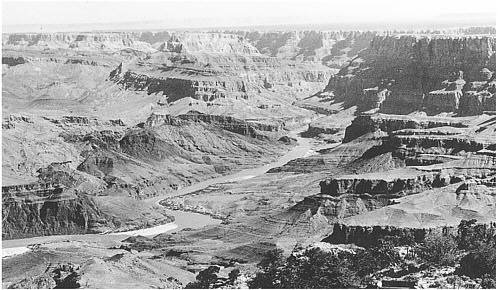
FIGURE 2-5 Colorado River in Grand Canyon National Park, ca. 1940.
SOURCE: Postcard c. 1940, no publisher.
been diverted out of headwater areas for municipal and agricultural uses. Because many soils in the Colorado River basin have large amounts of naturally occurring salts, return flows from irrigated agriculture have also contributed to increased salinity levels. For example, in the 1980s return flows from Colorado’s Grand Valley added an estimated 580,000 tons of salt each year to the Colorado River (Marston, 1987).
Of all the U.S. irrigation projects that affect Colorado River salinity levels, none are more important than the Wellton-Mohawk Irrigation and Drainage District near the mouth of the Gila River in south-western Arizona. The salinity problem arose in 1961 with the District’s discharge of drainage water into the Gila River. In 1962, the District began discharging drainage into the Bureau of Reclamation’s Main Outlet Drain, which discharged water into the Colorado River. In 1961 Mexico protested that the highly saline water it was receiving from Wellton-Mohawk return flow was unsuitable for agricultural uses and that crop production in the Mexicali Valley was being adversely affected. In the early 1970s Mexico and the United States agreed upon a prospective and hoped-for solution to the salinity problem, and in 1973 the International Boundary and Water Commission
(IBWC) adopted Minute 242, bearing the formal title Permanent and Definitive Solution to the International Problem of the Salinity of the Colorado River (IBWC, 1973). This Minute 242 requires the United States to adopt measures to ensure that 1.36 million acre-feet of water delivered annually to Mexico upstream of Morelos Dam has an average salinity of no more than 115 ± 30 parts per million over the annual average salinity of Colorado River water arriving at Imperial Dam (http://www.usbr.gov/dataweb/html/crwq.html#general).
In 1974 Congress passed the Colorado River Basin Salinity Control Act, which authorized construction, operation, and maintenance of works in the Colorado River basin to control the salinity of water delivered to users in the United States and Mexico. Title I of the Act provided means for the United States to comply with its obligations under Minute 242; in addition, Title II created the Colorado River Basin Salinity Control Program and charged the U.S. Department of the Interior and the U.S. Department of Agriculture to manage the river’s salinity, including salinity contributed from public lands (see http://www.nrcs.usda.gov/PROGRAMS/salinity/).
The Yuma Desalting Plant was constructed as a key facility to help comply with the 1974 Act and meet obligations set forth in Minute 242. Completed in 1992, the plant is the world ’s largest brackish water reverse osmosis desalting plant (http://www.usbr.gov/lc/yuma/facilities/ydp/yao_ydp.html). Prior to the plant’s construction, a bypass drain was installed as an interim measure to divert saline drainage water from the Wellton-Mohawk irrigation project in Arizona away from the Colorado River mainstem and south to the Cienega de Santa Clara in Mexico. This was done in an effort to maintain acceptable levels of salinity of Colorado River water delivered to Mexico. The Yuma Desalting Plant was tested upon completion in 1992 but the facility was soon mothballed after heavy flooding along the Gila River in early 1993 destroyed parts of the canal that delivered water to the plant from the Wellton-Mohawk District. Since then, Colorado River salinity standards at the U.S.-Mexico border have been met through bypass of drainage water (which also represents a less expensive option)to the Cienega de Santa Clara.
Glen Canyon Environmental Studies (1982)
Glen Canyon Dam was constructed before enactment of the National Environmental Policy Act of 1969. As a result, a formal environmental impact statement (EIS) was not conducted as part of the planning studies for Glen Canyon Dam construction. In the early 1980s the Bureau of Reclamation sought to upgrade the hydroelectric power generators at Glen Canyon Dam and adjust operations to increase the dam’s peak generating capacity. These changes could have had significant impacts on river flows, but it was not entirely clear from a legal perspective that an EIS would be necessary. Nevertheless, it was clear that the Bureau of Reclamation would have to assess, in some manner, the potential impacts of these changes at Glen Canyon Dam on the downstream riparian environment. As a result, in 1982 the Glen Canyon Environmental Studies (GCES) program was initiated to conduct this environmental research.
The GCES program was conducted in two phases—from 1982-1988 and from 1988-1996—and arrived at several findings relevant to Colorado River management (NRC, 1999). One finding from GCES was that Glen Canyon Dam and its operations have impacted the downstream environment and will continue to affect many ecosystem resources. GCES also demonstrated the value of an environmental monitoring system in managing ecological resources downstream of a large dam. GCES concluded that operation and management of Glen Canyon Dam could be modified to minimize losses of some resources, and to protect and enhance others. Through these findings, GCES provided a foundation for changes and adjustments to Glen Canyon Dam operations—including a highly publicized controlled flood released in March 1996 (Webb et al., 1999). GCES provided essential input into the Bureau of Reclamation’s 1995 EIS on the operations of Glen Canyon Dam. It also laid the groundwork for a subsequent monitoring and scientific program—the Grand Canyon Monitoring and Research Center—that continues today.
TIGHTENING SUPPLIES AND INCREASING DEMANDS: MID-1980s TO THE PRESENT
The fourth phase of water development across the region began roughly in the mid-1980s and continues into the 21st century. This
phase is characterized by limited development of new water supplies via traditional, structural means; rapid population growth and urbanization; an increasing emphasis on urban water efficiencies; and a shift of water supplies away from the agricultural sector to municipal and industrial users. This period has seen and continues to witness large population increases in the basin's major cities such as Las Vegas, Phoenix, and Tucson, as well as several cities on the basin’s periphery that depend on Colorado River water, such as Albuquerque, Denver, Los Angeles, and San Diego. In some instances, increasing water demands caused by population increases have been partly offset by practices such as water pricing, new technologies, and conservation measures. But the overall effect of rapid regional population growth in this period has been to increase demand, causing municipalities to seek additional water sources. This has entailed numerous agricultural-urban water transfers across the region, such as a highly publicized transfer of water from the Imperial Irrigation District to the San Diego County Water Authority. In addition to serving as potentially valuable new supplies for municipalities, the trend of water shifting from agricultural to urban users has important economic, ecological, social, and cultural implications. This period has also seen a shift in the definition and vision of new water projects. In earlier periods, the vision of new water projects entailed dams, reservoirs, and conveyance facilities. Across the West today, new water projects are more likely to entail desalination plants, landscaping programs, water conserving technologies, underground storage, and educational programs designed to limit per capita uses (Chapter 4 reviews water conservation and augmentation efforts in the region).
Grand Canyon Protection Act (1992) and the Adaptive Management Program (1996)
In addition to limited water supplies and the growth of urban centers in the West, the contemporary era of Colorado River development features a water storage infrastructure that faces challenges of meeting traditional supply needs, along with relatively new demands—especially recreation and instream flows that support endangered species and distinctive ecological habitats. Two good examples of efforts in the Colorado River basin to balance shifting interests among a broad group of stakeholders are reflected in the Grand Can-
yon Protection Act and the Glen Canyon Dam Adaptive Management Program.
The Grand Canyon Protection Act of 1992 (P.L. 102-575) calls for the Secretary of the Interior to operate Glen Canyon Dam in accordance with the Law of the River and “in such a manner as to protect, mitigate adverse impact to, and improve the values for which Grand Canyon National Park and Glen Canyon National Recreation Area were established, including, but not limited to natural and cultural resources and visitor use.” The act calls for the Secretary of the Interior to define operating criteria for Glen Canyon Dam in consultation with the Bureau of Reclamation, the Fish and Wildlife Service, the National Park Service, the Department of Energy, basin states, Indian tribes, and members of “the general public” that include environmental and recreational interests. It also called for completion of a final Glen Canyon Dam EIS; in response, the Bureau of Reclamation issued its Glen Canyon Dam EIS in 1995. This 1995 EIS and the 1992 Grand Canyon Protection Act serve as the primary guidance documents for the Adaptive Management Program.
The Glen Canyon Dam Adaptive Management Program was established in 1996 by the Secretary of the Interior to develop modifications to Glen Canyon Dam operations and to exercise other authorities under existing laws as provided in the Grand Canyon Protection Act. Its broad intent was to establish both a participatory stakeholder group and an ecological monitoring program, which were to help implement management decisions that would be studied and occasionally revisited, all of which would lead to more flexible, adaptive resources management (see Holling [1978], Lee [1999], and Walters [1986] for more on adaptive management; see Gloss et al. [2005] and NRC [1999] for more on adaptive management within the Grand Canyon ecosystem). The Adaptive Management Program was not intended to satisfy all mandates of the Grand Canyon Protection Act or to derogate any agency’s resources management responsibilities. Rather, the Adaptive Management Program recommends administrative provisions, but these recommendations do not supersede basic management responsibilities of any of its cooperating entities (USBR, 1995). Adaptive Management Program constituents include the Secretary of the Interior’s designee, an Adaptive Management Work Group, a Technical Work Group, and the Grand Canyon Monitoring and Research Center (see NRC [1999] and http://www.usbr.gov/uc/rm/amp/index.html).
Population Growth and Increasing Water Demands
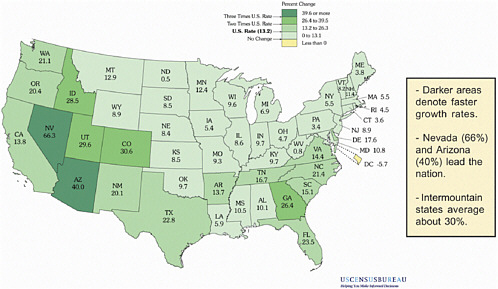
A key driver affecting Colorado River basin water demands from the mid-1980s to the present has been rapid increases in population in many areas of the western United States served by Colorado River water. This population growth is being driven by a combination of migration from other U.S. states, immigration, and natural growth rate (birth rates minus death rates). Table 2-1 lists 1990-2000 population growth rates for several U.S. states and Figure 2-6 maps demographic changes across the entire United States for the same period. The sharp increase in growth rates in Arizona and Nevada, as well as in Colorado and Utah, is evident. In fact, these four Colorado River basin states were the fastest-growing (in percentage terms) U.S. states during the 1990s. From 1995 to 2005, population of the seven Colorado River basin states grew by nearly 11 million, an increase of roughly 25 percent (Griles, 2004).9 These high percentage rates of population growth certainly stand out, but they should be considered along with absolute numbers of population growth. For example, the State of Nevada’s 66 percent rate of population growth in the 1990s was the highest rate in the United States during this period. The State of California exhibited a far lower percentage rate of population
TABLE 2-1 U.S. Population Growth, 1990-2000
|
Rank |
State |
Census Population |
Population Change |
||
|
April 1, 2000 |
April 1, 1990 |
Number |
Percent |
||
|
1 |
Nevada |
1,998,257 |
1,201,833 |
796,424 |
66.3 |
|
2 |
Arizona |
5,130,632 |
3,665,228 |
1,465,404 |
40.0 |
|
3 |
Colorado |
4,301,261 |
3,294,394 |
1,006,867 |
30.6 |
|
4 |
Utah |
2,233,169 |
1,722,850 |
510,319 |
29.6 |
|
5 |
Idaho |
1,293,953 |
1,006,749 |
287,204 |
28.5 |
|
6 |
Georgia |
8,186,453 |
6,478,216 |
1,708,237 |
26.4 |
|
7 |
Florida |
15,982,378 |
12,937,926 |
3,044,452 |
23.5 |
|
8 |
Texas |
20,851,820 |
16,986,510 |
3,865,310 |
22.8 |
|
9 |
N. Carolina |
8,049,313 |
6,628,637 |
1,420,676 |
21.4 |
|
10 |
Washington |
5,894,121 |
4,866,692 |
1,027,429 |
21.1 |
|
12 |
New Mexico |
1,819,046 |
1,515,069 |
303,977 |
20.1 |
|
18 |
California |
33,871,648 |
29,760,021 |
4,111,627 |
13.8 |
|
32 |
Wyoming |
493,782 |
453,588 |
40,194 |
8.9 |
|
SOURCE: http://www.census.gov/population/cen2000/phc-t2/tab03.xls. |
|||||
growth during the 1990s; but during this period, while Nevada’s population was increasing by 800,000 people, California added over 4 million people.
Studies and essays that consider the limits of western U.S. water resources and growth date back well over 100 years. Knowledge of “The Great American Desert,” for example, was recorded on maps dating back to the report of Zebulon Pike of 1810 (Stegner, 1954). There have since been many debates over the limits and potentials for development of the region. These differing perspectives were prominently represented in the contrasting viewpoints of William Gilpin, first territorial governor of Colorado, and the western explorer and scientist John Wesley Powell. Whereas Gilpin saw nearly unlimited potential for western growth and settlement, Powell saw limits posed by the region’s aridity that would require careful scientific management and a different approach to settlement than in the humid eastern United States (see Stegner, 1954).
Over the ensuing years of western growth and water development, there has been a paradigm that water supplies will always be available to satisfy ever-expanding population. And this paradigm was generally fulfilled as long as more rivers and groundwater supplies were available to be tapped. As western populations have grown, this historical approach has become less viable than in a previous era, leading to questions and debates about the limits of western growth and water supplies. These different views were pointed out in a proceedings of a 1991 National Academy of Sciences conference on western water and climate variability: “In all the major arid states, unlimited population growth is taken as an article of faith and the function of water policy is to supply all the water necessary to accommodate this growth. Many serious observers of the West think that the question is backwards. We should first set growth limits and use them to temper water demands to the more realistic use of available, possibly diminishing supplies” (Tarlock, 1991). Today’s population levels and growth rates, intensifying competition for limited water supplies, and nontraditional water uses such as recreation and instream flows suggest that the relationships between population and urban water supplies soon will have to be confronted more seriously than in the past.
Scientists studying climate and drought across the region are making connections between population growth, increasing water demands, and ability to cope with drought. A 2004 report on the western U.S. drought, for example, notes that
The current drought is amplified by increased water demand in the southwest. This highlights the importance of evaluating all the possible causes of a decreased water supply. A mild hydrologic drought combined with the overuse of water supply can cause extreme drought condtions in a basin (Hidalgo, 2004).
It has also been noted that increasing demands on water supply will make it more difficult for the Colorado River storage system to recover from drought:
Although six consecutive years of below-average inflow has not occurred in the past 100 years, we should not bet on a turn-around. More likely, storage will continue to decline in the near-term and the system will take longer to recover than it did after previous droughts—largely because of greater demands today. These increasing demands, including more use by the Upper basin states as they develop their allocated shares of the river, will mean less storage, on average, regardless of how long the current drought lasts (Fulp, 2005a, emphasis added).
Beyond increasing water demand, population growth across the region portends a range of negative impacts that include deteriorating air quality, additional urban “sprawl” and congestion, reductions in open space, and increased levels of traffic and strained transportation systems. Each additional person entails an increase in water demand of, roughly, at least 140 gallons per day (and often more).
Population growth in the West is contributing to increasing water demands. Population growth figures, however, do not necessarily equate as direct surrogates for regional water demand figures. Per capita water use is affected by several factors including water prices, household habits and preferences, landscaping choices, and public education programs. Many municipalities across the Colorado River region have implemented measures that have helped limit or reduce per capita water demands in many areas. Many federal, state, and local and municipal water organizations have generated water demand forecasts to help anticipate future per capita demands. The
generation of accurate demand forecasts represents a data-intensive and analytical challenge, however, and there is a history of flawed demand forecasts at a variety of scales (see CRS [1980] and Rogers [1993] on challenges associated with water demand forecasting). With increasing population growth and a limited ability to extend water supplies through traditional means, accurate demand forecasts are as important as ever for water planning. As a scientific field, however, regional water demand forecasting lags behind much research on hydroclimatic and other water resources issues.
Increasing population growth rates and water demands in the 1990s and early 2000s have prompted many water users and managers to consider nontraditional means to extend water supplies. For example, groundwater sources have been increasingly tapped over the past few decades; water tables have dropped precipitously in many areas and the limits of groundwater resources are being approached in some areas (see Box 2-1). One prominent development on this front has been the sales, leases, and transfers of agricultural water to meet the needs of expanding urban populations.
Agriculture-Urban Water Transfers
Transfer of water from agricultural to municipal and industrial users in the U.S. West is not a new phenomenon. A well-known example of such a transfer was the purchase of agricultural water rights in rural Owens Valley by the City of Los Angeles (Gottlieb and Fitzsimmons, 1991; Kahrl, 1982). Today, these agricultural-urban transfers are taking place in many sites across the region including Colorado’s South Platte River Basin (Denver), Las Vegas, and the Phoenix and Tucson metropolitan areas. In strict monetary terms, the sales, leases, and transfers of water from agricultural to urban users often represent “win-win” transactions for the buyer and seller, as water typically shifts from (in dollar terms) lower-value agricultural uses to (in dollar terms) higher-value urban uses. Municipalities and industries generally have a greater willingness to pay for a given unit of water than irrigators or ranchers, and these transfers may offer a cost-effective way for cities to meet increasing water demands. They also often prove profitable to individual farmers or ranchers.
|
Box 2-1 Groundwater Resources in the Colorado River Region Groundwater serves as an important water source for many people and municipalities across the nation. According to the U.S. Geological Survey, groundwater is the source of drinking water for about half the the nation and nearly all of its rural population (USGS, 2003). As in many regions of the United States, Colorado River basin groundwater resources have been heavily utilized to satisfy agricultural, municipal, and industrial water demands. High rates of groundwater pumping have led to depletion of aquifers in some areas, such as in southern Arizona. Use of groundwater to support population growth in south-central Arizona (primarily the Tucson and Phoenix metropolitan areas) has resulted in declines of water tables of between 300 and 500 feet (USGS, 2003). Rapid population growth in the Las Vegas region has also led to more groundwater pumping and declining water tables (up to 300 feet in some areas; USGS, 2003). High rates of groundwater extractions have also led to lowered water tables in peripheral areas along the Colorado River basin, in both Southern California and New Mexico. Groundwater is a valuable resource in the arid West and its pumping provides a wealth of social and economic benefits. Intensive pumping of groundwater, however, may entail negative impacts. One important concern related to groundwater extraction is reduced flows from groundwater systems to streams. Surface and groundwater systems are usually linked, and groundwater extraction may alter how water moves between aquifers and streams. Lowered water tables can inhibit groundwater flow into streams, or increase the rate at which water moves from a surface body into an aquifer. In either case the impact is a reduction of flows to surface water, which can lead to the |
The amount of water devoted to agricultural uses across the West is not insignificant. The 75-80 percent of western U.S. water supplies presently diverted to agriculture represents many millions of acre-feet of water. In the State of Arizona, for example, water allocated to the agricultural sector as of 2006 exceeded 5 million acre-feet per year (Table 2-2). Table 2-2 illustrates several important points. One is a striking rate of population growth and water demand: the period 1990-2040 is forecast to experience roughly a doubling in municipal and industrial water demand (roughly 2 percent annually). Another point within this table is the large percentage of water currently devoted to agricultural uses—nearly 80 percent as of 1990. This leads
|
loss of riparian vegetation and wildlife habitat. A prominent regional example of the impacts of groundwater extraction on riparian ecology is in the Santa Cruz River near Tucson. The Santa Cruz River valley once supported a large assemblage of mesquite, cottonwood, and other species, and provided important wildlife habitat. Over time, water extractions to meet the demands of a growing population have caused declining water tables, leading to reduced surface water availability and a large loss of riparian vegetation (USGS, 2003). In response to high rates of groundwater extraction in many areas of the state, the State of Arizona has enacted legislation that represents some of the nation’s most stringent guidelines surrounding groundwater use. In 1973, the Arizona legislature enacted the Adequate Water Supply Program, a law requiring land developers to obtain a statement of water adequacy from the (former) Arizona Water Commission (Davis, 2006). In 1980, the Arizona legislature enacted a Groundwater Management Act to conserve groundwater resources. These areas were legally defined as Active Management Areas and they are centered on the state’s largest urban and agricultural centers (they do not cover the entire state). Passage of the Groundwater Management Act saw the Adequate Water Supply Program replaced by the Assured Water Supply Program (Davis, 2006). Perhaps the most notable administrative difference in the new program is that if a subdivider within an Active Management Area fails to demonstrate an assured water supply to the Arizona Department of Water Resources, the Arizona Department of Real Estate cannot approve the subdivision for sale, the county cannot record the plat, and the developer thereby is prevented from selling lots. Whether these new regulations will help to noticeably resolve groundwater pumping issues in the State of Arizona remains to be seen; but state officials and water providers clearly take problems related to groundwater overdraft seriously and are seeking measures to remedy them. |
to another observation: modest portions of water reallocated from this large amount of water in agricultural uses to the municipal and industrial sector can help satisfy increasing municipal and industrial demands.
Modest shifts (in percentage terms) of agricultural water to municipal and industrial uses, therefore, can do much to quench increasing urban water demands. Although this water can serve as a valuable supply for growing urban areas, these shifts are not without costs and limitations. There are direct effects associated with water rights being transferred out of agriculture, such as reduced food
TABLE 2-2 Water Demands in Arizona
|
Category |
Water Demand (acre-feet) |
A-F Change 1990-2040 |
% Change 1990-2040 |
||
|
1990 |
2015 |
2040 |
|||
|
Municipal and industrial |
1,332,000 |
1,922,000 |
2,605,000 |
1,273,000 |
96 |
|
Agriculture |
5,339,000 |
5,220,000 |
5,037,000 |
-302,000 |
-6 |
|
STATE TOTAL |
6,671,000 |
7,142,000 |
7,642,000 |
971,000 |
15 |
|
SOURCE: http://geochange.er.usgs.gov/sw/impacts/society/water_demand/. |
|||||
production capability. Another important consideration is that such changes in points of diversion and water uses nearly always entail “third-party” effects beyond those that accrue to the buyer and seller of water rights. Examples of these effects include reduced agricultural return flows that support riparian ecosystems, and lost business suffered by local merchants as a result of reductions in irrigated cropland. The various costs that may be borne by such third parties are well recognized (e.g., NRC, 1992). If not addressed carefully and equitably, effects on third parties can be a cause of conflict. For example, water being transferred from a rural area to a municipality may negatively affect agriculture-related businesses (e.g., farm machinery dealers) that depend on irrigated agriculture, which may be harmful to small western U.S. farming communities (Howe et al., 1990).
Another factor that may inhibit transfers is limited physical infrastructure, especially water storage and conveyance facilities, available to facilitate transfers. Several innovative and useful practices—especially water banking and aquifer storage—have been developed to help obviate the need for new storage and conveyance facilities (see Box 2-2 for a discussion of the Quantification Settlement Agreement, a comprehensive and prominent arrangement for transferring water from agriculture to urban users). Nevertheless, there will always be some physical limitations on potential transfers across the basin. Many creative water transfer programs, involving legally defined water banks and underground water storage programs, have been developed to help effect these transfers, but the amount of agricultural water is finite and such programs thus are necessarily limited in their ability to satisfy ever-increasing demands over the long term. Certain basin states also have consistently opposed leasing, trading, or selling of water beyond state boundaries, although many complex, recent agreements are designed to allow flexibility while protecting allocations.
The waters diverted by the agricultural sector likely represent the final large source of water that municipalities in the Colorado River region will be able to draw upon to significantly support urban growth. As this finite “source” of water approaches its limits in being transferred to municipalities and industries, urban users will be increasingly pressed to adopt more stringent conservation and regula-
|
BOX 2-2 Moving Water from Agriculture to the Cities: California’s Quantification Settlement Agreement For many years, the State of California diverted more than the 4.4 million acre-feet of Colorado River allocated within the Boulder Canyon Project Act because a portion of the lower basin’s allocation of 7.5 million acre-feet remained unused by the other lower basin states of Arizona and Nevada. With increasing population and increasing water demand for Colorado River water in these other states, however, it became essential for California to limit its annual diversion to 4.4 million acre-feet. The key to California’s meeting its commitment was an agreement among its southern farming and urban communities on the way in which its share would be allocated. This accord took the form of the 2003 Colorado River Water Delivery Agreement: Federal Quantification Settlement Agreement among the Secretary of the Interior, Imperial Irrigation District, Coachella Valley Water District, Metropolitan Water District of Southern California, and the San Diego County Water Authority (or the CRWDA). The CRWDA was signed on October 16, 2003, at Hoover Dam by the Secretary of the Interior and four Southern California water agencies. Its cornerstone is an agreement by the Imperial Irrigation District, California’s largest user of Colorado River water, to transfer up to 200,000 acre-feet annually to the San Diego County Water Authority for up to 75 years. This long-term agriculture-to-urban water transfer is the largest in U.S. history and will supply San Diego with about one-third of its future water needs. Under a set of Interim Surplus Guidelines agreed upon by the seven basin states and the Department of the Interior in 2000, the relevant California water agencies were to adopt a Quantification Settlement Agreement (QSA) by December 31, 2002. This QSA represents an agreement among Imperial Irrigation Disrict, Coachella Valley Water District, and the Metropolitan Water District of Southern California. If California met this and other benchmarks, it would continue to have access to more than its share of Colorado River water during a transition period, making possible a so-called “soft landing” as it gradually reduced its use to the allocation of 4.4 million acre-feet as specified in the 1928 Boulder Canyon Project Act. However, if it missed a benchmark it would immediately lose access to all water above that amount, resulting in a “hard landing.” The latter outcome followed from the failure of the rural and urban agencies to adopt a QSA by the end of 2002. The sharp reduction in the water supply spurred new negotiations which, though difficult, finally produced the 2003 QSA. This agreement led the Secretary of the Interior to reinstate the “soft landing” features of the Interim Surplus Guidelines. |
tory measures in order to stretch existing supplies (Chapter 4 of this report discusses technological and other prospects for augmenting water supplies). Water transfers will no doubt continue to be used to meet increasing water demands, and municipalities, tribes, farmers, and other water users will continue to develop innovative means for effecting these transfers. But growing populations will nonetheless act to offset “gains” in water supplies achieved by transfers. It is recognized that population growth and higher water demands are reducing the region’s ability to cope with drought and increasing the potential for conflicts over limited water supplies (see, for example, the Department of Interior’s Water 2025 website: http://www.doi.gov/water2025/). The limits of Colorado River water supplies, increasing populations and water demands, warmer temperatures, and the specter of recurrent droughts point to a future in which tension and conflict among existing and prospective new users are likely to be endemic.
Challenges of meeting water demands always increase during periods of drought. As described in the following section, the early 2000s saw below-normal precipitation across much of the Colorado River basin, which resulted in sharp decreases in inflows into Colorado River system reservoirs.
Early 21st Century Drought
A severe, multiyear drought across much of the western and southwestern United States in the early 21st century had substantial impacts on Colorado River basin water supplies. Figure 2-7, for example, illustrates changing patterns of precipitation and the worsening drought across the region from 2000 to 2006. The nature of drought makes it difficult to identify exact dates on which it may have begun and ended (see Box 2-3). By one measure—inflows into Lake Powell—drought conditions existed from 2000 to 2004 (Table 2-3). By other measures, drought conditions extended beyond 2004 and affected portions of the basin in late 2006 (see Piechota et al. [2004] for an evaluation of 1999-2004 drought conditions across the basin).
Reduced amounts of precipitation and inflows resulted in substantial drops in reservoir storage levels in the late 1990s and early 2000s. In 1999, reservoirs on the Colorado River were more than 90 percent full, but by 2005 system-wide storage had fallen to about 50 percent—a decrease in volume of some 25 million acre-feet of water
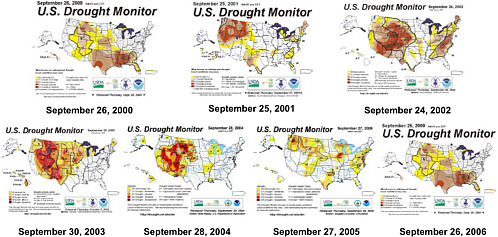
FIGURE 2-7 Western U.S. drought conditions, 2000-2006.
SOURCE: http://www.drought.unl.edu/dm/archive.html. The U.S. Drought Monitor is a partnership between the National Drought Mitigation Center (NDMC), U. S. Department of Agriculture, and National Oceanic and Atmospheric Administration. Map courtesy of NDMC UNL.
|
BOX 2-3 Defining Drought Clear definitions of drought are elusive. Drought is generally understood in terms of the definition offered in Webster's Dictionary: dryness; want of rain; or a prolonged period of dryness. Drought is a normal part of climate in nearly all of the United States but it is of special concern in arid regions of the western United States, where precipitation is often in short supply and where one thus might say drought exists much of the time. Drought can be defined in different terms, including meteorological, agricultural, hydrologic, and socioeconomic (Wilhite and Glantz, 1985). Hydrologic definitions of drought are of particular interest within this report, as Colorado River water managers generally define drought in terms of reservoir inflows. The Colorado River basin drought of the early 21st century saw well below normal inflows into Lake Powell for the 5-year period 2000-2004. It should be noted, however, that 1999 and 2005 both had only slightly above-normal inflows, and one or two years of slightly above normal inflows do not end a drought of such magnitude. For 1999-2005, average inflows into Lake Powell were below normal. The 2006 water year is likely to extend this trend. A basic concept invoked in understanding drought is that of a water budget. Water is held in storage buffers such as soil root zones, aquifers, lakes, reservoirs, and surface stream flows. These buffers act as water supplies, are subject to demands, and are replenished and lose water at varying rates. When losses exceed replenishment, impacts are experienced and, at lower storage levels, become increasingly severe. In essence, drought is defined by its impacts on both natural and manmade environments because without impacts there is no drought, no matter how dry it might be. Drought infers a relationship between supply rates and demand rates; drought is not simply a supply-side phenomenon, but also depends on water demands. Without demands, there is no drought, whether a given supply of water is big, small, or even zero. It can be difficult to determine exactly when a drought has begun or ended, and there can be differences of opinion over whether a drought actually exists. Droughts begin slowly. They may be interrupted by wet periods, during which it is not clear if precipitation will continue or if dry conditions will return. A drought may not be widely recognized until it has been under way for several months or longer, and it can be particularly difficult to recognize in arid regions that experience seasonal dry periods. Recognizing that drought began in some parts of the Colorado River basin in the late 1990s, and that it is ongoing in many areas and may not abate any time soon, this report uses the descriptors of drought of the early 21st century and drought of the early 2000s to refer to the drought that has affected Colorado River hydrology in this period. |
TABLE 2-3 Unregulated Inflow to Lake Powell
|
Water Year a |
Percent of Average |
|
1999 |
109% |
|
2000 |
62% |
|
2001 |
59% |
|
2002 |
25% |
|
2003 |
52% |
|
2004 |
51% |
|
2005 |
109% |
|
|
|
|
a “Water year” refers to the period from October 1 to September 30 of the following year (e.g., Water Year 2004 refers to the period from October 1, 2003, until September 30, 2004). SOURCE: Fulp (2005b). |
|
(Fulp, 2005a). In early 2005 Lake Powell was at its lowest level of storage since 1969, when it was initially filling (Figures 2-8 and 2-9), and Lake Mead had not been as low since 1967 (Fulp, 2005a). The drought of the early 2000s was severe by any measure; in terms of climate statistics, the probability is very low—less than 0.1—that any 5-year drought period since 1850 had been as dry as 2000-2004 (Woodhouse et al., 2006).
During the early 21st century drought, the Colorado River storage system performed much like it had been designed to do and, even after 5 consecutive below-average years of precipitation and inflows, still held roughly 2 years of annual Colorado River flows (Fulp, 2005a). Precipitation across the Colorado River basin was closer to average conditions in 2005, but in 2006 drier conditions returned and were exacerbated by above-normal temperatures; July 2006, for example, was the second-warmest-ever month of July in the continental United States (http://www.noaanews.noaa.gov/stories2006/s2677.htm), and the 2006 average annual temperature for the contiguous United States was the warmest on record (and nearly identical to the record set in 1998; http://www.ncdc.noaa.gov/oa/climate/research/2006/ann/us-summary.html).
It is not clear how drought will impact future reservoir storage levels, nor is it clear exactly how long it would require the storage system to refill once again. According to one estimate, it may require roughly 15 years of average hydrology to refill Lakes Powell and Mead (Jeanine Jones, California Department of Water Resources, personal communication, 2005). Closer-to-normal precipitation may
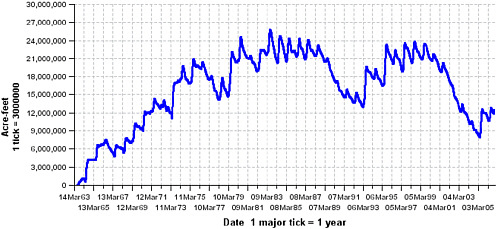
FIGURE 2-8 Storage in Lake Powell through December 1, 2006. Lake Powell’s capacity is 27 million acre-feet, including dead storage. Values shown do not include the volume of water in dead storage.
SOURCE: Generated at http://www.usbr.gov/uc/crsp/GetSiteInfo.

FIGURE 2-9 Glen Canyon Dam and Lake Powell, August 2004. Note the residual ring around the top of the lake caused by declining water levels.
SOURCE: Courtesy of Brad Udall, University of Colorado.
end the drought, but a return of drier conditions could extend it. Regardless of future precipitation conditions, higher levels of population and water demand will make it more difficult to fill reservoirs and meet future water demands and obligations.
Coping with Drought and Increasing Water Demands
The early 21st century drought has been notable for its hydrologic and related impacts, such as forest fires in some areas of the Colorado River basin. The drought, along with increasing population growth and water demands, stimulated a variety of responses. It is not possible to list here every new water use and drought mitigation strategy across the West, but this section introduces some notable drought responses in the early 2000s (Chapter 5 includes more detail on drought mitigation programs and studies).
In response to drought conditions and increasing competition over the West’s water resources, the Department of the Interior initiated a program to help increase awareness of possible future conflicts over water, especially during drought. Entitled Water 2025: Preventing Crises and Conflict in the West, the program was started in 2003 in an effort to concentrate “existing federal financial and technical resources in key western watersheds and in critical research and development, such as water conservation and desalinization, that will help to predict, prevent, and alleviate water supply conflicts” (DOI, 2003). The Water 2025 program has provided limited funds for competitive “challenge grants,” much of which have gone to agricultural conservation projects. It has also sponsored workshops across the western United States that convened scientists, engineers, and water managers to discuss water shortage problems and possible solutions. A key premise driving the Water 2025 initiative is that “In some areas of the West, existing water supplies are, or will be, inadequate to meet the demands for water for people, cities, farms and the environment even under normal water supply conditions” (http://www.doi.gov/water2025/Water2025-Exec.htm). Water 2025 produced a map (see Figure 2-10) of areas across the western United States that may experience water supply crises by the year 2025. This figure shows that several areas of “highly likely” to experience conflicts lie within or adjacent to the Colorado River basin.
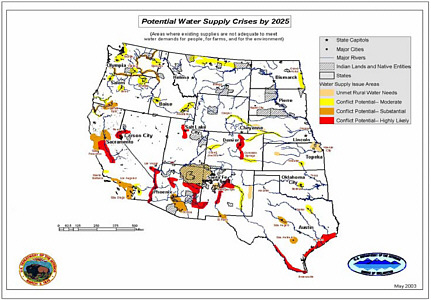
Colorado River basin states are engaged in a variety of long-range water planning, drought management, and conservation plans and programs. The State of Colorado, for example, in 2004 began a Statewide Water Supply Initiative that examined all aspects of the state’s water uses through 2030 and discussed water supply options and management alternatives. The report’s first finding was that “[s]ignificant increases in Colorado’s population—together with agricultural water needs and an increased focus on recreational and environmental uses—will intensify competition for water” (CWCB, 2004). Another example of state-level planning for future water demands and shortages is the Arizona Drought Preparedness Plan. Issued in 2004 by the Governor’s Drought Task Force, this report provides guidance to water users within Arizona and serves as a foundation for a long-term, statewide water conservation strategy. In 2006, the California Department of Water Resources issued an extensive report on incorporating climate change into California state water management (California DWR, 2006). The other basin states are also involved in plans and studies aimed at enhancing water conservation, drought planning, and long-term water supply availability (Chapter 5 includes further discussion of drought management programs and initiatives in the region).
An important development that grew out of drought conditions in the early 2000s was a letter of agreement signed by representatives of all seven Colorado River basin states (see Appendix A). Dated February 3, 2006, this letter was sent to the Secretary of the Interior in response to the Secretary’s request for the states to develop shortage guidelines and management strategies under low-reservoir conditions. No basin-wide shortage criteria existed prior to the 2000s, and the Secretary had declared that the Department of the Interior would develop these guidelines if the basin states were unable to arrive at a consensus agreement. The letter and the level of cooperation it represents constitute an important step toward devising the first formal set of shortage criteria among the seven basin states and, as such, provide some optimism regarding future interstate cooperation on Colorado River water supply issues.
COMMENTARY
The past 150 years have been marked by four broad phases of Colorado River water development. The first era extended from the middle of the 19th century until roughly 1920. This period was characterized by explorations led by John Wesley Powell and by the origins of contemporary practices of irrigated agriculture. The second era extended from roughly 1920 to 1965. This period saw the signing of several crucially important water development agreements and rulings, and the construction of many major, multipurpose water projects. This era began with the planning for Boulder (Hoover) Dam and ended with the construction of Glen Canyon Dam. A third phase of Colorado River water development extended from 1965 until the mid-1980s. This period was characterized by ample water supplies that supported population growth and economic growth across a variety of sectors, including both urban and agricultural uses. Fewer dams and water projects were constructed during this period as compared to the 1920-1965 era. Water storage facilities constructed between 1920 and 1965 generally provided adequate water to support additional people and economic development. This provided a water supply “cushion” during periodic droughts, such as during drought across much of the basin in the late 1970s. The period also witnessed rising concerns regarding environmental impacts of large-scale dams and associated water supply systems.
The fourth phase of regional water development began in the mid-1980s and continues today. This phase is characterized by limited water supply development and rapid population growth and urbanization. During the 1990s the four fastest-growing states (in percentage terms) in the nation were Nevada, Arizona, Colorado, and Utah, respectively. The basin's major cities, such as Las Vegas, Phoenix, and Tucson all experienced large increases in population, as did several cities on the basin’s periphery that depend on Colorado River water, such as Albuquerque, Denver, Los Angeles, and San Diego. Not only do these larger numbers of people increase urban water demands, many of these urban dwellers enjoy and support other, nontraditional uses of western water, namely instream flows for both recreation and environmental preservation. In some instances, population increases have been partly offset through water pricing and conservation measures that have reduced per capita demands, and by transfers of water from agricultural users. Increasing water de-
mands are also encouraging a reordering of priorities to favor uses with a stronger economic base and users possessing a greater willingness to pay for water. But as population and water demand continue to grow, urban water supply gains realized by conservation, water transfers, and other measures are eventually absorbed. The impact of high, steady population growth has been to increase water demands; in the face of limited water supplies, these increasing and broadening demands portend a decreasing ability to cope with drought conditions and heightened conflicts over limited water supplies.
When the Colorado River Compact was signed in 1922, except for municipal water demands in Southern California, use of water for irrigated agriculture was a predominant concern. The basin was lightly populated and the river’s water was allocated equally between the upper and lower basins. At that time, population in the lower basin states was roughly double that in the upper basin states. Since that 1922 allocation the upper and lower basins experienced different levels of population growth and urbanization. The most important demographic feature in the ensuing years was population growth in Southern California (and to a lesser extent in Arizona). Today, population in the lower basin states is four to five times the population in the upper basin states. Fueled by this growing population, the lower basin states eventually began to use their full 7.5 million acre-feet annual allocation of Colorado River water. By contrast, the upper basin states have never used their full allocation of 7.5 million acre-feet of water per year.
Releases of water from Glen Canyon Dam have always exceeded the upper basin’s delivery obligation of not less than 75 million acre-feet for any 10 consecutive years, pursuant to Article III(d) of the Colorado River Compact. Even during the drought of the early 2000s and lowered water storage in Lake Powell, Glen Canyon Dam was delivering flows above the upper basin’s Colorado River Compact commitment. There is no imminent prospect that this delivery obligation will not be met, and any change in the Colorado River Compact would require the resolution of numerous complex legal issues that could require many years or even decades to resolve. Nevertheless, the upper basin states intend to utilize a greater portion of their 7.5 million acre-feet per year allocation and, with rapid population growth in many areas, they continue to come closer to their full Colorado River Compact allocation. Future droughts and climate change may also affect precipitation and inflows into Lake Powell and other
storage facilities. Any shortages in water delivery obligations that resulted from climate change would be dealt with in the same way as shortages caused by drought or other factors. If changes in climate rendered the Law of the River inadequate to deal with resulting shortages, the Colorado River basin states could conceivably seek to amend the Compact and the United States and Mexico could conceivably seek an amendment of their 1944 treaty. Water releases from Glen Canyon Dam are a key issue at the hydrology-climate-population growth nexus in the Colorado River basin and bear close watching in the years ahead.
One initiative that grew from the drought conditions of the late 1990s and early 2000s was the Department of the Interior’s Water 2025 program. The following excerpt comments on the Water 2025 program and touches on the water supply and demand issues discussed in this chapter:
On the very first page of its 2003 report, “Water 2025,” the United States Bureau of Reclamation explains with chilling frankness that “today, in some areas of the West, existing water supplies are, or will be, inadequate to meet the demands of people, cities, farms, and the environment even under normal water supply conditions.” The report goes on to explain “the reality” that: “explosive population growth in western urban areas, the emerging need for water for environmental and recreational uses, and the national importance of the domestic production of food and fiber from western farms and ranches are driving major conflicts between these competing uses of water. The ‘major conflicts’ are occurring because most all of the surface waters in the region have been appropriated, leaving little for the continuing stream of newcomers” (Gavrell, 2005).
Another critical issue is the prospect for transferring water from agricultural uses to help meet growing urban demands. Roughly 80 percent of the Colorado River basin’s water is allocated to the agricultural sector. Given limitations on constructing (and filling) new storage reservoirs, growing western cities are looking to agricultural water as a source of additional supplies. Municipalities often have a large willingness to pay for agricultural water rights, and both parties (i.e., agricultural sellers and urban buyers) often stand to gain by these types of transfers. There is a large amount of water held in agricultural water rights that could support a great deal of future urban
population growth. There are barriers to transferring water to municipalities from agricultural and other users, such as tribal groups. These barriers include direct and third-party effects, and limited physical facilities for storing and rerouting water among willing buyers and sellers. As agricultural supplies are diverted to urban uses, this last remaining substantial amount of water that could be made available for urban uses in the Colorado River region is, slowly but surely, being depleted.
Steadily rising population and urban water demands in the Colorado River region will inevitably result in increasingly costly, controversial, and unavoidable trade-off choices to be made by water managers, politicians, and their constituents. These increasing demands are also impeding the region’s ability to cope with droughts and water shortages.
The drought of the early 2000s brought climate-related concerns to the fore across the Colorado River region. Not only did the drought result in numerous, direct hydrologic impacts, it raised questions about what climate trends and future conditions across the region and the planet might portend for Colorado River flows. The early 21st century also saw a great interest in several climate and hydrologic studies of the Colorado River region, especially several long-term reconstructions of past Colorado River flows that were based on studies of the annual growth rings of coniferous trees. The following chapter discusses how features of the global climate system affect the Colorado River region, temperature and precipitation trends and projections across the region, the gaged record of Colorado River flows, and studies of annual growth rings of coniferous trees (dendrochronology) and what they imply for regional hydrology and climate.


