
4
Benchmarking Results: Detailed Assessment of U.S. Leadership by Area of Chemical Engineering
Chapter 3 provided an assessment of U.S. chemical engineering research at large. In this chapter we focus the assessment on each area/subarea of chemical engineering research. Based on the analysis of data regarding the composition of the VWC, publications and citations, patents, recognition of individual researchers through prizes and awards, and prevailing trends, the Panel compiled an overall assessment for each subarea in terms of the following two indices:
-
Current Position of U.S. Research in Chemical Engineering
-
Expected Future Position of U.S. Research in Chemical Engineering
In assessing the future position of U.S. chemical engineering research the Panel took into consideration, in addition to the above, a set of key determinants of leadership, such as the following:
-
intellectual quality of researchers and ability to attract talented researchers
-
maintenance of strong, research-based graduate educational programs
-
maintenance of strong technological infrastructure
-
cooperation among government, industrial, and academic sectors
-
adequate funding of research activities
Table 4.45 summarizes the Panel’s assessment of the Current and Future Positions of U.S. Research Chemical Engineering in all subareas alongside the expected future trends.
The leadership determinants (ability to attract talented students, educational and research programs, technological infrastructure, cooperation among government, industry, and academia, and funding) and their (projection) are analyzed in Chapter 5.
4.1
AREA-1: ENGINEERING SCIENCE OF PHYSICAL PROCESSES
This area encompasses research in the science and engineering of processes, which are characterized, primarily, by physical phenomena. It has been divided into the following five subareas:
-
transport processes
-
thermodynamics
-
rheology
-
separations
-
solid particle processes
4.1.a
Transport Processes
The role of transport processes in chemical engineering has evolved from fundamental understanding and cutting edge/frontier research in the 1960s into two parallel fronts: one deepening fundamentals, the other evolving towards applications. It has also taken a role as a platform technology, with a presence in nearly all areas of chemical engineering, spanning from traditional processing (e.g., reactors, separation systems) to biological applications and materials. Transport phenomena, with or without chemical reaction, are at the heart of all processing systems at any scale (macro, micro, nano) and as such are at the very core of chemical engineering; indeed, in what may be a commonly held belief, they define chemical engineering.
In defining the scope of this subarea we have considered traditional aspects of fluid mechanics, such as low Reynolds number flows and turbulent flows including multiphase flows; fluid-particle systems; all types of mass and heat transport, including chemically assisted mass transport; flows of complex fluids (connecting smoothly with rheology); flows induced by electric or magnetic fields (bridging with colloidal science); and transport at interfaces. Other aspects include a blend of research and practical considerations, such as numerical simulation for analysis and design as well as prediction of and correlations for transport properties. Topics of current importance have evolved towards fluid mechanics and mass transport at interfaces and small scales, as in microfluidics, nanoscale devices, molecular-level modeling of tribology, and biological molecules and living cells. Particulate and multiphase flows, interfacial flows, non-Newtonian fluid
mechanics, and flow mechanics of complex fluids and biomolecules remain subjects of intense research interest due to their intellectual challenge and broad range of potential applications.
U.S. Position. The number of experts for the VWC in this area was five U.S. and two non-U.S. The percentage of U.S. participants in the Virtual Congress was 81% when multiple entries for the same person were allowed. This was among the highest representations in all subareas considered by this panel. The percentage was 77% when name duplication was disallowed, and indicates that several U.S. names appeared in multiple lists. These numbers point to strong U.S. leadership in transport. An analysis of names reveals that a significant number of the names are associated with “classical” fluid mechanics as opposed to mass transfer or energy transfer, which are clearly regarded today as mature areas in chemical engineering.
A survey of the flagship journals in the fluid mechanics area, the Journal of Fluid Mechanics and Physics of Fluids reveals that the number of U.S. contributions, across disciplines, from 1990 to 2006, increased by a factor of 2, but its relative percentage was reduced by 9%, due to higher rates from, European Union (EU) and Asia (see Table 4.1). In terms of quality and the impact, U.S. contributions dominate (66%) the list of the 50 most-cited papers (Table 4.2).
The chemical engineering contributions worldwide have more than doubled in number, maintaining roughly the same relative percentage, about 8% of the total papers.
U.S. chemical engineering has dominated the chemical engineering contributions: 84% in the period 1990-1994 and 75% in the period of
TABLE 4.1 Publications in Journal of Fluid Mechanics and Physics of Fluids
|
|
1990-1994 |
1995-1999 |
2000-2006 |
|||
|
% |
% |
% |
||||
|
Total Number of Papers |
2,070 |
|
3,439 |
|
5,029 |
|
|
Total No. of U.S. Papers |
1,174 |
57 |
1,836 |
53 |
2,300 |
46 |
|
Total No. of Chem. Eng. Papers |
163 |
7.87 |
286 |
8.32 |
389 |
7.74 |
|
U.S., Chem. Eng. |
143 |
87.73 |
245 |
85.66 |
289 |
74.29 |
|
EU, Chem. Eng. |
6 |
3.68 |
19 |
6.64 |
48 |
12.34 |
|
Asia, Chem. Eng. |
12 |
7.36 |
33 |
11.54 |
53 |
13.62 |
|
Canada, Chem. Eng. |
7 |
4.29 |
9 |
3.15 |
9 |
2.31 |
|
S. America, Chem. Eng. |
1 |
0.61 |
0 |
0.00 |
4 |
1.03 |
|
Internationalization (overlap) |
|
3.68 |
|
6.99 |
|
3.60 |
TABLE 4.2 Distribution of the 50 Most-Cited Papers in Journal of Fluid Mechanics and Physics of Fluids
|
|
1990-1994 |
1995-1999 |
2000-2006 |
|
No. of U.S. Papers |
36 |
30 |
33 |
|
No. of Chem. Eng. Papers |
3 |
3 |
3 |
|
No. of U.S. Chem. Eng. Papers |
3 |
2 |
3 |
|
(% share among chemical engineering papers) |
(100%) |
(66%) |
(100%) |
2000-2006. In addition, all papers from chemical engineering researchers in the list of 50 most-cited papers for 2000-2006 come from the United States. These numbers are consistent with the dominant representation of U.S. chemical engineers in the Virtual World Congress for this subarea, and both indicate that the relative U.S. position is “Dominant, at the Forefront,” in relationship to chemical engineering research elsewhere in the world. The real competition comes from other disciplines, notably physics, applied mathematics, and mechanical engineering. Indeed, Table 4.2 indicates that only 6% of the 50 most-cited papers come from U.S. chemical engineering research. This is primarily due to the fact that chemical engineering research activities in fluid mechanics represent a small subset of this field.
Analysis of the publications from mainstream journals of chemical engineering such as AIChE Journal, I&EC Research and Chemical Engineering Science indicates that in 1995 there were about 1.5 papers from U.S. authors for every paper from a non-U.S. author. This ratio has changed to about 0.5 to 0.6, following the significant increase in the research output from the European Union and Asia. It should be noted that a number of publications that in the past would have gone to classical journals, such as the Journal of Fluid Mechanics and Physics of Fluids, now go to more peripheral publications associated with niche areas, e.g., microfluidics. At the same time there has been a decrease in the number of publications in once classical and central areas of chemical engineering, such as two-phase flow, heat transfer, fluidization, and the like. The volume of research in these areas and the number of ensuing publications from Asian countries has increased substantially.
Relative Strengths and Weaknesses. U.S. chemical engineering scholarly activities in transport phenomena have, until the mid 1980s, attracted some of the best talent in the United States and transport was considered to be a prestige area. Now, opportunities for long-range funding in pure fluid mechanics and fundamentals in mass transport are virtually nonexistent in the United States. This can have long-term negative consequences for chemical
engineering in the United States. Loss of transport strength will result in a loss of differentiation that has been critical for chemical engineering work across multiple areas, at a time when processing at the micro- and nano scale, formation of structured materials and their processing into a multitude of functional parts, the production of efficient energy devices (at any scale), and efficacy of a broad range of biomedical devices, may hinge on better understanding of the associated transport processes.
With the exception of niche centers such as Stanford’s Center for Turbulence Research (largely dominated by mechanical engineering), the United States has surprisingly few large institutes wholly dedicated to fluid mechanics and mass transport, and even fewer with a significant component of chemical engineering. (There are, however, a few devoted to mixing, for example). Current U.S. research in transport tends to be concentrated on applications in fluid mechanics. Fluid mechanics in industry is dispersed throughout many areas, though recognizable pockets may include computational fluid mechanics, e.g., analysis and design of reactors with complex flows, heat and mass transport, as well as groups focused on fluid mechanics of suspensions, high-precision coating processes, mixing, and transport and reaction in heterogeneous and porous systems.
Future Prospects. As the framework of transport phenomena developed and tools were created there was a migration outwards, and many areas that were once frontiers of transport research have become permanently integrated with many surrounding areas. It has become increasingly difficult to delineate the boundaries between transport and colloidal science, transport and solid/particulate systems, and transport and rheology.
Significant advances have taken place over the last decade. Some of these advances have been in traditional areas such as simulation of multiphase and turbulent flows at single and multiple length and time scales, mixing, and coating flows. It is now possible to simulate efficiently suspensions and emulsions, and flow of non-Newtonian fluids for almost any admissible constitutive law, and to apply fundamental transport phenomena to a variety of practical microfluidic devices.
New areas and opportunities lie at the intersection of transport and colloid science, e.g., cases involving sophisticated couplings of interparticle colloidal forces, and external fields and fluid mechanics. These ideas find application in the directed self-assembly of materials and separations as in electrophoresis, diffusiophoresis, induced-charge electrophoresis, and others. New challenges are arising in microrheology, as it is used to probe complex fluids and biological systems. The frontier areas of designing and making nanocomposites and nanoparticulate/polymer complex fluids require the simultaneous tailoring of transport, rheological, and mechanical properties. Another area of active research involves granular matter and
study of jamming, ageing and flow properties of glassy/disordered materials ranging from pastes to polymers to granular media.
Panel’s Summary Assessment. The current U.S. position is at the “Forefront,” and the Panel expects that in the future it will be “Among World Leaders.”
4.1.b
Thermodynamics
Thermodynamics has evolved from the classical studies of estimating thermophysical properties and phase behavior of fluids that defined the field in the middle of the 20th century to a much more molecular and science-based field with a significantly broader range of applications. Experimental studies now examine new formulations of consumer products, e.g., refrigerants; new solvents as diverse as carbon dioxide and ionic liquids; degradation and stabilization of biological molecules, e.g., proteins, DNA, RNA; supercooled liquids and glasses; thermophysical properties of biological systems; structure and properties of polymers and blends; nucleation and growth; and others. Theoretical advances frequently follow application of the principles of statistical thermodynamics and, increasingly, quantum mechanics, to engineering problems. Molecular simulations are becoming quite entrenched and their predictive efficiency is progressing by leaps and bounds. Examples include improvements in the understanding of the properties of water; ab initio calculations of molecular interactions important in biological processes, e.g., complex immune systems, and estimation of thermophysical properties and phase behavior of biomolecules; computational studies of self-assembled systems at meso- and nano scale, e.g., copolymers, polymer blends, composites; theoretical and computational studies on nucleation/formation and growth of e.g., colloids, crystals, emulsions, foams;
Thermodynamics is an integral part of the chemical engineering science base and underlies many traditional chemical engineering unit operations. As the academic interests and industrial emphasis have been shifting towards better understanding of molecular-level phenomena, thermodynamics is playing a key role in advance understanding of the molecular forces underlying molecular organization, self-assembly, and materials design, and in developing new media and their applications, such as environmentally benign solvents for dry cleaning; water-based dispersions of inks, dyes, and pigments for the electronic and automobile industries; and functional structured fluids for the personal care industry, home and office products industry, food industry, and other sectors.
U.S. Position. In addition to the mainstream chemical engineering journals, such as AIChE Journal, I&EC Research and Chemical Engineering Science
other principal journals in this subarea include the Journal of Chemical Physics, Journal of Physical Chemistry B, Molecular Simulations, Fluid Phase Equilibria, and the Journal of Chemical Thermodynamics. In the first three journals, the relative contribution of U.S. chemical engineering researchers against non-US contributions has decreased from 3.5 U.S. papers per non-U.S. paper to about 1.0. Significant increases in submissions from European Union and Asian countries have been the main factor contributing to this change. In each of the latter five journals the U.S. contributions in the past few years across disciplines range from 15% to 40%, and in all cases contributions from the European Union are more numerous than those from the United States (Tables 4.3 and 4.4).
Tables 4.5, 4.6, and 4.7 summarize the trends in chemical engineering contributions for the five journals. The numbers indicate that for the past 20 years chemical engineering papers have captured a roughly constant relative percentage of all publications, ranging from 4% to 30%. For the Journal of Chemical Physics and Journal of Physical Chemistry B the percentage contribution from chemical engineers worldwide has been increasing (from about 4% in 1990-1994 to over 7% in 2000-2006), but it remains at low levels, with contributions from chemists outnumbering those of chemical engineers by factors of 3 to 6. Tables 4.6 and 4.7 also indicate that the percentage contribution of U.S. chemical engineers has been decreasing over the past 20 years, e.g., from 40% to 23% (combined numbers
TABLE 4.3 Publications in Three Area-Specific Journals for Thermodynamics
|
|
J. of Chemical Physics |
J. of Physical Chemistry-B |
Molecular Simulations |
||||||
|
% U.S. |
U.S. Papers |
EU Papers |
% U.S. |
U.S. Papers |
EU Papers |
% U.S. |
U.S. Papers |
EU Papers |
|
|
2003 |
40 |
1064 |
1311 |
|
|
|
30 |
27 |
35 |
|
2004 |
39 |
1048 |
1363 |
36 |
857 |
1093 |
29 |
23 |
46 |
|
2005 |
40 |
1110 |
1400 |
36 |
1169 |
1317 |
25 |
33 |
53 |
TABLE 4.4 Publications in Two Area-Specific Journals for Thermodynamics
|
|
Fluid Phase Equilibria |
J. of Chemical Thermodynamics |
||||
|
% U.S. |
U.S. Papers |
EU Papers |
% U.S. |
U.S. Papers |
EU Papers |
|
|
2003 |
12 |
27 |
95 |
18 |
31 |
45 |
|
2004 |
19 |
50 |
107 |
16 |
21 |
25 |
|
2005 |
15 |
58 |
134 |
15 |
22 |
37 |
TABLE 4.5 Publication Trends in Journal of Chemical Physics and Journal of Physical Chemistry-B
|
|
1990-1994 |
1995-1999 |
2000-2006 |
|||
|
% |
% |
% |
||||
|
Total Number of Papers |
9,672 |
|
15,582 |
|
30,064 |
|
|
No. of U.S. Papers |
5,516 |
57.00 |
6,936 |
45.00 |
11,819 |
39.00 |
|
No. of Chem. Eng. Papers |
369 |
3.82 |
866 |
5.56 |
2,182 |
7.26 |
TABLE 4.6 Publication Trends in Fluid Phase Equilibria and Journal of Chemical Thermodynamics
|
|
1990-1994 |
1995-1999 |
2000-2006 |
|||
|
% |
% |
% |
||||
|
Total Number of Papers |
1,714 |
|
2,102 |
|
2,630 |
|
|
No. of U.S. Papers |
430 |
25.00 |
432 |
21.00 |
439 |
17.00 |
|
No. of Chem. Eng. Papers |
478 |
27.89 |
621 |
29.54 |
757 |
28.78 |
|
U.S., Chem. Eng. |
191 |
39.96 |
209 |
33.66 |
178 |
23.51 |
|
EU, Chem. Eng. |
83 |
17.36 |
115 |
18.52 |
166 |
21.93 |
|
Asia, Chem. Eng. |
162 |
33.89 |
223 |
35.91 |
279 |
36.86 |
|
Canada, Chem. Eng. |
52 |
10.88 |
49 |
7.89 |
44 |
5.81 |
|
S. America, Chem. Eng. |
3 |
0.63 |
23 |
3.70 |
39 |
5.15 |
TABLE 4.7 Publication Trends in Molecular Simulations
|
|
1990-1994 |
1995-1999 |
2000-2006 |
|||
|
% |
% |
% |
||||
|
Total Number of Papers |
159 |
|
220 |
|
496 |
|
|
No. of U.S. Papers |
48 |
30.00 |
36 |
16.00 |
125 |
25.00 |
|
No. of Chem. Eng. Papers |
26 |
16.35 |
19 |
8.64 |
74 |
14.92 |
|
U.S., Chem. Eng. |
25 |
96.15 |
14 |
50.00 |
42 |
56.76 |
|
EU, Chem. Eng. |
1 |
3.85 |
7 |
25.00 |
14 |
18.92 |
|
Asia, Chem. Eng. |
1 |
3.85 |
6 |
21.40 |
23 |
31.08 |
|
Canada, Chem. Eng. |
1 |
3.85 |
0 |
0.00 |
2 |
2.70 |
|
S. America, Chem. Eng. |
0 |
0.00 |
1 |
3.60 |
1 |
1.35 |
for Fluid Phase Equilibria and Journal of Chemical Thermodynamics), and from 96% to 57% (Molecular Simulations). These reductions are primarily due to higher growth rates in other parts of the world, notably European Union and Asia.
In terms of quality and impact, Table 4.8 summarizes the distribution of the 50 most-cited papers for three groups of journals. Overall, across
TABLE 4.8 Distribution of the 50 Most-Cited Papers for Combined Journal of Chemical Physics and Journal of Physical Chemistry-B, Combined Fluid Phase Equilibria and Journal of Chemical Thermodynamics and Molecular Simulations
|
|
J. of Chemical Physics and J. of Physical Chemistry B |
Fluid Phase Equilibria and J. of Chemical Thermodynamics |
Molecular Simulations |
||||||
|
1990-1994 |
1995-1999 |
2000-2006 |
1990-1994 |
1995-1999 |
2000-2006 |
1990-1994 |
1995-1999 |
2000-2006 |
|
|
No. of U.S. Papers |
32 |
28 |
31 |
20 |
21 |
11 |
12 |
4 |
11 |
|
No. Chem. Eng. Papers |
2 |
1 |
4 |
35 |
31 |
32 |
7 |
6 |
9 |
|
No. of U.S. Chem. Eng. Papers |
2 |
1 |
4 |
17 |
13 |
7 |
5 |
3 |
8 |
|
(% share among chemical engineering papers) |
(100%) |
(100%) |
(100%) |
(50%) |
(42%) |
(28%) |
(70%) |
(50%) |
(89%) |
disciplines, the United States possesses a position “Among the Leaders” with strong competition from the European Union. With respect to chemical engineering contributions, the United States is in a “Dominant, at the Forefront” position. Furthermore, when we take a close look at the list of the 100 most-cited papers (2000-2006) in chemical engineering at large, we notice that the field of thermodynamics is well represented in the list—two of the top three and three of the top five most-cited papers have thermodynamics as their subject. Pioneering papers in this field are published in top journals, including Nature, Science, and Proceedings of the National Academy of Sciences.
Two hundred seventeen participants were identified in the area of thermodynamics for the Virtual World Congress, and 68% of them were from the United States (61% when duplications were disallowed), which is about the same for the overall U.S. participation in the Virtual World Congress. This is in line with the numbers and impact of U.S. publications among chemical engineering researchers, firming up the conclusion that U.S. chemical engineering research in the area of thermodynamics is “Dominant, at the Forefront.”
Relative Strengths and Weaknesses. Thermodynamics is a large and vibrant field in chemical engineering worldwide, and like many engineering fields that are closely linked to science, many significant contributions come from workers outside of chemical engineering departments. This is true in the United States, but is particularly evident in the European Union. Thus, it is difficult to benchmark only U.S. chemical engineers in this arena, and there are many substantial and important U.S. academic collaborations that involve chemical engineers together with chemists or physicists, all working on both experimental and theoretical problems. This interdisciplinary work is clearly a strength, and it allows new ideas to be readily applied to problems of interest to chemical engineering practitioners.
The field has in general expanded over the time period represented in our analysis of publications, with growth by a factor of 2 in publications in Fluid Phase Equilibria and a factor of over 4 in Molecular Simulations. These journals primarily reflect, respectively, reports of experimental and simulation studies. The relative rates of growth indicate a substantially larger rate of new developments in simulations, which is of course to be expected given the availability of increasing computational power. The percentage of U.S. contributions in Fluid Phase Equilibria was 20% in 1997 and 15% in 2005, and in Molecular Simulations was 10% in 1997 and 25% in 2005. This further validates the impression that simulations are a more attractive area for research than are traditional experiments, but in all cases the absolute number of U.S. publications increased.
Participants in the Virtual World Congress spanned a range of ages
with a healthy distribution of experience. There are certainly senior leaders, but also a good diversity of younger chemical engineers involved in this area, particularly on the computational and simulation side. The relative lack of experimental activity may be worrisome for the future prospects.
From the publication analysis there appears to be no dramatic shift in the international distribution of articles with the United States and EU a substantial majority, but there is a noticeable increase of papers from China in Fluid Phase Equilibria.
Future Prospects. Significant advances in molecular simulation for the estimation of thermodynamic properties have taken place during the past 10 years for complex systems such as polymers, surfactants, liquid crystals, subcooled water, biomacromolecules, and ionic liquids. Application of quantum mechanics for the calculation of intermolecular forces in phase equilibrium description of fluid mixtures, elucidation of the effects of pressure and solutes on the thermodynamics of hydrophobic hydration of large and small solutes, development of ionic liquids as solvents for separations, and thermodynamics of glasses and disordered systems are some of the other major advances in recent years.
Thermodynamics will continue to be a critical area of chemical engineering for the foreseeable future, and a large and continually growing portion of the field will continue to exploit computer simulations to address practical problems. Other areas of growth will be the application of thermodynamics to biological and complex materials synthesis and processing problems. These will occur both in processing steps in industry, where for example thermodynamic studies can guide optimization of unit operations such as protein crystallization, and in increasingly sophisticated descriptions of the molecular interactions responsible for recognition events. As the theoretical tools in this field enable more accurate descriptions of molecular features, experiments will also probe finer scales. This is particularly true in applications of thermodynamics to descriptions of self-assembly processes involving surfactants, polymers and polyelectrolytes, and other nanoscale building blocks, which are becoming the core components for high added-value products in a variety of industries.
The Panel expects that in the future the following items will continue to attract the research interest: multiscale modeling, which starts with atomic-level descriptions for the simulation of soft matter-colloid solutions, surfactants and micellar solutions, polymers, and self-assembly from these; thermodynamics of biological molecules, the hydrophobic effect, and protein folding; thermodynamics of solubility, bioavailability, and protein binding for drug discovery and development; thermodynamics of small systems needed for the simulation and design of nanostructures; nontraditional
measurements (e.g., spectroscopy, X-ray diffraction) to obtain equations of state and other models; practical thermodynamic models needed for product engineering and green products and processes.
Panel’s Summary Assessment. The current U.S. position is “Among World Leaders,” and in the near future it will remain so.
4.1.c
Rheology
In its broadest definition, rheology is the study of deformation, and ultimately flow, of any material under the influence of an applied force or stress. The study of rheology and the application of its teachings are important to the development of both chemical processes and products. Rheology occupies the area between solid mechanics, which is not usually the realm of chemical engineers, and Newtonian fluid mechanics, which is. As a result many chemical engineers are involved in at least some aspect of rheology research, and most of the leading chemical engineering departments have at least one rheologist. Current research directions include emphasis on fluids in microfluidic flows, flows of complex fluids, and flows in biological systems. The modern study of microrheology, for example, is shedding light on the formation of actin gels, and rheology can be used to probe the kinetics of nanoparticle formation. Rheology will be of increasing importance in the design and characterization of both food and personal care products—the formulation of both is now increasingly based on science rather than empiricism.
U.S. Position. For the Virtual World Congress the number of experts in this area was eight, with six from the US. 113 speakers were identified for the Virtual World Congress, with 62% of them from the United States when multiple nominations were included. This share was only slightly below the 67% of the overall U.S. participation in the Virtual World Congress participation. The percentage of the U.S. participation in the Virtual World Congress drops to 52% when no duplications were allowed, indicating that the U.S. research in this subarea is “Among the Leaders,” but not dominant.
In addition to the three mainstream chemical engineering journals, principal journals in the field include the Journal of Rheology, Journal of Non-Newtonian Fluid Mechanics, and Rheological Acta. U.S. and European Union contributions are about equal in number except for the Journal of Non-Newtonian Fluid Mechanics, which is dominated by European Union papers (Table 4.9). There is a negligible contribution of papers from China and India to the journals surveyed. The percentage of U.S, authorship has been relatively constant over the past 10 years. For all three journals, authors affiliated with chemical engineering departments are the dominant
TABLE 4.9 Geographic Distribution of Publications in Journal of Rheology, Journal of Non-Newtonian Fluid Mechanics, and Rheological Acta
|
|
Journal of Rheology |
Journal of Non-Newtonian Fluid Mechanics |
Rheology Acta |
||||||
|
% U.S. |
Papers U.S. |
Papers EU |
% U.S. |
Papers U.S. |
Papers EU |
% U.S. |
Papers U.S. |
Papers EU |
|
|
1997 |
51 |
38 |
28 |
32 |
33 |
61 |
52 |
33 |
22 |
|
2000 |
32 |
25 |
43 |
44 |
50 |
43 |
33 |
25 |
40 |
|
2003 |
48 |
41 |
44 |
32 |
31 |
48 |
25 |
15 |
29 |
|
2004 |
39 |
30 |
40 |
33 |
38 |
60 |
19 |
13 |
41 |
|
2005 |
53 |
42 |
38 |
21 |
27 |
80 |
33 |
26 |
36 |
TABLE 4.10 The Percentage Contributions of Researchers from Chemical Engineering in Journal of Rheology, Journal of Non-Newtonian Fluid Mechanics, and Rheological Acta
|
|
Journal of Rheology |
Journal of Non-Newtonian Fluid Mechanics |
Rheology Acta |
|
1997 |
27 |
21 |
32 |
|
2000 |
35 |
37 |
24 |
|
2003 |
38 |
25 |
31 |
|
2004 |
43 |
30 |
24 |
|
2005 |
53 |
19 |
30 |
contributors (Table 4.10), so on balance U.S. chemical engineers contribute about one-third of the papers published in this field. At least three rheological papers appear on the list of the 100 most-cited papers in chemical engineering (2000-2006), although in Macromolecules, not in the journals listed above. The percentage of U.S. paper contributions is substantially lower than the U.S. participation in the Virtual World Congress. However, when we consider only chemical engineering researchers, publications and Virtual World Congress participation come closer in agreement.
Relative Strengths and Weaknesses. Rheology is a relatively small field worldwide. The number of publications has been constant over time, so the field is relatively stagnant in that sense, but rheological ideas are now being applied to many new areas including complex fluids and biological assemblies. It is nearly certain that the results of those studies are in some cases being published outside of the traditional rheological journals, so this publication analysis does not measure the growth of these new areas of application.
Future Prospects. Rheology has been and will continue to be an area of significant chemical engineering research for the foreseeable future, but is unlikely to grow. Rheologists will continue to expand the scope of their work to new problems and applications. This is particularly true in applications of rheology to characterize and control self-assembly processes involving surfactants, polymers and polyelectrolytes, and other colloidal or nanoscale building blocks. The rate of this growth could be expanded, and the rheology community should embrace new interactions with industry as, for example, established by the International Fine Particle Research Institute (IFPRI).
Panel’s Summary Assessment. The current U.S. position is at the “Forefront/Among World Leaders,” and in the near future, it will be “Among World Leaders.”
4.1.d
Separations
Separation is critical to every chemical process and, typically, more than half of the invested capital in a plant is dedicated to separation and purification. There is a wide variety of unit operations employed, including:
-
concentration-controlled separations: absorption, adsorption, distillation, drying, etc.
-
electric and/or magnetic field-controlled separations: electrostatics, electrophoresis, electroosmosis, etc.
-
gravity-controlled separations: centrifugation, liquid/liquid, liquid/ gas, solid/gas, etc.
-
size-controlled separations: membranes, sieves, etc.
-
chemically assisted separations
Research activities cover most of these separation methods, and researchers have expanded the range of industrial problems to include separation and purification of bioproducts, novel membranes for fuel cells and water reuse, separations in microsystems, and others. Bioprocess-related separations are discussed in Section 4.3.c.
U.S. Position. The United States has a strong historical background in separations within the chemical process industries (CPI), but is not necessarily in a dominant position. The European community (particularly Germany) has had strong programs in applied technology, including separation technology. A survey of the key journals in this area (Separation Processes, Separation Science and Technology, Filtration and Separation) reveals that the U.S. contribution from 1997 to 2005 has remained relatively constant at 13%-30%.
This seems to underrepresent the U.S. status and may be a result of the journals selected for the study. Indeed, when we analyze the separations-oriented publications in the mainstream chemical engineering journals, AIChE Journal, I&EC Research, and Chemical Engineering Science, the ratio of U.S. to non-U.S. papers has changed from 60/40 (mid 1990s) to 50/50 (2000-2006), indicating a higher rate of growth for non-U.S. contributions, while the United States has remained the leader in numbers and impact.
To account for membrane separations, contributions in the Journal of Membrane Science were analyzed. The percentage of U.S. contributions declined from 29% (1990-1994) to 22% (1995-1999) to 20% (2000-2006). While the percentage of chemical engineering contributions worldwide remained about the same (35% to 38% of all published papers) from 1990-2006, the representation of U.S. chemical engineers declined from 49% of all chemical engineering contributions in 1990-1994 to 29% in 2000-2006. The percentage of the Asian chemical engineering contributions increased significantly during the same period from 29% in 1990-1994 to 46% in 2000-2006. Also, in terms of quality and impact we see an erosion of the U.S. position: 16 of the 30 most-cited papers in 1990-1994 were contributions from the United States and this number was reduced to 9 of the 30 most cited in 2000-2006. The difference was taken up by contributions from the European Union and Asia.
Furthermore, the Virtual World Congress suggested that 65% of the speakers would be from the United States and examination of U.S. patents granted in separations for 1995, 2000, and 2004 reveals that 55%, 53%, and 56%, respectively, were assigned to U.S. companies, suggesting a consistent and higher level of contribution.
Relative Strengths and Weaknesses. The United States has developed some successful industrial consortia such as Fractionation Research, Inc. (FRI), but these have usually a narrow focus (e.g., distillation) rather than a broad focus on separations. The Separations Research Program (SRP, University of Texas) is an exception. It has a broader focus that includes adsorption, extraction, and membranes. A unique area of U.S. strength is membrane research.
In general, interest in traditional chemical engineering unit operations, of which separations is a subset, is declining. There are few U.S. universities that offer graduate-level studies directed towards separations, compared to the past when separation research was present in virtually every U.S. chemical engineering department. The U.S.-based educators and industrial practitioners are an aging population. There is concern regarding training of future leaders in the area of process separations. For example, as the United States is seriously contemplating the biochemical production of ethanol as fuel from cellulose, it is the cost of ethanol separation and purification that could dominate the total process cost, and thus the economic viability of the
proposal. Such prospects may be at risk, given the progressive deterioration in human and facilities infrastructure of the United States in this subarea.
There are few broad consortia in the United States that focus on larger topics such as process synthesis (of which separations is a critical subset) or hybrid separations development. There are active consortia in Europe and elsewhere that are looking into broad developments in chemical processing, which include separations. To give a concrete example, the concept of dividing wall columns (DWC) was strongly supported by a European consortium of companies and universities over the last several decades. The result is that European (particularly German) companies are more advanced in industrial implementation, even though the key patent work occurred in the United States.
Major advancements (as opposed to incremental) in separations technology are seriously hindered in the United States by the inability of academic and industrial partnerships to develop and test concepts on industrial chemicals of interest. Issues around intellectual property, scale and safety, and handling of hazardous chemicals in an academic environment, are serious obstacles to such partnerships.
Future Prospects. Realistically, one must describe our position in this area as challenging. Publications on separation synthesis, process intensification, and many other advanced topics are coming from Asia (particularly China) at an increasing pace. Asia and China in particular have the need and desire to develop a chemical process industry, and this need and desire is seen as an important part of that growth. The current escalation in the cost of energy and feedstocks should spark a renewed interest in improving separations methodology and technology. Many of the advancements require capital investment, and this has been seen as a roadblock in the past. As the price of energy rises, it is more likely that separations technologies that in the past could not support reinvestment could now support this expense. There are a number of advanced separations technologies that would require substantial research and validation, but there are also a number of technologies that could be implemented with only a modest research investment.
There should be a strong interplay between separations scientists and engineers and those working in thermodynamics and in the synthesis, characterization, and computational modeling of new separations membranes and other materials. Separations should grow to be considerably more multidisciplinary. The area of membrane separations will continue to be strong and thriving. The European Union is the primary competitor in terms of quality and impact (see numbers of cited papers, above). Asia is very competitive in membrane separations (see above) and will remain so in the near future. The number of Asian papers in membrane separations
is larger than that from the United States and the quality and impact have increased significantly since 1990. Subjects of particular importance will be the development of efficient and selective processes for gas separation, the development of advanced techniques of solute separation, improved high-flux membranes, and low and high molecular weight solute separation. Ionic liquids for separations, merging Computational Fluid Dynamics with rate-based modeling of separation processes, and low-cost membrane systems for vapor-liquid contacting with significantly reduced energy requirements, are some of the technologies that will be developed in the near future. The United States will continue to play a primary role in this field mostly through the leadership of major U.S. chemical corporations. A focused dialog between academia and industrial practitioners is needed to counter new initiatives coming from Asia and Europe.
Panel’s Summary Assessment. The current U.S. position is “Among World Leaders,” and although in the future it is expected to weaken, it will still be “Among World Leaders.”
4.1.e
Solid Particles Processes
In this subarea we consider particle formation processes (nucleation, growth), particle measurement techniques (size, shape, distribution), processing (mixing, blending, and segregation), separation, attrition and agglomeration, compaction, sintering, tribology of particulate systems, and electrostatic effects in particle processing. The literature on the above topics is scattered among various branches of engineering—chemical, civil, and mechanical—as well as geophysics, pharmacy, and materials science. The most decidedly science-based work appears in physics. Current research has expanded the scope of engineering issues in this subarea to include formation, growth, scaling up, and processing of nanoparticles, but the discussion of the associated activities will be found in Section 4.5.d. Aerosols and the associated science and engineering aspects are discussed in Section 4.8.c.
U.S Position. For the Virtual World Congress the number of experts were five U.S., one non-U.S. The percentage of U.S. participants in the Virtual World Congress was 83% when duplication of names is allowed, and the percentage dropped to 51% when duplication was not allowed. This indicates that several U.S. names appeared in multiple lists. It is important to stress that the solids area was perceived by some to be in severe state of crisis in the United States as recently as a dozen years ago (see B. J. Ennis, J. Green, R. Davis, Legacy of Neglect in the United States, Chem. Eng. Progress, 90, 32-43, 1994.). There are indications that the picture is changing, and a few numbers from the Institute of Scientific Information are
revealing. Consider the number of papers with the key words “particulate system,” “granular material,” “granular matter,” and “granular flow,” in the periods 1955-1996 and 1997-2006. The numbers are 168/69, 11/181, 530/1065, 143/624, respectively. The numbers for “particulate system” decreased, whereas all others increased (clearly, time intervals differ by a factor of 4, but the number of journals and the size of the research enterprise have increased also). It is then clear that this area, as indicated by the numbers above, has had a resurgence of interest. This was partly driven by physics and also by a smoother connection with fluid mechanics, fluid mechanics being a point of strength for the United States. The area is attracting small numbers of talented researchers, and there is an unmistakable trend upwards. However, research in this area is clearly driven by physicists. A survey of the key journals in this area, e.g., Powder Technology and Granular Matter (Tables 4.11 and 4.12) reveals that the U.S. contribution from 1997 to 2005 has declined from 27%-30% to around 20% for the first and has remained roughly constant at about 20% for the second. This is lower than the virtual congress assessment with 51% of the proposed speakers being from the United States, making it 8th from the bottom in U.S. participation in all areas surveyed. Chemical engineers have contributed about 25 to 30% of the publications in Powder Technology and 10%-15% in Granular Matter. Thus, the percentage of papers from U.S. chemical engineers was approximately 5%-6% for Powder Technology and about 3% for Granular Matter, both rather low.
Table 4.12 shows the trends in the two journals over the past 16 years. Although the number of U.S. papers has increased by 80% its relative percentage has been declining. Chemical engineers have more than doubled their contribution, but the relative percentage has remained the same. Asia (including Australia) dominates the numbers, but not the quality and impact (see Table 4.13), which is dominated by the European Union. Chemical engineers dominate the list of the 30 most cited, and U.S. chemical engineering has a good representation in this list at 30%-40%.
Relative Strengths and Weaknesses. There are several U.S. research centers concentrated around applications such as pharmaceuticals, fluidization, and energy. The picture here is almost the reverse of fluid mechanics. Since the 1960s fluid mechanics has been driven by fundamentals, and applications has followed. In particle technologies the situation has been exactly the opposite—the driver was applications, some of them very general, to be sure, but it is only recently that emphasis on more physics-like research focusing on general principles has reached chemical engineering.
In the area of characterization, industrial labs, in spite of the tremendous importance of solids processing across processes and products, have efforts that are manifestly less organized or standardized than labs focused
TABLE 4.11 Recent Contributions in Powder Technology and Granular Matter
|
|
Powder Technology |
Granular Matter |
|||||
|
% U.S. |
% EU |
% China + India |
% Chem. Eng. |
% U.S. |
% EU |
% Chem. Eng. |
|
|
1997 |
27 |
38 |
5 |
0 |
|
|
|
|
2000 |
30 |
38 |
11 |
28 |
6 |
94 |
0 |
|
2003 |
15 |
49 |
16 |
29 |
25 |
75 |
14 |
|
2004 |
20 |
40 |
15 |
25 |
11 |
52 |
7 |
|
2005 |
21 |
42 |
15 |
0 |
21 |
69 |
10 |
TABLE 4.12 Publication Trends in Powder Technology and Granular Matter
|
|
1990-1994 |
1995-1999 |
2000-2006 |
|||
|
% |
% |
% |
||||
|
Total Number of Papers |
749 |
|
863 |
|
1,783 |
|
|
No. of U.S. Papers |
209 |
28.00 |
211 |
24.00 |
360 |
20.00 |
|
No. of Chem. Eng. Papers |
206 |
27.50 |
246 |
28.51 |
493 |
27.65 |
|
U.S., Chem. Eng. |
47 |
22.82 |
76 |
30.89 |
123 |
24.95 |
|
EU, Chem. Eng. |
20 |
9.71 |
32 |
13.01 |
77 |
15.62 |
|
Asia, Chem. Eng. |
80 |
38.83 |
93 |
37.80 |
208 |
42.19 |
|
Canada, Chem. Eng. |
18 |
8.74 |
17 |
6.91 |
29 |
5.88 |
|
S. America, Chem. Eng. |
2 |
0.97 |
7 |
2.85 |
12 |
2.43 |
TABLE 4.13 Distribution of the 30 Most-Cited Papers in Powder Technology and Granular Matter
|
|
1990-1994 |
1995-1999 |
2000-2006 |
|
No. of U.S. Papers |
7 |
8 |
7 |
|
No. of Chem. Eng. Papers |
17 |
20 |
17 |
|
No. of U.S. Chem. Eng. Papers |
7 |
5 |
5 |
|
(% share among chemical engineering papers) |
(41%) |
(25%) |
(30%) |
on rheology, for example, in which there is a commonality of infrastructure across industries.
Opportunities for long-range funding in basic applications-free aspects of solids processing are virtually nonexistent in the United States.
Future Prospects. Historically the solid particles technology subarea has not been—in comparison with fluids—in the center of chemical engineer-
ing. A rejuvenation has taken place in the past decade, and significant progress has been made in problems ranging from the design and synthesis of “smart” particles to the ability to model extensive reaction schemes with complex fluid-particle hydrodynamics to the ability to study granular flows mixing and segregation using discrete-element methods. Much of this has been accompanied by advances in nonintrusive measurement techniques, such as magnetic resonance imaging, electrical capacitance volume tomography and positron emission for real-time solids flow measurements. Clearly all of these advances bring new science into chemical engineering.
Advances can be expected in drug delivery of particles (e.g., via inhalation), biomass (slurry) processing, and modeling of “real” particles (nonspherical, deformable, or cohesive, and particles with a wide size distribution), nanoparticle technology, and particle design for high pressure and high temperature for energy and environmental system applications.
Panel’s Summary Assessment. The current U.S. position is “Among World Leaders,” and in the near future, it will maintain this position.
4.2
AREA-2: ENGINEERING SCIENCE OF CHEMICAL PROCESSES
This area encompasses research in the science and engineering of processes, which are characterized, primarily, by chemical transformations. It has been divided into the following four subareas:
-
catalysis
-
kinetics and reaction engineering
-
polymerization reaction engineering
-
elecrochemical processes
4.2.a
Catalysis
Catalysts accelerate the rate of chemical reactions by reducing their energy of activation. Catalysts also can improve the selectivity of chemical reactions by selectively catalyzing the rates of their different pathways. It has been said that over 95% of commercial chemicals and fuels are produced via catalytic reactions. Homogeneous catalysts are typically dissolved in the reaction medium, while heterogeneous catalysts are typically used in the solid phase.
The field of catalysis is core to chemical engineering. Relying on complex chemical and physical phenomena, catalysis interfaces with several disciplines including surface science, kinetics, solid-state materials science, and electrochemistry.
Catalysts are employed in large-scale industries, such as chemicals, hydrocarbon fuels, energy conversion, and transportation (e.g., automobile emission control). Catalysts are also employed in the manufacture of petrochemicals, specialty chemicals, pharmaceuticals, and polymeric materials. Correspondingly, progress in catalysis impacts the world’s economy and well-being in significant positive ways.
U.S. Position. The Virtual World Congress in catalysis identified 144 speakers of whom 56% were from the United States when duplication in names was allowed and 50% when duplication was disallowed. The large non-U.S. representation is significant in light of the fact that 100% of those canvassed (experts) were from the United States.
Two of the leading catalysis journals are the Journal of Catalysis and Applied Catalysis (both A-General, and B-Environmental). Table 4.14 summarizes the publications data for these two journals. While the number of U.S. papers has increased from 1990-1994 to 2000-2006, the corresponding fraction of the total has decreased steadily from 33% (1990-1994) to 23% (1995-1999) and 15% (2000-2006). Chemical engineers have contributed 29%, 25%, and 21%, respectively, for the three periods examined. Of the chemical engineer authored papers, 60%, 50%, and 40% were U.S.-authored; notable is the stability of the European Union share (19%, 24%, and 22%) and the rapidly increasing Asian share (16%, 24%, and 36%).
We have also examined the citation statistics in the aforementioned suite of catalysis publications (Table 4.15). Among the 50 most-cited papers in these two journals, the share of U.S.-originated papers declined from 27 papers (i.e., 54% share) to 12 papers (i.e., 24% share); likewise the share
TABLE 4.14 Analysis of Publications in Journal of Catalysis and Applied Catalysis
|
|
1990-1994 |
1995-1999 |
2000-2006 |
|||
|
% |
% |
% |
||||
|
Total Number of Papers |
2,255 |
|
3,932 |
|
6,859 |
|
|
No. of U.S. Papers |
747 |
33.00 |
891 |
23.00 |
1,047 |
15.00 |
|
No. of Chem. Eng. Papers |
666 |
29.53 |
1,002 |
25.48 |
1,439 |
20.98 |
|
U.S., Chem. Eng. |
401 |
60.21 |
496 |
49.50 |
576 |
40.03 |
|
EU, Chem. Eng. |
127 |
19.07 |
238 |
23.75 |
323 |
22.45 |
|
Asia, Chem. Eng. |
109 |
16.37 |
244 |
24.35 |
514 |
35.72 |
|
Canada, Chem. Eng. |
31 |
4.65 |
35 |
3.49 |
59 |
4.10 |
|
S. America, Chem. Eng. |
3 |
0.45 |
24 |
2.40 |
39 |
2.71 |
|
Internationalization (overlap) |
|
0.75 |
|
3.49 |
|
5.01 |
TABLE 4.15 Distribution of the 50 Most-Cited Papers in Journal of Catalysis and Applied Catalysis
|
|
1990-1994 |
1995-1999 |
2000-2006 |
|
No. of U.S. Papers |
27 |
22 |
12 |
|
No. of Chem. Eng. Papers |
27 |
28 |
14 |
|
No. of U.S. Chem. Eng. Papers |
23 |
13 |
8 |
|
(% share among chemical engineering papers) |
(85%) |
(46%) |
(57%) |
of chemical engineering papers declined from 27% to 14%, while the share of U.S. chemical engineering citations shrank from 85% to 57%—which is still a leading position.
Although the United States represents about one-third of the world’s economic activity, our role in catalysis falls below that fraction, and has been decreasing with time. The reduction of the U.S. role is being taken up by Asia, and it can now be projected that the number of Asian chemical engineering papers in catalysis will likely exceed the U.S. numbers in the coming 5-year period.
The general trend of decline in the relative share of U.S.-based participation in catalysis was also observed in our analysis of U.S.-, European Union-, and Asian-originated U.S. patents for the 5-year time periods discussed above.
Catalysis research is most often associated with large-scale chemical, petrochemical, or oil refinery processes. These business activities represent rapid growth areas in Asia while they are stagnant in the U.S. and in the European Union. It seems the Asian growth in catalysis R&D is mostly at the expense of a reduced U.S. share in overall R&D activity. It can be expected that the current (2006) upsurge in energy-related economic activity will reenergize U.S. R&D interest in catalysis, but it is unlikely that it will soon reverse the relative trends discussed above.
Relative Strengths and Weaknesses. While large-scale industrial catalysis originated in Europe (e.g., the Haber-Bosch synthesis of ammonia from hydrogen and nitrogen), modern catalytic science was, arguably, created in the United States, beginning with the evolution of the large-scale petroleum (e.g., fluid cracking catalysis) and petrochemicals (e.g., ethylene oxide) industry, during and immediately after World War II. This was followed by an upsurge in polymerization catalysis (e.g., polyolefins) then by emission control (e.g., automobile catalytic converters). These waves of catalytic technologies evolved on top of each other in a cumulative fashion, thus catapulting U.S. industrial catalysis R&D to world dominance and U.S. chemical engineering catalysis to a world-leadership position. However, the
Europeans caught up fast in petrochemicals and in emission control, followed by the Japanese. With the migration of large-scale catalytic process investments to either the source of oil (Middle East) or to the emerging markets (China, India), the rapid growth of the share in the world’s catalysis research in Asia appears to be at the expense of research in the developed economies. While the relative share of U.S. catalysis research may be in decline, its absolute extent and its quality are not, as exemplified by still very strong academic efforts (e.g., 2005 Nobel Prize to two U.S. scientists working in catalysis, shared with one in Europe) and by the still leading position of U.S.-based authors in the most-cited papers.
Future Prospects. Among the most notable advances during the past 10 years are deep desulfurization catalysts for gasoline and diesel fuels; catalysts for olefin metathesis; extension of high-throughput and combinatorial techniques for catalyst development; asymmetric catalysts; solid acid-base catalysts; and computational chemistry for the design of homogeneous catalysts. Catalysis will remain the dominant technology in the world’s petroleum, chemical, and polymer industries. It will also dominate both stationary and automobile emission control for a long while. Catalysis will also play an important role in the chemical conversion of biomass to chemical feedstocks and fuels, as well as the synthesis of new functional polymers for medical and biomedical applications and the electronics and communications industries.
The United States will remain a major source for scientific and technological progress, despite the rapidly growing competition in Asia. The current concerns about sufficient supply of petroleum and high energy prices will demand new, more energy-efficient and environment-friendly catalytic technologies. This is going to stimulate more R&D funding in catalysis, producing more graduates as well. Another major stimulus for catalysis research is the emerging and rapidly growing petrochemical industry in developing countries such as China and India. Catalyst and catalytic process research in these countries will take a significant part in generating new basic knowledge and commercially significant technologies. The Panel expects that the following will become problems of increased research interest: catalysis with chain shuttling; catalysts with higher surface area and supports with larger than 60% void space; partial oxidation of alkanes; direct fluorination of alkanes; methane activation catalysis; and coal conversion catalysis.
Catalysis, still being largely an experimental science, has been benefiting greatly from the introduction and rapid acceptance of combinatorial and parallelized high-throughput screening technologies. Equipment and software (to control the equipment and to analyze the data) are now available to conduct thousands of catalysis experiments per day, in an organized
search for new and better catalysts or for improved products (such as metallocene catalysts for polyolefins and the resulting polymers themselves). It is expected that this massive acceleration of catalysis research will fuel rapid progress, especially when combined with traditional techniques. U.S. industrial research in heterogeneous catalysis is very strong and will continue to be so in the future. The European Union and Japan are two principal and nearly equal competitors. However, one should not overlook the progressive deterioration of the U.S. academic position in the area of heterogeneous catalysis, where a perception of having “peaked” exists. While the forecast for U.S. homogeneous catalysis research, driven primarily by chemists, is rather comforting, the forecast for academic heterogeneous catalysis is pessimistic.
Panel’s Summary and Assessment. The current U.S. position is “Among World Leaders,” and although in the future this position is expected to weaken, the United States will remain “Among World Leaders.”
4.2.b
Kinetics and Reaction Engineering
The subarea of chemical reaction engineering deals with the engineering aspects of chemically reacting systems. In the broader sense, these systems include the quantitative (usually model-based) analysis of chemical reactors of different types (batch or continuous; continuously stirred [CSTR] or plug-flow; fixed-bed, moving-bed, or fluidized; isothermal, non-isothermal, or adiabatic; one-phase or multiphase; catalytic or noncatalytic; homogeneous or heterogeneous, etc.). In a narrower sense, the core of the traditional chemical reaction engineering discipline is centered on the interactions of transport phenomena (heat, mass, and momentum transport) with chemical or catalytic kinetics in determining reactor behavior.
Reaction engineering covers a wide range of spatial scales, from meters (the scale of reactors), to centimeters or millimeters (the scale of catalysts), to microns and fractions of nanometers (the scale of catalyst pores), to fractional nanometers (the scale of catalytic surface phenomena).
Chemical reactors are the heart of most chemical processes, and thus reaction engineering is a core discipline in chemical engineering. Computational chemistry and molecular simulations, multiscale modeling, visualization of patterns in reacting systems, reactor design for large and complex reaction networks, multiphase reactors, microreactors, integrated bioreactors, and novel reactor configurations, are a few of the current research interests in kinetics and reaction engineering.
U.S. Position. Chemical Engineering Science is a leading journal for the field. The Panel examined 7,923 papers, published in three 5-year time
intervals: 1990-1994, 1995-1999, and 2000-2006. While the field appears to be growing (number of papers increasing from 2,019 to 2,460 to 3,444), the U.S. share has been declining (30%, 23%, and 19%). European Union participation has been stable over this 15-year period (35%, 40%, and 38%), while Asian participation has grown (12%, 16%, and 22%). Notable is the European Union dominance in recent times (38%), followed by Asia (22%), and the United States (19%).
Of the eight experts for the Virtual World Congress, seven were from the United States. They proposed 142 speakers, 69% of whom were from the United States when duplication of names was allowed, or 50% when unique names were counted. The European Union was strongly represented; notable is the essential absence of proposed speakers from Asia. With chemical reaction engineering being a core area to chemical engineering, very few nonchemical engineers are active in the field.
Of the 100 most-cited papers, the US share has been declining (42%, 31%, and 23%), while the European Union share remained dominant (44%, 56%, and 51%). Asian papers were not so frequently cited 15 years ago (2%), but their share has increased significantly in recent years (12%).
The Virtual World Congress suggests that U.S. researchers lead the field, with Europe following as second. When we consider the volume of publications the European Union leads with United States being second and declining, and Asia third and growing. The European Union dominance in citations is also prominent.
Relative Strengths and Weaknesses. The origins of the field of chemical reaction engineering can be traced back to the 1940s and involve three essentially simultaneous papers by Thiele (United States), Damkoehler (Germany), and Zeldovich (Russia); they were the first to formally compute diffusion-reaction problems in porous catalyst pellets. The field blossomed first in the United States in the 1950s, and by the 1970s United States reaction engineering research represented the leading edge, exemplified by path-breaking mathematical modeling work for petroleum refining and automobile emission catalysis. The field had matured by the 1980s, and the United States lost its preeminence by the 1990s. U.S. chemical engineering departments have reduced their activity in reaction engineering, although the applications of the field are thriving in other subfields such as electronic and structural materials, polymers, biotechnology, and environmental science and technology. In the past 10 years the following developments have been among the most important: computation of kinetics for large and complex networks of chemical reactions; quantum-mechanical estimates of reaction rates; high-performance software for the analysis and design of complex, multiphase reactors; integrated
microscale reactor configurations; and advances in reaction engineering of microelectronics fabrication.
The strengths of the U.S. position include a strong interdisciplinary approach built upon a broad and rigorous chemical engineering curriculum, and the broadening of the applications of reaction engineering principles to nontraditional fields, enumerated above.
The U.S. position has been weakened by the reduced industrial interest in large-scale process (catalysis) research and development, and the correspondingly reduced research funding in this area. Potentially encouraging is the recent resurgence of interest in energy-related chemical engineering problems, and it is expected that chemical reaction engineering thinking and problem-solving approaches (e.g., for fuel cells) will make significant contributions.
Future Prospects. The field of reaction engineering might be revitalized during the coming decade due to a combination of increasing industrial needs (pressures of energy supply and pricing, global competition, local and global environmental regulations) and increasingly sophisticated and powerful computational capabilities (e.g., computational fluid mechanics, computational chemistry, and new analytical techniques). There is also a trend to broaden the field to include stochastic model-building techniques beyond the traditional, deterministic models; examples include reactor models based on neural networks, data mining and filtering, adaptive control, and Monte Carlo techniques. Yet another trend is to embrace the (larger) field of combustion in reaction engineering and expand the field to include reaction engineering at the microscale. The interface between chemical reaction engineering and biological reaction engineering has been tenuous, and techniques and methodologies developed within the scope of the former have not found their full way to applications within the scope of the latter.
Panel’s Summary Assessment. The current U.S. position is “Among World Leaders,” and although in the future this position is expected to weaken, the United States will remain “Among World Leaders.”
4.2.c
Polymerization Reaction Engineering
Development of synthetic polymers has been one of the most successful achievements of the chemical industry in the past 80 years, with numerous applications in the fiber, rubber, plastics, and coatings industries. In the early years, polymers like polystyrene or high-pressure polyethylene were produced mainly by radical polymerization, but catalytic polymerizations attained rapid industrial importance. Two very important innovations have
been polycondensation reactions for the production of polyamides and polyesters by DuPont, in the United States, and the Ziegler-Natta catalytic polymerization for the production of isotactic polypropylene and other polyolefins, initiated in Europe in the late 1940s. More recently, catalytic systems have become sophisticated using ionic catalysts, metallocenes, and other single-site catalysts. Radical polymerization control methods have also improved and use different systems of living radicals or transfer agents. UV-induced polymerizations have become particularly important in sound replication (i.e., systems for storage and replication of sound and information, such as CDs, DVDs) and biomedical polymers.
The recent evolution in polymerization technologies has allowed a fine control and monitoring of the microstructure of polymers produced, while achieving the usual requirements for an industrial chemical process: safety, environmental concerns, and productivity. Eventually, engineers in this field must deliberately and accurately control the interaction among polymerization conditions, the resulting polymer microstructure and the polymer properties. Control of the polymer microstructure is related to the molecular weight distribution, stereoregularity/stereotacticity, copolymerization conditions, grafting, etc. Advanced innovations in this field have led to multibloc polymerizations, giving access to improved mechanical properties due to control of the microstructure of the polymeric materials.
U.S. Position. Eleven experts (10 from the United States) suggested 89 scientists and engineers for the Virtual World Congress with 44% of them from the United States, indicating a leading U.S. position in this subarea.
This is an interdisciplinary area with chemical engineers contributing between 15% (Macromolecules and Journal of Polymer Science Part A: Polymer Chemistry) and 50% (mainstream chemical engineering journals: I&EC Research, AIChE Journal, Chemical Engineering Science)of the total publications with the balance contributed primarily by chemists and material scientists. There is no specialized journal for publication of polymerization reaction engineering studies. Most publications in the field are published in Macromolecules and the Journal of Polymer Science Part A: Polymer Chemistry (if related to kinetics), Industrial Engineering Chemistry Research, Chemical Engineering Science, and AIChE Journal (if of an engineering and modeling nature) and the Journal of Polymer Engineering (if of an applied nature). From Table 4.16 we see that in the area of polymer synthesis and kinetics U.S. contributions have more than doubled from the 1990-1994 to the 2000-2006 period, but their percentage of the total has been reduced from 40% to 30%. We also notice a similar reduction (from 48 to 29%) in the corresponding percentage of U.S. contributions in the area of polymerization modeling, engineering, and control (see Table 4.17) despite an almost 3-fold increase in the number of papers. Both of these
TABLE 4.16 Distribution of Polymerization Reaction Engineering Published and Most-Cited Papers in Macromolecules and Journal of Polymer Science: Polymer Chemistry Part A
|
|
1990-1994 |
1995-1999 |
2000-2006 |
|||
|
% |
% |
% |
||||
|
Total Number of Papers |
1,873 |
|
2,991 |
|
5,701 |
|
|
No. of U.S. Papers |
753 |
40.20 |
1,001 |
33.47 |
1,744 |
30.59 |
|
No. of Chem. Eng. Papers |
195 |
10.41 |
342 |
11.43 |
777 |
13.63 |
|
U.S., Chem. Eng. |
97 |
49.74 |
195 |
57.02 |
334 |
42.99 |
|
EU, Chem. Eng. |
22 |
11.28 |
31 |
9.06 |
103 |
13.26 |
|
Asia, Chem. Eng. |
68 |
34.87 |
119 |
34.80 |
345 |
44.40 |
|
Distribution of 30 Most-Cited Papers |
|
|
|
|
|
|
|
U.S. |
13 |
|
12 |
|
9 |
|
|
EU |
6 |
|
7 |
|
11 |
|
|
Asia |
5 |
|
10 |
|
9 |
|
|
Canada |
6 |
|
1 |
|
1 |
|
TABLE 4.17 Distribution of Polymerization Reaction Engineering Published and Most-Cited Papers in I&EC Research, AIChE Journal, and Chemical Engineering Science
|
|
1990-1994 |
1995-1999 |
2000-2006 |
|||
|
% |
% |
% |
||||
|
Total Number of Papers |
112 |
|
247 |
|
491 |
|
|
No. of U.S. Papers |
54 |
48.21 |
103 |
41.70 |
144 |
29.33 |
|
No. of Chem. Eng. Papers |
69 |
61.61 |
158 |
63.97 |
269 |
54.79 |
|
U.S., Chem. Eng. |
47 |
68.12 |
79 |
50.00 |
100 |
37.17 |
|
EU, Chem. Eng. |
7 |
10.14 |
20 |
12.66 |
57 |
21.19 |
|
Asia, Chem. Eng. |
9 |
13.04 |
31 |
19.62 |
73 |
27.14 |
|
Distribution of 30 Most-Cited Papers |
|
|
|
|
|
|
|
U.S. |
17 |
|
13 |
|
12 |
|
|
EU |
5 |
|
8 |
|
8 |
|
|
Asia |
3 |
|
2 |
|
5 |
|
|
Canada |
4 |
|
6 |
|
4 |
|
|
S. America |
1 |
|
0 |
|
0 |
|
|
Other |
0 |
|
0 |
|
1 |
|
trends are due to much faster (5-fold to 8-fold) growth in the number of publications from European Union and Asian countries. In terms of quality and impact the distribution of most-cited papers indicates that European Union and Asian countries have established a parity with U.S. contributions in the area of synthesis and kinetics (see the most-cited papers list for 2000-2006 in Table 4.16), but the U.S. publications maintain a dominant position on problems related to the engineering of polymerization processes (Table 4.17).
In addition to academic research, industrial R&D by the U.S. petrochemical companies has played a significant role in the development of innovative polymerization processes (e.g., metallocenes, single-site catalysis). For example, analysis of the patents on polymerization catalysts filed in the United States during the period 1990-2005 indicates that U.S. companies filed as many patents (about 1,700) as European Union (about 900) and Japanese (about 800) companies combined. Such a strong technological position has allowed U.S. companies to be world leaders in licensing polymerization processes around the world.
In conclusion, the leadership of U.S. research in polymerization reaction engineering remains strong.
Relative Strengths and Weaknesses. The subarea of polymerization reaction engineering is interdisciplinary in nature as it involves chemists, chemical engineers, and practicing polymer engineers. The contributions of chemical engineers have been pivotal, as they provide much needed understanding of advanced reaction engineering methods for better design and control of polymerization reactors. Polymerization reactors come in a wide range of systems from gaseous to homogeneous noncatalytic or catalytic reactors, as well as bulk, solution, suspension, and emulsion polymerization reactors. Significant stability and control problems are faced due to high operating viscosities and the associated autoacceleration and other effects. For these reasons U.S. and European chemical engineers who were educated early on in reaction engineering principles have been major contributors to this field.
The close cooperation of academic and industrial teams through research consortia has been a significant strength of U.S. research in polymerization reaction engineering. Furthermore, the strong safety-oriented culture of the U.S. chemical industry has expanded the scope of polymerization reaction engineering to include aspects of process systems engineering, such as dynamic modeling and operational scheduling and control, and has led to a significant differentiation of U.S. research activities in this subarea. However, as the strategies of the U.S. and European chemical companies focus more and more on the Asian polymers market, it is reasonable to expect that the research center may migrate to Asia as well. Indeed, the number of Asian publica-
tions and their quality in polymerization reaction engineering have steadily improved, especially in the past 10 years (see Tables 4.16 and 4.17).
Future Prospects. Metallocene and postmetallocene catalysis have been among the most significant advances in polymerization reaction engineering during the past 10 years. In addition, controlled living free-radical polymerization, atom-transfer radical polymerization, polymerization in supercritical CO2, and dendrimer polymerization have had significant effects. Increased focus on the interplay between polymerization operations and resulting micro- and macrostructure and properties of polymer products will require creative new approaches for polymerization reaction engineering. The United States has strong position in this area to address the needs for the production of a variety of new products; cost-competitive block copolymers, conducting and semiconducting polymers, self-assembled polymers during polymerization, polymers with dynamic response, self-healing polymers, polymers from biomass, polymers from bacteria and plants, and others. The European Union and Japan are very strong in this area while the other Asian countries are making significant strides in more classical technologies.
Panel’s Summary Assessment. The current U.S. position is “Among World Leaders,” and in the future, the United States will maintain this position.
4.2.d
Electrochemical Processes
Electrochemistry and electrochemical engineering have far-reaching technological significance. Electrochemical processes for the manufacture of chemicals (e.g., chlorine) and metals (e.g., aluminum), electrochemical storage batteries (e.g., lead-acid for cars, lithium for computers and cell phones), electroplating (e.g., in microelectronic chip and circuit board manufacture or for structural and decorative purposes in the car industry), electroorganic synthesis of chemicals, electrochemical sensors (e.g., glucose sensor in blood), fuel cells, and many other applications are the result of our knowledge about and ability to manipulate electrochemical processes.
Despite the significance of the field, it is no longer viewed as a core area in academic chemical engineering departments. Very few concentrated graduate-level educational and research efforts in electrochemical engineering still exist within chemical engineering departments in the United States; among these few are Berkeley, Case Western, and the University of South Carolina.
Electrochemical engineering overlaps with several fields, such as catalysis, materials science, and biomedical engineering, and thus practitioners of the discipline may not be easily identified as chemical engineers.
U.S. Position. The Virtual World Congress poll yielded 67 speakers, 57% of whom are from the United States when name duplication is allowed or 50% when duplications are disallowed.
Five journals were analyzed for U.S. representation in the electrochemical engineering literature. Three of these, Journal of the Electrochemical Society, Journal of Applied Electrochemistry, and Electrochimica Acta, were grouped together for this analysis (Table 4.18). For the three periods analyzed, 1990-1994, 1995-1999, and 2000-2006, the total number of papers increased from 6,305 to 7,017 to 10,089; U.S. papers represented a decreasing set of percentages, from 34% to 28% to 23%. Interestingly, the percentage of chemical engineering papers (of the total number of papers published) held constant at the level of 11%-12%.
The chemical engineering papers were further analyzed for their geographical origins; the United States had a dominating, although declining, share: 63%, 57%, and 44%, respectively. The European Union share (8%, 13%, and 13%) appears to have been modest, while a strong and growing Asian publishing activity is evident (23%, 27%, and 43%). Of the 50 most-cited papers in these journals, few were written by chemical engineers.
We have also analyzed the publications in two more specialized electrochemical journals, Journal of Power Sources and Solid State Ionics. In the former, 5%-13% of papers were from chemical engineers; in the latter, 2%-5%. However, in both cases, publication by chemical engineers has been increasing with time with the largest (and growing) component being from Asia.
TABLE 4.18 Analysis of Publications in Journal of Electrochemical Society, Journal of Applied Electrochemistry, and Electrochimica Acta
|
|
1990-1994 |
1995-1999 |
2000-2006 |
|||
|
% |
% |
% |
||||
|
Total Number of Papers |
6,305 |
|
7,017 |
|
10,089 |
|
|
Total No. of U.S. Papers |
2,165 |
34 |
1,982 |
28 |
2,336 |
23 |
|
Total No. of Chem. Eng. Papers |
694 |
11.01 |
746 |
10.63 |
1,299 |
12.88 |
|
U.S., Chem. Eng. |
435 |
62.68 |
427 |
57.24 |
570 |
43.88 |
|
EU, Chem. Eng. |
53 |
7.64 |
96 |
12.87 |
172 |
13.24 |
|
Asia, Chem. Eng. |
157 |
22.62 |
205 |
27.48 |
554 |
42.65 |
|
Canada, Chem. Eng. |
46 |
6.63 |
24 |
3.22 |
46 |
3.54 |
|
S. America, Chem. Eng. |
6 |
0.86 |
3 |
0.40 |
14 |
1.08 |
|
Internationalization (overlap) |
|
0.43 |
|
1.21 |
|
4.39 |
Relative Strengths and Weaknesses. The data collected from the Virtual World Congress poll and the literature review indicate that the strength of U.S. electrochemistry and electrochemical engineering is approximately proportional to the U.S. share of publications in the world economy. The U.S. share is declining, the European Union share is stable, and the Asian share is increasing.
U.S. strengths include a strong and broad education of chemical engineers, able to deal in depth with a wide variety of technical challenges that involve, but are not restricted to, electrochemical problems. Another U.S. strength is the thriving venture-capital system, which allows small, technology-oriented companies to be spawned from breakthrough university, or government-funded research programs; notable examples are fuel cells, advanced batteries, and biomedical sensors. A possible U.S. weakness is the rapid drift of electrochemical engineering away from the core educational curriculum.
Among the most notable developments during the past 10 years are the following: advances in rechargeable lithium ion batteries with liquid or polymer electrolytes; advances in fuel cells with proton-conducting membranes; electrochemical sensors for blood glucose level monitoring; and room-temperature solid electrolytes.
Future Prospects. Electrochemical engineering is gaining increased relevance again, due in part to the world’s repeated energy crises. Electrochemical engineering could be key to a future hydrogen economy (e.g., nuclear energy–powered water electrolysis, fuel cells), and with a possibly abundant future electrical energy supply, it could be the basis of an increasing share of electroorganic synthetic processes in the chemical industries. In the shorter run, there is a huge demand for portable and mobile electrical energy storage (laptops, personal communicating devices, hybrid electric vehicles), and this will likely stimulate academic R&D involvement and generate R&D support (e.g., the Department of Energy lithium battery program managed at the Lawrence Berkeley National Laboratory). However, the same events drive electrochemical R&D in other parts of the world and at increasingly higher levels. So, the relative U.S. position may not be as strongly affected as the magnitude of the U.S. effort. Japan is the major competitor in this subarea with significant industrial and government investments directed towards R&D of new materials for batteries and fuel cells. Other Asian countries such as Korea have been making significant investments in this subarea.
Panel’s Summary Assessment. The current U.S. position is “Among World Leaders,” and although in the future this position is expected to weaken, the United States will remain “Among World Leaders.”
4.3
AREA-3: ENGINEERING SCIENCE OF BIOLOGICAL PROCESSES
This area encompasses research on the science and engineering of processes, which are characterized, primarily, by biological transformations. It has been divided into the following four subareas:
-
biocatalysis and protein engineering
-
cellular and metabolic engineering
-
bioprocess engineering
-
systems, computational, and synthetic biology
Biomedical products and biomaterials are considered separately in Area-6 (see Section 4.6).
Chemical engineering is an important contributor in each of the four subareas, which are also influenced by significant contributions from other disciplines, notably chemistry and/or biology. In general (as evidenced mainly by the journal analysis), within each subarea U.S. chemical engineers are playing a major role, or are sharing a prominent role with nonchemical engineers. The influence of chemical engineering appears to have been, and continues to be, strongest in bioprocess engineering and in cellular/metabolic engineering, where chemical engineers have played a leading role. Nonetheless, chemical engineering has yet to realize the full potential of its continuing and progressive integration of biology and its unique approach to the analysis, synthesis, and design of complex systems on multiple scales.
It should be noted that these subareas are fairly young in comparison to the more traditional subareas of chemical engineering, and the history of chemical engineers working in them is relatively short. Furthermore, the journal analysis does not accurately reflect the many fundamental and practical innovations emerging from industry, e.g., the pharmaceutical and biotechnology industries, which are intellectually fertile industries and in the latter case at least, is clearly a sector of U.S. dominance. For example, the steady growth of commercial biotherapeutics is testimony of efficient production methods and manufacturing technologies that utilize cellular engineering and bioprocess engineering, among many other engineering contributions. Furthermore, as this industry continues to mature and bring more products to market, chemical engineering can be expected to play an ever-increasing role. However, the extent to which such activity will take place in the United States versus overseas, as manufacturing facilities expand abroad, is an open question.
U.S. Position. In each subarea, the contribution of biology is very significant, even in journals with very strong engineering orientation. For example, the
percentage of papers from biologists in the journal Biotechnology & Bioengineering increased from 12% in 2000 to 23% in 2005 (Table 4.19). The percentage from chemical engineers decreased from 1990-1994 to 2000-2006, but has remained roughly constant during the past 5 years (31% ± 2%, based on data from 2000, 2003, 2004, and 2005; see Table 4.21). Furthermore, as Table 4.20 shows, contributions from chemical engineers to the journal Biotechnology Progress decreased from 56% (1990-1994) to 37% (2000-2006), and from 36% in 2000 to 28% in 2005. Although these numbers suggest a declining influence of chemical engineers, Table 4.22 indicates that the impact of papers published by U.S. chemical engineers is exceptionally strong. In addition, of the top 100 papers published from 2000-2006 in Biotechnology & Bioengineering, U.S. chemical engineers contributed 23%, and the corresponding percentage for Biotechnology Progress over the same period is 31%.
4.3.a
Biocatalysis and Protein Engineering
Biocatalysis, and to a lesser extent the newer field of protein engineering, has long been an area of active international participation. Biocatalysis encompasses the use of enzymes and whole cells to carry out biotransformations on a wide range of scales, from analytical devices to industrial processes. Enzymes are often used in heterogeneous formulations, which raise many of the same issues as heterogeneous chemical catalysts for reaction engineering and reactor design. Immobilized enzymes and whole cells are examples of heterogeneous biocatalysts, which were initially developed for practical applications primarily in Europe and Japan, respectively. Enzymes
TABLE 4.19 Analysis of Publications in Biotechnology & Bioengineering
|
|
1990-1994 |
1995-1999 |
2000-2006 |
|||
|
% |
% |
% |
||||
|
Total Number of Papers |
1,323 |
|
1,605 |
|
2,275 |
|
|
Total No. of Chem. Eng. Papers |
568 |
42.93 |
547 |
34.08 |
737 |
32.40 |
|
U.S., Chem. Eng. |
400 |
70.42 |
342 |
62.52 |
406 |
55.09 |
|
EU, Chem. Eng. |
31 |
5.46 |
69 |
12.61 |
134 |
18.18 |
|
Asia, Chem. Eng. |
65 |
11.44 |
66 |
12.07 |
144 |
18.54 |
|
Canada, Chem. Eng. |
50 |
8.80 |
42 |
7.68 |
51 |
6.92 |
|
S. America, Chem. Eng. |
0 |
0.00 |
6 |
1.10 |
23 |
3.12 |
|
Internationalization (overlap) |
|
39.06 |
|
30.06 |
|
35.24 |
TABLE 4.20 Analysis of Publications in Biotechnology Progress
|
|
1990-1994 |
1995-1999 |
2000-2006 |
|||
|
% |
% |
% |
||||
|
Total Number of Papers |
366 |
|
570 |
|
1,368 |
|
|
Total No. of U.S. Papers |
274 |
75 |
302 |
53 |
541 |
40 |
|
Total No. of Chem. Eng. Papers |
204 |
55.74 |
253 |
44.39 |
513 |
37.50 |
|
U.S., Chem. Eng. |
167 |
81.86 |
181 |
71.54 |
286 |
55.75 |
|
EU, Chem. Eng. |
24 |
11.76 |
14 |
5.53 |
65 |
12.67 |
|
Asia, Chem. Eng. |
16 |
7.84 |
49 |
19.37 |
133 |
25.93 |
|
Canada, Chem. Eng. |
7 |
3.43 |
9 |
3.56 |
26 |
5.07 |
|
S. America, Chem. Eng. |
1 |
0.49 |
3 |
1.19 |
17 |
3.31 |
|
Internationalization (overlap) |
|
5.39 |
|
1.19 |
|
2.73 |
TABLE 4.21 Percentage of Papers Published in Biotechnology & Bioengineering That Include an Author with a Chemical or Biochemical Engineering Affiliation
|
|
Based on Total Papers (all chemical engineers) |
Based on Most-Cited Papers (U.S. chemical engineers) |
|
2003a |
29 |
20 |
|
2004a |
34 |
34 |
|
2005b |
29 |
24 |
|
aBased on top 50 papers (with most citations). bBased on top 42 papers (with 3 or more citations). |
||
TABLE 4.22 Distribution of the 30 Most-Cited Papers
|
|
Biotechnology & Bioengineering |
Biotechnology Progress |
||||
|
1990-1994 |
1995-1999 |
2000-2006 |
1990-1994 |
1995-1999 |
2000-2006 |
|
|
Total No. of U.S. Papers |
19 |
9 |
14 |
23 |
23 |
21 |
|
No. of Papers Chem Eng. |
21 |
18 |
18 |
20 |
20 |
18 |
|
No. of Papers U.S. Chem Eng. |
14 |
6 |
10 |
14 |
16 |
13 |
|
(% share among chemical engineering papers) |
(70%) |
(33%) |
(55%) |
(70%) |
(80%) |
(70%) |
suspended in nonaqueous media are another type of heterogeneous biocatalyst, an innovation with principal roots in the United States.
Protein engineering, a relatively recent breakthrough advance for the design and application of proteins, comprises various genetic techniques that enable the development of new enzymes with improved properties (including the potential for biotherapeutic applications) and infuses elements of protein chemistry and molecular biology into the domain of industrial biocatalysis. This emerging field is an outgrowth of genetic engineering, whose origins are centered in the United States. In addition, the prediction and simulation of protein structure and function are research topics that continue to attract and benefit from the participation of chemical engineers.
The Virtual World Congress proposed for this subarea includes 130 nominations, 54% of which were for U.S.-based researchers, the lowest percentage of the four subareas. When duplication of names was disallowed, the percentage of U.S. participation dropped to 42%. The leading journals in this area include Angewandte Chemie International, which is primarily a chemistry journal, and Biotechnology & Bioengineering, which is primarily an engineering journal. In addition to the two already mentioned, the following three journals were included in the analysis of publications and citations: Proteins: Structure, Function, and Bioinformatics, Protein Science, and Enzyme and Microbial Technology. In 2005 U.S. authors contributed 34% of the papers on average. However, on average, only 11% of the total contributions in 2005 were from chemical engineers. Furthermore, two of these five journals (Biotechnology & Bioengineering and Enzyme and Microbial Technology) accounted for 84% of the contributions from chemical engineers. These percentages reflect the international and interdisciplinary nature of this subarea, and indicate that U.S. chemical engineering occupies a significant, but clearly nondominant position.
4.3.b
Cellular and Metabolic Engineering
This subarea is of growing importance within chemical engineering and combines elements of cellular and molecular biology with reaction engineering and control theory. Rational strategies for manipulating the behavior of cells for functions ranging from protein or small molecules production to more favorable growth characteristics are proving useful in the advancement of biotechnology for many applications, and hold great promise as an instrument of future breakthroughs throughout the industry. Metabolic engineering has evolved into a codified discipline largely through the vision and efforts of U.S. chemical engineers. Furthermore, chemical engineers are well suited to lead this field because of their facility in analyzing and optimizing large reaction networks and their understanding of feedback regulation mechanisms in complex interactive systems.
Of the leading journals in this field, three are engineering oriented (Metabolic Engineering, Biotechnology & Bioengineering, and Biotechnology Progress), and one is in applied microbiology (Applied and Environmental Microbiology). In 2005 U.S. authors contributed 42% on average of the papers published in these four journals, with chemical engineers contributing only 20%. The proportion of U.S. speakers among the Virtual World Congress participants was 75% (independent of allowing or disallowing name duplications) with 57 unique U.S. speakers. In all, these percentages reflect a strong U.S. position in this subarea, but the percentage contribution of U.S. chemical engineering research was less than expected, especially in comparison to biology (which was 23%).
4.3.c
Bioprocess Engineering
Biochemical process engineering is arguably the most well-established biorelated subarea of chemical engineering. This area has seen steady growth since the phenomenally successful scale-up of antibiotics production that began in the 1940s. The advent of recombinant DNA technology in the 1970s and the rapid emergence of mammalian cell culture were two further developments that spurred great interest and progress in bioprocess engineering, and firmly established it as a critical discipline within chemical engineering. Biochemical processes now encompass a diversity of biological systems, and include technologies over a wide range of scales, from the nanoscale to production scales. The rise of biotechnology products within the marketplace for pharmaceuticals (e.g., the glycoprotein erythropoietin, which is manufactured and marketed by U.S.-based companies, is now among the 10 top-selling drugs in the world) is but one example of how recent developments in chemical and bioprocess engineering are making a major impact.
In 2005 U.S. authors contributed 23% on average of the papers published in the leading four journals, with chemical engineers contributing 24% and biologists 18%. Of the Virtual World Congress participants in this subarea, 63% (duplications disallowed) or 69% (duplications allowed) were from the United States.
4.3.d
Systems, Computational, and Synthetic Biology
This subarea actually encompasses separate but overlapping subareas, all of which interface closely with biological sciences. It is a relatively new (and rapidly evolving) area within chemical engineering that caters to the quantitative mindset and aptitudes of chemical engineers, their facility with computational methods, and their ability to analyze complex and interactive reaction networks. It is thus recognized as a ripe area for growth within
chemical engineering and one that chemical engineers would appear well suited to lead. Synthetic biology parallels metabolic engineering in its objective of developing cellular systems with improved synthetic capabilities, but is broader in that it goes beyond metabolic pathways to encompass even more complex aspects of cellular and organismal functions.
Of the journals considered for this field, four are engineering oriented (Biotechnology & Bioengineering, Metabolic Engineering, Biotechnology Progress, and Computers and Chemical Engineering, whose scope extends well beyond biological systems), and one is Bioinformatics. In 2005 U.S. authors contributed 41% on average of the papers published in these four journals, with chemical engineers contributing 26% (however, the contribution to the journal Bioinformatics was only 1%). Notably, 78%-79% of the Virtual World Congress participants in this subarea were from the United States, the highest of all four subareas.
Relative Strengths and Weaknesses. Relative strengths and weaknesses of chemical and biochemical engineering (broadly defined here to encompass the four subareas discussed above) are summarized below.
The interdisciplinary outlook of chemical engineering and its integrative approach to the analysis, synthesis, and design of complex systems provides an ideal intellectual platform to interface with and complement biology. In this regard, chemical engineering is poised to play a leading role in the expanding quantification of biology, and has been at the forefront of such efforts for many years.
In addition, the chemical engineering curricula at many universities have been expanding to include greater emphasis on the biological sciences and biotechnology, and in many cases department names, faculty and student distributions, and degree options are changing to reflect this emphasis. The expanding portfolio of biotechnology products and the associated manufacturing needs will present a steady demand for chemical engineering expertise in the marketplace. Continuing advances and dynamism in biology will provide abundant opportunities for chemical engineers to facilitate the advent of new products and processes; likewise, as chemical engineering encompasses more biology, it will make greater contributions to the discovery of new information in biological fields.
Growing competition from overseas production facilities may undercut opportunities in the manufacturing sector for U.S. biochemical engineers, especially at the bachelor’s level.
Funding for biorelated chemical engineering research has not kept pace with the expanding scope and popularity of the field. In general, funding for biorelated research is dominated by National Institutes of Health funding for medically-oriented projects. Bioprocess engineering will contract due to
funding limitations. The field is also at risk of becoming overshadowed by biomedical engineering because of the imbalance in resources.
As biochemical engineering becomes more diverse and specialized, there is a growing risk that it will become separate and distinct from the rest of chemical engineering and/or suffer destabilizing fragmentation within itself. As a field, chemical engineering must develop a central academic curriculum and professional identity that encompasses its newer and emerging subfields, including biochemical engineering, while preserving unifying and distinguishing themes.
Future Prospects. The following developments have been among the most notable advances in the past 10 years: laboratory evolution and rational design strategies for the creation of enzymes and antibodies with novel functions; design of peptides with antimicrobial activity; de novo design of peptides and proteins; bacterial and yeast systems for surface display of polypeptides with improved biological functions and biotechnological properties; incorporating metabolic engineering into practice within the pharmaceutical industry; microarray technologies and microscale platforms for genetic and biochemical analyses, including human toxicology; development of herbicide-tolerant and insect-resistant biotech crops; and sequencing of human, plant, and animal genomes.
Biotechnology will continue to evolve and expand as an underpinning technology of U.S. competitiveness in academia as well as industry. As fundamental understanding of biology continues to expand, from the molecular to the organismal level, so will opportunities for chemical engineering to enhance and exploit that understanding. Such opportunities will include more traditional avenues such as manufacturing processes for biotherapeutics and biofuels, as well as emerging challenges associated with increasing engineering capabilities for biomolecular and cellular design and the implementation of design principles within the paradigm of synthetic biology. From improved health care to renewable energy to a clean and sound environment, biochemical engineering, as defined by the sum of the four subareas, has enormous potential for positive impact. In this regard, as chemical engineering shifts or expands its focus more toward product design, as opposed to process design, biological systems could occupy a position of even greater importance. With regard to promising funding initiatives, the Genome to Life program and the Department of Energy’s initiative on biofuels offer significant opportunities for chemical engineering research.
Maintaining a position of prominence in this area is of critical importance. The competitive position of U.S. chemical engineering in this area is strong, with chemical engineering having played a major role in the inception and development of entire fields. However, signs point to a situation
where this position is not improving, and is possibly declining in relation to expansion of other disciplines. This is particularly true in biocatalysis and the systems area, both of which bridge the traditional and modern paradigms of chemical engineering and are ripe for innovation and further development (as are all of the subareas considered). These areas, at least, require strengthening to avoid further slippage against an expanding base of international competition.
The Panel expects that the following subjects will attract researchers’ attention in the future:
-
Biocatalysis and protein engineering: biomimetic catalysts and functionally robust enzyme mimics; biocatalytic composites combining enzymatic function and advanced material properties including nanoscale structures; advanced algorithms for protein structure-function prediction
-
Cellular and metabolic engineering: integration of stem cell biology into tissue engineering; design of cellular systems with specialized functions and/or enhanced synthetic capabilities
-
Bioprocess engineering: efficient and sustainable production of biofuels; plant-based vaccines and biotherapeutics; cell-free systems for the synthesis and production of bioproducts; marine biotechnology and marine-derived processes
-
Systems, computational, and synthetic biology: integration of modeling, analysis, and design of genetic and metabolic processes; elucidating the structure of signal transduction pathways; creation of novel biological entities and technologies through the assembly of disparate “parts” from multiple sources
Panel’s Summary Assessment
-
Biocatalysis and protein engineering: The current position is “Among World Leaders,” and in the future the United States will be “Gaining or Extending” this position relative to others.
-
Cellular and metabolic engineering: The current position is at the “Forefront,” and in the future U.S. research in this subarea will be “Gaining or Extending” this position relative to others.
-
Bioprocess engineering: The current position is “Among World Leaders,” and in the future the United States will be “Maintaining” this position relative to others.
-
Systems, computational and synthetic biology: The current position is at the “Forefront,” and in the future the United States will be “Maintaining” this position relative to others.
4.4
AREA-4: MOLECULAR AND INTERFACIAL SCIENCE AND ENGINEERING
Molecular and interfacial science and engineering refers to the study of the structure, properties, and fabrication of large molecules (usually organic molecules or polymers) and molecular aggregates, and of the interfaces between different phases and/or materials. The relevant length scale is generally between a fraction of a nanometer and roughly 100 nanometers. As a result of this governing length scale, it is not surprising that there is significant overlap between this area and nanostructured materials, discussed in Section 4.5.d of this report.
One of the distinguishing features in this subfield is the importance of the molecule itself: from its chemical composition and conformation to the way in which an ensemble of molecules assembles into a larger entity such as a two-dimensional film, a single three-dimensional nanostructure, or a topologically complex larger structure. Such different structures can in some cases be achieved in a single system simply by varying the conditions under which the structure is formed. Potential end uses are extremely varied and include applications such as purification, filtration, molecular recognition and sensors, drug delivery vehicles, molecular electronic devices, structured materials, and others. The youth of the field suggests that many additional applications will be identified and realized over time.
The emphasis on control and exploitation of molecular structure has meant that the field has been substantially populated by chemists, chemical engineers, and materials scientists. All of these fields are heavily represented in the data examined in the preparation of this report. In some cases, it has been possible to separate the contributions by chemical engineers; in other cases it has proven difficult or impossible.
U.S. Position. Polling of 15 world leaders in molecular and interfacial science and engineering resulted in the identification of 166 unique Virtual World Congress speakers, 63% of whom were U.S. based. When multiple nominations of the same individual are allowed, 69% of the 168 nonunique nominations were U.S. based (see Table 3.1). Analysis of the names of the speakers shows that the European Union made up most of the non-U.S. nominations, with notable contributions from Israel, Canada, and Asia.
The results of the Virtual World Congress poll show the United States to be in a “Dominant, at the Forefront” position today (60%-70%), followed by the European Union. Despite the dominance of materials scientists and chemists in this field, chemical engineers have significant presence.
Analysis of publications in the top journals of molecular and interfacial science and engineering shows general consistency, with some interesting differences from the above results. The top journals for the field are Langmuir,
Journal of Physical Chemistry B, Journal of Colloid and Interface Science, Macromolecules, and Colloids and Surfaces A. The total number of papers in all of these journals in 2005 was 8,088. Of these, 32% had authors from the United States, 39% from the European Union, 11% from China, and 4% from India. In addition, 13% had authors affiliated with a chemical engineering department. Although the total number of papers published in these journals in 2004 was 20% less than in 2005, the percentages of U.S.-based, India-based, and chemical engineering-department affiliated papers were unchanged. European Union-based authors accounted for 2% more papers than in 2005, while China-based authors accounted for 3% (less than a year later). Earlier data were available only for Journal of Colloid and Interface Science, Colloids and Surfaces A, and Macromolecules. Table 4.23 shows the results for these three journals over the time period for which data are available.
Relative Strengths and Weaknesses. The Virtual World Congress analysis shows that today the United States is a world leader in this field with 60%-70% of the top experts identified in the exercise. In addition, U.S. leaders were more likely to be chosen by multiple organizers, indicating that they were particularly widely recognized. It is important to recognize, however, that these results could be somewhat skewed by the preponderance of U.S.-based respondents to the Virtual World Congress survey.
Publication analysis shows that for the journals studied, the field is very global in nature. U.S. and European Union contributors account for the majority of papers, with the European Union as the single leading region over the period examined. The dominance of these two regions has diminished over the past decade, however, falling from nearly 75% in 1997 to 62% in 2005. The rise in the percentage of publications from China accounts for this fall.
TABLE 4.23 Papers Published in Journal of Colloid and Interface Science, Colloids and Surfaces A, and Macromolecules for 3 Years over the Past Decade
|
|
1997 |
2000 |
2005 |
|
Total Number of Papers |
2,002 |
2,400 |
3,362 |
|
No. of U.S. Papers |
665 |
705 |
875 |
|
%, U.S. |
33 |
29 |
26 |
|
%, EU |
40 |
40 |
36 |
|
%, China and India |
6 |
7 |
22 |
The combination of these two findings suggests that the intellectual leadership in this field has a significant U.S. component. At the same time, total U.S. participation is well under half of the total activity in the field, and the fraction of work carried out in the United States is shrinking. The United States continues to achieve rough parity with the European Union. Significant caution about the future is warranted due to the rapid rise of the rate of Chinese publications at the expense of both the United States and the European Union. Further anecdotal support for this interpretation is provided by the list of the “25 hottest papers” in Colloids and Surfaces A for the period January-March 2006. Only five of these papers had U.S. authors (three of these with authors from at least one other country). Eight papers had European Union authors, and nine had authors from China.
Future Prospects. Molecular and interfacial science and engineering represents one of the primary ways that chemical engineers interact with the enormous challenges and opportunities presented by nanotechnology. The National Nanotechnology Initiative has provided substantial funding to academic chemical engineering researchers to advance in many areas, very often in close collaboration with researchers from other disciplines. This research also connects directly to problems in thermodynamics and rheology, and often leads to the synthesis of new materials. Examples are improvements in understanding the mechanisms of friction and wear (tribology), polymerization in confined geometries, development of remarkably efficient new sensors, and generation of a variety of sophisticated microfluidics devices. Equally impressive are the advances in theory and simulation that have illuminated our understanding of block copolymer self-assembly, surfactant micellization, polymer/colloid interactions, and more fundamental issues such as the hydrophobic effect. Chemical engineers are also well placed to apply the x-ray and neutron characterization tools now available at synchrotron and the new advanced spallation neutron sources.
The United States is currently among the world leaders in molecular and interfacial science and engineering. The current major competitor is the European Union; the United Kingdom, France, and the Netherlands show particular strength. Asia is not a significant player today, although there are signs that its position may be evolving quickly. The U.S. standing is roughly equivalent to that of the European Union, but its position is slipping. In addition, if China continues the current rate of increase in publication numbers, its output will equal or surpass the United States within the next 5 years.
Panel’s Summary Assessment. The current U.S. position is at the “Forefront,” and in the future, it will be “Among World Leaders.”
4.5
AREA-5: MATERIALS
How to design, make, use, and adapt materials, has been central to social advancement and economic growth since the dawn of history. Since the end of World War II, there has been an explosion in our understanding and application of the science and engineering related to materials. Many disciplines, e.g., chemistry, physics, materials science and engineering, chemical engineering, biology, and mechanical engineering, have contributed actively in the research for new and better materials and their more efficient production. For chemical engineering research the area of materials has been of increasing emphasis over the last 30 years.
For the purposes of this report, the Panel divided the area of materials into the following four subareas:
-
polymers
-
inorganic and ceramic materials
-
composites
-
nanostructured materials
Research in biomaterials and materials for cell and tissue engineering are discussed in Area-6 (see Sections 4.6.b and 4.6.c).
4.5.a
Polymers
While most people equate polymers simply with plastics, these versatile and diverse materials are critical to the manufacture of an enormous range of products that include semiconductor chips, medical and pharmaceutical products, food packages, structural materials, materials for automobiles and airplanes, adhesives, paints, many other types of protective and functional coatings, and numerous consumer and household items. Quite simply, polymers are everywhere. Major U.S. corporations derive significant profits from the sale of polymers, formulated polymer systems, and downstream products which are enabled by polymers.
U.S. Position. The United States has had a historical leadership position in the field of polymers. Many of the most significant polymer development efforts in the United States were initiated before World War II, such as nylon and synthetic rubber. Polymer foam was also developed during World War II because of the need for flotation devices. In the 1950s, the United States expanded its leadership position, especially in high-performance polymeric systems. One of the most celebrated Nobel Prizes was awarded to Paul Flory of Stanford University in 1974 for his work in polymers. More recently, U.S. scientists Alan MacDiarmid and Alan Heeger received the
2000 Nobel Prize for work in conductive polymers. In the area of polymers for medicine, the United States has been in the forefront of development and commercialization for the past 50 years.
Polling of 20 world leaders in polymers resulted in the identification of 151 unique Virtual World Congress speakers, 68% of whom were U.S. based. On the basis of a total name count of 341, U.S.-based experts were more likely to receive multiple votes from the 20 experts, since the nonunique name count was 74% for U.S.-based Virtual World Congress speakers (see Table 3.1). Detailed analysis of the names of the speakers shows that the European Union and Japan make up most of the non-U.S. speakers.
Despite the strong interdisciplinary nature of this area (chemical engineering, materials science, and chemistry), there was a significant presence of chemical engineering speakers (about 20%). It is also worth noting that another 8% of these speakers were actually trained as chemical engineers but now work in materials science or chemistry departments.
The three top journals for polymer materials with significant impact are Progress in Polymer Science, Macromolecules, and Polymer. Of these, Progress in Polymer Science is a review journal, one of two major journals (the other being Advances in Polymer Science) that publishes exclusively invited reviews in the field. Analysis of each follows.
Tables 4.24 and 4.25 show the results for Progress in Polymer Science. Trends from this journal should be taken cautiously because of the journal’s very low publication rate from chemical engineers (~5%) and small absolute number of publications (<15 in each 5-year period). From the 1990s through today, total U.S. contributions from all disciplines have doubled in number, while the fraction of the total has remained about the
TABLE 4.24 Papers Published in Progress in Polymer Science
|
|
1990-1994 |
1995-1999 |
2000-2006 |
|||
|
% |
% |
% |
||||
|
Total Number of Papers |
133 |
|
149 |
|
238 |
|
|
Total No. of U.S. Papers |
21 |
16.00 |
36 |
24.00 |
47 |
20.00 |
|
Total No. of Chem. Eng. Papers |
7 |
5.26 |
5 |
3.36 |
13 |
5.46 |
|
U.S., Chem. Eng. |
1 |
14.29 |
2 |
40.00 |
4 |
30.77 |
|
EU, Chem. Eng. |
2 |
28.57 |
0 |
0.00 |
4 |
30.77 |
|
Asia, Chem. Eng. |
4 |
57.14 |
1 |
20.00 |
5 |
38.46 |
|
Canada, Chem. Eng. |
0 |
0.00 |
2 |
40.00 |
2 |
15.38 |
|
S. America, Chem. Eng. |
0 |
0.00 |
0 |
0.00 |
0 |
0.00 |
|
Internationalization (overlap) |
|
0.00 |
|
0.00 |
|
15.38 |
TABLE 4.25 Distribution of the 30 Most-Cited Papers Published in Progress in Polymer Science
|
|
1990-1994 |
1995-1999 |
2000-2006 |
|
No. of U.S. Papers |
4 |
3 |
3 |
|
No. of Chem. Eng. Papers |
3 |
0 |
4 |
|
No. of U.S. Chem. Eng. Papers |
0 |
0 |
0 |
|
(% share among chemical engineering papers) |
(0%) |
(0%) |
(0%) |
same. Worldwide chemical engineering contributions have also doubled in number, with the fraction of the total remaining roughly constant. Finally, U.S. chemical engineering contributions have doubled in fraction showing a strong sign of increasing activity, but we are not yet seeing any significant impact from this increased activity, because there were no U.S. chemical engineering contributions in the list of 30 most-cited papers (Table 4.25). It is again noted here that these observations are for a journal that is publishing invited reviews rather than original scientific discovery.
Tables 4.26 and 4.27 show results for the journal Macromolecules. Data from this journal is more relevant than Progress in Polymer Science, because it publishes original research results and the number of chemical engineering contributions is larger (>500 chemical engineering contributions in each 5-year period) and statistically significant. As we can see from Table 4.26, the fraction of U.S. papers has declined from 51% (1990-1994) to 38% (2000-2006), indicating the increasing research output of polymer science and engineering in other countries, especially Japan, Korea, and China. The contributions from chemical engineers worldwide have in-
TABLE 4.26 Papers Published in Macromolecules
|
|
1990-1994 |
1995-1999 |
2000-2006 |
|||
|
% |
% |
% |
||||
|
Total Number of Papers |
4,756 |
|
5,723 |
|
8,307 |
|
|
Total No. of U.S. Papers |
2,430 |
51.09 |
2,369 |
41.39 |
3,168 |
38.14 |
|
Total No. of Chem. Eng. Papers |
537 |
11.29 |
772 |
13.49 |
1,365 |
16.43 |
|
U.S., Chem. Eng. |
440 |
81.94 |
579 |
75.00 |
909 |
66.59 |
|
EU, Chem. Eng. |
60 |
11.17 |
115 |
14.90 |
245 |
17.95 |
|
Asia, Chem. Eng. |
72 |
13.41 |
130 |
16.84 |
354 |
25.93 |
|
Canada, Chem. Eng. |
20 |
3.72 |
25 |
3.24 |
82 |
6.01 |
|
S. America, Chem. Eng. |
1 |
0.19 |
1 |
0.13 |
6 |
0.44 |
|
Internationalization (overlap) |
|
10.43 |
|
10.10 |
|
16.92 |
TABLE 4.27 Distribution of the 50 Most-Cited Papers in Macromolecules
|
|
1990-1994 |
1995-1999 |
2000-2006 |
|
No. of U.S. Papers |
17 |
25 |
25 |
|
No. of Chem. Eng. Papers |
8 |
2 |
16 |
|
No. of U.S. Chem. Eng. Papers |
7 |
2 |
12 |
|
(% share among chemical engineering papers) |
(87%) |
(100%) |
(75%) |
creased substantially (>2X) and by almost 50% as a fraction of the total. Thus, Macromolecules is of strong interest to chemical engineers, and this interest is growing. It is worth noting, however, that the contributions of chemical engineers in this journal are more in the areas of synthesis, physicochemical analysis, kinetics, property estimation, dynamic behavior, and molecular modeling and much less in polymer engineering and processing. The U.S. chemical engineering contributions more than doubled, but the relative amount decreased from 82% (of all chemical engineering contributions) in 1990-1994 to 67% in 2000-2006. Asian (including Japanese) contributions increased 5-fold, and their relative amount doubled.
Relative to the impact of these publications, the United States leads the most-cited list (50%), and U.S. chemical engineers dominate the list of most cited among chemical engineering contributions (>75%) in each period analyzed (Table 4.27).
Tables 4.28 and 4.29 show the results for the journal Polymer. Like Macromolecules, this is a journal with many chemical engineering contributions. Although the number of U.S. publications has increased by about
TABLE 4.28 Papers Published in Polymer
|
|
1990-1994 |
1995-1999 |
2000-2006 |
|||
|
% |
% |
% |
||||
|
Total Number of Papers |
3,010 |
|
3,893 |
|
6,654 |
|
|
Total No. of U.S. Papers |
788 |
26.17 |
727 |
18.67 |
1,423 |
21.38 |
|
Total No. of Chem. Eng. Papers |
311 |
10.33 |
566 |
14.54 |
1,105 |
16.61 |
|
U.S., Chem. Eng. |
185 |
59.49 |
208 |
36.75 |
395 |
35.75 |
|
EU, Chem. Eng. |
24 |
7.72 |
75 |
13.25 |
123 |
11.13 |
|
Asia, Chem. Eng. |
76 |
24.44 |
283 |
50.00 |
576 |
52.13 |
|
Canada, Chem. Eng. |
23 |
7.40 |
24 |
4.24 |
78 |
7.06 |
|
S. America, Chem. Eng. |
1 |
0.32 |
5 |
0.88 |
11 |
1.00 |
|
Internationalization (overlap) |
|
–0.64 |
|
5.12 |
|
7.06 |
TABLE 4.29 Distribution of the 30 Most-Cited Papers in Polymer
|
|
1990-1994 |
1995-1999 |
2000-2006 |
|
No. of U.S. Papers |
18 |
13 |
15 |
|
No. of Chem. Eng. Papers |
9 |
3 |
12 |
|
No. of U.S. Chem. Eng. Papers |
7 |
2 |
9 |
|
(% share among chemical engineering papers) |
(78%) |
(66%) |
(75%) |
80%, its relative fraction of the total has slightly decreased. The chemical engineering contributions have tripled worldwide, raising the fraction of the total from 10% (1990-1994) to 17% (2000-2006).
U.S. chemical engineering contributions have more than doubled, but their relative fraction has decreased from 59% (1990-1994) to 36% (2000-2006). Asian chemical engineering contributions (including Japan’s) have increased 7-fold and dominate the volume of contributions.
Regarding impact in this journal, U.S. contributions dominate the list of most cited, and U.S. chemical engineering contributions have a very strong showing in the list of most cited (about 30%) and dominate (75%) contributions from chemical engineers worldwide.
Relative Strengths and Weaknesses. The Virtual World Congress analysis shows that today the United States is a world leader in this field with ~70% of the top experts. In addition, U.S. leaders are more likely to be chosen by multiple organizers. This is clearly a strength for the United States at this point in time. Trends in publications, however, suggest that this position is at risk given the explosive growth in quantity and steady improvements in quality of the Asian research efforts.
Publication analysis shows that for the two premier journals in the field that publish original publications, more and more chemical engineers are publishing in the area of polymer materials. However, as a fraction of the total, U.S.-based authors from all disciplines as well as U.S.-based chemical engineering authors are losing significant share as publications increase from Asia.
On an impact basis using citation analysis, the picture is somewhat better. For both Macromolecules and Polymer, the fraction of the 50 most-cited papers that are coauthored by U.S. authors from all disciplines is strong. U.S. chemical engineers have an even higher fraction of the worldwide chemical engineering contributions. While this is a current strength, the overall trend of total article share loss is likely to change this picture in the future unless there is an increasing focus on the impact of future work. Quality and not quantity will have to be the approach if the United States is to retain leadership and influence.
Future Prospects. The polymer materials market is large. Through company consolidations and emergence of new applications the field continues to flourish. Advanced research on polymers is expected to increase over the next 20 years with the advent of combinatorial chemistry methods; fast-throughput techniques for rapid property characterization; new and improved technologies of polymerization; and advanced techniques of molecular structure and surface modification by functional group decoration, grafting, and other approaches. Such methods are expected to continue to drive development of new polymers into important areas such as electronics and health care and open new possibilities for polymers in applications such as affordable consumer and industrial products for emerging economies. We expect that major growth areas for polymer applications are separation media, barrier coatings, packaging, and electronic-photonic applications such as displays and resists. In addition, cost-competitive block copolymers, self-assembly and forced-assembly polymer technologies, polymers from biomass, nanostructured self-assembled polymers, polymers for portable power (fuel cells and batteries), holographic storage polymeric materials, advanced conducting and semiconducting polymers for electronic applications, advanced polymers with dynamic response, and self-healing polymers are some of the research challenges to be addressed by future research.
Although new functions are being continuously demanded of polymers, today there is little focus on new classes of polymers (as there was during the first half of the 20th century), and the emphasis is on more specialized polymers that are often simply “offspring” of current polymer platforms. Very important examples of this lie in the fabrication of microfabricated and micropatterned devices and semiconductor chips. The enabling lithographic manufacturing process is totally dependent on new polymers. This will drive more innovation and scientific discovery in academic, government, and industrial laboratories around the world. The increasing participation of chemical engineering contributions in the leading polymer journals is also an indication that this group believes in the importance of this area. Rising energy costs encourage research in biomass-based production of monomers and polymers.
The Panel’s analysis clearly indicates the United States is currently in a leadership position at the “Forefront.” However, emerging economies such as China’s threaten to dilute the influence of the U.S. contribution, which would have a serious economic impact. As manufacturing jobs continue to migrate to Asia, the United States will be challenged to retain the more valuable jobs that make new scientific discoveries and ultimately turn them into new products. This can only be done by continuing to do high-impact work. This must be a top priority that is supported by adequate funding, which will also attract the best talent.
The Panel believes that in the future the United States will be “Maintaining” its current position at the “Forefront,” but it assumes that U.S. government, academic, and business leadership understand the importance of this field and will ensure we educate and train the appropriate talent in this area. The Panel is cautiously optimistic about this prospect, and that is why we believe the United States will be “Maintaining” its current position. An example of where this is happening is in the new field of nanostructured materials (see below). Polymer materials are a subset of this subarea (and vice versa), and the strong U.S. funding of nanostructured materials research strengthens the research base of polymer materials as well. Our note of caution is due to the fact that there are many “headwinds” in the face of this optimism. In addition to the issues already noted above, a recent report on materials science and engineering has underlined concerns about funding levels in the United States versus other countries. Creative solutions should be aggressively explored such as the highly successful SEMATECH government- and industry-funded precompetitive consortium (http://www.sematech.org/corporate/history.htm). Such a consortium could be used, for example, to fund precompetitive work on alternate feed stocks for polymers and monomers.
Panel’s Summary Assessment. Currently, the U.S. position is at the “Forefront,” and in the future, the United States will be “Maintaining” this relative position.
4.5.b
Inorganic and Ceramic Materials
Inorganic materials cover an extensive range of applications. Significant emphasis in recent years has focused on nanotechnology, semiconductors, electronic materials, phosphors, magnetic materials, inorganic materials for catalytic and environmental applications, inorganic-organic hybrids and, to a lesser but still significant extent, biomediated inorganic synthesis of materials. Experimental synthesis, characterization and properties, modeling of materials formation processes, and development of a broad range of applications are the questions attracting the majority of current research efforts.
U.S. Position. The U.S. position in inorganic chemistry and materials research remains on par with the rest of the world, but is not dominant. The two most highly cited articles authored by chemical engineers dealt with inorganic materials. A survey of the key journals in this area (Advanced Materials, Inorganic Chemistry, Chemistry of Materials, Materials Research Bulletins, Inorganic Materials) reveals that the U.S. contribution from 1997-2005 has remained relatively constant at 30%-35%. Of the unique
speakers proposed by the Virtual World Congress, 63% were from the United States. Analysis of U.S. patents in ceramics is consistent with the other metrics indicating 51%, 48%, and 49% of U.S. patents were assigned to U.S. companies in 1995, 2000, and 2004, respectively. The United States remains a strong contributor to many areas of inorganic materials. However, in the area of advanced ceramics, the United States is losing ground to Japan, Korea, and Germany. There was also a significant increase of activity in China, with publications from the mainland growing from 2% in 1997 to 13% in 2005.
Relative Strengths and Weaknesses. Key strengths of the U.S. research can be found in solid-state electronic materials, catalysts and supports, ceramic composites, and nanomaterials. Applications of these inorganic materials to aerospace, defense, armor, telecommunication, and data storage and transmission are among the areas impacted by U.S. strength in the area of inorganic materials. The United States has lost some leadership in the area of traditional solid-state synthesis, ceramic processing, and more traditional coordination chemistry.
The United States does not have any large dedicated institutes such as Japan’s National Institute for Research in Inorganic Materials. U.S. research tends to be concentrated around applications. Infrastructure implications for inorganic materials include the need for many more energy-efficient and precisely temperature-controlled furnaces for synthesis, and a recommitment to the development of analytical characterization instruments for inorganic materials, such as significant reductions in beam- or spot-size to chemically characterize nanoscale domains and grain boundaries. Perhaps of greatest impact would be the development of high-throughput capabilities, which could synthesize an array of materials at temperatures of up to 1500°C and then exhaustively analyze them.
Korea and China are making significant advances in the areas of inorganic materials and metallurgy. Unlike the past, many foreign-born experienced graduates are now returning to their native countries, and research facilities are improving to rival those in the United States. In addition, countries in the European Union enjoy significantly greater opportunities for longer-range funding than seems to be experienced in the United States today.
In spite of the need for continued growth in inorganic materials, given their temperature stability, versatile chemical and physical properties, and independence from hydrocarbon as a feedstock, the disappearance of much of the U.S. steel and ceramics industries has led many students to pursue other areas of study. In an attempt to attract future students, many traditional ceramics and metallurgy departments morphed into materials science and engineering departments with only occasional pockets of strength in ceramics and metallurgy.
Future Prospects. The United States will continue in the near term to be a key contributor to the area of inorganic materials. The United States and Japan share leadership in ceramics used for their thermal, electric, and mechanical characteristics. However, the Japanese manufacturing advantage (which has an effect on engineering and research), reduced U.S. funding of basic engineering research, and a perception that other areas such as biotechnology offer more attractive opportunities, the leadership in ceramic materials that the United States has enjoyed is likely to continue to decline. An exception to this trend is in the area of nanocrystalline and nanoporous materials, whereby increasing efforts by chemical engineers have led to significant advances in novel catalysts, ceramic membranes, fuel cells, and optical/electronic/magnetic materials.
Panel’s Summary Assessment. The current U.S. position is “Among World Leaders,” and although in the future this position is expected to weaken, the United States will remain “Among World Leaders.”
4.5.c
Composites
Composites are heterogeneous materials generally consisting of a matrix and fillers. The most common example is “fiberglass” in which glass fibers, used for structural reinforcing, are held together by a thermosetting resin (e.g., epoxy). As the strength-to-weight ratio becomes increasingly critical, the use of carbon fibers is growing. High-performance applications, such as windmills, jet engines, and plane fuselages (e.g., Boeing’s 787), can often achieve their design specifications only through the extensive use of composites. A small portion of this area concentrates on inorganic composites where the matrix and/or reinforcing filler is a metal or ceramic for high-temperature application. Composites for the automobile industry offer the promise of significant reductions in total weight, and this area of applications is one that is expected to flourish significantly in the future. Composites for building materials is another broad area of applications.
U.S. Position. The United States does not dominate, but continues to be a strong contributor in both the research and application of composite materials. A reduction in military and space research funding has affected R&D activities in advanced composites. U.S. industry has maintained some activity but of reduced intensity. Recyclability issues associated with thermoset resins, as well as complicated and costly manufacturing processes, have limited the growth of consumer applications. U.S.-based composite fabrication centers were leaders during 1980-1990, but have declined as funding has been reduced. The European Union has maintained investment and continues in a leadership role. European Union legislation and priorities
have driven the need for lighter weight and greener products. There has been a resurgence of some U.S. activity, mostly linked to nanocomposites and bioscience with the possibilities for biocomposites.
Although 86% of the experts polled were from the United States, only 63% of the proposed participants in the Virtual World Congress were U. S. based, further illustrating the relative weakness of the U.S. research enterprise in this subarea.
A survey of the key journals in this area, Polymer Composites, Composites Science & Technology Composite Structures, Advanced Materials, and Chemical Materials, reveals that U.S. contributions from 1997 to 2005 have remained relatively constant at 31%-39%. The European Union was more dominant, producing 41%-49% of the publications. The largest change was China, which went from 2% of the publications in 1997 to 14% in 2005. Of the uniquely named speakers proposed by the Virtual World Congress, 70% were from the U.S. This validates that the work in the United States is of high quality. Analysis of patents issued by the U. S. Patent Office on composites also shows a consistent and high level of contribution from the United States:in 1995, 60%, in 2000, 53%, and in 2004, 54% of the patents issued in composites.
Relative Strengths and Weaknesses. Centers focusing on composite manufacturing processes are difficult to maintain and are declining in number. This is a serious weakness, given the strong and continuous support of such centers in other parts of the world. Nonetheless, there is significant investment in composite research at universities by the U.S. Department of Defense, and composite technology is finding growing use in both commercial and military aircraft.
As with most areas, the talent follows the funding. Significant technical depth remains in the United States and could be reapplied to address issues in composites if sufficient funding and interest were to develop. However, students and faculty are currently pursuing research interests in other areas to the detriment of the composite materials.
Future Prospects. Some of the most notable advances during the past 10 years are the following: expansion in carbon fiber usage; ambient temperature curing of composites through electron beams; ceramic matrix composites; advanced dielectric composites; and electrophoretic preparation of thin films. However, as the international benchmarking of U.S. materials science and engineering research1 has observed, “…basic research into
|
1 |
“International Benchmarking of US Materials Science and Engineering Research,” Appendix B in Experiments in International Benchmarking of US Research Fields, National Research Council, National Academy Press, Washington, D.C., 2000. |
composites at US universities is coming to a standstill as a result of the Department of Defense decision to strictly curtail university research funding in metal, polymer, and ceramic matrix composites. If this situation long persists, the US could forfeit its leadership role in composites.” Without a cost breakthrough, composites may not become a big research and new business platform in the United States. Once a cost breakthrough occurs, a drive may become apparent, and big issues in fuel economy and emissions regulation could become the driver for composites. Indeed, while academic research is at low level, new developments in industry are spurring a series of applications, especially in transportation (e.g., automobiles, airplanes) and construction. Furthermore, the emerging field of nanocomposites may provide additional impetus for new research and markets in the field.
Panel’s Summary Assessment. Currently, the United States is “Among World Leaders,” and in the future, the United States will be “Maintaining” its relative position.
4.5.d
Nanostructured Materials
A nanostructured material is generally considered to be any material that has a feature of interest in at least one dimension that is 1 to 100 nanometers in size, or “nanoscale.” Nanoparticles, quantum dots, nanocapsules, nanocrystalline materials (e.g., metals and ceramics), nanocomposites with structures modulated in some way at the nanoscale, and nanoporous solids are the most common subjects in this area. Potential end uses are extremely broad and include electronics, transportation, energy, consumer products, catalysis, and medicine. This field is quite young in comparison with other areas reviewed in this report. Further, although nanostructures such as 65- and 90-nanometer transistor gates in microprocessor chips are in commercial production, discovery of captivating novel materials such as carbon nanotubes and cadmium selenide quantum dots has yet to achieve significant economic impact. Nanopowders of zinc oxide and silver are, however, finding their way into products.
The promise of this field has caused great interest among chemists, physicists, material scientists, electrical engineers, and chemical engineers. As pointed out in earlier sections of this chapter, chemical engineers have slowed their research activities and publishing in traditional areas such as separations, transport processes, and thermodynamics and increased it in other areas such as nanostructured materials.
U.S. Position. This young field has always had an international flavor, with the discovery of fullerenes (1981 by Kroto in the United Kingdom, and Curl and Smalley in the United States) and carbon nanotubes (1991 by Iijima in
Japan) doing much to stimulate activity. Another major milestone was when U.S. researchers at IBM used the scanning tunneling microscope in 1989 to write the letters “IBM” with xenon atoms. These and other discoveries helped create the field of nanostructured materials, which has had heavy participation by U.S. researchers throughout its evolution. The establishment of the U.S. National Nanotechnology Initiative (NNI) in 2001 has fueled much activity with a total funding of over $6.5 billion through 2007 on nanotechnology from this funding source alone.
Polling of 13 world leaders in nanostructured materials resulted in the identification of 123 unique Virtual World Congress speakers, 65% of whom were U.S. based. When multiple nominations of the same individual were allowed, 74% of the 208 nonunique nominations were U.S. based (see Table 3.1). Analysis of the names of the speakers shows that the European Union (especially Germany) and Asia make up most of the non-U.S. names.
Virtual World Congress polls show the United States to be a strong leader today (75%-80%), followed by Europe, especially Germany. Despite the dominance of materials scientists and chemists in this field, chemical engineers have a significant presence.
The top journals for nanostructured materials are Nano Letters, Advanced Materials, Chemistry of Materials, and Advanced Functional Materials. Tables 4.30 and 4.31 show the results for Nano Letters and Advanced Material, two journals with similar impact factors. The abrupt increase in the number of papers during 2000-2006 is due to the initiation of Nano Letters in 2001, which had 1,973 papers during this period. During 2000-2006, the sudden rise in the fraction of U.S. contributions is
TABLE 4.30 Papers Published in Nano Letters and Advanced Materials
|
|
1990-1994 |
1995-1999 |
2000-2006 |
|||
|
% |
% |
% |
||||
|
Total Number of Papers |
720 |
|
1,284 |
|
4,948 |
|
|
Total No. of U.S. Papers |
152 |
21.11 |
334 |
26.01 |
2,285 |
46.18 |
|
Total No. of Chem. Eng. Papers |
8 |
1.11 |
39 |
3.04 |
374 |
7.56 |
|
U.S., Chem. Eng. |
5 |
62.50 |
33 |
84.62 |
271 |
72.46 |
|
EU, Chem. Eng. |
2 |
25.00 |
4 |
10.26 |
30 |
8.02 |
|
Asia, Chem. Eng. |
2 |
25.00 |
4 |
10.26 |
124 |
33.16 |
|
Canada, Chem. Eng. |
0 |
0.00 |
1 |
2.56 |
5 |
1.34 |
|
S. America, Chem. Eng. |
0 |
0.00 |
0 |
0.00 |
8 |
2.14 |
|
Internationalization (overlap) |
|
12.50 |
|
7.69 |
|
17.11 |
TABLE 4.31 Distribution of the 50 Most-Cited Papers Published in Nano Letters and Advanced Materials
|
|
1990-1994 |
1995-1999 |
2000-2006 |
|
No. of U.S. Papers |
14 |
21 |
29 |
|
No. of Chem. Eng. Papers |
0 |
2 |
4 |
|
No. of U.S. Chem. Eng. Papers |
0 |
1 |
2 |
|
(% share among chemical engineering papers) |
(0%) |
(50%) |
(50%) |
primarily due to Nano Letters, in which U.S. papers have accounted for roughly 66% of the total, while in Advanced Materials the U.S. fraction has been about 33%.
It is also clear that there is a very significant increase in the number (and fraction) of chemical engineering contributions worldwide. This is clearly a field that has seen growing interest from chemical engineers.
For U.S. chemical engineering contributions, we see a very strong increase over the past 10 years, both in absolute and relative numbers. The U.S. fraction of total articles appears to have peaked, however, as Asian chemical engineering authors have settled at around one-third of the chemical engineering papers in the latest period. There has been noticeable improvement in the fraction of most-cited papers by U.S., chemical engineering contributors over the period of study.
Tables 4.32 and 4.33 show the results for Chemistry of Materials and Advanced Functional Materials, two journals with similar impact factors and highly relevant to this field. The abrupt increase in the number of
TABLE 4.32 Papers Published in Chemistry of Materials and Advanced Functional Materials
|
|
1990-1994 |
1995-1999 |
2000-2006 |
|||
|
% |
% |
% |
||||
|
Total Number of Papers |
1,329 |
|
2,335 |
|
5,804 |
|
|
Total No. of U.S. Papers |
934 |
70.27 |
1,232 |
52.76 |
1,957 |
33.72 |
|
Total No. of Chem. Eng. Papers |
115 |
8.65 |
206 |
8.82 |
469 |
8.08 |
|
U.S., Chem. Eng. |
111 |
96.52 |
164 |
79.61 |
274 |
58.42 |
|
EU, Chem. Eng. |
0 |
0.00 |
11 |
5.34 |
53 |
11.30 |
|
Asia, Chem. Eng. |
6 |
5.22 |
35 |
16.99 |
192 |
40.94 |
|
Canada, Chem. Eng. |
0 |
0.00 |
9 |
4.37 |
5 |
1.07 |
|
S. America, Chem. Eng. |
7 |
6.09 |
5 |
2.43 |
8 |
1.71 |
|
Internationalization (overlap) |
|
7.83 |
|
8.74 |
|
13.43 |
TABLE 4.33 Distribution of the 50 Most-Cited Papers Published in Chemistry of Materials and Advanced Functional Materials
|
|
1990-1994 |
1995-1999 |
2000-2006 |
|
No. of U.S. Papers |
40 |
40 |
30 |
|
No. of Chem. Eng. Papers |
5 |
5 |
0 |
|
No. of U.S. Chem. Eng. Papers |
5 |
4 |
0 |
|
(% share among chemical engineering papers) |
(100%) |
(80%) |
(0%) |
papers during 2000-2006 is due to the initiation of Advanced Functional Materials in 2001, which had 830 papers during this period. While the number of U.S. papers has doubled from 1990-1994 to 2000-2006, the U.S. fraction of the total number of papers has been decreasing continuously due to the significant increase in the number of papers from Asia and the European Union.
Chemical engineering contributions in Chemistry of Materials and Advanced Functional Materials, worldwide, represent a respectable 8%-9%, much like the participation rate in 2000-2006 in Nano Letters and Advanced Materials. U.S. chemical engineering contributions have more than doubled in number, but their fraction of the total chemical engineering contributions has decreased due to increasing competition from Asian countries. The number of U.S. publications in the top 50 most-cited has decreased in the past 5 years, as has the number of highly cited U.S. chemical engineering publications in these two journals.
Relative Strengths and Weaknesses. The Virtual World Congress analysis shows that today the United States is a world leader in this field with over 70% of the top experts. In addition, U.S. leaders are more likely to be chosen by multiple organizers, indicating that they are particularly widely recognized. This is clearly a U.S. strength. Trends in publications, however, suggest that this position may be at risk.
Publication analysis shows that for the top two journals, Nano Letters and Advanced Materials, there is a greatly increasing interest of chemical engineering researchers in this field. U.S. contributors make up the largest fraction of this chemical engineering interest, but over the period of 2000-2006 there has been a substantial growth in Asian and European Union chemical engineering contributions as well. The second pair of journals, Chemistry of Materials and Advanced Functional Materials, shows a striking loss in article share for all U.S. authors and for U.S. chemical engineering authors, despite the increasing number of publications.
Thus, the picture today is one of strength with concern about the future, as further erosion of publications shares, i.e., higher relative growth
rates in research activities around the world, might lead to a loss in critical U.S. impact in this field.
Future Prospects. Today’s most advanced semiconductor chips are built with nanoscale transistors. Their fabrication also relies on nanoscale powders that are formulated into slurries used to planarize individual circuit layers during manufacture. New sunscreens use nanoscale zinc oxide to give better protection, and silver nanoparticles are being incorporated into household appliances for germ control. Such examples are only the start of a long and prosperous road for this young area that will see significant scientific discovery and resulting development of many important new products.
The Panel’s analysis shows that while the United States leads the world in this area, it will be challenged to retain its position. Asia is investing heavily and can be expected to take a significant position in the long term. However, many of the applications for nanostructured materials are being conceived in the United States and are used by the U.S. semiconductor industry, which is still the most advanced in the world. Continued high investment by the United States is critical to ensure future success in this important emerging area of science and technology.
In the future, the Panel expects that the United States will be “Gaining or Extending” its current position at the “Forefront,” primarily due to the fact that there is a high level of investment in the United States in this field. Investment is coming in the form of government-sponsored centers and research grants, direct academic investments, and commercial R&D by large corporations and small venture investors in and outside the chemical industry.
Panel’s Summary Assessment. The current U.S. position is at the “Forefront,” and in the future, the United States will be “Gaining or Extending” its relative position.
4.6
AREA-6: BIOMEDICAL PRODUCTS AND BIOMATERIALS
Chemical engineering research in health care-related matters has at least a 40-year-long history. During this period we have seen an increased collaboration between chemical engineers and medical researchers in addressing significant issues and coming up with innovative products such as dialysis devices, drug targeting and delivery systems, biomaterials for catheterization, wound healing and protection, surgical instruments, cardiovascular ailments, lenses, orthopedic applications, and others.
For the purposes of this benchmarking study, the Panel divided this area into the following three subareas:
-
drug targeting and delivery systems
-
biomaterials
-
materials for cell and tissue engineering
4.6.a
Drug Targeting and Delivery Systems
The subarea of drug delivery has attained a prominent position in chemical and biological research over the last 40 years. From its relatively simple infancy as a subarea of pharmaceutical sciences and as a research subject addressing predominantly formulation aspects for small molecular weight drugs, it has matured into a field that addresses the design and deployment of advanced systems for the delivery of small molecules, peptides, and proteins. Corollary research issues include detailed analysis of transport processes in carriers and tissues; carrier/tissue and carrier/cell interactions; advanced methods of analysis of cellular behavior; drug and protein absorption (transport) mechanisms; and modeling, pharmacokinetics, and pharmacodynamics. Chemical engineering educational preparation and technical skills are ideally suited to address these research issues.
U.S. Position. Eleven experts, 8 of whom were from the United States, proposed 94 participants, 64% of whom were U.S. based. Chemical Engineers comprised 38% of the participants, with the rest being pharmaceutical scientists (22%), chemists (18%), and others (22%). This is an impressive number of U.S. chemical engineers, considering that the field of drug delivery and controlled release started as a subarea of pharmaceutical sciences, and a clear recognition of the contributions of chemical engineers in the field.
Drug delivery scientists disseminate their research in original publications and review articles. This is a very competitive interdisciplinary field, where early protection in the form of disclosures and patents is desired and in fact promoted, even in the academic sector. Drug delivery scientists publish in many of the high-profile journals, such as Science, Nature, Proceedings of the National Academy of Sciences, Chemistry of Materials, Biomacromolecules, and Nature Drug Discovery.
The large majority of drug delivery research contributions are published in several journals of the field. The leader among them, Journal of Controlled Release, has seen significant increases in the number of publications from 597 in the 1990-1994 period to 2,022 in the 2000-2006 period, a near 3-fold increase (Table 4.34). While the number of U.S. papers has increased nearly 2.5 times, the relative ratio has decreased from 43% (1990-1994) to 30% (2000-2006). The contributions from chemical engineers have increased 4-fold, but the relative fraction has remained about the same, at 7%-9%. Over the last 8 years U.S. publications have doubled
TABLE 4.34 Distribution of Publications in the Journal of Controlled Release
|
|
1990-1994 |
1995-1999 |
2000-2006 |
|||
|
% |
% |
% |
||||
|
Total Number of Papers |
597 |
|
936 |
|
2,022 |
|
|
Total No. of U.S. Papers |
257 |
43.05 |
346 |
36.97 |
606 |
39.97 |
|
Total No. of Chem. Eng. Papers |
44 |
7.37 |
85 |
9.08 |
161 |
7.96 |
|
U.S., Chem. Eng. |
27 |
61.36 |
54 |
63.53 |
98 |
60.87 |
|
EU, Chem. Eng. |
3 |
6.82 |
16 |
18.82 |
24 |
14.91 |
|
Asia, Chem. Eng. |
8 |
18.18 |
20 |
23.53 |
42 |
26.09 |
in number (from 172 in 1997 to 347 in 2005), but the corresponding fraction has decreased from 38% to 27%. The data clearly show that the rest of the world is publishing more in this field with China being a major new contributor (0 publications in 1997, 2 in 2000, and 29 in 2005). The number of publications directly associated with chemical engineers has been around 8% to 10%.
In terms of quality and impact, Table 4.35 summarizes the main results: the United States, the European Union (including Switzerland for this categorization), and Asia (primarily Japan and Korea) approximately share the fractions of most-cited papers, e.g., 10/10/10 (1995-1999) and 13/9/8 (2000-2006).
Three more traditional pharmaceutical journals that publish not only drug delivery papers but also papers in pharmaceutics, pharmacokinetics, in vitro/in vivo correlations, etc., are Pharmaceutical Research, European Journal of Pharmaceutics and Biopharmaceutics, European Journal of Pharmaceutical Sciences. The U.S. contributions in these journals in the 2000-2006 period were 50%, 14%, and 12%, respectively. Chemical
TABLE 4.35 Distribution of the 30 Most-Cited Papers in the Journal of Controlled Release
|
|
1990-1994 |
1995-1999 |
2000-2006 |
|
No. of U.S. Papers |
10 |
10 |
13 |
|
No. of Chem. Eng. Papers |
0 |
2 |
3 |
|
No. of U.S. Chem. Eng. Papers |
0 |
2 |
2 |
|
(% share among chemical engineering papers) |
|
(100%) |
(66%) |
|
EU Chem Eng. Papers |
10 |
9 |
9 |
|
Asian Chem. Eng. Papers |
11 |
11 |
8 |
engineers contributed about 4% of the total, indicating their preference for journals with more chemical or technical rather than pharmaceutical orientation.
Finally, the leading review and assessment journal in the field, Advanced Drug Delivery Reviews, with an impact factor of 7.189, published 113 reviews in 2005, of which 42 (37%) were from the United States. The editorial practice of this journal (invited thematic review issues) does not allow for a totally independent analysis of the contributions, but scientists affiliated with chemical engineering have contributed 5% of the articles.
Relative Strengths and Weaknesses. The United States has had a historical leadership position in the field of drug delivery, and chemical engineers were a pivotal force behind the explosive developments of the 1970s and 1980s. They provided the scientific and methodological scope for principles-based rational frameworks in the design and optimization of what is now known as system-responsive medical devices.
This leadership is still in force, as reflected in the publications and citations record, and even more important, in the significant number of startups and the proliferation of very creative drug delivery systems in the market place by U.S. corporations. However, this is an area of significant interest and attention around the world. The European Union, Switzerland, and Asia have excellent research programs in drug delivery, as manifested by their strong presence in the list of the most-cited papers, and the levels of investment and research activity are growing strongly. The competition has been on for some time and will continue to be sharpened in the future.
Future Prospects. With the sales of advanced drug delivery systems in the United States approaching $20 billion annually, extensive research that focuses on improving and creating advanced drug delivery systems will continue. A significant portion of this market will continue to focus on the development and commercialization of “conventional” and generic drug delivery systems (tablets, capsules, micropowders), which are not as research-intensive. However, the development of advanced drug targeting and delivery systems will continue to be a real need and will provide an additional surge in associated research over the next 20 years. It is interesting that of the 2,698 original articles published in Science in 2005, 765 referred to “drug delivery” either directly or as a possible application of the published research.
The envisioned systems will provide a form of “intelligent response” as they do not simply release a drug at a specific rate, but release it to a specific site, often in pulses or in response to high concentrations of undesirable compounds. Additionally, because drug delivery can improve safety,
efficacy, convenience, and patient compliance, improving delivery methods will become a major focus of pharmaceutical companies’ research.
In recent years, microfabrication technologies have been applied in drug delivery, facilitating novel advanced drug delivery microsystems. These microfabricated drug delivery devices enable tailored drug delivery that is essential for the successful therapeutic activity of a drug. Although still in its infancy, this technology has demonstrated immense potential for surmounting barriers that are common to traditional drug delivery technologies.
Chemical engineers are uniquely qualified to address the drug targeting and delivery problems because of their education on chemical and biological processes and materials. As the needs in this subarea become more sophisticated, so will the research challenges leading to further expansion of interdisciplinary research opportunities.
Panel’s Summary Assessment. The current U.S. position is at the “Forefront,” and in the future, the United States will be “Maintaining” this relative position.
4.6.b
Biomaterials
Biomaterials science and engineering started in the United States immediately after World War II, in response to the growing needs for materials compatible with the human body, e.g., medical devices such as artificial kidneys, contact lenses, and orthopedic applications. While most people equate biomaterials simply with artificial organs, and indeed a range of materials are critical to many aspects of reconstructive medicine, e.g. the manufacture of contact and intraocular lenses, artificial joints, assist devices, heart muscles, liver tissues, etc., the definition of this subarea extends to include biomedical drug delivery systems, such as insulin pumps, and other applications involving materials in the human body. Chemical engineers have played a pivotal role through their contributions in designing new biomaterials, composing improved evaluation methods of their biocompatibility, pursuing advanced understanding of material/tissue interactions, and catalyzing the use of biomaterials for a wide range of applications. Numerous U.S. corporations have established strong commercial leadership in the biomaterials field, a field with a global market in excess of $65 billion.
U.S. Position. The U.S. position in this subarea is very strong. Polling of 10 world leaders in biomaterials for the Virtual World Congress resulted in the identification of 77 unique speakers, 81% of whom were U.S. based. 52% were chemical engineers. Further analysis of the names of the speakers shows that the European Union (mostly France, Italy, and the Netherlands), Japan and Korea make up most of the non-U.S. speakers.
The two leading journals in the field, the Journal of Biomedical Materials Research, the official organ of the U.S. Society for Biomaterials, and Biomaterials, the official organ of the European and Japanese societies are comprised of 44% and 29% U.S. articles, respectively, and chemical engineers have contributed 10% and 12% of the papers. This is a healthy presence of chemical engineers in a field with many contributing sciences and engineering disciplines. The editors of Biomaterials from 1982 to 2002 were two U.S. chemical engineers. The Journal of Biomaterials Science, Polymer Edition, whose editor is a U.S. chemical engineer, contained 28% U.S. publications in 2005. The chemical engineering contributions were 19%.
A further analysis of the 100 most-cited chemical engineering publications in the period 2000 to 2006, revealed six publications of biomaterials content, with two publications in the top 10. A more detailed analysis of all 2000-2006 publications in the same archival source that listed “biomaterials” as a portion of its studies indicated that of the six most-cited scientists in the field, four are chemical engineers.
Relative Strengths and Weaknesses. The subarea of biomaterials is an interdisciplinary one, involving chemists, chemical engineers, materials scientists and engineers, biomedical engineers, biologists, and medical professionals (Japan and Korea). In the United States it has been populated and directed by many chemical engineers. From the early days, U.S. chemical engineers provided direction and leadership in basic and applied research (e.g., biomedical membranes functioning as separators in artificial kidneys in the mid 1960s), founded and managed the early corporate entities in this market, and defined the path that was followed in the subsequent 30 years of developments.
The establishment of the Society for Biomaterials in the United States was an important catalyst for the rapid advancement of the field. The Society had its first meeting in Clemson, SC, in April 1974, but was not incorporated as a Society until 1975. In the past 33 years, 18 academic and industrial chemical engineers have served in leadership positions of this organization.
A major impetus in this field was the establishment of federal funding in the United States by the National Institutes of Health in 1968. For the next 20 years, ample federal funding led to major research contributions in the fields of soft material replacement, biocompatibility, non-thrombogenic biomaterials, orthopedic biomaterials, and advanced composites. While countries such as France, Japan, Germany, Italy, and the Netherlands attained prominent positions in the world of biomaterials research by 1985, the United States became the leading country in the field and in related commercial ventures.
Biomaterials are essential for the future of the U.S. competitiveness in health care. As with drug delivery, the international competition has increased substantially. European Union and Asian investments in research and business development are significant and constitute a very visible threat to the U.S. preeminence in this subarea.
Future Prospects. Recent developments, inventions, and commercial successes required the use of advanced materials for biomedical applications. Indeed, biomaterials can be found in about 7,700 different kinds of medical devices; 2,500 separate diagnostic products; and 39,000 different pharmaceutical preparations. Just in the United States, the estimated annual sales of medical devices and diagnostic products in 2006 will be about $32 billion. Although biomaterials already contribute to an enormous improvement of health, there is a need for design and production of better materials with improved properties, with ability to have versatile functions, and with lower cost.
The development of biomaterials has been an evolving process. Many biomaterials in clinical use were not originally designed as such but were off-the-shelf materials that clinicians found useful in solving a problem. In the past few years, imaginative synthetic techniques have been used to impart desirable chemical, physical, and biological properties to biomaterials. Materials have either been synthesized directly, so that desirable chain segments or functional groups are built into the material, or indirectly, by chemical modification of existing structures to add desirable segments or functional groups. The advent of novel biohybrids will further fuel research activities in the synthesis, development, and commercialization of novel biomedical materials.
Our analysis indicates that the United States retains a leadership position in the field and that the younger generation of leading chemical engineering biomaterials scientists has both the reputation and recognition to direct the field for a substantial period in the future.
Panel’s Summary Assessment. The current U.S. position is at the “Forefront,” and in the future, the United States will be “Maintaining” its relative position.
4.6.c
Materials for Cell and Tissue Engineering
Tissue engineering is a relatively recent field with about 20 years of research activities. Its objective is to develop the scientific understanding associated with the formation of cell tissues and convert this understanding into practical technologies, which would allow the eventual in vivo growth of human tissues for reconstructive and therapeutic purposes. Its starting
point is usually associated with the first request for research proposals issued by the National Science Foundation in 1986. The early engineering was done in departments of chemical engineering and bioengineering. Chemical engineers have played a leading role in defining and advancing this field, as well as educating a generation of chemical engineers in this subarea. While the field has intellectually matured over the past 20 years, its scientific promise has not been translated into commensurable commercial success. Thus, although the scientific support by the National Institutes of Health continues, and although scientific symposia continue to be organized with great success, the industrial implementations are not yet evident.
U.S. Position. Eight experts identified 94 participants for the Virtual World Congress. The U.S. participation was very strong, with 78% of the nominations being for U.S. scientists and engineers (when duplication of nominations was allowed). This number was slightly reduced to 75% when duplication of nominations was disallowed. Of the 70 U.S. participants, it is interesting to note that only 16 were chemical engineers (23%), but an additional 30 participants (43%) have had chemical engineering education or were associated with chemical engineering units in the past, although they have since moved to other disciplinary units, such as biomedical engineering.
The leading journal in the field is Tissue Engineering, edited by a U.S. chemical engineer. It published 51% U.S. articles in 2005. About 18% of the published articles were by chemical engineers. Other journals publishing work by tissue engineers are covered in Section 4.6.b on Biomaterials.
Analysis of the 100 most-cited papers in chemical engineering from 2000 to 2006 indicates that there were seven papers from the field of tissue engineering.
Relative Strengths and Weaknesses. The international Tissue Engineering Society was formed in 1995. U.S. chemical engineers have been quite prominent in the leadership of this organization and have defined the scope of the field through their editorship of the leading journal, Tissue Engineering. While tissue engineering started in the United States, the strong medical component of this field has led to a rapid expansion to other countries and to medical schools. Engineers continue to be important participants in meetings and scientific organizations, but they do not have the prominence they once had. The same can be said about the position of U.S. chemical engineers in the field. Most experts expect that reconstructive medicine is one of the most promising areas for business development in the health-care field. Tissue engineering is the core of all such technologies. Chemical engineering has been critical in important developments, but its role seems to have been diminished. This is a threat and an opportunity for the future of chemical engineering at large, and U.S. chemical engineering in particular.
Future Prospects. In the past few years the subarea of cell and tissue engineering has adopted the more general scope of regenerative medicine, indicating an expansion to its repertory of materials and methods that will lead to tissue replacement. Currently, research activities utilize synthetic extracellular matrices to synthesize or regenerate tissues and organs. The materials that form the scaffold must be biocompatible, promote cell adhesion and growth, and biodegrade into nontoxic components. These have included poly(lactic acid), poly(glycolic acid), poly(DL-lactic-co-glycolic acid), and collagen-based matrices. They have been produced in a number of ways including freeze drying (collagen-based matrices for skin regeneration), fiber bonding (PGA, PLLA fibers for hepatocytes), foaming, salt leaching, and three-dimensional printing. Therefore, to create functional tissues, the key factors are extracellular matrices that anchor, orient, and deliver cells; bioactive factors to provide instructional and molecular cues; and cells that are capable of responding to their environment and capable of synthesizing the new tissue or organ of interest. However, the Panel has recognized that major commercial breakthroughs are needed in order to maintain the present levels of research interest and rekindle interest in additional independent funding.
Panel’s Summary Assessment. The current U.S. position is at the “Forefront,” and in the future, the United States will be “Maintaining” its relative position.
4.7
AREA-7: ENERGY
Energy provides the underpinning of an industrial society, with fossil energy dominating total energy consumption globally (~ 89%) and in the United States (~86%). Chemical engineers have had a long history of involvement in energy. The rapid growth of chemical engineering in the first half of the 20th century can be tied to the demand for technology and manpower by the petroleum and petrochemical industries. U.S. chemical engineers made major breakthroughs in the development of the processes for cracking, hydroprocessing, reforming, isomerization, coking, and distillation. As the industry matured and R&D departments downsized, the demand for chemical engineers declined, leading to a decline in the level of research activities with a corresponding decrease in publication rates. The recent increase in demand for petroleum, driven, in part, by the growing economies of China and India, and a decline in petroleum reserves, have led to a rapid escalation in oil and gas prices, and with them new opportunities for the chemical engineer: enhanced recovery of petroleum and gas; clean and efficient utilization of gas, oil, and coal; and development of major new industries for the production of liquid fuels from coal, shale, and tar sands.
In the longer term, as fossil energy resources become depleted, or their use possibly curtailed by penalties on the emission of CO2, the need will be for non-fossil energy including solar, biomass, wind, and nuclear, as well as coal utilization with possible carbon capture and sequestration.
For the purposes of this benchmarking exercise, the area of energy-related research is subdivided into the following three subareas:
-
fossil energy extraction and processing
-
fossil fuel utilization
-
non-fossil energy
4.7.a
Fossil Energy Extraction and Processing
The increase in the price of oil and gas has led to increased interest in enhanced oil recovery, liquefied natural gas (LNG), coal gasification, and coal liquefaction, all of which are technical areas that draw on the skills of chemical engineers. For example, CO2 flooding (tertiary oil recovery) can extend the lifetime of mature fields, providing an extra 5%-15% recovery of the oil in the ground. With the prevailing high prices of petroleum tertiary oil recovery is again economical. Optimum strategies for recovering oil by the management of the fields requires sophisticated analysis of multiphase flow in porous media, which draws on traditional chemical engineering skills, skills that are also needed for the proposed sequestration of CO2 in depleted gas and oil reservoirs and saline aquifers. The complementary increase in gas prices has led to revived interest in LNG imports to the United States, and the associated engineering of the gas purification, liquefaction, and revaporization plants. Also, the increase in gas and oil prices and the large U.S. coal reserves are motivating renewed interest in coal gasification and liquefaction.
U.S. Position. Virtual World Congress sessions were organized on reservoir engineering, LNG, coal gasification and coal liquefaction. The results are as follows:
-
All of the speakers for reservoir engineering were from the United States, mostly petroleum engineers with a significant contribution (20%) from chemical engineers.
-
For the LNG session all of the speakers were from the United States and from industry; where professional affiliation could be ascertained, they were mostly chemical engineers.
-
The United States contributed 50% of the speakers for gasification, with most being chemical engineers.
-
For liquefaction, 29% percent of the speakers were from the United
-
States. Japan had a stronger representation with 37%. The rest were from the European Union, Turkey, and South Africa. Chemists were dominant.
The United States was the major contributor to the U.S.-based journals related to petroleum and gas. For the SPE Journal the percent U.S. contribution declined from 71% in 1997 to 51% in 2005. U.S. contributions to Oil and Gas averaged 61%, when omitting an anomalously low 22% in 1997. The balance of the publications in both journals was from the European Union. By contrast the United States contributed an average of 23% of the articles in the Journal of Canadian Petroleum Technology with the majority (65%), not surprisingly, coming from Canada. Publications in Fuel cover the more fundamental literature related to coal science, gasification, and liquefaction. U.S. contributions averaged 12%, compared to 38% for the European Union. Contributions from China have exceeded those from the United States starting in 2003, and the gap between them is growing with time. The U.S. contribution to Energy and Fuels, one of the premier energy utilization journals, was 27% in 2005. In Fuel Processing Technology, another journal related to gasification and liquefaction, U.S. contributions have declined from 46% in 1997 to 25% in 2005. Again the major other contributors are the European Union and China, with an increasing contribution from India.
Relative Strengths and Weaknesses. The U.S. dominance of the oil and gas industries is not likely to diminish soon. However, there are problems of declining and aging manpower. The decline is both in chemical engineers and petroleum engineers, the latter being particularly in short supply reflected by a graduation rate in 2004 of only 20% of that in 1984. Industry hires and funding for research by both industry and government have been cyclical and these are reflected in the publication rates on gasification and liquefaction that have shown remarkable growth and decline in the 30-year period following the oil crises of the 1970s (see Figures 4.1 and 4.2).
For U.S. publications on gasification (Figure 4.1), one can note a peak in 1982 followed by a sharp downturn, with a leveling off around 2000 and moderate growth beyond 2002. More significant is the rapid rate of growth of gasification publications from China, which overtook U.S. publications in 2000. The U.S. contribution to the liquefaction literature (Figure 4.3) has shown a dramatic, near monotonic, decline since 1975.
The United States has been at the forefront of gasification, pilot units for Fischer Tropsch, and, through FutureGen, the world’s first integrated sequestration and hydrogen production research power plant, a step towards fulfilling the vision for a hydrogen economy.
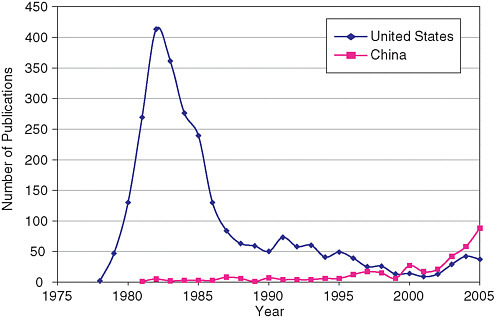
FIGURE 4.1 Publications related to gasification by United States and China for 1975-2005.
SOURCE: Data collected and presented by L. L. Baxter. Provided by L. L. Baxter, personal communication, 2006.
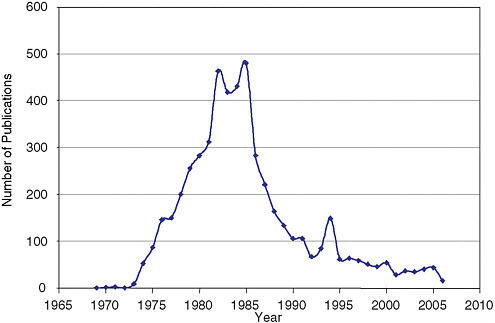
FIGURE 4.2 Trends in publications related to coal liquefaction for 1975 to 2006.
SOURCE: Data collected and presented by L. L. Baxter. Provided by L. L. Baxter, personal communication, 2006.
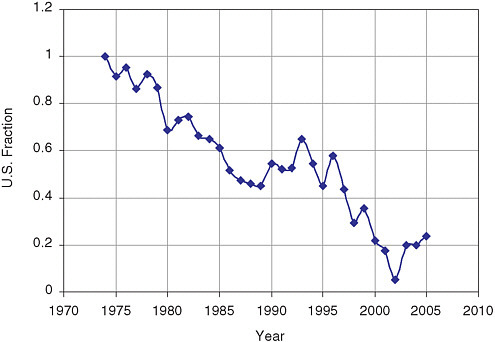
FIGURE 4.3 U.S. publications related to coal liquefaction as a fraction of total publications, 1974-2005.
Future Prospects. It can be reasonably anticipated that the oil price increases experienced during 2005-2006 will lead to a new resurgence in research on oil and gas, with improved exploration and recovery technologies for petroleum and natural gas, new technologies for coal gasification and liquefaction, and in situ recovery of oil from tar sands and shale. The difference in the activities this time will be greater international competition, particularly from Asia. The United States has a lead position in gasification technologies (GE-Texaco, Philips-Conoco, and Shell entrained flow gasifiers), with significant sales in China. Japan appears to be taking the lead in coal liquefaction, having operated a 150-ton/day pilot plant since 1992 and is aggressively pursuing opportunities in China. Competition from China will grow as China strives to transition from a manufacturing economy based on imported technologies to one based on domestic technologies. This is reflected by its investment in R&D and in their increasing rate of publication in the premier technical journals. Opportunities in which the United States has a major stake are the development of gasification, cleanup, and syngas utilization technologies that take advantage of developments in nanostructured materials. Carbon capture and sequestration could become
a major area of activity, but the prospects of its adoption on a large scale are uncertain.
Panel’s Summary Assessment. The current U.S. position is at the “Forefront,” and in the future, the United States will be “Gaining or Extending” its relative position.
4.7.b
Fossil Fuel Utilization
Fossil energy, used mainly in combustion devices, is the main provider of electricity, heating and cooling, motive power, and electricity in the United States. Nonenergy uses of fossil reserves for chemical production (e.g., coke from coal; petrochemicals, hydrogen, fertilizers from petroleum and natural gas) are relatively small. For combustion applications, the technical challenges are to achieve efficient, clean, and safe utilization for stationary sources. For motive sources additional challenges are ignition, flame stability, and flame blowout. The driving force for technology development continues to be tighter standards on emission of NOx, SOx, and particulate matter, using both combustion process modification and/ or exhaust treatment. In propulsion systems challenges are in design and control of the new generation of engines, such as homogeneous charge compression ignition (HCCI) or scramjets, the latter requiring the ignition, stabilization, and completion of combustion at supersonic speeds. These processes are governed by turbulent reaction flows, an intersection of chemical kinetics and transport processes, made more difficult by short time constants and proximity to discontinuity in fuel conversion in time or space. Fossil energy utilization faces its greatest challenge with the rise of concern about global warming. The consequences of global warming are uncertain and more so are the consequences of the proposed mitigation strategies. If proposals to stabilize CO2 emissions are implemented, they will require major developments of new fuel conversion technologies. Combustion and CO2 mitigation technologies clearly draw on the core competencies of chemical engineers. Other disciplines actively involved are chemistry, materials science, and mechanical and aeronautical engineering.
U.S. Position. Sessions in the Virtual World Congress were organized on combustion science, technology, and policy; emissions from both automotive and stationary sources; clean and efficient power generation; micro and solid oxide fuel cells; ion transport membranes; carbon oxidation and gasification; and oxy-fuel combustion. Of the eight experts, five (62.5%) were from the United States. However, 55% of the nominated speakers were from the United States. The nominations to the Virtual World Congress from the three non-U.S. experts included only 41% of U.S.-based
nominations; a measure of regional bias, as was seen in other subareas. Disciplinary affiliation was not always reported, particularly for industrial speakers. Chemical engineers represented 56% of the nominated participants. Interestingly, one expert inserted a policy dimension to the energy field—most appropriate at a time when many issues such as global climate and nuclear energy have clear social and political dimensions, and when the Secretary of Energy is a chemical engineer.
Analysis of the relevant journals on combustion and energy showed a decline in U.S. contributions to Progress in Energy and Combustion Science, a highly cited U.S.-based invited-review journal, from 100% in 1997 to 25% in 2005. Contributions from the United States to the major combustion journals showed no clear temporal trends and averaged 53% for the past two issues (previous issues were not abstracted by the American Chemical Society) of the Proceedings of the Combustion Institute, the premier publication for combustion science, 48% for Combustion and Flame, and 37% for Combustion, Science and Technology.
Relative Strengths and Weaknesses. As evidenced by representation in the Virtual World Congress and in publications on energy and combustion, the United States has maintained a strong position in the combustion field. Additional measures of the quality of the U.S. research in combustion is the receipt by U.S. researchers of 29 of the 59 gold medals awarded by the Combustion Institute from 1958 (date of first awards) to the present. However, the United States has not maintained as strong a position in technological contributions. In a growing number of areas leadership has moved to the European Union and Japan. In the area of automotive engines, Japanese and European Union firms have taken the lead in the development of the hybrid-electric gasoline engine and common rail direct injection engine for diesels. For stationary combustion Japan is taking the lead in the introduction of high-efficiency electricity generation plants, using ultra-supercritical boilers. China, the European Union, and Japan are providing strong competition for leadership in fluidized bed technology. U.S. weakness in translating strengths in fundamental combustion science to applications is partly due to the perception that combustion and energy are mature technologies and that there is little need for applied research. The exception is in gas turbines and the development of the next generation of propulsion systems, where the applied efforts have been sustained by the interest of National Aeronautics and Space Administration and the Department of Defense. Although the United States has maintained a position among world leaders in clean combustion technologies, it has fallen behind in technologies for increasing the efficiency of energy utilization for both stationary and mobile applications.
Future Prospects. One can anticipate major transformations in energy utilization technologies in the next decades with drivers being the needs for increased efficiency and decreased emissions. Action on global climate change and any penalties imposed on carbon emissions will have the greatest impact. The leading contenders for mitigating carbon emissions from coal-fired utility boilers, one of the major sources of carbon emission, are in the near term (by 2050) integrated gasification combined cycle (IGCC) with water gas-shift and oxyfuel combustion. The United States is taking the lead for the former and the European Union, Japan, and Australia the latter. Development of these technologies will require major inputs from the engineering community with chemical engineers being particularly in demand for the gasification route. Future developments, such as the increase in conversion efficiency of fossil fuels to electrical energy using solid-oxide and proton-exchange-membrane fuel cells, chemical looping, advanced cyclic CO2 absorption or desorption schemes, and the next generation of oxyfuel plants with oxygen transport membranes, also provide great opportunities for the engineer, particularly the chemical engineer. The development of gas turbines and fuel cells running on hydrogen and chemical and fuel synthesis from syngas will be important components of proposed polygeneration plants. The need to accelerate the translation to markets of technical innovations will be facilitated by advances in predictive science—at a molecular level for chemical rate constants, at a component level for engines and furnaces, and at a system level. Validation and verification will be important to the acceptance of simulations, which in turn will depend upon the advances in diagnostics and instrumentations using lasers and high-energy beams.
Panel’s Summary Assessment. The current U.S. position is “Among World Leaders,” and in the future, the United States will be “Maintaining” this relative position.
4.7.c
Non-Fossil Energy
No one source can replace the gap resulting from diminishing fossil fuel supplies. The contenders are nuclear, which will require inputs from chemical engineering for fuel reprocessing; biomass, used in combustors, gasifiers, and as a source of biodiesels; geothermal; photovoltaics; and wind. Sources such as wind and solar are intermittent and require energy storage media such as batteries. Another problem is that of developing a high-energy density transportable fuel to replace fossil fuel derived liquids; hydrogen is being seriously considered for this purpose in the United States. The areas best aligned with chemical engineering skills are developing improved biomass transformation products as alternatives to fossil energy; improving the
energy density and life cycle of batteries; and developing hydrogen separation technologies. Contributions by chemical engineers to other areas are in support of complementary disciplines: geologists for geothermal; a range of disciplines for photovoltaics, including chemistry, physics, and materials science; and mechanical, aeronautical, and materials scientists for wind.
U.S. Position. The range of technologies is broad, and the selection of the following topics for the Virtual World Congress is far from complete: biomass direct utilization; biomass gasification; biofuels and biomass-derived green chemicals; geothermal energy; electrochemistry (batteries); adsorption-enhanced hydrogen production. U.S.-based speakers constituted 48% of the total nominations for the Virtual World Congress. However, the recommendations of the non-U.S. experts (two out of six) included only 25% U.S.-based participants. Chemical engineers constituted 40% of the speakers over all, with a higher percentage of 50% for the biomass-related areas. The session on hydrogen separation was dominated by chemical engineers, whereas geothermal was dominated by petroleum engineers and batteries by chemists and material scientists.
Analysis of a small number of specialized publications showed that the U.S. contribution to Biomass and Bioenergy was variable and averaged 21% of the total. It was exceeded only by European Union contributions. Contributions to Solar Energy and Solar Materials averaged 11% and Wind Energy 15%. Chemical engineers contributed more than their peer groups (chemistry, biomedical engineering, biology, and materials science) to Biomass and Bioenergy. The sessions for the Virtual World Congress were limited, and the samplings of journals was too small to draw any firm conclusions, but they support the perception that chemical engineers are aligned best with biomass utilization, both direct and after conversion to syngas, green chemicals, and biodiesel.
Relative Strengths and Weaknesses. The United States has strong programs in biomass utilization but is competing with the European Union, Canada, and countries in tropical zones that have high yields of bioenergy crops, such as Brazil, where ethanol from sugar cane supplies 40% of the fuel that would be needed to run the transportation fleet on gasoline alone. The increased gas prices have contributed to the growth of interest in gasification of biomass including black liquor, paralleling the increase in interest in coal gasification. The United States will continue to face strong competition from Canada and the European Union in the biomass area. The growth in utilization in the European Union is driven in part by the financial incentives provided by carbon penalties. The issue on how well the United States will be able to maintain a strong position is driven to a large extent by political considerations.
Future Prospects. Renewable energy is an essential component of both sustainability and a partial solution to global warming (partial because it is unlikely that biomass can replace more than about 20% of fossil fuel consumption). However, much of the renewable energy (hydropower, tidal power, solar energy, wind energy, and biomass) depends on solar insolation, which is diffuse. Biomass utilization in its various forms shows the potential for rapid growth with active participation of chemical engineers. Progress has been made in the direct utilization of biomass usually co-fired with coal, production of biodiesel by the transesterification of rapeseed oil and yellow grease, and the production of ethanol from sugar cane and corn. The challenge for the future is to effectively use all of the ingredients of biomass in a forest or from crops to produce a variety of green chemicals in addition to heat and power, in what has been named a biorefinery in analogy to a petroleum refinery. The lead efforts on biorefineries are in the United States, Canada, and the Nordic countries. Chemical engineers are expected to play a major role in the development of the biorefinery and materials for multijunction photovoltaic cells. One example is the development of improved catalysts for chemical and biochemical conversion of lignin-cellulose biomass to fuels. Chemical engineering will play an important, but lesser, role in the development of other sources of renewable energy. The largest challenge with abundant room for leadership is advocating and genuinely supporting a plan that will decrease the dependence on fossil fuels, probably including the use of nuclear, taking full account of the problems related to emissions and waste disposal.
Panel’s Summary Assessment. The current U.S. position is “Among World Leaders,” and in the future, the United States will be “Maintaining” this relative position.
4.8
AREA-8: ENVIRONMENTAL IMPACT AND MANAGEMENT
Environmental impact and management is an interdisciplinary field to which chemical engineers make critical contributions. In addition to the traditional areas of water and air pollution, new challenges now include concerns about global climate change and of pollution prevention or green engineering. The United States maintains a healthy leadership position in the environmental field, with a strong and growing program even though the percentage of the total contributions is decreasing due to higher growth rates in Europe and Asia. Over the period 1997-2005, U.S. authors contributed 53% to 65% of the articles to the leading U.S. environmental journals: Environmental Science and Technology and the Journal of Air and Water Management. The U.S. contribution to Chemosphere, a journal based in Europe, was only 13% showing the preference of authors to publish in their
regional journals. The number of publications in Environmental Science and Technology from the United States and the European Union increased from 355 to 688 and from 143 to 508, respectively. China and India showed very high rates of growth, with the annual contributions by China increasing from 2 to 81 over the 5-year period. On average, chemical engineers contributed 5.8% of the papers in Environmental Science and Technology, the most cited of the environmental journals, exceeded only by chemists (10%) and biologists (7.4%). Chemical engineers, however, have taken the lead in selected areas, such as modeling the fate and transport of pollutants, aerosol science and technology, and controlling pollutants at their source. The four subareas covered in the Virtual World Congress are:
-
air pollution
-
water pollution
-
aerosol science and engineering
-
green engineering
4.8.a
Air Pollution
Air pollution deals with sources of air pollutants, their transport and transformation in the atmosphere, and their impact on health, the natural environment, and materials. On a decreasing spatial scale air pollution is concerned with global climate (due to the depletion of stratospheric ozone and global warming); emissions of the criteria air pollutants (ozone, particulate matter, nitrogen dioxide, sulfur dioxide, and lead); and the 188 hazardous (toxic) air pollutants emitted during manufacture and use of industrial chemicals. Chemical engineers contribute to the management of air pollution problems by
-
controlling the production of pollutants through process changes and development of technologies for the separation or destruction of the pollutants;
-
modeling the fate and transport of the pollutants, particularly the formation of undesirable by-products such as ozone and organic particulate, and utilizing the models to guide control strategies; and
-
supporting toxicologists in providing pharmacokinetic models for the distribution of chemicals in vivo, materials scientists on the effect of chemicals on building materials and products, ecologists in understanding and minimizing the impacts of chemicals (e.g., acid rain) on crops and ecosystems, and archeologists in restoring historic artifacts and buildings.
U.S. Position. Seven experts, six from the United States, organized sessions on scrubbers, catalytic processes, and pressure and temperature swing absorption for control of emissions; environmental monitoring and modeling of urban, regional, and global air pollution; and the formation and health impact of fine particles.
-
The Virtual World Congress speakers from air pollution control technologies were nearly exclusively chemical engineers, with the possible exception of speakers from industry whose educational background was unknown. The national affiliation of speakers was 46% United States, 26% European Union, and 18% Asia.
-
The Virtual World Congress speakers from environmental monitoring and the modeling of urban, regional, and global air pollution were drawn from a variety of disciplines, with major contributions from atmospheric chemistry, atmospheric science, and civil and environmental engineering. U.S. participants, however, were dominant, representing 74% of the total, with European Union speakers representing most of the balance.
-
In the area of the health effects of pollutants, chemical engineers provide a key supporting role to toxicologists in identifying the complex mixture of chemicals and aerosols that are characteristic of toxic air pollutants. U.S. speakers constituted 63% of the total, with the balance being primarily from the European Union. Chemical engineers constituted more than a third of the speakers with the balance drawn from a wide range of disciplines, including mechanical engineering, public health, chemistry, and physics.
The publications of interest vary widely: AIChE Journal, I&EC Research, and Environmental Science and Technology for control technologies; Environmental Science and Technology, Atmospheric Environment, Journal of Air and Water Management, Atmospheric Chemistry and Physics, Journal of Geophysical Research for transport and fate; Health Effects Perspectives for health effects. U.S. contributions to air pollution control is covered in the chemical engineering journals reviewed elsewhere, which show a strong and growing number of publications by U.S. researchers, but a declining percentage of the total because of greater growth rates in the European Union and Asia. Contributions to the specialized air pollution journals, Journal of Atmospheric Sciences, Journal of Geophysical Research, and those relating to the health impact of air pollution, generally show a greater than 50% contribution by U.S. authors, but no major trends with time. Journals such as Atmospheric Chemistry and Physics, based in Europe, showed a smaller U.S. contribution of about 25%.
Relative Strengths and Weaknesses. The number of publications in air pollution has been increasing, with the United States maintaining a strong leadership position. However, the aggregate statistics can be misleading. There are two technological drivers for air pollution studies. The first is the establishment of the causal relationships between anthropogenic emissions and adverse health that lead to the establishment of regulations on emissions. The second is the development of the technologies to bring industry into compliance with the regulations. U.S. chemical engineers contributed to the interdisciplinary studies that led to the understanding of the causal relationship between emissions of sulfur oxides and particles and increased morbidity and mortality; the contributions of SO2 and NO2 emissions to acid rain; and photochemical transformation of hydrocarbons and nitrogen oxides into photochemical smog and ozone. In response, the United States took the lead in the establishment of the standards with the promulgation of the Clean Air Act of 1970. Once standards were established, U.S. chemical engineers took the lead in the development of a series of technologies for SO2 control, NOx control, and simultaneous control of NOx and hydrocarbons from automotive sources. They have also taken a lead in the development of the models used to set up state implementation plans for controlling the emissions of hydrocarbons and nitrogen oxides to meet ozone standards at the urban and regional levels. The success of the emission reduction program is reflected in the decrease over the 30-year period 1970 to 2002 in the aggregate emissions of the six principal pollutants by 48%, despite increases in population of 38%, energy consumption of 42%, vehicle miles traveled of 155%, and gross domestic product of 164%. The United States is among the world leaders in flue gas desulfurization, catalytic processes for pollution abatement, and mercury control technologies. However, as the European Union and Japan have adopted more stringent emission standards, they have taken the technological lead in selected technologies, e.g., selective catalytic reduction (SCR) of NOx.
The United States developed SCR, but it was commercialized in Japan and Europe; the United States is now importing SCR technologies to meet stringent regional emission regulations prompted by failure to meet local ozone standards. The European Union is taking the lead in waste treatment technologies motivated by the Landfill Directive of the European Union. The United States is falling behind in the implementation and realization into commercial practice of new pollutant control ideas. An exception is the lead being taken by the United States in regulating the emissions of new pollutants, e.g., mercury with the promulgation of the Clean Air Mercury Rule (CAMR; March 2005). As a consequence, research and publications on mercury control technologies are rapidly increasing in volume with the United States in a strong lead position.
Future Prospects. With increased population densities and per capita consumptions, there will be continued tightening of emission limits of regulated pollutants in the United States. More stringent controls of SOx and NOx emissions will be required as part of the Clean Air Interstate Rules promulgated in March 2005. The very low NOx emission requirements in ozone nonattainment areas such as Houston have provided constraints on industrial operations as well as an impetus for development of a new generation of low-NOx burners. One can also anticipate regulation on carbon emissions that will require major research activities to develop and implement mitigation strategies. The challenges also provide opportunities for export of technologies and consulting services to the emerging economies that often set up standards modeled on those adopted by the United States.
The greatest challenge, however, will come from any adoption of regulations for carbon emissions. The problem is of such magnitude that it will require the adoption of multiple strategies, including conservation, renewable energy, increased nuclear, carbon capture and sequestration, and multiple disciplines. The impact of global warming on urban and regional air pollution will require the active involvement of air pollution modeling and chemical engineers.
Panel’s Summary Assessment. The current U.S. position is “Among World Leaders,” and in the future, the United States will be “Maintaining” this relative position.
4.8.b
Water Pollution
The subarea of water pollution in the United States is covered mainly by the civil and environmental engineers. The areas in which chemical engineers provide critical leadership are
-
development of water purification technologies for multiple purposes, notably drinking, irrigation, and for specialty industries such as microelectronics that have very stringent standards. Technologies for water purification draw on traditional chemical engineering process development and implementation. Chemical engineers also contribute to the biotreatment of wastes together with civil, environmental, and bioengineers.
-
assessment of the problems associated with the release of toxic chemicals into the natural environment and prediction and/or mitigation of exposure by humans or ecosystems. The need for these assessments is both prospective, in premarket screening of chemicals, and retrospective, in dealing with the adverse consequences of chemicals released into the environment. The fate of chemicals in the natural environment involves the multi-media partitioning of chemicals, transport through porous media,
-
and occasionally two-phase flows. The assessment of the impact of chemicals in the environment is multidisciplinary, involving civil, environmental, and bioengineers, geophysicists, chemists, and toxicologists.
U.S. Position. Seven experts, all from the United States, organized sessions in the areas related to water purification (water purification, water quality management and control, water separation and desalination) and the fate and transport of pollutants (chemodynamics, environmental chemistry, environmental fate of organic chemicals, control of hazardous substances).
-
The speakers in the water purification area were predominantly (91%) from the United States. Chemical engineers represented 58% of academic speakers and environmental engineers represented an additional 33%.
-
The majority (78%) of speakers in the area of fate and transport of pollutants were from the United States, with the balance from the European Union (15%) and Canada (6%). The speakers in the fate and transport area were mostly (56%) associated with an environmental department, often joint with civil engineering and/or geography; chemical engineers represented 20% of the total.
Contributions to technologies for water purification are expected to be distributed among journals dealing with separation processes, covered elsewhere in this report, with indications of a strong U.S. position. Many of the articles on the fate and transport of contaminants are published in Environmental Science and Technology, the Journal of Air and Water Management, and Chemosphere, discussed at the beginning of this section. Publications specializing in water treatment show that the publication rate was fairly constant over the period 1997 to 2005 for the Journal of Contaminant Hydrology, Ground Water, Water Science and Technology, and Water Resources Research, as were the U.S. contributions. The United States had the largest contribution to the Journal of Contaminant Hydrology (50%), Ground Water (70%), and Water Resources Research (64%). However, the United States contributed only 11% of the papers in Water Science and Technology, an international journal with offices in London. The European Union had the largest contribution to Water Science and Technology (52%) and the second largest to the other journals.
Relative Strengths and Weaknesses. Water pollution problems probably influence the chemical engineer most in terms of the regulations pertaining to the development and use of chemicals. U.S. researchers, many of them chemical engineers, have led the development of models for predicting the risks from chemical releases due to production, processing, usage, and dis-
posal, using structure-activity relationships to extrapolate the risks to new chemicals. The models provide the scientific base for the implementation of the Toxic Substances Control Act of 1972. Similarly, chemical engineers were involved in the assessment of transport of chemicals in ground waters, essential to the characterization of hazards of waste disposal sites, responsive to the enactment of the Comprehensive Environmental Response, Compensation, and Liability Act (CERCLA or Superfund) of 1980, and active in the development of technologies for the remediation of these sites. The weakness, if any, is that students do not appreciate the applicability of a classical chemical engineering education to environmental problems and that, although the fate and transport of chemicals are one of the constraints on the development of new chemicals, chemical engineers will play a diminishing role in addressing the development of new and more effective tools to deal with these problems.
Future Prospects. Exciting opportunities exist for chemical engineers in both the development of water purification technologies and in reducing the risk from chemicals released into the environment. The United States is facing increasing water shortages in the West and Southwest. New water purification technologies have a role to play in the treatment of water for both U.S. municipalities and for undeveloped countries, for which water pollution problems constitute the major source of disease and water availability a major hurdle to development. New technologies in combinatorial testing and microsensors and the molecular understanding of toxicology open up opportunities for development of less hazardous chemicals and more effective ways to reduce the risk from the release of chemicals in the environment. Chemical engineers can continue to play an important role in combination with chemists, toxicologists, and environmental scientists in reducing the time and cost of bringing new chemicals to market and the risk once they are introduced.
Panel’s Summary Assessment. The current U.S. position is “Among World Leaders,” and in the future, the United States will be “Maintaining” its relative position.
4.8.c
Aerosol Science and Engineering
The aerosol community is diverse with wide-ranging interests related to health (the assessment of the hazards of inhaling fine particles as well as the use of aerosols for inhalation therapy); environmental impact of aerosols on human exposure, visibility, and climatic change; and the synthesis of aerosols for use in a wide range of products including pigments, planarization agents for microelectronics, composite materials, and others. Chemical
engineers have played a key role in the characterization of aerosols, modeling the formation and evolution of size and shape, and incorporating these models into general formulations that describe environmental impact at the local, urban, regional, and global level. Chemical engineers interface with researchers from a wide range of disciplines including physicists, chemists, toxicologists, atmospheric scientists, and all branches of engineering. Chemical engineers have taken the lead in bringing the diverse communities together in founding the American Association of Aerosol Research (AAAR).
U.S. Position. The experts for the Virtual World Congress focused on two areas with the following results:
-
The formation of atmospheric aerosols and environmental consequences. In this area the United States contributed 70% percent of the speakers, the European Union contributed 25%. The affiliations of the speakers varied widely, with the largest numbers being chemical engineers, chemists, and environmental/aerosol scientists, each with about 30% of the total. Aerosol synthesis of nanostructured materials. U.S. speakers at this Virtual World Congress represented 52% of the total, with participants from the European Union and Japan comprising most of the remainder with contributions of 31% and 26%, respectively. Again the speakers represented many disciplines with chemical engineers contributing 27% of the total, chemists 19%, physicists 14%, and other engineering disciplines and materials science 31%.
The publication rate in the journals dedicated to aerosols—Aerosol Science and Technology and the Journal of Aerosol Science—show a moderate increase during the period 1997 to 2005. U.S. authors contributed 66% of the papers in Aerosol Science and Technology (associated with the American Association of Aerosol Research) with no clear trend over time.
The second largest contribution was from the European Union; the contribution from Asia was small. By contrast the contributions of U.S. authors in the Journal of Aerosol Science (associated with the European Aerosol Assembly) averaged 34%, and were exceeded by those of European Union authors for all years excepting 2005. The percentage of papers attributed to chemical engineers, although small (<20%), exceeded those by chemists, biomolecular engineers, biologists, and materials scientists. The Journal of Colloid and Interface Science, Journal of Nanoparticle Research, and Powder Technology, even though not dedicated to aerosol research, were also surveyed because of their inclusion of many papers on aerosols. The U.S. contributions to these journals were 37% for the Journal of Nanoparticle Research with no trend for the brief period (2003-2005)
surveyed; 23% for Powder Technology; and 21% for the Journal of Colloid and Interface Science. For the latter two journals the number of articles contributed by U.S. authors increased over the period surveyed, but the U.S. percentage decreased because of greater growth rates from the European Union and China. The increase in the rate of publication by Chinese authors in the Journal of Colloid and Interface Science from 30 in 1997 to 153 in 2005 is notable (U.S. numbers for these dates are 159 and 181).
Relative Strengths and Weaknesses. The United States is a world leader in aerosol science and technology. Many—probably most—government agencies and major labs have aerosol programs including the Environmental Protection Agency, Department of Defense, Department of Energy, National Aeronautics and Space Administration, National Institute for Occupational Safety and Health, Nuclear Regulatory Commission, National Institute of Standards and Technology, and National Center for Atmospheric Research. Many deal with “bad” (that is, undesired unintentionally produced aerosols with undesirable effects on the environment and public health). However, there are few formal cooperative efforts among these organizations. Many industries have major aerosol-based commercial activities, for example Cabot, DuPont, Dow, Corning, in addition to many start-ups that manufacture nanoparticles by aerosol processes.
Significant contributions have been made to defining the major uncertainty in the role of the atmospheric aerosol in climate change, the development of aerosol reaction engineering as a major design methodology for companies such as Cabot, DuPont, Degussa, Corning, ATT/Lucent, and major breakthroughs in aerosol instrumentation largely driven by academic researchers now marketed commercially (e.g., online differential mobility analyzers for particle size distribution measurements, online single particle aerosol chemical analysis by mass spectrometry, and an aerosol aerodynamic lens TSI).
This subarea of aerosol science and technology shows a healthy growth with continuing challenges in the environmental field and new challenges from threats of global warming and bioterrorism. The growth of industrial applications for nanostructured materials has provided opportunities for the synthesis of novel materials and new manufacturing techniques. The U.S. programs are strong and growing, with the United States contributing a greater number of publications to the lead journals in the area. The highest honor in aerosol research, the Fuchs Memorial Award, jointly administered by German, Japanese, and U.S. institutions and given every 4 years, was awarded to U.S. chemical engineers in 1990 and 1998, was shared by a U.S. mechanical engineer in 1994, and was jointly awarded to a U.S. chemical engineer and a U.S. mechanical engineer in 2006. Other awardees for 1994 and 2002 were from Austria, Japan, and Russia. The United States is facing
increasing competition from the European Union and Japan in all aspects of aerosol research and technology, and it is anticipated that China will soon become a serious competitor, judging from the growth in the number of Chinese publications in the Journal of Colloid and Interface Science. The area of aerosol science and technology is highly interdisciplinary. Chemical engineers have traditionally produced the leaders in the field. It is hoped that this tradition can be maintained by highlighting the opportunities in the field to future generations of students and young faculty.
Future Prospects. The future of aerosol science and technology is bright, with opportunities arising in both the environmental and materials synthesis areas. Currently regulations on the health effects of fine particles are based on correlations from epidemiological studies between the mortality and morbidity and the mass concentration of particles smaller than 2.5 microns in diameter (called fine particles). Regulations have been promulgated that control the ambient concentration of particles under 2.5 microns in size, in the absence of evidence of the composition and the actual sizes of particles responsible for the observed health effects. The United States has taken the lead in establishing the importance of fine particles on health and is taking the lead in the characterization, both theoretically and experimentally, of smaller particles, including nanoparticles (1 to 100 nanometers) that many believe to be of primary concern. Similar challenges are present in characterizing the role of particles on global climate. Nonabsorbing particles, primarily sulfates and nitrates formed in the atmosphere from the emissions of nitrogen and sulfur oxides, have a negative radiative forcing tending to a cooling of the surface temperatures whereas carbonaceous particles (mainly soot) are responsible for a positive radiative forcing. The magnitude of the forcing functions are dependent on the size of the particles, the details of their composition (for mixtures of soot and condensate, whether homogeneous, coated, or mixed), and their distribution with height and altitude. These are challenges that draw on many disciplines, with chemical engineers playing a major role. The skills needed to address the formation and characterization of the complex environmental particles are the same as those required to synthesize nanoparticles of given size, shape, and composition, and many of the chemical engineers studying environmental aerosols also contribute to their synthesis. As the area of aerosol, science, and technology grows, the question is raised as to whether it will remain an interdisciplinary field or establish its own discipline. U.S. researchers are active in the area and will continue to play a major role with major competition coming from the European Union (in the area of environmental aerosols) and Asia (Japan, in nanostructured materials).
Panel’s Summary Assessment. The current U.S. position is at the “Forefront,” and in the future, the United States will be “Maintaining” its relative position.
4.8.d
Green Engineering
The cost to society for containing and eliminating the unintended consequences of chemical production can be greatly reduced by careful design of processes and products with a life-cycle analysis of their environmental, safety, and health effects. Examples of products that resulted in major societal and economic benefits when introduced, only to later have enormous health and environmental costs are DDT, freon, and tetraethyl lead. Such widely publicized problems have led to the recognition of the need for products that are environmentally acceptable. Additional major costs to society have resulted from the improper disposal of hazardous chemicals. The costs of the cleanup of contaminated sites over a 50-year period are projected to be $1 trillion dollars. Green engineering is the design of products and processes that will use natural resources and energy efficiently, and minimize harmful by-products and risk over the life cycle of the product. This clearly involves all disciplines, but especially the chemist, chemical engineer, environmental engineer, and toxicologist. The implementation of properly selected chemical reactions into product and process design with a life-cycle analysis to ensure that they meet environmental and health concerns involves other disciplines with chemical engineers playing a major role. “Development that meets the needs of the present without compromising the ability of future generations to meet their own needs,” as sustainability is defined in the 1987 Brundlandt Report, is the goal. Translation of that goal into achievable engineering objectives is the challenge.
U.S. Position. Themes selected for the Virtual World Congress were sustainability, product engineering, technologies for a sustainable environment, and industrial ecology and life-cycle management. The United States contributed the majority (62%) of the speakers to the Virtual World Congress, with the European Union contributing most (34%) of the balance. Chemical engineers contributed a large majority (90%) of the speakers to process and product development, but their contribution dropped to 55% for the areas of life-cycle analysis and sustainability.
The publications for process and product development are in the mainstream chemical engineering journals and have been analyzed elsewhere in this report. The United States maintains a strong publication record in these journals, since green engineering cannot be easily viewed apart from broader chemical engineering activities. Publications in the Journal of Environmental Engineering are more focused on green engineering; contribu-
tions by U.S. authors represented 61% of the total; and contributions by chemical engineers exceeded those by the other peer disciplines. Designing green products requires a quantification of risk. The United States, with its preeminence in bioengineering and the complementary tools for risk assessment, is in a strong position here. U.S. authors contributed the largest percentage of the papers in Environmental Toxicology and Chemistry, although the percent contribution declined from 60% in 1997 to 44% in 2005, a consequence of significant increases in contributions from the European Union and Asia. The areas of the life-cycle analysis and industrial ecology are more broadly based with strong economic and sociological components. Publication rates are growing with more specialized journals being established in the past decade: International Journal of Life Cycle Analysis (1996), Journal of Industrial Ecology (1997), Green Chemistry (1999), and Clean Technologies and Environmental Policies (2002). The U.S. contributions to these journals are strong, but the European Union presence is dominant in those journals sponsored by European organizations. The United States is poorly represented in the 10 most-cited papers in Green Chemistry and the International Journal of Life Cycle Analysis. The chemical engineering contributions to life-cycle analysis and industrial ecology is smaller than those to product and process development, given the multifaceted dimensions of these disciplines.
Relative Strengths and Weaknesses. It takes well-publicized incidents such as DDT and Love Canal to energize public interest in environmental problems. The response to these problems has resulted in major reductions in the releases of persistent bioaccumulative toxins (PBTs), and major progress has been made in the cleanup of hazardous waste sites. The cost to society of these problems, both environmental and economic, have motivated the move to green chemistry and sustainability, not so much driven by the public but by the Environmental Protection Agency and industry. The Virtual World Congress and publications show a strong U.S. leadership in these areas, with competition coming mainly from the European Union, in part because of strong governmental and industry support for innovations in these areas. The United States has made significant contributions to the life-cycle assessment method of environmental impact accounting of products and processes, sustainability metrics, green chemistry themes and benign syntheses (e.g., supercritical CO2, ionic liquids, and microwave), various design tools for pollution prevention approaches, and significant advances in cleaner production practices in industry. It is among the world leaders in energy intensity reduction and the development of market-based methods for alternative energy development and pollution prevention (P2) tools and methods.
The evolution of the response from drivers based on command and
control (compliance based of reducing end of pipe emissions) to a more holistic sustainable development with constraints based on health, safety, and environmental (HS&E) considerations is directly related to the core skills of chemical engineers. The risk is that such skills as process development and design are threatened by the reduction of the corresponding research activities.
U.S. efforts have been supported by Environmental Protection Agency grants, programs complemented by the leadership of major chemical companies, which are showing that green chemistry and sustainable development are good business and are promoting such activities through the AIChE Centers for Waste Reduction Technology (CWRT) and Sustainable Technology Practices (CSTP). The commercial value of good environmental management has already been reflected in increased stock value for those corporations with superior management of environmental issues. While major progress has been made in reducing the environmental footprint of individual corporations, the establishment of the broader policy and economic framework that will lead to sustainable development is still in an evolutionary stage. Chemical engineers will be called to play a pivotal role, but the requisite skills are gradually deteriorating, thus threatening the success of the proposed enterprise.
Future Prospects. One of the major developments during the past 10 years has been the introduction of anticipatory approaches to pollution prevention through life-cycle analysis, product engineering, and new chemical synthesis routes. When coupled with improved life-cycle assessment methods of environmental impact accounting of products and processes, one has the essential framework for progress in this area. The integration of environmental impact assessment software into widely used process simulation, design, and optimization software offers the enabling tools. U.S. researchers have taken a healthy leadership position and have been involved in all of these efforts, but the European Union has taken a more decisive position.
One can expect a continued strong leadership position by U.S. researchers in the development of technologies for reducing the environmental footprint of chemicals in the environment through their life cycle, supported by the Environmental Protection Agency and industry. The challenge of sustainability will be more difficult to solve given its social, political, and economic dimensions, which need to be addressed worldwide. Of particular concern to the chemical engineer will be the availability of raw materials, which deplete over time, particularly natural gas and petroleum.
Of particular importance for the future are the following areas, which will require continuation or initiation of properly supported research efforts: Risk assessment of nanotech products; pollution prevention through nanotechnology; biotechnology as an enabling technology for green products
and processes; and life-cycle impact from the development of alternative energy sources.
Panel’s Summary Assessment. The current U.S. position is “Among World Leaders,” and in the future, the United States will be “Gaining or Extending” its relative position.
4.9
AREA-9: PROCESS SYSTEMS DEVELOPMENT AND ENGINEERING
This area has always formed a key component of the core of chemical engineering, being concerned with concepts, tools, and techniques for the design, development, and exploitation of process systems in the broadest sense. Traditionally, the focus of activities has been on the design and operation of manufacturing systems for chemical products (chemical plants) based on traditional manufacturing components (unit operations), but there has been increasing interest in the development and exploitation of products, as well as in the development of novel manufacturing concepts (e.g., process intensification, or micromanufacturing). As in all research involving methodological developments, the application of new techniques to challenging practical problems is a key part of research in this area.
Four distinct subareas of research activities make up the research scope of this area:
-
process development and design
-
dynamics, control, operational optimization
-
safety and operability of chemical plants
-
computational tools and information technology
The mainstream chemical engineering journals, AIChE Journal, I&EC Research, and to lesser extent, Chemical Engineering Science, Chemical Engineering Research and Design, and the Canadian Journal of Chemical Engineering, along with the area-specific journals, Computers and Chemical Engineering and the Journal of Process Control have been the primary depositories of research contributions by chemical engineers in this area worldwide. A series of other subarea-specific journals have attracted a smaller number of very influential publications by chemical engineers and will be discussed later in this section.
Analysis of publications in the first three journals indicates that the ratio of U.S.-papers per non-U.S. papers has been reduced by roughly 50% during the last 5 years, as a result of rapid growth in research activity and output, primarily in Asia.
Analysis of the publications in Computers and Chemical Engineering,
a popular journal in which to publish methodological contributions on theory, tools and techniques, and applications, is very instructive for the trends of chemical engineering research in process systems engineering in various geographic regions. Table 4.36 shows that while the number of U.S.-originated papers has grown by about 60% from the 1990-1995 to the 2000-2006 period, the relative percentage has remained roughly the same (37% in 1990-1994, 34% in 2000-2006). The corresponding percentage for European Union papers has been reduced, and Asian contributions have increased significantly (from 7% to 21%), a phenomenon which is completely in line with the rates of industrial investments in commodity plants observed in China and India during the past 10 years. Looking at the years 2003 to 2005, the total number of articles published in the journal (which obviously covers a broader field than only process design methodologies) grew from 129 in 2003 to 213 in 2005, a growth rate of 65%. U.S. contributions also grew from 51 to 71 (39% growth). The corresponding growth rates for Europe, China, and India were 81%, 114%, and 80%, respectively. For the latter two countries, the absolute numbers are currently small, but European contributions were of a similar scale to those from the United States in 2005, having been significantly lower in 2003 (see Table 4.37 below).
TABLE 4.36 Origin of Publications in Computers and Chemical Engineering
|
|
1990-1994 |
1995-1999 |
2000-2006 |
|||
|
% |
% |
% |
||||
|
Total No. of Papers |
679 |
|
1,338 |
|
1,218 |
|
|
United States |
254 |
37 |
364 |
27 |
413 |
34 |
|
EU |
238 |
35 |
421 |
31 |
319 |
26 |
|
Asia |
47 |
7 |
160 |
12 |
253 |
21 |
|
Canada |
19 |
3 |
35 |
3 |
68 |
6 |
|
S. America |
31 |
5 |
90 |
7 |
170 |
14 |
TABLE 4.37 Geographic Distribution of Origin of Papers Published in Computers and Chemical Engineering in Recent Years
|
|
United States |
EU |
China and India |
|
2003 |
51 |
36 |
12 |
|
2004 |
64 |
60 |
17 |
|
2005 |
71 |
65 |
24 |
In terms of quality and impact, the U.S.-originated papers held a very commanding lead in the list of the 30 most-cited papers for the three periods, 1990-1994, 1995-1999, and 2000-2006, as shown in Table 4.38. However, one should not overlook the fact that with increased levels of research activity, the overall quality improves. Indeed, in 1990-1994, Asian and South American countries had no representation in the list of the 30 most-cited papers. In the period 2000-2006 the number is seven.
4.9.a
Process Development and Design
Included in this subarea are methodologies, tools, and techniques to aid engineers in the synthesis, development, and design of new manufacturing systems (e.g., single plants, supply chains). Systematic and integrated handling of raw materials pretreatment, synthesis of reactor configurations, of separation trains, and of energy management systems is at the heart of rational process development. In addition, for batch processes the early integration of synthetic chemists and chemical engineers is essential for the early evaluation of alternative synthetic routes and the selection of the most promising processing schemes from an economic and environmental point of view. Rational strategies for process scale-up remain a subject of importance.
Research on novel manufacturing concepts (e.g., process intensification, miniaturization) also falls under this heading and involves skill sets brought forth by a variety of skilled chemical engineers. With the emphasis on molecular-level understanding that characterizes current trends in chemical engineering research, systematic approaches to process development are being explored for micro- and nanoscale processes.
U.S. Position. The number of experts in this subarea was 16, with 10 (63%) from the United States. Of the speakers, 57% of nominations were for U.S.-
TABLE 4.38 Distribution of the 30 Most-Cited Papers in Computers and Chemical Engineering
|
|
1990-1994 |
1995-1999 |
2000-2006 |
|
United States |
28 |
21 |
20 |
|
EU |
2 |
7 |
3 |
|
Asia |
0 |
0 |
3 |
|
Canada |
0 |
1 |
0 |
|
S. America |
0 |
0 |
4 |
based researchers when duplication of names was allowed and 59% when duplication was disallowed. These results indicate that the United States holds a leadership position in this subarea, although the strength of that position is not as pronounced as in other areas considered in this study.
Given the breadth of the subarea, and the fact that many contributions are published in “generalist,” mainstream chemical engineering journals (AIChE Journal, Chemical Engineering Science, and Industrial and Engineering Chemistry Research), it is difficult to draw reliable conclusions for this topic from an analysis of publications. A limited examination of publications in these three journals indicated that the number of U.S.-papers per non-U.S. paper has decreased by about 50%, in line with trends we have seen for these journals in other subareas.
Relative Strengths and Weaknesses. Within the broader scope of process systems engineering, U.S. chemical engineering research activities in process development and design took an early leadership position since the pioneering activities on process synthesis in the late 1960s to early 1970s. U.S. leadership strengthened with the entry of many young U.S. chemical engineering researchers into the field and the parallel deployment of their ideas into industrial practice. During the following 20 years process synthesis research was introduced in the undergraduate curricula of U.S. chemical engineering, and its reach encompassed most countries of the world. As a result of all these developments, U.S. academic and industrial activities in process synthesis led to a significant competitive advantage, especially in continuous processes, and the introduction to the market place of a series of computer-aided tools by software and engineering services companies (founded and managed by chemical engineers). Analogous activities for batch processes started in the early 1980s and have led to similar systematization of process development for the pharmaceutical and fine chemicals industries. Relevant computer-aided tools have also been developed and are being marketed, primarily by U.S.-based software and engineering services companies.
However, during the past 15 years we have witnessed a gradual deterioration in the funding and the level of research activities associated with process synthesis, for continuous and, to a lesser extent, for batch processes. A number of research laboratories and centers have closed or have reduced the level of their research activity significantly. The primary reason has been the shift in the strategic plans of major commodity chemical companies, and the collateral effect on federal funding supporting such activities. Consequently, although a number of people with high skills in process synthesis and design are presently working in U.S. chemical companies, the number of new graduates with research experience in this area has dropped dramatically. While no one expects that chemical companies
will start building new petrochemical plants in the United States, process synthesis and design are essential skills for the development of new generations of petrochemical plants, built by U.S. companies in Asia and the Middle East; cellulose-based ethanol plants; multipurpose batch plants for the pharmaceutical and fine chemicals industries; and plants for the manufacturing of a broad variety of functional materials. All of these areas are arguably of significant interest to U.S. chemical companies for the needs of the U.S. economy. However, the skilled human resources who would enable such a resurgence may not be available if the level of research activities in process synthesis and design continues to drop.
Future Prospects. Some of the most significant advances in process development and design during the past 10 years are the following: industrial implementation of systematic process synthesis methodologies and algorithmic procedures for continuous and batch plants; widespread implementation of residual curve maps for the design of distillation separations; engineering of integrated process networks (e.g., reaction, energy, mass, and water); process intensification (e.g., microplants, modular plants); and integrated process design and control. U.S. researchers have been leading contributors in all of these developments. Europe is very strong, while Asian contributions have dealt primarily with specific applications.
In the near future, research is expected to focus on processes with lower levels of energy consumption, high-throughput synthesis of pharmaceuticals and fine chemicals with parallel consideration of process development, process intensification (e.g., plants on a chip), green production routes with parallel process development, and design of novel hybrid unit operations integrating reactions and separations.
One of the most interesting developments during the past 10 years is the emergence of systematic product design as a subject of chemical engineering research. Given the current trends of an increasingly productcentric chemical industry, this interest will continue and will become more closely integrated with the design of the process on which the manufacturing of the product is based.
U.S. researchers are well positioned to address these needs, provided that sufficient support becomes available.
Panel’s Summary Assessment. The current U.S. position is “Among World Leaders,” and although in the future this position is expected to weaken, due to uncertainties in funding, the United States will remain “Among World Leaders.”
4.9.b
Dynamics, Control, and Operational Optimization
This subarea is concerned with research in support of achieving operational excellence and covers process control; optimization of various aspects of operational performance (online optimization of steady-state and transitional operations, including startup and shutdown, performance for continuously operated plants, trajectory optimization for batch plants); and scheduling and supply-chain management. Monitoring and control of polymer processes, microelectronic fabrication, biological processes, microchemical processes, electrochemical processes, as well as planning, scheduling, and supply-chain management and dynamic simulation and optimization, are a few of the current research interests in chemical engineering for this subarea. The underlying numerical methodologies and computer-aided tools of analysis and design for control systems, optimization of large-scale integrated plants and/or supply chains of plants, and simulation of nonlinear steady-state or dynamic processes are within the scope of several disciplines (e.g., for control, electrical, mechanical, and aerospace engineering; for optimization, operations research; for dynamic simulation, applied math). However, chemical engineers have been the unique enablers of the application of these methods and tools in the chemical industry at large, and have led several breakthrough developments, notably the introduction of advanced model-based control in chemical processes and methods for global mixed-integer optimization. Furthermore, theoretical and methodological contributions from chemical engineers in, for example, control and optimization, have had broad impact in other disciplines.
U.S. Position. U.S. representation among the experts for this subarea was 8 from 12, i.e., 67%. Out of 212 total nominations, 122 were for U.S.-based speakers (58%). These results indicate a leadership position in this subarea for the United States.
AIChE Journal, I&EC Research, and Computers and Chemical Engineering have attracted a sizeable fraction of process control and optimization papers by chemical engineers worldwide. A close analysis of these papers indicates that the contributions in control and optimization follow similar lines as those described above for all publications in these journals. The Journal of Process Control is a popular medium of control-related publications by chemical engineers. Table 4.39 shows a comparison of publication rates from the 1995-1999 and 2000-2006 periods by different geographical regions. The figures indicate a marginal, though possibly insignificant, decline in the U.S. share of contributions between the two 5-year periods, with strong growth (in share and numbers) from the European Union and Canada. Data for the past 5 years (see Table 4.40) indicate a stronger decline in the percentage of U.S.-originated publications.
TABLE 4.39 Geographic Distribution of the Origin of Papers Published in Journal of Process Control
|
|
1995-1999 |
2000-2006 |
||
|
% |
% |
|||
|
Total No. of Papers |
217 |
|
433 |
|
|
United States |
68 |
31 |
125 |
29 |
|
EU |
46 |
21 |
119 |
27 |
|
Asia |
52 |
24 |
111 |
26 |
|
Canada |
22 |
10 |
67 |
15 |
|
S. America |
8 |
4 |
21 |
5 |
TABLE 4.40 Papers Published in Journal of Process Control in Recent Years
|
|
2000 |
2001 |
2002 |
2003 |
2004 |
2005 |
2006 (part) |
|
Total Number of Papers |
53 |
61 |
62 |
69 |
65 |
92 |
31 |
|
No. of U.S. Papers |
23 |
23 |
18 |
14 |
18 |
21 |
8 |
|
U.S. Papers |
43 |
38 |
29 |
20 |
28 |
23 |
26 |
Whilst the number of total articles published in the journal since 2000 has grown significantly (from 53 in 2000 to 92 in 2005), the number of articles originating from the United States has stayed roughly constant at best, and as a result, the U.S. share of contributions has fallen significantly since 2000.
An analysis based on the 30 most-cited papers from the journal is shown in Table 4.41. The results reveal that the United States and the European Union maintain a strong lead based on this criterion, although it is perhaps too early for these data to be affected by the recent significant decline in the U.S. share of contributions.
TABLE 4.41 Distribution of the 30 Most-Cited Papers in Journal of Process Control
|
|
1995-1999 |
2000-2006 |
|
United States |
11 |
16 |
|
EU |
11 |
10 |
|
Asia |
2 |
2 |
|
Canada |
5 |
2 |
|
S. America |
1 |
0 |
The process control community in chemical engineering is part of the broader automatic control community, and we were interested to seek information on the position of chemical engineers, and of U.S. chemical engineers in particular, within that broader grouping.
Popular journals for automatic control researchers are Automatica and IEEE Transactions on Automatic Control. An analysis of the chemical engineering contributions to those journals is shown in Table 4.42.
The proportion of chemical engineering contributions to these generalist journals is clearly low, and there is little evidence of growth in the past 15 years. (Absolute numbers of contributions from chemical engineers have grown, but at a rate in line with overall growth in contributions from all disciplines.) A very striking feature of the chemical engineering contributions is the dominant position of U.S. authors. This is illustrated in Table 4.43 where percentages of contributions featuring chemical engineering authors from various geographical regions to Automatica are presented.
In the area of optimization, most of the contributions by chemical engineers are published in the journal Computers and Chemical Engineering. The relative contributions by U.S. and non-U.S. authors follow similar trends as those discussed earlier for the journal at large.
In the area of optimization, chemical engineers have been publishing in a variety of specialized journals, like the Journal of Optimization Theory and Applications, Mathematical Programming, INFORMS Journal on Computing, and others (see Table 4.44). The numbers of papers and
TABLE 4.42 Percentages of Papers Featuring Chemical Engineering Authors Published in Automatica and IEEE Transactions on Automatic Control by Time Period
|
|
1990-1994 |
1995-1999 |
2000-2006 |
|
Automatica |
3.3 |
4.1 |
3.4 |
|
IEEE Trans. Automatic Control |
1.2 |
1.2 |
0.7 |
TABLE 4.43 Percentages of Papers in Automatica with Chemical Engineering Authors by Geographical Region (Papers with authors from more than one region have been counted for each region featured.)
|
|
1990-1994 |
1995-1999 |
2000-2006 |
|
United States |
18.2 |
46.0 |
55.3 |
|
EU |
45.5 |
13.5 |
19.2 |
|
Asia |
18.2 |
18.9 |
25.5 |
|
Canada |
18.2 |
29.7 |
17.0 |
TABLE 4.44 Chemical Engineering Contributions to the Optimization Literature (2000-2006 August)
|
|
No. of Chem. Eng. Papers |
Total No. of Papers |
|
Mathematical Programming |
5 |
579 |
|
J. Optimization Theory and Applications |
4 |
834 |
|
J. Global Optimization |
19 |
550 |
|
Annals of Operations Research |
7 |
799 |
|
INFORMS J. on Computing |
1 |
210 |
|
Optimization and Engineering |
8 |
50 |
|
SIAM J. on Optimization |
4 |
420 |
|
Computational Optimization and Applications |
5 |
314 |
|
SIAM J. on Scientific Computing |
11 |
739 |
corresponding percentages are small: About 1% to 3.5% were contributed almost exclusively by a small number of U.S. academic researchers, leading to very large per capita numbers of papers. The percent contributions are quite healthy, given the extensive interdisciplinarity of these journals, and the quality of the chemical engineering contributions is usually high, set by a very competitive interdisciplinary group of researchers.
Relative Strengths and Weaknesses. As with process development and design, discussed in the previous paragraph, the U.S. chemical engineering community took an early lead in theoretical and applied process control and optimization activities in the mid 1960s. It was not until the mid to late 1970s that major breakthroughs in process control were introduced in the operation of large-scale chemical plants. The subsequent growth of industrially relevant and effective process control was rapid. The number of research groups around the country increased significantly, and the population of graduate students with education and skills in process dynamics and control expanded rapidly. During the 20-year period 1975-1995, process control research expanded to include control synthesis for complete chemical plants, integration of regulation and operational optimization, design of multivariable optimal regulators for fairly large systems, and fairly sophisticated diagnostic methodologies for the early detection of process faults, and promised to materialize the concept of an “operator-less” plant. In addition, advances in dynamic simulation opened the door to complex nonlinear control systems, and the expansion of optimization capabilities allowed the optimal planning, scheduling, and control of a large number of batch operations. It should be noted that chemical engineers have contributed substantially more than other engineering disciplines in advancing the
theory and industrial practice of interdisciplinary areas, such as nonlinearnonlinear programming, optimization with integer and continuous variables, and global optimization.
All of these achievements are presently at risk. For the past 10 years we have witnessed the gradual reduction in the level of research activities in process control and optimization. Federal funding and industrial support for such research have been reduced. Academic researchers in process systems engineering have turned their attention to problems for which they can secure funding. While such reorientation is healthy in many respects, it has undermined the broad-impact breakthroughs that came with earlier research, and while it helps maintain certain low numbers of graduates skilled in process control and optimization, it has undermined the morale of U.S. researchers in this area.
Ensuring that adequately trained human resources are available in sufficient numbers to ensure success in the new challenges, analogous to those described in the previous section on process development and design, is the most critical issue for this subarea.
Future Prospects. The rapid growth in the number of model-predictive control (MPC) systems installed in chemical plants and their integration with operational optimization algorithms in real time are two of the significant developments during the past 10 years. In addition, very effective optimization algorithms for large-scale and nonlinear supply-chain problems have resulted in significant shifts of industrial practices. U.S. academic and industrial researchers and engineers have driven most of the theory and applications development of MPC in the chemical industry, and the principal contributions in large-scale optimization theory have come from the United States. The European Union is very strong in all the subject matters of this subarea, and Asian researchers have focused primarily on applications.
Research towards the development of model-predictive control systems, which monitor, diagnose, and adapt their performance, and parametric programming for process control are well on their way for industrial implementation, but still need support for their successful completion. Industrial needs for commodity chemical plants require further development of online and large-scale dynamic process optimization algorithms with the ability to monitor, diagnose, and adapt their search and performance. Control of multiscale and distributed processes, and model-predictive control and operational optimization of nonlinear and hybrid processes will become more prominent in the future, especially for materials- and device-manufacturing processes with quality specifications at small scales and many discrete operations. Online process monitoring for product quality assessment will also attract more interest for such manufacturing systems.
Panel’s Summary Assessment. The current U.S. position is at the “Forefront,” and although in the future this position is expected to weaken, due to uncertainties in funding, the United States will remain “Among World Leaders.”
4.9.c
Plant Operability and Safety
This subarea involves research into the identification and mitigation of hazards associated with the operation of manufacturing facilities, as well as all practical engineering considerations associated with safe, smooth, flexible, resilient, and robust operability of such facilities.
U.S. Position. For the Virtual World Congress 11 experts were consulted with 10, i.e., 91%, of them being from the United States. U.S.-based speakers represented 77% of nominations (137 out of a total of 179) when duplications were allowed. This number dropped to 69% (70 out of 102), when duplications were disallowed. These results indicate a clear leadership position in this subarea for the United States.
Key journals in this area are published by national chemical engineering professional bodies: Process Safety Progress is published by the American Institute of Chemical Engineers, and Process Safety and Environmental Protection by the Institution of Chemical Engineers based in the United Kingdom. The proportions of U.S. papers published in these two journals reflect their geographical origins: in 2005, 77% of the papers published in Process Safety Progress featured U.S.-based authors; for Process Safety and Environmental Protection the corresponding figure was as low as 10%. It is difficult to argue that these results provide confirmatory evidence of U.S. leadership for this area. Indeed, the higher proportion of non-U.S. contributions in Process Safety Progress than of U.S. contributions in Process Safety and Environmental Protection might be argued to show relative weakness of U.S. research internationally in this area.
Future Prospects. Large-scale data reconciliation, process monitoring and fault detection for continuous commodity plants, and advanced systematic methods for the identification of hazards and safety analysis have been the most significant advances in the past 10 years. Efforts along these lines for advanced methods will continue, as the implementation of new technologies requires shifts in operating procedures and management of operations. The Panel expects that the scope of traditional concerns on safety will expand to include the evolving and more stringent constraints on environmental impact. This is a fertile area of future research, since it leads to an integrated approach in process conceptualization, process design and process safety, and operability and control. Computer-aided systems for integrated
hazards-safety-risk assessments will also become necessary, and the need will increase for new sensor designs, data visualization, and image processing and analysis.
Panel’s Summary Assessment: The current U.S. position is “Among World Leaders,” and in the future is expected to remain “Among World Leaders.”
4.9.d
Computational Tools and Information Technology
Mathematical and computational modeling is an underpinning technology supporting research in many areas of chemical engineering. This subarea includes research in methods and tools for the modeling and simulation of process systems. Dynamic simulation of nonlinear systems (hybrid or not), dynamic pattern formation, modeling and analysis of multiscale systems, complexity theory and modeling/analysis of complex systems, as well as knowledge extraction from operating data, large-scale information processing for enhanced performance, security, and environmental impact, knowledge management and organizational learning, and aspects of an emerging cyber infrastructure, are a few of the issues attracting current research interests. The computational challenges associated with resolving the complex mathematical and computational problems that arise are often significant. As a result, chemical engineering researchers are making important contributions to the fundamentals of computation, through the development of concepts, methods and algorithms to handle complex process systems problems. Other important areas of computing, such as decision support and the organization, retrieval, and interpretation of large complex datasets, are also included in this subarea.
U.S. Position. The number of experts for the Virtual World Congress in this subarea was seven, with five (71%) from the United States. Of the speakers, 63% nominations were for U.S.-based researchers. These results indicate that the United States holds a leadership position in this subarea.
Computers and Chemical Engineering is a popular journal in which to publish contributions on the topics of this subarea. Analysis of the papers indicated that the general trend observed for the journal at large (see above) hold true for the contributions in this subarea. Chemical engineering researchers contribute little to interdisciplinary journals in this subarea, such as SIAM Journal on Scientific Computing (1.4%), International Journal on Numerical Methods in Engineering (0.7%), International Journal on Bifurcation and Chaos (0.4%), and others with smaller fractional contributions.
Relative Strengths and Weaknesses. Advanced methods and computer-aided tools for modeling, analysis, and simulation of processing systems and sophisticated information management systems form the underpinnings of all process systems engineering activities and have a critical effect on the deployment of all systems engineering tasks, such as product and process development and design, process control, supply-chain management and optimal planning and scheduling of process operations, and process monitoring and fault detection. These technologies along with the infrastructures that allow the coordinated aggregation and interaction of software, hardware, and human researchers and engineers, have a critical effect on the creativity and productivity of the chemical industry and have led chemical operations to unprecedented levels of operational efficiency.
Over the last 45 years, a large and vibrant community of U.S. (and United Kingdom) academic researchers and industrial practitioners established this subarea as a pole of significant attraction for talented young people. The results of their work fueled the generation of a series of commercial products with global reach, which have substantially increased the effectiveness and productivity of chemical engineers. The highly sophisticated process design and engineering allowed U.S. chemical companies to lead the competition in process licensing around the world.
However, today the systems engineering infrastructure (human and technological) of the U.S. chemical industry is at risk of losing its preeminence and competitive advantage. The number of active researchers in this subarea has decreased significantly during the past 10 years. The primary reason for this decrease has been a significant reduction in available funding for research in this subarea. The corresponding number of research groups and graduating PhD students is very low as well. Research in the design and deployment of a modern “cyber infrastructure” is not taking place, threatening a deterioration in the productivity and competitiveness of new chemical processes (independently of the geographic location) and the creativity and effectiveness of the industrial research enterprise in health-care products (pharmaceuticals, diagnostic products), fine chemicals, functional materials, biomass-based fuels, and new energy devices.
Future Prospects. The establishment of the CAPE-OPEN standards and the opening of the path for the design of plug-and-play software in process systems engineering is one of the most interesting developments during the past 10 years. In addition, effective algorithmic approaches have been developed for modeling, simulation, and optimization of continuous, discrete-event, hybrid, and multiscale dynamic processes. Simulation, design, and optimization under uncertainty, very effective global optimization algorithms, and the expanding use of Monte Carlo simulators, along with the advances mentioned above, have enhanced the abilities of chemical engineering
researchers in many subareas by offering the tools they need for materials and peptides design, metabolic engineering, green engineering, combustion, kinetics and reaction engineering, and others.
The single most important development for the future may be the systematic design, deployment, and utilization of large-scale cyber infrastructures. Such systems, which will provide transparent integration of algorithmic procedures, databases, experimental equipment, and human researchers, may have far-reaching effects on the creativity and efficiency of chemical engineering research in all subareas. A subset of the possibilities includes biocatalysis and protein engineering; cellular and metabolic engineering; engineering of green products and processes; design of new materials; design and simulation of self-assembled systems; integrated product and process design; and integration of chemical production routes with process conceptualization and design, process safety, operability, and control.
The Panel believes that the need for decision-making, computer-aided tools that support efforts in the area of sustainability (e.g., dealing with uncertainty, multiple objectives, and complexity) will become more prominent in the future. The pressure for continuous improvements in the following areas of computational tools and information systems will remain strong: global optimization; multiscale and multi-agent process systems engineering; problem-specific mixed-integer optimization approaches; complexity and engineering design; and tools for visualization of data and operations.
Panel’s Summary Assessment. The current U.S. position is “Among the Leaders,” and in the future is expected to remain “Among World Leaders.”
4.10
SUMMARY
Based on the analysis of data regarding the composition of the Virtual World Congress, publications and citations, patents, recognition of individual researchers through prizes and awards, and prevailing trends, the Panel compiled an overall assessment for each subarea in terms of the following two indices:
-
Current Position of U.S. Research in Chemical Engineering
-
Expected Future Position of U.S. Research in Chemical Engineering
Table 4.45 summarizes the Panel’s assessment of the Current and Expected Future Positions of U.S. Chemical Engineering Research in all
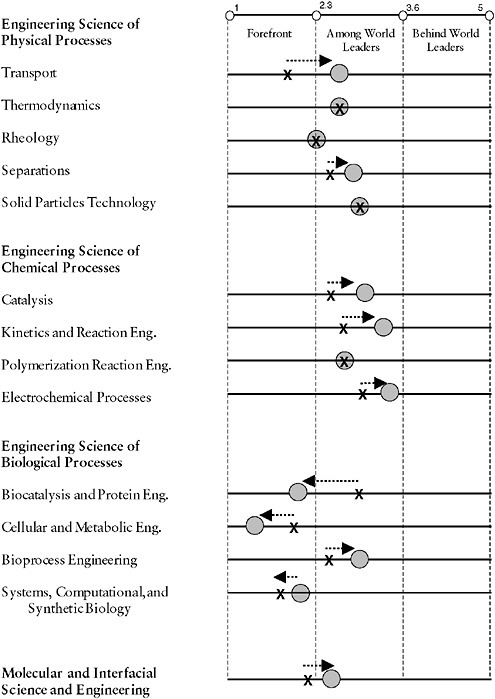
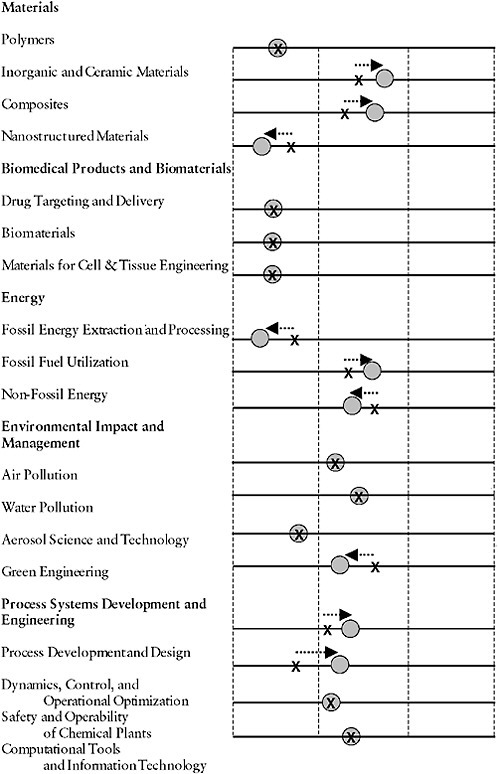
subareas alongside the expected future trends. The major conclusions are as follows:
Conclusion 1: U.S. chemical engineering research is strong and at the “Forefront” or “Among World Leaders” in all subareas of chemical engineering. It is expected to remain so in the future.
Conclusion 2: U.S. research is particularly strong in fundamental engineering science across the spectrum of scales: from macroscopic to molecular. In these areas of research, the primary competition in terms of quality and impact comes from other disciplines rather than from chemical engineers from other countries. However, recent trends of increasing levels of applications-oriented research with a parallel decrease in the levels of basic research will continue and may undermine the historical strength and preeminence of U.S. chemical engineering.
Conclusion 3: In the core areas of chemical engineering research, the level of output from Asian and European Union countries has increased significantly during the past 10 years, but the United States maintains a strong leadership position in terms of quality and impact.
Conclusion 4: In the following subareas of chemical engineering research, the United States will be “Gaining or Extending” its current relative position: biocatalysis and protein engineering; cellular and metabolic engineering; systems, computational, and synthetic biology; nanostructured materials; fossil energy extraction and processing; non-fossil energy; and green engineering.
Conclusion 5: The Panel has recognized that funding policies (government and industrial) may put at risk the U.S. position in the following subareas of chemical engineering research: transport processes; separations; catalysis; kinetics and reaction engineering; electrochemical processes; bioprocess engineering; molecular and interfacial science and engineering; inorganic and ceramic materials; composites; fossil fuel utilization; process development and design, and dynamics, control, and operational optimization.
Conclusion 6: The degree of interdisciplinarity varies from subarea to subarea but is significant in all areas of chemical engineering research and in recent years has been growing. Therefore, the future competitiveness of U.S. chemical engineering research must be benchmarked against a broader spectrum of disciplinary contributions.


