
6
Champions for Change
Implementing new approaches to constructing buildings requires commitment from institutional leadership. Roger Oxendale and Scott Slotterback contributed to the successful adoption of green building practices at their respective healthcare institutions. Roger Oxendale’s presentation at the workshop focused on implementing the decision to build green in university medical centers, while Scott Slotterback shared his expertise on the subject of building green on a large scale.
CREATING A COMPREHENSIVE GREEN HEALTHCARE SYSTEM
In the 1940s, Pittsburgh was extremely polluted, acquiring the nickname of the Smoky City; the streetlights were turned on by 3 p.m. every day because of the darkness created by smoke from the steel mills. Local leaders in the 1940s met with the architect Frank Lloyd Wright and asked him what could be done to improve Pittsburgh—Wright’s suggestion was to abandon it. The city leaders did not choose to abandon the entire city; instead, they considered how to change the environment and stimulate new ways of thinking, said Roger Oxendale of the Children’s Hospital of Pittsburgh at the University of Pittsburgh Medical Center (UPMC). The leaders made an insightful move toward sustaining the long-term health of the people in the region. One of the first steps was to initiate the requirement for businesses and civic leaders to change from coal (the primary cause of pollution) to gas and other smokeless fuels for heating. This was the beginning of a significant green renaissance for the Pittsburgh region, noted Oxendale. By moving forward with courage and conviction, Pittsburgh’s leaders created a livable, diverse economic region, with one of the most highly regarded and sophisticated healthcare systems in the world.
Major Components of Greening Throughout the University of Pittsburgh Medical Center
Today, it is imperative that regional leaders continue working to improve the health of residents, noted Oxendale. The University of Pittsburgh Medical Center is the largest employer in western Pennsylvania, and the second largest employer in the state of Pennsylvania. UPMC healthcare providers have a significant role in efforts to provide health information to the community.
UPMC used this role to create a vision of a comprehensive green healthcare system, one that embraces
-
constructing new high-performance buildings,
-
taking a leadership role in western Pennsylvania in educating families and schools about the effects people have on their environment and their own health,
-
applying and sharing the scientific research the hospital pursues to advance the treatment of children,
-
improving the training of medical residents in green health care, and
-
• incorporating green practices and treatment into the health care and the overall improvement of children, both in their homes and in their communities.
Part of the mission of the Children’s Hospital of Pittsburgh is to use information to leverage its activities. The hospital’s leadership goes beyond its four walls and extends into the community, said Oxendale. In conjunction with the provision of children’s health care, hospital leaders consider numerous areas of importance, including how the community lives, how the hospital is operated, how research is performed, how patients are cared for, and how the community is affected by the hospital.
Two key partners for constructing the green pediatric hospital were the Heinz Endowments and the state of Pennsylvania. They awarded the Children’s Hospital of Pittsburgh $5 million toward the construction of a new green hospital. UPMC is working to construct new green buildings, retrofit existing buildings, and transform health care in numerous areas, such as chemical and hazardous waste management, air quality, energy and water conservation, and housekeeping, said Oxendale.
The new hospital campus has a budget of $575 million and will be built on a 10.2-acre campus. The research building is scheduled for completion in 2008, and the hospital building will open in 2009. Approximately 60 percent of the hospital will be new construction, and the remainder will involve renovation and retrofitting of the old medical campus (Figure 6-1). The challenge is to construct a technologically advanced research building by retrofitting a partially demolished building and incorporating it with new construction. According to Oxendale, the Children’s Hospital of Pittsburgh is among the first pediatric hospitals in the country to apply for LEED certification.
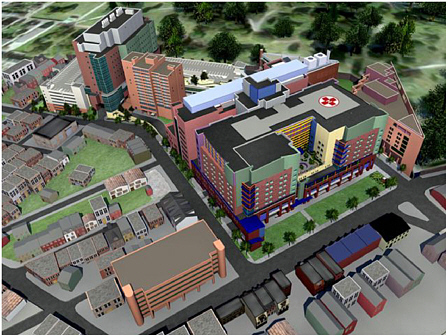
FIGURE 6-1 The new UPMC hospital campus has a budget of $575 million and will be built on a 10.2-acre campus, with 1.2 million square feet of floor space. New construction will make up about 60 percent of the hospital, and the rest is an old medical campus, which will be renovated and retrofitted.
SOURCE: Children’s Hospital of Pittsburgh (2005, unpublished).
The Center for Building Performance and Diagnostics at Carnegie Mellon University is currently engaged in surveying UPMC’s existing operations and practices. It has provided a set of recommendations for environmental sustainability and future innovations.
Purchasing practices are a critical area for both cost reduction and environmental gains. The Carnegie Mellon evaluation identified the purchasing of medical and laboratory supplies, patient comfort and care supplies, office supplies, and food services as areas of focus. In addition, it suggested that UPMC should identify and test alternative cleaning products and track public health and environmental benefits of alternative operations.
UPMC staff learned how to develop, test, and (when possible) implement strategies for the efficient conversion of heating, cooling, ventilation, and lighting systems. They also gained understanding of other approaches to reduce consumption of natural resources. In their effort to reduce waste streams, the hospital focused on a multiple waste management approach through recycling
and disposal methods for chemotherapeutic, radioactive, and other infectious and hazardous waste products, noted Oxendale.
Reduction of vehicle pollution was also taken in consideration. The hospital will use hybrid or nondiesel parking shuttles and public transportation. Employees are encouraged to carpool and drive alternative fuel vehicles. Other strategies currently being evaluated and planned include the provision of bike racks and showers and electric outlets for hybrid cars, said Oxendale. The hospital also plans to ensure that truck engines are shut down at loading docks during deliveries.
The impacts of building design on healthcare outcomes, employees, and the work environment are being studied at the Center for Building Performance and Diagnostics and the University of Pittsburgh’s Mascaro Sustainability Initiative Center. Healthful initiatives, such as access to open areas, walking paths, and ergonomically designed furniture, will be incorporated. New patient rooms are designed with green materials and additional space in which patients and families have privacy and some level of control over their environment. The hospital also plans to establish a rooftop healing garden to promote the healing environment.
UPMC’s Collaboration Efforts
The University of Pittsburgh Cancer Institute, the Graduate School of Public Health, and the Center of Environmental Oncology formed a team to work on the elimination of persistent toxins, such as mercury. The hospital also plans to reduce the use of toxic chemicals, reduce the quantity of water used for cleaning, and use new materials to improve infection control. For example, the hospital is currently implementing the use of microfiber mops. In addition to any health benefits, these measures save thousands of gallons of water a year and require fewer cleaning chemicals, noted Oxendale.
Among other environmental initiatives, the team is looking for ways to buy equipment and medical instruments that are state of the art and less harmful to the environment. One focus area is the recycling and donation of surplus hospital supplies to developing nations. In addition, use of the electronic health record is being implemented throughout the Children’s Hospital of Pittsburgh. As a result, most filing space and cabinets for paper records are being eliminated, and it is anticipated that the new campus will be paperless.
With the University of Pittsburgh School of Engineering, UPMC is working to optimize software and control systems that will reduce costs for chilled water, steam, electricity, and water disposal throughout the system. These significant measures will enable the development of baseline data to be used in tracking the impact of the new green Children’s Hospital of Pittsburgh. The hospital will be a highly efficient, sustainable facility—it will incorporate water and energy conservation, improved air quality, green building materials and cleaning processes, and light, open, airy spaces, said Oxendale.
The leadership measures taken to clean up the Pittsburgh region almost 60 years ago laid the groundwork for a future in which hospitals can be models of disease prevention and cure. The greening of the pediatric institution will allow the medical community to continue improving the futures of their young patients, concluded Oxendale.
BUILDING GREEN ON A LARGE SCALE
Media commentator and author Marshall McLuhan once said: “If we drove the way we typically plan, we would spend most of our time looking into our rearview mirrors and we would crash our cars.” We often look to the past so we can build on our traditions and learn from our mistakes, said Scott Slotterback of Kaiser Permanente. Today, we need to look to the future, project where we want to be, and then determine how to get there. This is especially true when trying to build green on a large scale. Kaiser Permanente is using The Green Guide for Health Care to define what is green and as a foundation for the next version of the Eco-Toolkit (a design and construction resource guide), said Slotterback.
Located in nine states and the District of Columbia, Kaiser Permanente is one of the nation’s largest nonprofit health plans. It has 8.3 million members and 60 million square feet of occupied floor space in more than 900 buildings. Kaiser Permanente is an integrated model of care, consisting of three companies: the Kaiser Foundation Health Plan (an insurance company); Kaiser Foundation Hospitals (a healthcare provider); and the Permanente Medical Groups (a for-profit group of physicians). Kaiser Permanente’s planned facility growth includes building 23 new hospitals (6 of them on green-field sites), major hospital bed expansions, replacement or significant addition projects, thousands of renovations, new medical office buildings to support hospital projects, as well as additional utility plants and parking structures, noted Slotterback.
Kaiser Permanente established an Environmental Stewardship Council to lead the effort in going green on a large scale. The Environmental Stewardship Council reports directly to the chief executive officer and is driven by a vision statement, stating that Kaiser Permanente “aspires to provide healthcare service in a manner that protects and enhances the environment and the health of the community now and for future generations” (Slotterback, 2006). The company’s role is not limited to protecting people in the buildings, but also involves making decisions that protect the communities in which members live, noted Slotterback.
Formed in 1998, the Kaiser Permanente Alliance Program is a group of architects and contractors serving the company’s design and construction needs. The company brought its physicians, nurses, environmental health specialists, and individuals responsible for maintaining and operating its buildings into discussions at the very beginning of the construction project. This integrated design approach ensured that all groups involved were educated in the same concepts.
Among other initiatives, pervious paving to filter water from parking lots
back into the aquifer was introduced. The cost of the pervious paving per square foot was higher than the cost of conventional asphalt, said Slotterback. However, from a system standpoint, conventional asphalt would have required a connection to the city’s storm sewer system. Because all of the pipelines to that system were not nearby, the cost of installing large piping might have cost more than the pervious paving. Other Kaiser Permanente initiatives include using drought-tolerant native species in landscaping (they help reduce water consumption and costs in maintenance), providing access to daylight and views in the facilities, installation of photovoltaics in lieu of mechanical screens on one portion of the building, taking steps to eliminate polyvinyl chloride (PVC) in the building materials, using recycled content in materials, encouraging alternative transportation, and creating tobacco-free sites.
Standards for Kaiser Permanente Design and Construction
As a large-scale consumer, Kaiser Permanente is able to leverage its buying power to transcend institutional barriers, said Slotterback. Taking advantage of the company’s large scale, Kaiser Permanente was able to create incentives that transformed not only what was available to them, but also the marketplace at large.
Kaiser Permanente’s National Facility Services have responsibility for the design and construction of the new facilities. A robust standards program monitors quality control and facilitates design and operational efficiency; it is also used to promote the company’s green building program.
Kaiser Permanente’s National Purchasing Agreement program (NPA) joins with manufacturers to drive down costs, provide equipment with longer operating lives, and support the company’s green agenda. Compliance with the NPA is mandatory for the company’s design and construction teams, and this strategic alliance enables Kaiser Permanente to develop products and systems that meet their specific needs, noted Slotterback.
In 1993, Kaiser Permanente negotiated the first NPA for carpeting. The request for proposal included a requirement for bidders to state how they reduce waste and support recycling. Most of the manufacturers did not understand, and only one manufacturer indicated that they were recycling carpet in response to Kaiser Permanente’s request, said Slotterback.
In 2002, the carpet contracts for the NPA were up for renewal. This time, Kaiser Permanente decided to focus on sustainability of current and potential partners, explained Slotterback. The company’s negotiating team included interior designers, a representative from the janitorial group, and the director of environmental stewardship. In addition, two other members of the green buildings committee, an outside architect, and a representative of the Healthy Building Network were included in the team. The team was charged with focusing on three
main criteria in evaluating current and potential builders: sustainability, product performance, and aesthetics.
The negotiating team conducted research on the carpet industry to identify which companies were leaders in sustainability. To gain understanding of the environmental impact of carpet fiber, the team also met with fiber manufacturers. Kaiser Permanente partnered with the Healthy Building Network to develop a detailed questionnaire for determining the chemical composition of carpets and the environmental impact of carpet manufacturing. The questionnaire was used to assess effects on the environmental quality of buildings and their surrounding communities. Because conventional testing was not adequate for Kaiser Permanente’s needs, the company developed a special testing procedure to measure impermeability.
After deliberations, the team selected five carpet companies; two that were currently under contract and three that were included on the basis of their leadership in sustainable practice. The negotiating team then prepared a request for proposal and sent it to all five companies. The team invited each manufacturer to make a presentation with a focus on their sustainable practices, healthcare product line, and product performance. The team then met and scored each company on the basis of the selection criteria.
Sustainable practices and product evaluation or performance were assigned a weight of 45 percent each, and green innovation was assigned a 10 percent weight. An ideal product did not exist at that time, noted Slotterback. A major issue for Kaiser Permanente was the elimination of PVC, and all products meeting the performance criteria had PVC backing in the carpet. The two companies selected, Interface and C&A Floorcoverings, had aggressive recycling programs and agreed to work with Kaiser Permanente to develop a PVC-free carpet backing that met performance criteria in a 2-year time frame.
C&A Floorcoverings managed to meet the criteria, and they have been awarded Kaiser Permanente’s NPA for carpet in all of Kaiser Permanente’s facilities. C&A Floorcoverings developed a carpet backing that performs at the level of PVC but uses material that is reclaimed from laminated safety glass and contains 96 percent postconsumer recycled content.
Kaiser Permanente explored the environmental performance of other flooring products as well. The company looked for a replacement of dominant surfaces, such as vinyl sheet flooring and vinyl tile flooring, within the hospital. Kaiser Permanente revised its standard to use two alternative flooring systems: Stratica by Amtico and Nora rubber flooring, noted Slotterback.
Chemical content of the materials is not the only important component of Kaiser Permanente’s flooring standards, said Slotterback. The maintenance process is very important as well. The maintenance cycle of PVC-based products usually requires stripping and waxing. The stripping releases particulates that may trigger asthma; in addition, the cleaning chemicals used to treat PVC-based products are believed to be harmful. The Nora and the Stratica flooring requires
minor cleaning (mostly damp mopping), and lower VOC-emitting cleaning solvents are used for more thorough cleaning.
Slotterback concluded that additional research would benefit consumers and give a firmer foundation for Kaiser Permanente’s programs, such as the PVC removal program. To make intelligent consumer decisions, a better understanding is needed of the impacts of chemicals used in building products, asserted Slotterback. A federal standard—similar to the food labeling standard—that indicates the content of building and furnishings products, would enable consumers to make intelligent decisions. The ability to make informed decisions and choices would shift the marketplace to the use of sustainable products and in turn will help to achieve sustainability goals, concluded Slotterback.


