
Regulated Deficit Irrigation in Trees and Vines
Dr. David A. Goldhamer
Kearney Agricultural Center
University of California, Davis
Introduction
Irrigated agriculture is the primary user of water in much of the world, commonly using 70% more of developed water supplies. Irrigation water may be used consumptively in crop transpiration or evaporation from soil; a process termed evapotranspiration (ET), and may have other sinks such as deep percolation or tailwater runoff. As in the urban and industrial sectors, irrigated agriculture has been steadily improving the efficiency of water use for decades. More efficient irrigation systems and improved irrigation management practices that reduce tail water and apply water with high uniformity, thus minimizing percolation, are being widely adopted.
However, tailwater and deep percolation are usually not true water losses. Tailwater is normally collected and reused elsewhere on a grower's acreage. Unless it moves to a salty, perched water table or flows to the ocean, water "lost" to deep percolation can be pumped and reused. Thus, one field's or grower's loss is another field's or grower's source of supply.
On the other hand, any reductions in consumptive use (ET) result in the net saving of water to the basin in question. Thus, it's important to explore the potential of reducing ET in irrigated agriculture. Research done on soil evaporation (E) indicates that the potential for reducing E in the intensive agriculture of California is small in most situations. One exception is the few early years of orchard crops. Buried drip irrigation in mature crops can reduce E by 5-10% (Bonachela at al., 2001) but is very expensive to install and maintain (Camp, 1998). Transpiration (T) is by far the largest component of ET and is where we need to focus our objective of reducing ET.
It has been known for many decades that when T is decreased by water deficits, crop production is also reduced below its maximum potential (Hsiao, 1973; Bradford and Hsiao, 1982). This is because the processes of carbon assimilation and T take place through the stomata, the microscopic pores in the leaves of plants that are responsible for gas exchange. As water stress is imposed, the stomata close and that reduces both water loss and carbon uptake and thus, productivity. Indeed, preventing water stress forms the basis for most of the water budget irrigation scheduling programs that exist today, including CIMIS. Does that mean that there is no opportunity to reduce T in irrigated agriculture?
This goal of reducing transpiration by stressing the plant has been extensively researched in the past for field and row crops but has been shown to reduce yields and also water productivity (crop yield per unit of water used) in most herbaceous crops. However, numerous studies the past 15-20 years in California, Australia, Spain and Israel (Chalmers et al., 1981; Mitchell et al., 1986; Caspari et al., 1994; Lampinen et al., 1995; Naor, 2000; Naor et al., 2001; Teviotdale et al., 2001; Girona, 2002; Moriana et al., 2003; Goldhamer et al., 2002) have shown that regulated deficit irrigation (RDI) can reduce consumptive use in tree crops and vines without reducing grower profits, and in some cases, even increasing grower profits. A recent review on irrigation
of fruit trees has highlighted the potential of using various forms of deficit irrigation in the water management of orchard and vineyards (Fereres et al., 2003).
Regulated Deficit Irrigation
We define regulated deficit irrigation (RDI) as a regime that purposely stresses the trees or vines at specific developmental stages of the crop such that there is little, if any, negative impact on the yield of marketable product and/or profits. The water stress is normally imposed at stages of the season when reproductive growth is relatively low. The water stress results in lower tree water status, partial stomatal closure, which reduces ET (Fig. 1). The objective of RDI is to maintain or increase farm profits while reducing the consumptive use of water.
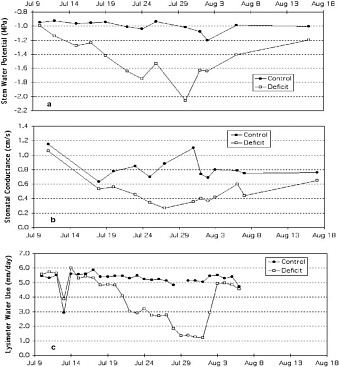
FIGURE 1 Impact of progressively more severe deficit irrigation from July 10 to August 1 on a) midday stem water potential, 2) midday stomatal conductance, and 3) ET of mature peach. Control was fully irrigated. Deficit trees returned to full irrigation on August 2. Adapted from Goldhamer et al. (1999), Fereres et al. (1999), and Mata et al. (1999).
Crop-Specific RDI Opportunities
Citrus
Recent research on the mature navel orange, “Frost Nucellar” has shown that early season stress improves harvest fruit quality by reducing peel creasing (Goldhamer and Salinas, 2000). This resulted in a higher percentage of the fruit graded as Fancy (high value) and a lower percentage as Juice (low value). Fruit drop and fruit load were not negatively affected. Figures 1 and 2 show mean data from the final three years of a four year study involving 14 RDI regimes and a fully irrigated Control. Note that due primarily to slightly reduced individual fruit weight, the relationship between gross yield (kg/ha) and applied water is fairly linear (Fig. 2). On the other hand, there is no relationship between gross revenue ($US/ha) and applied water (Fig. 3). Thus, total grower revenue was higher under many of the RDI regimes (those that imposed stress early in the season) while applied water (and consumptive use) were reduced.
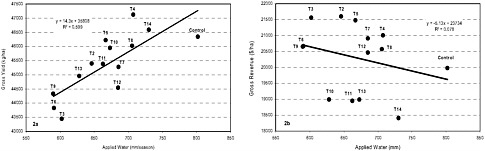
FIGURE 2 Mean data from the final three years of a four year study in the San Joaquin Valley of California of mature navel orange tree (‘Frost Nucellar’) response to 14 RDI regimes compared with a fully irrigated Control showing a) gross yield versus applied water, and b) gross revenue versus applied water. Adapted from Goldhamer and Salinas (2000).
Another issue in late harvest citrus is excessively large fruit and granulation. Goldhamer and Salinas (unpublished data) found that granulation can be significantly reduced using RDI (Table 1). Additionally, some RDI regimes shifted the fruit size distribution toward smaller, more valuable fruit. While this had a modest impact on gross yield (Fig. 3a), it resulted in higher grower revenue, water productivity, and revenue productivity (Figs. 3b, 3c, and 3d, respectively).
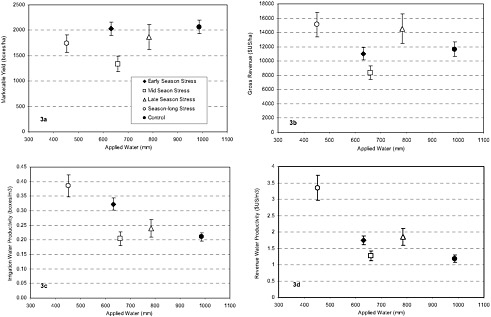
FIGURE 3 Mean data from the first two years of a study in the San Joaquin Valley of California involving four RDI regimes on mature late harvest navels (‘Lane Late’) compared with a fully irrigated Control showing applied water versus a) marketable yield, b) gross revenue, c) irrigation water productivity, and d) revenue water productivity. Unpublished data from Goldhamer and Salinas. Vertical bars are ± one standard error of the mean.
TABLE 1 Fruit granulation (drying of the pulp) measured at harvest in the first year of a study in the San Joaquin Valley of California involving four RDI regimes on mature late harvest navels (‘Lane Late’) compared with a fully irrigated Control. Unpublished data from Goldhamer and Salinas.
|
Irrigation Treatment |
Small Sizes 88+113+138+163 Granulation |
Medium Sizes 56+72 Granulation |
Large Sizes 48 Granulation |
Extra Large sizes 24+36+40 Granulation |
|
|
------------------------------ (%) ------------------------------ |
|||
|
T1; early summer stress |
1.2 a* |
4.3 a |
6.6 ab |
13.9 ab |
|
T2; mid summer stress |
2.6 ab |
6.5 ab |
9.6 b |
15.5 ab |
|
T3; late summer-fall stress |
4.4 ab |
14.0 c |
15.4 c |
22.2 bc |
|
T4; continuous stress |
1.1 a |
2.2 a |
3.2 a |
8.8 a |
|
T3; fully irrigated Control |
5.8 b |
10.5 bc |
21.4 d |
30.7c |
Pistachio
Mature pistachio trees have the potential to transpire water at an extremely rapid rate (Goldhamer et al., 1985). While pistachio trees are extremely drought tolerant, they are able to withstand severe stress (Goldhamer et al., 1984). Pistachio production involves many more yield components than the other nut crops and each of these yield components can be negatively influenced by water stress. However, the unique fruit development pattern of pistachio nuts provides a period where the tree is relatively tolerant of stress: just after full shell size has been attained until the onset of rapid kernel growth. We refer to this as Stage 2 growth and it normally occurs from Mid May thru early July in the southern San Joaquin Valley of California. Goldhamer and Beede (2004) reported that irrigation at 50% of potential ET during this period can occur without negative impacts on production and a significant increase in irrigation water productivity (kg/m3; Table 2).
TABLE 2 Mean data from the final two years of a four year study in the San Joaquin Valley of California of water deprivation (shown as 0%) during fruit growth stages and the most successful RDI regime (irrigation at 50% ET during stage 2 and 25% ET post harvest) compared with a near fully irrigated Control.
|
Irrigation Treatment |
Yield Dry Split Nuts (kg/ha) |
Irrigation Water Productivity (kg/m3) |
|
0% Stage 1 |
3170 d |
0.407 bc |
|
0% Stage 2 |
2510 bc |
0.408 bc |
|
0% Stage 3 |
1140 a |
0.287 a |
|
0% Post harvest |
2750 bcd |
0.344 ab |
|
50% Stage 2; 25% PH |
3070 cd |
0.469 c |
|
Control |
3040 cd |
0.361 ab |
Additionally, Goldhamer and Beede (2004) found that mild to moderate stress from leafout to full shell size (Stage 1) can significantly improve shell splitting which can sometimes be a major problem for growers. Closed shell nuts are worth much less than split nuts. The downside of Stage 1 stress is that it can reduce nut size. Nevertheless, Goldhamer and Beede (unpublished data) showed that Stage 1 stress can reduce closed shell production by about 50% relative to fully irrigated trees (Table 3). Similar results were obtained when Stage 1 stress was coupled with Stage 2 stress. This treatment reduced applied water by almost 30% and significantly increased irrigation water productivity.
TABLE 3 Mean data from the first two years of a study at Parlier, CA involving two RDI regimes (T1; stress during stage 1, and T2; stress during both stages 1 and 2) compared with a fully irrigated Control on two pistachio scion cultivars.
|
Rootstock |
Irrigation Treatment |
Harvested Dry Split Nut Weights (g) |
Harvested Fresh Closed Shell Nuts (% by No.) |
Applied Water Productivity (kg/m3) |
|
Atlantica |
T1 |
1.14 a* |
15.3 a |
0.267 ab |
|
|
T2 |
1.13 a |
15.3 a |
0.324 a |
|
|
Control |
1.23 b |
28.7 b |
0.229 b |
|
PG1 |
T1 |
1.17 a* |
17.9 a |
0.355 ab |
|
|
T2 |
1.19 a |
16.3 a |
0.426 a |
|
|
Control |
1.25 b |
34.8 b |
0.305 b |
Almonds
Smaller kernels translate into both lower yield (assuming no impact on fruit load) and less valuable kernels as processor prices are related to kernel size. There are approximately 5% differences in kernel value for each of the five or so kernel size categories. Most of the RDI work to date that imposed preharvest stress in almonds reduced harvest kernel size (Goldhamer and Viveros, 2000; Girona et al., 1993a; Goldhamer, 1997; Torrecillas et al., 1989). The magnitude of the size reductions was related to the magnitude of the stress. On the other hand, Shackel (2002) and Romero et al. (2004) found no significant reduction in fruit weight with preharvest stress. Most of the published studies report that RDI can be imposed without negatively impacting fruit load if the stress is biased to preharvest. Even though individual fruit size was reduced regardless of the preharvest RDI imposed, Goldhamer and Viveros (2000) found significant improvement in irrigation water productivity in most of RDI regimes.
Peach
The pioneering RDI work in fruit trees was conducted on late harvest peaches (Chalmers et al., 1981). Since the fruit has a double sigmoid development pattern, where a rapid growth first stage is followed by a slower growth second stage, which, in turn, is followed by a rapid growth third stage, the theory was that stress can be imposed during Stage 2 of fruit growth. Researchers in Australia found that with this approach, there was no significant reduction in harvest fruit size, unwanted vegetative growth was reduced (presumably less pruning required), and consumptive use was less (Chalmers et al., 1981). There was no increase in fruit drop. However, we in California and others in Europe have been unable to reproduce these results in late harvest peaches; we usually observe a slight reduction in harvest fruit size (Girona et al., 1993b; Goldhamer et al., 2002; Girona, 2002). While these size reductions may not be statistically significant relative to fully irrigated trees, the fact that fruit value is so closely tied to fruit size results in significant loss of grower revenue.
This is not the case with early harvest peaches; those harvested in late May-early July (Larson et al., 1988; Johnson et al., 1992). The RDI regimes impose stress only following harvest. Since fresh peach production includes early season thinning of the crop to a desired number, any impact of the previous year's stress on fruit load is negated. However, stress in late August-mid September has been found to increase the percentage of fruit "doubles;" two fruit in varying degrees of completeness attached to one stem (Johnson et al., 1992). This fruit is worthless and can be removed in the thinning process. However, it requires the thinning personnel to be more watchful, thereby slowing down their work. The fruit double problem can be largely avoided by reintroducing full irrigation in the late August-mid September period.
Wine Grapes
There is unanimity of opinion that water stress in grapes can improve the quality of the wine produced (Goodwin and Jerie, 1992). In fact, irrigation of wine grapes was against the law until recently in some European countries. While it was recognized that irrigation could increase yields, there was a fear that wine quality would also be reduced. Now it's recognized that irrigation is required to maximize both production (yield) and grower profit. However, there is no agreement on the extent of the stress required to produce the maximum amount of fruit of the best quality for wine making.
It's been thought that the main objective of RDI in wine grapes is to produce a berry that is smaller than when fully irrigated; thus increasing the ratio of skin to pulp (Kennedy et al., 2002; Prichard, 2003). The constituents of the skin are thought to have the primary influence on wine quality. However, reducing berry size also reduces yield, assuming the same fruit load. Some believe that it's not necessary to impose stresses severe enough to reduce berry size in order to produce higher quality wine; that stress-related chemical changes in the fruit are primarily responsible (Matthews et al., 1990). However, there is universal agreement that reduced vegetative growth and thus, smaller canopies, improves grape color by allowing more sunlight to penetrate into the canopies.
Most agree that optimal RDI in wine grapes involves stress prior to veraison (berry color change). Early season stress is usually imposed by delaying irrigation until a desired level of stress occurs in the vines (Prichard, 2003). The triggers used to identify when enough stress has occurred vary. One approach uses plant water stress measured with a pressure chamber; the other is based on irrigating at certain fractions of ET (Prichard, 2003).
Grower Adoption of RDI and Likely Consumptive Use Reductions
We believe that growers are motivated by two primary forces: profit and regulation. If growers believe that a new technology or approach to irrigation will increase their profits, adoption is much more likely. Purposely imposing stress with RDI is considered a risk by most growers and the rewards must balance this risk. Water cost savings may not be considered as reward enough for adopting RDI. We believe that in the future, it's likely that growers will be compensated for actually reducing consumptive use by agencies that supply water. The scenario is that agencies that meet the growing demand from the urban sector due to an expanding population and environmental sectors will offer to pay growers for water that they currently apply to crops.
Growers will be forced to consider whether the highest profit will be achieved by having their plants consume the water or selling it. If growers recognize that 200-300 mm can be saved using RDI without negatively impacting production and this water can add to their profit by being used elsewhere, RDI adoption is likely. We are not implying that all "saved" water will be sold. To the contrary, the growers will decide how they can better use this water by planting more land, for example.
References
Bonachela, S., F. Orgaz, F.J. Villalobos, and E. Fereres. 2001. Soil evaporation from drip-irrigated olive orchards. Irri. Sci. 20(2):65-71.
Bradford, K.J. and T.C. Hsiao. 1982. Physiological responses to moderate water stress, p. 264-312. In: O. L. Lange, P.S. Nobel, C.B. Osmond and H. Ziegler (eds.). Physiological Ecology II Encyclopedia of Plant Physiology (N. S. vol. 12B). Springer-Verlag, NY.
Camp, C.R. 1998. Subsurface Drip Irrigation: A Review. Trans. ASAE 41(5):1353-1367.
Caspari, H.W., M.H. Behboudian, and D.J. Chalmers. 1994. Water use, growth, and fruit yield of Hosui Asian pears under deficit irrigation. J. Amer. Soc. Hort. Sci. 119(N3): 383-388.
Chalmers, D.J., Mitchell, P.D., and van Heek, L.A.G.. 1981. Control of peach tree growth and productivity by regulated water supply, tree density, and summer pruning. J. Amer. Soc. Hort. Sci. 106(3):307-312.
Fereres, E., D. Goldhamer, M. Cohen, J. Girona, and M. Mata. 1999. Continuous trunk diameter recording can reveal water stress in peach trees. California Agriculture 53(4):21-25.
Fereres, E., D.A. Goldhamer, and L.G. Parsons. 2003. Irrigation of Fruit Trees. Invited paper to commemorate the Centennial of the American Society of Horticultural Science. HortScience 39(5):1036-1042.
Girona, J. 2002. Regulated deficit irrigation in peach. A global analysis. Acta Hortic. 592:335-342.
Girona, J., J. Marsal,M. Cohen, M. Mata, and C. Miravete. 1993a. Physiological growth and yield responses of almond (Prunus dulcis L.) to different irrigation regimes. Acta Hortic. 335:389-398.
Girona, J., M Mata, D.A. Goldhamer, R.S. Johnson, and T.M. DeJong. 1993b. Patterns of soil and tree water status and leaf functioning during regulated deficit irrigation scheduling in peach. J. Amer. Soc. Hort. Sci. 118(5):580-586.
Goldhamer, D.A. 1997. Regulated deficit irrigation for almonds. Proc. of 25th Almond Research Conference, Modesto, CA.
Goldhamer, D. A. and R.H. Beede. 2004. Regulated deficit irrigation effects on yield, nut quality and water-use efficiency of mature pistachio trees. J. Hort. Sci. and Biotech. 79(4):538-545.
Goldhamer, D.A., E. Fereres, M. Cohen, M. Mata and J. Girona. 1999. Sensitivity of continuous and discrete plant and soil water status monitoring in peach trees subjected to deficit irrigation. J. Amer. Soc. Hort. Sci. 124(4):437-444.
Goldhamer, D. A., R. Kjelgren, R. Beede, J. M Moore, J. Menezes, Jr., and G. Weinberger. 1984. Physiological response of pistachio to severe water stress. Annual Report of the California Pistachio Commission, Crop Year 1983-1984. Fresno, CA. pp 44-47.
Goldhamer, D. A., R. K. Kjelgren, R. Williams, and R. Beede. 1985. Water use requirements of pistachio trees and response to water stress. Adv. Evapotranspiration. Amer. Soc. Agr. Eng. Pub. 14-85, pp. 216-223.
Goldhamer, D.A. and M. Salinas. 2000. Evaluation of regulated deficit irrigation on mature orange trees grown under high evaporative demand. Proc. Intl. Soc. Citrucult. IX Congress 227-231.
Goldhamer, D.A., M. Salinas, C. Crisosto, K.R. Day, M. Soler, and A. Moriana. 2002. Effects of regulated deficit irrigation and partial root zone drying on late harvest peach tree performance. Acta Hortic. 592:343-350.
Goldhamer, D A. and M. Viveros. 2000. Effects of preharvest irrigation cutoff durations and postharvest water deprivation on almond tree performance. Irrig. Sci. 19:125-131.
Goodwin, I. and P. Jerie. 1992. Regulated deficit irrigation: from concept to practice. Advances in vineyard irrigation; 10 July 1992; Aust. NZ Wine Ind. J. 258-261.
Hsiao, T.C. 1973. Plant responses to water stress. Annu. Rev. Plant Physiol.. 24:519-570.
Johnson, R.S., D.F. Handley, and T.M. DeJong. 1992. Long-term response of early maturing peach trees to postharvest water deficits. J. Amer. Soc. Hort. Sci. 117(6): 881-886.
Kennedy, J.A., M.A. Matthews, and A.L. Waterhouse. 2002. Effect of maturity and vine water status on grape skin and wine flavonoids. Am. J. Enol. and Vit. 53(4):268-274.
Lampinen, B.D., K.A. Shackel, S.M. Southwick, B. Olson, J.T. Yeager, and D. Goldhamer. 1995. Sensitivity of yield and quality of French Prune to water deprivation at different fruit growth stages. J. Amer. Soc. Hort. Sci. 120(2): 139-147.
Larson, K.D., T.M. DeJong, and R.S. Johnson. 1988. Physiological and growth responses of mature peach trees to postharvest water stress. J. Amer. Soc. Hort. Sci. 113(3):296-300.
Mata, M., J. Girona, D. Goldhamer, E. Fereres, M. Cohen, and S. Johnson. 1999. Water relations of lysimeter-grown peach trees are sensitive to deficit irrigation. California Agriculture 53(4):17-21.
Matthews, M.A., R. Ishii, M.M. Anderson, and M. O'Mahoney. 1990. Dependence of wine sensory attributes on vine water status. J. Sci. Food and Agric. 51(3):321-335.
Mitchell, P.D., D.J. Chalmers, P.H. Jerie, and G. Burge. 1986. The use of initial withholding of irrigation and tree spacing to enhance the effect of regulated deficit irrigation on pear trees. J. Amer. Soc. Hort. Sci. 111:858-861.
Moriana, A., F. Orgaz, M. Pastor, and E. Fereres. 2003. Yield Responses of Mature Olive Orchard to Water Deficits. J. Amer. Soc. Hort. Sci. 123(3): In press.
Naor, A. 2000. Midday stem water potential as a plant water stress indicator for irrigation scheduling in fruit trees. Acta Hortic. 537:447-454.
Naor, A., H. Hupert, Y. Greenblat, M. Peres, A. Kaufman, and I. Klein. 2001. The response of nectarine fruit size and midday stem water potential to irrigation level in stage III and crop load. J. Amer. Soc. Hort. Sci. 126(1):140-143.
Prichard, T.L. 2003. Imposing water deficits to improve wine quality and reduce costs. University of California Publication (in press).
Romero, P., J.M. Navarro, F. Garcia, and P. B. Ordaz. 2004. Effects of regulated deficit irrigation during the pre-harvest period on gas exchange, leaf development and crop yield of mature almond trees. Tree Physiol. 24:303-312.
Shackel, K. 2002. Deficit irrigation management during hull-split. Proc. Of the 30th Almond Research Conference, pp. 71-75.
Teviotdale, B.L., D.A. Goldhamer, and M. Viveros. 2001. Effects of deficit irrigation on hull rot disease of almond trees caused by Monilinia fructicola and Rhizopus stolonifer. Plant Dis. 85(4):399-403.
Torrecillas, A., M.C. Ruiz-Sanches, A. Leon, and F. Del Amor. 1989. The response of young almond trees to different drip-irrigated conditions. Development and yield. J. Hortic. Sci. 64:1-7.


