
General Summary
The United States has long recognized and honored the service and sacrifices of its military and veterans. Veterans who have been injured by their service (whether their injury appears during service or afterwards) are owed appropriate health care and disability compensation. For some medical conditions that develop after military service, the scientific information needed to connect the health conditions to the circumstances of service may be incomplete. When information is incomplete, Congress or the Department of Veterans Affairs (VA) may need to make a “presumption” of service connection so that a group of veterans can be appropriately compensated. The missing information may be about the specific exposures of the veterans, or there may be incomplete scientific evidence as to whether an exposure during service causes the health condition of concern. For example, when the exposures of military personnel in Vietnam to Agent Orange could not be clearly documented, a presumption was established that all those who set foot on Vietnam soil were exposed to Agent Orange.
The Institute of Medicine (IOM) Committee was charged with reviewing and describing how presumptions have been made in the past and, if needed, to make recommendations for an improved scientific framework that could be used in the future for determining if a presumption should be made. The Committee was asked to consider and describe the processes of all participants in the current presumptive disability decision-making process for veterans. The Committee was not asked to offer an opinion about past presumptive decisions or to suggest specific future presumptions. The Committee heard from a range of groups that figure into this decision-making process, including past and present staffers from Congress,
the VA, the IOM, veterans service organizations, and individual veterans. The Department of Defense (DoD) briefed the Committee about its current activities and plans to better track the exposures and health conditions of military personnel. The Committee further documented the current process by developing case studies around exposures and health conditions for which presumptions had been made. The Committee also reviewed general methods by which scientists, as well as government and other organizations, evaluate scientific evidence in order to determine if a specific exposure causes a health condition.
The history of presumptions is a fascinating and complex story. In 1921 Congress empowered the VA Administrator (now Secretary) to establish presumptions of service connection for veterans. Only Congress and VA have the authority to establish presumptions for veterans. Since 1921, nearly 150 health outcomes have been service-connected on a presumptive basis by Congress and VA. This process has evolved over the years. The current process for making presumptions can be traced to the Agent Orange Act of 1991 (Public Law 102-4. 102d Cong., 2d Sess.), an act that established a model for decision making by VA that still stands today. In the 1991 Act, Congress asked VA to contract with an independent organization to review the scientific evidence on Agent Orange. VA turned to the IOM of the National Academy of Sciences to carry out these reviews. Subsequently, VA turned to IOM for issues arising from the 1990 Gulf War. Based on the work of a committee, IOM provides VA with reports that describe the strength of evidence that links agents of concern with specific health conditions. VA uses IOM reports and other information in an internal decision-making process to decide whether a presumption will be made.
The Committee carefully studied the current approach to presumptive disability decision making and examined a number of specific case examples. This assessment led to a number of recommendations to improve the process:
-
As the case studies demonstrated, Congress could provide a clearer and more consistent charge on how much evidence is needed to make a presumption. There should be clarity as to whether the finding of an association in one or more studies is sufficient or the evidence should support causation.
-
Due to lack of clarity and consistency in congressional language and VA’s charges to the committees, IOM committees have taken somewhat varying approaches since 1991 in reviewing the scientific evidence and in forming their opinions on the possibility that exposures during military service contributed to causing a health condition. Future committees could improve their review and classification of scientific evidence if they were given clear and consistent charges and followed uniform evaluation procedures.
-
The internal processes by which the VA makes its presumptive decisions following receipt of an IOM report have been unclear. VA should adopt transparent and consistent approaches for making these decisions.
-
Complete exposure data and health condition information for military personnel (both individuals and groups) usually have not been available from DoD in the past. Such information is one of the most critical pieces of evidence for improving the determination of links between exposures and health conditions.
All of these improvements are feasible over the longer term and are needed to ensure that the presumptive disability decision-making process for veterans is based on the best possible scientific evidence. Decisions about disability compensation and related benefits (e.g., medical care) for veterans should be based on the best possible documentation and evidence of their military exposures as well as on the best possible information on any health conditions caused by these exposures. While it is impossible to provide certainty in every case, a fresh approach could do much to improve the current process. The Committee’s recommended approach (Figure GS-1) has several parts:
-
An open process for nominating exposures and health conditions for review; involving all stakeholders in this process is critical
-
A revised process for evaluating scientific information on whether a given exposure causes a health condition in veterans; this includes a new set of categories to assess the strength of the evidence for causation, and an estimate of the numbers of exposed veterans whose health condition can be attributed to their military exposure
-
A consistent and transparent decision-making process by VA
-
A system for tracking the exposures of military personnel (including chemical, biological, infectious, physical, and psychological stressors), and for monitoring the health conditions of all military personnel while in service and after separation
-
An organizational structure to support this process
To support the Committee’s recommendations, we suggest the creation of two panels. One is an Advisory Committee (advisory to VA), that would assemble, consider, and give priority to the exposures and health conditions proposed for possible presumptive evaluation. Nominations for presumptions could come from veterans and other stakeholders as well as from health tracking, surveillance, and research. The second panel would be a Science Review Board, an independent body, which would evaluate the strength of the evidence (based on causation) that links a health condition to a military exposure and then estimates the fraction of exposed veterans
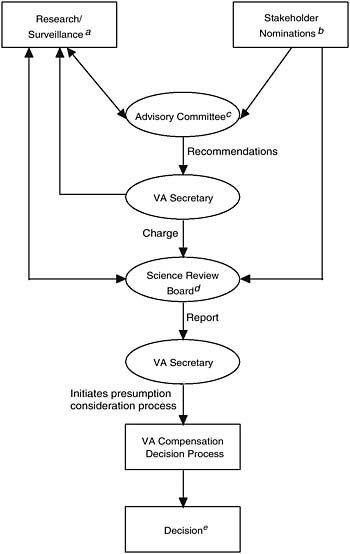
FIGURE GS-1 Proposed framework for future presumptive disability decision-making process for veterans.
a Includes research for classified or secret activities, exposures, etc.
b Includes veterans, Veterans Service Organizations, federal agencies, scientists, general public, etc.
c This committee screens stakeholders’ proposals and research in support of evaluating evidence for presumptions and makes recommendations to the VA Secretary when full evidence review or additional research is appropriate.
d The board conducts a two-step evidence review process (see report text for further detail).
e Final presumptive disability compensation decisions are made by the Secretary, Department of Veterans Affairs, unless legislated by Congress.
whose health condition could be attributed to their military exposure. The Science Review Board’s report and recommendations would go to VA for its consideration. VA would use explicit criteria to render a decision by the VA Secretary with regard to whether a presumption would be established. In addition, the Science Review Board would monitor information on the health of veterans as it accumulates over time in the DoD and VA tracking systems, and nominate new exposures or health conditions for evaluation as appropriate.
This Committee recommends that the following principles be adopted in establishing this new approach:
-
Stakeholder inclusiveness
-
Evidence-based decisions
-
Transparent process
-
Flexibility
-
Consistency
-
Causation, not just association, as the target for decision making
The Committee suggests that its framework be considered as the model to guide the evolution of the current approach. While some aspects of the approach may appear challenging or infeasible at present, feasibility would be improved with the full implementation of the Committee’s recommendations, provision of appropriate resources to all of the participants in the presumptive disability decision-making process for veterans, and future methodological developments. DoD and VA have already been discussing various aspects of improving exposure and health tracking and how the two agencies can share data and information with each other. Veterans deserve to have these improvements accomplished as soon as possible.


