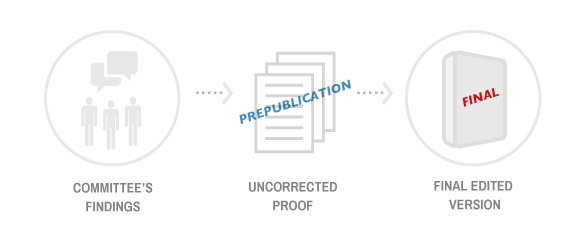
Below are the first 10 and last 10 pages of uncorrected machine-read text (when available) of this chapter, followed by the top 30 algorithmically extracted key phrases from the chapter as a whole.
Intended to provide our own search engines and external engines with highly rich, chapter-representative searchable text on the opening pages of each chapter.
Because it is UNCORRECTED material, please consider the following text as a useful but insufficient proxy for the authoritative book pages.
Do not use for reproduction, copying, pasting, or reading; exclusively for search engines.
OCR for page 47
ESSAY
Ethical
Considerations
in the Use of
Human Materials
~ he first successful human transplant of a solid organ took
place in 1954, when a young man in Boston, Massachusetts, received a kidney
from his identical twin brother. Since then, scientific, technical, and meclical
advances have made organ transplantation a relatively common procedure. In
1987, some 1,500 Americans received transplanted hearts, approximately
1,200 receiver] livers, another 1,200 received bone marrow, some 10,000
received kiclneys, and approximately 35,000 received corneas. If not for a
severe shortage of available organs, many thousands of other patients would
receive transplants.
Biological materials taken from humans serve a number of other purposes
besides transplantation, according to Arthur Caplan, professor of philosophy
and surgery and director of the Center for Biomedical Ethics at the University
of Minnesota. Human materials are essential in a wide range of biomedical
research and training. Some human materials, such as blood plasma and
sperm, are used for medical procedures unrelated to transplants. Human
materials may even be used as exhibits for educational purposes. '`One of my
first memories of wondering about values in science occurred at the Harvard
Museum, where I stood as a cub scout watching a display of fetuses in glass
jars," Caplan recalls.
The sources of human materials are as diverse as their uses, spanning the
entire range of human development. Human materials can come from sex
cells, embryos, fetuses, abortuses, newborns, children, adults, and cadavers.
In some cases, such as blood donations, human materials can be removed
without harming the donor. In other cases, the materials are essential to life
and therefore can be removed only after death.
Ethical questions have always surrounded the use of human materials, but
rapid advances in transplantation procedures have brought these questions to
center stage. How should a limited number of organs be allocated among a
large number of potential recipients? What are the appropriate ways to obtain
organs from potential donors? How should transplantation therapy be balanced
against other forms of medical care?
47
OCR for page 48
More generally, bioethicists have asked: What human materials should
ethically be used? Under what conditions should they be used? And what are
the purposes for which they should be used? The diversity of sources and
uses for human materials has generated a rich array of ethical questions,
which will only become more numerous as medical capabilities increase.
The Inadequacy of Simple Rules
Much has been said and written about the ethical obligations of those who
use human materials, but according to Caplan much of current practice can
be boiled down to three simple rules. ~`One, don't worry about it unless the
source of the material is a person. Two, treat everything with respect. Three,
never violate either (a) God's will with respect to these materials or (b), if you
don't believe in God, then nature's order."
The problem with these rules and other "simple nostrums" is that they
leave crucial questions unanswered, Caplan says. In the case of the first rule,
the obvious question is, What constitiite~ ~ Norman? One Wrath tm it;
_ _ 1 1 ~1
.
~ ~ ~11. ~11~ A to t111~
proDlem nas neen to try to equate the humanness or moral worth of an entity
with its stage of development. For instance, an embryo can be seen as having
more moral value than a sex cell, and a fetus as having more AL then an
^~7~ ~ ~ ~ ~_._~ ~ ~ ~ _ 1~ _ _ 1 . 1
w111~1~, "llU ~ tiOWUOl-~1 ~5 navlng more value than a fetus. `'When we think
of the world around us, we tend to assign more and more moral standing to
things the farther along they are in the hierarchy of development," Caplan
points out.
Caplan believes that this approach is fundamentally wrong. The quest for
some kind of moral essence that would make one entity human and another
not is `'a vain search," he says. Despite decades of effort, ethicists have not
been able to find a distinctive property, such as consciousness or volition,
that would allow them to make such a distinction. ``Part of the emptiness of
the search is proven by the fact that it has been going on for over 30 years,"
says Caplan. "Some very good people have sallied forth to try and find the
magic property that confers moral worth on things, and they've come back
not carrying anything."
The other two rules are equally problematic, according to Caplan. What
does it mean to treat a human material with respect? Standards of respect
vary, and it is difficult to derive a code of conduct from such a vague concept.
As to the edict that humans should not intervene in the natural course of
events, it is hard to know why not. Medicine is by its nature an intervention
in natural processes. And it is difficult to be a living creature and not interfere
to some extent with the natural course of events.
48 SHAPING THE FUTURE
OCR for page 49
The Social Dimension of Ethnics
If the users of human materials are to develop some sort of consistent
framework within which to view their responsibilities, they must look beyond
simple rules, Caplan believes. First, they must realize that moral worth is not
intrinsic to any given object. Rather, it arises from the standing that society
assigns to an object.
The social value of human materials derives partly from the wide-ranging
implications of their use. For example, when a researcher uses a material to
investigate a particular problem, the research does not just influence the
researcher or the donor of the material. It potentially influences everyone,
both through the research findings and through the precedent established for
the future use of human materials. It is this social dimension that is missing
in the search for moral essences, according to Caplan.
In examining the social dimensions of the issue, 'Ccertain values loom large
as forming the moral environment in which we can interact with human things,"
Caplan observes. One of the most important values is that the user of these
materials do no harm. As an extreme example, it is morally wrong to bring
about the death of someone prematurely just to get materials from that person
to benefit someone else.
Away from the extremes, the application of this standard can be more
difficult. It implies, for instance, that creating human embryos simply for the
purpose of doing research on them would be morally wrong. But sometimes
human embryos are not created specifically for that purpose. In vitro fertil-
ization programs, for instance, typically create more human embryos than are
reimplanted into a prospective mother. As a result, spare embryos are po-
tentially available for research. In this case, Caplan contends, it may not be
morally wrong to conduct research on these embryos because they were not
created with a harmful intent.
The edict to do no harm can be extended to produce a more positive
statement. If faced with an inevitably tragic situation, the user of a human
material should strive to redeem the situation by doing good. This is why it
is acceptable to take advantage of a fatal accident to make human materials
available.
"Notions of redemption and transformation are very critical in dealing with
our bodies," says Caplan. Christian traditions speak of the reconstitution of
the physical body into a spiritual body, and something quite similar happens
when a physician takes an organ from an accident victim and transplants it
into another person. In this way, an act that otherwise would border on the
sacrilegious can be transformed into something laudatory. "It might be profane
manipulating human materials to achieve certain goals or ends," Caplan says
THE USE OF HUMAN MATERIALS 49
OCR for page 50
"but it can somehow be made acceptable if there is the possibility of redeeming
or transforming a situation that began as tragic."
Another factor in the moral framework is certainty, according to Caplan.
When a person uses a human material that is essential to life, that person
needs to know that the donor of the material is "at least doomed to die and,
hopefully, dead." The desire for certainty has led to what Caplan calls "one
of the strangest discussions of the twentieth century an attempt to figure out
what death is." In recent years, society has reached a consensus over the so-
called brain death theory that a person is no longer alive when the brain
has irreversibly ceased all function. But this consensus disguises the questions
that still remain about the nature of death. "Whatever death is, it probably
doesn't have very much to do with the electrical measurements of the brain,"
Caplan asserts.
A third value that influences the use of human materials is the deeply felt
need! for permission to use a certain material in a certain way. This is part
of the rationale behind donor cards. People in the United States are encouraged
to fill out cards stating how they would like their bodies to be treated after
death. Moreover, even if a person indicates that the transplant of organs would
be acceptable, organs are generally not removed without first obtaining the
permission of family members.
A final social value is related to the need for efficacy. The users of human
materials must be able to demonstrate that they will be able to use those
materials effectively.
The Origins of Social Values
An examination of these four values do no harm (and if possible try to
Rev aw~=J, ~w ~tatll, t~y to sct perrlllSslon' ana ne eIIectlve reveals some-
thing quite remarkable about their origins, Caplan points out. They are not
Am ~~\ ~ ~;~ am. ~ _~* ~ ~ 1 1 rr .
the kind of values that would be imposed on researchers and clinicians by a
society anxious to control the use of human materials. Rather, they are values
that researchers anal clinicians impose on themselves. "The drive to get ethical
principles is not something that comes from without," says Caplan. "It's
something that derives from within. It is very suggestive of what the research-
er's or the clinician's values are about what ought to be done with human
organs and tissues."
Caplan goes even further. The self-imposition of these values, he believes.
answers a deep-seated need that the users of human materials have to be
given permission for what they do. "It seems to me that 'respect' is a code
word for something a bit different," Caplan says. "We want to make sure that
those whose materials we use have given us exculpation to do it."
50 SHAPING THE FUTURE
OCR for page 51
The Need for Equity
By recognizing the social origins of the values affecting the use of human
materials, it is possible to draw a clearer picture of the moral obligations
incumbent upon the users of those materials. For example, a key consideration
in the use of human materials is that they be distributed equitably and fairly.
If the public perceives inequities in the distribution of organs acquired through
public appeals, they will come to have a "jauncliced view" of organ donation,
according to Caplan. "When people believe that the rich get access to trans-
plants but the poor don't, or that publicity plays a role in who lives and dies,
it has a decimating impact on people's willingness to put faith or trust or
condolence in those who would deal with biological materials."
One concrete implication of the need for equity, Caplan points out, is that
the users of human materials should conduct much more follow-up than is
typically done with the families of organ donors. Often, after families grant
permission to use the organs of a relative, they are kept unaware of how those
organs are used. By letting families know how the organs of a relative con-
tributec! to another person's life, misgivings about the distribution of organs
will diminish.
The need for equity also demonstrates why many people object to putting
monetary values on organs and distributing them through the marketplace.
Such a practice can be seen as unfairly affecting the distribution of human
materials. "Money is not in itself evil or dirty," Caplan says. "But what bothers
people is the perception that money or commercialization will adversely affect
the distribution of materials."
Public perceptions about the distribution of organs and tissues will play a
large part in determining how they will be used in the future, Caplan believes.
"Concerns about fairness, about equity, about how justly we distribute what
it is we can do with respect to human biological materials is going to dem-
onstrate society's willingness to tolerate their use."
THE USE OF HUMAN MATERIALS 51
OCR for page 52
Representative terms from entire chapter:
human embryos