
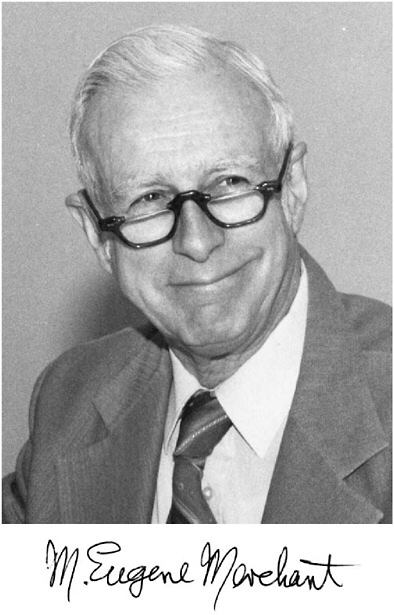
M. EUGENE MERCHANT
1913–2006
Elected in 1975
“For contributions in machine tool research and development.”
PROVIDED BY TECHSOLVE SUBMITTED BY THE NAE HOME SECRETARY
M. EUGENE MERCHANT was honored and respected all over the world. Tireless travelers, Dr. Merchant and Helen, his wife of 69 years, were welcomed and given VIP treatment by universities, organizations, and friends worldwide.
Gene Merchant attended high school in Essex Junction, Vermont, and then the University of Vermont. He received a graduate fellowship from the Cincinnati Milling Machine Company (CMMC) to study at the University of Cincinnati, where he received his Sc.D. degree. In 1936, Gene began a long and illustrious career in engineering research at CMMC (later Milacron). His early research was focused on analyzing the nature of friction between the cutting tool and the chip. As a young engineer, he developed an innovative mathematical model of the metal-cutting process that continues to be taught and used. This was just the beginning of years of creative research, for which his name was recognized and respected all over the world.
As director of physical research at CMMC, Dr. Merchant created a world-class department to study manufacturing processes. He and his staff facilitated the growth of industry by building up the knowledge base of manufacturing engineers. Later, as Milacron’s principal scientist for manufacturing research, he took a creative leap into the future. When computers were still in their infancy and software was extremely difficult to produce, he recognized the possibilities for computers in manufacturing.
In a series of far-reaching papers, he outlined his vision of computer-integrated manufacturing systems. His brilliant thinking influenced the development of computer-aided design/computer-aided manufacturing (CAD/CAM) and other software now used by manufacturing organizations throughout the world. He also helped introduce innovative concepts for eliminating waste in batch production, which is critical to lean manufacturing.
When he retired from Milacron at age 70, Dr. Merchant continued his work at Metcut Research Associates. Then, from 1995 to 2005, he was a senior consultant at TechSolve, a Cincinnati-based, nonprofit, engineering consulting firm. In his honor, TechSolve named its research laboratory for him and established the Dr. M. Eugene Merchant Scholarship Fund through the University of Cincinnati College of Engineering. TechSolve also published Dr. Merchant’s recent book, An Interpretive Review of 20thCentury U.S. Manufacturing and Grinding Research.
Dr. Merchant was a leader in many organizations, including the Society of Manufacturing Engineers (SME), American Society of Lubrication Engineers, Federation of Materials Societies, and International Institution for Production Engineering Research (CIRP), a prestigious organization with a limited international membership. Throughout his career of more than six decades, he received numerous honors and awards. In 1955, he was named Cincinnati’s Engineer of the Year by the Technical and Scientific Societies Council of Cincinnati. In 1968, he was awarded the SME Frederick W. Taylor Research Medal. In 1986, he was the first to receive an honor named for him, the M. Eugene Merchant Manufacturing Medal, sponsored jointly by the American Society of Mechanical Engineers (ASME) and SME. He was also the recipient of the Award of American Machinist Magazine, the National Award of the American Society of Lubrication Engineers, and the Research Medal and Richards Memorial Award of ASME.
Dr. Merchant was held in high esteem by colleagues worldwide, and he received many international honors, including the 1980 Tribology Gold Medal of the Institution of Mechanical Engineers (Great Britain), the Otto Benedikt Prize of the Computer and Automation Institute of Hungary, and the Medal of
the Polish Institute of Metal Cutting. Universities also recognized Dr. Merchant for his outstanding achievements. He held honorary doctorates from the University of Vermont (1973) and the University of Salford, England (1980), as well as an honorary doctor of engineering degree from GMI Engineering and Management Institute (1994).
Dr. Merchant always had time for friends and colleagues, as well as for young people. In March 2006, he was honored with the Spirits of Scouting Award for his 80-year affiliation with the Boy Scouts of America. His soft-spoken manner and courtly ways were appreciated by young engineers, who were in awe of his monumental reputation and his important accomplishments.
“He was a visionary,” said grandson, George Alexander, of Taylor Mill. “He had a lifelong commitment to learning. He was never not learning something.”
“It was always a charmingly surreal time to visit my 90-something grandfather and have him show me new tricks on his computer,” said another grandson, John Jacobson of Milwaukee, a self-described techie. “It got to the point where I started taking along a notepad and pen whenever I’d sit with him in his home office.”
His daughter, Leslie Alexander, died in 2004, and his son, M. David Merchant, also died earlier. Survivors include his wife of 69 years, Helen Merchant; daughter, Frances Sue Jacobson of Pontiac, Illinois; brother, Robert Prescott Merchant of Lynchburg, Virginia; six other grandchildren and four great grandchildren.


