
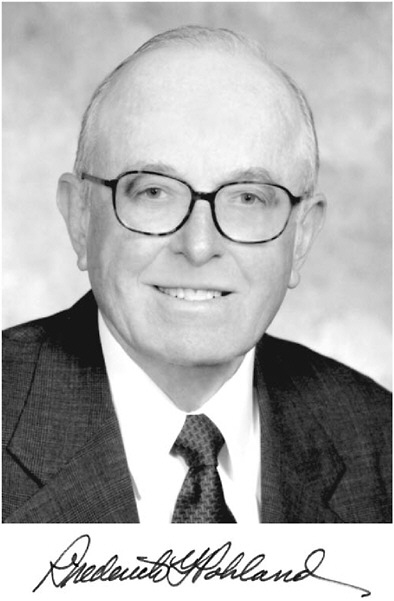
FREDERICK GEORGE POHLAND
1931–2004
Elected in 1993
“For advancing the theory of anaerobic treatment processes and applications to solid waste management.”
BY RICHARD A. CONWAY
FREDERICK GEORGE POHLAND was born in Oconomowoc, Wisconsin, on May 3, 1931. The middle child of five, he had a rather strict Lutheran upbringing and spent summers on the Upper Peninsula of Michigan. His family later moved to Charlotte, North Carolina, where he attended his final year of high school. He received his B.S. in civil engineering from Valparaiso University (1953) and, after working as an engineer driving spikes with the Erie Lackawanna Railroad Company (one of many jobs that helped pay for his education), he completed service with the U.S. Army and then earned an M.S. (1958) and Ph.D. (1961) in environmental engineering at Purdue University. He was awarded the prestigious Harrison Prescott Eddy Medal by the Water Environment Federation (WEF) in 1964 for his excellent dissertation and research.
After working his way though college, and assisting his younger brother through the same institutions, Fred demonstrated his discipline and responsibility, which was reflected in all of his later endeavors. He received an Sc.D. (honoris causa) from Valparaiso University in 1996 for “excellence in service to the human family” as an engineer, student, explorer, teacher, professor, and writer interested in “the ways in which humans use and misuse that most vital of all elements—water.”
Fred devoted most of his professional career to engineering education, research, practice, and service. He led the environmental engineering programs at the Georgia Institute of Technology (1961–1988) and then at the University of Pittsburgh (1989–2004). He was also Visiting Scholar at the University of Michigan (1967–1968) and a Guest Professor at the Delft University of Technology in the Netherlands (1976–1977). At the time of his death, Fred was Professor and Edward R. Weidlein Chair of Environmental Engineering at the University of Pittsburgh; after his death, he was awarded an Emeritus Professorship, the first time the university conferred this honor posthumously.
Fred’s research led to fundamental advances in anaerobic processes. His concept of a landfill as a bioreactor through controlled leachate recycling was adopted by the Delaware Solid Waste Authority, among many others. Fred originated and chaired the International Water Association (IWA) Specialist Groups on Anaerobic Digestion (1985–1992) and Landfill Management (1995–1999), which brought together practitioners, researchers, and educators from all over the world.
In keeping with his commitment to applying research to practice and disseminating vital information, he served as regional editor of Water Research and Water Science and Technology (both 1993–2002) and as honorary executive editor of Water Research (1994–2000). Fred could often be found on weekends in his office working on manuscripts, and thanks to his expertise, these publications became the exceptional journals they are today. From 1991 to 1998, he chaired the American Academy of Environmental Engineers (AAEE) WASTECH Program, which developed two series of books for practitioners in remediation. A writer himself, Fred was the author of more than 150 technical and scientific publications. His clear, precise, insightful prose was praised by even the most rigorous critics.
As chair of the WEF Program Committee (1989–1992), he worked to ensure that all professionals in the water-quality field were supplied with the latest science and technology. In 1989, WEF honored him with the Gordon Maskew Fair Medal for “exemplary demonstration of proficient accomplishment in the
training and development of engineers in the environmental engineering field.” Fred served on the Environmental Protection Administration Science Advisory Board (1989–1997), where he worked hard to ensure that science and technology were used in the regulatory process.
Fred’s ability to unite education, research, and practice was recognized in many ways, including his election to the National Academy of Engineering (1993), honorary memberships in WEF (1993) and IWA (2000) and the bestowal of the Gordon Maskew Fair Award (2000), the presidency of AAEE (1992–1993), selection as the American Society of Civil Engineers (ASCE) Simon Freeze Memorial Lecturer (2001), and bestowal of the Association of Environmental Engineering and Science Professors Frontier Award (2003).
Fred served on many National Research Council committees addressing research on water resources, innovative technologies, landfills, subsurface contamination, environmental remediation at Navy facilities, biosolids, and advanced technology for human support in space.
Fred was also an active member of his community. In Atlanta and Pittsburgh, he was a member of Rotary Club International (and president of his local club), and he hosted international students through the organization’s exchange program. He was always a willing volunteer for Junior Achievement, Special Olympics, and state certifying and examining boards.
After his untimely death in 2004, the Association of Environmental Engineering and Science Professors, in conjunction with the American Academy of Environmental Engineers, established the Frederick George Pohland Medal and honorarium to recognize his outstanding, sustained efforts to bridge environmental engineering research, education, and practice. Fred’s family, colleagues, and friends hope his example will encourage others to work toward combining these three elements of engineering and science.
When I reflect on Fred’s life and accomplishments, I am reminded that he was fascinated by the achievements of Abraham Lincoln and other great statesmen like George Washington and John Adams. He was also inspired by great environmental engi-
neers like Thomas Camp, Gerald Rohlich, Donald O’Connor, and Gordon Maskew Fair. What did Fred have in common with these men? A lot—especially courage and resolve. Here’s an example.
At my invitation, Fred was one of four adventurous engineers who took a whitewater rafting trip down the Gauley River in West Virginia, the most difficult rafting river in the East. At high water, the Gauley River has Class V rapids. At the start of the trip, our guide cautioned us that our success in navigating the big rapids would depend on hard paddling to build up the velocity we would need to steer the raft. We made it through the first dozen or so scary rapids and then reached a Class V rapid, where photographers were waiting to record the event. Unlike many rafts before and after us, we did not capsize or lose anyone.
Looking at the photographs later, we saw that most of the self-proclaimed adventurers were hanging onto the raft for dear life. Fred was the only passenger with a paddle in the water. Commenting later, he said, “That is what we were supposed to do.” His statement was simple but profound. Fred remained focused on accomplishing a goal—in this case paddling—although he thought he was just doing his duty. In the same way, his commitment to his professional life established him as one of the eminent engineers of his era. Fred’s sense of responsibility was apparent in his career and in his commitments to his community, family, and friends. Such is a measure of his eminence.
His professional goals included helping his academic institutions become the best they could be. As a professor dedicated to excellence, he taught a full load of courses, brought in numerous research grants, mentored his students, and assisted his colleagues. He reached beyond his institutions to facilitate the practice of engineering on a broad scale, to assist government agencies in making environmentally sound decisions, all the while honing his own skills and expertise. He felt he had a responsibility to excel in his profession so he could have a greater impact. Finally, he felt he had a responsibility to maintain high personal standards, to live up to a professional code of conduct. As a result, prestigious professional societies awarded him their
highest honors. Fred’s guidance and leadership will be missed by his family, friends, colleagues, and students.
I had the good fortune of working with Fred on technicalsociety leadership, government advisory boards, and National Academy committees. We became close friends, and I got to know his family, his beloved wife, Ruth, and daughter, Elizabeth, very well. It was an honor for me to write this memorial tribute.


