
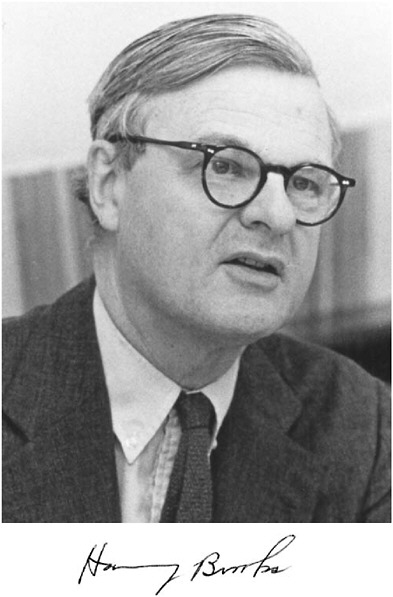
HARVEY BROOKS
1915–2004
Elected in 1968
“For technical contributions to solid-state engineering and nuclear reactors; leadership in national technological decisions.”
BY JOHN HOLDREN AND VENKATESH NARAYANAMURTI
HARVEY BROOKS, Gordon McKay Professor of Applied Physics, Emeritus, in the Division of Engineering and Applied Sciences and Benjamin Peirce Professor of Technology and Public Policy in the Kennedy School of Government at Harvard University died of natural causes at his home in Cambridge, Massachusetts, on May 28, 2004. He was 88 years old and is survived by his wife Helen and their four children, Alice, Katharine, Kingsley, and Rosalind, and by two grandchildren.
Harvey was born in Cleveland, Ohio, on August 5, 1915. He graduated from Yale in 1937 in mathematics and studied physics as a Henry Fellow at Clare College, Cambridge, England, and at Harvard, where he got his Ph.D. in 1940 under the direction of Nobel Laureate John Van Vleck. He was a Junior Fellow in the Harvard Society of Fellows from 1940–1942 and a staff member in the Harvard underwater sound laboratory from 1941 to 1945. He joined General Electric in 1946 and served there as Associate Head of the Knolls Atomic Power Laboratory.
In 1950 Harvard established the Division of Engineering and Applied Physics with Van Vleck as its first Dean. Van Vleck in turn invited Harvey back to Harvard as Gordon McKay Professor of Applied Physics in 1950. At Van Vleck’s retirement, Brooks succeeded him as Dean in 1957 and served in that post until 1975. During this period, Harvey made several notable contributions to the fundamental theory of semiconductors and the
band structure of metals. He founded the International Journal of Physics and Chemistry of Solids in 1957 and served as its editor-in-chief for nearly two decades. During his tenure as dean, the Division of Engineering and Applied Physics made many significant faculty appointments in the applied sciences and engineering.
In addition to his work in industrial and academic research, administration, and teaching in science and engineering, Harvey pursued an exceptionally vigorous and productive career of practice and scholarship in science and technology policy. He served as a member of the President’s Science Advisory Committee (PSAC) for Presidents Eisenhower, Kennedy, and Johnson and forever after was one of the shrewdest observers and chroniclers of the craft of science advice to the President.
He was one of the principal developers of the concept and methods of technology assessment and could take (although he never claimed) much credit for the establishment of the Congressional Office of Technology Assessment in 1973, which operated with great success for 22 years until its demise in a fit of congressional budget-cutting in 1995.
Harvey was a member of the National Academy of Engineering, the National Academy of Sciences, the Institute of Medicine, and the American Academy of Arts and Sciences, serving the American Academy as President from 1971 to 1976. He participated in and chaired an immense number of committees and panels in the academy complex, where the highlights of his service included instrumental roles in the founding of both the International Institute for Applied Systems Analysis in Vienna and the International Centre of Insect Physiology and Ecology in Nairobi. From 1975 to 1980 he co-chaired the largest and most complex committee effort ever undertaken by the National Research Council, generating the prescient and influential study of America’s energy future, Energy in Transition 1985-2010.
Harvey’s prodigious output of scholarly articles and chapters on science and technology policy, extending over five decades, conveyed a striking proportion of the seminal ideas that shaped this field. He was, for this whole period, the best known, most widely read, most respected scholar in the world in the science
and technology policy field—the acknowledged chief architect and dean of the discipline.
Harvey’s cross-cutting interests at the intersection of science and technology with policy were abundantly reflected in his trajectory at Harvard. He shepherded the newly formed, IBM-funded Program on Technology and Society from 1968 to 1972, and when he stepped down as dean of engineering and applied science in 1975 he became Benjamin Peirce Professor of Technology and Public Policy in the Kennedy School of Government. The following year he founded the Kennedy School’s Program in Science, Technology, and Public Policy in 1976 and directed it until his retirement in 1986. That program still flourishes today, guided in substantial part by Harvey’s ideas.
Harvey was the recipient of the Ernest O. Lawrence Award of the Atomic Energy Commission, the Philip Hauge Abelson Prize of the American Association for the Advancement of Science, and many other honors awards including six honorary doctorates.
For all of his erudition, experience, and distinction, though, Harvey was absolutely without arrogance or affectation. He invested tremendous effort in improving the thinking and writing of his students and colleagues (who were often tempted to publish the densely reasoned commentaries he produced on their drafts and throw the drafts away). Harvey cared about science and technology, about policy, about teaching, and about the intersection of these in making the world a better place. He never cared about who got the credit.
A much beloved scientist, engineer, dean, public intellectual, and advisor to three presidents and generations of policy practitioners and scholars, Harvey Brook had a lasting impact. He is sorely missed.


