
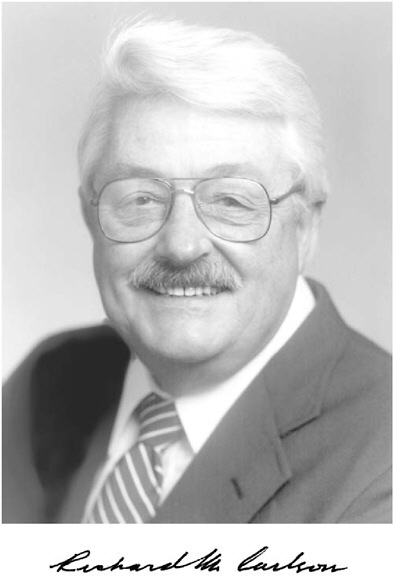
RICHARD M. CARLSON
1925–2004
Elected in 1990
“For significant contributions to the application of composite materials to operational helicopters.”
BY WILLIAM F. BALLHAUS JR.
RICHARD M. CARLSON, retired chief of the Advanced Systems Research and Analysis Office, U.S. Army Aviation and Missile Command, Ames Research Center, died at his home in Saratoga, California, on July 12, 2004. He was 79 years old.
Dick was born in Preston, Idaho, on February 4, 1925. His grandfather was a doctor who supported his interest in aviation—it was the Lindbergh era—by sending him, at age 10 or 12, on a flight from Salt Lake City, Utah, to Los Angeles to visit relatives. The plane, a Fokker, with wooden wings, was operated by TWA, predecessor of Trans Continental and Western Air. The experience made a big impression on Dick, who enrolled in the University of Washington after high school and participated in the U.S. Navy V-12 Program for reserve officer candidates. He earned a Bachelor of Science degree in aeronautical engineering in 1945.
Following graduation, Dick was commissioned as an ensign in the U.S. Navy; he served as an aircraft maintenance officer for 10 months in the Pacific. One of his assignments, at Pearl Harbor, was disposing of surplus aircraft, many of them brand new, a task he did not relish, especially after he learned that some engines and other parts found their way into the hands of unscrupulous profiteers. After completing his service, Dick re-
turned to the University of Washington and, in 1948, was awarded a master’s in aeronautical engineering. Afterward, he gained valuable research experience working in the 12-foot pressure tunnel at Ames, then a part of NACA (National Advisory Committee for Aeronautics), predecessor of the National Aeronautics and Space Administration (NASA), at Moffett Field, California. He gained his initial industry experience in fixed-wing engineering at Convair and Douglas Aircraft in Southern California.
In 1950, Dick joined Hiller Aircraft Corporation, Menlo Park, California, as a structures engineer, and, in just three years, he was manager of the Aerostructures Department. He worked closely with the company founder, Stanley Hiller Jr., a pioneer in helicopters (who died on April 20, 2006); at the same time, Dick attended Stanford University, where he earned a Ph.D. in engineering mechanics in 1960.
Dick’s involvement with rotary-wing aircraft began while he was at Hiller, where he was instrumental in providing technology and design contributions to a generation of helicopters, particularly the early application of composite structures, and in developing unique aircraft configurations (e.g., tilting thrusters). Aircraft he worked on include the UH-12B, Hiller Hornet (HJ-1), Navy One-Man Helicopter (XROE), H-23D, UH-12E, X-18 Tilt Wing, OH-5A, and XC-142 Tilt Wing.
In 1964, when Hiller was sold, Dick joined Lockheed California Company in Burbank, where, as an engineer in the Advanced Design Division, he was responsible for aerodynamics, dynamics, structures, and weights development analyses for the AH-56 Compound Helicopter (Cheyenne). While continuing to encourage the development and use of composites in vertical take-off and landing (VTOL) aircraft (for example, for the AH-56 propeller, tail rotor, and structural panels), Dick was assigned to support fixed-wing projects related to C-5A wing problems, L-1011 empennage, and development of the supersonic transport (SST) and to serve as a consultant to the Advanced Development Projects activity, also known as the Skunk Works. He worked with many engineering luminaries, such as Kelly Johnson and Jack Real, and was an advisor to Howard Hughes. He directed
pre-design activities on the Canadian “Bush Pilot” and Dutch navy’s anti-submarine warfare (ASW) versions of the Model 286 helicopter; the U.S. Army Composite Aircraft Program; the U.S. Air Force Combat Aircrew Rescue Aircraft; and the Light Intra-theater Transport.
From 1958 to 1974, while commuting from southern California during his Lockheed years, he was a lecturer at Stanford, where he developed and taught a full helicopter curriculum at the undergraduate and graduate levels, covering VTOL aerodynamics, dynamics, aeroelasticity, and design. He enjoyed his academic experience and was dedicated to it. When he finally relinquished his duties, he enlisted other rotorcraft experts to lecture.
After leaving industry in 1972, Dick went to work for the U.S. Army at Ames. Beginning as chief of the Advanced Systems Research Office, U.S. Army Air Mobility Research and Development Laboratory, he rose to the position of laboratory director in 1976, assuming responsibility for all rotorcraft research activities for the Army and directing programs at Ames, Lewis, and Langley Research Centers and at Fort Eustis. He was the leader for technology development programs for the advanced digital-optical control system, advanced rotorcraft transmission, the Advanced Composite Airframe Program, and the Crew Station Research and Development Facility at Ames. His influential role in the research and development program of the XV-15 tilt-rotor aircraft was integral to the foundation of the V-22 Osprey, the third VTOL aircraft (after the helicopter and jet lift) to attain production status.
Dick retired from the government in 1995 but continued his professional career as an Army emeritus volunteer and as a designated engineering representative (structural) for the Federal Aviation Administration (FAA), a position he held from 1952 until his death. Among his many awards and honors, were a Presidential Rank of Meritorious Executive Award and three Army Meritorious Civilian Service Awards. He was the author of 25 technical papers on circular frames, helicopter rotor-blade structural analysis, and the use of composite material in rotorcraft structures.
He was an honorary fellow of the American Helicopter Society (AHS), which awarded him the Alexander Klemin Award (for notable achievement in the advancement of rotary-wing aeronautics), Paul E. Hauter Award (for significant contributions to the development of VTOL aircraft other than helicopters), and Alexander Nikolsky Lectureship Award (for exceptional achievements in V/STOL aircraft engineering and development). He served with distinction as a member of the original Aircraft Industry Association W-76 Committee on CAA/FAA Structural (Fatigue) Certification of Aircraft, the AHS Technical Council, the NATO-sponsored Advisory Group for Aerospace Research and Development Structures and Materials Panel, and three-terms on the Congressional Advisory Committee on Aeronautics. In addition, he was a member of the U.S. Department of Defense/NASA Aeronautical/Astronautical Coordinating Board Subcommittee for VTOL Aircraft and the NASA Special Advisory Subcommittee on Manned Aeronautical Flight Research.
Dick was elected a member of the National Academy of Engineering in 1990. He was also a fellow of the American Institute for Aeronautics and Astronautics; a fellow of the British Royal Aeronautical Society; a member of the Swedish Society of Aeronautics and Astronautics; the Army Aviation Association of America; and Sigma Xi, the Scientific Research Society. He was a registered professional engineer (mechanical) in California.
Dick was a mentor to a legion of practicing engineers and aviation professionals. He liked to “walk the boards” and meet engineers. He was interested in their work and was always looking for promising young talent. He was also very interested in developments in VTOL overseas and was involved extensively in international research on rotary-wing aircraft conducted jointly by the U.S. Army and France, West Germany, Italy, and Israel.
Dick was widely recognized as a leader in the development of aviation technology. His lifetime of technical achievement spanned some 50 years, and his impact on the aerospace technology field in industry, government, and academia is practically unmatched. His personal contributions to the field of rotorcraft technology greatly advanced and continue to benefit
the domestic and international VTOL community. Dick’s guidance and direction for technology development in the Army gave the United States a substantial lead in the rotorcraft field.
Dick is survived by his wife Venis Carlson; a son, Richard Carlson Jr., of Santa Cruz, California; two daughters, Judith Anderson of Eureka, California, and Jennifer Peterson of San Jose, California; and two grandchildren.


