
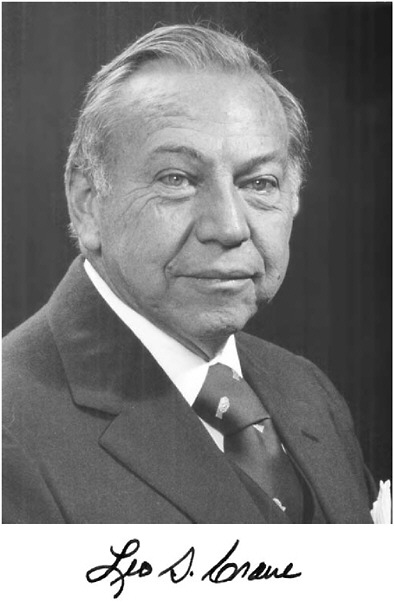
L. STANLEY CRANE
1915–2003
Elected in 1978
“For pioneering the application of modern and creative engineering concepts to more productive railroad equipment and operations.”
BY WILLIAM J. HARRIS JR.
STAN CRANE was born in Cincinnati, Ohio, on September 7, 1915. He died in a hospice in Boynton, Florida, on July 15, 2003.
Stan attended the Engineering School of George Washington University in Washington, D.C., and earned the degree of Bachelor of Science in Engineering in 1938. While he was still an undergraduate, he was elected to Tau Beta Pi, the engineering honorary fraternity.
In 1934, he began work as a laboratory assistant at Southern Railroad, where he continued working after graduation. At that time, the railroad industry was facing serious financial problems. The economy was in a depression, and, as highways and trucks were improved, railroads were facing growing competition for transportation services. When Stan Crane joined Southern Railroad, he believed they could beat the competition by using diesel locomotives, which could pull longer and heavier trains. As a result of Stan’s hard work and leadership, Southern was the first Class I railroad to achieve complete conversion to diesel power. Engineers working for Southern Railroad raced to replace cars that could carry 40 tons of cargo with cars that could carry 100 tons of freight. Diesel locomotives pulling trains with 100 of these 100-ton cars dramatically improved transportation services.
Until that time, railroad track had been assembled by bolting
together 39-foot long sections of rail. These steel track sections were laid on cross ties of wood or concrete and held down on the cross ties by spikes or other fasteners. Then crushed rock or other materials were laid on the ground to ensure good drainage and good support for the crossties and rail. With the advent of longer and heavier trains, it was necessary to increase the strength and stability of track. This was accomplished by welding many sections of rail together and fastening the welded sections to the cross ties. The longer sections of rail not only provided more stability, but also required less maintenance. Southern Railroad was a pioneer in the introduction of welded rail and a significant contributor to the development of track-laying and maintenance technology. The operation of long, heavy trains also necessitated that locomotive engineers be retrained. Southern Railroad developed training programs based on research and operations experience. As Stan’s career developed, all of these issues fell within the limits of his responsibility. He was promoted to assistant chief mechanical officer, then to vice president of engineering and research, then to executive vice president of operations.
Nothing in Stan’s education signaled his unique leadership qualities, but from the beginning, he displayed a capacity to identify the nature of problems and the resources necessary to address them. Exchanges between Stan Crane and his senior staff were more like the sharing of views in an extended family than typical boss/employee exchanges. Stan had the presence of a father figure and the ability to infuse the discussion with the excitement of a doctoral examination. He knew how to generate excitement for solving the problems of the hour.
Stan’s progression from laboratory assistant was duly noted by other companies faced with making the same improvements, and the Pennsylvania Railroad recruited Stan Crane to serve as director of industrial engineering. After just two years, however, Southern Railroad won him back, and Stan renewed his climb to the top of the company. He was soon named president and chief executive officer (CEO).
Southern had an inflexible requirement for retirement at age 65. At that time, Stan left to become chairman and CEO of
Conrail, a group of railroads in the Northeast that had gone into bankruptcy, had been reassembled as a single operating property, and were facing significant economic losses. Stan Crane was ideally suited to rescuing them. Not only was he highly regarded by executives in the industry, but he also had a management style that generated dedication and enthusiasm for achieving common objectives. His achievements at Conrail were extraordinary. In a single year, he transformed a railroad that was losing hundreds of millions of dollars per year into a profitable venture. The following year, the company earned even more, despite very difficult times.
When he became head of Conrail, all of the company’s stock was owned by the U.S. Department of Transportation, but Stan was convinced that Conrail should be operated as a private company. Ultimately, Conrail was divided into two separate elements, one that merged with Norfolk Southern Railroad and one that merged with Seaboard Coastline Railroad. The Conrail segments of both continue to make significant traffic and economic contributions to their parent companies.
Throughout his decades of accomplishment, Stan was a strong supporter of the research program of the Association of American Railroads (AAR), which had a facility in Chicago where new components were tested to ensure that they met performance requirements. To expand the program, he worked cooperatively with the Federal Railroad Administration (FRA) to establish a research facility in Pueblo, Colorado, dedicated to improving the efficiency and safety of railroad operations in general. Stan was deeply involved in efforts to mark all freight cars with machine-readable identifiers and develop a reliable way of communicating the order of cars as they approached the switching yard so they could be efficiently sorted and reassembled in trains moving toward their proper destinations.
In 1970, when FRA decided to close down the Pueblo facility, Stan Crane was instrumental in persuading FRA to keep it open. Eventually, all AAR research was transferred to Pueblo, which still uses test tracks and test equipment to improve the safety and efficiency of rail transportation.
Stan was the recipient of many awards in recognition of his
contributions to the railroad industry: Modern Railroads named him Railroad Man of the Year in 1983 and 1987; Financial World awarded him the Silver Award of CEO of the Decade and named him Chief Railroad Executive of the Year; the Pennsylvania Chamber of Business and Industry named him Business Leader of the Year in 1987; the Women’s Transport Seminar gave him the Philadelphia Award; the Cooperstown Conference gave him the Right Hand Man Award; Syracuse University awarded him the Salzberg Memorial Medallion; Industry Week gave him the Excellence in Management Award; the National Defense Transportation Association gave him an award for excellence; the St. Louis Railway Club named him Man of the Year; the Transportation Association of America gave him the Seley Award; and the American Society of Traffic and Transportation honored him with the Joseph C. Scheleer Award. Stan was elected to the National Academy of Engineering in 1978.


