
1
Fundamentals: The Health of the Public Is Threatened
In a world where health threats range from AIDS and bioterrorism to an epidemic of obesity, the need for an effective public health system is as urgent as it has ever been. An effective public health system requires well-educated public health professionals. (IOM, 2003b)
Despite the achievements that have been made in public health, there is now a growing shortage of public health workers (ASTHO, 2004). A recent study found that between 1980 and 2000, the number of public health workers in the United States decreased by more than 28 percent, from 220 to 158 workers per 100,000 Americans (Merrill et al., 2003). Furthermore, many of the workers who are currently employed in this area are unevenly prepared to face today’s public health challenges (IOM, 2003a,b).
A key component of the public health workforce is physicians. The U.S. Congress, through the Consolidated Appropriations Act of 2005 (Public Law 108-447, Conference Report 108-792), authorized the Health Resources and Services Administration to contract with the Institute of Medicine to determine what knowledge and skills that public health physicians need, the number of programs needed to maintain an adequate supply of physicians trained for public health careers, and to examine how these programs can be funded.
Physicians are a vital part of the public health workforce and are the focus of this report. The committee’s vision for the public health physician workforce has three components. First, the committee envisions a future in which sufficient numbers of well-trained public health physicians are working with other public health professionals to address population issues, such as health promotion and disease prevention, chronic and infectious diseases, safe food and water supplies, sanitation, and environmental exposures. Second, the committee envisions a future in which
sufficient numbers of well-trained public health physicians are available to provide the scientific and clinical input along with the leadership and management necessary to link and coordinate the efforts of the many participants of a strong public health system, as described in The Future of the Public’s Health (IOM, 2003a). Third, in the face of public health emergencies, the committee envisions a future with sufficient numbers of well-trained public health professionals, including physicians, to plan for and prevent these emergencies or to respond to them. Such emergencies would include disasters, such as hurricanes and threats of bioterrorism, or emerging or reemerging infectious diseases, such as pandemic influenza and multiple-antibiotic-resistant tuberculosis.
PUBLIC HEALTH IN THE UNITED STATES
Industrialization, population growth, and increasing urbanization led to worsening public health conditions in the United States in the late 1700s and early 1800s. “The mixing of dense populations living in unsanitary conditions and working long hours in unsafe and exploitative industries with wave after wave of cholera, smallpox, typhoid, tuberculosis, yellow fever, and other diseases was a formula for disaster” (Turnock, 2004). The devastating yellow fever epidemic in New York City in 1798 led the state legislature to grant the city authority to pass its own health laws (Rosen, 1963). Also in 1798, the U.S. Congress passed an “act for the relief of sick and disabled seamen” (Parascandola and Robinson, 2005) that established a federal network of hospitals for the care of merchant seamen. John Maynard Woodworth, the first Supervising Surgeon (a position later designated Surgeon General), put together a medical staff of physicians who could be assigned to the various marine hospitals on the basis of need. In 1870 these marine hospitals were reorganized into the Marine Hospital Service, which, as services and activities expanded, became the U.S. Public Health Service in 1912. Federal Public Health Service commissioned officers engaged in activities aimed at controlling the spread of contagious diseases, conducted biomedical research, and provided health care and assistance following disasters, as well as numerous other activities (USPHS, 2006).
In 1850, Lemuel Shattuck issued the Report of the Sanitary Commission of Massachusetts, which called for the establishment of state and local health departments to focus on improving sanitation, controlling communicable diseases, providing services for infants and children, and collecting data on the public’s health (Turnock, 2004). The development of local health departments spread rapidly to address the public health needs of local communities.
The dawn of the 20th century marked the beginning of an era bur-
geoning with new innovations and discoveries that advanced the public health objective of improving the health of individuals and populations. Improved sanitation and hygiene, safer workplaces, cleaner air, and enhanced food and drug safety led to reductions in morbidity and mortality due to infectious diseases and other illnesses. Innovative preventive health programs improved health through family planning and maternal and infant health services, along with school health programs, immunization for vaccine-preventable diseases, and behavioral health services that addressed alcohol and drug abuse and mental health problems. Innovative technological advances such as seat belts, motorcycle helmets, and smoke detectors resulted in a marked decline in the number of deaths and disabilities from injuries.
Despite the many achievements of public health, the beginning of the 21st century finds the public health system facing major problems. According to the Institute of Medicine (IOM, 2003a), governmental public health agencies are severely underfunded; obsolete and inconsistent laws and regulations hinder coordinated, effective action; information systems are inadequate; and public health laboratories suffer from insufficient staffing, training, and resources. Furthermore, the current public health workforce is poorly prepared to meet new challenges.
THE CURRENT STATE OF PUBLIC HEALTH STRUCTURE AND PRACTICE
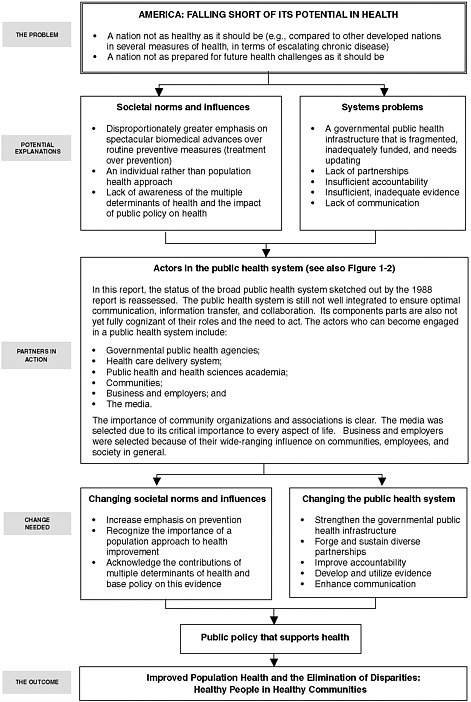
In 2001 the Institute of Medicine undertook a study to examine the current state of public health in the United States and make recommendations for its improvement. The resulting report (IOM, 2003a) concluded that America was not as healthy as it should be nor was it as well prepared as it should be to address future health challenges. The report’s central message was that to protect and promote health and well-being, the nation needs a strong governmental public health infrastructure. Although governmental public health agencies are the backbone of the public health system, they are clearly in need of support and resources and must build and maintain partnerships with other organizations and sectors of society.
Most people view health as an individual or personal issue. However, ensuring the health of the public requires an approach that recognizes there are multiple determinants of health that interact over the life course. Addressing these determinants requires the combined efforts of a “complex network of individuals and organizations that have the potential to play critical roles in creating the conditions for health” (IOM, 2003a). The public health system envisioned in the 2003 report includes governmental public health agencies at the core working with the health care delivery
system, public health and health sciences academia, communities, businesses and employers, and the media.
Figure 1.1 lays out graphically the report’s identification of the problems and the kinds of changes needed.
The 2003 Institute of Medicine report explored several areas of action and change, including adopting a focus on population health that includes multiple determinants of health, strengthening the governmental public health infrastructure, building partnerships with other sectors, developing systems of accountability, emphasizing evidence, and improving communication within the public health system (e.g., among all levels of the governmental public health infrastructure and between public health professionals and community members). The full report makes 34 recommendations (see Appendix A), several of which are most pertinent to the present study about preparing physicians for public health careers (see Box 1-1).
The recommendations in that report were directed to many parties because, as the report indicates,
[I]n a society as diverse and decentralized as the United States, achieving population health requires contributions from all levels of government, the private business sector, and the variety of institutions and organizations that shape opportunities, attitudes, behaviors, and resources affecting health. Government public health agencies have the responsibility to facilitate and nurture the conditions conducive to good health. But without the active collaboration of other important institutions, they cannot produce the health outcomes envisioned in Healthy People 2010. (IOM, 2003a)
PHYSICIANS AND THE NATURE OF PUBLIC HEALTH PRACTICE
Public health is an interdisciplinary field of study and practice devoted to preventing illness, disease, and injury and to promoting and protecting human health with respect for human rights and dignity. It is defined as “what we as a society do collectively to assure the conditions in which people can be healthy” (IOM, 1988). Effective public health interventions are designed, implemented, and managed by a wide range of professionals, including physicians, nurses, engineers, dentists, veterinarians, sanitarians, community planners, attorneys, health educators, community outreach workers, and countless other professionals and volunteers. Each of these professionals works in an environment greatly influenced by public policy, which in turn is affected by economic, political, business, and community interests and concerns.
The foundation for effective public health interventions rests on sound scientific principles developed by using a broad range of scientific disciplines, such as epidemiology, statistics, environmental health, health
|
BOX 1.1 Selected Recommendations from The Future of the Public’s Health in the 21st Century
SOURCE: IOM (2003a). |
administration, and behavioral science. In addition, clinical practitioners and researchers in basic health and social sciences work to design and implement public health interventions using the combined expertise of these diverse disciplines and professions to ensure that they have practical applicability and relevance. An effective public health system requires a well-trained workforce of sufficient numbers and diverse disciplines to address current and emerging public health needs. Despite the number and kinds of professionals, public health physicians remain central to the
public health mission. However, given this complex environment, the unique role of public health physicians is perhaps less clear now than it was in the past.
Historically, the majority of public health professionals were physicians (Hager, 1999). In the late 19th century, physicians, who often achieved distinction by participating in public health campaigns, made up 80 percent of the membership of the American Public Health Association (Brandt and Kass, 1999). As the association between public health and medicine that existed during the 19th and the early 20th centuries began to decline and as time passed, medical and public health professionals adopted different beliefs regarding individualized health care and the promotion of wellness for populations.
However, a symbiotic relationship exists between public health physicians and medicine. For example, today’s effective efforts to decrease the incidence of lung cancer through the reduction in the use of tobacco products began when epidemiologists and clinicians discovered the link between lung cancer and tobacco use. Over the years, new scientific discoveries, coupled with education and strong advocacy on the part of public health advocates, changed community norms, such that smoking is now widely understood to be a significant health hazard. Efforts are now designed to both prevent the initiation of tobacco use and assist with the cessation of tobacco use by people of all ages. These broad public health programs and efforts combine the most current scientific discoveries with the expertise of individuals in other disciplines—advertising and social marketing, indoor air quality assessment, legal enforcement, and public opinion—that have become synonymous with public health practice.
Nevertheless, as mentioned earlier, there is a growing shortage of public health workers (ASTHO, 2004), and many of the existing public health workers are ill prepared to meet the public health challenges of the 21st century (IOM, 2003a,b). Kennedy and colleagues conducted an 18-month study of the public health workforce in Texas and found that only 7 percent of public health professionals had formal education in public health (Kennedy et al., 1999). The Centers for Disease Control and Prevention estimated that 80 percent of public health workers lacked basic training in public health (CDC, 2001), and Turnock (2004) stated that only 22 percent of local health department chief executives have graduate degrees in public health. According to Glass (2000), a large number of physicians who engage in public health activities have no formal training in public health. Although specific data are scarce, expert opinion and testimony to the committee show that many current physicians do not have training in population or preventive health and are ill prepared to undertake public health careers.
PHYSICIAN CONTRIBUTIONS TO PUBLIC HEALTH
The medical paradigm is focused on providing individualized medical care. This approach requires the practitioner to weigh the benefits of a particular course of treatment or other health care services for the well-being of the individual. Population-based issues such as income and social supports may influence the treatment plan, but treatment has been viewed through the lens of the individual. Furthermore, specialization in the medical paradigm segments the individual into organ systems or body parts and provides focused care to that system as a component of the whole. The success of a medical treatment(s) is thus defined as the wellness of the individual.
Public health professionals, on the other hand, focus on population health broadly by using interventions designed to improve public health through changes to the environments in which people live and work, by making concerted efforts to modify human behavior and lifestyles to improve their health, and by ensuring that all individuals in society receive uniform medical care. Public health professionals specialize in population-based areas, such as epidemiology, environmental health, disease control, maternal and child health, injury control, occupational health, and nutrition (Fineberg et al., 1994). Success in public health is thus defined as the reduction, delay, or prevention of a disease or disability for a group of individuals or a community as a whole. Although individuals are the beneficiaries of the interventions, they are not usually the primary focus.
Physicians contribute to public health in many important and unique ways. The medical education that physicians receive provides them with a deep understanding of molecular biology, human anatomy, pathophysiology, pharmacology, and other basic sciences that are essential to understanding the interaction between people and their environment. For example, physicians must understand the interactions between diet and cardiovascular disease. Medical education encourages the gathering of data from a myriad of sources, whether it be by clinical examination, the taking of patient history, or laboratory tests. Their medical education teaches physicians to formulate the nature of the health problem, craft solutions, and monitor their patients to the conclusion of the particular health event. In addition, optimal medical care requires frequent reassessments and midcourse corrections to solve clinical problems. Physicians often work in multidisciplinary teams as well. These experiences on teams provide physicians with the basic leadership skills for team building, which is an essential skill in the field of public health. These skills reflect the three core public health roles of assessment (problem list), policy development (treatment plan), and assurance (reevaluation and retreatment).
Physicians must often make decisions, despite unsettling and irresolvable uncertainties. This demand for action in the presence of insufficient or conflicting data can be directly applied to the public health domain when there are major threats to the health of populations, such as disasters or disease outbreaks. Physicians are taught to deal with cause and effect to remedy what are often contentious or life or death situations. This valuable combination of skills and strategic thinking makes them highly qualified to help protect and ensure the public’s health and could prove invaluable if a natural or human-made disaster were to occur. Physicians who have supplemented their medical training with formal training in public health (in certificate or degree programs) or appropriate public health experience have the added benefit, from a public health perspective, of being able to draw upon their medical training while addressing issues using a more population-based approach.
Furthermore, physicians are the front line in disease recognition and diagnosis efforts that form the backbone of current community surveillance activities. Astute clinicians have alerted public health authorities to disease clusters or outbreaks. For example, in 1974, a physician diagnosed hemangiosarcoma of the liver in three patients. Knowing their occupations, he made the link between this highly unusual cancer and their exposure to vinyl chloride at their workplace. This led to the redesign of the workplace to provide a safer work environment. In another instance, surveillance data in New York City in 1999 did not show an increase in the number of reported cases of either meningitis or encephalitis. It was not until an alert clinician reported a case of encephalitis associated with severe muscle weakness that the city health department first became aware of the existence of the West Nile virus outbreak. Without that first call, the outbreak might have lingered for weeks without being recognized. Finally, in October 2001, an infectious disease physician in Palm Beach, Florida alerted authorities to the fact that severe health problems experienced by Bob Stevens, a newspaper employee, were the result of anthrax poisoning. The outcome of this event might well have been much more severe were it not for the intervention of this physician. In these cases, the physicians’ specialized knowledge and skills enabled them to recognize and identify illnesses that could threaten the health and well-being of the general public. The availability of physicians with specialized knowledge and skills is therefore especially important when public health actions that require advanced medical knowledge of disease processes, such as drug-resistant tuberculosis or emerging or reemerging infectious diseases, must be addressed.
Physicians are also spokespeople and champions for public health. Because of their knowledge and experience, they are often trusted and are effective voices that can address the health problems that might be occur-
ring within a community. The public also finds physicians to be credible experts with the most comprehensive backgrounds in health and disease prevention. This leadership role is vital in times of emergency when there is an urgent need to explain risks, contend with fear, and galvanize groups to contend with the emergency. Furthermore, when the collaboration of the entire community is needed to address significant health problems, a physician who is trained in public health can more easily leverage his or her relationships with people within the medical community and gain cooperation and commitment from those individuals.
Physicians can also help bridge gaps between human medicine and other disciplines, such as nutrition, biostatistics, epidemiology, psychology, veterinary medicine, and public health through collaboration with their counterparts. Their in-depth knowledge of medically related health issues make them important allies when partnerships are formed to investigate and study areas of interest to public health professionals. Physicians are therefore vital to the public health enterprise and bring unique knowledge, skills, and competencies that add value to addressing public health problems.
Attracting Physicians to Public Health
Ensuring that an appropriate number of physicians choose careers in public heath helps build a public health infrastructure that will provide benefits for all members of society. In addition, increasing the number of public health physicians who are members of minority and other underrepresented groups could help create and reinforce access to ethnically and culturally diverse communities that can otherwise become marginalized if they lack physicians whom community members believe can relate to their special circumstances.
Unfortunately, for many disparate reasons, it is difficult to attract physicians to the public health workforce. For many physicians, their first introduction to public health topics or concerns may be after they are well into their medical school training. Although many medical schools include public health among their required classes, medical students often do not recognize the relevance of public health to the care of patients. When such courses are offered, they often lack the visibility and importance that are given to other areas of medical specialization. Additionally, both in medical school and in general, few medical students are exposed to recognizable and respected public health physicians during their training. This lack of exposure contributes to the inability of physicians in training to identify public health practitioners or researchers whom they could emulate in their pursuit of a career in public health.
Once they have completed medical school, additional concerns influ-
ence the choices that graduating physicians make when they choose careers in areas other than public health. Currently, the major mechanism for funding graduate medical education (GME) relies on federal funds provided by reimbursements for clinical services and additional add-ons for training in clinical settings through the Medicare and Medicaid programs. Because public health settings often do not include direct clinical care activities, no direct or indirect GME funding is therefore available. This lack of funding for graduate training in public health means that training programs in public health must obtain funding from alternative sources, which may result in an increased burden of loans for physicians receiving graduate training in public health that those in other specialties do not have.
Furthermore, physicians who choose more traditional medical careers command high salaries and are typically rewarded with the respect of their peers and their communities. Public health physicians, on the other hand, have a more diffuse public image and are therefore often regarded as having less prestigious careers. They also receive salaries significantly lower than those that their counterparts in private practice receive. In 2005, for example, the mean salary for state health officer positions requiring a medical degree was $150,295 (ASTHO, 2005), whereas the mean compensation for medical directors in health plans (health maintenance organizations, hospitals, multispecialty groups, and single-specialty groups) was $239,630 (ACPE, 2005). Additionally, public health physicians have the added burden of working in a heavily politicized environment where uncertainty about stability and funding is ever present. For example, data show that the average tenure of state health officers between 1990 and 2006 was 3.76 years.1
CONTEXT
Physicians are a crucial component of the workforce, and it is therefore imperative that adequate numbers of physicians with training in public health be available to support the broader public health community. All physicians engage in public health activities some of the time; and their training in public health is important to excellence in public health practice, teaching, and research. Other physicians, however, are engaged in careers in public health. These public health physicians are defined as those “whose training, practice and world view are based in large part on a population focus rather than individual practice, that is, on assuring the availability of essential public health services to a population using
skills such as leadership, management and education as well as clinical interventions” (Gebbie and Hwang, 1998).
Physicians engaged in public health activities work in a variety of settings. However, governmental actions and agencies are recognized as constituting “the backbone of all efforts to assure the health of the public” (IOM, 2003a). Yet, in 2005, less than one-half (43 percent) of local health departments (LHDs) employed full-time or part-time physicians. For LHDs serving populations of less than 25,000 people (930 LHDs), only 20 percent employed a physician. Furthermore, for LHDs serving populations of more than 500,000, 46 percent had top executives with medical degrees,2 whereas only 9 percent of LHDs with populations less than 25,000 were led by individuals with medical degrees (NACCHO, 2006).
CONCLUSION
The public health system must be prepared to respond to, prevent, and detect health threats that range from natural disasters, bioterrorism, and emerging infections to chronic health threats, such as obesity. An effective public health system requires a well-educated public health workforce that includes sufficient numbers of physicians in a variety of positions. However, predicting the future needs for public health physicians is an imperfect science. Events or significant changes in health care could dramatically alter the estimates of the numbers of physicians needed in the public health workforce. Factors that could alter future needs include
-
the emergence of new, as yet unknown environmental risks, such as emergent infectious disease agents or environmental toxins;
-
dramatic changes in the delivery of health care that reduce the risk of disease onset and the progression of diseases that demand a significant effort by public health physicians, such as the development of a vaccine or the implication of a therapy that derives from genomic medicine;
-
the discovery of behaviors that could significantly increase or reduce the risk of disease and disease progression that requires significant input from public health physicians to implement the behavior;
-
a dramatic change in or fragmentation of the existing health care system that places an increased burden upon public health physicians; and
-
a natural or human-made disaster (perhaps much more severe than recent disasters encountered in the United States) that requires a
-
coordinated and rapid mobilization of public health physicians to a site (or multiple sites) around the country.
Physicians need to be trained to be part of the first line of defense against future health threats and also need to be groomed to take on leadership roles in the public health community. This report explores and presents conclusions about educating physicians for careers in public health and identifies issues and approaches to the question of funding physician education in public health. Chapter 2 describes roles for public health physicians, the areas of knowledge that these physicians need, and estimates of the numbers of physicians needed to maintain an adequate public health physician workforce. Chapter 3 focuses on the different pathways by which physicians come to careers in public health and describes both the degree and the nondegree options for training in public health for physicians. Chapter 4 addresses the funding of physician training for careers in public health. Chapter 5 presents some concluding thoughts.
REFERENCES
ACPE (American College of Physician Executives). 2005. Health plan medical directors doing well. Managed Care 14(12):13.
ASTHO (Association of State and Territorial Health Officials). 2004. State public health employee worker shortage report: A civil service recruitment and retention crisis. Washington, DC: Association of State and Territorial Health Officials.
———. 2005. 2005 SHO salary and agency infrastructure survey. Washington, DC: Association of State and Territorial Health Officials.
Brandt, A., and A. Kass. 1999. Collaboration and competition: Tracing the historical relationship of medicine and public health in the 20th century. In Education for more synergistic practice of medicine and public health, edited by Hager, M. New York: Josiah Macy, Jr., Foundation. Pp. 23-34.
CDC (Centers for Disease Control and Prevention). 2001. A global lifelong learning system: Building a stronger frontline against health threats. January 5. In A global and national implementation plan for public health workforce development. Atlanta, GA: CDC.
Fineberg, H. V., G. M. Green, J. H. Ware, and B. L. Anderson. 1994. Changing public health training needs: Professional education and the paradigm of public health. Annual Review of Public Health 15:237-257.
Gebbie, K., and I. Hwang. 1998. Preparing currently employed public health professionals for changes in the health system. New York: Columbia University School of Nursing, Center for Health Policy & Health Services Research.
Glass, J. K. 2000. Physicians in the public health workforce. In Update on the physician workforce. Rockville, MD: U.S. Department of Health and Human Services, Health Resources and Services Administration. Pp. 41-55.
Hager, M. 1999. Education for more synergistic practice of medicine and public health. New York: Josiah Macy, Jr., Foundation.
IOM (Institute of Medicine). 1988. The future of public health. Washington, DC: National Academy Press.
———. 2003a. The future of the public’s health in the 21st century. Washington, DC: The National Academies Press.
———. 2003b. Who will keep the public healthy: Educating public health professionals for the 21st century. Washington, DC: The National Academies Press.
Kennedy, V. C., W. D. Spears, H. D. Loe, Jr., and F. I. Moore. 1999. Public health workforce information: A state-level study. Journal of Public Health Management and Practice 5(3): 10-19.
Merrill, J., R. Btoush, M. Gupta, and K. Gebbie. 2003. A history of public health workforce enumeration. Journal of Public Health Management and Practice 9(6):459-470.
NACCHO (National Association of County and City Health Officials). 2006. 2005 national profile of local health departments. Washington, DC: National Association of County & City Health Officials.
Parascandola, J., and M. A. Robinson. 2005. Anchor & Caduceus, Commissioned Corps of the U.S. Public Health Service. Tampa, FL: Faircount Publication.
Rosen, G. 1963. A history of public health (expanded edition). Baltimore, MD: The Johns Hopkins Press.
Turnock, B. 2004. Public health: What it is and how it works. 3rd ed. Sudbury, MA: Jones and Bartlett.
USPHS (United States Public Health Service). 2006. The history of the Commissioned Corps. http://www.usphs.gov/html/history.html (accessed October 20, 2006).


