
2
Factors That Influence Building Protection
Buildings do not merely provide shelter for and enable the performance of their occupants; they are built to resist damage from fire, earthquakes, wind, and other hazards. Safety measures in buildings reduce the probability of injury to occupants and thereby minimize the disruption of operations in the facilities. However, threats to buildings are not limited to natural and industrial disasters and unintentional releases of hazardous substances. There have been intentional attacks on buildings in the United States in recent years, such as the attacks on the Alfred P. Murrah Federal Building in Oklahoma City and on the World Trade Center in New York City, and the anthrax incidents in various locations. Although the motive behind the mailing of letters containing Bacillus anthracis in 2001 is not known, the outcome was essentially an attack on humans in buildings, which both harmed the victims and disrupted operations within the buildings.
To protect against such attacks, it is important to consider various types of threats and their potential modes of delivery. Before designing any protection system for a building, the goals of protection have to be established. The goals are often driven by the mission of and activities in the building. The ability to meet these goals is partly constrained by the building type and procurement and the budget for the protection system. The Department of Defense (DOD) defines a DOD building as any building or portion of a building owned, leased, privatized, or otherwise occupied, managed, or controlled by or for the department (DOD, 2003). In other words, DOD buildings vary in type, procurement, and mission, all of which influence the design and implementation of building protection from biological and chemical airborne threats. This chapter discusses the factors that determine the goals and objectives of building protection. Cost, a consideration
in the design of a protection system, is also a criterion for evaluation and is discussed in detail in Chapters 4 and 6.
THREAT TYPES AND AGENTS
“Threat type” refers to different categories of methods and agents that a perpetrator could use in an attack—biological, chemical, and radiological agents and explosives in combination with a dissemination means. “Threat agent” refers to the specific biological or chemical agent used in an attack, such as B. anthracis or sarin. Within the two threat types that are considered in this report, biological and chemical, many threat agents could be used against buildings and occupants. Different threat agents can have different physical properties—they could be solid particulates, liquid, or vapor. There are advantages in choosing different threat agents or physical properties depending on the configuration, location, and condition of the specific target building and the emergency preparedness of the building and its occupants. Target selection depends on building design; security in place; design of the HVAC system; personnel schedules; availability of agents; and technical capability of the perpetrator(s). Agent selection considerations might include availability, ease of handling, volume required, and the intent and skill of the perpetrator. Agent-disseminating devices can be simple or complicated; volatile chemicals or very fine prepared powders can be disseminated more easily than nonvolatile liquids. Taking all of the variables into account, it is clear that no building can be completely protected from a sophisticated, well-trained, determined aggressor. In buildings that are at high risk of a terrorist attack, the goal of building protection is to reduce vulnerabilities to and consequences of external or internal delivery of threat agents into buildings. Enhanced physical and operational security is as important as sensors and mechanical response systems in reducing the likelihood and impact of an attack.
Biological Threat Agents
Biological threat agents include bacteria (vegetative and spores), viruses, and products of such organisms as toxins. They can be delivered as nonvolatile particulates or suspended liquids. The most likely mode is the delivery of aerosolized particles in the size range of 0.3 to 10 µm. Generally, particles larger than 10 µm are less likely to reach the lungs, but they could be lodged in the mucosa of the nasal passage or the pharynx or simply settle out of the airstream and contaminate the area. Biological threat agents include disease-causing microorganisms and protein or low–molecular weight toxins. Biological threat agents are often mixed with inert materials that enhance dispersal and improve stability (see NRC, 2005a, Table 2-1). Once detected, microorganisms and toxins can be identified definitively by various means of analysis.
Microorganisms
Disease-causing organisms that are most likely to be used as threat agents include bacteria in vegetative or spore form and viruses. These threat agents can be persistent—that is, they can remain infective for a relatively long time—or nonpersistent depending on their innate properties, environmental conditions, and whether they have been processed to enhance their stability. They can be contagious (easily transmissible from person to person, especially by the aerosol route without physical contact) or noncontagious (poorly transmissible, typically by direct contact with the agent). The ease of spread depends on the organism’s ability to survive different environmental conditions; its tropism (the involuntary response of an organism or part of an organism toward or away from external stimuli) and presence in body fluids (such as airway secretions); its infectivity (number of organisms needed to initiate infection), pathogenicity, and incubation period; a suitable host population; and other factors.
Noncontagious threat agents have many of the characteristics of contagious ones, except that noncontagious organisms infect individuals only by direct exposure and cannot be transmitted from one person to another. Thus, individuals exposed to noncontagious threat agents are limited to those who come in direct contact with the initially released material or with material that remains viable in the environment after the primary aerosol cloud has dissipated.
Toxins
Many of the most lethal toxins, such as botulinum, are less toxic if inhaled (by the aerosol route) rather than injected into the body. However, inhaled doses of certain toxins can lead to illness or death within minutes to hours. Toxins would typically be distributed as particulate aerosols and are not transmissible. Unlike volatile chemicals, some toxins are persistent and could require active mitigation, although many toxins are less stable than human-made chemicals.
Impact of Biological Threat Agents
Infectious biological threat agents pose a serious threat because of the relatively small amount of material (milligram to gram quantities) required to infect many building occupants. Biological threat agents are typically odorless and not visible to the naked eye as aerosols so that humans cannot detect them during exposure. Some, such as the spores of B. anthracis, are stable and significantly complicate the ability to resume operations (NRC, 2005a). Infectious biological threat agents that are transmissible complicate response and recovery because the impact of their release can reach beyond the building attacked. Therefore, rapid identification of the agent used is important to minimize its spread and transmission. Methods for delivery of aerosolized biological threat agents are more
limited that those of chemical threat agents. Whereas chemical threat agents can be dispersed by explosive devices, many biological threat agents are highly flammable and sensitive to heat, both of which restrict the methods of delivery.
Chemical Threat Agents
Chemical threat agents can be in the form of particulates (solid particles or liquid aerosols) or in the gaseous state (gases and vapors). Chemical threat agents include traditional military blister and nerve agents and toxic industrial chemicals (TICs) and materials (TIMs). TICs and TIMs are common industrial chemicals manufactured, stored, and transported in large quantities, and the former has an appreciable (undefined) vapor pressure at 20°C. The industrial chemicals are broadly available worldwide, although they are often less acutely toxic than chemical warfare agents.
Blister and Nerve Agents
Blister agents, also called “mustard” agents, are considered less of a threat in the twenty-first century because they have not been used since World War I and their manufacture as weapons of war is probably very limited today. Blister agents include formulations of sulfur mustard (H, HD, and HT) and arsenicals such as Lewisite. Nerve agents include VX (O-ethyl S-[2-diisopropylamino]eth yl]methylphosphonothiolate), GB (sarin), and GD (soman). The Tokyo subway attacks of 1995 involved the use of the poor-quality, homemade nerve agent sarin. Nerve agents are organophosphonate compounds that are extremely toxic at very low doses and can cause convulsions and death within minutes. Because of their potency, nerve agents are likely to be used in small quantities by perpetrators and would pose a threat if they were released inside a building.
TICs and TIMs
TICs and TIMs are produced in large quantity as chemical feedstocks, and products are typically transported to their destinations in liquid form via railcar or tanker trucks. Thousands to millions of gallons of these substances could be present in a shipment. Although they might have lower acute toxicity than blister and nerve agents, they are pervasive and available in large quantities (DOJ, 2000). TICs and TIMs are hazardous because they are toxic by definition and because many of the products, intermediates, and by-products are highly volatile and can form vapor clouds upon release. Some TICs are also flammable. A large spill or an intentional introduction from outside a building could result in rapid distribution of large quantities of the agent within a building through the HVAC system or infiltration. TIC plumes that are heavier than air tend to be persistent because they gravitate toward the ground and are unlikely to disperse quickly.
This is potentially problematic in buildings where air intakes are not elevated, increasing the possibility that the contents of the plume could infiltrate the building. However, such gases might not distribute readily.
In addition to their toxicity, some TICs and TIMs pose a health threat because they can cause respiratory, skin, and eye irritation, but they might not be easily distributed. Although many TICs do not pose an immediate hazard to life, exposure in sufficient amounts can cause fatalities in most cases. A comprehensive threat assessment (see Chapter 6) would evaluate the spectrum of TICs that might be of concern and their toxicological properties. Exposure to TICs generally causes such respiratory symptoms as coughing and respiratory distress up to and including pulmonary edema, and it induces a variety of systemic effects. Examples of TICs include chlorine, bromine, hydrochloric acid, anhydrous ammonia, and organics such as benzene, toluene, and other industrial solvents.
Impact of Chemical Threat Agents
The vapor pressures and volatilities of the various chemical threat agents are particularly relevant to their detection as airborne vapors. The volatility of sarin is comparable to that of water or volatile organic compounds such as limonene and cyclohexanone (24,000 to 28,000 mg m−3). In contrast, VX has a low volatility, on the order of long-chain aliphatic waxes (for example, the volatility of docosane [C22H46] is about 17 mg m–3). TICs of concern as threat agents typically have higher vapor pressures than many other chemical threat agents; they could be attractive to attackers because they can be dispersed more easily than compounds with low vapor pressure.
A variety of chemical threat agents such as mustard, blister agents, nerve agents, and acute toxic materials (such as cyanide gas) can be released as vapors. Some agents are toxic at extremely low concentrations and pose an immediate threat to the lives of exposed individuals. The time between exposure and death is usually only a few minutes. Others have longer-term impact on health. Delivery of volatile agents can be as simple as opening a vial and allowing material to vaporize into the target area. Less-volatile materials are more effectively disseminated as aerosols. The degrees to which chemical agents have good warning properties (distinctive odors or minor irritation at concentrations lower than those that induce severe acute toxicity) vary. Threat agents with good warning properties are readily detectable, but because of variability in the properties of threat agents, a unique threat assessment is necessary for each building. The assessment is an important aspect of having a systematic approach for building protection as discussed in later chapters.
Once a threat agent is detected, the best way to avoid widespread exposure is to evacuate the contaminated area and allow the material to evaporate while increasing air circulation and exhausting air from that isolated area. From the perspective of building protection, chemical threat agents with relatively high vapor
pressure pose only a short-term threat to the building because they are cleared by evaporation and dilution with uncontaminated outdoor air. In general, chemical attacks require larger quantities of material to affect a given volume of air space within a building than do biological threat agents. Therefore, keeping certain illicit chemical threat agents out of a building through physical and operations security might be easier than keeping out biological threat agents.
Delivery of Threat Agents
There are numerous methods through which threat agents could be delivered to the inside of a building to harm humans and disrupt operations. The two fundamental approaches for agent dissemination are through outdoor release (leading to building air contamination through infiltration or uptake through HVAC air intakes) and through release directly within the building. Attack from the outside might be done through a broad release upwind from the facility or a focused release near an air intake or other access point. Inside attack could be through an internal release by a visitor, delivery person, or trusted employee or through a delayed release from munitions or a delivery system sent through the mail or left behind. A threat agent release could cause disruption through rapid or delayed onset of illness or rapid or delayed death with or without long-term contamination of the facility.
Classification of Threats
Because there are many combinations and variations of threat agents, delivery types, and targets, it might be useful to group threats on the basis of the ability to detect the presence of an agent and the ability to treat exposed individuals. Such grouping provides a structure for managing threats. The committee proposes four groups of threats that are based on the ability to detect and treat them (Figure 2-1). The term “detect” refers to detection of a threat agent by visual identification or a sensor system, by a symptomatic response, or by clinical determination. The term “treat” refers to treatment of exposed victims. The proposed groups account for both agent characteristics and available capabilities so that they are still applicable even if the threat agents or capabilities of delivery change or advance over time. By analyzing a given building, mission, and situation in the context of the proposed scheme, one might be able to arrive at a relative cost estimate and highlight vulnerabilities that might not be otherwise obvious. The four groups (A–D) generally represent situations that proceed from less vulnerable (A) to more vulnerable (D).
-
Group A—Can Detect, Can Treat. Examples that apply to this group include threats that are visible (for example, large quantities of white powder such as that seen in the Hart Senate Building), that cause treatable disease al-
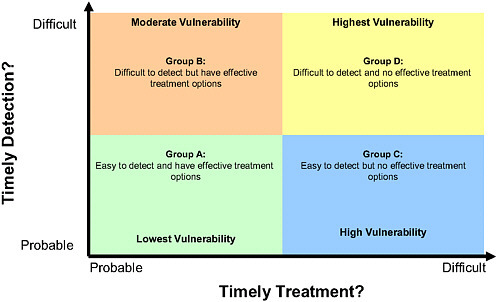
FIGURE 2-1 Grouping threats on the basis of the ability to detect the threat and treat it in a timely manner.
-
most immediately (for example, B. anthracis that can be treated with medical countermeasures before the onset of disease), or that can be detected by available and effective real-time or near-real-time sensor systems (such as a multitiered detection and identification system that is capable of definitive identification of an invisible cloud of B. anthracis released in a building). In most of the examples above, with appropriate response, exposed victims could receive medical treatment long before the onset of clinical signs when treatment is highly effective.
-
Group B—Cannot Detect, Can Treat. An example of this group might be release of an invisible, antibiotic-sensitive, infectious bacterial agent with an incubation period of several days. For example, the B. anthracis release in the former Brentwood Postal Facility was unnoticed until the first victim became ill and manifested clinical signs, after which a definitive diagnosis was made. Although treatment is available for anthrax, it is of little value once the victim shows signs of illness. There are other cases in which treatment administered early in the infection or disease process could reduce the duration and severity of an infection.
-
Group C—Can Detect, Cannot Treat. This category might be represented by an extremely fast-acting agent that causes illness or death in seconds or minutes and for which treatments are unavailable in the facility (such as cyanide) or for which there is no therapy (such as saxitoxin).
-
Group D—Cannot Detect, Cannot Treat. The final and most difficult combination is the invisible release of an aerosolized agent for which there is no
-
treatment. The agent has a long latent period before the exposed victim shows clinical signs. Individuals might not know that they were exposed until hours or days after the attack (for example, the release of a well-prepared, fine particulate of dry ricin toxin). Even when the victims are diagnosed with diffuse necrotizing pneumonia and pulmonary edema, little can be done other than provide supportive care.
The four groups of generic threats support a rational approach to evaluating the options in building protection. This approach would, for example, suggest several opportunities to reduce or eliminate the impact of the powdered ricin attack scenario described above (cannot detect, cannot treat). First, a building could be passively protected from outside attack, and physical security and a personnel reliability program could be implemented to reduce the likelihood of a perpetrator gaining access to the building. Second, if the elimination of a threat agent released inside the building cannot be ensured, compartmentalization of the facility could limit the number of humans exposed to the ricin powder.
MISSIONS AND ACTIVITIES IN BUILDINGS
In planning to deploy building protection from chemical and biological airborne threats, the missions executed in a specific building need to be considered to ascertain the requirements of building protection and the importance of the mission relative to the life-cycle costs of a protection system. Addressing the full complexity of DOD missions is beyond the scope of this report, but broad types of activities can be defined to aid planning.
Broad types of activities in buildings or uses of buildings can be categorized as follows:
-
Buildings with storage only. Assets in these buildings are limited to physical items that have utility as a resource later. Because the value of the asset is determined by later use, the need for protection varies. The primary vulnerability is from contamination of the resource that renders the storage inoperable or delays its intended use. Most threat agents do not directly damage physical objects, so the primary concern of contamination in such facilities is the safety of humans who enter the facility.
-
Buildings with equipment operation only. Assets in these buildings are limited to operating equipment without personnel. Most threat agents (except for corrosive agents) typically would not directly interfere with equipment operations, but if the building becomes unusable by humans, the operation of the equipment could become degraded over time and affect broader operations. Risks of contamination that could affect the mission of this type of building would be the main concern.
-
Buildings with personnel only. Assets of these buildings (for example,
-
barracks) are limited to people and no other activities. Because the personnel typically have other utility outside of the building, the primary vulnerability to biological and chemical threats to the missions of this building type is the secondary impact on other operations. The operations affected by an attack vary in importance, and their importance determines whether building protection should be installed to prevent loss of asset at all times (incapacitation or deaths) or to delay the loss of an asset in the short term.
-
Buildings with operations conducted by personnel. Assets in these buildings are the sustained or intermittent activities of the personnel. The primary vulnerabilities are the interruption of operations and the hazards to personnel. Buildings with such function generally require more protection than ones with other functions because the occupants and their activities are critical to maintaining the mission of the building. The requirements of building protection are determined also by the timing of operations being conducted, which can range from intermittent to continuous.
In general, buildings are used for a combination of the above activities. Although some generalization could be made about the relative importance of the missions (for example, operations are more important than storage), counter examples often can be provided so that generalizations of relative mission importance are not useful. The importance of each building and its mission determines the goal and the level of protection required, and they all have to be considered on a case-by-case basis.
Buildings with different missions require different operational responses in combination with the appropriate building protection options (Chapter 3). For example, in a building that requires personnel to fulfill its mission, these people would require training on the operational responses in the event of an attack. Such training is not necessary in a building used exclusively for storage.
FACTORS THAT LIMIT DESIGN AND IMPLEMENTATION OF BUILDING PROTECTION
Building Procurement
Building procurement influences the strategies used in protection because implementation of protection strategies is likely to have fewer limitations if DOD owns the building. Generally, most federal and DOD space for operations can be acquired by three major avenues: build-to-acquire, build-to-lease, and lease. Building-to-acquire is accomplished by several contractual schemes, with private constructors building government-designed facilities specifically for the sole use of DOD occupants. When the build-to-lease option is used, private contractors build a facility per government design. The building will eventually be leased by the government, ideally in a long-term arrangement. Space for government use
can be acquired by leasing an existing building for the sole use of DOD occupants or for shared use with private tenants.
When constructing new facilities, building protection measures can be included in the building design at the outset with a higher probability of successful installation and operation. When DOD wholly leases a facility, even if the building already exists, rehabilitation for building protection can be achieved. Although rehabilitation is a somewhat less than advantageous situation, the resulting facility can eventually function as a protected building.
If a new or existing facility is only partially leased for government operations, some lease restrictions and other limitations could pose challenges to the required protection of DOD personnel and operations in the facility. In the October 2002 report Building Security, Security Responsibilities for Federally Owned and Leased Facilities released by the U.S. Government Accountability Office (GAO, 2002), most of the federal government agencies surveyed responded that a major barrier to securing federal facilities arises when the space is leased. Specifically, buildings that are not occupied solely by federal employees can pose problems. Private landlords leasing space to federal agencies reportedly do not want to inconvenience private tenants sharing the space. The report gives an example of when the judiciary is assigned space by the U.S. General Services Administration (GSA) in a portion of a nonfederal office building. The security screening can be provided only at the entrance to the judiciary’s assigned space without any screening at the building’s entrance. In this situation, weapons and other hazardous material can be brought into the building. The report suggests that facilities leased by the government and occupied solely by federal employees could also pose problems in providing the level of security required for federal government operations and personnel. Whether building protection can be achieved in leased buildings depends on the cooperation of the landlord and private tenants. The terms of cooperation should be discussed prior to leasing and stated in leasing documents.
Building Types
In this report, building type refers to interior layout or compartmentalization. Building compartmentalization is a more useful categorization of building types than one used by DOD (DOD categorizes its buildings into “inhabited,” “uninhabited,” “primary gathering,” and “billeting”) in the context of protection from biological and chemical airborne threats. Compartmentalization within a facility generally increases building protection because it helps limit the spread of a threat agent throughout the building.
The interior space in a building can be organized into four formats. Buildings could have an open floor plan, be subdivided into cells, be designed for large assemblies, or combine all three layouts. An example of a building with an open floor plan is a warehouse. Buildings organized into cellular space contain
rooms that are fully partitioned and have individual air supply or 100 percent air exhaustion (such as in hospitals and hotels). Spaces designed specifically for large assemblies of people are different from the open floor plan because assembly spaces are equipped to control the indoor environment for large group gatherings. All of these space types can be combined in one building—for example, a school building with several classrooms, open-space cafeterias, and an auditorium. Protection strategies for each of these building types likely vary with the building’s mission. The ability to achieve different levels of protection depends on the building type. A highly cellular building has a reduced risk of exposing a large number of occupants to a threat agent in the event of an interior release because the threat agent can remain localized.
CONCLUSION
The need to protect a building from different threat types is driven by its mission and operations. To design an appropriate system, the goals of protection must be defined first, and the factors that limit its design and implementation (for example, building procurement and type, costs) have to be considered. Grouping of threats helps to determine the level of protection needed and the necessary components in the protection scheme to achieve that level of protection.


