
5
Assessment of the Impact of MRSEC Collaboration with Industry
Throughout the history of the Materials Research Science and Engineering Centers program (MRSEC program), one important goal has been to promote “active cooperation with industry to stimulate and facilitate knowledge transfer among the participants and strengthen the links between university-based research and its application,” as stated in the National Science Foundation (NSF) request for proposals. To implement this goal, each Materials Research Science and Engineering Center (MRSEC) is required to implement and execute a program for knowledge transfer to industry. The requirement is illustrated by MRSEC program solicitations issued since 1993 (e.g., NSF 93-106, NSF 95-89, NSF 97-98, NSF 99-125, etc.); representative excerpts are given below:
[MRSECs] are expected to have strong links to industry and other sectors, as appropriate, and to contribute to the development of a national network of university-based centers in materials research. (MRSEC Program Solicitation NSF 99-125)
[MRSECs foster] active cooperation among university-based researchers and those concerned with the application of materials research in industry and elsewhere. (MRSEC Program Solicitation NSF 99-125)
MRSECs incorporate most or all of the following activities to an extent consistent with the size and vision of the center…. Active cooperation with industry to stimulate and facilitate knowledge transfer among the participants and strengthen the links between university-based research and its application…. (MRSEC Program Solicitation NSF 99-125)
Modalities of the industry cooperation are cited more explicitly in, for example, the following solicitation:
Active cooperation with industry, to stimulate and facilitate knowledge transfer among the participants and strengthen the links between university-based research and its application…. Cooperative activities may include, but are not limited to: joint research programs; affiliate programs; joint development and use of shared facilities; visiting scientist programs; joint educational ventures; joint seminar series, colloquia or workshops; stimulation of new business ventures; involvement of external advisory groups; and industrial outreach programs. (MRSEC Program Solicitation NSF 97-98)
The MRSEC program stresses flexibility in each center’s approach to setting research directions, seed projects, and outreach and education:
Each MRSEC has the responsibility to manage and evaluate its own operation with respect to program administration, planning, content and direction. NSF support is intended to promote optimal use of university resources and capabilities, and to provide maximum flexibility … in developing cooperative activities with other organizations and sectors…. [Emphasis added.]
Thus, the National Science Foundation solicitations cited are consistent with the view that industrial collaboration in the context of the MRSEC charter should be an integral part of the MRSEC program. Its implementation should be flexible and consistent with the size, capabilities, mission, and vision of each individual MRSEC. It is important to note that industrial collaboration includes cooperation and interaction with relevant sectors involved with the application of materials research beyond just commercial industries. Consequently, industrial collaboration includes national laboratories and other federal entities (e.g., Department of Defense [DOD] laboratories) that apply the results of basic materials research to address important technical needs.
Materials science and engineering (MSE) is a key national resource. The recent decline in basic and exploratory materials research and development (R&D) in industry transfers the responsibility to universities not only to do transformational research in the area but also to transfer the knowledge obtained to industry for its application. Knowledge transfer to industry to facilitate the application of university research is especially critical for maintaining the preeminence of the United States in materials science and technology in today’s global and technology-based economy. The effective transfer of knowledge from the university to industry is crucial to achieving the goals of the “American Competitiveness Initiative” promulgated by the President and Congress in early 2006. As such, it is most appropriate to continue industry collaboration and knowledge transfer as an integral part of the MRSEC program.
CURRENT INDUSTRIAL COLLABORATION AND KNOWLEDGE-TRANSFER ACTIVITIES
The initial step in evaluating the effectiveness and impact of industrial collaboration and knowledge transfer activities across the MRSEC program was to understand the range of current efforts. The committee’s assessment of the current situation, which considered the efforts and results in this area over the past several years, was based on numerous teleconferences with MRSEC directors, discussions with industry participants, site visits to MRSECs, study of the MRSEC annual reports, and consideration of written responses from MRSECs to questions from the committee. An especially valuable perspective was provided by the November 2004 report of the MRSEC Directors Industry Working Group—the Working Group was chaired at the time by Michael Ward—which documented much of the ongoing industrial collaboration activities for 2002-2004 period. The “Ward report” did an excellent job of meeting its stated purpose, which was to “evaluate industrial participation with the MRSEC program as a whole,”1 rather than focusing on specific activities or best practices at individual centers.
The information gathered by the committee provided a self-consistent picture of the industrial collaboration effort, which was in line with the NSF view that there are numerous effective ways to address the program goals for industrial collaboration and knowledge transfer. Workshops, short courses, and symposia were among the most common approaches to engaging industry and disseminating knowledge. Most of these meetings focused on specific technical topics. As documented in the Ward report, MRSECs fully or partly sponsored 22 such meetings in 2002 (916 total industrial attendees), 40 in 2003 (1,541 industrial attendees), and 43 in 2004 (1,620 industrial attendees).2 MRSEC annual reports from 2005 suggest that the number of workshops, short courses, and symposia has remained at a similar level. The obvious advantage to this type of activity is the ability to promote broad engagement among MRSEC students and faculty and interested industrial representatives. It was emphasized by several MRSEC directors that student participation in these meetings was very important for enabling them to interact with industrial scientists and managers. These interactions were especially important at campuses that do not have a strong tradition of industrial engagement. From an industry perspective, the breadth provided through a MRSEC-sponsored technical event was seen as a value-added way of engaging a broad faculty group.
Many of the technical meetings sponsored by MRSECs are advertised, such as
through the www.mrsec.org Web site, and have open registration to promote the broadest interactions. Other technical meetings are restricted to participation by companies that are members of an industrial consortium or center at the university. In a number of cases, the MRSEC program is intimately linked with a university center explicitly focused on industrial collaborations. Examples include the Materials for Information Technology Center (MINT) at the University of Alabama, the Cooperative University of Massachusetts Industry Research Program (CUMIRP), the Princeton Institute for Science and Technology of Materials (PRISM), and the Materials Processing Center (MPC) at the Massachusetts Institute of Technology. The explicit linking of a MRSEC with a related industrial consortium program provides good synergy, but it complicates the assessment of the MRSEC industrial collaboration effort. Some collaboration efforts are specifically focused on engaging individual companies. Workshops that are not topically specific but that instead emphasize the breadth of a given MRSEC program have also been conducted as part of industrial collaboration activities. This type of interaction is more typical of a non-thematic MRSEC than of a MRSEC with a strong thematic focus.
Collaborative research projects drive all industrial interactions at MRSECs. As is clear from the annual reports, every MRSEC is able to provide an impressive list of collaborators, including numerous industrial ones. Such industrial involvement provides graduate and undergraduate students and postdoctoral associates in MRSECs with the opportunity to connect their research with industrially interesting problems. There can also be opportunities to work directly with industry R&D staff and/or with managers responsible for product development. Often these collaborations lead to industrial internships. The Ward report provides an analysis of the students performing MRSEC work that involved industrial collaborations.3 There was a very large number of students working on projects with industry—some of which were entirely supported by MRSEC funding, some entirely supported by industrial funding, and some jointly funded. There are also examples of industry scientists spending time as interns with the MRSEC. This spectrum of interactions provides further evidence of strong engagement between MRSECs and industry.
The committee also saw some very creative approaches to working with industry. A notable example was at the University of Chicago, where MRSEC graduate students have been working with Master’s of Business Administration (MBA) students on projects through the Management Laboratory, which is a course run by the Graduate School of Business. By working with students of the School of Business on industrial problems that have both a technical and a business focus,
MRSEC students have been offered a unique educational opportunity to expand their appreciation of the role of research in the industrial sector. It is also worth noting that the University of Chicago is an example of a case in which the MRSEC requirement for industrial collaboration created the necessary driver for the center to develop this effort. As noted by its director, Heinrich Jaeger, the University of Chicago did not have a strong history of industrial interactions, unlike many universities (e.g., MIT, the University of Wisconsin, the University of Minnesota). Nevertheless, he stated that the need to have an industrial collaboration effort has been very valuable for students and faculty, especially with respect to informing the research efforts with real problems of interest.
One critical aspect of industrial collaborations is intellectual or proprietary property. The committee discerned from discussing this issue with a number of MRSEC directors that proprietary research with industry is not pursued with MRSEC funding. Such research is directly funded by industry. Some MRSEC directors went to the extent of stating that no proprietary work is done within the MRSEC, since the distinguishing principle of the MRSEC is that all work is shared openly within the center, which is not consistent with conducting proprietary work. A complementary perspective offered by MIT was that if MRSEC work reaches a sufficiently mature point to attract significant external funding, the work is moved out of the MRSEC to make way for new activities. The committee agrees that the philosophy of not doing proprietary work is appropriate and important for MRSEC research.
In any discussion of university-industry collaborations, issues concerning the negotiation of intellectual property rights continue to be a major hurdle for developing stronger and more flexible interactions. While it is outside the scope of this study, the situation with respect to intellectual property rights is in need of serious consideration in order to improve the rate of technical innovation and the transfer of knowledge from universities to industry. MRSECs can largely avoid these concerns by staying away from research that is inherently of a proprietary nature and by working through another entity (e.g., an industrial consortium) to focus on collaborations that are proprietary. As mentioned previously, many universities have very mature industrial consortium programs that readily enable this approach.
The centers are trying to strike a delicate balance between having programs that are compelling for the industrial sector but not so closely coupled with industry that industry is setting the research direction for a center. Having industrial members on the external advisory boards for MRSECs is a common practice to employ for providing a business perspective for the program. Given that an explicit goal for many centers is to have MRSEC research nucleate industry-sponsored research activities and that cost sharing with industrial funding for some centers can be
significant, maintaining the research independence of MRSECs is an important goal that requires constant attention. It is important to state that the committee did not find any examples of MRSEC research appearing to be overly focused on the needs of its industrial collaborators.
As industrial collaboration continues to be more important at most research universities, industrial liaison programs have become increasingly coordinated at the university level. Consequently, support is provided by university funds, which are often supplemented by additional funding, such as through state-funded programs. Given the interdisciplinary nature of MRSEC research, the number of faculty involved across campus, and the requirement for industrial collaboration, MRSECs tend to be an important part of the industrial collaboration efforts at their universities. One direct implication of this situation is that the level of MRSEC funding spent on the industrial collaboration effort varies widely from center to center, as shown in the Figure 5.1. In cases where the level of university or state support is sufficient, a significant industrial collaboration effort can be achieved, even with little or no MRSEC funding spent directly on the effort. As an aside, additional analysis showed that there was no correlation between the age of the MRSEC and its industrial collaboration effort’s budget, indicating that maturity as a center was not a factor.
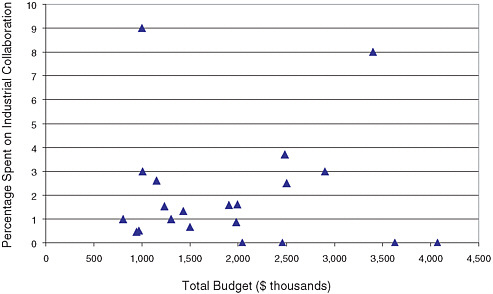
FIGURE 5.1 Materials Research Science and Engineering Center (MRSEC) funds spent directly on industrial collaboration and knowledge-transfer activities as a percentage of total MRSEC budget (by center).
The type of leveraging indicated is typical of how various funding sources are brought together to meet the expectations of different sponsors. The committee is comfortable with this pooling of resources, even if it makes it difficult to understand the specific role of MRSECs in industrial collaboration. An area of concern with respect to financial resources (and time) spent on industrial collaboration activities is associated with smaller centers. Smaller centers, especially if they do not have a strong university-sponsored industrial liaison program, can expend significant resources on this aspect of the program. Consequently, industrial collaboration is one more MRSEC program requirement that can be a proportionately larger burden on small centers as compared with larger ones.
There are a variety of success stories in MRSEC industrial collaboration. Over the years, MRSEC research has led to the establishment of a number of start-up companies. From the committee’s evaluation, about 12 start-up companies have been established over a number of years as a direct result of MRSEC work. MRSEC science has also been used by established industries to provide better understanding of their material processes and performance and to help solve problems associated with product development or production. In other cases, access to shared experimental facilities (SEFs) at MRSECs has been seen as critically important to industry, especially smaller companies that did not have certain needed capabilities. It is worth pointing out that as innovation in the United States is being increasingly driven by small (including start-up) companies, an appropriate focus on working with small companies is suitable for the program. The committee also notes that these success stories were largely anecdotal; the narratives generally do not have enough specific information to ascertain the relative importance of the MRSEC contribution.
The committee was generally impressed with the breadth of the industrial collaboration efforts across the MRSEC program. Although some centers showed a stronger focus on industrial interactions than others did, especially based on the type of research conducted, all centers appeared to have a significant effort aimed at meeting the industrial collaboration and knowledge-transfer goals of the program. As industrial liaison programs have become important at research universities, the MRSEC program goals are generally well aligned with the goals of university administration. As previously noted, the explicit MRSEC program requirement for industrial collaboration has been effective at ensuring that all centers give attention to the program’s intent with respect to knowledge transfer, even at institutions that do not have a strong history of industrial interactions. The inherent flexibility provided by the NSF program managers in meeting the program goals seems to work well in that centers take different approaches, including some creative ones, to meet the intent of the program effectively.
One potential feature that the committee found notably lacking was interaction among MRSECs in relation to industrial collaboration. There was no evidence
of a systematic program or network approach to knowledge transfer, even when programs at various universities could be highly synergetic. A barrier to such interactions is the handling of intellectual property. Nevertheless, if knowledge transfer to spur industrial innovation is a program driver, creating a more effective network among related MRSEC research efforts should be an important goal for the future.
ASSESSING THE EFFECTIVENESS OF INDUSTRIAL COLLABORATION
The committee looked closely at the impact of industrial collaborations with MRSEC partners. This section reviews the committee’s data-gathering activities, its analysis, and some perspectives from MRSEC participants.
Methodology
Many direct outcomes of MRSEC industrial collaboration can be used to evaluate its quality and effectiveness. It is clear that a successful MRSEC—that is, one that is reviewed successfully—must address its role in industrial collaboration seriously. Outcomes that can be cited include the following: number of industrial collaborations, time spent by industrial participants on projects, number of MRSEC-funded individuals working with industry, joint publications, patent filings and awards (MRSEC-owned or owned jointly with industry), licensing of patents, and so on. What is not so clear is what criteria (or metrics) should be used to judge the effectiveness of industrial collaboration and knowledge-transfer efforts. Also, it is unclear what metrics are currently being used by NSF to judge the performance of the program as a whole. The adage “What gets measured gets done” is important here and needs to be considered carefully when addressing appropriate metrics for this aspect of the program.
While there are many potential metrics that could be used to assess the effectiveness of the industrial collaboration effort, quantitative information is not typically available on many of the outcomes of potential interest to the committee, and the effort needed to gather it is outside this study’s scope. Some quantitative information is available through the MRSEC annual reports, but most of the information collected through all of the sources used by the committee was anecdotal. These sources included teleconferences with MRSEC directors, industrial collaboration coordinators, students, and members of corporate leadership; site visits to MRSECs, Engineering Research Centers (ERCs), and other materials research centers; and formal data requests to NSF and to the MRSECs.
An additional difficulty in developing a clear understanding of the impact from industrial collaboration was that many MRSECs are closely aligned with other complementary centers of research, as mentioned in the previous section. Decou-
pling outcomes from MRSEC activities with those supported from other sources is impossible, and determining the value of attribution to a particular outcome (such as a patent) could be misleading.
In considering criteria and metrics for assessing effectiveness, there was a desire to develop a systematic approach for assessing the impact of specific centers, which speaks to review criteria, and how to assess the impact of the MRSEC program as a whole.
Analysis of Data
The MRSEC annual reports do contain some quantitative information on accomplishments that can be indicators of the impact of industrial outreach. This section provides a brief summary and analysis of the MRSEC program’s performance based on data reported in annual reports (generally from 2005) and other sources noted.4
In recent years, many universities have increased their patenting activity. Pressure has increased at these institutions to convert their research into potentially profitable intellectual property (IP). Although most patents generate no direct income, there are examples of license royalties that are valuable to universities. Given the charter for industrial collaboration and the interdisciplinary nature of MRSEC research, it is worth examining whether MRSECs are more successful at generating IP than is generally seen within the academic community.
The program’s contribution to patents awarded to academia has hovered around 1 percent since 1999 (Figure 5.2), where academia’s share of total U.S. patenting activity is about 4.4 percent over the past 5 years. At an average of 0.21 percent of federally supported university R&D expenditure, the MRSEC program secures more IP per dollar spent than the average university R&D dollar. However, when examining patent filings and patent awards within the program from center to center, the committee saw no correlation between the level of industrial collaboration (measured by number of collaborations, funding, and so on) and the IP activity. Several MRSECs had a significant level of patent activity, but most centers had little or no patent output. It may be that a center’s patenting activity is more firmly rooted in the university’s culture and emphasis on IP and licensing than being related to its success in industrial collaboration and knowledge transfer. Differences in internal university policy and state law exist also across MRSECs, which can affect patenting activity. In addition, it is not clear whether university-held patents have a beneficial impact on industry and the level of knowledge transfer.
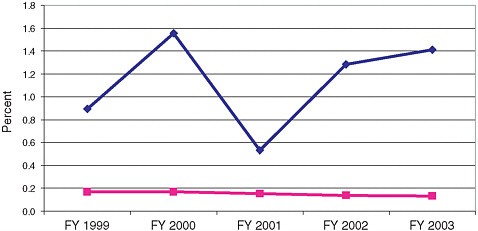
FIGURE 5.2 Percentage of patents and academic research and development funding belonging to Materials Research Science and Engineering Centers (MRSECs) as a percentage of the total for universities, FY 1999 to FY 2003. SOURCE: National Science Foundation, Science and Engineering Indicators 2006, and Division of Materials Research, National Science Foundation.
Consequently, patent output, while reported annually, was not seen as an especially useful metric for determining programmatic success.
Another potential metric of the effectiveness of industrial outreach activities at a MRSEC is the number of industrial collaborators involved. The number of industrial collaborations for a MRSEC is reported annually. However, it is difficult to assess the significance of the collaboration on the basis of the information available. The time or resources applied to a collaboration may provide some insight into the quality of the interaction, but there is no straightforward way to assess the quality of a collaboration, especially as it relates to impact. There is also no obvious correlation between the level of MRSEC funding for industrial outreach and the number of industrial collaborations.
Successful interactions might also be expected to provide return on investment through company-sponsored research (see the subsection below entitled “Industrial Perspectives” for an extended discussion of the industrial view of MRSECs). Some MRSEC programs are very clear about their goal of obtaining complementary research support from industry; others are not as focused on this goal. One difficulty in assessing impact under this category is that support provided by industrial sponsors is generally brought in through direct contracts with individual faculty or through one of the complementary industrial liaison centers
on campus. Consequently, accomplishments in this category may not be attributed to the role of the MRSEC.
Additionally, joint industry–university publications could indicate that a MRSEC has a healthy industrial collaboration program. However, industry does not value publications like university departments do, and the mismatch of motivations becomes a problem with considering this outcome as a metric for success.
Furthermore, successful university research initiatives, depending on their character and the research topic, can develop into small “spin-off” companies. However, these spin-offs occur somewhat infrequently and depend heavily on local circumstances. While success in creating spin-offs is a positive outcome, this metric is probably not an especially important one for all centers.
The use of SEFs at a MRSEC is also another metric of impact. The use of facilities tends to be by local companies, often smaller ones, that cannot or do not want to invest in highly specialized equipment. The use of facilities, especially when coupled to a collaborative effort, is a positive outcome. It was noted by MRSEC directors that the use of MRSEC facilities is appropriate under many circumstances, but not for doing a lot of routine work for a company. Routine access to university facilities is better accommodated through an industrial liaison program.
Intellectual property, collaborations, joint publications, creation of spin-off companies, direct funding, and other quantitative outcomes may collectively provide an indication of the health and vitality of a MRSEC’s industrial collaboration efforts. All of these metrics are helpful in understanding industrial impact, but it is important not to rely only on simple metric(s) to judge effectiveness lest the overall picture of program success be lost.
MRSEC Perspectives
MRSECs conduct a very wide variety of research, differing not only by topic but also by degree of “applicability.” Some centers’ research is more thematic, or focused on a particular problem, whereas others have multiple thrusts without strong connection among the Interdisciplinary Research Groups (IRGs). MRSECs are also judged on the basis of being centers of excellence in basic research with a charter to focus on furthering the state of knowledge in materials science, rather than focusing on the needs of industry, which is appropriate. Nevertheless, an active industrial partnership effort has a positive impact on the research in that industrial challenges often stimulate new science. Consequently, knowledge transfer goes in both directions, and MRSECs see the benefits of this exchange. Some MRSECs even credited the program requirement for collaboration as being the impetus for their establishing a valuable mechanism for knowledge transfer.
Although many centers see industrial collaboration and technology transfer as generally beneficial, and NSF stresses it in the proposals, according to many
MRSECs, industrial outreach receives an incommensurately low amount of attention in the review process, or in some cases, is ignored. There may be several reasons for this situation or impression. First, some MRSECs find that the NSF-selected review panels are not populated to evaluate these activities astutely and do not regularly include members from industry (the committee understands that this situation has been improving with recent reviews). Without an appropriate industrial perspective, it can be difficult to judge whether an industrial partnership program has fulfilled its goals. Second, the review panels do not know how to evaluate and assess industrial collaboration because the NSF does not provide them with a set of criteria to use. Without clear criteria, it is hard for review panels to objectively evaluate programs about which they know little.
Students are often cited as the most important aspect of a MRSEC. Beyond providing financial support for students and postdoctoral associates, MRSEC participation is believed to provide a unique and broader research experience than would be possible under a single-investigator grant. MRSECs provide more industrial interactions for students on some campuses than would otherwise be the case, and MRSEC involvement can often lead to other opportunities, such as industrial internships. Since MRSECs put a concerted effort into stimulating industrial partnerships, one might expect this emphasis to have an impact on students’ employment decisions. Interestingly, as shown in Figure 5.3, a student receiving a Ph.D. from a MRSEC is equally as likely to take a job in industry as any other student with a degree in materials science and engineering nationwide. It is tempting to conclude that the industrial collaboration part of the MRSEC experience has little impact on the career decisions of those trained in materials science.
Industrial Perspectives
The committee found that the view of MRSECs from the industrial perspective was quite mixed. Since the main goal of the MRSEC program is to carry out fundamental materials science that is not directly tied to industrial interests, perhaps it is not surprising that the perceived interest in the MRSECs by industry is modest. However, it is important to keep in mind that Figure 2.3 showed that industrial support of all academic research and development is quite modest. While the MRSECs can list an array of successful interactions with industry, their direct impact on the development and application of new technologies would appear to be quite limited.
Smaller companies can clearly benefit in straightforward ways from MRSECs—for example, through access to equipment and capabilities that such companies could not afford to purchase themselves. Moreover, access to expertise in particular areas of materials research is facilitated by the MRSEC through a single focal contact point that provides access to a larger number of academic re-
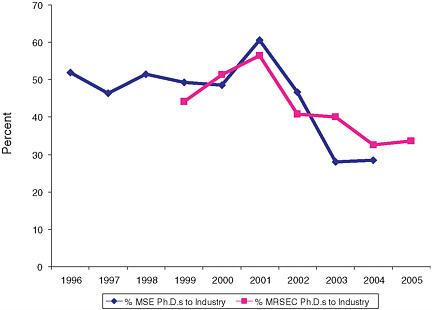
FIGURE 5.3 Percentage of new Ph.D.s with materials science and engineering (MSE) degrees who are then employed in industry compared to the percentage of Ph.D.s awarded their degree by a Materials Research Science and Engineering Center (MRSEC) who are then employed in industry, 1996-2005. SOURCE: Division of Materials Research, National Science Foundation.
searchers. While smaller companies may have more to gain from the MRSECs than larger companies might, it is clearly more challenging for the MRSECs to identify and develop interactions with a multitude of small enterprises. On the other hand, larger companies have less direct interest in the MRSECs on a day-to-day basis, but MRSECs can identify these larger enterprises more readily and perhaps see these companies as being a more likely source of additional funding.
One potentially important role of the MRSECs is the training of students in the methods of working in large interdisciplinary research projects, perhaps more similar to the style of industrial research. However, as discussed above, there is no evidence that students who carry out their Ph.D. research in a MRSEC are more likely to find a job in industry.
In the past two decades, the large industrial research laboratories in the United States, which used to carry out significant broad-based exploratory research programs in materials, have largely disappeared as increased globalization and worldwide competition makes them uncompetitive. Thus, programs such as the MRSEC
program become of greater importance for the long-term sustainability of technology leadership in the United States. This need is recognized by industry, which largely supports the scientific independence of the MRSECs. Paradoxically, too great an influence by industry would rob the MRSECs of their very importance to industry. However, strong links that foster the transfer of knowledge from the MRSECs to industry are of paramount importance, but these links appear to be relatively weak. For example, the committee found very few examples of scientists from industry spending any significant time at a MRSEC. By contrast, this is common practice in Japan where scientists from the major electronics companies such as Hitachi, Toshiba, NEC, SONY, and other companies post their scientists to major universities and national laboratories for one or more years at a time. This practice is also common in Europe where Hitachi, for example, has several small exploratory research laboratories embedded on university campuses in several countries. Encouraging extended sabbaticals by industrial scientists to spend time within a MRSEC might be a productive means of enhancing links between MRSECs and industry.
Major companies are willing to spend significant sums of money (relative to an individual MRSEC funding) to encourage exploratory research in broad areas of interest to the company, but because the landscape of industrial research has changed, they now need to look outside their walls to support it. One industrial partner told the committee that it was much cheaper for his company to fund basic research at a university than to carry out the same research in his own research laboratory. This gives the company flexibility to approach more short-term, applied research problems while leaving the longer-term, broader-scope research to the university-based MRSEC. Given this relationship and the static funding of the MRSEC program over the past several years, an initiative to attract increased funding from industry to support the MRSEC program would appear to be an attractive proposition. Such an initiative would likely be most successful if carried out by an industry coordinator at NSF for the network of MRSECs as a whole.
Only one MRSEC, the Center on Polymer Interfaces and Macromolecular Assemblies (CPIMA) program centered at Stanford University (with partners at the University of California at Davis and at Berkeley), has a full industrial partner, the IBM Almaden Research Center. CPIMA appears to have an outstanding record of accomplishment with notable scientific successes. The committee sees that such partnerships can be very valuable and recommends that such partnerships be encouraged.
NSF Perspective
The NSF sees the MRSEC program performing exceptionally in enhancing industrial outreach and knowledge transfer. In discussions with officials at NSF, it
was evident that there was a clear understanding of the tangible benefits produced by the program. In response to the committee’s query, “What are your program goals for industrial interactions?,” NSF MRSEC program managers gave the following perspectives:
-
Dissemination of knowledge, more multifaceted than individual principal-investigator efforts;
-
Enhancing the educational experience—educating students by providing opportunities for industrial collaborations;
-
Leveraging NSF funding of centers through industry support and projects;
-
Intellectual property—patents and licensing;
-
Contributing to the establishment and success of new businesses;
-
Being a national resource, especially by making unique facilities available; and
-
Informing the research—using industrial challenges to help catalyze the formulation of research directions within the MRSEC.
This perspective is based on a belief that industrial interactions allow a center to magnify its impact in a way that is greater than the impact that an individual could create. This broader impact can occur for several reasons:
-
As centers, MRSECs act as nucleation points for contact with industry with a scale and focus that matches well with business-driven research;
-
Industry interactions enhance the experience of the students involved;
-
Collaborating with industry can attract new and other types of resources to the center; and
-
Industrial partners benefit from economic and competitive advantages.
MRSECs are engaged in collaboration to varying degrees, numbers exist to show the activity, and centers report a positive effect. What is missing is a critical understanding of impact, partly because of the difficulty with measuring impact as a desired outcome. Resolving this dilemma will require a concerted effort by NSF, since it is difficult to find reliable, standard metrics to evaluate impact with a program as diverse as MRSEC.
In addition, the requirement to have an industrial collaboration effort is just one of many program expectations that must be satisfied simultaneously. It was also not evident that the NSF understood the impact of numerous program requirements, including this one, on the centers, especially the smaller ones. This issue associated with balancing multiple program goals without clear relative priorities may explain why NSF believes that while industrial partnership is an important
part of the program, a struggling industrial outreach program will not sink a MRSEC. Nevertheless, NSF needs to determine what it expects out of the MRSEC program, determine how to assess those expectations, and convey that information explicitly to the review panels to improve the process.
The MRSEC program is one of many mechanisms that a research center can use to conduct industrial collaboration and knowledge transfer. Other center programs at NSF, such as the Science and Technology Centers (STC) and the Engineering Research Centers (ERCs), also have requirements for industrial outreach.5 Science and Technology Centers are problem-driven NSF research centers investigating topics ranging from remote sensing of ice sheets to environmentally friendly solvents. An STC is composed of a multi-university collaboration of researchers investigating a single problem. STCs are required to “have significant intellectual exchange and resource linkages among various types of institutions and organizations to facilitate knowledge transfer,” and to “include industrial, national or international internships or other career broadening experiences as appropriate to the research are.”6 ERCs are tightly linked to industry and attack research problems with a specific end application in mind. ERCs are expected to create an “interdisciplinary research environment where academe and industry join in partnership to advance fundamental knowledge and engineered systems” and “are expected to be self-sustaining after ten years when NSF support ceases” by industry support and other means.7
There are important differences between these centers and MRSECs with respect to industrial collaboration. MRSECs are research-driven, and industrial outreach should be a natural outcome of the research focus. The other centers are tightly linked to application outcomes, and industrial collaborations are integral to success. In this context, maintaining the MRSECs’ focus on basic research is viewed by the committee as highly desirable.
FINDINGS AND RECOMMENDATIONS
Conclusion: The program goals for MRSEC industrial collaborations are appropriate. A flexible approach to meeting those goals is essential to address the needs and capabilities of the individual MRSECs.
Conclusion: The MRSEC program requirement for industrial collaboration leads to important activities that likely would not occur otherwise
|
5 |
See http://www.erc-assoc.org/ and http://www.nsf.gov/od/oia/programs/stc/ for additional information. |
|
6 |
National Science Foundation, Program Solicitation for Science and Technology Centers: An Integrative Partnership, NSF 03-550, Washington, D.C., 2003. |
|
7 |
National Science Foundation, Program Solicitation for Engineering Research Centers: Partnerships in Transforming Research, Education and Technology, NSF 07-521, Washington, D.C., 2007. |
(e.g., workshops, short courses, external advisory boards with industrial advisers).
The MRSEC directors whom the committee informally interviewed all were supportive of the industrial outreach and knowledge-transfer goals for the program. Although some centers had an existing campus culture that already supported industrial outreach activities, other MRSECs had to create a culture of industrial outreach in order to respond to program requirements. As a result, all centers had substantial collaboration efforts that added significant value to the overall program. The committee found that local flexibility in meeting the program goals was effective in taking advantage of inherent differences between MRSECs, the university environment that they resided in, and the targeted industrial community. As with education and outreach, there is a disproportionate impact on small centers to demonstrate accomplishments in all MRSEC program goals.
Conclusion: MRSECs have developed industrially relevant programs while maintaining a commitment to solving long-term research problems.
Maintaining this approach is important to the quality of the research efforts and to educational continuity for students, especially those involved in Ph.D. research programs. Industrial interactions are a positive part of the educational experience for students. The ability to connect their research to external needs and to have an opportunity to work with industrial scientists was clearly cited as being beneficial by the students interviewed by the committee.
MRSEC research programs are stimulated through industrial interactions as a result of the challenges and research needs articulated by industrial partners. This positive feedback to the research planning effort was reinforced through discussions with numerous MRSEC directors. To date, MRSEC industrial collaboration appears to have been primarily focused on large industrial research laboratories, but the opportunity to interact more with innovative small and start-up companies is coming to be appreciated to a greater extent.
MRSEC research is generally well focused on leading-edge and transformational research, as appropriate. MRSECs have developed industrially relevant programs without getting involved with near-term problem solving.
Conclusion: MRSEC industrial collaboration efforts are generally supported by multiple sources, in addition to MRSEC funds, such as funds from industrial partners themselves.
In a few cases, a significant portion of the MRSEC funding (more than 8 percent) was used for industrial outreach. More typically, MRSEC industrial partnerships are supported primarily by university and/or state funding and are usually assisted by a university liaison program. This leveraging is valuable to the MRSEC
program in meeting its goals, but it makes assessing the effectiveness of the industrial outreach program more difficult to judge as a function of MRSEC resources supporting the effort.
Conclusion: The importance given industrial collaboration and technology transfer in the review process is seen as not being commensurate with the importance of this program goal.
Industrial outreach is seen as not having an emphasis in evaluating MRSEC performance that is commensurate with the importance of this program goal. The evidence on this point is all anecdotal (from conversations with MRSEC directors). Nevertheless, the strong impression is that a viable industrial collaboration effort is required for a successful renewal, but an especially strong outreach effort is not rewarded. This impression is consistent with minimal industrial involvement on MRSEC review panels. One aspect of this finding is that the NSF struggles with being able to assess the effectiveness of the industrial outreach effort. If the program managers cannot clearly articulate expectations and how to evaluate performance against those expectations, it will be almost impossible to improve the way in which this aspect of MRSEC performance is considered as a part of the reviews.
Each MRSEC tends to have its own program for industrial outreach and collaboration, and industrial contacts typically do not interact with more than one MRSEC. There is evidence of occasional industrial interactions that incorporate more than one MRSEC, but collaborative efforts among centers are the exception.
MRSEC leaders understand the change in the research landscape within the United States and are trying to respond appropriately. In particular, there is a shift away from a system dominated by several large, comprehensive industrial research laboratories toward a greater number of small and entrepreneurial companies involved with technology innovation. Understanding how to work effectively with these smaller companies and ensuring that these interactions are properly recognized and valued by the MRSEC program will be critical.
The committee was generally impressed with the breadth of the industrial outreach efforts across the MRSEC program. Each center seems to have a vital industrial outreach activity that meets the stated program goals. While it is difficult to evaluate the impact of the industrial outreach efforts clearly, the committee believes that the MRSEC program is generally meeting its goals and that the industrial outreach is valuable.
Recommendation: NSF should establish metrics for evaluating the effectiveness of industrial collaboration and technology transfer.
In addition to considering worldwide best practices, NSF should quantify the relative importance of industrial outreach and knowledge transfer relative to other
program requirements in program solicitations. This would enable centers to put the appropriate focus and resources on this aspect of their center and for reviewers to make appropriate judgments about accomplishments.
Recommendation: Together with the team of MRSEC directors, NSF should provide a mechanism to enable industry to effectively understand the resources and expertise available through the network of MRSECs. This may require a coordination function that currently does not seem to exist, such as a national network liaison officer based at NSF.
Industrial outreach and knowledge-transfer effort is inherently based on interactions among people. Encouraging more personnel exchanges, such as student internships, extended sabbaticals for industrial researchers at MRSECs, visits by MRSEC faculty to key industry partners, significant industrial involvement on MRSEC advisory boards, and so on, will be essential to effective knowledge transfer and skill development (especially for students). For instance, centers that have better exposure to industrial partners could provide access to students involved in other MRSECs. Centers’ tapping into these shared opportunities presented by the entire MRSEC program would enhance the program’s overall impact.


