
A
Minority Opinion: Dissenting Statement of Gilinsky and Macfarlane
These remarks concentrate on the Global Nuclear Energy Partnership (GNEP), the most prominent U.S. Department of Energy (DOE) R&D program addressed in the committee’s report. The committee report criticizes DOE’s excessive eagerness to start building commercial-scale facilities when the technologies it relies on are still unproven.
However, the committee does not question the desirability of a substantial “closed” fuel cycle R&D program; moreover, it recommends a reprocessing and fast reactor R&D program along the lines of GNEP’s predecessor, the Advanced Fuel Cycle Initiative (AFCI). Nor does the committee question whether DOE and its laboratories should have a key role in developing the new fuel cycle technologies, despite DOE’s poor track record in developing commercial technologies.
Our own views on these issues may be summarized as follows: (1) commercial reprocessing and recycle will not help solve resource or waste or proliferation problems and are not sensible technical goals for the United States for the foreseeable future—we would close down GNEP and hold DOE R&D spending in this area to pre-2003 levels, before AFCI; and (2) DOE is the wrong agent for developing commercial technologies beyond the early laboratory stage—it has been unsuccessful in the past and its overall record of managing sizeable projects is very poor. Our thinking is explained below.
It is important to clear up one point at the outset. No one appearing before the committee argued that conserving uranium was a reason for pursuing reprocessing and recycle. The resource argument does not appear in the GNEP Strategic Plan. Instead, the Strategic Plan argues that reprocessing and fast reactors would solve the waste disposal and proliferation problems that bar expanded use of nuclear energy.
WASTE DISPOSAL: DEALING WITH SPENT FUEL
GNEP proposes to operate the nuclear fuel cycle so as to eliminate the need for more than one U.S. waste repository for the rest of the 21st century, even if the number of power reactors—now at about 100—increased by many hundreds. This goal drives the design of both GNEP reprocessing and fast reactor technologies. (By comparison, the “proliferation” constraint—no pure plutonium—is only a wrinkle on the basic pattern.)
GNEP’s waste logic runs as follows. A much larger U.S. nuclear program operated on the current once-through basis—with direct disposal of spent fuel—would require many repositories—say, one for every 100 reactors. But the struggle over DOE’s proposed Yucca Mountain nuclear waste repository proves, the argument goes, there will never be any additional repositories. We therefore need a closed fuel cycle that could accommodate a large expansion in nuclear power and still use only one repository.
GNEP plans to finesse Yucca Mountain’s design capacity—limited by temperature constraints on the repository rock—by leaving the heat-generating waste out of the repository. In particular, it would leave the hottest fission products (shown in red in Figure A-1) in surface storage. This does not expand repository capacity; it just puts less of each reactor’s waste inside. Of course, you could do that without GNEP by putting spent fuel in dry cask surface storage, which is essentially unlimited. But GNEP excludes this option. If Yucca Mountain fails to get a license and long-term surface storage is acceptable, the GNEP story collapses; and the same is true if people accept other repositories in the future.
Note that GNEP would leave the radioactive cesium-137 and strontium-90 on the surface. The half-lives of these isotopes are about 30 years, so they would have to remain in such storage for at least 300 years. There is no word on where DOE would store this material. As this would involve roughly as much storage capacity as would the original spent fuel, it is difficult to see any gain over the current once-through fuel cycle, especially considering that reprocessing would produce other waste streams as well.
The proposed technology is complex and would inevitably be very expensive. The design requirements for GNEP’s form of light water reactor (LWR) spent fuel reprocessing
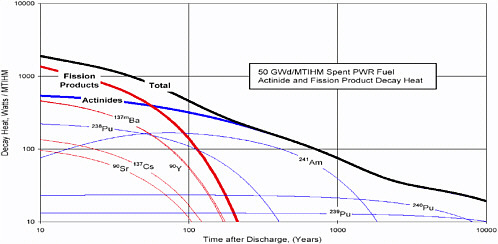
FIGURE A-1 50 GWd/MTIHM spent PWR fuel actinide and fission product decay heat. GWd, gigawatt days of thermal energy production; MTIHM, metric tonnes initial heavy metal; PWR, pressurized water reactor. SOURCE: R.A. Wigeland, T.H. Bauer, T.H. Fanning, and E.E. Morris. 2004. Spent Nuclear Fuel Separations and Transmutation Criteria for Benefit to a Geologic Repository. Paper presented at Waste Management 2004 Conference, February 29-March 4, 2004, Tucson, Ariz.
are driven by the need to separate the various radioactive spent fuel constituents into separate streams to allow different solutions for each. Aside from the radioactive cesium and strontium, the main ones are the plutonium and minor actinides neptunium, americium, and curium (shown in blue in Figure A-1), which are destined for transuranic fast reactor fuel. The longer-lived fission products, technetium-99 and iodine-129, are to be sent to a geologic repository. There are also assorted other radioactive products, including gases such as tritium and krypton; uranium, which DOE wants to send to a low-level waste repository; the cladding hulls, which are destined for a geologic repository; and other wastes from the reprocessing process.
Even if GNEP worked as planned it would likely exacerbate the nuclear waste problem, at least for a long time. The most important thing to remember is that the hottest fission products would accumulate on the surface for hundreds of years. These fission products are the reason that the NRC, the last time it looked at separation and closed fuel cycles, in 1996, recommended the need for geologic repositories. Putting less of the waste into a repository is a choice we could make now without GNEP—we could leave the spent fuel in surface dry storage and put nothing in a repository. Or we may be able to site other repositories. GNEP’s notion that siting reprocessing plants and fast reactors and surface storage for radioactive cesium and strontium would be easier is fanciful.
The need for specialized fast reactors comes from GNEP’s decision to burn the plutonium and minor actinides to further reduce the repository heat load and long-lived radioactive isotopes. The main heat source after cesium and strontium’s radioactivity subsides is americium-241. A new type of fast reactor would have to be designed to burn actinide fuel (and, secondarily, to produce electricity). To make the scheme work would take about one fast reactor for every four ordinary LWRs, so about 100 fast reactors out of a total of, say, 500 nuclear units. DOE acknowledges fast reactors would be more expensive than LWRs; but in our opinion DOE still underestimates the difference in capital and fuel costs.
Further, as pointed out in Chapter 4, it would take many cycles through the fast reactors to burn up a large fraction of the actinides. That means, in effect, the spent actinide fuel from the fast reactors would be reprocessed many times (each time separating the hot fission products for surface storage). The fast reactors’ spent fuel would need an entirely new and different reprocessing technology. Each cycle—residence in the fast reactor, cooling, reprocessing, and fuel fabrication—would take a good many years. So in the best of circumstances, many cycles would take the better part of a century. But no one has yet fabricated such an actinide fuel, or designed a reactor to burn it, or developed a reprocessing scheme that could handle it. It is premature to be thinking of going beyond the laboratory with reprocessing and fast reactor technologies.
Finally, the GNEP concept applies only if there is a multifold expansion of nuclear capacity. However, even today’s optimistic projections involve a relatively small number of reactors (as of July 2007 no new reactors had been ordered);
it would take hundreds more to get into the GNEP ballpark. Nor is it plausible that GNEP would facilitate such an expansion.
PROLIFERATION: INTERNATIONAL ASPECTS OF GNEP
The other main GNEP goal is antiproliferation, keeping additional countries from getting bombs. There is a lot of confusion about this goal. GNEP’s fuel cycle is said to be “proliferation-resistant” because it would keep plutonium mixed with other radioactive elements—the current choice is neptunium—to provide some self-protection.
A committee member pointed out that mixing plutonium with mildly radioactive neptunium is about as effective protection as mixing it with highly enriched uranium, because neptunium-237 and uranium-235 have similar properties. Therefore, the proposed addition of actinides to plutonium does not significantly increase the radiological barriers to theft or make it significantly more difficult to use the material as an explosive. This feature of the reprocessing scheme is really intended to protect against theft and terrorism in the supplier countries that have reprocessing plants and has nothing to do with antiproliferation.
The more important point—GNEP Strategic Plan (Section 2.1.2)—is that the GNEP Strategic Plan is based on there being no technological fix that would make reprocessing safe enough to spread to all countries. The GNEP Strategic Plan argues that antiproliferation dictates finding a way to keep most countries from engaging in reprocessing. Thus GNEP would rely on fuel supply assurances to dissuade most countries—call them B countries—from developing their own enrichment or reprocessing facilities.
These countries would in effect lease fuel from a small number of A countries and return the spent fuel containing plutonium. In this scheme, only the A countries would reprocess and burn the plutonium-actinide mixture in their own fast reactors, so the B countries would never have access to this nuclear explosive. GNEP assumes the B countries would voluntarily forgo reprocessing to get assured access to fresh fuel.
But if this decision were based on economics, there would not be any reprocessing and recycle today (MOX, plutonium-based fuel, is several times as expensive as low-enriched uranium fuel). And there is no problem today for any country adhering to the Non-Proliferation Treaty (NPT) in buying uranium fuel, so what advantage would GNEP assurances have over current fuel contracts? DOE’s Office of Nuclear Energy (NE) said the extra assurances would make it even more difficult than it now is for a country like Iran to justify its own enrichment or reprocessing. That is not a serious reason to spend tens of billions of dollars.
It is also unclear why, as GNEP argues, the United States has to reprocess in order to provide fuel assurances. Since the GNEP idea is that the B countries would just lease fresh fuel and send back spent fuel, why would they care whether the spent fuel is reprocessed or not?
There is also the problem of creating, beyond the NPT, another division of nuclear countries, the As and the Bs—or haves and have-nots. One indicator of the likely reaction is that there are lots of volunteers to be “A” countries but, apparently, none to be a “B” country.
There is another problem: consistency. It is evident from the presentations to the committee that the administration does not intend to take back foreign spent fuel—for one thing because doing so would jeopardize congressional approval of the initial parts of the GNEP program. So the nonproliferation part of GNEP is really about other “supplier” countries—for example, France—taking back foreign spent fuel. It is naïve to expect that the existing reprocessing countries would adopt the more complicated and expensive GNEP technology.
The ultimate nonproliferation argument for GNEP is that only if the United States engages in large-scale reprocessing can it gain a seat at the table in international discussions about the rules for nuclear energy use. The only thing to say about this is that the United States is always going to have a seat at the table.
To sum up, the main point of our discussion is that GNEP’s antiproliferation goal does not provide a rationale for DOE-NE R&D on reprocessing and fast reactors, whether in the context of GNEP or of the original AFCI.
We do want to acknowledge that while we disagree with its planned execution, we agree with some of GNEP’s underlying assumptions about the dangers of easy access to plutonium: (1) that all grades of plutonium, regardless of the source, could be used to make nuclear explosives and must be controlled; (2) that widespread access to reprocessing, no matter what the technology, is equivalent to access to plutonium and poses an international security problem; (3) that widespread use of MOX fuel by both weapons states and nonweapons states is similarly risky, because the contained plutonium can be extracted relatively easily; and (4) that even in the weapons states, the plutonium must be in a self-protecting form.
MANAGEMENT
DOE-NE has no track record of successful project management. We are unaware of any successful historical DOE model for bringing technology to a commercial scale, as the agency intended to do under GNEP; nor was NE able to provide an example.
In fact, DOE has suffered chronic project management problems, as recorded in numerous GAO reports, the latest of which1 states as follows:
For years, GAO has reported on DOE’s inadequate management and oversight of its contracts and projects and on its failure to hold contractors accountable for results. The poor performance of DOE’s contractors has led to schedule delays and cost increases for many of the department’s major projects. Such problems led us to designate DOE’s contract management—defined broadly to include both contract administration and project management—as a high-risk area for fraud, waste, abuse, and mismanagement in 1990…. Ultimately, in January of this year, we concluded that despite DOE’s efforts to address contract and project management weaknesses, performance problems continued to occur on DOE’s major projects, and DOE contract management remained at high risk for fraud, waste, abuse, and mismanagement.
Congress has taken note of this in reviewing the FY 2008 budget.
The presentations to the committee by NE were also disappointing in how they reflected on NE management capability. The briefing points on GNEP were all pluses and no minuses, and the DOE managers were defensive about any possible deficiencies in their arguments and planning. Perhaps it is natural that they underplayed the technological uncertainties and difficulties, but they also showed a lack of the intellectual flexibility and depth that managers need to address a complicated new subject. Nor did cost enter importantly into their thinking. We had a similar impression of the Idaho National Laboratory presentations and reports.
We also doubt that the DOE laboratories are able to develop technology to full scale in a form that is attractive to the commercial world. The problem is that the laboratory R&D environment is not sufficiently cost-conscious. The laboratories have a lot of strengths, but developing commercial technology is not one of them.


