
9
Modeling and Predictability
JOSEPH SMAGORINSKY
Geophysical Fluid Dynamics Laboratory, NOAA; Princeton University
9.1
INTRODUCTORY REMARKS
It is generally the aim of physical science to construct models that are capable of reproducing observational facts. One then has some confidence that the body of physical laws that constitute the model can be used to predict states for differing circumstances, that is, for different initial or boundary conditions, or for different values of the parameters of the model. In principle, the more fundamentally constructed the model, the broader its range of validity in parameter space. These considerations are directly relevant to the problem of climate and climatic variation, within the inherent deterministic limits of the problem. But even the very question of determinism (or intransitivity) can, in principle, be investigated with such models.
One would like to have the capability of answering in some usefully reliable way the “what if?” questions raised by various energy utilization alternatives.
-
How sensitive is climate to the release of particulates, gases, and heat and to changes in the characteristics of the earth’s surface that may result from a particular mode, or some combination of modes, of energy utilization?
-
Is a megalopolis source better or worse than a more uniform distribution?
-
Would the climate today be materially different if the industrial revolution had never happened?
Which brings one to the question: Do we really understand “natural” climate and its many time scales of variability spanning from month to month to year to year and beyond? This last question is fundamental to a large class of climate-related problems of which energy use is one important example. Others include the optimization of food and water resources and the impacts of supersonic transports, chlorofluoromethanes, or even nitrate fertilizers.
Underlying these questions is a scientific problem: to develop a fundamental understanding of the mechanisms and dynamics of climate. As such, it has, in the past six years, received extraordinary attention by national and international bodies. These bodies have assessed the current scientific base to determine what can be done to accelerate its development. There are at least three such committees in the National Research Council. Recently, the U.S. Domestic Council (1974) has addressed the question. Among international conferences were the Stockholm Conference on the
Study of Man’s Impact on Climate (Matthews et al., 1971) and a comprehensive scientific study conference on climate (GPS No. 16, 1975) that was organized by the Joint Organizing Committee for GARP and sponsored by the World Meteorological Organization, the International Council of Scientific Unions, and the United Nations Environment Program. The conclusions of these bodies generally coalesce about the following points:
Climate modeling seems to be the most clearly promising path.
We are fortunately already well along the way as a result of scientific initiatives of two decades ago, but models are still too simple to answer subtle questions.
One can identify many if not most of the missing pieces of the jigsaw puzzle.
New observational data are required to inspire, advance, and verify improved models.
There is a need for technological innovation, faster computers, and possibly new institutions.
It will be useful to consider the physical basis for climate modeling, to expose some critical problems impeding model development, particularly those relevant to energy utilization, and to show some results of a recent simulation experiment as a vehicle for discussing common misconceptions.
9.2
ON THE INGREDIENTS OF A CLIMATE MODEL
An exposition of the elements that enter into a comprehensive climate model is treated at length elsewhere (Smagorinsky, 1974). Our present purpose is to outline briefly the degree to which we are presently capable of modeling each of these physical processes (see Figure 9.1).
The most extensive experience lies with modeling the large-scale three-dimensional hydrothermodynamics of the global atmosphere. Although constant improvement is still being achieved, it is no longer a critical factor in general circulation modeling. Smaller-scale convective transfer, although a current subject of concentrated research activity, is well enough at hand in general circulation models that simulations with such models of the long-term dispersive characteristics of inert tracers in the atmosphere show reasonable correspondence with observation (Mahlman, 1973). Radiative-transfer theory for a given distribution of the radiatively active constituents carbon dioxide, ozone, and water vapor seems to be adequate. However, arbitrary distributions of clouds and other aerosols still cannot be dealt with in full generality.
The elements of the hydrologic cycle have been modeled with moderate success. The ability to predict the atmospheric water-vapor distribution seems to be sufficient for calculating infrared radiative absorption (the greenhouse effect) but not for determining the formation of clouds. Simple engineering parameterizations seem almost adequate for determining continental water storage, that is, soil moisture. Also, an ability to model variations in continent al snow cover gives a reasonable first approximation. This is particularly important in determining changes in surface reflectivity (albedo).
The oceans play a key role in virtually all questions of climatic interest. Coupled ocean-atmosphere models are still in a crude state of development since their first construction in the mid-1960’s. An understanding of the mechanisms governing sea-ice variations and how this alters the transmission of heat between ocean and atmosphere is still to be adequately modeled.
As indicated above, an ability to predict the cloud stage with adequate precision to determine the radiative consequences remains one of the most difficult problems in climatic modeling.
The above elements are all essential to a model presumably capable of assessing the sensitivity of climate to thermal pollution. Furthermore, if one wishes to assess the consequences of other industrial effluents, that is, particulates and carbon dioxide, additional elements are required to be determined by models. The CO2 buffering mechanisms in the ocean and biosphere are not yet fully understood. More-
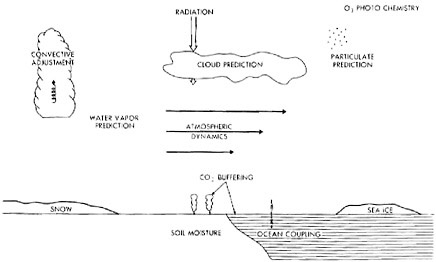
FIGURE 9.1 A schematic representation of the elements that enter into a model of the “climate system.”
over, the kinds of particulates, their optical properties, and their source-sink mechanisms are yet to be determined. However, if the modeling requirements to assess effects of thermal pollution are met, a first estimate of climate sensitivity can be made by assuming a discontinuous change in the CO2 or in the particulate distribution, without trying to understand how it can be maintained by the “climate system.”
Finally, the indirect influence of supersonic transports and chlorofluoromethanes on climate through ozone sensitivity depends on a sufficiently correct understanding of ozone photochemistry. This is a rapidly maturing field.
9.3
A CLIMATE EXPERIMENT—CIRCA 1971
One is tempted to presume that climatic change is primarily the result of extraterrestrial influences. For example, the most spectacular of all sensible climatic changes is the seasonal cycle in response to solar radiation changes as an orbital consequence. Nevertheless, the complex earth-atmosphere-ocean-cryospheric system (the “climatic system”), because of its highly interactive nonlinearity, could conceivably be responsible for all past evidences of climatic change, including ice ages. This could be the result of a subtle interplay of positive and negative feedbacks with a variety of relaxation times. This would mean that for fixed external boundary conditions, a unique stable statistical equilibrium does not exist. This possible intransitivity is only suspected now; hard experimental substantiation is yet to be achieved. We shall return to this question later.
Nevertheless, one might ask what would be the result, in the so-called statistical equilibrium, if one of the external conditions were to be changed discontinuously? Recognizing the risk in prematurely trying to ask such a question, let us consider an example—an experiment conducted several years ago by Manabe and Wetherald (1975).
What is the climatic consequence of a CO2 increase of a factor of 2, in a model in which CO2 is specified, that is, not self-determined? First, let us note that the observed increase of CO2 in this century has been 10 to 15 percent. It is estimated that approximately this much has also been buffered by the oceans. In the calculations we shall discuss, it has been assumed that the solar constant and the distributions and amounts of cloud and ozone do not change. It is assumed that the CO2 concentration in two different simulation experiments (a control and a perturbation experiment) is doubled from 300 to 600 ppm.
The experiment was performed with what is already a physically very sophisticated three-dimensional model, which has succeeded in simulating, with actual geography, many of the details of the contemporary general circulation and climate (Manabe et al., 1974). This model accounts for the complete water-vapor thermodynamic interaction (including radiation as well as released heat of condensation). It also assumes an idealized distribution of oceans and continents but with no heat storage by continents or oceans (the swamplike ocean has water available for evaporation) and with no transport by the ocean. Snow and soil moisture
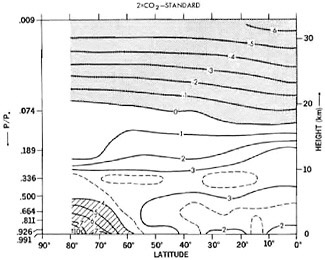
FIGURE 9.2 The latitude-height distribution of the zonally averaged temperature difference (°C) between the statistical equilibrium of a general circulation simulation with the CO2 concentration set at 600 ppm and one set at 300 ppm. This is a fully three-dimensional model with idealized geography (after Manabe and Wetherald, 1975).
are self-determined over continents, and sea ice is self-determined over the ocean. Reflectivity (albedo) depends on the nature of the earth’s surface according to empirical criteria.
When a new quasi-equilibrium is established after doubling the CO2 (Figure 9.2), there is general warming in the model troposphere because of an increase of the CO2 greenhouse effect. Particularly, there is a 2.9°C global average surface temperature rise with the main increase poleward of 60° latitude. On the other hand, the stratospheric temperature decreases. Incidentally, the reduced meridional temperature gradient resulted in a reduced intensity of baroclinic instability or storminess, the maximum of which moved poleward with the receding perimeter of snow cover.
We must remember that seasonal variability and the effects of the oceans and cloud reaction have not been accounted for and could materially alter, if not reverse, the conclusions.
This model already possesses the mechanisms for both a water-vapor greenhouse positive feedback and a snow-cover positive feedback, which have enhanced the CO2 greenhouse effect. It is useful to discuss qualitatively the physical nature of these destabilizing mechanisms.
The water-vapor greenhouse feedback chain can be reasoned purely in terms of the interaction between the infrared radiation field, the water-vapor content, and the convection in the presence of buoyant instability. Everything else being equal, one can reason that
-
An increase in temperature throughout the troposphere results in an increase in water vapor content,
-
Which increases the absorption of infrared (ir) radiation from below (the “greenhouse”),
-
Which in turn increases the in situ temperature and therefore the back-ir radiation,
-
Which yields an increase of temperature in the lower troposphere and the boundary below—a positive feedback,
-
Which gives rise to convective instability,
-
Which distributes the heat throughout the troposphere but which reduces the magnitude of the surface temperature increase (a partially compensating negative feedback).
The snow-cover feedback involves only the interaction between snow cover, its effect on reflecting solar radiation, and the net effect on the resulting temperature regime. Reasoning as before, we have that
-
An increase in atmospheric temperature
-
Decreases the area of snow cover,
-
Which decreases the albedo of the earth’s surface and therefore increases the absorbed solar radiation,
-
Which further increases the atmosphere-earth temperature at the latitude of reduced snow perimeter.
This argument is generally reversible for a temperature decrease.
9.4
A CRITIQUE ON WHAT WAS MISSING
Many of the interactive degrees of freedom of the actual terrestrial climatic system were not included in the above model. To name some of the more obvious mechanisms:
CO2-OCEAN BUFFERING
An increase of atmospheric CO2 increases the surface temperature of the sea and at the same time will reduce the ocean’s capacity to buffer CO2. Hence, a given CO2 source rate of increase would yield a greater rate increase of atmospheric CO2 concentration and hence surface temperature. We do not yet have a parameterization to represent this interaction adequately (see Chapter 4).
CLOUD REACTION
The cloud stage is generally negligible in the water-vapor transition to precipitation, as far as the water and released latent heat budgets are concerned. The importance of clouds comes from their role in reflecting and attenuating solar radiation. Although clouds can be accounted for by simple parameterizations drawn from contemporary terrestrial observations, they must be inadequate to describe systematic large changes of cloud type and distribution that may be associated with large excursions of climatic regime. Yet, the magnitude of seasonal change (or alternatively the interhemispheric difference in January or July) of surface temperature is of the same order of magnitude (about 10°C) and, therefore, within the scope of actual observation. There is, therefore, some independent empirical check of a cloud parameterization over a significant span of parameter range but probably not enough to cover the extremes of complete glaciation to complete deglaciation.
A general radiation algorithm for an arbitrary distribution of clouds has yet to be developed. Equally important is the development of a means to predict the large-scale distribution and variability of clouds as the transitional stage between unsaturated water vapor and falling precipitation.
Empirically, stratiform cloud amount varies proportionately with relative humidity (Smagorinsky, 1960), the rate being greater for high clouds. In this sensitivity experiment the intensity of the hydrologic cycle (precipitation and evaporation) increased with increasing CO2. The relative humidity at the low level increased by about 2 percent, at the middle level decreased by about 1 percent, and at the high level decreased by about 2 percent (Figure 9.3).
However, let us note that an increase in middle and low clouds
-
Increases the atmospheric albedo,
-
Decreases net downward solar radiation,
-
Cools the atmosphere-earth-ocean system,
-
Decreases surface temperature.
On the other hand, an increase in high clouds because of its low albedo and low emission temperature
-
Increases the absorption of solar radiation,
-
Decreases the net outgoing radiation,
-
Heats the atmosphere-earth-ocean system,
-
Increases surface temperature.
Therefore, the increased low-level relative humidity and the decrease at high levels each contributes to decreasing the surface temperature—qualitatively a negative or stabilizing feedback.
A possible parameterization of stratiform cloud amount based on the relative humidity-cloud correlation is very
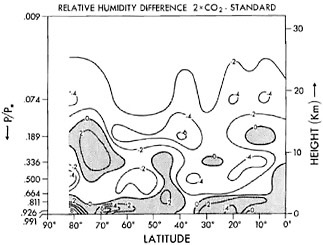
FIGURE 9.3 The latitude-height distribution of the zonally averaged relative humidity difference (%) between the statistical equilibrium of a general circulation simulation with the CO2 concentration set at 600 ppm and one set at 300 ppm. This is a fully three-dimensional model with idealized geography (after Manabe and Wetherald, 1975).
sensitive. The parameterization (based on Smagorinsky, 1960; Manabe, 1970) yields the following radiative-convective equilibrium surface-temperature dependence on stratiform cloud amount: low clouds −0.82 degree/percent, middle clouds −0.39 degree/percent, and half black high clouds +0.04 degree/percent. Therefore, a 1 percent error in the low-level humidity would give an error in the equilibrium surface temperature (for a surface with no heat capacity) of over 2½ degrees, which is comparable with the magnitude of significant climatic change. Nevertheless, this parameterization may be used to provide an order-of-magnitude estimate of the second-order correction in the Manabe-Wetherald experiment that is due to stratiform clouds: −10°C due to low-level clouds, +1°C due to middle clouds, and −0.1°C due to high clouds. This suggests an overriding compensation by low clouds. Hence the cloud interaction is highly nonlinear and may completely damp the snow-cover and water-vapor greenhouse instabilities resulting from a twofold increase of CO2. On the other hand, if the sea-surface temperature were specified, implying a boundary of infinite heat capacity of half of the area in this model, the effect of variations in cloudiness as well as CO2 would be almost insignificant.
Finally, one must reiterate the absence in the above line of argument of how cumuloform clouds might react. One would expect the height of such clouds to increase with the increased intensity of the hydrologic cycle, thus reducing the upward terrestrial radiation at the top of the atmosphere and raising the surface temperature. It all points to the fragility of quantitative and even qualitative conclusions.
AEROSOL INTERACTION
The role of aerosols, such as dust, sea salts, or sulfates, is largely unknown. We have yet to monitor adequately the distribution and variability of the complex of aerosols and to understand the processes that determine the distribution and variability of each of the constituents. In addition to the transport properties of the atmosphere, one needs to know the processes responsible for the nonconservatism of each aerosol’s life cycle: the sources and sinks and the phase or chemical changes. Furthermore, upon identifying the aerosols, their optical properties must be determined and appropriate radiative algorithms devised.
Although climatic impact can sometimes be determined empirically, such as in the case of volcanic dust during massive volcanic eruptions (Newell, 1970), one probably will need to resort to simulation techniques in general.
It might very well be that their indirect effects on cloud formation may be aerosols’ most important climatic consequence.
OCEANS VERSUS CONTINENTS
Assuming the earth were all ocean-covered with known sea-surface temperature implies infinite heat capacity of the lower boundary, which greatly damps the response of the ocean-atmosphere system to changes in solar radiation, atmospheric composition, or albedo at the lower boundary (see, for example, Washington, 1972). On the other hand, assuming a continent-covered earth with infinitesimal (if not zero) heat capacity provides an earth-atmosphere system that is hypersensitive to changes in solar radiation, atmospheric composition, or albedo at the lower boundary (as is the case in the Manabe-Wetherald experiment).
The real terrestrial situation is somewhere in between. There are oceans and some continents, each with finite but greatly differing heat capacities. The relatively long thermal relaxation time of the oceans is of particular importance with respect to the forced seasonal heating-cooling cycle.
Much of the heat that impinges on the oceans is used to evaporate water rather than to raise the sea-surface temperature. This was taken into account in the Manabe-Wetherald experiment. On the other hand, one must also point out a compensating asymmetric response to heating and cooling. Buoyant instability is activated discontinuously in the atmosphere or ocean when either is sufficiently heated from below or cooled from above. For this reason, everything else being equal, it is easier to decrease the surface air temperature over a continent; and because the heat capacity of the ocean is much larger than that of the atmosphere, it is easier to increase the interfacial temperature over the sea, an effect not accounted for in the Manabe-Wetherald model.
An examination of the available observed seasonal inter-hemispheric temperature variation (Van Loon et al., 1972) shows that both the annual mean and especially the July-to-January range of midlatitude surface temperatures are smaller in the southern hemisphere. Furthermore, the summertime difference between the hemispheres is about twice as great as the wintertime difference. Since there is more ocean in the southern hemisphere, one would, therefore, conclude that in the absence of other considerations the evaporative effect dominates the compensating effect of buoyant instability. These considerations are further complicated if the earth’s surface can become snow or ice covered, especially the sea, for then the communication for heat exchange between the hydrosphere and atmosphere can be all but cut off.
Finally, the oceans transport heat horizontally. Estimates (Vonder Haar and Oort, 1973) indicate that the poleward transfer by the oceans is comparable with that by the atmosphere in meeting the total radiative requirement.
One, therefore, needs coupled ocean-atmosphere models to consider reaction times beyond a month. The reacting depth of the ocean increases with increasing time scale. Such models are under various states of development at a number of research institutions (see, for example, Manabe et al., 1975; Bryan et al., 1974). The fundamental difficulty in constructing ocean models is that the main baroclinic eddies are small in their horizontal dimensions compared with those in the atmosphere, and the computational detail to deal with them explicitly is prohibitive. One has yet to construct adequate means for dealing with their dynamical properties statistically, that is, to devise closure schemes for their parameterization. Conversely, the oceanic time scales are much larger than that of the atmosphere, so that, if one wishes to resolve characteristic atmospheric energetic
cycles, long climatic simulations for even hundreds of years require prohibitive amounts of computation time. However, in this, some progress has been already made.
In general, the oceanic heat storage and transport properties can be expected to stabilize climatic sensitivity, although there may be important counterexamples, especially for shorter periods [e.g., Namias’s work (1970) suggests some positive feedbacks].
SEASONAL VARIATION
Missing in the CO2 calculations was the seasonal cycle. The annual average solar radiation was assumed. This is of fundamental importance since the position of the snow perimeter is the net result of winter snow fall and summer melting. These seasonal fluctuations, in turn, are much greater when there are continents at the higher latitudes. Thus there is a fundamental difference between our northern and southern hemispheres. However, it is not yet clear whether the seasonal variation taken together with a correct account of the earth’s ocean-continent distribution would intensify or diminish the climatic response to a carbon dioxide increase.
9.5
PREDICTABILITY OF CLIMATE
The Manabe-Wetherald CO2 “sensitivity experiment” is typical of a class of experiments that asks what the result is of a discontinuous controlled or “external” change in boundary conditions (such as solar radiation, heat from sources below, or albedo) or in composition (such as CO2 and particulates). It assumes that a new unique quasi-equilibrium “climate” is established. However, since the real atmosphere, as well as a model, is highly nonlinear, the validity of this assertion of transitivity is suspect and is, in itself, an important problem in establishing the limitations on the predictability of climate. One must ask, does a statistical equilibrium ever really exist, or if one waits long enough will a new state evolve; and what is long enough? It should be kept in mind that the magnitude of critical sensitivity to climate change (e.g., several degrees) is within the noise level of the natural variability of the atmosphere and of the present simulative precision of models.
9.6
SOME COMMENTS ON SIMPLE CLIMATE MODELS
In discussing the state of climate modeling, it was implicitly assumed that so-called simple climate models will, in principle, be derived from the knowledge obtained from more complex models, This is largely dictated by our inadequate observed data base on climate within the context of the general circulations of the atmosphere and oceans. In a sense, we use the results of comprehensive model simulations, where necessary, as a substitute for observation in gaining insight into the dominant operative mechanisms. By this procedure, we can decide when and how we can simplify the models and still have meaningful and useful predictions.
In any case, simple models are didactically useful in isolating the nature of the interaction of particular sets of processes. However, unless it can be satisfactorily shown that other candidate processes are negligible in the parameter range of interest, one may not extrapolate to quantitative or even qualitative predictions of the real complex geophysical medium.
One looks for maximum conceptual simplicity to reduce the computation time for very long climatic simulations. In this respect, the major impact comes from reducing computational resolution; physical simplifications are relatively less effective, e.g., a factor of 2 of resolution in each of the three space dimensions is worth a factor of 16 in computation time.
It is, therefore, natural to look for a means to eliminate one of the spatial dimensions of the physical system by a suitable parameterization and thereby to increase greatly the time step. A favorite candidate is to parameterize the atmospheric baroclinic energy cycle, which has a characteristic time of tens of days, thus eliminating the longitudinal dimension.
It is still not certain whether physically consistent closure schemes are possible in principle. But even if they are, consistency of modeling precision may limit the admissible sophistication of the operative physical processes (e.g., in the radiation algorithms, ice dynamics, ocean coupling) below the threshold, where meaningful sensitivity experiments can be performed.
An alternative approach is to compress the time dimension by taking advantage of the ocean’s enormous thermal inertia, thereby transforming a necessity to a virtue. Effectively, one determines the statistical properties of the atmosphere’s driving mechanisms of the ocean by an explicit sampling of a detailed atmospheric simulation over a sufficiently long period, such as several years. These statistically determined fluxes of water substance, heat, and momentum are then applied as a boundary condition for driving the ocean over hundreds to a thousand years. This permits a corresponding enhancement of simulated evolution time of the model climatic system by a factor of several hundred. The computational advantage can be gained at little or no sacrifice to the physical complexity needed to describe adequately the model climate system. This approach, in principle, has already been employed in an early attempt to construct a coupled atmosphere-ocean model (Manabe and Bryan, 1969). But much future work is required to assess its shortcomings.
9.7
CONCLUSION
I have tried to expose the physical factors that enter into climatic modeling, the kinds of things that are possible today, their limitations for reliable conclusions at this time, and what the deficiencies in our modeling capacity are.
For the energy question in particular, the most immediately critical outstanding problems are ocean-atmosphere coupling, cryospheric dynamics, cloud feedback, and cloud-aerosol interaction. However, there is still a general requirement for refinement and sophistication of all model elements. Moreover, the transitivity properties of the climatic system must be better understood in order to design meaningful and convincing sensitivity experiments. At the moment, it appears that experiments on the effects of heat sources will be easiest to undertake. CO2 problems will be more difficult, and those due to particulates the most difficult.
As was pointed out in connection with the earlier discussion of cloud reaction and ocean-continent contrast, the interhemisphexic-interseasonal differences are of the magnitude of significant climatic change. A detailed definition and understanding of the contemporary seasonal and interannual-interhemispheric variability is essential.
The details of an orderly program of research to cover all of these needs, as well as those in general for a broad range of climatic sensitivity and stability questions, have be en addressed authoritatively by the study conference in Sweden (GPS No. 16,1975), as was indicated earlier.
The international Joint GARP Organizing Committee meeting in Budapest (JOC X, 1975) initiated a plan to implement accelerated development. It takes the form of a decade of definitive global observation and of modeling research in the 1980’s. Between now and then, a great deal of preparatory work will be required.
There seems to be no clear shortcut for a careful and responsible attack on the problem. We should be wary of premature, hasty, and sweeping conclusions at this time.
REFERENCES
Bryan, K., S. Manabe, and R. C. Pacanowski (1975). A global ocean-atmosphere climate model: Part II. The oceanic circulation, J. Phys. Oceanog. 5, 30.
GPS No, 16 (1975). The Physical Basis of Climate and Climate Modeling, Report of the Study Conference on the Physical Basis of Climate and Climate Modeling, Stockholm, Sweden, 1974, World Meteorological Organization, Geneva, Switzerland.
JOC X (1975). Report of the Tenth Session of the Joint Organizing Committee for GARP, Budapest, November 1974, World Meteorological Organization, Geneva, Switzerland.
Mahlman, J. D. (1973). A three-dimensional stratospheric point-source tracer experiment and its implications for dispersion of effluent from a fleet of supersonic aircraft, in Proceedings of AIAA/AMS International Conference on the Environmental Impact of Aerospace Operations in the High Atmosphere, Denver, Colo., June 11–13, 1973.
Manabe, S. (1970). Cloudiness and the radiative, convective equilibrium, in Global Effects of Environmental Pollution, Proceedings of AAAS Air Pollution Session, Dallas, Tex., Dec. 1968, S. F. Singer, ed., pp. 156–157.
Manabe, S., and K. Bryan (1969). Climate calculations with a combined ocean-atmosphere model, J. Atmos. Sci. 26, 786.
Manabe, S., and R. T. Wetherald (1975). The effects of doubling the CO2 concentration on the climate of a general circulation model, J. Atmos. Sci. 32, 3.
Manabe, S., D. G. Hahn, and J. L. Holloway, Jr. (1974). The seasonal variation of the tropical circulation as simulated by a global model of the atmosphere, J. Atmos. Sci. 31, 43.
Manabe, S., K. Bryan, and M. J. Spelman (1975). A global ocean-atmosphere climate model: Part I. The atmospheric circulation, J. Phys. Oceanog. 5, 3.
Matthews, W, H., W. W. Kellogg, and G. D. Robinson, eds. (1971). Inadvertent Climate Modification, Report of the Study of Man’s Impact on Climate (SMIC), The MIT Press, Cambridge, Mass.
Namias, J. (1970). Macroscale variations in sea-surface temperatures in the North Pacific, J. Geophys. Res. 75, 565.
Newell, R. E. (1970). Stratospheric temperature change from the Mt. Agung volcanic eruption of 1963, J. Atmos. Sci. 27, 977.
Smagorinsky, J. (1960). On the dynamical prediction of large-scale condensation by numerical methods, in Physics of Precipitation, Monograph No. 5, American Geophysical Union, Washington, D.C., pp. 71–78.
Smagorinsky, J. (1974). Global atmospheric modeling and the numerical simulation of climate, in Weather and Climate Modification, W. N. Hess, ed., John Wiley and Sons, Inc., New York, pp. 633–686.
US. Domestic Council (1974). A United States Climate Program, Environmental Resources Committee, Subcommittee on Climate Change, Dec.
Van Loon, H., J. J. Taljaard, T. Sasamori, J. London, D. V. Hoyt, K. Labitzke, and C. W. Newton (1972). Meteorology of the Southern Hemisphere, Meteorological Monographs, Vol. 13, No. 35, Nov.
Vonder Haar, T. H., and A. H. Oort (1973). New estimate of annual poleward energy transport by northern hemisphere oceans, J. Phys, Oceanog. 3, 169,
Washington, W. M. (1972). Numerical climatic-change experiments: The effect of man’s production of thermal energy, J. Appl. Meteorol. 11, 768.


