


Below is the uncorrected machine-read text of this chapter, intended to provide our own search engines and external engines with highly rich, chapter-representative searchable text of each book. Because it is UNCORRECTED material, please consider the following text as a useful but insufficient proxy for the authoritative book pages.
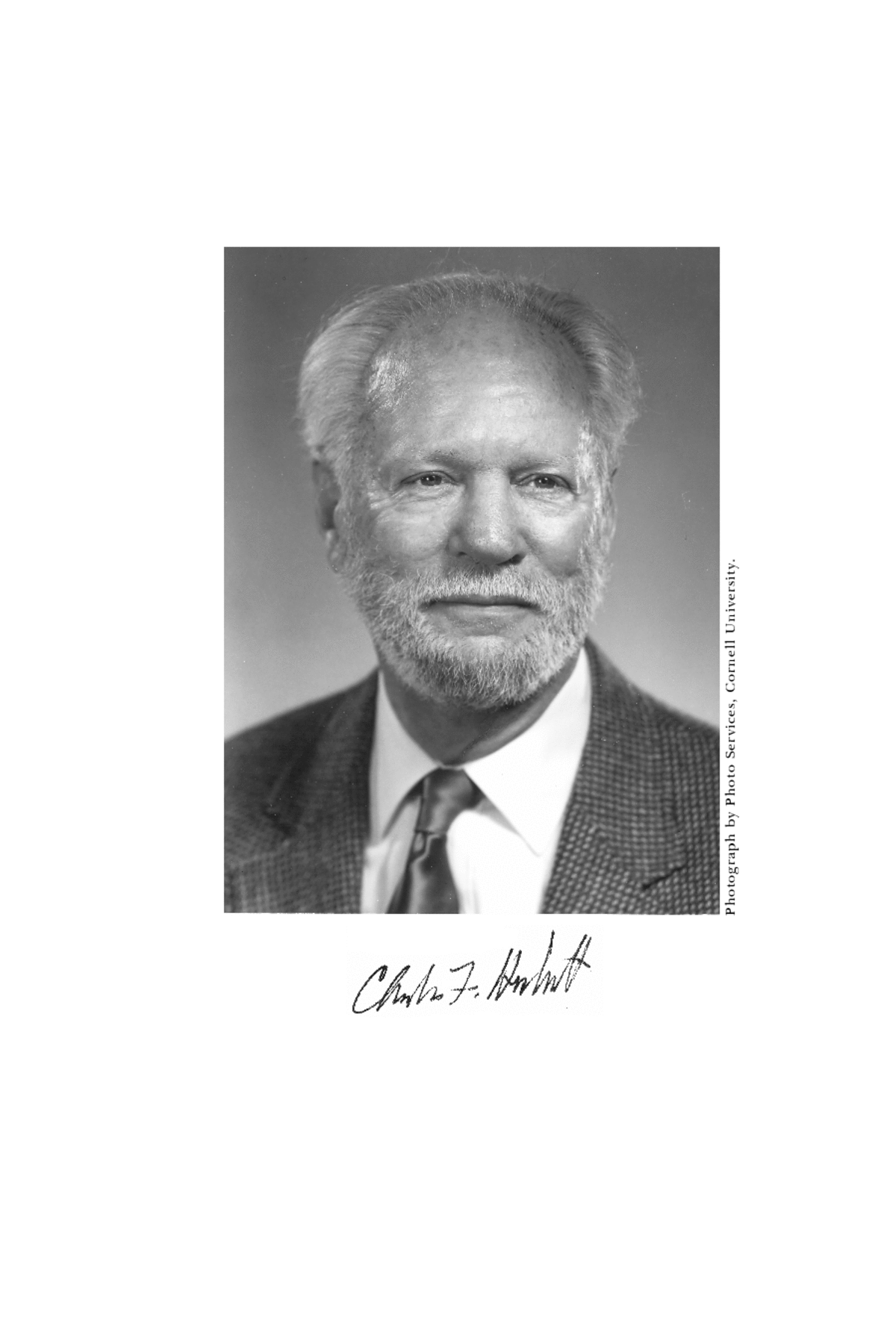
Photograph by Photo Services, Cornell University.
CHARLES F. HOCKETT January 17, 1916âNovember 3, 2000 BY JAMES W. GAIR C HARLES F. HOCKETTâ KNOWN to friends, students, and col- leagues as âChasââwas a leading figure in American structuralist linguistics, which flourished particularly in the four decades from the 1930s to the 1960s and did much to define linguistics as a science. Structuralist linguistics was sometimes referred to as Bloomfieldian linguistics from one of its pioneering figures, Leonard Bloomfield, who produced the seminal 1933 work Language. Hockett considered Bloom- field his master, and referred to his own influential 1958 work A Course in Modern Linguistics as âa commentary on Language.â Hockett was considered by many to be the bright- est young contributor to linguistic theory in the framework of structural linguistics, to which he contributed a number of basic concepts and issues. But he was by no means nar- row in his scope, and he firmly believed linguistics to be a branch of anthropology, to which he also made serious con- tributions. Hockett was the fourth child of Homer Carey Hockett, who taught American history at Ohio State University, and Amy Francisco Hockett. He entered Ohio State in 1932 at This obituary is largely drawn, with permission, from one by the same author that appeared in the Linguistic Society of America journal Language 79(3)(Sept. 2003):600- 613. 151
152 BIOGRAPHICAL MEMOIRS the age of 16, and in the spring of 1933 took George M. Bollingâs linguistics course in which the textbook was the newly published Bloomfield work referred to above. Subse- quently he took the only course in anthropology available at the time, and those experiences set him on the path to his future academic career. Hockett received his B.A. (summa cum laude) and M.A. simultaneously in ancient history at the age of 20, with a dissertation on the use of the Greek word logos in philosophy through Plato. Years later he de- scribed the introductory section of that work as showing âdespite some weird use of terms . . . the Bloomfieldian impactâ (1977, p. 1). He continued at Yale University, studying anthropology and linguistics with Edward Sapir, Franklin Edgerton, George P. Murdock, and Leslie Spier, also hav- ing Morris Swadesh, George L. Trager, and Benjamin Whorf as teachers and associates. Hockett received his Ph.D. in anthropology in 1939, with a dissertation based on his field- work in Potawatomi. His paper on Potowatomi syntax was published in Language in that year (1939), and the disser- tation, in streamlined form, was published as a series in the International Journal of American Linguistics in 1948. Af- ter a summer of fieldwork in Kickapoo and an autumn in Michoacán, Mexico, he went on to two years of postdoctoral study, including two quarters with Bloomfield at Chicago, followed by a stay at Michigan. Hockett was drafted into the U.S. Army in February 1942. After basic training in antiaircraft artillery and a few months helping to prepare other recruits for officer candidate school, he was transferred to Army Service Forces, where his lin- guistic capabilities were put to work on Chinese. In late 1942 he accompanied General Stillwellâs officers to their headquarters in Bengal, India, supervising their learning of Chinese while en route. Afterward Hockett was stationed in Washington and then in New York City, where he worked
CHARLES F. HOCKETT 153 under Major Henry Lee Smith in the dedicated and pro- ductive group preparing language-training materials, lan- guage guides, and dictionaries for military personnel. This unit numbered among its personnel or associates a number of the leading linguists of the time, and the effort allowed the application of a Bloomfieldian structural linguistic ap- proach to language teaching on an unprecedented scale. It thus served as a testing ground and laboratory for the ap- plicability and effectiveness of that approach. The materials produced there were later put to use in many postwar civil- ian programs, particularly in the less commonly taught lan- guages, and they became the model for many subsequent texts. In the course of this work Hockett, with C. Fang, produced a basic course in spoken Chinese (1944) and a guideâs manual for it, as well as a Chinese dictionary (1945) that included an introductory sketch of Chinese that was notable for both conciseness and clarity. He was commis- sioned as a second lieutenant in 1943, and after the Japa- nese surrender in 1945 was dispatched to Tokyo as a first lieutenant to help train U.S. troops in Japanese. In Febru- ary 1946 he was separated from the army with a terminal leave promotion to captain. After a short association with the American College Dic- tionary, he began his university teaching career in 1946, as an assistant professor of linguistics in the newly formed Division of Modern Languages at Cornell, a pioneering unit designed specifically to unite linguistics and language teaching on the university level following the model of the successful wartime effort. The division, which later morphed into the Department of Modern Languages and Linguistics, was given the responsibility for basic language teaching for virtually all languages at Cornell, a function it retained in a widen- ing number of languages until recently. It also served as the home for the graduate and subsequently the undergradu-
154 BIOGRAPHICAL MEMOIRS ate program in linguistics. Hockett was in charge of Chi- nese and continued to run the Chinese program for 15 years, while teaching a range of linguistics courses and di- recting students. Along with him were some of the leading names in structural linguistics, both descriptive and histori- cal, including William Moulton, Robert Hall, Frederick Agard, and Gordon Fairbanks, all of whom directed and taught in language programs and carried out productive research and teaching in linguistics. Hockett once described the situa- tion as âin effect, a linguistics institute in permanent ses- sionâ that âpermitted me to spend most of my time just as I have wanted to, in linguistics and anthropology alikeâ(1980, p. 104). His Cornell obituary describes him as having been âthe soul of the linguistics program from his first years un- til his retirement in 1982, serving on the committee of al- most all students enrolled in linguistics during his time and serving as director of 25 Ph.D. dissertations.â (He played a major role in the training of many more.) In 1957 he was invited to become a member of Cornellâs Department of Anthropology, and he was later named the Goldwin Smith Professor of Linguistics and Anthropology at Cornell, where he remained until his 1982 retirement to emeritus status. Hockett was elected to the National Academy of Sci- ences in 1974; he was also a member of the American Acad- emy of Arts and Sciences. He served as president of the Linguistic Society of America in 1964. In 1982 he was presi- dent of the Linguistic Association of Canada and the United States and in 1986 he was the distinguished lecturer of the American Anthropological Association. He held visiting po- sitions at a number of institutions, and throughout his ca- reer he gave invited lectures at a number of U.S. and for- eign institutions. Starting in 1986, he was first visiting professor and then adjunct professor of linguistics at Rice
CHARLES F. HOCKETT 155 University in Houston, Texas, an appointment still in effect at the time of his death. Hockett had a long and productive career. His Festschrift (Agard et al., 1983) contains the last available full bibliog- raphy. It lists 133 published items; he also produced many privately reproduced items presented to students and col- leagues. He continued to publish after his retirement, though at a much reduced pace, as he turned his attention increas- ingly to other interests, especially music. Though Hockett studied and associated with several lead- ing figures in American structural linguistics, Bloomfield was unquestionably the major influence on and model for him. Hockett was widely considered Bloomfieldâs chief dis- ciple, and the most prominent explicator and elaborator of Bloomfieldâs works. He was also the direct inheritor of Bloomfieldâs unfinished work, and he collected, edited, re- worked, and published much of that work, including East- ern Ojibwa Grammar, Texts and Word Lists , and The Menomini Language . In 1970 he produced A Leonard Bloomfield Anthology, with a slightly revised version of his own âImplications of Bloomfieldâs Algonquian Studies,â which had originally appeared in Language two decades earlier. In addition, he considered his own works on Algonquian languages, extending throughout his career, to be a tribute to the master. Like Bloomfield, Hockett was himself a master of lin- guistic description, producing numerous principled, meticu- lous, and perspicacious descriptions of an array of languages, including not only the Algonquian studies that he was most recognized for but also Chinese, Fijian, and English. American structural linguistics, consistent with its empirical orienta- tion, always had a strong descriptive component. Much of its impetus and many of its concepts grew out of and were inspired by the work of language description, particularly
156 BIOGRAPHICAL MEMOIRS of âexoticâ languages like Amerindian ones that exhibited structures very different from those found in the more com- mon ones of Europe. Those languages were consequently resistant to analysis in terms developed for the latter and required the development of new armament. Thus, in com- mon with the practice of other linguists in that school, Hockettâs descriptive works often served as the vehicle for the presentation of theoretical proposals, as in his âPeiping Phonologyâ (1947), âComponential Analysis of Si- erra Popolucaâ (1947), and âPeiping Morphophonemicsâ (1950), among numerous others. His directly theoretical productions were legion, and many of them were legendary, working their way into much of the work of structuralist linguists and becoming part of the conceptual equipment of several generations of students. The neo-Bloomfieldian structuralist linguistics of the 1940s and 1950s was developed by a number of productive lin- guists, including Bernard Bloch, George Trager, Henry Lee Smith, and Zellig Harris, but arguably Hockett was the single most productive and wide-ranging figure in the establish- ment of the parameters of the enterprise, and in discern- ing, defining, and elaborating issues that needed to be faced in that work. It is instructive that the volume Readings in Linguistics (Joos, 1957), which was intended to be a kind of representation of the status of the field, contained seven of Hockettâs papers, more than any other contributor (run- ners-up were Bernard Bloch and Zellig Harris, each with four). Hockettâs A Manual of Phonology (1955), though a sol- idly structuralist work, was to a degree revolutionary, char- acteristically original, and rich in content. It attempted a principled typology of phonological systems in the spirit of Troubetzkoy and the Prague school, argued for immediate constituents in phonology in a framework that included the
CHARLES F. HOCKETT 157 syllable, and developed a system of phonology based on distinctive features and the recognition of long components. As he duly acknowledged, many of its elements were al- ready present in the field in some form, but their combina- tion and development were innovative and, typical of much of his work, went counter to much of the prevailing struc- turalist practice and doctrine. They also foreshadowed ele- ments in later work in different frameworks, to an unfortu- nately often unrecognized extent. Hockett had a remarkable gift for mathematics and for comprehending and working with mathematical and for- mal systems. In 1953 he produced a review of Shannon and Weaverâs work on communication theory, and the informa- tion-theoretical approach became, as he put it in The View from Language (1977, p. 19), part of his standard intellec- tual equipment. One result was the inclusion in A Manual of Phonology (1955) of an introductory section presenting a finite state, Markovian view of speech communication and grammar, essentially of the kind that Chomsky famously critiqued in Syntactic Structures (1957). Hockett quite soon rejected that approach as not fitting the nature of human language, while retaining the view that information science had important contributions to make to linguistics. In 1966 he produced an extensive paper âLanguage, Mathematics and Linguisticsâ in which he attempted to ex- plore the formal properties of natural language that were susceptible to mathematical treatment. Ultimately, he also came to reject that endeavor as futile, except for some im- plications for sound change (1977, p. 19). Hockettâs best-known work was undoubtedly the 1958 textbook A Course in Modern Linguistics, which was widely used for many years. He considered this to be essentially a commentary on and updating of Bloomfieldâs Language and to a great extent, the pattern of topics covered in the book
158 BIOGRAPHICAL MEMOIRS echoes that earlier work, covering a wide range of areas in the study of human language, but introducing some new topics and omitting others. Though he considered the tenor of the work to be âconservative,â and presenting âthe gen- erally accepted facts and principles of the fieldâ (p. vii), when compared to other introductory texts it appears as a highly personal, original, and sometimes challenging work. It incorporated many of his own interests and much of his work, and consistent with his anthropological orientation, he included a chapter âManâs Place in Natureâ (1973), which contained the first publication of seven of his design fea- tures of communicative systems. Hockettâs treatment of grammatical analysis, especially syntax, in A Course in Modern Linguistics is especially in- teresting, and hindsight endows it with an element of dra- matic irony, since generative grammar was looming on the horizon. It was in that book that Hockett introduced his concept of âsurface and deep grammar.â It was a direct exemplification of his ability to perceive and isolate phe- nomena that had to be accounted for in any full account of language but that were at the time not amenable to or expressible in the canons of scientific linguistics to which he subscribed. In this case the stimulus was the result of his not failing to notice the pervasiveness and unavoidable im- portance of syntactic relations between noncontiguous ele- ments, of a kind that would later be called âlong distance dependencies.â As he recalled years later, âAt that period in American linguistic theory . . . if two forms stood in a construction, then we expected them to be adjacent and to be parts of a larger form that we called the constitute. Apparent connections at a distance were therefore embar- rassingâ (1997, p. 160). Such connections were admirably amenable to transformational treatment, and thus given later
CHARLES F. HOCKETT 159 developments in transformational-generative grammar, Hockettâs use of terms was to a degree prophetic. A Course in Modern Linguistics turned out to be the last major textbook summary of American post-Bloomfieldian structuralism, since its appearance essentially coincided with the appearance of Chomskyâs Syntactic Structures (Chomsky, 1957) and Leesâs laudatory review in Language (Lees, 1957) that foreshadowed the ultimate dominance of generative grammar. Though neither Chomsky nor Lees appear in the index of the work or are treated in the text itself, they are listed in the bibliography, and there is a note at the end of one chapter that the transformational approach of Chomsky, Harris, and Lees came too late to be worked into the treat- ment (1958, p. 208). In 1961 Hockett published a paper âLinguistic Elements and Their Relationsâ that in hindsight marked a turning point in his own views on language and its investigation, and to a degree signaled the end of structural linguistics as it had existed. It was an elegantly conceived attempt to solve the fundamental problem faced by structuralist de- scriptive linguistics: the fact that the elements that structur- alist descriptive linguistics recognized as basic, such as phones, phonemes, and morphemes, did not occur in a linearly parallel and compositional hierarchy of levels as many struc- tural linguists had envisioned. Hockettâs solution was to propose grammatical and phonological strata, with the âcom- posed ofâ relation holding only between elements within each stratum, and the strata linked by a mapping relation between them, but he ultimately rejected that as well. That 1961 paper closed with a characteristically Hock- ettian passage raising the possibility that the kind of lin- guistics that led to the problem in the first place, and hence the paper itself, might be misdirected and inadequate to deal with natural language:
160 BIOGRAPHICAL MEMOIRS In closing this paper, I must for the sake of honesty mention a suspicion that cannot be followed through in detail here, but that if verified, is due to undermine the logic of most of our accomplishments in descriptive linguistics since Saussure, Sapir, and Bloomfield, or even an earlier periodâ (1961, p. 52). What was at issue here was the underlying assumption that every occurring utterance in any given context had a specific âdeterminate grammatical structure involving an integral number of grammatical elements in specifiable struc- tural relations with each other,â which he saw as making linguistics as it stood inadequate to deal with such inescap- able and natural phenomena of language in action as blends, which âare not rare, but extremely common,â and âoccur not only as âslips of the tongueâ (whatever that means) but also as planned puns, double entendres, plays on words, and variously in poetry and advertising.â In dealing with these, there were three possibilities that he saw: (1) linguis- tics as it was then practiced could allow them to be ig- nored, (2) they could be regarded as deviations to be ex- plained with additional special machinery, or (3) they could be used as evidence for âsome new and very different theory of the generation of speech that would provide at once for such âdeviantâ utterances and for all âregularâ utterances.â At the time, Hockett was already shifting his perspec- tive to an insistence on a more dynamic approach that fo- cused on the hearerâs competence and behavior in real time. In part, this shift was stimulated by work that he had done in the 1950s in a project with the psychiatrists Robert Pittenger and Jack Danehy that involved a number of other anthropologists, linguists, and kinesicists and produced a fine-grained analysis of the first five minutes of a psychiat- ric interview published in 1960. As he remarked is his 1977 preface to the reprinting of his 1960 paper âEthnolinguistic
CHARLES F. HOCKETT 161 Implications of [Recent] Studies in Linguistics and Psychia- tryâ: It was Birdwhistellâs kinesics, Smith and Tragerâs paralinguistics, and the psychiatric-interview context that gradually rendered me uncomfortable with post-Bloomfieldian âmarble slabâ grammar with its atomic morphemes and that forced me to try to look at language in actionâ (1977, p. 107). The metaphor in âmarble slab grammar,â of course, in- vokes anatomy and the dissection of a cadaver; his discom- fort with that approach to grammar led to an increasing conviction that what had to be central to an adequate lin- guistic theory had to be a hearer-centered, dynamic ap- proach. Ultimately, pursuing this line of thought led him to reject what he saw as the three pillars of post-Bloomfieldian linguistics that he himself had played such a large part in developing and defending. As stated in the 1968 The State of the Art, these were âthe characterization of language as a ârigidâ system; the adoption of an item and arrangement model; and the consensus that grammar and semantics were separable and should be separatedâ(pp. 31-32). His propos- als leading toward the new kind of linguistics that he sug- gested in the finale of his 1964 presidential address were already present in the 1960 paper âEthnolinguistic Implica- tions of [Recent] Studies in Linguistics and Psychiatry,â as well as in the paper âGrammar for the Hearerâ of the same year, and in subsequent works. The developing stance that he expressed there remained a dominant theme in his work from then on. In his last book he stated (emphasis as in the original), âOur fundamental question can be phrased as follows: WHEN WE HEAR SOMEONE SAY SOMETHING IN A LANGUAGE WE KNOW, HOW DO WE KNOW WHAT IS SAIDâ (1987, p. 2.)
162 BIOGRAPHICAL MEMOIRS The thread that ran through all this later work was his rejection of the concept of language as a well-defined sys- tem that he saw as central to generative linguistics and in part at least as having its origins in the kind of structuralist theory that he had come to reject. He made this clear at the end of his 1967 paper âWhere the Tongue Slips, There Slip I,â in which he took three basic mechanisms to be the fundamental elements in the generation of speech: âanal- ogy; blending (=unresolved conflicts of analogies); and ed- itingâ (1977, p. 255). His conclusion was that: beyond the design implied by the factors and mechanisms that we have discussed, a language has no design. The search for an exact determinate formal system by which a language can be precisely characterized is a wild goose chase, because a language neither is nor reflects any such system. A language is not, as Saussure thought, a system âoù tout se tient.â Rather, the apt phrase is Sapirâs âall grammars leakâ (1977, p. 256). Hockettâs last book was the 1987 monograph Refurbish- ing Our Foundations. Its title reflected his intention to work further toward the formulation of a theory of hearing and speaking and redirect linguistic science to reexamine the nature of language in terms of how it operated in, and in fact was created within, the speaking-hearing-understand- ing situation. The book presented his thoughts and obser- vations on many of what he saw to be the basic properties of language in action, and characteristically, it included not only some new proposals and insights but also pro- posed some unresolved questions. While many of these were original, unorthodox, and invited examination and chal- lenge, the whole never eventuated into a clear and specific research program that others could take up and follow. For this and other reasons, it never attracted the attention that it could possibly repay, not least by stimulating new thoughts about the nature of its object and raising questions that the science of language would ultimately have to address. As he
CHARLES F. HOCKETT 163 saw it, this development of a âtheory of hearing and speak- ingâ would require operating in a region between linguis- tics and psychology as both were currently conceived and constrained, that is, by a kind of psycholinguistics, though he did not use that term. Especially with the appearance of his 1968 The State of the Art, Hockett became known as the most vocal and promi- nent critic of Chomsky and generative grammar, a role in which he was cast, for example, in Mehta (1971) and else- where, as in the subheading of his obituary in the New York Times describing him as âone who did not buy Chomskyâs revolutionâ (Fox, 2000). Actually, when transformational grammar emerged in both the Harris and Chomsky vari- ants, Hockett, like many other structuralists, welcomed it as an important and innovative development in syntactic theory that held great promise for dealing with problems, such as nonadjacent relations, that had proved intractable in im- mediate constituent syntactic analysis. In his 1964 presiden- tial address to the Linguistic Society of America, he went so far as to characterize Chomskyâs Syntactic Structures as âone of only four major breakthroughs in the history of modern linguistics.â In his 1964 Linguistic Institute lectures on math- ematics and linguistics, he made a number of approving references to Chomskyâs work, but by the time the work was published in 1966 he had added a footnote to the proof in the preface that those âconciliatory remarksâ were the re- sult of his âmisunderstanding,â and that â[while not pass- ing] detailed judgment on Chomskyâs frame of reference . . . let the record show that I reject that frame of reference in almost every detailâ (1966, p. 156). The footnote itself noted that the turnaround arose from a reading of Chomskyâs Aspects of the Theory of Syntax (Chomsky, 1965) that had appeared in the interim. The State of the Art gives as a major reason for his rejection of
164 BIOGRAPHICAL MEMOIRS the generative framework: that it viewed language as a well- defined system in the computational sense, as opposed to his view, characterized above, that it was ill-defined âthough characterized by various stabilitiesâ (1968, p.88). In his own changed perspective he had come by then to incorporate as crucial what he saw as the âtrueâ Bloomfieldian concep- tion that grammar, though not phonology, was inescapably and inextricably entwined with meaning, and unable to be analyzed apart from it. Another factor that entered here was that Aspects made clear Chomskyâs rationalist orientation in a way that Syntac- tic Structures had not. As a true Bloomfieldian, Hockett found that mentalistic stance thoroughly unpalatable, con- sidering it to be unscientific by his own canons of science. There was also a more personal and attitudinal element. In his 1964 address to the Linguistic Society of America, Hockett had included a statement deploring the aggressive confrontational style that marked even some of the earlier transformational work he cited. Despite the heated and not infrequently personal rhetoric that marked the argument on both sides and his own sometimes intemperately expressed personal feelings (1977, p. 61; Mehta, 1971, pp. 217-221), he characteristically strove, as his view of science demanded, to keep an open mind to the possibility that the other view might be right. As late as 1997 he remarked: Indeed, Chomskyâs paradigm may turn out to afford the best path toward the ultimate solution to our collective scientific problem; namely, the de- termination of the place of language in the universe. Some people are convinced that that is so, but no one can know for sure. My own impression is quite otherwise (1997, p. 162). The State of the Art did not, of course, slow the march toward dominance of the generative paradigm in its succes- sive forms, and it would be unfortunate if Hockett were to be remembered primarily as one who fought a futile
CHARLES F. HOCKETT 165 rearguard action against the dominance of the generative paradigm. To the extent that such is the case it can lead to easy dismissal and failure to take account of and appreciate his original and extensive contributions to the field of lin- guistics and beyond. His work in linguistics was by no means limited to synchronic theory and description. Throughout his career he continued to hold to the beliefâin common with Bloom- field, Sapir, Saussure, and their nineteenth-century forbearsâ that the investigation of language change was an integral part of the science, and his output included important his- torical analyses, notably in Algonquian but in other lan- guages as well, including Central Pacific languages and Old English. Hockett maintained the view that diachronic investiga- tion had laid the essential foundation for synchronic study, and that the latter had returned the favor. The two enter- prises thus informed each other, and any synchronic theory and description had to be at the very least compatible with what we knew and discovered about language change. In his later work the interaction between the diachronic and the synchronic was even more intimate, to the point that the distinction essentially disappeared. In the tradition of historical linguistics in which he worked, the three central mechanisms of change were sound change, analogy, and borrowingâand analogy accompanied by editingâhad be- come the fundamental mechanism in his dynamic theory of language generation. Hockettâs talents, scholarly interests, and productivity extended well beyond linguistics proper. He cast a wide net in his consideration of topics for investigation, including among other things the Whorfian theory, slips of the tongue, scheduling of linguistic and nonlinguistic events, animal communication, jokes, and the nature of writing systems
166 BIOGRAPHICAL MEMOIRS and their relation to speech. He collected a number of his papers on those topics in the 1977 book The View from Language. Its title was emblematic of his belief that the study of language constituted a unique locus for gaining insights and knowledge in other fields of inquiry. From the range of the papers included in it one can gather the range of his interests beyond what is generally considered to be linguistics as well as the power of his intellect in pursuing them. His Ph.D. was in anthropology, and he never ceased to consider linguistics as a component of that field, that is, as âlinguistics wrapped in anthropologyâ and as that branch of science devoted to the discovery of the place of human language in the universe. He believed that, as he remarked in his 1980 autobiographical interview âPreserving the Heri- tage,â âLinguistics without anthropology is sterile; anthro- pology without linguistics is blindâ (p. 100). Hockett considered his most important work to be his 1973 anthropology text Manâs Place in Nature. That book, with a bow to Thomas Huxleyâs work of the same title, raised and addressed very basic and challenging questions related to that enterprise. Hockett brought to bear on them an impressive quantity of scholarship from several fields and numerous original insights. In the chapter on language en- titled âMan as Chatterer: the Tongue Is a Fireâ he set forth his conviction that the wherewithal for acquiring language is âlocked intoâ the genes, and that its âappearance is as inevitable as menarche or the sprouting of axillary hair,â but that it also required ânurture in the bosom of an ongo- ing social groupâ so that âneither of these suffices without the otherâ (p. 101). The investigation of language was cru- cial because âan understanding of language is . . . essential for any understanding of manâs place in natureâ (p. 98).
CHARLES F. HOCKETT 167 Here and in a later chapter titled âThe Emergence of Man: Fire and Talkingâ he proceeded to present his views on the architecture of language and on productivity and change, differences among languages and universals, and the origin of language. The scope was daring and the issues and challenges remain, but the work remains well worth reading, if for no other reason than to set some more re- cent works by others in perspective. One of his most important contributions was his origi- nation and development of the design-feature approach to the comparative study of animal communication, including the human. He began with seven features appearing in the 1958 textbook and in the 1959 paper âAnimal âLanguagesâ and Human Language.â Those seven subsequently under- went numerous expansions and revisions, eventuating in 13 features as they appeared in his 1960 paper âLogical Con- siderations in the Study of Animal Communicationâ and the popularized version in Scientific American entitled âThe Origin of Speech.â These were part of a wider and more daring effort to determine the origin of human languageâ a subject of inquiry that was far from popular when he undertook it, and which led to the much reprinted 1964 paper with Robert Ascher on the human revolution. Hockettâs design features have not only found their way into linguistics texts but also have been crucially incorpo- rated into work within the field of animal communication. A Google search of the Web under his name will immedi- ately show by the sheer number of citations how widely they have been called upon in several fields. For Hockett the most important of the features that marked human lan- guage was duality of pattern, by which all of the meaningful elements of language were expressed in terms of meaning- less elements: in the case of human language, phonology. Though his concept of the architecture of grammar changed
168 BIOGRAPHICAL MEMOIRS radically, his belief in this basic feature of language as cru- cial remained throughout, though differing in detail. Hockett did not limit his productions to dry academic presentations. In 1955 he contributed a clear popularized account of structural phonemics field methods under the guise of âHow to Learn Martianâ to the magazine Astound- ing Science Fiction. Among his conclusions in Manâs Place in Nature was that âthe most important special factor in primate learning and behavior is playâ (1973, p. 74), and not only did he recognize its presence in language but also exercised it. His writings, even among the most serious, reflect his valuing of the aesthetic capabilities of language, and the delight that he took in finding and using the right turn of phrase. Metaphors abound in his work, and are used to effect, often serving to make clear a difficult point. His output is also studded with apt quotations and examples from literature ranging from the Bible and Shakespeare through T. S. Eliot, Nero Wolfe, Winnie the Pooh, and Dr. Seuss, and there are numerous oblique allusions as in the title âWhere the Tongue Slips, There Slip Iâ (1967). He included openness, aka creativity, as one of the basic de- sign features of human language, but he also delighted in the actual creative use of language and the witty turns that it made possibleâin short, in having fun with it. In a somewhat less serious vein, he indulged in such conceits as giving birth (in his head, as was the case with Athena) to one Casimir Cauchemar, adjunct professor of Etruscan rhetoric of the University of Psonch. Hockettâs alter ego, Cauchemar, then presented him with a paper âInnovation and Creativity,â as a tattered offprint from The Harvard Journal of Teleology and Cornucopia, which the recipient duly edited and published in The View from Lan- guage (1977)âa tongue-in-cheek effort that afforded him the delicious opportunity to comment on himself. Cauchemar
CHARLES F. HOCKETT 169 also included among his publications a 1968 volume of verse, Rugged Nuggets, which included several poems from âThe Red Boat,â a version of the Rubaiyat in the form of limer- icks, which Hockett had earlier distributed to friends. The Cauchemar volume bore an introduction by one Charles F. Hockett and a dedication to several poets that he knew âin the hope that they will never lose sight of the humor intrin- sic in all seriousity,â which reveals much about the editor/ author himself. Hockett contributed eight poems to the volume The Linguistic Muse (Napoli and Rando, 1979), and composed numerous others, especially lyrics for his own musical com- positions. Hockett is survived by a loving family. He had a long and happy marriage to the former Shirley Orlinoff, whom he wed while on furlough in 1942. She became a professor of mathematics at Ithaca College and the author of a half- dozen textbooks, typed by him, a collaboration that rein- forced his own considerable capability in mathematics. They had five children: four girls (Alpha Hockett Walker, Amy Robin Rose, Rachel Hockett Youngman, and Carey Beth Hockett) and a son (Asher Orlinoff Hockett), as well as five grandchildren. Music played a vital part in his life. He possessed a deep love for music and a keen ear, and he engaged in a lifelong practice of musical performance and composition. His com- positions ranged from the witty and light to the serious and sophisticated, and from short pieces through chamber works, to a full-length opera, The Love of Doña Rosita, based on a play by F. GarcÃa Lorca, Los TÃteres de Cachiporra, which received its premier performance by the Ithaca Opera at Ithaca College. Music was also a vital center of his home life. He and his wife, Shirley, were early members of the Ithaca Concert
170 BIOGRAPHICAL MEMOIRS Band, which closed every concert with âStars and Stripes Forever,â featuring Hockett on the piccolo, and the group often played his Ithaca-inspired composition âThe Small Plumâ (contra âThe Big Appleâ). Everyone in the family played an instrument, and they regularly conducted home musical performances, often of his compositions. Two of his children became professional musicians and a son-in- law is principal oboist with the Los Angeles Philharmonic. Throughout the last decades, as Hockett turned his efforts increasingly to music, he and Shirley were unstinting in their organizational efforts and financial support and inde- fatigable in the energy they devoted to bringing music to the Ithaca public. Their leadership and hard work were a vital part in establishing the Cayuga Chamber Orchestra, which after more than a quarter of a century continues to enrich the musical life of the Ithaca community. The ef- fects of their dedication and generosity are lasting and tan- gible in the Charles F. Hockett Music Scholarship, the Shirley and Chas Hockett Chamber Music Concert Series, and the Hockett Family Recital Hall at Ithaca College. Fittingly, Hockettâs memorial service was in great measure a concert at that institution that included several of his own composi- tions, some of them played by members of his family. Roman Jakobsen was once quoted as saying, âIt is very difficult for me to know what Hockettâs position on any question is. . . He changes his mind every dayâ (Mehta 1971, p. 235). There is a kernel of truth in this, since through- out his career he changed his theoretical views and was not hesitant to reject positions that he himself had espoused, developed, and argued for. However, one can consider that as more of a virtue than a vice, as the inevitable result was an active, questioning, and restless mind that was incapable of accepting any theory as immutable and necessarily true when faced with evidence to the contrary. It was also the
CHARLES F. HOCKETT 171 product of a questing temperament that was given to rang- ing into areas whose inclusion in or even relation to the field or subfield at hand were not immediately obvious. At times these qualities resulted in his apparently espousing two views at the same time in an overlapping fashion, with the demise of one preceded by the sprouting seeds of the other. Hockett was in essence a âGodâs truthâ linguist in Householderâs terminology (Householder, 1952, p. 260), dedicated to discovering the nature of human language and its place in humanity and the universe, and willing to pur- sue any clues toward that end. However he changed his views, not least on his own work, he never wavered from his Bloomfieldian commitment to the idea that the only valid generalizations about language were empirical generaliza- tions, and from a conviction that whatever hypotheses or theoretical leaps one might make it was an absolute re- quirement to be responsible to the observable data. In short, âLinguistics is either an empirical science or it is nonsenseâ (Chevillet, 1996, p. 183). Coupled with that commitment to empirical science, however, was his love for language and his marvelous ca- pacity for intuition into its structure, such that a colleague once characterized him by saying that in his Bloomfieldianism there was always a Sapir struggling to get out. That remark is insightful and essentially true, but without our over-psy- chologizing (which he would have abhorred), it was clearly more complex than that. To some of us who knew and worked with him, what appeared to be at work was an inter- secting play of a first-rate intelligence, a lively intuition, and a conscious commitment to rigor and precision, not infrequently challenged by an honest inability to exclude interesting observations or ideas, even when they did not support the analysis he was pursuing. This could lead to a
172 BIOGRAPHICAL MEMOIRS kind of internal tension that one could sense in much of his work, and even at times in personal interactions with him; one of its effects was that his work was often more interesting and sometimes more prophetic than that of many colleagues. One may charge Hockett with being subject to change of mind but never with being intellectually dishonest, un- original, or uninteresting. This carried over into his classes. When attending his lectures, one always got the feeling that there was a first-class mind directly engaging some problem as new and compelling. He would not infrequently pursue some line of investigation, and then reject, sometimes abruptly, the analysis that he had been developing as prov- ing inadequate or not properly accounting for the facts. This could be disconcerting to those students who wanted to fill their notebooks with accepted truth, but to others it was exciting as the model of how a scientific investigator proceeds and of the difficulty of arriving at whatever truth there existed to be found. In 1993 he captured the fundamental approach that had remained constant throughout his long career. Fittingly, it was included in a paper on Algonquian, and invoked Bloomfield: Time and again, what at first appears to be a knotty problem of linguistic analysis smooths [sic] out if, approaching a language with patience and reverence, we relax and let it show us how it worksâinstead of trying to force matters into some conceptual frame of reference we have imported, perhaps without realizing it, from elsewhere, This is how Bloomfield dealt with the languages he studiedâ (1993, p. 4). Hockett always had a sense of the science of linguistics as an ever-developing and social enterprise with a historical trajectory that demanded an attitude and behavior that he held up as a model for himself as well as others. In his
CHARLES F. HOCKETT 173 presidential address to the Linguistic Society of America (1965, p. 204) he said: The scholar earns immortality only of the sort that he bestows on those that have gone before him. As we extend the power and flexibility of our new tools, let us always temper passion with humor; let us never favor, nor disfavor, the new simply because of its novelty; let us dedicate our talents to building our heritage, not to tearing it down, praising our predecessors for their wisdom and ignoring their follyâreplacing a nail here or a plank there when we must, but always with humility rather than Schadenfreude when a bright old idea must give way to a bright new one. For those of us who were fortunate enough to have learned from him, there can be no better model and re- membrance.
174 BIOGRAPHICAL MEMOIRS REFERENCES Agard, F. B., G. B. Kelley, A. Makkai, and V. Makkai, eds. 1983. Essays in Honor of Charles F. Hockett. Leiden: E. J. Brill. Bloomfield, L. 1933. Language. New York: Holt. Chevillet, F. 1996. An interview with C. F. Hockett. Ãtudes Anglaises 49(2):180-191. Chomsky, N. 1957. Syntactic Structures. The Hague: Mouton. Chomsky, N. 1965. Aspects of the Theory of Syntax. Special Techni- cal Report No. 11 of the Research Laboratory of Electronics. Cambridge, MA.: MIT. Fox, M. 2000. Charles Hockett, 84, a linguist with an anthropologi- cal view: One who did not buy Chomskyâs revolution. New York Times, Nov. 13, p. B7. Householder, F. W. 1952. Review of Zellig S. Harris, Methods in Structural Linguistics. Int. J. Am. Linguist. 18(4):260-268. Joos, M., ed. 1957. Readings in Linguistics . Washington, DC: Ameri- can Council of Learned Societies, pp. 217-228. Lees, R. B. 1957. Review of Syntactic Structures by Noam Chomsky. Language 33:3. Mehta, V. 1971. John is easy to please. In John Is Easy to Please: Encounters with the Written and the Spoken Word. New York: Farrar, Straus, and Giroux, pp. 173-240. Napoli, D. J., and E. N. Rando, eds. 1979. The Linguistic Muse. Carbondale, IL: Linguistic Research.
CHARLES F. HOCKETT 175 SELECTED BIBLIOGRAPHY 1939 Potowatomi syntax. Language 15:235-248. 1944 With C. Fang. Spoken Chinese: Basic Course. Military edition pub- lished (without authorsâ names) as a War Department Education Manual. Civilian Edition. New York: Holt. 1945 With C. Fang. Guideâs Manual for Spoken Chinese. Military edition published (without authorsâ names) as a War Department Educa- tion Manual. Civilian Edition, New York: Holt. With C. Fang, eds. Dictionary of Spoken Chinese. Military edition only published (without authorsâ names) as War Department Tech- nical Manual 30-933. Authorized revision prepared under the supervision of R. A. Miller by the staff of the Institute of Far Eastern Languages, Yale University. New Haven: Yale University Press 1966. (No credit given in this version to the editors or other workers on the original military edition). 1947 Peiping phonology. J. Am. Orient. Soc. 67:253-267. Componential analysis of Sierra Populuca. Int. J. Am. Linguist. 13:258- 267. 1948 Potawatomi. Int. J. Am. Linguist. 14:1-4. Implications of Bloomfieldâs Algonquian studies. Language 24:17- 131. 1950 Peiping morphophonemics. Language 26:63-85. 1953 Review of C. L. Shannon and W. Weaver, The Mathematical Theory of Communication. Language 29:69-93.
176 BIOGRAPHICAL MEMOIRS 1954 Two models of grammatical description. Word 10:210-234. 1955 How to learn Martian. Astounding Science Fiction 55:97-106. A Manual of Phonology. Indiana University Publications in Anthro- pology and Linguistics, Memoir 11. Baltimore: Waverley Press. 1958 Eastern Ojibwa Grammar, Texts and Word Lists. Ann Arbor, MI: University of Michigan Press. A Course in Modern Linguistics. New York: Macmillan. 1959 The stressed syllabics of Old English. Language 35:575-597. Animal âlanguagesâ and human language. Hum. Biol. 31:32-39. 1960 Ethnolinguistic implications of [recent] studies in linguistics and psychiatry. Report of the Ninth Annual [1958] Georgetown Meeting on Linguistics and Language Study. Institute of Languages and Linguistics of Georgetown University Monograph Series no.11:175- 193. Grammar for the hearer. In The Structure of Language in Its Math- ematical Aspects, ed. R. Jakobsen. American Mathematical Soci- ety Proceedings of Symposia in Applied Mathematics 12:220-236. Logical considerations in the study of animal communication. In Animal Sounds and Communication, eds. W. E. Lanyon and W. N. Tavolga. Washington, DC: American Institute of Biological Sciences Symposium Series 7:392-432. The origin of speech. Sci. Am. 203(3):88-89. With R. E. Pittenger and J. J. Danehy. The First Five Minutes: A Sample of Microscopic Interview Analysis. Ithaca, NY: Paul Martineau. 1961 Linguistic elements and their relations. Language 37:29-53.
CHARLES F. HOCKETT 177 1962 Bloomfield, Leonard. The Menomini Language. Ed. Charles F. Hockett. William Dwight Whitney Series of Yale University. New Haven: Yale University Press. 1964 With R. Ascher. The human revolution. Curr. Anthropol. 5:135-168. 1965 Sound change. Language 41:185-204. 1966 Language, mathematics and linguistics. In Current Trends in Lin- guistics, vol. 3, Theoretical Foundations, ed. T. A. Sebeok, pp. 155-304. The Hague: Mouton. 1967 Where the tongue slips, there slip I. In To Honor Roman Jakobsen, ed. Thomas A. Seboek, pp. 910-936. The Hague: Mouton. Language, Mathematics and Linguistics (reprint with a new pref- ace). Janua Linguarum, Series Minor 90. The Hague: Mouton. 1968 The State of the Art. The Hague: Mouton. Rugged Nuggets (as Casimir Cauchemar). Cayuga Depths, NY: The Humanist Backlash Press. 1970 A Leonard Bloomfield Anthology. Bloomington, IN.: Indiana Uni- versity Press. 1973 Manâs Place in Nature. New York: McGraw-Hill. 1977 The View from Language. Athens, GA: University of Georgia Press.
178 BIOGRAPHICAL MEMOIRS 1980 Preserving the heritage. In First Person Singular: Papers from the Conference on an Oral Archive for the History of American Lin- guistics, eds. B. H. Davis and R. OâCain, pp. 99-107. Amsterdam: John Benjamins. 1987 Refurbishing Our Foundations. Amsterdam: John Benjamins. 1993 The Rice Papers, First Installment, June 1993. Photocopy. Rice Uni- versity. 1997 Approaches to syntax. Lingua 100:151-170.
CHARLES F. HOCKETT 179
