
5
Vulnerabilities Related to the People Who Run the Electric Power System
The employees and contractors who operate and support the U.S. power system have a remarkable record of dedicated and reliable service. However, just as physical substations, transmission lines, and information and communication systems can all be sources of vulnerability, so too, either inadvertently or intentionally, human activities can create or exacerbate disruptions in the operation of the transmission and distribution system.
It is obviously important to ensure that employees, contractors, and others who have access to critical physical assets and information systems are carefully and regularly screened for reliability. But, as with the other issues addressed in this report, it is also important to understand the broader context within which the issues of human reliability arise. Many jobs in the industry are becoming more technically demanding at the same time that the industry faces problems of an aging workforce, recruiting difficulties, and training needs that are among the most challenging of any major industrial sector.
In this chapter, the issue of ensuring the reliability of existing employees and contractors who have access to critical facilities is examined. Then, several broader issues are explored that complicate the problem of training high-quality staff and minimizing the chances that staff will inadvertently make mistakes that place the system at greater risk. Problems posed by the industry’s aging workforce and the declining pool of qualified new entrants are also examined. This is followed by some discussion of vulnerabilities that could arise from an accidental or intentionally introduced pandemic.
SECURITY THREATS FROM INSIDERS
Employees and contractors with legitimate reasons for access to the electric power system could do great harm should they ever decide to do so. Implicitly, such insiders have the capability to damage physical assets such as transformers and switch gear even more effectively than from attacks by outsiders. Great damage could also be done by system operators who intentionally took actions to place the system in vulnerable conditions. As noted in Chapter 1, disgruntled employees pose some risk but would typically be expected to operate alone. In contrast, one or several insiders working in conjunction with outsiders bent on inflicting major damage and disruption could likely do far more damage. While similar damage could also be done either directly or indirectly by contractors with access to utility equipment, a more subtle and troublesome concern is the possibility that contractor personnel who were charged with maintaining and updating critical software and intent on doing damage might insert “Trojan horses” or other destructive computer programs that could later become activated and wreak havoc in control systems at some future time.
Background security checks on all potential employees and periodic reviews of critical employees are essential. So, too, are such checks on all contractor personnel with direct or indirect access to critical elements of key physical or information and communication systems. Reviewing the quality of these security checks is also essential. Today, background checks are often outsourced to security service companies that begin the background checks as part of the initial employment process. Thorough, competent background checks must be conducted to ensure that electric utility personnel remain trustworthy and law abiding, with no links to terrorist organizations or criminal activity. Additionally, in today's environment, it is important that key employees have government security clearances so that they can work with and obtain intelligence information from government and law enforcement officials.
Standardized credentialing of utility and contractor personnel for security purposes is thus important and should utilize modern ID card technologies that use photographs, card readers, proximity access, and, where appropriate, RFID (radio frequency ID) capabilities. Standardized enterprise-wide credentials allow employees to function and gain access, in a manner that allows them to respond to a wide variety of incidents as well as to operate across a wide geographic area. While there has been much progress
in background checks of operational and security personnel, there is still much work to be done in this area, both within operating companies and in the contractor community.
PLANNING, TRAINING, AND REHEARSAL
The first important step to ensuring readiness in the face of unplanned events is by preparation through the planning process. The ability to identify key “what-if” scenarios and then develop the appropriate response plans to deal with such contingencies is the first key step in developing a comprehensive emergency response plan. Once plans have been developed, the next step is to test their effectiveness. The best way to accomplish this objective is through careful training and the use of drills and exercises. A well-constructed drill can test the ability of personnel to respond to simulated real-life situations as well as test their understanding of the overall plan. Well-designed drills test the ability of personnel to understand their roles and responsibilities as well as test the overall effectiveness of the plan in resolving the emergency situation. Crucial elements for a successful exercise include establishing clear objectives, providing realistic scenarios that simulate real-life conditions, and establishing expected actions or outcomes. Perhaps the most valuable component of a drill is an after-action review of the exercise. This allows for modifications to the plan to be discussed and implemented and an opportunity to avoid the risk of overgeneralizing from the results of a specific scenario or exercise. As further discussed in Chapter 7, many drills should include participants from outside local, state, and federal agencies.
There is also a need to reduce the vulnerability of key workers to both conventional security threats (e.g., from the use of firearms and explosive devices) and potential chemical/biological attacks. Employees serving as first responders should be provided with chemical and biological awareness training. The scope of this training should include threat and agent recognition, protection and first-aid training, personnel protection equipment, detection and sensor equipment, and training in emergency decontamination procedures.
Lastly, there is also a need for better and more realistic simulations and security training. While much has been done by industry in the security training area, better and more frequent simulation and red-teaming security exercises will improve the readiness of security personnel.1 Dramatic improvements in personnel readiness can result from introducing a comprehensive security training program that systematically includes emergency notification exercises, security training seminars, tabletop exercises, red-team exercises, force-on-force exercises, command-post exercises, and full field exercises. Training simulations and exercises such as these can:
• Provide insights into potential problem areas;
• Encourage a team approach to meeting security challenges;
• Improve organizational teamwork; and
• Audit the status of security preparedness.
It has sometimes proved important even in the aftermath of natural catastrophes to provide police protection for line crews working to restore power systems.2 In the event of a terrorist action, restoration workers themselves may become targets. Workers on poles and towers and in open areas in substations are particularly vulnerable, especially if the surrounding area is complex and offers cover in which it is easy for assailants to go undetected. Further complications arise if terrorist attacks involve chemical, radio nuclear, or biological agents. Workers must be able to determine if such an attack has occurred, the nature and extent of contamination, and what protective measures need to be taken before they can enter and work in an area where power system damage has occurred.
Restoration of a system in the context of a crime scene, as might be the case in a post-terrorist event, can also lead to involvement by personnel from myriad local, state, and federal law enforcement, security, and emergency agencies. In such situations, it is important to have previously established lines of communication. Clear manuals to explain the assignment of first responders, the roles of assisting utility teams, the jurisdiction of different law enforcement agencies, and so forth can provide a presumptive roadmap for action. As discussed in Chapter 7, carefully clarifying ahead of time the chain of command for restoration practices, for work rules, and for operational expectations on the ground will be very helpful in promoting efficient recoveries during the stress of an actual terrorist event.
The Electric Power Research Institute (EPRI) recently studied about 100 North American power outages that occurred in recent years and concluded that 12 of them were attributable to human error, either by operators in control rooms or by maintenance workers in the field (EPRI, 2000).3
_____________________
1Red teaming is the use of a group of specialists to conduct a mock attack on a power system. It is frequently used to test facility and cyber security strength against attack. It is intended to uncover vulnerabilities and weaknesses and to assist in hardening the system.
2For example, in the aftermath of Hurricane Katrina several line crews were shot at before police protection was introduced.
3For example, improper maintenance of relays contributed to cascading events, thus worsening the New York City blackout in July 1977. Improper maintenance at a San Mateo substation triggered a December 8, 1998, blackout in the San Francisco Bay Area, which cascaded from San Mateo, affecting 2 million people for up to 7 hours. Control room operator errors were a key factor in the Northeast blackout of August 2003.
Similarly, the London blackout in August of 2003 has been attributed to an incorrect relay setting.
Improved procedures and system designs can help avoid errors. With good surveillance and training, many errors can be detected and corrected before they lead to problems. But errors do happen. If they were to occur in the face of an unfolding terrorist attack, they could considerably complicate an already serious situation. This prospect further strengthens the importance of contingency planning, training, and simulated exercises.
The explosion in available information has made attention time an extremely valuable commodity for all workers. Most automated networks require some human intervention not only for routine control, but also especially when exhibiting anomalous behavior that may suggest actual or incipient failure. Progress continues to be needed in the design of interfaces that help users retain good situational awareness while allowing them to focus on the most important factors in a complex and rapidly evolving dynamic situation. Improved displays of the state of the electric power grid are being installed in control centers (Christie and Mahadev, 1994, Overbye and Weber, 2001), but there is room for a great deal of imaginative innovation in this area.
Humans have cognitive limitations that can cause them to make serious mistakes when they are interrupted. While actual or imminent local failures can be detected automatically, operators can easily be distracted by other tasks” including responding to multiple systems warnings. In the worst case, a detected failure can set off a multitude of almost simultaneous alarms as it begins to cascade through the system. Under this scenario, system operators may be unable to accurately determine the real source of the problem, which in turn could lead to the whole network shutting down automatically.
In recent years, systems have been designed that allow users to delegate tasks to intelligent software assistants (“softbots”) that operate in the background, handling routine tasks and informing the operators in accordance with some protocol that establishes the level of their delegated authority to act independently. In this arrangement, the operator becomes a supervisor, who must either cede almost all authority to subordinates or be subject to interruption by them. At present, there is very limited understanding of how to design user interfaces to accommodate interruption.
Two products developed by EPRI for substation operations and maintenance (O&M) could lead to tools for analysis of human performance. The first is the Maintenance Management Workstation (MMW), a data integration, analysis, and display tool that is used to guide decisions on equipment maintenance and replacement. Since it can connect to any database and data source, it could be adapted to analyze operational decision making. The other tool is the Planning and Resource Optimizer (PRO), which is a planning tool to assist in task scheduling and resource allocation (including labor). It allows for consistent and efficient work planning, optimized schedule and resource allocation, and facilitation of unexpected changes, and it can be used for backlog management. It also integrates with the MMW.
The degree of field information available to operators is also an area of concern. In many cases, there is little feedback from the maintenance crews to operations engineering and design engineering personnel with regard to the actual work done during a maintenance task and the as-found condition of the asset being maintained. Insufficient coordination and communication among these various personnel can result in a lack of information that can lead to less than optimal configurational control of the system and to incorrect decision making in responding to a system alarm or failure. As one example of attempts to address this issue, ConEd is evaluating a hand-held reporting system that requires specific feedback that can be uploaded to the work order management system. Such a system could enable an operator to quickly assess field work performed in evaluating the implications of an alarm. Despite the progress made to date in addressing the shortcomings of automation and human performance, the following challenges remain:
• Application of statistical methods to extract information and trending on human performance. These analytical techniques can be combined with enhanced visualization and techniques to improve situational awareness of the state of the system (perhaps using multimedia user interfaces and virtual reality) to assist the human operator.
• Network visualization and situation awareness. The exact nature of the information needed by operators, managers, users, and the general public may vary, but all need to understand what is going on in the infrastructure network. Adequate visualization of the state of the system is required for situation awareness. The proliferating new technology for multimedia user interfaces, and for virtual reality in particular, needs to be evaluated and fitted into this context of human performance. Such technology also should be incorporated into existing training simulators having adequate modeling and database capabilities at a regional transmission operator or an independent system operator level so that any entity in the region could use the same setup for its training facilities.
• Interface design. Little use has been made of esthetic considerations in the design of interfaces, yet it is clear that humans are attracted to, and seek to use more frequently, that which is esthetically pleasing. Such considerations may also be important if means are provided (e.g., on cable or broadcast television) to pass disaster mitigation information to the general public.
AGING WORKFORCE, RECRUITING, AND TRAINING
A skilled workforce is critical to continued reliable operation and resilience of the nation’s electric power system. Maintaining a skilled force is increasingly challenging for utilities, manufacturers, and consultants to the power industry.
The average age of all power system employees has increased significantly over the last decade. A serious shortage is developing, and will continue for several decades, as many of today’s employees reach retirement age. The loss of this expertise is a serious concern. Unless this issue is resolved, the nation’s electric power system will become less reliable and more vulnerable to external threats, including terrorist intrusion and disruption from natural phenomena. Preparation for, and an effective response to, a terrorist attack can only be achieved with a highly skilled and flexible workforce that is adequately sized.
For most of the past century, before the more recent widespread restructuring, the corporate culture of utilities focused on effective—perhaps liberal—use of human resources to ensure excellent performance and function. Jobs were seen as highly secure. Many professional and skilled workers remained with a company for their entire career. The complexity of managing investments, conducting system planning, running operations, running plant engineering, managing construction, and conducting maintenance required workers who were both highly trained and knowledgeable, but able to balance the needs of all stakeholders, including regulators and customers.
Industry restructuring, pressures from Wall Street and regulators, mergers and acquisitions, and the evolution of wholesale markets have led to massive reductions in the U.S. electric utility workforce. Similar to other industries, the goal of increased productivity has been largely realized, albeit with greater risk of insufficient human resources. Ashworth (2006) notes that 2005 employment levels in the U.S. power industry have “declined by 23.7 percent [compared] to pre-1975 levels, while output has continued to grow by 30 percent over the same 15 year period”(p. 1661). This substantial downsizing has made electric utility jobs far less secure and has made many jobs in the industry more stressful. Skilled laborers now often find that employment in other sectors is less demanding and more rewarding.
Ashworth (2006) also reports that the median age of the electric utility workforce is 3.5 years older than the U.S. national average of 43.9 years. Approximately 50 percent of electric utility workers are 45 or older. The average age of line workers is approximately 50. Analysis by Reder has shown a significant problem with the age distribution of engineers in the power industry (Reder, 2006). Many companies have less than 10 percent of their workforce below age 35, with the average age of employees increasing each year. The age distribution shown in Figure 5.1 projects an unsustainable and unhealthy increase in the average age of power industry employees over the next 10 years.
As many as 200,000 of 400,000 electric utility workers will be eligible to retire in the next 5 to 10 years. Ashworth (2006) reports results from a survey of top human resource executives in which 45 of the 65 respondents placed “aging workforce” in the highest category of problems facing the industry. This was followed by “skilled workforce” and “cost of employee benefits,” both of which were ranked in the top category by 11 of the 65 respondents. Clearly, with a substantially older workforce that will retire sooner, the loss of critical skills and the training of replacement workers are significant problems for the electric utility industry.
It is clear from these demographics that disruptive changes in the electric utility workforce are imminent. Many utility engineers report a substantial broadening of work assignments without the necessary time to become “experts” in the new areas of responsibility. They cover more functions and technical areas at less depth, primarily due to reductions in the available pool of engineers and other workers to cover the tasks at hand. Both because of the much smaller research investments being made by industry and government in power-related topics, and because students view opportunities for upward mobility and flexible life styles to be greater in “hot” fields such as information technology and microelectronics, many engineering schools have completely dropped power engineering as an area of study. Venkata (2004) estimates that today only 1.5 percent of engineering students select power engineering as a focus area. Clearly, the available pool of power engineering bachelor’s and master’s degree students is small, and competition by employers for future graduates will be intense.
University power engineering programs are key to the availability of sufficient numbers of engineers for the power industry. However, power engineering educators generally agree that electric power engineering education is facing a crisis. The educators on the committee that prepared this report concur that there are fewer than 12 truly viable power engineering programs in universities in the United States. Several power engineering programs have only one or two remaining faculty who are near retirement and will likely not be replaced.
The reduction in the number of viable power engineering programs in universities can be attributed to several factors. Many utilities stopped recruiting new students as they reduced their workforce. As a result of mergers, competitive forces, and deregulation, industry support of university programs in the form of scholarships, fellowships, and research funding has significantly declined. The level of funding from electric utilities to universities is significantly lower then it was 20 years ago.
Deans and department heads in universities must make decisions about the technical areas where new faculty will be hired. Generally, new faculty are hired to focus on industries that provide a strong demand for students and heavy R&D support. The electric utility industry has not demonstrated either of these characteristics over the last two decades.
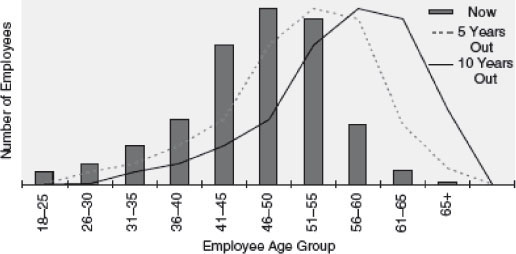
FIGURE 5.1 Typical power industry employee age distribution. SOURCE: Ashworth (2006).
Faced with the choice of limited faculty resources, many department heads replace retiring power engineering faculty with faculty working in “hot” technology areas with strong industry funding. Often these industries provide endowed professorships and chairs to support faculty positions, which guarantees the retention of faculty in these technical areas. By contrast, there are few endowed professorships and virtually no fully endowed chairs designated in electric power engineering in universities in the United States.
The widespread perception that the utility industry does not offer career opportunities that are as exciting as other industries is increasingly untrue. Technology advances are altering the nature of the technologies being deployed in the industry. Going forward, the electric power industry will need increasingly more eclectic workers with skills to address digitization and the complexity of electronics, communications, computers, and highly integrated systems; the integration and operation of renewable energy sources; the operation of sophisticated chemical processes for providing clean coal and for controlling other pollutants and carbon dioxide; and perhaps a new generation of nuclear power. Much of this modernization will be driven by consumers” increasing demands for near-perfect reliability and quality of supply at a reasonable cost and by ever tighter environmental constraints.
As the workforce population declines through retirement, attrition, and down-sizing, a precipitous loss in institutional knowledge is occurring. This knowledge is often not documented, and frequently it is known only to a very few people. As today’s employees leave the workforce, this knowledge leaves with them. EPRI and others have worked to develop tools to capture this knowledge before it is lost.
New advanced training and worker support tools may help to provide tomorrow’s employees with the knowledge and skills they will need. For example, multimedia and virtual reality tools may help with training workers in critical areas and in high-hazard tasks such as live-line work. The National Aeronautics and Space Administration is already using virtual reality tools in place of replica training simulators for team building and training with members in distributed locations. Improved haptics (the science of the sense of touch) is the most obvious requirement both in virtual reality and in multimedia in general, and there is a significant amount of research and development being done in this area.
Over the last 15 years, the response of the utility industry to a shrinking and overstressed workforce has been to turn increasingly to consultants and to outsourced engineering and information and communication technology service providers. This system is not sustainable. Many of the employees of consulting and engineering service companies are older and are therefore not a solution to the manpower needs 10 years hence. Furthermore, the majority of the experienced employees of these firms were trained in the electric utility industry as utility employees before joining service providers. The electric utility industry is no longer a training ground for skilled engineers and will not provide the increasing number of employees needed by service providers.
The conundrum is obvious. As engineers and other skilled workers retire, electric utility companies either will need ever more external support from consultants and engineering and information and communication technology service providers, or they will need to mount major new initiatives to recruit, train, and retain new workers in a competitive environment in which other power companies (and other industries) will be working vigorously to hire the same well-trained men and women.
All of this raises significant security concerns. As new employees charged with a range of responsibilities replace older workers with deep, specialized knowledge, the risk grows that people will make mistakes that compromise
security, or that exacerbate the consequences of attacks on the system. Clearly, regaining some of the workforce stability that characterized this industry in years past, while also adding to the technical depth and knowledge of the future workforce, will be an essential part of reducing the risks that terrorism poses to the electric power delivery system.
A partial solution to the workforce issue that is relevant to DHS and other federal agencies, at least in the short term, concerns the severe H1-B visa limits, currently 65,000 per year—with high competition from many industries. Electric power in the United States has greatly benefited for over 100 years from the talents of tens of thousands of immigrant engineers, including those from industry giants such as Tesla and Steinmetz. A very high proportion of U.S. graduate students in electric power today are not U.S. citizens, but many would choose to work in the U.S. power industry following graduation if allowed. Assuming that appropriate and timely background security checks can be conducted for immigrant students and others with the necessary skills, they could provide needed talent and expertise in both academic and industrial environments. Obviously, adequate numbers of student visas are also required.
WORKFORCE VULNERABILITY TO PANDEMICS
Recently, the threat of a pandemic has become an area of much concern because of both the threat to life and the disruption of the services provided by those afflicted. The threat presents unique implications, and it exposes many points of vulnerability across the electric power system infrastructure. Should a pandemic occur—whether naturally or by malicious action—it will touch every part of the electric system in ways few have considered. Recognizing the potential societal and economic impact of a pandemic, the U.S. government and the North American Electric Reliability Council (NERC) have issued advisories to the electric industry on the need for preparedness plans.
Many businesses today have implemented business continuity and emergency preparedness plans. Those plans that address high absentee levels are an important tool to ensure that critical business activities are sustainable in the event of various possible extreme situations, including health emergencies. This is particularly relevant to an industry that has relied on mutual assistance agreements in responding to catastrophic events.
Since 2003, of the 270 people known to be infected with avian flu, 164 have died (WHO, 2007). To date, 10 countries across three continents have reported confirmed human cases of avian flu. As a result, avian flu is now being described by health officials as a possible pandemic. The late Lee Jong-wook, former director-general of the World Health Organization (WHO) noted, “It is only a matter of time before an avian flu virus ... acquires the ability to be transmitted from human to human, sparking the outbreak of human pandemic influenza. We don’t know when this will happen. But we do know that it will happen” (Knox, 2005). As with other catastrophic events (e.g., hurricanes, earthquakes flooding), that the risk exists is known; however, the full impact is difficult to predict. Unlike the effects of other catastrophic events, the damage caused by a pandemic will not, by definition, be limited to a single geographic region. A pandemic can affect businesses nationally and internationally, with a primary impact on both staff and the public at large. Yet as a business continuity risk, the prospect of a pandemic can best be approached by organizations acting on a regional basis.
When a pandemic does occur, it has both social and economic impacts. The private sector and government must be prepared to manage both. The social impacts directly relate to the health and well-being of employees, customers, and business partners. Understanding how to manage the social impacts of this threat is critical and should be the focus of planning for a pandemic. A pandemic can also have major financial consequences as a result of disruption of operations or loss of key vendors or suppliers. These can directly affect an organization’s ability to recover from the event and resume normal operations. Understanding and managing both aspects of the business impact is a prerequisite to effectively and efficiently dealing with the threat of a pandemic.
In the event of a pandemic, the electric power industry, unlike some organizations, cannot completely shut down if a high percentage of the workforce is absent. Essential services such as health care, water and sewer systems, as well as basic economic activity depend on electricity to operate. Thus it is essential that the electric industry continue to develop and refine plans to address the business and human capital risks associated with a pandemic. These plans will help to ensure business continuity in the event of a pandemic and can be a natural extension to existing business continuity plans.
It should be recognized that no organization has unlimited resources to tackle a pandemic scenario. The only rational way to prepare for a pandemic is to focus on those operations that are mission critical and people-dependent. Such plans should create a leadership succession process, cross-train people to perform multiple critical business functions, include a crisis health and sanitation plan, provide for advance employee training, and include a communication and information dissemination plan.
• Robust background screening programs for all personnel need to be uniformly implemented across the electric power industry. These programs not only should apply to new employees but also should include members of the existing workforce who are staffing critical operational positions and to all contractors and others with direct or indirect access to such facilities.
• Pre-event training programs need to be developed to ensure that utility workers, as first responders, are
adequately trained to respond to a terrorist event. Training should include instruction on how to detect and operate within an area that has been contaminated by radioactive, chemical, or biological agents. The training at the engineering workforce level should also include aspects of organizational theory, risk communication, and risk perception. It should also recognize the high likelihood that such areas will be classified as a crime scene. It is important to note that such training is specifically intended to expose utility workers to probable scenarios that are a consequence of malicious attacks, and it should be clearly separated from the training utility workers receive for day-to-day system operation and maintenance.
• The electric power industry faces serious and growing security and other challenges as a result of more rapid churning of employees in utilities and among contactors. This change is resulting from workforce aging, the attrition of skilled workers, the loss of core competencies and institutional knowledge, and competition for the declining supply of electrical engineers and other skilled professionals. A detailed analysis of workforce issues in the U.S. electric power industry, including a careful examination of associated security issues, is needed and should be a priority activity for organizations representing the industry. Appropriate organizations in the public and private sector (e.g., the Edison Electric Institute CEO Committee) must engage utilities at an executive level to create and implement a set of systematic solutions to these problems.
• Mid-term and long-term solutions to the shortage of an educated power engineering workforce are dependent on the health of electric power engineering programs in universities—programs that, in many cases, have been eliminated or undergone major contraction. The utility industry must find a systemic, coordinated solution for the support of those universities that have maintained power engineering faculty and are capable of expanding power curricula and increasing student numbers over the near term. While direct student support is important in the form of scholarships and graduate fellowships, endowed chairs and professorships are needed to secure power faculty positions in electrical engineering departments. The key to the success of power engineering programs is a significant increase in direct research support for faculty and students. Increased research funding must be targeted to universities in order to provide incentives to deans and department heads who must decide which technical areas will be emphasized and where new faculty will be hired. To date, no industry organization has provided adequate leadership and “ownership” of the crisis facing power engineering education in universities.
• All utility service providers should develop business continuity plans that ensure that power can continue to be reliably supplied in the face of a pandemic. Such plans should create a leadership succession process, cross-train people to perform multiple critical business functions, include a crisis health and sanitation plan, provide for advance employee training, and include an internal and an external communication and information dissemination plan.
Ashworth, M.J. 2006. Workforce Aging in the U.S. Electric Power Industry. Briefng to the workshop on the same topic, Carnegie Mellon Electricity Industry Center, Pittsburgh, Pa., April 17.
Christie, R.D. and P.M. Mahadev. 1994. “Case Study: Visualization of an Electric Power Transmission System.” IEEE Proceedings of the Conference on Visualization ’94.
EPRI (Electric Power Research Institute). 2000. Power Delivery Reliability Initiative: Phase One Summary Report. EPRI Report 1000200. Palo Alto, Calif.: EPRI, December.
Knox, N. 2005. “‘Matter of Time Before Bird Flu Pandemic Strikes,’ WHO says.” USA Today, November 8.
Overbye, T.J., and J.D. Weber. 2001. “Visualizing the Electric Grid.” IEEE Spectrum 38(2): 52-58.
Reder, W.K. 2006. “The Technical Talent Challenge (and Implications of Our Maturing Workforce).” IEEE Power and Energy Magazine 4(1): 32-39.
Venkata, S. 2004. “Human Resource Needs in Electric Energy/Power Engineering.” Presentation. Clarkson University, Albany, N.Y., May 17.
WHO (World Health Organization). 2007. “Cumulative Number of Confirmed Human Cases of Avian Influenza A/(H5N1) Reported to WHO, 29 January 2007.” Available at http://www.who.int/csr/disease/avian_influenza/country/cases_table_2007_01_29/en/index.html. Accessed January 2007.


