


Below is the uncorrected machine-read text of this chapter, intended to provide our own search engines and external engines with highly rich, chapter-representative searchable text of each book. Because it is UNCORRECTED material, please consider the following text as a useful but insufficient proxy for the authoritative book pages.
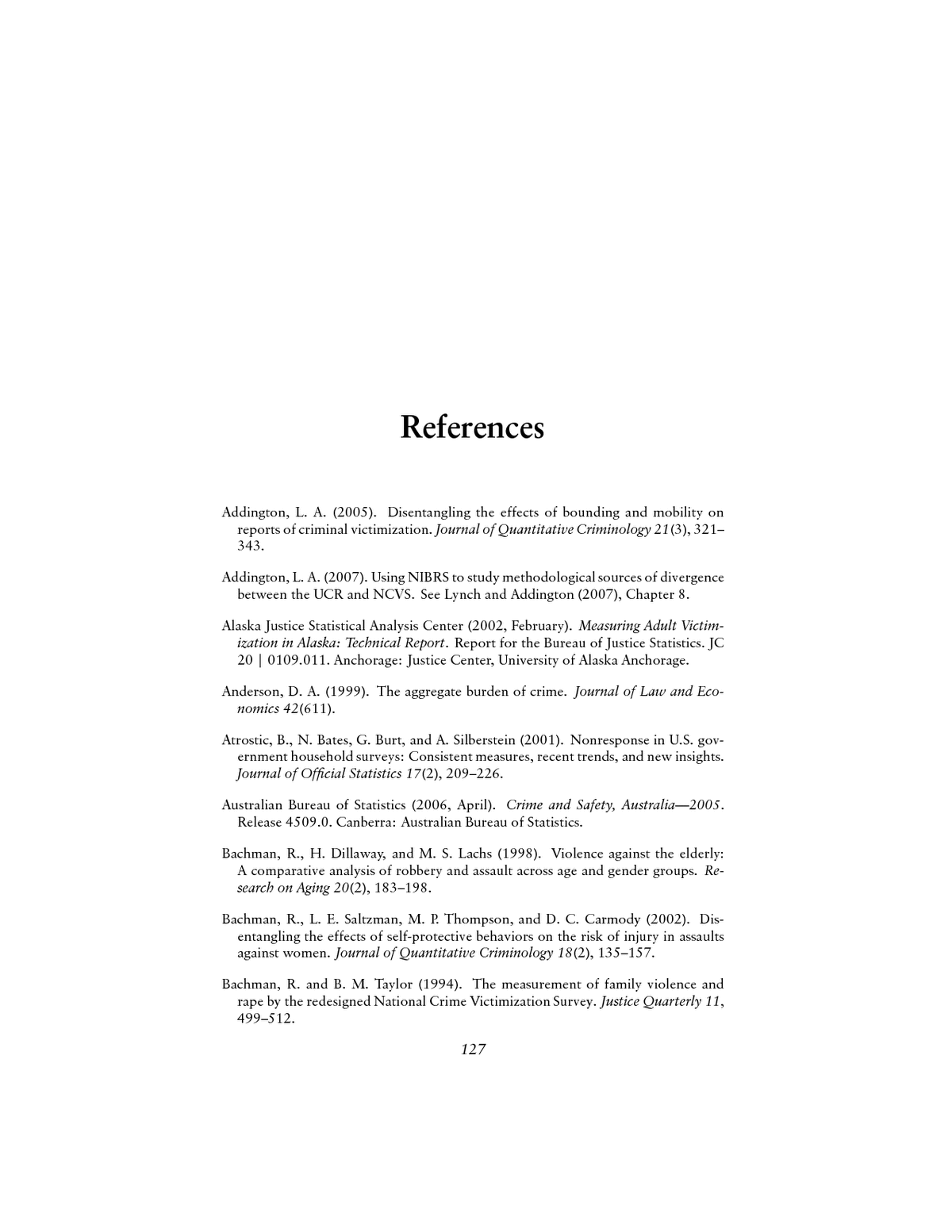
References Addington, L. A. (2005). Disentangling the effects of bounding and mobility on reports of criminal victimization. Journal of Quantitative Criminology 21(3), 321â 343. Addington, L. A. (2007). Using NIBRS to study methodological sources of divergence between the UCR and NCVS. See Lynch and Addington (2007), Chapter 8. Alaska Justice Statistical Analysis Center (2002, February). Measuring Adult Victim- ization in Alaska: Technical Report. Report for the Bureau of Justice Statistics. JC 20 | 0109.011. Anchorage: Justice Center, University of Alaska Anchorage. Anderson, D. A. (1999). The aggregate burden of crime. Journal of Law and Eco- nomics 42(611). Atrostic, B., N. Bates, G. Burt, and A. Silberstein (2001). Nonresponse in U.S. gov- ernment household surveys: Consistent measures, recent trends, and new insights. Journal of Ofï¬cial Statistics 17(2), 209â226. Australian Bureau of Statistics (2006, April). Crime and Safety, Australiaâ2005. Release 4509.0. Canberra: Australian Bureau of Statistics. Bachman, R., H. Dillaway, and M. S. Lachs (1998). Violence against the elderly: A comparative analysis of robbery and assault across age and gender groups. Re- search on Aging 20(2), 183â198. Bachman, R., L. E. Saltzman, M. P. Thompson, and D. C. Carmody (2002). Dis- entangling the effects of self-protective behaviors on the risk of injury in assaults against women. Journal of Quantitative Criminology 18(2), 135â157. Bachman, R. and B. M. Taylor (1994). The measurement of family violence and rape by the redesigned National Crime Victimization Survey. Justice Quarterly 11, 499â512. 127
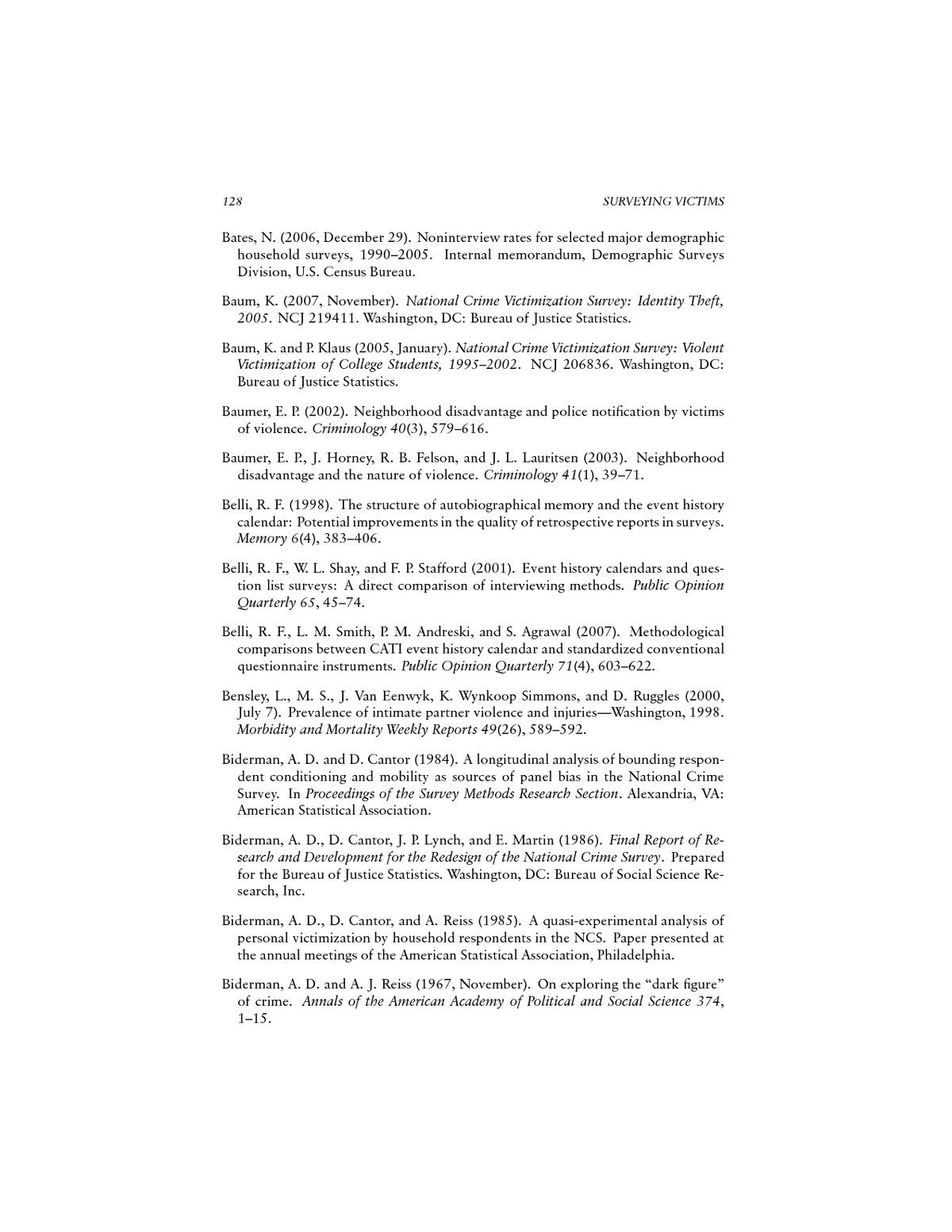
128 SURVEYING VICTIMS Bates, N. (2006, December 29). Noninterview rates for selected major demographic household surveys, 1990â2005. Internal memorandum, Demographic Surveys Division, U.S. Census Bureau. Baum, K. (2007, November). National Crime Victimization Survey: Identity Theft, 2005. NCJ 219411. Washington, DC: Bureau of Justice Statistics. Baum, K. and P. Klaus (2005, January). National Crime Victimization Survey: Violent Victimization of College Students, 1995â2002. NCJ 206836. Washington, DC: Bureau of Justice Statistics. Baumer, E. P. (2002). Neighborhood disadvantage and police notiï¬cation by victims of violence. Criminology 40(3), 579â616. Baumer, E. P., J. Horney, R. B. Felson, and J. L. Lauritsen (2003). Neighborhood disadvantage and the nature of violence. Criminology 41(1), 39â71. Belli, R. F. (1998). The structure of autobiographical memory and the event history calendar: Potential improvements in the quality of retrospective reports in surveys. Memory 6(4), 383â406. Belli, R. F., W. L. Shay, and F. P. Stafford (2001). Event history calendars and ques- tion list surveys: A direct comparison of interviewing methods. Public Opinion Quarterly 65, 45â74. Belli, R. F., L. M. Smith, P. M. Andreski, and S. Agrawal (2007). Methodological comparisons between CATI event history calendar and standardized conventional questionnaire instruments. Public Opinion Quarterly 71(4), 603â622. Bensley, L., M. S., J. Van Eenwyk, K. Wynkoop Simmons, and D. Ruggles (2000, July 7). Prevalence of intimate partner violence and injuriesâWashington, 1998. Morbidity and Mortality Weekly Reports 49(26), 589â592. Biderman, A. D. and D. Cantor (1984). A longitudinal analysis of bounding respon- dent conditioning and mobility as sources of panel bias in the National Crime Survey. In Proceedings of the Survey Methods Research Section. Alexandria, VA: American Statistical Association. Biderman, A. D., D. Cantor, J. P. Lynch, and E. Martin (1986). Final Report of Re- search and Development for the Redesign of the National Crime Survey. Prepared for the Bureau of Justice Statistics. Washington, DC: Bureau of Social Science Re- search, Inc. Biderman, A. D., D. Cantor, and A. Reiss (1985). A quasi-experimental analysis of personal victimization by household respondents in the NCS. Paper presented at the annual meetings of the American Statistical Association, Philadelphia. Biderman, A. D. and A. J. Reiss (1967, November). On exploring the âdark ï¬gureâ of crime. Annals of the American Academy of Political and Social Science 374, 1â15.
REFERENCES 129 Bijleveld, C. C. and P. R. Smit (2004, September). Netherlands. See Farrington et al. (2004), Chapter 6, pp. 151â186. Bradburn, N. M., J. Huttenlocher, L. Hedges, N. Schwartz, and S. Sudman (1994). Telescoping and temporal memory. In N. Schwartz and S. Sudman (Eds.), Autobi- ographical Memory and the Validity of Retrospective Reports. New York: Springer- Verlag. Bureau of Justice Statistics (1989). Redesign of the National Crime Survey. NCJ 111457. Washington, DC: U.S. Department of Justice. Bureau of Justice Statistics (2000, May). Criminal Victimization in the United States, 1995: A National Crime Victimization Survey Report. NCJ 171129. Washington, DC: U.S. Department of Justice. Bureau of Justice Statistics (2006a, December). Criminal Victimization in the United States, 2005âStatistical Tables. NCJ 215244. Washington, DC: U.S. Department of Justice. Bureau of Justice Statistics (2006b). National Crime Victimization Survey Longitu- dinal File, 1995â1999. Computer ï¬le. Conducted by U.S. Department of Com- merce, Bureau of the Census. ICPSR 04414. Ann Arbor, MI: Inter-university Con- sortium for Political and Social Research [producer and distributor]. Bureau of Justice Statistics (2006c). State Justice Statistics Fiscal Year 2006 Program Announcement. Washington, DC: U.S. Department of Justice, Ofï¬ce of Justice Programs. Bureau of Justice Statistics (2007a). National Crime Victimization Survey, 2005. Computer ï¬le. Conducted by U.S. Department of Commerce, Bureau of the Cen- sus. ICPSR 04451. Ann Arbor, MI: Inter-university Consortium for Political and Social Research [producer and distributor]. Bureau of Justice Statistics (2007b, January 15). National Crime Victimization Sur- vey: MSA Data, 1979â2004. Computer ï¬le. Conducted by U.S. Department of Commerce, Bureau of the Census. ICPSR 04576. Ann Arbor, MI: Inter-university Consortium for Political and Social Research [producer and distributor]. Bureau of Labor Statistics (2007, February 16). 2005 Consumer Expenditure Diary Survey, Public Use Microdata Documentation. Washington, DC: U.S. Department of Labor, Bureau of Labor Statistics, Division of Consumer Expenditure Surveys. Bushery, J. M. (1981a). Recall biases for different reference periods in the National Crime Survey. In Proceedings of the Survey Methods Research Section, pp. 238â 243. Alexandria, VA: American Statistical Association. Bushery, J. M. (1981b, March 31). Results of the NCS Reference Period Research Experiment. Memorandum for the NCS Reference Committee. Washington, DC: U.S. Bureau of the Census.
130 SURVEYING VICTIMS Cantor, D. and J. P. Lynch (2000). Self-report surveys as measures of crime and criminal victimization. In Measurement and Analysis of Crime and Justice, Vol- ume 4 of Criminal Justice 2000, pp. 85â138. NCJ 182411. Washington, DC: U.S. Department of Justice. Cantor, D. and J. P. Lynch (2005). Exploring the effects of changes in design on the analytical uses of the NCVS data. Journal of Quantitative Criminology 21(3), 293â319. Carcase, C. (2004, September). Australia. See Farrington et al. (2004), Chapter 4, pp. 75â118. Catalano, S. M. (2006, September). National Crime Victimization Survey: Criminal Victmization, 2005. NCJ 214644. Washington, DC: U.S. Department of Justice. Catalano, S. M. (2007). Methodological change in the NCVS and the effect on convergence. See Lynch and Addington (2007), Chapter 5. Centers for Disease Control and Prevention (2003). Public health surveillance for behavioral risk factors in a changing environment: Recommendations from the Behavioral Risk Factor Surveillance Team. Morbidity and Mortality Weekly Re- port 52(RR-9), 1â12. Centers for Disease Control and Prevention (2005, September 2). Behavioral Risk Factor Surveillance System Questionnaire. Behavioral Surveillance Branch. At- lanta: U.S. Department of Health and Human Services, Centers for Disease Con- trol and Prevention. Centers for Disease Control and Prevention (2006a). Behavioral Risk Factor Surveil- lance System Operational and Userâs Guide. Version 3.0. Behavioral Surveillance Branch. Atlanta: U.S. Department of Health and Human Services, Centers for Disease Control and Prevention. Centers for Disease Control and Prevention (2006b, January 23). Behavioral Risk Factor Surveillance System Questionnaire. Behavioral Surveillance Branch. At- lanta: U.S. Department of Health and Human Services, Centers for Disease Con- trol and Prevention. Centers for Disease Control and Prevention (2007, February 14). 2006 Behavioral Risk Factor Surveillance System Data Quality Report Handbook. Version 1.0.0. Behavioral Surveillance Branch. Atlanta: U.S. Department of Health and Human Services, Centers for Disease Control and Prevention. Central Statistics Ofï¬ce (2007, April 25). Crime and Victimisation: Quarterly National Household Survey, 2006 (including results for 1996 and 2003). Ref 75/2007. Dublin: Central Statistics Ofï¬ce. Clements, W. and M. Bellas (2003). Criminal Victimization in Vermont, 2001. Mont- pelier, VT: Vermont Center for Justice Research.
REFERENCES 131 Cochran, W. G. (1977). Sampling Techniques (3rd ed.). New York: Wiley. Cohen, M. A. (1988). Pain suffering and jury awards: A study of the cost of crime to victims. Law and Society Review 22, 538â555. Cohen, M. A. (2000). Measuring the costs and beneï¬ts of crime and justice. Criminal Justice 4, 264â315. Cohen, M. A. (2005). The Costs of Crime and Justice. London and New York: Routledge. Conaway, M. and S. Lohr (1994). A longitudinal analysis of factors associated with the reporting of violent crime to the police. Journal of Quantitative Criminol- ogy 10, 23â39. Cook, P. J. (1985). The case of the missing victims: Gunshot woundings in the National Crime Survey. Journal of Quantitative Criminology 1(1), 91â102. Cowan, C. D., L. R. Murphy, and J. Wiener (1984). Effects of supplemental ques- tions on victimization estimates. See Lehnen and Skogan (1984), pp. 69â73. Curtin, R., S. Presser, and E. Singer (2000). The effects of response rate changes on the index of consumer sentiment. Public Opinion Quarterly 64(4), 413â428. Czaja, R., J. Blair, B. Bickart, and E. Eastman (1994). Respondent strategies for recall of crime victimization incidents. Journal of Ofï¬cial Statistics 10(257â276). de Leeuw, E. and W. de Heer (2002). Trends in household survey nonresponse: A longitudinal and international comparison. In R. Groves, D. Dillman, J. Eltinge, and R. Little (Eds.), Survey Nonresponse, pp. 41â54. New York: Wiley. DeFrances, C. J. and S. K. Smith (1994, June). Crime and Neighborhoods. NCJ 147005. Washington, DC: Bureau of Justice Statistics. DeFrances, C. J. and S. K. Smith (1998, April). Perceptions of Neighborhood Crime, 1995. NCJ 165811. Washington, DC: Bureau of Justice Statistics. DeMaio, T. J. (1980). Refusals: Who, where, and why. Public Opinion Quar- terly 44(2), 223â233. Demographic Surveys Division, U.S. Census Bureau (2007a, April 13). Key Points of Interest Regarding the National Crime Victimization Survey (NCVS). Material provided to accompany comments to the Panel to Review the Programs of the Bureau of Justice Statistics. Washington, DC: U.S. Census Bureau. Demographic Surveys Division, U.S. Census Bureau (2007b, January). Survey Ab- stracts. Washington, DC: U.S. Census Bureau. Dinkes, R., E. F. Cataldi, W. Lin-Kelly, and T. D. Snyder (2007, December). Indica- tors of School Crime and Safety: 2007. NCES 2008-021; NCJ 219553. Washing- ton, DC: U.S. Department of Education and U.S. Department of Justice, Ofï¬ce of Justice Programs.
132 SURVEYING VICTIMS Dugan, L. (1999). The effect of criminal victimization on a householdâs moving decision. Criminology 37(4), 903â930. Dugan, L. and R. Apel (2003). An exploratory study of the violent victimization of women: Race/ethnicity and situational context. Criminology 41(3), 959â980. Duhart, D. T. (2000, October). Urban, Suburban, and Rural Victimization, 1993â 98. NCJ 182031. Washington, DC: U.S. Department of Justice, Bureau of Justice Statistics. Durose, M. R., C. W. Harlow, P. A. Langan, M. Motivans, R. R. Rantala, and E. L. Smith (2005, June). Family Violence Statistics: Including Statistics on Strangers and Acquaintances. NCJ 207846. Washington, DC: U.S. Department of Justice. Engel, R. S. (2005). Citizensâ perceptions of distributive and procedural injustice dur- ing trafï¬c stops with police. Journal of Research in Crime and Delinquency 42(4), 445â481. Engel, R. S. and J. M. Calnon (2004). Examining the inï¬uence of driversâ charac- teristics during trafï¬c stops with police: Results from a national survey. Justice Quarterly 21(1), 49â90. Farrington, D. P., P. A. Langan, and M. Tonry (Eds.) (2004, September). Cross- National Studies in Crime and Justice. NCJ 200988. Washington, DC: U.S. De- partment of Justice. Federal Bureau of Investigation (2004). UCR: Uniform Crime Reporting Handbook. Washington, DC: U.S. Department of Justice. Federal Interagency Forum on Child and Family Statistics (2007). Americaâs Chil- dren: Key National Indicators of Well-Being, 2007. Washington, DC: U.S. Gov- ernment Printing Ofï¬ce. Folsom, R., B. Shah, and A. Vaish (1999). Substance abuse in states: A method- ological report on model based estimates from the 1994â1996 national household surveys on drug abuse. In Proceedings of the Survey Methods Research Section, pp. 311â375. Alexandria, VA: American Statistical Association. Gannon, M. (2006). Crime statistics in Canada, 2005. Juristat: Canadian Centre for Justice Statistics 26(4), 1â23. Catalogue no. 85-002-XIE. Giblin, M. (2003, July). Measuring Adult Criminal Victimization: Findings from the Anchorage Adult Criminal Victimization Survey. Report for the Alaska Jus- tice Statistical Analysis Center to the Bureau of Justice Statistics. JC 0109.021. Anchorage: Justice Center, University of Alaska Anchorage. Grant, C., K. Bolling, and M. Sexton (2007). 2005â6 British Crime Survey (England and Wales): Technical Report, Volume I. Prepared for Research, Development and StatisticsâStrategic Data Flows (Crime Reduction and Community Safety Group). London: Home Ofï¬ce, United Kingdom.
REFERENCES 133 Gray, C. M. (Ed.) (1979). The Costs of Crime. Beverly Hills, CA: Sage Publications. Greenfeld, L. A. and M. A. Henneberg (2001). Victim and offender self-reports of alcohol involvement in crime. Alcohol Research and Health 25(1). Greenfeld, L. A., P. A. Langan, and S. K. Smith (1997). Police Use of Force: Collection of National Data. NCJ 165040. Washington, DC: Bureau of Justice Statistics. Grifï¬n, D. H., J. K. Broadwater, T. F. Leslie, P. D. McGovern, and D. A. Raglin (2004, December). Meeting 21st Century Demographic Data Needsâ Implementing the American Community Survey; Report 11: Testing Voluntary MethodsâAdditional Results. Washington, DC: U.S. Census Bureau. Grifï¬n, D. H., D. A. Raglin, T. F. Leslie, P. D. McGovern, and J. K. Broad- water (2003, December). Meeting 21st Century Demographic Data Needsâ Implementing the American Community Survey; Report 3: Testing the Use of Vol- untary Methods. Washington, DC: U.S. Census Bureau. Groves, R. M. (2006). Nonresponse rates and nonresponse bias in household sur- veys. Public Opinion Quarterly 70(5), 646â675. Groves, R. M. and M. P. Couper (1998). Nonresponse in Household Interview Sur- veys. New York: Wiley. Groves, R. M., D. A. Dillman, J. L. Eltinge, and R. J. Little (Eds.) (2002). Survey Nonresponse. New York: Wiley. Groves, R. M., S. Presser, and S. Dipko (2004). The role of topic interest in survey participation decisions. Public Opinion Quarterly 68, 2â31. Haddon, M. and J. Christenson (2005). Shedding Light: 2004 Utah Crime Victmiza- tion Survey. Salt Lake City: Utah Commission on Criminal and Juvenile Justice, Research and Data Unit. Harlow, C. W. (2005, November). National Crime Victimization Survey and Uni- form Crime Reporting: Hate Crime Reported by Victims and Police. NCJ 209911. Washington, DC: Bureau of Justice Statistics. Hart, T. C. and C. M. Rennison (2003). Reporting Crime to the Police, 1992â2000. NCJ 195710. Washington, DC: Bureau of Justice Statistics. Hiselman, J., P. Stevenson, G. Ramker, D. Olson, and L. Levinson (2005). The Extent and Nature of Adult Crime Victimization in Illinois, 2002. Chicago: Illinois Criminal Justice Information Authority. Home Ofï¬ce (2007, February). Guidance on Statutory Performance Indicators for Policing, 2006/07, Version 4. Police and Crime Standards Directorate. London: Home Ofï¬ce, United Kingdom. Hope, S. (2005). Scottish Crime and Victimisation Survey Calibration Exercise: A Comparison of Survey Methodologies. Edinburgh: Scottish Executive.
134 SURVEYING VICTIMS Hubble, D. L. (1999). NCVS: New questionnaire and procedures development and phase-in methodology. In Proceedings of the Survey Methods Research Section, pp. 63â72. Alexandria, VA: American Statistical Association. Iachan, R., J. Schulman, E. Powell-Griner, D. E. Nelson, P. Mariolis, and C. Stan- wyck (2001). Pooling state telephone survey health data for national estimates: The CDC Behavioral Risk Factor Surveillance System, 1995. In M. L. Cynamon and R. A. Kulka (Eds.), Conference on Health Survey Research Methods, Num- ber 7th, DHHS Publication No. (PHS) 01-1013. Hyattsville, MD, pp. 221â226. Conference on Health Survey Research Methods: National Center for Health Statistics. Jansson, K. (2007). British Crime SurveyâMeasuring Crime for 25 Years. London: Home Ofï¬ce, United Kingdom. Johnson, H. (2005). Crime Victimisation in Australia: Key Results of the 2004 Inter- national Crime Victimisation Survey. Number 64 in Research and Public Policy. Canberra: Australian Institute of Criminology. Karmen, A. (2007). Crime Victims: An Introduction to Victimology (6th ed.). Bel- mont, CA: Thomson Wadsworth. Karr, A. F. and M. Last (2006, September 29). Survey Costs: Workshop Report and White Paper. Research Triangle Park, North Carolina: National Institute of Statis- tical Sciences. Summarizes a workshop held April 18â19, 2006, at the National Center for Education Statistics, Washington, DC. Keeter, S., C. Miller, A. Kohut, R. M. Groves, and S. Presser (2000). Consequences of reducing nonresponse in a national telephone survey. Public Opinion Quar- terly 64(2), 125â148. Killias, M., P. Lamon, and M. F. Aebi (2004, September). Switzerland. See Farrington et al. (2004), Chapter 9, pp. 239â302. Kindermann, C., J. Lynch, and D. Cantor (1997). Effects of the Redesign on Victim- ization Estimates. NCJ 164381. Washington, DC: U.S. Department of Justice. Kish, L. (1976). Optima and proxima in linear sample designs. Journal of the Royal Statistical Society, Series A 139, 80â95. Klaus, P. (1999, March). Carjackings in the United States, 1992â96. NCJ 171145. Washington, DC: Bureau of Justice Statistics. Klaus, P. (2004, July). National Crime Victimization Survey: Carjacking, 1993â2002. NCJ 205123. Washington, DC: Bureau of Justice Statistics. Klaus, P. (2007, April). National Crime Victimization Survey: Crime and the Nationâs Households, 2005. NCJ 217198. Washington, DC: U.S. Department of Justice. Klaus, P. and C. M. Rennison (2002, February). Age Patterns in Violent Victimization, 1976â2000. NCJ 190104. Washington, DC: Bureau of Justice Statistics.
REFERENCES 135 Klaus, P. A. (1994). The Costs of Crime to Victims: Crime Data Brief. NCJ 145865. Washington, DC: U.S. Department of Justice, Bureau of Justice Statistics. Lauritsen, J. L. (2001). The social ecology of violent victimization: Individual and contextual effects in the NCVS. Journal of Quantitative Criminology 17(1), 3â32. Lauritsen, J. L. (2005). Social and scientiï¬c inï¬uences on the measurement of crimi- nal victimization. Journal of Quantitative Criminology 21(3), 245â266. Lauritsen, J. L. (2006a, August). Criminal victimization in American metropolitan areas. Paper presented at the annual meeting of the American Sociological Associ- ation, Montreal, Canada. Lauritsen, J. L. (2006b, February 17). Evaluation of NCVS Methodology and Costs: Report for the Bureau of Justice Statistics. Final Report for Visiting Research Fel- lowship, Grant (2005-BJ-CX-K025). Washington, DC: U.S. Department of Justice. Lauritsen, J. L. and R. Schaum (2004). The social ecology of violence against women. Criminology 42(2), 323â358. Lauritsen, J. L. and R. J. Schaum (2005). Crime and Victimization in the Three Largest Metropolitan Areas, 1980â98. NCJ 208075. Washington, DC: U.S. De- partment of Justice. Law Enforcement Assistance Administration (1981). Current objectives for the Na- tional Crime Survey program. See Lehnen and Skogan (1981), pp. 10. Excerpted from a memorandum from James Gregg, Acting Administrator, Law Enforcement Assistance Administration, to Peter F. Flaherty, Deputy Attorney General, entered as testimony before the Committee on the Judiciary, U.S. House of Representa- tives, October 13, 1977. Lee, M., D. Lewis, M. Crowley, E. Hock, C. Laskey, C. Loftin, W. Logan, and L. Addington (1999). Developing hate crime questions for the National Crime Victimization Survey. In Proceedings of the Survey Methods Research Section, pp. 1036â1041. Alexandria, VA: American Statistical Association. Lehnen, R. G. and W. G. Skogan (Eds.) (1981). The National Crime Survey Work- ing Papers: Volume I: Current and Historical Perspectives. Number NCJ 75374. Washington, DC: U.S. Department of Justice. Lehnen, R. G. and W. G. Skogan (Eds.) (1984). The National Crime Survey Working Papers: Volume II: Methodological Studies. Number NCJ 90307. Washington, DC: U.S. Department of Justice. Lepkowski, J. P. and M. P. Couper (2002). Nonresponse in longitudinal household surveys. See Groves et al. (2002), Chapter 17, pp. 259â272. Levitt, S. D. (1999). The changing relationship between income and crime victim- ization. Economic Policy Review 5(3), 993â1016.
136 SURVEYING VICTIMS Lewis, D. (2002, June). NCVS research. NCVS Research Unit, Demographic Surveys Division, U.S. Census Bureau, Memorandum 02-02. Lynch, J. P. (2002). Trends in Juvenile Violent Offending. Juvenile Justice Bulletin. NCJ 191052. Washington, DC: U.S. Department of Justice, Ofï¬ce of Juvenile Justice and Delinquency Prevention. Lynch, J. P. (2006). Problems and promise of victimization surveys for cross-national research. Crime and Justice: A Review of Research 34. Accessed through Lexis- Nexis; pagination differs from printed volume. Lynch, J. P. and L. A. Addington (Eds.) (2007). Understanding Crime Statistics: Re- visiting the Divergence of the NCVS and UCR. Cambridge Studies in Criminology. New York: Cambridge University Press. Lynch, J. P., M. L. Berbaum, and M. Planty (1998). Investigating Repeated Vic- timization with the NCVS. Final report for National Institute of Justice Grant 97-IJ-CX-0027. Washington, DC: U.S. Department of Justice. Lynn, P. (1997). Collecting Data About Non-Respondents to the British Crime Survey. London: Social and Community Planning Research. Maltz, M. D. (1999, September). Bridging Gaps in Police Crime Data: A Discussion Paper from the BJS Fellows Program. Bureau of Justice Statistics and Federal Bureau of Investigation Uniform Crime Reporting Program. NCJ 176365. Washington, DC: U.S. Department of Justice. Maltz, M. D. (2007). Missing UCR data and divergence of the NCVS and UCR trends. See Lynch and Addington (2007), Chapter 10. Martin, E., R. M. Groves, J. Matlin, and C. Miller (1986). Report on the Develop- ment of Alternative Screening Procedures for the National Crime Survey. Washing- ton, DC: Bureau of Social Science Research, Inc. May, D., J. Wells, K. Minor, K. Cobb, E. Angel, and K. Cline (2004). Crime Victim- ization Experiences, Fear of Crime, Perceptions of Risk, and Opinion of Criminal Justice Agents Among a Sample of Kentucky Residents. Center for Criminal Jus- tice Education Research, Department of Correctional and Juvenile Justice Studies, College of Justice and Safety. Richmond, KY: Eastern Kentucky University. McDowall, D. and C. Loftin (2007). What is convergence, and what do we know about it? See Lynch and Addington (2007), Chapter 4. McManus, R. (2002). Criminal Victimization Trends in South Carolina. Blythewood, SC: Ofï¬ce of Justice Programs, South Carolina Department of Public Safety. Miller, P. V. and R. M. Groves (1985). Matching survey responses to ofï¬cial records: An exploration of validity in victimization reporting. The Public Opinion Quar- terly 49(3), 366â380.
REFERENCES 137 Miller, T. R., M. A. Cohen, and B. Wiersema (1996). Victim Costs and Consequences: A New Look. Research Report. NCJ 155282. Washington, DC: U.S. Department of Justice, National Institute of Justice. Minnesota Justice Statistics Center (2003). Safe at Home: 2002 Minnesota Crime Survey. Minnesota Planning. St. Paul, MN: Minnesota Department of Public Safety, Ofï¬ce of Justice Programs. Murphy, L. (1976). The Effects of the Attitude Supplement on NCS City Sample Vic- timization Data. Unpublished internal document. Washington, DC: U.S. Bureau of the Census. Murphy, L. R. (1984). Effects of bounding on telescoping in the National Crime Survey. See Lehnen and Skogan (1984), pp. 83â89. National Center for Victims of Crime (2003). Extending Our Reach, Reaching More: Victims of Crime, 2000â2002 Progress Report. Washington, DC: National Center for Victims of Crime. National Research Council (1976a). Setting Statistical Priorities. Washington, DC: National Academy Press. National Research Council (1976b). Surveying Crime. Panel for the Evaluation of Crime Surveys. Bettye K. Eidson Penick, editor, and Maurice E.B. Owens III, associate editor. Committee on National Statistics, Academy of Mathematical and Physical Sciences. Washington, DC: National Academy of Sciences. National Research Council (1984). Cognitive Aspects of Survey Methodology: Build- ing a Bridge Between Disciplines. Report of the Advanced Research Seminar on Cognitive Aspects of Survey Methodology. Thomas B. Jabine, Miron L. Straf, Ju- dith M. Tanur, and Roger Tourangeau (Eds.), Committee on National Statistics, Commission on Behavioral and Social Sciences and Education. Washington, DC: National Academy Press. National Research Council (1997). Small-Area Estimates of School-Age Children in Poverty: Interim Report 1, Evaluation of 1993 County Estimates for Title I Allo- cations. Panel on Estimates of Poverty for Small Geographic Areas, Constance F. Citro, Michael L. Cohen, Graham Kalton, and Kirsten K. West (Eds.), Committee on National Statistics. Washington, DC: National Academy Press. National Research Council (1998). Small-Area Estimates of School-Age Children in Poverty: Interim Report 2, Evaluation of Revised 1993 County Estimates for Title I Allocations. Panel on Estimates of Poverty for Small Geographic Areas, Constance F. Citro, Michael L. Cohen, and Graham Kalton (Eds.), Committee on National Statistics. Washington, DC: National Academy Press. National Research Council (1999). Small-Area Estimates of School-Age Children in Poverty: Interim Report 3. Panel on Estimates of Poverty for Small Geographic Areas, Constance F. Citro and Graham Kalton (Eds.), Committee on National Statistics. Washington, DC: National Academy Press.
138 SURVEYING VICTIMS National Research Council (2000a). Small-Area Estimates of School-Age Children in Poverty: Evaluation of Current Methodology. Panel on Estimates of Poverty for Small Geographic Areas, Constance F. Citro and Graham Kalton (Eds.), Commit- tee on National Statistics. Washington, DC: National Academy Press. National Research Council (2000b). Small-Area Income and Poverty Estimates: Pri- orities for 2000 and Beyond. Panel on Estimates of Poverty for Small Geographic Areas, Constance F. Citro and Graham Kalton (Eds.), Committee on National Statistics. Washington, DC: National Academy Press. National Research Council (2003a). Measurement Problems in Criminal Justice Re- search: Workshop Summary. Committee on Law and Justice and Committee on National Statistics, John V. Pepper and Carol V. Petrie (Eds.), Division of Behavioral and Social Sciences and Education. Washington, DC: The National Academies Press. National Research Council (2003b). Survey Automation: Report and Workshop Pro- ceedings. Oversight Committee for the Workshop on Survey Automation, Daniel L. Cork, Michael L. Cohen, Robert Groves, and William Kalsbeek (Eds.), Com- mittee on National Statistics. Washington, DC: The National Academies Press. National Research Council (2004). Principles and Practices for a Federal Statistical Agency (Third ed.). Committee on National Statistics. Margaret E. Martin, Miron L. Straf, and Constance F. Citro (Eds.), Division of Behavioral and Social Sciences and Education. Washington, DC: The National Academies Press. National Research Council (2006). Once, Only Once, and in the Right Place: Resi- dence Rules in the Decennial Census. Panel on Residence Rules in the Decennial Census. Daniel L. Cork and Paul R. Voss (Eds.), Committee on National Statistics, Division of Behavioral and Social Sciences and Education. Washington, DC: The National Academies Press. National Research Council (2007). Using the American Community Survey: Beneï¬ts and Challenges. Panel on the Functionality and Usability of Data from the Ameri- can Community Survey. Constance F. Citro and Graham Kalton (Eds.), Committee on National Statistics, Division of Behavioral and Social Sciences and Education. Washington, DC: The National Academies Press. OâBrien, R. (1996). Police productivity and crime rates: 1973â1992. Criminol- ogy 34, 183â207. Pepper, J. V. and C. V. Petrie (2003). Introduction. See National Research Council (2003a), Chapter 1, pp. 1â9. Pfeffermann, D. (2002). Small area estimationânew developments and directions. International Statistical Review 70(1), 125â143. Planty, M. (2007). Series victimization and divergence. See Lynch and Addington (2007), Chapter 6.
REFERENCES 139 Planty, M. and K. Strom (2007). Understanding the role of repeat victims in the production of annual US victimization rates. Journal of Quantitative Criminol- ogy 23(3), 179â200. Presidentâs Commission on Law Enforcement and Administration of Justice (1967, February). The Challenge of Crime in a Free Society. Washington, DC: U.S. Gov- ernment Printing Ofï¬ce. Commonly known as the Crime Commission report. Raghunathan, T. E., D. Zie, N. Schenker, V. L. Parsons, W. W. Davis, K. W. Dodd, and E. J. Feuer (2007). Combining information from two surveys to estimate county-level prevalence rates of cancer risk factors and screening. Journal of the American Statistical Association 102(478), 474â486. Rand, M. and S. Catalano (2007, December). Criminal Victimization, 2006. NCJ 219413. Washington, DC: Bureau of Justice Statistics. Rand, M. R. (1994, April). Guns and Crime: Handgun Victimization, Firearm Self- Defense, and Firearm Theft. NCJ 147003. Washington, DC: Bureau of Justice Statistics. Rand, M. R. and C. M. Rennison (2005). Bigger is not necessarily better: An anal- ysis of violence against women estimates from the National Crime Victimization Survey and the National Violence Against Women Survey. Journal of Quantitative Criminology 21(3), 267â291. Rao, J. (2003). Small Area Estimation. New York: Wiley. Rennison, C. M. (2003). Violent Crime and Victims Gender, 2002: An Examina- tion of Differences in Correlates of Male and Female Non-Fatal Violent Victimiza- tion in the State of Illinois, 2002. Chicago: Illinois Criminal Justice Information Authority. Rennison, C. M. and M. R. Rand (2007). Introduction to the National Crime Vic- timization Survey. See Lynch and Addington (2007), Chapter 2. Robinson, L. (2007, March 21). Statement. Prepared testimony for the Subcommit- tee on Commerce, Justice, Science, and Related Agencies, Committee on Appro- priations, U.S. House of Representatives. Rosenfeld, R. (2007). Explaining the divergence between UCR and NCVS aggra- vated assault trends. See Lynch and Addington (2007), Chapter 9. Rubin, M. (2007). Maine Crime Victimization Report: Informing Public Policy for Safer Communities. Edwin S. Muskie School of Public Service, University of Southern Maine. Portland, ME: Maine Statistical Analysis Center. Savage, I. R. (1985). Hard-soft problems. Journal of the American Statistical Associ- ation 80, 1â7.
140 SURVEYING VICTIMS Singh, R. P. (1982, October 27). Investigation to determine the best reference pe- riod length for the National Crime Survey (NCS). Census Bureau memorandum, addressed to Gary M. Shapiro. Sirken, M., T. Jabine, G. Willis, E. Martin, and C. Tucker (Eds.) (1999). A New Agenda for Interdisciplinary Survey Research Methods: Proceedings of the CASM II Seminar. Hyattsville, MD: National Center for Health Statistics. Skogan, W. G. (1990). A review: The National Crime Survey redesign. The Public Opinion Quarterly 54(2), 256â272. Smith, A. F. (2006). Crime Statistics: An Independent Review. Report of the Review Group. London: Home Ofï¬ce, United Kingdom. Smith, M. D. (1987). Changes in the victimization of women: Is there a ânew female victimâ? Journal of Research in Crime and Delinquency 24(4), 291â301. Smith, M. D. and E. S. Kuchta (1993). Trends in violent crime against women, 1973â1989. Social Science Quarterly 74(1), 28â45. Smith, S. K., G. W. Steadman, T. D. Minton, and M. Townsend (1999, May). Crimi- nal Victimization and Perceptions of Community Safety in 12 Cities, 1998. Bureau of Justice Statistics and Ofï¬ce of Community Oriented Policing Services. NCJ 173940. Washington, DC: U.S. Department of Justice. Spencer, B. D. (1982). Feasibility of beneï¬t-cost analysis of data programs. Evalua- tion Review 6, 649â672. Statistics Commission (2006, September). Crime Statistics: User Perspectives. Report No. 30. London: Statistics Commission, United Kingdom. Steffensmeier, D. and M. D. Harer (1999). Making sense of recent U.S. crime trends, 1980 to 1996/1998: Age composition effects and other explanations. Journal of Research in Crime and Delinquency 36(3), 235â274. Stohr, M. and S. Vazques (2001). Idaho Crime Victimization Survey, 2000. Meridian, ID: Idaho Statistical Analysis Center, Idaho State Police. Sudman, S., N. M. Bradburn, and N. Schwarz (1996). Thinking About Answers: The Application of Cognitive Processes to Survey Methodology. San Francisco: Jossey- Bass. Teske, R. H. and N. L. Lowell (1977). Texas Crime Poll: Fall, 1977 Survey. Huntsville, Texas: Survey Research Program, Criminal Justice Center, Sam Hous- ton State University. Manuscript is undated and assumed to be 1977. Available: http://www.cjcenter.org/cjcenter/research/srp/cparchive/1977.pdf. Thacher, D. (2004). The rich get richer and the poor get robbed: Inequality in U.S. criminal victimization, 1974â2000. Journal of Quantitative Criminology 20(2), 89â116.
REFERENCES 141 Thaler, R. (1978). A note on the value of crime control: Evidence from the property market. Journal of Urban Economics 5, 137â145. Tourangeau, R. and M. E. McNeeley (2003). Measuring crime and crime victimiza- tion: Methodological issues. See National Research Council (2003a), Chapter 2, pp. 10â42. Tourangeau, R. and T. Smith (1996). Asking sensitive questions: The impact of data collection mode, question format, and question context. Public Opinion Quarterly 60, 275â304. Turner, C., B. Forsyth, J. OâReilly, P. Cooley, T. Smith, S. Rogers, and H. Miller (1998). Automated self-interviewing and the survey measurement of sensitive be- haviors. In M. Couper, R. Baker, J. Bethlehem, C. Clark, J. Martin, W. Nicholls II, and J. OâReilly (Eds.), Computer-Assisted Survey Information Collection. New York: Wiley. U.S. Bureau of the Census (1968). Report on National Needs for Criminal Justice Statistics, pp. 53. In Bureau of Justice Statistics (1989). U.S. Census Bureau (2003). National Crime Victimization Survey: Interviewing Man- ual for Field Representatives. NCVS-550. Washington, DC: U.S. Census Bureau. U.S. Department of Health and Human Services (2000, November). Healthy People 2010 (2nd ed.). With Understanding and Improving Health and Objectives for Improving Health. 2 vols. Washington, DC: U.S. Government Printing Ofï¬ce. U.S. Ofï¬ce of Management and Budget (2000). Statistical Programs of the United States Government: Fiscal Year 2001. Washington, DC: Government Printing Ofï¬ce. U.S. Ofï¬ce of Management and Budget (2006a, January). Questions and Answers When Designing Surveys for Information Collections. Washington, DC: Ofï¬ce of Information and Regulatory Affairs, U.S. Ofï¬ce of Management and Budget. U.S. Ofï¬ce of Management and Budget (2006b, September). Standards and Guide- lines for Statistical Surveys. Washington, DC: Statistical and Science Policy, Ofï¬ce of Information and Regulatory Affairs, U.S. Ofï¬ce of Management and Budget. U.S. Ofï¬ce of Management and Budget (2006c). Statistical Programs of the United States Government: Fiscal Year 2007. Washington, DC: Government Printing Ofï¬ce. U.S. Ofï¬ce of Management and Budget (2007). Statistical Programs of the United States Government: Fiscal Year 2008. Washington, DC: Government Printing Ofï¬ce. Walker, A. (2006, January 23). Victim survey methodology: Mode, sample design and other aspectsâresults from the inventory of victimisation surveys. Working Paper Number 6, submitted by the Home Ofï¬ce, United Kingdom, for the Joint
142 SURVEYING VICTIMS United Nations Economic Commission for Europe and United Nations Ofï¬ce on Drugs and Crime Meeting on Crime Statistics, Vienna. Walker, S. (1998). Popular Justice: A History of American Criminal Justice (2nd ed.). New York: Oxford University Press. Warchol, G. (1998, July). Workplace Violence, 1992â96. NCJ 168634. Washington, DC: Bureau of Justice Statistics. Wiersema, B. (1999). Area-Identiï¬ed National Crime Victimization Survey Data: A Resource Available Through the National Consortium on Violence Research. NCOVR Census Center Working Paper 1. Pittsburgh, PA: National Consortium on Violence Research. Woltman, H. and J. Bushery (1984). Summary of a study examining âdifferentially weighted estimates of annual victimization rates using a 12-month bounded refer- ence periodâ. See Lehnen and Skogan (1984), pp. 117â118. Woltman, H., J. Bushery, and L. Carstensen (1984). Recall bias and telescoping in the National Crime Survey. See Lehnen and Skogan (1984), pp. 90â93. Work, C. R. (1975). Objectives of the NCS and of victimization surveys. See Na- tional Research Council (1976b), pp. 219â228. Incorporated into memorandum to Charles Kindermann. Wyoming Statistical Analysis Center (2004, Winter). First-ever Wyoming crime vic- timization survey. Field Notes from the SRC. Newsletter, Survey Research Center, University of Wyoming. Ybarra, L. M. and S. L. Lohr (2002). Estimates of repeat victimization using the National Crime Victimization Survey. Journal of Quantitative Criminology 18(1), 1â21. Young, M., T. DuPont-Morales, and J. Burns (1997). Volume I: Pennsylvania Crime Victimization Survey, Executive Report. The Center for Survey Research, Institute of State and Regional Affairs. Middletown, PA: Pennsylvania State Universityâ Harrisburg. Zawitz, M. W. (1995, July). Guns Used in Crime: Firearms, Crime, and Criminal Justice. NCJ 148201. Washington, DC: Bureau of Justice Statistics. Zimring, F. E. and G. Hawkins (1995). Incapacitation: Penal Conï¬nement and the Restraint of Crime. New York: Oxford University Press.
