
9
Electricity Transmission and Distribution
Electric power transmission and distribution (T&D) in the United States, the vital link between generating stations and customers, is in urgent need of expansion and upgrading. Growing loads and aging equipment are stressing the system and increasing the risk of widespread blackouts. Modern society depends on reliable and economic delivery of electricity.
Recent concerns about T&D systems have stemmed from inadequate investment to meet growing demand, the limited ability of those systems to accommodate renewable-energy sources that generate electricity intermittently, and vulnerability to major blackouts involving cascading failures. Moreover, effective and significant utilization of intermittent renewable generation located away from major load centers cannot be accomplished without significant additions to the transmission system. In addition, distribution systems often are incompatible with demand-side options that might otherwise be economical. Modernization of electric T&D systems could alleviate all of these concerns.
The U.S. T&D system has been called the world’s largest machine and part of the greatest engineering achievement of the 20th century (NAE, 2003). This massive system delivers power from the nearly 3000 power plants in the United States to virtually every building and facility in the nation.
This chapter reviews the status of current T&D systems and discusses the potential for modernizing them (thus creating the “modern grid”). The focus is on the technologies involved—their potential performance, costs, and impacts—and potential barriers to such a deployment in the United States over the next several decades.
BACKGROUND
The Current Transmission and Distribution System
T&D involves two distinct but connected systems (as shown in Figure 9.1):
-
The high-voltage transmission system (or grid) transmits electric power from generation plants through 163,000 miles of high-voltage (230 kilovolts [kV] up to 765 kV) electrical conductors and more than 15,000 transmission substations. The transmission system is configured as a network, meaning that power has multiple paths to follow from the generator to the distribution substation.1
-
The distribution system contains millions of miles of lower-voltage electrical conductors that receive power from the grid at distribution substations. The power is then delivered to 131 million customers via the distribution system. In contrast to the transmission system, the distribution system usually is radial, meaning that there is only one path from the distribution substation to a given consumer.
The U.S. T&D system includes a wide variety of organizational structures, technologies, economic drivers, and forms of regulatory oversight. Federal, state, and municipal governments and customer-owned cooperatives all own parts of these systems, but approximately 80 percent of power transactions occur on lines owned by investor-owned regulated utilities (IOUs). These fully integrated utilities own generating plants as well as the T&D systems that deliver the power to their customers. In the past, this was the dominant model, but deregulation in some states has transformed the industry. In deregulated areas, generation, transmission, and distribution may be handled by different entities. For example, independent power producers (IPPs) may sell power to distribution utilities, or even directly to end users, using the transmission system as a common carrier (as shown in Figure 9.2).
The Federal Energy Regulatory Commission (FERC) has long had the authority to regulate financial aspects of the transmission of electricity in inter-
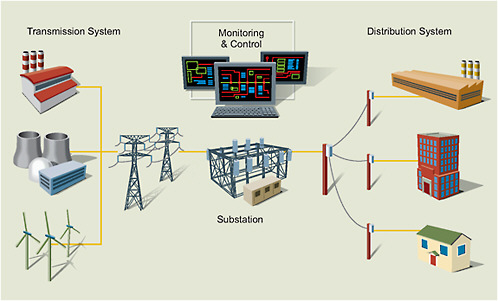
FIGURE 9.1 The current T&D system comprises two distinct but connected systems: transmission and distribution.
Source: Courtesy of NETL Modern Grid Team.
state commerce. The Energy Policy Act of 2005 expanded FERC’s mandate, giving it the authority to impose mandatory reliability standards on the bulk transmission system and to impose penalties on entities that manipulate electricity markets. As part of its new authority, FERC has in turn granted the North American Electric Reliability Corporation (NERC)—a private organization created by the utility industry in 1968 to advise on reliability—the authority to develop and enforce reliability standards. The National Institute of Standards and Technology also is involved in developing standards for the grid.
In some areas, independent system operators/regional transmission operators (ISO/RTOs) are responsible for operating the transmission system reliably, including constantly dispatching power to balance demand with supply and monitoring the power flows over transmission lines owned by other public or private entities. The ISO/RTOs, with oversight by FERC and NERC, monitor their systems’ capac-
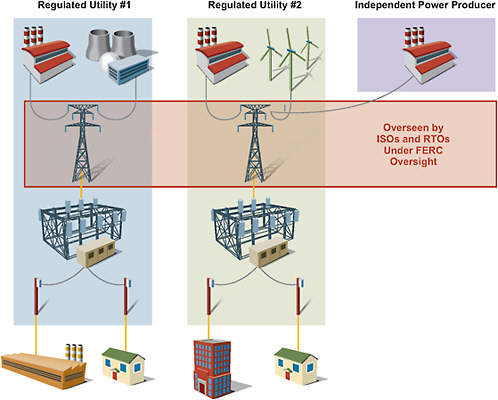
FIGURE 9.2 Key players in the T&D system. Power is produced by regulated investor-owned utilities (IOUs), which own the majority of the T&D systems, and in some areas by independent power producers (IPPs). IOUs typically provide electricity to end users through their own distribution systems, while IPPs sell to a utility or purchase transmission services to deliver electric power directly to an end user. There are also utilities that are federally or locally owned, such as municipal and rural co-ops. Most of these utilities own generating plants as well as T&D lines.
Source: Courtesy of NETL Modern Grid Team.
ities and conduct the wholesale market to clear short-term transactions.2 There are nine ISO/RTOs in North America, as shown in Figure 9.3. Seven of the nine come
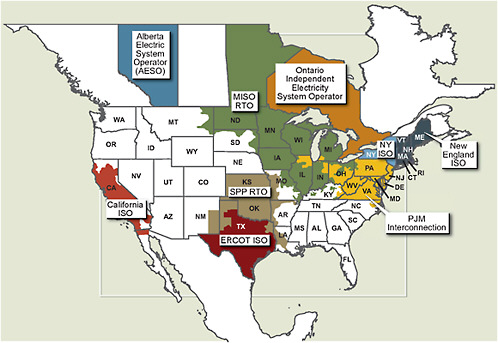
FIGURE 9.3 Independent System Operators (ISO) and Regional Transmission Organizations (RTO) in North America. Regions in which the power industry has been restructured, such as Texas, the Northeast, the Upper Midwest, and much of California, are colored. In these areas, ISO/RTOs are responsible for operating the transmission system. In the white regions, where the industry has not been restructured, vertically integrated power utilities continue to operate the transmission system.
Source: North American Electric Reliability Corporation.
under FERC’s reliability oversight. The remaining two are subject to Canadian regulations.
Operationally, the electric transmission systems of the United States and Canada are divided into four large regions known as “interconnections,” as shown in Figure 9.4:
-
The Eastern Interconnection, which includes most of the United States and Canada from the Rocky Mountains to the Atlantic coast;
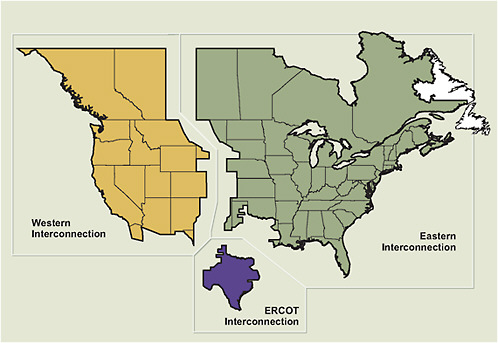
FIGURE 9.4 North American power interconnections. The Quebec Interconnection is shown as part of the Eastern Interconnection because operations are coordinated.
Source: North American Electric Reliability Corporation.
-
The Western Interconnection, which extends from the Pacific coast to the Rockies;
-
The ERCOT Interconnection, which encompasses most of Texas;
-
The Quebec Interconnection, which is shown in Figure 9.4 as part of the Eastern Interconnection because they are operated jointly.
Within each interconnection, all generators operate in synchronism with each other. That is, the 60-Hertz alternating current (AC) is exactly in phase across the entire interconnection. While all interconnections operate at 60 Hz, no attempt is made to synchronize them with each other. Electricity is transmitted between interconnections, but that is done by converting to direct current (DC) and then back to AC.
Controlling the dynamic behavior of this interconnected transmission system presents an engineering and operational challenge. Demand for electricity is constantly changing as millions of consumers turn on and off appliances and industrial equipment. The generation of and demand for electricity are balanced regionally by about 140 balancing authorities to ensure that voltage and frequency are maintained within narrow limits (typically 5 percent for voltage and 0.02 Hz for frequency). If more power is drawn from the grid than is being pumped into it, the frequency and voltage will decrease, and vice versa. If the voltage or frequency strays too far from its prescribed level, the resulting stresses can lead to system collapse and possibly damage to power system equipment.
Problems with the Current System
Most U.S. transmission lines and substations were constructed more than 40 years ago and are based on 1950s’ technology, but demands on the electric power system have increased significantly over the years. Since 1990, electricity generation has risen from about 3 trillion kilowatt-hours (kWh) to about 4 trillion in 2007. Long-distance transmission has grown even faster for reliability and economic reasons, including new competitive wholesale markets for electricity, but few new transmission lines have been built to handle this growth.3
Figure 9.5 shows transmission investment from 1975 to 2007. From 1985 through 1995, transmission investment was fairly stable at the level of about $4.5 billion per year. Although this was about $2 billion per year lower than during the previous decade, reserve margins4 were adequate because of prior over-building and slow growth in demand. However, in the late 1990s, the restructuring and re-regulation of the U.S. transmission system led to a decrease in invest-
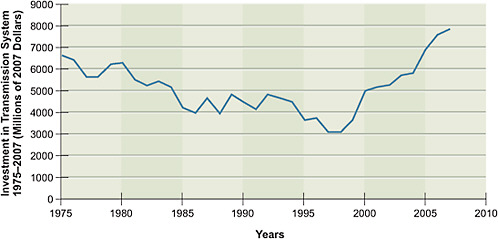
FIGURE 9.5 Transmission investment by integrated and stand-alone transmission companies. The IOU data cover only 80 percent of the transmission system. All investment is shown in 2007 dollars. Data were adjusted as necessary using the Handy-Whitman index of Public Utility Construction Costs.
Sources: 1975–2003 from EEI, 2005; 2000–2007 from Owens, 2008.
ment. This decrease “was principally due to uncertainty in the rate of return on investment (and whether it would be modified or disallowed in future years) offered to transmission owners/investors” (EPRI, 2004). Transmission investment averaged about $3 billion per year from 1995 to 2000.
The deficit of the late 1990s is still affecting reliability; it has contributed to transmission bottlenecks and other transmission deficiencies throughout North America, even with the more recent upward trend in transmission expenditures since 2000. According to NERC, the transmission system is being operated at or near its physical limits more of the time (Nevius, 2008). Stressed grids have less reserve margin for handling disturbances. Figure 9.6 shows the increase in transmission loading relief events. (TLR is a measure of when scheduled transmission requests could not be accommodated.5)
Inadequate system maintenance and repair also have contributed to an
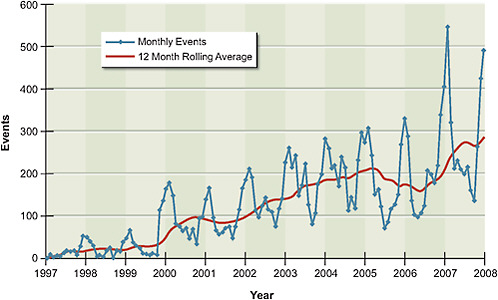
FIGURE 9.6 Transmission loading relief (TLR) events. The number of TLR events is not an outage measure; it is the number of times a congestion limit is reached. Although this measure has been used to characterize transmission reliability, congestion limits can be reached purely for market reasons.
Source: See www.nerc.com/docs/oc/scs/logs/trends.htm.
increase in the likelihood of major transmission system failures (EPRI, 2004), and the number of such disturbances has in fact been increasing in recent years, as shown in Figure 9.7. Of greatest concern is the risk of these disturbances cascading over large portions of the T&D systems. The 2003 blackouts in the world’s two largest grids—the North American Eastern Interconnection and the West European Interconnection—resulted from such cascading failures (see Box 9.1). Each event affected 50 million people.
Another result of diminished investment in transmission is that the manufacturing of associated equipment has largely disappeared from the United States, along with commercial research and development (R&D) for transmission equipment (including transformers, switchgear, and high-voltage DC [HVDC] technology). Today, essentially all large power-transmission equipment is imported from Europe and Japan. This could become a potentially
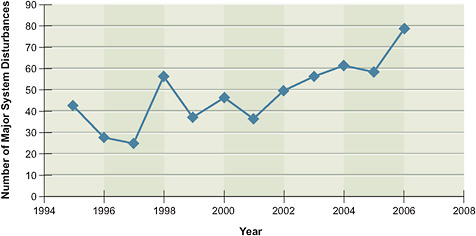
FIGURE 9.7 Major transmission system disturbances reported to NERC. Disturbances include electric service interruptions, unusual occurrences, demand and voltage reductions, public appeals, fuel supply problems, and acts of sabotage that can affect the reliability of the bulk electric systems.
Source: Compiled from data in NERC, 1994, 1995, 1996, 1997, 1998, 1999, 2000, 2001, 2002, 2003, 2004, 2005, and 2006.
serious problem, especially with long lead-time components, in case of major natural disaster or terrorist attack.
Modernization is progressing much more rapidly abroad. For example, China and India are building 800 kV HVDC and 1000 kV AC transmission lines, along with the underlying high-power infrastructure. About 30 high-power HVDC projects are under construction in Europe, including many submarine cable connections to increase utilization of offshore wind power. Two-way metering is common in Europe because it helps to maximize the potential of rooftop photovoltaics, which are being heavily promoted in Germany and other countries. Although the United States has vast potential for wind and solar generation, there is no consensus or plan for how this power could be transmitted to load centers.
While expenditures on the replacement and new construction of American T&D assets have increased recently (see Figure 9.5), grid assets are aging, and investments are still not keeping pace with the growing demand for electric power and power marketing. To meet these challenges, transmission
|
BOX 9.1 The Northeast Blackout of August 14, 2003 A modern T&D system could have helped to avoid the circumstances that initiated the August 2003 Northeast blackout. Two major issues contributed to this blackout: first, the operators did not know the system was in trouble; and second, there was poor communication between the utilities operating the transmission lines—First Energy and American Electric Power—and also between these utilities and the ISO responsible for the area (the Midwest Independent System Operator). The U.S.-Canada Power System Outage Task Force (2004) noted that four major factors contributed to the blackout:
A modern T&D system could have provided better understanding of the state of the system, better communications, and, ultimately, better controls. Adequate monitoring, communication, and dynamic reactive power support during the initial voltage sag could have helped to prevent lines from overloading, heating up, and sagging excessively. Operators would have been better informed, and online real-time dynamic contingency analysis of potential system collapse would have helped operators stay aware of possible risks and actions to be taken in response. Finally, automatic actions could have been taken to island (isolate) portions of the system and prevent the ultimate cascading event (which spread the localized outage across much of the northeast United States and Canada). The system could also have been restored much more rapidly if a modern grid had been in place. |
systems must be modernized—a complex but vital undertaking.6 However, orders for modern transmission technologies remain low, largely because they are perceived to be risky and uneconomic,7 as discussed in more detail later in this chapter. Thus if business continues as usual, investment will focus on new construction to meet peak load growth, which is projected to increase
|
6 |
Modernization is defined here as the deployment of a suite of technologies (described in the coming sections) that will enable the T&D systems to meet a variety of challenges, particularly the seven characteristics (adapted from NETL, 2007d) discussed in more detail in the section titled “A Modern Electric T&D System.” |
|
7 |
This view was presented repeatedly to the committee by industry representatives, including those representing Southern California Edison Co., Areva, ABB, and Siemens. |
by 0.7 percent per year to 20308 according to the reference case of the DOE Energy Information Administration (EIA, 2008) and the replacement of aging components with equivalent technology.
Distribution systems are in better condition. Reliability, for example, has increased steadily over the last 7 years—in part because these systems have to be enlarged to handle new consumers. Public utility commissions usually provide revenue incentives based on indexes, shown in Annex 9.A, that directly measure customer service reliability. Consequently, the distribution companies have improved or at least held steady their customer outage statistics.9
Growth provides the opportunity for distribution companies to introduce new and smarter technologies on a limited basis before undertaking a wider application. For example, a utility can introduce modern, smart technologies on a substation-by-substation basis as it is determined that portions of the distribution network need upgrading. The nature of the distribution system allows upgrades to be done in such “modular” steps.
Addressing the Problems
T&D systems will require considerable investment just to maintain current capabilities and reliability, and the use of new technology could make the grid considerably more resilient. For example, the present system of local automatic controls overseen by human operators at regionally based control centers is not able to adequately foresee that disturbances in Cleveland can black out New York, Toronto, and Detroit, or that transmission outages in Switzerland can black out all of Italy. Modern communications and controls can move much faster to diagnose problems and bypass or isolate them. The same technology can provide cost benefits by maximizing power flows and integrating power from renewable energy sources.
New technology is an important part of the answer to the challenges facing the grid, but policy and regulatory changes will also be needed, particularly with
respect to the transmission system. Policies regarding T&D systems are varied and imposed by many entities; there is significant public resistance to siting new transmission lines; and the business cases for utilities to invest in modern grid processes and technologies are often incomplete, as societal costs and benefits are not typically internalized in companies’ decision making. For example, the cost of not having power when it is needed is far greater to the user than the lost revenues to the utility that cannot provide it. Recognizing the value of a reliable, efficient, and flexible grid, and supporting the investments to make that possible, may require a national-level strategy.
As discussed below in this chapter, expanding and modernizing distribution systems will require considerably more investment than for transmission systems. Much of the expansion will be noncontroversial because it will be required to meet growing loads and can be done without much impact on people who do not directly benefit from it. In addition, modernization of distribution can be achieved on a more limited basis than for transmission, which will require coordination across many systems. Therefore, the emphasis in this chapter will be on transmission.
A MODERN ELECTRIC T&D SYSTEM
A modern T&D system should have capabilities beyond the reach of current systems through their incorporation of new technologies (hardware and software). They must also be expanded to meet future needs. New technologies such as power electronics, real-time thermal rating of transmission lines, and composite conductors can allow an increase in power flow on the existing T&D system, but new lines also will be needed.
Modern T&D systems are intended to provide effective operation, asset optimization, and systems planning capabilities under routine conditions and emergency response and fast restoration after a system failure. The characteristics required to achieve these performance standards are as follows:10
-
Accommodates all generation and storage options. A modern transmission infrastructure would include emerging technologies such as large-scale variable power sources and advanced energy storage devices. For example, it could smooth the variability of power from remotely located intermittent renewable resources11 and maintain reactive power12 on the system. The distribution system should be able to accommodate increasing amounts of distributed generation—often variable (such as rooftop photovoltaic devices)—and smaller-scale advanced energy storage devices.
-
Enables wholesale power markets. A modern T&D system should be enlarged to handle increased long-distance power flows and equipped with new communications and control capabilities to manage the vast amount of information required for wholesale power transactions (NETL, 2007a). In addition, the distribution system should enable the end user to participate in power markets by allowing self-generation opportunities.
-
Is self-healing. A modern T&D system would incorporate methods to automatically stop outages before they spread, thereby preventing major system collapses.13 If a major system did collapse, the means would be available to isolate the problem, prevent it from spreading, and restore it rapidly and effectively. A modern T&D system would be able to monitor the state of the system, communicate key information to control centers, and take appropriate action automatically.
-
Motivates and includes the customer. The modern distribution system would empower customers to make end-use decisions that increase
-
energy efficiency, help in load-leveling,14 and enable residential and small-scale power generation. It would allow for self-generation and storage as well as for customers to participate in an interactive mode by responding to price signals.
-
Provides high power quality where needed. The modern distribution system would be capable of supplying higher “power quality”15 where needed for a digital society that increasingly relies on sensitive microprocessor-based devices in homes, offices, commercial buildings, and industrial facilities. The highest power quality is not necessarily cost-effective for all users, so some may still need to provide additional sources of power, standby generation, or other devices that can ride through minor electrical disturbances on either the transmission or the distribution system.
-
Is secure. The modern T&D infrastructure would be minimally vulnerable to human error, natural disasters, and physical and cyber attacks. Resilience would be built into each element, and the overall system would be designed to deter, detect, respond to, and recover from any plausible disruption. The modern transmission system would also reduce the consequences of a successful attack through its self-healing and “islanding”16 capabilities.
-
Optimizes assets and operates efficiently. A modern transmission system would utilize power lines as efficiently as possible, integrating and coordinating assets to maximize their overall function in an economical way.
These characteristics cannot be fully achieved by introducing individual modern technologies in isolation. Key technologies (such as high-speed measurements and communications and automated controls, discussed in the sections that follow) must be integrated using a systems approach designed to meet performance
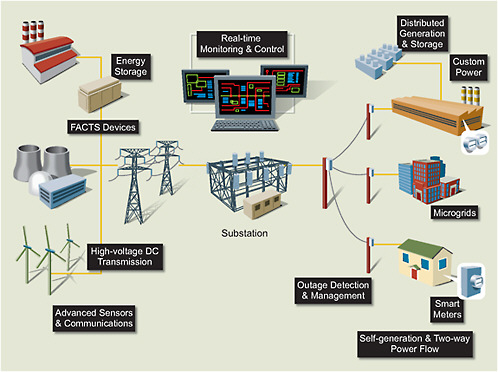
FIGURE 9.8 Components of a modern T&D system.
Source: Courtesy of NETL Modern Grid Team.
goals and metrics. A set of technologies that could be integrated as part of a modern grid is shown in Figure 9.8 and discussed in the following section.
KEY TECHNOLOGIES FOR A MODERN ELECTRIC T&D SYSTEM
Many of the technologies needed for a modern T&D system already exist, and some, to a limited extent, are already deployed in parts of the T&D systems. However, many technologies will need to be deployed in a systematic and integrated way to realize maximum benefits from a modernized T&D system. These technologies can be roughly divided into three categories: (1) advanced equipment and components; (2) measurements, communications, and controls; and
(3) improved decision-support tools. The major technologies within each category are discussed in the following sections, and the annex provides more detail.
Advanced Equipment and Components
Advanced equipment and components include technologies for improving and controlling power flows, enabling greater efficiency in long-distance transmission, storage of electrical energy (to be dispatched into the grid as needed), and grid operation. Advanced electronic equipment is also being used for smart metering and control in the distribution networks. The status of these technologies, likely future technology improvements, and potential for deployment into the T&D system are addressed in the five subsections below.
Power Electronics
A T&D system requires power-flow control and protection against overloads and instability. The electromechanical devices currently used for these purposes are slow and cannot react quickly enough to handle rapid transients, but modern solid-state power electronics can overcome this problem. Power electronics are not new, but their deployment has been limited to particular applications in which their higher cost is offset by their benefits to investors. Power electronics can be used in the transmission system (for both AC and HVDC applications),17 and in the distribution system.
Power electronics on the AC transmission system are referred to as flexible alternating current transmission system (FACTS) devices.18 FACTS devices can control both real and reactive power flows along transmission corridors, thereby maintaining the stability of transmission voltage. FACTS devices can also increase the power transfer capability of transmission lines and improve overall system reliability by reacting virtually instantaneously to disturbances. FACTS can enable wholesale markets, increase security, enable self-healing capacity, and optimize the use of system assets by controlling the flow of power, and they can help to
|
17 |
The transmission system in the United States is almost entirely AC. Transmitting electricity via HVDC involves converting AC to DC, transmitting the electricity in DC, and converting it back to AC at the receiving end. |
|
18 |
Annex 9.A describes specific flexible alternating current transmission system (FACTS) devices and their applications in more detail. |
integrate variable renewables by managing reactive power. FACTS devices are currently available and are already deployed in limited applications.
Power electronics also can be used for lower-voltage applications on distribution systems, where the equivalent to FACTS is known as custom power. Custom power devices can provide for significant improvement in power quality on the customer side by controlling voltage and frequency distortions. High power quality is needed for many modern applications, especially in industries with automated production, which could benefit from more economical local solutions to improved power quality. Power electronics also plays an important role in smart metering with two-way power flow (to encourage local power generation) and in real-time pricing (to shift loads away from expensive peak demand periods).
Custom power technologies that offer such solutions exist now, but their application is restricted to situations where their high cost is offset by significant benefits. R&D could help reduce costs and expand their use by 2020.
AC and DC Lines and Cables
A cost-effective way to obtain extra transmission capacity is to upgrade transmission lines and corresponding substations along existing corridors. Transmission capacity can be increased by “reconductoring” existing lines (using materials such as composite conductors that can carry higher current). These materials are presently available but not widely deployed; taking lines out of service for reconductoring is difficult, and new materials are expensive. In addition, all overhead lines can carry current higher than their nominal rating when weather conditions are favorable, and real-time rating that could be continuously adjusted would increase available capacity.19
HVDC becomes cost-effective at long distances, where the reduced capital costs of the lines and reduced energy losses can compensate for the cost of the converters.20 For example, long-distance, high-power HVDC transmission could
aid in the deployment of large-scale wind generation and, potentially, solar generation by 2020;21 these energy sources are regional, intermittent, and often far away from major population centers. As the down periods for wind vary from region to region, long-distance transmission would help to pool such resources for transmitting the power to load centers. HVDC also is less expensive than AC if lines need to be underground—for example, when passing through pristine areas. Several HVDC lines already exist in the country, and, if planning is started within the next few years, several more large lines22 could be completed before 2020.
Further R&D on advanced materials and nanotechnology could lead to improved lightweight insulators, high-temperature low-sag conductors, and light-weight high-strength structures after 2020. In the longer term, breakthroughs in superconducting materials are needed for superconducting cable technology to become widespread. This is unlikely to occur until after 2030.
Storage
Cost-effective storage would be useful both on transmission and on distribution systems. Transmission systems require large-scale storage capacity with high power ratings (on the order of hundreds of megawatts) and long discharge times (hours to days). The variable power output of renewable resources is currently managed by standby generation, but as large-scale and remote wind or solar generation facilities are built, such storage technologies would be very beneficial for the transmission system that must deliver the power. Today, this type of storage is largely limited to pumped hydro storage, where water is pumped uphill into a reservoir and released to power turbines when needed. Another technology that has been demonstrated and is currently available for commercial deployment is compressed air energy storage (CAES).23 A CAES plant stores energy by using electricity (from off-peak hours) to compress air into an underground geologic formation (or potentially in aboveground tanks). The energy is recovered when a combustion turbine burns natural gas in this compressed air in lieu of operating
|
21 |
These electricity sources are discussed in detail in Chapter 6. |
|
22 |
For example, lines might connect wind resources in Wyoming to California, or deliver wind power in the Dakotas to Chicago. Such lines might account for a large fraction of the cost of that electricity. |
|
23 |
CAES has been demonstrated at a pilot plant in Alabama as well as at locations in Germany. |
its own compressor.24 CAES is now a viable option for providing 100–300 MWe or more of electric power for up to 10 hours. Before 2020, CAES will be the only viable option, aside from pumped hydro, for storing hundreds to thousands of megawatts of energy. Both are dependent on specific features being available (caverns or hills where reservoirs can be built), which greatly limit their applicability.
For distribution systems, storage at lower power ratings (10 MW and below) and lower discharge times (hours to minutes, depending on the application) can be used to improve power quality and security. Distributed storage can help to regulate the system and improve system stability, including reducing the risk of system collapse by supporting islanding and restoration following a disruption. Some battery-storage technologies for these applications, such as lead-acid and sodium-sulfur batteries, have been demonstrated and are currently available for deployment (Bjelovuk, 2008). Batteries are modular and not site specific, meaning they can be located close to intermittent generation sites, near the load, or at T&D substations. However, current battery technologies are expensive and have high losses and reliability issues.
In the longer term, battery storage technology at larger capacities (in the 100 MW range) may help to accommodate variable renewable energy sources, but further R&D is needed before more widespread deployment is likely. Given the large potential in the electric vehicle market for lithium-ion, nickel metal hydride, and other types of batteries, much R&D is now in progress. Advanced batteries with lower cost, high energy density, and higher charge-discharge cycles could also be used for storage in the T&D systems. They may be available for deployment in T&D systems after 2020.
Other longer-term possibilities for energy storage in the grid include supercapacitors, superconducting energy storage, and flywheels. None of these technologies is currently suitable for grid use because of high costs and low energy-storage density. Flywheel storage units are being installed for first-of-a-kind experience with power capacity in the MW range that can smooth out short variations of wind power. However, the technology is a long way from economic deployment on a large scale that would affect daily peaks and day-to-day variations. If advances are made, particularly in materials, all these technologies may become
suitable for energy storage in distribution systems after 2020. Pumped hydroelectric power underground storage, which requires a deep underground water reservoir or aquifer and construction of a power plant deep underground as well, is not considered an effective solution in general because of high costs, but it may be suitable for some sites.
Distribution Transformers
From generation to the customer’s meter, power typically flows through four transformer stages,25 accumulating about 4 percent losses in total. The last transformer in the chain is the distribution transformer for residential/small commercial customers, and because there are so many in the distribution system, they account for a large portion of these losses. Improved materials used to form the transformer’s core can reduce the losses. In the past, grain-oriented steel was universally used as the core material, and there has been sustained but slow progress in reducing its losses. A new material, amorphous steel, has become commercially available in significant quantities over the last 10 years. Transformers made with amorphous steel have about one-third the core loss of those made with grain-oriented steel. The market for amorphous steel transformers has been small, however, primarily because of their higher cost. This material may become more competitive economically as a result of new DOE standards regarding distribution-transformer efficiency for new equipment.26
Potential for Future Deployment
Many of the technologies needed to implement a modern T&D system, such as FACTS and custom power devices, are presently available for commercial deployment. While R&D is needed to reduce costs and improve performance, no breakthroughs are necessary to start using them in large quantities. In addition, some higher-voltage long-distance lines and substations could be deployed before 2020,
|
25 |
Electrical transformers are used to increase or decrease AC voltage. For example, a transformer near the generating plant increases the electrical voltage (“steps it up”) at the transmission line, and a transformer at the distribution substation decreases the voltage (“steps it down”) from transmission voltages to voltages appropriate for distribution. Others are used within the distribution system to deliver the power at levels appropriate to end users. |
|
26 |
These standards are discussed in more detail in the subsection “Economic Benefits” within the section “Potential Benefits of a Modern T&D System.” |
and dynamic thermal rating of power lines could increase capacity along existing lines.
Some storage technologies will be ready for deployment before 2020; however, significant room for improvement remains. At larger scales that may be needed to support large quantities of intermittent renewable energy sources, pumped hydroelectric power and CAES will be the only viable options before 2020. Batteries may also be used for large-scale storage in the T&D systems but are unlikely to be available for deployment at the hundreds-of-MW scales until after 2020. On a smaller scale (around 10 MW), batteries are already being deployed to enable islanding and load-leveling in the distribution system. Newer technologies (including ultracapacitors and flywheels) may not be ready for wide-scale use before 2035.
Measurements, Communications, and Controls
A modern electric T&D system will need measurement, communications, and control technologies to gather real-time data on the state of the grid, communicate those data, and process them to enhance system controlability. These technologies, including associated software, are the basis for “intelligence in the grid.” The following subsections discuss the status of several of these technologies, likely technology improvements, and the potential for their deployment in the U.S. T&D system.
Sensing and Measurements
Understanding and acting on the current state of the U.S. T&D system requires measuring the power characteristics at numerous points. The basic measurements needed are current (amperes) and voltage (volts) at every electrical connection and the status of all switches (on or off). These data provide information on the grid’s electrical condition and connectivity.27
Measurements are made at each T&D substation and are used to drive its controls and protective devices (relays).28 Supervisory control and data acquisi-
tion (SCADA) systems collect and transmit this information to control centers.29 In most existing substations, the data can be sampled every few seconds, entered into a remote terminal unit (RTU), polled by the SCADA, and sent to the control center over relatively slow communications channels—usually microwave. In modern substations, some of which are already in place, the substation control and protection system is digital and the connectivity is through a local area network (LAN) within the substation. Data can be sampled many times per second, rather than once every few seconds. Most of the substation’s controllers and protection systems, known collectively as intelligent electronic devices (IEDs), are based on microprocessors, as are recording systems such as fault recorders and sequence-of-events recorders.
Monitoring of the state of the transmission system is best if the high-voltage substations are equipped with measurement systems that sample at rates of 60–120 times per second30 and incorporate global positioning system (GPS) signals.31 Although the individual hardware costs of these measurement units are now very modest,32 the cost of retrofitting them into the thousands of existing substations will be significant.
There are approximately four times more low-voltage distribution substations than there are high-voltage substations. Although the sampling speed does not need to be as large, high-bandwidth communication will be needed in order to use these data for system control.
Existing customer billing meters could be replaced with microprocessor-based meters which could provide the customer with new buying options such as time-of-day pricing, and could increase end user efficiency. These meters could also allow control signals from the power company to be brought directly into appliances and equipment on the customer side for load management.
|
29 |
For further explanation of SCADA systems, see Annex 9.A. |
|
30 |
Automatic control action to stabilize the power system after a disturbance has to be taken in well under a second, thus requiring measurement sampling of around 60 times a second. The available phasor measurement units (PMUs) routinely provide measurement sampling at 30 or 60 Hz, and faster sampling rates are already appearing in the market. |
|
31 |
Global positioning system (GPS) signals and the associated absolute-time references allow accurate phase shifts in AC quantities to be measured between widely separated substations. |
|
32 |
PMUs were priced at around $50,000 when first introduced in the 1980s, but they cost less than $10,000 today; moreover, other substation equipment such as protective relays today can perform this function at almost no incremental cost. |
Integrated Communications
Real-time measurements can be used to monitor and control the T&D system, but the measurement data must be transmitted to a location where they can be processed. To appropriately process the data, a fully integrated communications system with universal standards (protocols) must be developed, along with real-time data handling software that can collect and move the data to where they are needed.
If the measurement technologies described above are fully implemented, each control center will need to process approximately one million data points per second.33 The existing communication channels between the control centers and the substations, many dating from the 1960s, cannot handle these data rates. They are currently being replaced with high-bandwidth optical fiber. However, even with increased bandwidth, the present system (in which all data from substation RTUs are collected at the control center SCADA) cannot handle the expected proliferation of real-time measurement data.
An alternative to this communications architecture is shown in Figure 9.9. Each substation has its own data-gathering system connected internally by a LAN. A gateway server connects these data to the rest of the system through a high-speed network of switching routers, which can move the needed data efficiently to monitoring and control applications. These applications require coordination across several substations, either regionally or over the entire interconnection. Such applications are often referred to as wide-area controls or special protection schemes. Today’s local controls are contained within a substation and will remain part of the substation automation design.
Communication systems must be able to handle a wide range of speed and data flow requirements, and the switching network and distributed database will have to be designed. Although similar systems exist today (e.g., cellular telephone systems), the communications needs for the power grid are unique; specialized software will have to be designed and developed. Such a communications system should be ready for deployment by 2020, possibly continuing into the 2020–2030 time period.
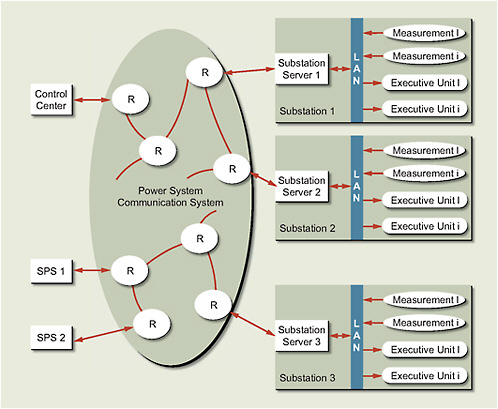
FIGURE 9.9 An alternative measurement architecture for the transmission system. Each substation (shown on the right) takes measurements that are collected by its own data-gathering system. These measurements are communicated internally by a local area network (LAN). A substation server communicates these data to the rest of the system through a high-speed network of switching routers (shown as circles) that can move the data efficiently as needed to specific monitoring and control applications.
Advanced Control Methods
Measurement and communication technologies create a picture of the state of the systems, which control technology can use for greater reliability and security (including self-healing following a disruption) and more efficient operation and optimization of assets. If the T&D system is equipped with new measurement sensors, a high-speed communication network, and power electronics, fast wide-area controllers can be designed and installed with software only. This will enable the evolution of better controls to make the grid increasingly reliable and efficient.
The thousands of mostly local controllers in existing T&D systems are slow; response times typically are measured in seconds. In contrast, FACTS devices (already in use as fast local controllers) can control voltages and power flows with response times measured in milliseconds. Moreover, fast wide-area controls, combining rapid communications with remotely controlled FACTS devices, are becoming feasible. Time-stamped measurements will make multiple inputs available to the controller, which can then send out multiple output signals to several FACTS controllers simultaneously.
With these technologies, many types of grid monitoring and control will become possible.34 Digitized measurements that incorporate data at high sampling rates will allow faster and more frequent calculation of the state of the transmission system. This can provide better predictions of the T&D system’s behavior under contingencies (natural, human error, or malicious), thus enabling automatic corrective and preventive actions. Cascading failures can be predicted, and defensive actions such as islanding can prevent the spread of the disturbance. Advanced distribution controls can accommodate two-way power flow from distributed generation by balancing the load on all the distribution feeders. In addition, demandside responses can be efficiently coordinated if appropriate sensors and communications are in place. Such control technologies could begin to be deployed by 2020.
Potential for Future Deployment
Measurement, communications, and control technologies are already being deployed to a modest degree and could be fully deployed by 2030. About 15,000 transmission substations will require new sensors, measurement systems, and LANs. To add high-bandwidth communications hardware (mainly fiber-optic cables) across the transmission system of approximately 200,000 miles of network and 20,000 switches, investment in both hardware and software will be needed. The costs of developing the needed software to operate the hardware for control will be significant.
Technologies for distribution systems are different in character from transmission. Sensing, monitoring, and communications technologies will need to be
installed in the approximately 60,000 distribution substations and their associated feeders. These controls will be particularly important as smart metering is introduced into distribution networks. Additional investment will also be needed for coordination between transmission level-controls and distribution-level controls.
Improved Decision-Support Tools
The T&D system in the United States is managed by a large number of private and public entities that have long used computer-based decision-support tools both for commercial and for engineering decisions. These tools need to be further improved because of the massive amounts of data that are available in real time and the need to use these data in system control. This section examines improved decision-support technology (IDST), including those tools necessary for split-second decision making by system operators during emergencies as well as for long-term decision making on investments needed in the grid itself.
System Operations
A recurring theme in blackout investigations has been the need for better visualization capabilities and decision-support tools over a wide geographic area. In many circumstances, a human operator will require at least some seconds to make a decision, but automatic controls operate on the order of milliseconds. IDST enables grid operators and managers to make faster decisions by converting the complex power-system data into information that can be understood at a glance. Improved visualization interfaces and decision-support technologies will increase reliability, decrease outages due to natural causes and human error, and enhance asset management.
IDST covers three general systems-operations categories:
-
Grid visualization. Real-time analysis of system stability will require online analytical tools that process the vast amount of data and automatically determine what actions should be taken to prevent an incipient disturbance from spreading. This objective requires completing the analysis within a fraction of a second and presenting it visually in a control room for fast responses to deteriorating conditions. The algorithms have not yet been developed to perform these functions, but they could be deployed by 2020 and would be continually improved in the 2020–2035 timeframe and beyond.
-
Decision support. Decision-support technologies can identify existing, emerging, and predicted problems and provide analysis to support solutions. By analyzing the consequences of each contingency and its probability of occurrence, decision-support systems can quantify relative risk and severity. These relative risks can be integrated into a composite risk factor and presented to the operator to assist in decision making. Further work on decision-support algorithms will be needed to make them available for deployment before 2020, with continuing improvements in the 2020–2035 timeframe and beyond.
-
Systems operator training. Advanced simulators currently under development will give operators a real-time, faster-than-real-time, or historic view of the power system and its parameters. These dynamic simulators, together with industry-wide certification programs, will significantly improve the skill sets and performance of system operators. Such simulators could be ready for deployment by 2020, as soon as the visualization and decision-support algorithms are in place. IDST, together with system-operator training, will then need to be continuously evaluated and improved.
As the systems become more complex, R&D on software and artificial intelligence will be needed to improve the operator’s ability to control a wide-area transmission system as well as an ever more complicated distribution system. Improved software and artificial intelligence for IDST could begin to be deployed by 2020, and deployment is likely to continue into the 2020–2035 timeframe.
Operations Planning and Design
Decision tools are also needed for decisions that occur over longer timescales than do real-time operating decisions. Applications include next-day planning decisions for the power market, planning for adequate generation, and design of T&D substations as well as distribution feeders.
Operations-planning decisions set the schedules of how the T&D system will be operated over the next day. Decisions include forecasting the load, scheduling dispatchable generation and long-term contracts to meet the load, conducting auction markets, using power contracts to check on possible congestion on the transmission system, and modifying the power contracts if congestion is indicated. The decision tools needed for these tasks are mostly new or have been significantly modified in recent years.
Longer-term planning for new generation and transmission capacity must deal with considerable uncertainty, especially where the industry has been restructured and no one organization holds the ultimate responsibility for building adequate generation. Transmission is still regulated, but transmission planning is dependent on knowing where the new generating plants are going to be located. Computerized planning decision tools must be improved to handle increased uncertainty for the 20- to 30-year time horizon. It is anticipated that renewables will present unique challenges, and the addition of probabilistic methods not in use today may help system operators respond to the changing generation mix.
T&D substations are designed by computerized tools that need to be further coordinated with asset-management tools—inventory management for spare parts and maintenance of all components for example—used by utilities. The two tool sets should be seamlessly coordinated with one another and connected to the operations and operations-planning databases so that customer trouble calls can be coordinated with maintenance crews, spare part inventories, and system operations.
Potential for Future Deployment
Several major conditions must be met before IDST can be effectively implemented. First, modern measurement, communications, and control technologies must be implemented along with the power electronics technologies needed to enable automated controls. In addition, development is needed in applications that integrate advanced visualization technologies with geospatial tools to improve the speed of comprehension and decision making. Some of these technologies could begin to be implemented well before 2020.
Integrating Technologies to Create a Modern Electric T&D System
The key technologies discussed above are in various stages of development, with many already having been deployed in a limited way. However, the primary challenge will be the integrated deployment of these technologies to achieve the desired characteristics and performance of a modern grid. For example, the capabilities of power electronics would be maximized by coupling them with real-time measurement, communications, control, and decision-support tools. Smart meters with two-way communications tied to wireless controllers within the customer’s premises will be needed on distribution systems to maximize the benefits of a modernized transmission system.
It is important to note that even though most modernization technologies are available now, further R&D is very important. All these technologies can be improved upon and would benefit from cost reduction. A few, such as large-scale storage, are simply impractical now. In addition, the nation is facing a critical shortage of power engineers, the very people who will be needed to implement modernization. University R&D funding is vital in persuading students to embark on careers in power engineering.
COSTS OF MODERNIZATION
Projecting the costs of modernizing the U.S. T&D systems is complex, given the expansive and interconnected nature of the system, the difficulty of estimating development costs (especially for software), and uncertainties over technology readiness. Complicating matters further, costs have been escalating sharply in recent years for large-scale T&D construction, as for other energy projects. Transmission investment is anticipated to continue to increase to meet load growth and replace aging equipment, but additional investment will be needed over the next few decades to modernize the T&D system.
A comprehensive discussion of the costs of modernization was published in 2004 by the Electric Power Research Institute (EPRI 2004).35 The AEF Committee reviewed the assumptions made by EPRI in this report and largely agrees with its estimates, with two exceptions for transmission. First, EPRI projected that superconducting cables would be added to the system over the next 20 years, but the committee concluded that high costs and slow technological development would preclude commercial deployment before 2030. The committee has thus modified EPRI’s cost estimates to reflect this judgment.36 Second, the cost of developing and deploying software on the transmission system is routinely underestimated; it is likely that more investment will be required for this purpose.
|
35 |
Estimates by the Electric Power Research Institute (EPRI), originally in 2002 dollars, were escalated to 2007 dollars for the committee’s analysis. In addition, recent real escalation in materials and construction costs were accounted for by using the national average transmission and distribution indexes (33 percent for transmission, 40 percent for distribution). These changes are described in Annex 9.A. |
|
36 |
The investment in superconducting cables has been removed from the total investment needed for the transmission system. It has also been removed from the synergies calculation. These changes are described in detail in Annex 9.A. |
The improvements needed in the T&D system could be completed over the next 20 years, with significant progress by 2020. Modifying the EPRI results as detailed in Annex 9.A suggests that a total investment of $225 billion will be required for transmission systems, and modern distribution systems are likely to require a total of $640 billion.37 If the T&D system is not modernized but simply expanded to meet growing loads, transmission would require $175 billion and distribution $470 billion. Thus the incremental costs of modernization are $50 billion for transmission and $170 billion for distribution spread over the next 20 years.38 Modernization would actually cost about twice this amount, but less expansion would be needed to meet projected loads, and the savings from these synergies would account for the difference. For example, existing lines could carry greater loads if improved control systems prevented overloading, so some new lines would not be needed.
A more recent analysis was performed by the Brattle Group, which built on the EPRI analysis (Brattle, 2008). Estimated costs in the two studies are very similar.39 The Brattle study does not distinguish between investments to meet increased load demands and investments in modernizing the system, but it estimates that $233 billion will be needed for the transmission system (compared to EPRI’s $225 billion).40 Brattle estimates that $675 billion will be needed for distribution versus EPRI’s $640 billion.
Neither report explicitly accounted for the construction of new transmission lines to bring power from remote wind or other renewable energy sources to load centers. These lines could be longer than those from conventional power sources and carry power at a lower capacity factor, thus increasing costs. According to a DOE report on achieving 20 percent of U.S. electricity from wind power, an estimated 12,000 miles could be constructed for $20 billion (DOE, 2008). Actual expenditures will be highly dependent on the routes chosen and the capacities of the lines, but additional costs on the order of tens of billions of dollars seem plausible. Large-scale power generation from photovoltaics or solar thermal technology is a longer-term possibility if cost reductions are achieved. Much of this power
|
37 |
These estimates are in 2007 dollars. |
|
38 |
The cost of implementing a T&D system is less than the cost of meeting load growth plus the cost of adding intelligence to the systems because of synergies, which are discussed in Annex 9.A. |
|
39 |
A comparison between these two studies is made in more detail in Annex 9.A. |
|
40 |
Again, these estimates are in 2007 dollars. |
could be generated in the Southwest region, which would require additional long-distance transmission. Construction of such lines will depend on the regulatory environment and government policy; the transmission technology is available, although further improvements would be beneficial.
T&D expenditures are unlikely to be linear over the next 20 years. Representatives of EPRI and the Edison Electric Institute (EEI), which funded the Brattle study, have suggested that the split would be approximately one-third during the first 10 years and the remaining two-thirds over the second 10 years.41 The AEF Committee has assumed that 40 percent of the expenditures should be made before 2020, with the remaining 60 percent between 2020 and 2030. Thus investments averaging $9 billion per year would be needed in the transmission system from 2010 to 2020, with approximately $2 billion per year of this total dedicated to modernization.42 From 2020 to 2030, an average of approximately $14 billion per year will be needed, including $3 billion per year for modernization.
As discussed in the section “Barriers to Deploying a Modern T&D System,” utilities and transmission operators may find it more difficult to raise the relatively small amount needed for modernization than to raise the more substantial amount needed for expansion. If modernization were not included, however, utilities would have to continue using existing technologies for control, sensing, and monitoring equipment, and the nation would be deprived of the many benefits discussed here.
For distribution systems, an investment of $26 billion per year would be needed from 2010 to 2020 ($19 billion for expansion, $7 billion for the modernization increment). From 2020 to 2030, approximately $38 billion per year would be needed (including $10 billion for modernization).
POTENTIAL BENEFITS OF A MODERN T&D SYSTEM
A modern T&D system would offer significant benefits. Costs to consumers could be reduced through more efficient electricity markets; national security could be
enhanced because of greater reliability and reduced vulnerability to major disruptions; greater capacity to accommodate renewables would improve the environment; and public safety would be enhanced. Although these benefits are even harder to estimate than are the costs (as described in the previous section), estimates of the benefits of a modern T&D system significantly outweigh the costs. For example, EPRI estimates these benefits to U.S. society to be about $640–800 billion over the next 20 years for a cost of implementation of $165 billion; that is a cost-benefit ratio of 1:4 (EPRI, 2004). On a more local scale, a recent study by the University of San Diego considered the value of a modern distribution system to the San Diego area. The investigators found about $1.4 billion in system benefits, plus another $1.4 billion in societal benefits, producing an internal rate of return of at least 26 percent (San Diego, 2006).
While the benefits of modernizing the T&D system in the United States are potentially very large—possibly several times the investment—this study had neither the time nor the resources to examine the assumptions and modeling needed for a reliable estimate. The following sections, however, provide some specific examples of potential benefits from modernizing the system.
Economic Benefits
A blackout in a single area can cost approximately $1 billion, and major regional blackouts can cost $10 billion. EPRI estimates the annual cost of power disturbances to the U.S. economy to be between $80 billion and $100 billion (EPRI, 2004). Disturbances to power quality add to the total, and inefficiency and congestion in the current T&D systems also have significant economic costs. These costs could be reduced significantly by a modernized T&D system. Thus improving grid reliability and efficiency could result in substantial economic benefits.
A modern T&D system will benefit the U.S. economy in less direct ways as well, such as by allowing cost information to be made available to buyers and sellers of electricity in real time. These energy price signals will allow customers to more effectively participate in the electricity market, based on current supply-and-demand influences. Overall, markets will be more efficient when consumer decisions are based on realistic prices. There will also be a reduction in grid congestion and forced power outages. A modernized grid will enable a wide array of new options for load management, distributed generation, energy storage, and
revenue opportunities for those who choose to participate, such as residential self-generators.43
Security Benefits
A modern grid can contribute to energy security by reducing the energy system’s vulnerability to terrorist attacks and natural disasters, thereby reducing the risk of a devastating long-duration blackout. In addition, the ability to handle a high level of electricity generated from domestic renewable energy sources has national security benefits as well as the environmental benefits discussed in the next section.44 In other words, the enhanced controllability that a modern T&D system could provide, and the broad penetration of distributed generation, will make the transmission system far more difficult to disrupt. Moreover, sophisticated analytical capabilities can detect and prevent or mitigate the consequences of an attack or disaster, and probabilistic analytical tools can identify inherent weaknesses in the grid so that they can be integrated into an overall national security plan.
However, as T&D systems become increasingly dependent on computer-driven communications and control networks, physical attacks will not be the only concern. Guidelines for cyber-security are already in place, but these may not be adequate for a fully deployed communications and control system. Cyber-security has to be an integral part of modernizing the grid.
A modern grid could improve the diversity of energy supplies by allowing larger proportions of renewable energy into the U.S. energy supply. Coal is the source of about half the nation’s electricity, but although domestic coal reserves will be sufficient for many decades to come, concerns about carbon emissions may affect its future use. Natural gas is also a concern because projected rates of consumption may lead to importing increased amounts of liquefied natural gas, some from politically unstable areas of the world. Little oil is used for electric generation, but the modern grid will reduce oil imports by helping to make electric vehicles commercially viable.
Environmental Benefits
Modernizing the power delivery system is an essential step in reducing emissions of carbon dioxide and other pollutants such as SOx, NOx, and mercury:
|
43 |
Self-generation refers to electricity generation that the end user owns and controls. |
|
44 |
See Chapter 6 for further discussion. |
-
A modern T&D system can allow for greater penetration of large-scale intermittent renewable electricity sources as well as distributed generation and self-generation, thereby reducing the amount of coal that must be burned.45
-
Modern demand-response technologies (such as grid-friendly appliances that can be controlled by the utility to shift load to off-peak times) can be better accommodated, thereby reducing demand that must be met by inefficient generating equipment.
-
Battery electric vehicles (BEVs) can be better accommodated, particularly after 2030.
-
Efficiency can be improved in the T&D system as well as in end-uses, reducing the need for new generation and the siting of new transmission lines.
A modern T&D system can enable intermittent renewable electricity sources (particularly wind power) to contribute substantially to the U.S. energy supply. The electricity provided by wind power varies significantly over the course of a day and over the year because of natural variations in wind speed. As a general rule, a power-delivery system can handle the loss of 10–20 percent of the local generating capacity as long as adequate reserve capacity is available.46 Grid operators normally require generating companies to have spinning reserve (generators that can increase their output very quickly) equivalent to the largest unit on the system; if that unit fails it can be replaced without disrupting delivery of power. Because intermittent sources cannot be depended on, the spinning reserve has to include a significant fraction of the renewable capacity in addition to the largest unit of conventional power.47 Above 10–20 percent, a rapid loss of wind power could cause system instability unless the system was modernized.48 Even at lower
|
45 |
Self-generation is a special case of distributed generation. End users generate some portion of their own energy needs, utilizing, for example, rooftop solar panels. Under some conditions, any excess power may be sold to the utility. |
|
46 |
Grid modernization is not needed for integrating intermittent renewable-electricity sources in relatively small percentages of the overall electricity supply. This is discussed in greater detail in Chapter 6. |
|
47 |
Wind and solar power are the main intermittent renewable-energy sources. Other renewables, such as hydropower, geothermal, and biofuels, are not intermittent. |
|
48 |
The changes needed to accommodate renewables are discussed in more detail in the technology section of this chapter; they involve large-scale storage as well as high-voltage long-distance transmission. |
levels, modernization would help integrate wind power and reduce the need for spinning reserve.
In addition to intermittency, the location of many renewable resources (remote or distributed) poses a challenge that a modern grid could address better than the current T&D system does. Many high-quality renewable resources, such as wind in the Dakotas and solar resources in the deserts of the Southwest, are located far from population centers. More transmission capacity will be required to bring electricity from these locations to areas of high demand, potentially using technologies such as HVDC transmission. Other low-emission and renewable resources are likely to be used as distributed generation (e.g., natural-gas-fired micro-turbines, small wind turbines, and solar panels on residential and commercial rooftops). The modern grid will enable better integration of these resources by incorporating two-way power flow and smart metering on the distribution system.
Many modern demand-response technologies can be regulated in response to grid conditions. With the implementation of time-of-day pricing, such technologies could allow for more cost-effective and efficient electric power generation (i.e., by running primarily at off-peak times, when the price of electricity is lower and generating capacity of greater efficiency is available).
A modern T&D system can also assist in the integration of BEV (including plug-in hybrids), thus reducing the consumption of petroleum fuels for transportation.49 BEVs could result in an overall decrease in greenhouse gas emissions even though some of the electricity is generated at coal-fired power plants. Rapid growth of BEVs might significantly increase the demand on T&D systems, but this is unlikely before 2020, when the use of advanced meters could enable controlled battery charging. With the addition of such technologies, the impact on the grid could also be small even by 2035.
A modern grid can operate more efficiently, reducing the need for construction of new generators and transmission lines. Approximately 10 percent of the total power produced in the United States is lost in the process of delivering it to the end user. For example, reactive power flow over a transmission line not only increases losses in the transmission line but also significantly reduces the power-carrying capacity of the line; the use of power electronics, however, can reduce such flow of reactive power. In addition, power electronics can reduce losses by shifting power flow to the most advantageous transmission paths and by the use
|
49 |
Plug-in hybrid vehicles are discussed in further detail in Chapter 4. |
of more efficient distribution transformers.50 The committee estimates that T&D losses could potentially be reduced by as much as 10–20 percent, resulting in an efficiency improvement in the overall electric system of about 1–2 percent, which in turn would produce significant economic benefits.
Public Safety Benefits
The American Public Power Association reports that about 1000 fatalities and 7000 flash burns occur annually in the electric utility business (Trotter, 2005). Improved monitoring and decision-support systems would quickly identify problems and hazards. For example, the ability to identify equipment that is on the verge of failure is certain to save lives and reduce severe injuries. Also, the modern T&D system would need less maintenance, which means less exposure to accidents and increased safety of maintenance workers. In addition, by reducing the risk of long-term outages following terrorist attacks or natural disasters, modernization could help prevent public health and safety catastrophes.
BARRIERS TO DEPLOYING A MODERN T&D SYSTEM
It should be clear from the previous section that a modernized electric grid is very much in the nation’s best interest. The benefits would be substantial and quite likely to far outweigh the costs. Nevertheless, modernization is unlikely to happen unless it is also in the interests of those who must implement it.
Several barriers have the potential to impede this implementation. First, the technologies that utilities would employ to modernize the grid entail additional costs and uncertainties—particularly regarding how well they will work relative to older technologies. Second, some utilities may be reluctant to invest the additional funds required for modernization even when it would appear to make sense to do so. Third, there is a lack of regulatory and political support that could provide incentives for modernization. Finally, there is difficulty in communicating the need for modernization to the public and to regulatory and political decision makers.
Technical Barriers
Most of the technologies needed for modernization of the T&D system are available now, but some technical hurdles, such as energy storage, remain. In addition, some technologies are still expensive; R&D is necessary to reduce costs and improve performance. Yet the rate of technology research, development, and deployment in the power industry is low compared to that of other industries.
Utilities, at least in part because they are regulated, are relatively risk averse and may be reluctant to deploy new T&D technologies—particularly new transmission technologies—until they are fully proven. Also, modernization technologies must be deployed in unison to achieve their full benefits, posing challenges in integrating technologies. For example, universal communications standards as well as a common architecture that promotes interoperability are needed. However, the security issues that are involved in an open system must be met with industry-approved and -adapted standards and protocols.
Investment Barriers
Modernization will cost more than simply building more transmission lines and replacing aging equipment. Even though the additional investment would eventually pay off, financial markets and regulatory constraints drive utilities to minimize investments.
In addition, some of the benefits of modern grid technologies are societal (higher quality, more reliable power) and not typically internalized in a company’s decision making. The companies, however, must bear the full cost of modernizing the parts of the grid that serve their customers. This barrier is more significant for the transmission system, which is inherently interconnected: many entities own and regulate different parts of it. Cooperation will be needed among utilities and regulatory agencies.
Regulatory and Legislative Barriers
As noted above, utilities are cautious about adopting new technologies that may involve some risk. This is especially true when familiar technologies have lower first costs and utilities are given no incentive to invest more than the minimum required to maintain operations. If modernization is to occur and produce all the advantages it offers, legal and regulatory changes are likely to be necessary.
Legislators and regulators have not taken a strong leadership role regarding grid modernization, nor have they adopted a clear and consistent vision for
the modern grid. There has been significant focus in recent years on individual technologies and on energy-related issues such as environmental impact, but less attention has been paid to developing a vision that integrates technologies, solves the various grid-related issues, and provides the desired benefits to stakeholders and society. The Energy Policy Act of 2005 and the Energy Independence & Security Act of 2007 have been positive steps in the right direction, but much more is needed to directly address the regulatory and policy factors that create significant impediments to the modernization of the U.S. T&D system. For example, a wholesale pricing structure that recognizes the value of reliability and signals when transmission system upgrades are necessary would help provide investment predictability.
In addition, policies regarding the grid are often inconsistent because they are set by multiple groups—individual states (state energy policies and public utility commissions [PUCs]); the Federal Energy Regulatory Commission (FERC); and environmental agencies. Inconsistent policies among states and between state and federal regulators, for example, prevent effective collaboration across transmission regions.
Also, time-of-day rates for consumers that reflect actual wholesale market conditions are not yet widely implemented, thereby preventing the level of demand-side involvement needed in the modern grid. Net metering policies that provide customers with retail credit for energy generated by them are also not widely deployed, which reduces the incentive for end users to install rooftop photovoltaics or other generating technologies. Finally, regulatory policies often do not reward customers for investments that provide substantial societal benefits, such as credits for local storage that has been made dispatchable.51
A reduction in R&D expenditures by utilities, an unintended result of restructuring, has impacted the development and deployment of newer T&D technologies. A more predictable regulatory environment that accounts for societal costs and benefits in the rate structure and supports R&D will be needed.
Cultural and Communication Barriers
The fundamental value of the T&D system in general and the societal and economic benefits of a modernized grid and the costs associated with antiquated sys-
tems in particular have not been adequately communicated to decision makers and the general public. Some electric utility executives assert that their customers value lower rates more than the benefits of a modernized grid, which would increase costs in the short term (NETL, 2007b).
In order to overcome this barrier, significant efforts need to be made to communicate the benefits of a modern grid to all stakeholders. Improved communication with the public is also necessary regarding the costs and benefits associated with the current transmission system in particular, which is experiencing ever increasing congestion and needs expansion. It is difficult to site new transmission lines. Many proposals for new lines generate considerable opposition, usually based on aesthetic, property value, or health and safety concerns. For example, American Electric Power, a large Midwest utility, recently experienced a 12-year approval process for a new 90-mile 765-kV transmission line.52
DEPLOYING A MODERN T&D SYSTEM
Many of the technologies needed to modernize the grid can be deployed before 2020, but most of the technical challenges will involve seamlessly integrating these technologies. Not only must multiple technologies work in concert across a huge and sprawling system, but the system is owned and operated by numerous (often regional) stakeholders with diverse perspectives, incentives, and constraints.
Given these factors, a broad vision and an accompanying road map are required to achieve consensus on common goals and to guide the integrated deployment of modern technologies that meet the performance requirements of the modern grid, as described previously in this chapter.
The complexity of the transmission system suggests that the development of clear metrics to measure societal benefits will be essential to measuring progress. The types of metrics that may be considered include reductions in electricity demand forecasting error (from 6 percent to, say, less than 0.5 percent); reductions in maintenance cost (by as much as 4 times); reductions in average recovery from major outages (from hours/days to minutes/seconds); reductions in average annual customer outages (from 100 minutes to, say, 3 seconds); and increases in
the use of power electronics (FACTS, custom power technologies), which benefits wider areas than just where they are installed. Thus a major challenge for the PUCs, which play an essential role in regulating the rates and services of the utilities, is to translate policy-level performance criteria into the metrics they need to analyze the overall economics and determine the merits of modernizing the T&D system (Centolella, 2008). For example, PUCs could look for methods to establish accountability for transmission availability, to measure and internalize the value of lost load and power quality, and to measure and appropriately reward utilities for contributions to efficiency improvement and market transformation.
With such a vision in place, modern technologies could be seamlessly deployed across regions. For example, they would be incorporated whenever new facilities were built, while control centers could be gradually modernized. Communications and control software, as well as tools for improved decision support, could then begin to be implemented.
In contrast, the modernization of distribution systems can occur on a regional level, and programs are emerging in the United States as well as around the world. Pilot projects involving smart meters have begun in many areas. For example, American Electric Power (AEP) is designing an advanced meter infrastructure network involving two-way communications with system-control devices and remote connect/disconnect, time-of-use, and demand-management capabilities. AEP expects to have all 5 million of its customers on this system by 2015 (Bjelovuk, 2008). Other countries that have already implemented partial distribution-system modernization programs report very positive results. For example, Italy’s ENEL Telegestore Project is the largest metering program in the world, with over 27 million meters networked. Smart meters can come with a wide range of capabilities, and it will be important to determine what is needed to achieve specific goals and how they will be integrated into a utility’s system.
The committee judges that a T&D system can be modernized within a 20- to 30-year timeframe, assuming that the resources and a strategy for the modernization are in place. As discussed previously in this chapter, modernizing and expanding the T&D system will require a comprehensive national vision and investment; however, the investment needed is not much greater than the amount that industry has already proposed to be invested in T&D systems. The key components of the modern grid (FACTS devices, custom power, HVDC and HVAC technologies, and storage) have largely been developed, as noted earlier, and measurement, communications, and control technologies to manage these components will be deployable on a large scale, along with the associated decision-support tools, before
2030. While R&D will be important in reducing costs and improving equipment performance, the main challenges involve integrating the diverse technologies. Development of a nationwide strategy to modernize the U.S. T&D system will be an important first step.
FINDINGS AND CONCLUSIONS
The U.S. electric T&D infrastructure remains dependent upon technologies developed and deployed in the 1950s and 1960s. Recently, many factors, including changes in the regulatory structure of the power industry, have lowered the reliability of this critical national infrastructure.
While it is encouraging that the industry has greatly increased its T&D investment in the past several years, more is still needed to implement a modern grid capable of meeting future challenges—such as enabling power markets, intermittent renewable-electricity sources, and modern efficiency technologies—while maintaining reliability and security in the systems. The following findings relate to the issues that need to be addressed to modernize today’s electric T&D system so as to best serve our national needs over the coming decades:
Performance: The T&D system in the United States is not adequate to manage the reliability, peak loads, and diverse sources of power that will be needed to meet U.S. electrical needs over the next 20 years. However, many technologies capable of meeting these challenges are currently available or will be available before 2020. Significant progress in modernizing the systems could be achieved by 2020, and T&D system could be fully modernized by 2030.
Technology: Many advanced T&D technologies, including the following, are ready for deployment:
-
Advanced equipment. Many power electronics devices and transmission line technologies are currently commercially available and can be deployed before 2020. These technologies are not widely deployed at present.
-
Measurements, communications, and control. Most measurement, communications, and control technologies are currently available and can begin to be deployed before 2020; however, software development is still needed. Further work is needed to establish a standard communications protocol. Such a protocol could be deployable before 2020.
-
Improved decision-support tools. Improved decision-support technologies could begin to be deployed before 2020; however, they will require the co-deployment of modern measurements, communications, and controls, as well as power electronics, to be effective. Further work is needed to develop and implement algorithms for rapid decision making and advanced search and optimization. This software is likely to be deployable before 2020.
-
Infrastructure. Shortages of trained personnel and needed equipment could form a barrier to modernization of the T&D system. In particular:
-
A growing global demand for T&D technologies (as nations such as China build up their infrastructures) and a decline in U.S. equipment designers and manufacturers may lead to short-term bottlenecks in acquiring needed equipment.
-
A significant shortage in the skilled T&D workforce over the next 5 to 10 years is expected unless efforts are instituted quickly to address this issue. The number of university programs in power engineering, as well as R&D support, has decreased markedly.
-
Deployment:
-
Transmission. The modernization of the transmission system will benefit greatly from a comprehensive national vision based on consensus among the many stakeholders. The transmission system is national in scale, and the major benefits of a modern system come from the operation of many technologies in concert across the entire system rather than from technologies deployed in isolation. State, regional, and national planning is needed on how the nation will deliver 20 percent of its energy and beyond from renewables, especially wind and solar. If such a vision is established and it addresses the many barriers to modernization, the transmission system could be modernized by 2030.
-
Distribution. Smart meters and related technologies can improve the efficiency and economics of distribution. Modernization of the distribution system can occur regionally, allowing for rapid parallel deployment while encouraging experimentation to develop best practices. This modernization is already occurring in limited areas; however, it would benefit from a nationwide consensus on best practices such as standardization of communication methods (to better enable smart meters) and
-
grid-friendly appliances. The distribution systems could be modernized by 2030 if such a consensus is reached nationwide.
Costs: The estimated cost to modernize the T&D system is modest relative to the investments that will be required simply to meet load growth and replace or upgrade aging equipment.
-
Transmission. At a minimum, an investment of $9 billion per year would be needed in the transmission system from 2010 to 2020, and $14 billion per year from 2020 to 2030. Of these investments, $2 billion per year from 2010 to 2030 and $3 billion per year from 2020 to 2030 would be the incremental costs of modernizing the transmission system. In comparison, utilities and organizations that operate transmission systems spent $7.8 billion in 2007.
-
Distribution. An investment of $26 billion per year between 2010 and 2020 and $38 billion per year from 2020 to 2030 will be needed for the distribution system. Of these sums, $7 billion per year from 2010 to 2020 and $10 billion per year from 2020 to 2030 would be devoted to modernization.
Barriers: The committee has identified the major barriers to T&D modernization as follows:
-
Technical. Current high costs of advanced technologies, as well as challenges of systematically integrating existing technologies, constitute a barrier to modernizing the T&D system. This situation is further compounded by the risk-averse nature of the electric utility industry.
-
Investment. The exclusion of societal benefits (such as avoiding costs to the public from widespread blackouts) in the return on investment for the transmission system is a barrier to industry investment in modern transmission technologies.
-
Regulatory and legislative. The lack of a comprehensive national vision for the transmission system could form a barrier to transmission modernization. In particular:
-
There is limited multiregional planning and coordination of improvements to the transmission system. Overarching consensus-based standards for grid modernization are necessary but do not currently exist. An open-protocol communications architecture and mechanisms for
-
-
-
developing, implementing, and integrating advanced technologies should be part of the standards.
-
There are no clear guidelines for measuring progress toward T&D modernization, particularly regarding societal benefits. Such guidelines can help each state’s PUC to analyze the overall economics and determine the merits of modernizing its T&D system.
-
-
Cultural and communications. Active public opposition stemming from environmental or cost concerns could form a barrier to construction of new transmission lines.
Integrating renewables: Renewable-electricity sources present additional challenges for the T&D system:
-
To integrate renewable sources such as wind and solar on a large scale, the transmission system will need to accommodate their variability. This objective can be met with backup generation (such as gas-fired power plants) or by large-scale storage technologies, such as compressed air energy storage (CAES). Backup generation or CAES could be deployed before 2020.
-
Many renewables are likely to be deployed as distributed generation (such as rooftop PV panels), which will require two-way power flow capability.
-
Transmitting power from high-quality renewable resources to population centers creates economic challenges. These challenges include securing the rights of way for the needed corridors and making a business case for the transmission lines.
R&D: Many of the technologies needed to modernize the grid are available now, but additional R&D is needed to reduce costs to encourage more rapid deployment. In addition, the current level of R&D investment is inadequate for developing new technologies that may be needed to meet future challenges (such as enabling a broad systems approach to managing the network). The level of technology research, development, and deployment in the U.S. power industry is quite modest compared to other industries. In particular, the current level of R&D funding for the nation’s T&D system is at an all-time low. University power-engineering programs have been badly hurt by low R&D funding, and the lack of graduates qualified to manage the future of the grid is becoming a serious issue.
REFERENCES
Bjelovuk, G. 2008. Presentation to the AEF Committee, February.
Brattle. 2008. Transforming America’s Power Industry: The Investment Challenge 2010-2030. Washington, D.C.: The Edison Foundation.
Centolella, P. 2008. Ohio PUC. Presentation to the T&D Subgroup of the AEF Committee, January.
DOE (U.S. Department of Energy). 2007. 10 CFR 431. Energy Conservation Program for Commercial Equipment: Distribution Transformers Energy Conservation Standards, Final Rule. Federal Register 72(197), October 12. Available at www1.eere.energy.gov/buildings/appliance-standards/commercial/pdfs/distribution-transformers_fr_101207.pdf. Accessed July 2009.
DOE. 2008. 20% Wind Energy by 2030: Increasing Wind Energy’s Contribution to U.S. Electricity Supply. May. Available at www1.eere.energy.gov/windandhydro/pdfs/41869.pdf. Accessed May 8, 2009.
EEI (Edison Electric Institute). 2005. EEI Survey of Transmission Investment: Historical and Planned Capital Expenditures (1999-2008). Washington, D.C. May.
EIA (Energy Information Administration). 2008. Annual Energy Outlook 2008. DOE/EIA-0383(2008). Washington, D.C.: U.S. Department of Energy, Energy Information Administration.
EPRI (Electric Power Research Institute). 2003. Electricity Technology Roadmap—Power Delivery and Markets. Palo Alto, Calif.
EPRI. 2004. Power Delivery System of the Future: A Preliminary Study of Costs and Benefits. Palo Alto, Calif.
NAE (National Academy of Engineering). 2003. A Century of Innovation: Twenty Engineering Achievements That Transformed Our Lives. Washington, D.C.: The National Academies Press.
NERC (North American Electric Reliability Corporation). 1994. 1994 System Disturbances: Review of Selected Electric System Disturbances in North America. Available at www.nerc.com/files/disturb94.pdf. Accessed July 2009.
NERC. 1995. 1995 System Disturbances: Review of Selected Electric System Disturbances in North America. Available at www.nerc.com/files/disturb95.pdf. Accessed July 2009.
NERC. 1996. 1996 System Disturbances: Review of Selected Electric System Disturbances in North America. Available at www.nerc.com/files/disturb96.pdf. Accessed July 2009.
NERC. 1997. 1997 System Disturbances: Review of Selected Electric System Disturbances in North America. Available at www.nerc.com/files/disturb97.pdf. Accessed July 2009.
NERC. 1998. 1998 System Disturbances: Review of Selected Electric System Disturbances in North America. Available at www.nerc.com/files/disturb98.pdf. Accessed July 2009.
NERC. 1999. 1999 System Disturbances: Review of Selected Electric System Disturbances in North America. Available at www.nerc.com/files/disturb99.pdf. Accessed July 2009.
NERC. 2000. 2000 System Disturbances: Review of Selected Electric System Disturbances in North America. Available at www.nerc.com/files/disturb2000.pdf. Accessed July 2009.
NERC. 2001. 2001 System Disturbances: Review of Selected Electric System Disturbances in North America. Available at www.nerc.com/files/disturb2001.pdf. Accessed July 2009.
NERC. 2002. 2002 System Disturbances: Review of Selected Electric System Disturbances in North America. Available at www.nerc.com/files/disturb2002.pdf. Accessed July 2009.
NERC. 2003. 2003 System Disturbances: Review of Selected Electric System Disturbances in North America. Available at www.nerc.com/files/disturb2003.pdf. Accessed July 2009.
NERC. 2004. 2004 System Disturbances: Review of Selected Electric System Disturbances in North America. Available at www.nerc.com/files/disturb2004.pdf. Accessed July 2009.
NERC. 2005. 2005 System Disturbances: Review of Selected Electric System Disturbances in North America. Available at www.nerc.com/files/disturb2005.pdf. Accessed July 2009.
NERC. 2006. 2006 System Disturbances: Review of Selected Electric System Disturbances in North America. Available at www.nerc.com/files/disturb2006.pdf. Accessed July 2009.
NERC. 2007. 2007 Long Term Reliability Assessment: 2007-2016. Princeton, N.J. Available at www.pserc.org/cgi-pserc/getbig/publicatio/specialepr/workforcec/etra2007.pdf. Accessed July 2009.
NETL (National Energy Technology Laboratory). 2007a. A Systems View of the Modern Grid—Enables Markets. Available at www.netl.doe.gov/moderngrid/docs/ASystemsViewoftheModernGrid_Final_v2_0.pdf. Accessed May 11, 2009.
NETL. 2007b. The NETL Modern Grid Initiative Powering Our 21st Century Economy—Barriers to Achieving the Modern Grid. Available at www.netl.doe.gov/moderngrid/docs/Enables%20Markets_Final_v2_0.pdf. Accessed July 2009.
NETL. 2007c. Modern Grid Initiative Powering Our 21st Century Economy—Modern Grid Benefits. August. Available at www.netl.doe.gov/moderngrid/docs/Modern%20Grid%20Benefits_Final_v1_0.pdf. Accessed July 2009.
NETL. 2007d. A Vision for the Modern Grid. Available at www.netl.doe.gov/moderngrid/docs/A%20Vision%20for%20the %20Modern%20Grid_Final_v1_0.pdf. Accessed July 2009.
Nevius, D. 2008. Presentation to the T&D Subgroup of the AEF Committee, February.
Owens, D. 2008. Personal communication with the T&D Subgroup of the AEF Committee; data from EEI surveys.
San Diego. 2006. San Diego Smart Grid Study: Final Report. Available at www.sandiego.edu/epic/publications/documents/061017_SDSGStudyES_FINAL.pdf. Accessed July 2009.
Trotter, J. 2005. Safety programs that work. Presentation at the American Public Power Association National Conference, Anaheim, Calif., June 18–22.
U.S.-Canada Power System Outage Task Force. 2004. Final Report on the August 14, 2003, Blackout in the United States and Canada: Causes and Recommendations. Available at www.reports.energy.gov/BlackoutFinal-Web.pdf. Accessed July 2009.
ANNEX 9.A:
SUPPORTING INFORMATION
This annex provides selected additional information to support the material in the main text of Chapter 9. The first section provides information on reliability measures. Next is a more detailed description of the characteristics of a modern grid than could be discussed in the section “A Modern Electric T&D System” of the chapter, followed by a more detailed description of some of the technologies discussed in the section “Key Technologies for a Modern Electric T&D System.” Finally, the cost analysis in the section “Costs of Modernization” in the main text is elaborated upon.
Reliability Measures in the Distribution System
The reliability of the distribution system is often measured using three indexes: the Customer Average Interruption Duration Index (CAIDI); the System Average Interruption Frequency Index (SAIFI); and the System Average Interruption Duration Index (SAIDI). CAIDI tracks the average duration (typically expressed in minutes) of customer interruptions over a given time period. SAIFI tracks the average number of customer interruptions in power service in a given period of time. SAIDI tracks the average number of customer interruptions in power service in a given time period. However, unlike CAIDI, the SAIDI average is calculated across the total number of customers served, rather than the number of customer interruptions. Results of applying these indexes are shown in Figures 9.A.1, 9.A.2, and 9.A.3 for the state of Ohio, which is roughly representative of the nation as a whole.
Characteristics of a Modern Electric Grid
The modern grid must meet the ever expanding needs of society and at the same time be reliable, secure, economic, efficient, environmentally friendly, and safe. In order to realize all these elements of modernity, our nation’s T&D system should achieve the following goals:
-
Emergency response. A modern grid provides advanced analysis for predicting problems before they occur and assessing problems as they develop. This capability allows actions that respond more effectively and minimize disruptions.
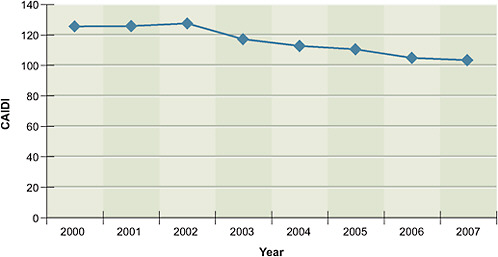
FIGURE 9.A.1 Customer Average Interruption Duration Index (CAIDI) for the state of Ohio, 2000–2007.
Source: Ohio Public Utility Commission.
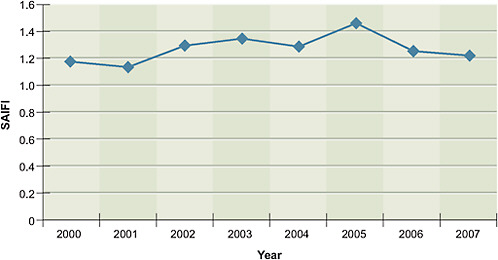
FIGURE 9.A.2 System Average Interruption Frequency Index (SAIFI) for the state of Ohio, 2000–2007. As shown, Ohio’s average SAIFI has been holding approximately steady over the last 7 years.
Source: Ohio Public Utility Commission.
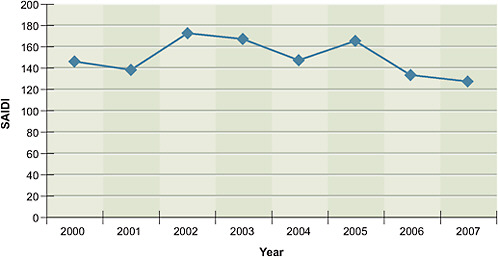
FIGURE 9.A.3 System Average Interruption Duration Index (SAIDI) for the state of Ohio, 2000–2007. Expressed in minutes, the average SAIDI in the state of Ohio has been holding approximately steady over the last 7 years.
Source: Ohio Public Utility Commission.
-
Restoration. It can take days or weeks to return today’s grid to full operation after an emergency. As better information, control, and communication tools become available to assist the operators and field personnel of a modern grid, it can be restored much faster and at lower cost.
-
Routine operations. With the help of advanced visualization and control tools, fast simulations, and decision-support systems, the operators of a modern grid can better understand its real-time state and trajectory, provide recommendations for secure operations, and allow appropriate controls to be initiated. These capabilities could help achieve significant reduction of the system peak-to-average ratio, thereby saving resources.
-
Optimization. The modern grid provides advanced tools for comprehending conditions, evaluating options, and exerting a wide range of control actions to optimize grid performance, whether from reliability, environmental, efficiency, or economic perspectives.
-
System planning. Grid planners must analyze projected growth in supply and demand to guide their decisions about where to build, what to
-
build, and when to build. The data-mining and data-modeling capabilities of a modern grid will provide much more accurate information for answering those questions while potentially realizing significant savings.
In order to meet these goals, the modern T&D system will need to display the seven characteristics listed in the chapter, which were adapted from a sequence of 2007 reports by the National Energy Technology Laboratory (NETL, 2007a-e). To acquire these characteristics (each of which is discussed in turn below), it will not be enough simply to add isolated technologies to the existing system. Technologies will need to be integrated with one another and also have a common basis for communication across regions. Thus creating a transmission system that displays these characteristics will require a multiregional effort based on consensus among all of the key stakeholders and reflecting a common approach to deployment across the various transmission regions. (Given the regional nature of the distribution system, such a common vision for distribution is less essential.)
Such a vision for the future of the transmission system will need to be developed and proposed at a high enough level to become the basis for support from state and federal regulators, owners, and operators of the T&D system. This would encourage stakeholders to begin the planning process and eventual investments for the deployment of the technologies needed to modernize the T&D system. The following is an in-depth discussion of the seven characteristics.
Accommodating All Generation and Storage Options
The transmission system must be designed to accommodate large baseload generation, such as nuclear and coal, as well as sources that do not typically operate in baseload mode, such as renewables. In addition, the distribution system must accommodate smaller distributed-energy sources. Large-scale baseload generation resources may require backup generation and, possibly, also power electronics to ensure that power flows are accommodated. Also, both the transmission and the distribution system must accommodate the intermittency of wind and solar generation.
Because electricity for consumption is produced on demand, the T&D system must be able to allow for the sudden loss of a generation source or an increase in demand. For transmission, this requirement translates into the ability to withstand the loss of the largest single generator on the system. The variability of small amounts of renewables on the current system can be accommodated reasonably
well, but as intermittent renewables grow to a significant portion of the system’s total generating capacity—say, 10 to 20 percent—new measures will be required to maintain reliability (EWIS, 2007).
The modern transmission system can meet the challenges posed by remotely located renewable-energy sources in large part through the use of technologies such as high-voltage direct current (HVDC) and power electronics. Dispatchable energy storage or backup generation can help to smooth intermittent generation, but the cost of the backup generation, storage, and power electronics and the actual cost of the transmission line and substations will need to be incorporated into the overall economics (cost of power) of, for instance, a proposed wind farm.
For distributed renewable power systems, the situation is somewhat different. For small amounts of power, net metering schemes and two-way power flow will adequately support them. If distributed renewable power becomes significant, however, storage to buffer it will be required. Such storage carries a secondary benefit of improving power reliability. As the local distribution becomes smarter, the easier it will be to accommodate renewable power.
Enabling Power Markets
The transmission system is being pressed into a new mode, in which wholesale power is bought and sold across wide areas. Although some modifications have been made, the systems are woefully short of the flexibility and intelligence required to accommodate wholesale power markets (EPRI, 2004; NETL, 2007d). Better knowledge of the transmission grid, including its available capacity and potential congestion locations in real time, can make the generation market more efficient. (While many of the most pressing needs in this area are related to the transmission system, changes will also be needed on the distribution side. For example, it is difficult at present for consumers to respond to increases in price to seek lower-cost products.)
Major improvements must be made to the transmission system to achieve well-designed and operating markets, especially as industrial, commercial, and even residential consumers will generate and sell power. These contributors will be enabled by emerging generation and storage technologies; the modern grid will allow for two-way power flow on the distribution system and thereby provide self-generation opportunities for the end user to also participate in power markets. Thus transmission capacity needs to be increased, and communication and control between regions must be expanded to accommodate the vast amount of information flow required in real time.
Some of these needed improvements will require little in the way of new or advanced technologies, but they will depend more on policy decisions and implementation. For example, improvements in regulations, the training of participants in the market, and significant capital investments are all important.
Self-Healing
Power outages can cause significant financial losses for U.S. industrial and commercial customers, as much as $80–100 billion annually, and can be very inconvenient or even dangerous for people. As discussed in the main text of this chapter, the 2003 blackout in the North American Eastern Interconnection occurred because a small problem in one part of the system resulted in cascading failures throughout the system. A self-healing transmission system could minimize such occurrences.
Self-healing actions are defined as automatic responses by the system such that system collapse will not occur and that, at worst, “graceful degradation”—which involves minimal interruption of service—will result. For example, faulty equipment or lines can be isolated when necessary to prevent problems from spreading. A self-healing system should be capable of being restored to normal operation with little or no human intervention. This means that both the transmission and the distribution system will have the ability to sense the state of the system as well as communicate this information to other parts of the system and take appropriate action. A wide variety of new measures will need to be implemented to create a self-healing T&D system. Many of these measures will be technological, while others will involve the development of software and standards. For example, research and development (R&D) is still needed on many of the algorithms involved (J. Eto, personal communication, 2008). In addition, integrating the new technologies will be a major challenge.
For transmission, the needed measures include: effective and advanced monitoring; methods for very quickly determining the cause and location of a fault or instability; probability-based contingency analysis; rapid system alignment for the next contingency; effective use of flexible alternating current transmission system (FACTS) devices and HVDC to stabilize system voltages and power flows; remotely dispatchable storage near generators and load centers; effective use of customer-generated power and storage; intelligent load-shedding; effective islanding; fast restoration means; strict reliability standards; and predictive maintenance of key components (NETL, 2007b). Many of these approaches are described in the sections that follow.
On the distribution side, measures to enable self-healing include distribution automation; alternate feeders with power-electronics-based transfer switching; micro-grids and meshed distribution systems; high impedance fault location; automatic switching off of nonessential loads; and effective use of local, generally customer-owned power and storage.
Motivating and Involving the Customer
Customers are not just consumers of electricity; they may also participate in generation and storage options as well as interactively respond to price signals. One way to optimize the use of electricity resources, in fact, is to motivate the customer to make wise end-use decisions (PNNL, 2007). Implementing new technologies (such as smart two-way meters and wireless communications with a residence’s major appliances) empowers consumers to make sound choices about their electricity use, thereby contributing greatly to a robust, efficient, and reliable distribution system (CECA, 2003; NETL, 2007c).
For example, providing electricity-pricing information to customers has been shown to reduce peak demand and assist in levelizing power demand. In addition, better information of this kind can enable the distribution-system operator to utilize the system more efficiently. The challenge primarily addresses the distribution system; however, it must ultimately include transmission, as decisions on the consumer side will, when taken in bulk, affect power markets and energy trading.
The aggressive introduction of technologies such as intelligent metering and real-time pricing could create incentives to shift energy use to off-peak times, thereby reducing demand for peak-load power generation and decreasing stress on the T&D system overall. For example, 20 percent of California’s electricity demand is used to move water, which can be done predominantly at night. Similarly, technologies could automate industrial and residential electricity-use decisions so that energy-intensive equipment and appliances could be run at night (or on weekends) rather than during peak-load hours. Utilities may be able to reduce demand in this way, at virtually any time of day and in real time, by communicating with end users and even directly with their appliances.
Detailed information on energy use and costs empowers individuals to take more proactive actions in their best interests. Programs to enhance consumers’ understanding of their pricing options will be critical in order to fully utilize the potential of the peak-shaving capability of demand response and grid-friendly appliances.
Resisting Physical and Cyber Attacks
Terrorist threats to the transmission system, whether physical or cyber, are serious; a widespread attack against the electric-system infrastructure cannot be ruled out. The transmission system is the primary focus: an attack on the distribution system would have only local impact, while an attack on the transmission system could affect millions. Because the aging system’s infrastructure was never designed to handle well-organized acts of terrorism, it is critical that increased security be a requirement for all of the transmission system’s elements.
Resilience must be built in to each element, and the overall system must be designed to deter, detect, respond to, and recover from human-induced (as well as natural) disruptions. Moreover, in order to reduce the threat of attack, the modern transmission system must conceal design vulnerabilities; disperse, eliminate, or reduce single-point failures; and protect key assets from both physical and cyber assaults. The modern transmission system must also reduce the consequences of a successful attack by devoting resources to recovery.
Many of the technologies described previously for advanced components, measurements, communications and controls, and improved decision-support technology (IDST) will help to guard the T&D system against physical and cyber attacks. In order to make the most significant difference, they will need to be deployed in an integrated manner, with an eye toward maximizing the system’s reliability and resiliency.
For example, the T&D system should be able to implement self-healing (as described above) and “islanding” (the autonomous operation of selected grid elements). These capabilities would allow the systems to respond to attack by rerouting to unaffected segments, isolating the affected portion, and thus preventing the disturbance from spreading. In addition, predictive models and decision-support tools could help operators respond to impending disruptions in real time and preempt further disruption. Providing greater automation, wide-area monitoring, and remote control of electrical distribution systems would enable all of these measures.
In order to further increase security, it is also important to acquire and position spares for key elements, such as high-voltage transformers and breakers, and to ensure that added equipment and control systems do not create additional opportunities for attack.1
Providing Power Quality for 21st-Century Needs
Forty percent of the power used in this country today is regulated through microchips of various types that run a wide range of equipment. Over the coming decade, this proportion could grow to 60 percent. In order to accommodate these microchips, the utility supply voltage must be reasonably free from harmonics, and any voltage variations should be within acceptable limits. The utility supply voltage deviates from the ideal because of events such as faults; the switching of lines, loads, or system equipment; overloads and light loads; and loads that inject harmonics into the utility system. Providing high-quality power is primarily an issue for the distribution system, as it affects the end user of the electricity and not its long-distance transmission.
It is estimated that problems with power quality cost tens of billions of dollars annually. Accordingly, many industrial and commercial users install equipment—such as uninterruptible power supplies, alternate utility feeders with high-speed transfer switches, standby generators, or a variety of power electronics devices, depending on cost and benefit—to attain the needed power quality. But with proper monitoring of the network condition and anticipation of changes, power-quality problems can be avoided at the system level through the use of existing technologies. Flexible AC transmission systems with superconducting condensers can reduce sags, which are the biggest customer power-quality problem. Fault current limiters can reduce the voltage depressions; synchronous switching can eliminate transient over-voltages.
Mitigating these problems in a fundamental way will require setting and enforcing proper standards applying to utilities’ power quality and to users’ loads.
Optimizing Assets and Operating Efficiently
In order to make optimal use of T&D systems, losses must be reduced and lines utilized as efficiently as possible. This is not currently the case, particularly on the transmission side. Losses in the T&D system account for about 10 percent of the electricity generated in the United States, or 390 billion kWh (McDonald, 2008). Reducing these losses by just 10 percent would be equivalent to adding seven new 800 MW power plants operating 80 percent of the time.
Average loads are much lower than peak loads, but the system must be sized to accommodate peak loads along with adequate safety margins to allow for failure contingences. Over the course of a year, the transmission system carries only about 50 percent of its full load capacity, and that fraction is dropping.
This trend will necessarily drive the cost of electricity upward because the full cost of the system must be borne by the average transmission. Further, the growth in intermittent renewable sources of energy may shift baseload generation capacity to standby power, resulting in more capacity that is not fully utilized. Reducing transmission losses is important not just for the cost of the losses but also for increasing available transmission capacity. Several options could be considered:
-
Reducing flow of reactive power over the lines. In principle, a deficit or surplus of reactive power should be corrected at or near where it occurs—namely, generators, transmission lines, and loads or load areas. Reactive power flow over a transmission line not only increases losses in the transmission line but also significantly reduces the line’s power-carrying capacity.
-
Power flow through parallel paths. Currents flow through all parallel paths and are distributed according to their impedances, which, if not carefully selected, may cause losses or reduce transmission capacity. In general, losses can be decreased by appropriate adjustment of impedances—for example, through series capacitor compensation of some lines or phase-shifting transformers.
-
Evaluation of transformer losses. Most utilities evaluate load and no-load losses as part of their evaluation of procurement price. Nevertheless, for cash flow or other reasons there is a temptation to procure transformers on a first-cost basis. Appropriate regulations could ensure that they are purchased with appropriate loss evaluation.
In a modern electric T&D system, asset optimization does not mean that each asset will reach its maximum operational limit. Rather, it means that each asset will be coordinated with all other assets to maximize the overall function. For example, load-sharing would routinely adjust the loads of transformers or lighten the loads of transmission-line sections, thereby allowing for more efficient operation of the transmission system. Optimized maintenance will be possible when, for example, equipment monitors send a “wear” signal as part of a predictive maintenance program or a direct malfunction signal to a condition-based maintenance program.
Such ends may be accomplished because modern T&D systems will include many sensors and enhanced communications capability needed to monitor equipment conditions in real time. This information may be gathered as a direct reading
of the condition of a component or piece of equipment, for example, by means of a vibration monitor, temperature sensor, hydrogen monitor on a transformer, or a derived estimation using a wear algorithm. Automated analysis, such as comparing the wear to the threshold value, would enable the signaling of an exceeded threshold to the asset manager, who would then perform maintenance. Today, operators know the condition of equipment only when they perform scheduled maintenance or when a failure occurs.
In the operation of a modern grid, optimization can extend to the identification of untapped capacity, thus avoiding the start-up of more costly generation resources. Dynamic real-time data reveal when and where such unused generating capacity is available. The use of excess capacity also applies to transformers, transmission lines, and distribution lines. For example, deploying a costly distributed energy resource could be avoided if the operator knew that the distribution system was capable of carrying a greater load from the substation.
As the sensors of a modern T&D system provide more data, asset planning is also enhanced. Decision makers can decide more economically where, what, and how to invest in future grid improvements. Whether from optimizing assets or operating efficiently, the real-time information from the modern grid sensors, coupled with communicating it widely and processing it effectively, will significantly enhance the system.
Detailed Discussion of Selected Technologies
Flexible Alternating Current Transmission System
The Flexible Alternating Current Transmission System (FACTS) is a collection of mostly power-electronics-based devices that are applied, depending on the need, to control one or more AC transmission parameters—such as current, voltage, active power, and reactive power—in order to enhance power-transfer capability and stability. FACTS devices will be needed, in several ways, to meet the challenges of modernized T&D systems. They will improve power quality and increase efficiency by enabling high-speed control of power systems, power-flow control over lines, control of voltages, and reactive-power management. They will also be of value in the prevention of system collapse and restoration. FACTS technology helps meet many of the challenges outlined previously: enabling the connection of remote and asynchronous sources of power such as wind, solar, fuel cells, and microturbines; supporting wholesale power markets through power-flow control; stabilizing power swings; making the system more secure and self-healing; and optimizing the use of available assets.
There are three basic applications of FACTS devices, each with high-speed control. The first can be characterized as adding voltage in series with a line, while controlling the line’s reactive and active current. The second application is injection of current in shunt, which enables control of the line voltage. The third application is a combination of voltage injection in series and current injection in shunt both for active/reactive power and voltage control. All FACTS devices can help stabilize the power system and enhance the usable capacity of lines.
Within these three basic types of FACTS devices there are many specific device concepts, and several FACTS devices are commercially available. The ones most used are the following:
-
Static volt-amperes reactive compensators (SVCs), which together with variable shunt capacitors or inductors help to control shunt current and reactive power, are used primarily for controlling the line voltage and stabilizing the power system.
-
Thyristor-controlled series capacitors (TCSCs), which control the magnitude of current flow through the line, are used primarily for controlling the current and stabilizing the power system.
-
Static shunt compensators (STATCOMs), which are voltage-sourced converters connected in shunt with a line for controlled injection of lagging or leading reactive current (and hence for controlling reactive power), are used primarily for controlling the voltage and stabilizing the power system.
-
Variable frequency transformers (VFTs) are used primarily to control active and reactive power flow through a line as well as to adjust frequency drift.
Hundreds of SVCs, and a few STATCOMs, TCSCs, and VFTs, are currently deployed in the T&D system. More FACTS devices will be available with further R&D and can be deployed by 2020.
Custom Power
Custom power is very much like FACTS, but it is designed for lower voltages and for use in the distribution system. Custom-power devices, inserted between the utility and the customer, can achieve significant improvement in power quality by
controlling voltage dips and harmonics and allowing for high-speed switching to alternate feeders.
These capabilities address the need for power quality in 21st-century applications. They would provide relief to many present users, such as banks, that have to employ expensive uninterruptible power supplies, along with standby generation, because any power interruption and voltage dip would be unacceptable. In other industries, annual losses because of power-quality issues amount to billions of dollars. Therefore many electricity consumers—in particular, companies with automated production—would appreciate low-cost solutions that provide substantial improvement in the number and duration of voltage dips and power outages.
Several custom-power devices are commercially available to control voltage or current. However, they are still too expensive for widespread use. The present market is about 100 devices (greater than 1 MW rating) per year, representing about $50–100M. Further R&D could help to decrease these costs.
High-Voltage Direct Current
DC lines have several advantages over AC lines that make them preferable under certain circumstances. While power on an AC line automatically follows the path of least resistance, DC current is controllable. Therefore, a DC line carrying power from a distant generating plant is considered to have the same reliability as a local plant, a significant advantage when an ISO is determining required reserve margins. DC lines can be less expensive per mile than AC lines are, especially for underground transmission. DC lines require two cables, while AC requires three. A DC underground or submarine line can carry 2–3 times the power of a comparably sized AC line. Finally, heat dissipation in an underground DC cable is less of a problem because the lower voltage allows a solid insulator rather than one containing fluid, which raises concerns about possible leaks and damage to groundwater.
Because the U.S. transmission system today is almost entirely AC, transmitting electricity via HVDC involves converting AC to DC, transmitting the DC electricity, and then converting it back to AC at the other end. Most HVDC projects to date have been based on current source converter technology, in which the DC current flows in the same direction and power reversal involves reversal of voltage. These converters, assembled with thyristors,2 have been operated at
a power rating of 6000 MW and 800 kV per two-conductor DC line. Recently, voltage source converter technology has become available in which the DC voltage has the same polarity and the power reversal involves reversal of current. This technology, which offers the advantages of low harmonic levels, a reactive power supply, and easier multiterminal HVDC (in which more than two converters are connected to one line), is available at ratings of up to 1000 MW.
Storage
Storage of electrical energy would offer many benefits to the T&D system, especially if it included significant input from intermittent sources such as wind and solar. Storage would provide improved system stability and efficiency by enabling load-leveling, system regulation, instantaneous reserve power, and the dispatch of reactive power to the system.
Pumped hydroelectric power, currently the only proven means of large-scale energy storage, is unlikely to be expanded greatly because few sites are both economically and environmentally acceptable. Other near-term candidates are compressed-air energy storage (CAES) and, for lower power levels, battery storage. Longer-term candidates include ultracapacitor storage, flywheel storage, and superconducting energy storage.
CAES technology has already been demonstrated and will be available for deployment in the near future. A CAES plant stores energy by using electricity (typically from off-peak hours) to compress air into an underground geologic formation (or, in some cases, in aboveground tanks). The energy is released by sending the compressed air to a combustion turbine, where it is mixed with natural gas and burned, increasing the efficiency of the gas turbine by as much as a factor of three.3
The compressed air can be stored in several types of underground sites, including porous rock formations, depleted natural gas or oil fields, and caverns in salt or rock formations. Considerable energy can be stored in underground geologic formations, and such facilities are much less expensive to build than are pumped hydroelectric plants. The compressed air can also be stored in
aboveground or near-surface pressured-air pipelines, which can be cost-effective for about 2 to 4 hours of energy.
EPRI studies have found that approximately three-fourths of the United States has geology that is potentially suitable for locating reliable underground CAES systems (EPRI, 2008). The Alabama Electric Cooperative built (with EPRI support) the first U.S.-based CAES plant, with a capacity of 110 MW for 26 hours. Because the plant was the first of its kind, the cost was high ($800/kW). With new CAES plants projected to cost in the range of $500–600/kW, CAES will be a viable option for providing the backup power that compensates for the electrical-output variability, for example, of a large wind farm. A 300 MWe CAES storage facility can utilize wind power to compress air, and then, during low wind periods, the compressed air can provide the combustion air for a natural-gas-fired combustion turbine providing up to 10 hours of backup capability for the wind farm.
Another possible storage technology for use in the grid is batteries, which rely on electrochemical processes to store electricity. There is a wide variety of battery types with potential for large- to small-scale dispatchable storage. Examples include lithium ion, sodium sulfur, zinc bromide, nickel metal hydride, and vanadium. In general, present battery technologies are expensive ($400/kW for 2 hours), incur high losses as the batteries are charged and discharged, and have reliability issues. In addition, battery storage requires AC/DC converters, which at present add $100–150/kW to the cost and about 4 percent to the in-out losses. However, more R&D and the mass production of standard power-electronics building blocks should bring converters’ costs and losses down to less than half by 2020 and to one-quarter by 2035. Also, in converter-based FACTS applications, batteries can be added at little extra converter cost.
There are significant advantages to battery storage. Batteries are modular and non-site-specific, meaning they can be located close to intermittent-generation sites, near the load, or at T&D substations. Battery storage technology can provide needed reliability and flexibility to the T&D system if it can be economically developed in the 100 MW range. Some battery storage technologies, such as sodium sulfur batteries, have been demonstrated and should be available for deployment before 2020. For example, American Electric Power plans to increase reliability by deploying 25 MW of sodium sulfur batteries in its distribution system by 2010 (Bjelovuk, 2008). Meanwhile, extensive R&D is in progress on lithium ion, nickel metal hydride, and other types of batteries. These technologies
have promise for lower cost and higher energy density. It is likely that these batteries would be available for deployment in the T&D systems after 2020.
In addition to batteries and CAES, there are several other possibilities for energy storage. For example, supercapacitors have been used as energy storage devices in power-quality and similar short-time applications, including HVDC and FACTS. They have very long life as well as very high efficiency compared to batteries. A second example is superconducting energy storage (SES), whereby energy is stored in a magnetic field created by circulating DC current through a coil made of superconducting material. SES, which has high in-out efficiency and cycle life, has been demonstrated for stabilizing power systems and used for power-quality applications, but its application for storage will require more advances in materials science. Energy can also be stored in flywheels, which are particularly suitable for power-quality applications and have a very long cycle life. Given their high costs and low energy-storage density, none of these three technologies is currently suitable for storage in the grid. However, if advances are made, particularly in materials, they may become suitable for use in distribution systems during the 2020–2035 and post–2035 time periods. Because no one type of storage fits all applications, R&D is needed for all of these technologies.
At the distribution and customer levels, the loads being protected or leveled are generally much smaller in size (a few kilowatts to a few megawatts). Thus devices such as ultracapacitors, flywheels, batteries, and uninterruptible power supplies can be used. The choice will normally be determined by the load characteristics. Figure 9.A.4 shows the various types of storage and their applications.
Transformers
Electrical transformers are devices used to raise or lower AC voltage. For example, a transformer near the generating plant increases the voltage (steps it up) at the transmission line, and a transformer at the distribution substation decreases the voltage (steps it down) from transmission levels to those appropriate for the distribution system. This voltage is subsequently reduced as the power travels to the consumer. All told, power from the point of generation to the customer’s meter may flow through four transformers stages, causing total energy losses of about 4 percent in the process. Though utilities procuring transformers generally take estimates of such losses into account, there is always a trade-off between capital costs and operating costs which can push the buyer toward lower first cost. Thus
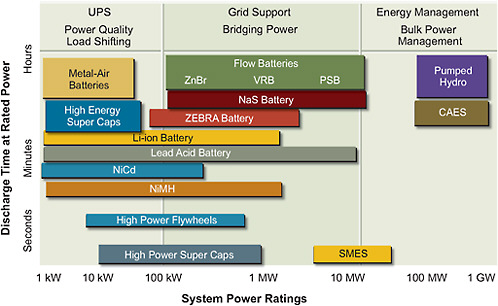
FIGURE 9.A.4 Energy storage options.
Note: CAES = compressed-air energy storage; Caps = capacitor; Li-ion = lithium ion; NaS = sodium sulfur; NiCd = nickel-cadmium battery; NiMH = nickel metal hydride battery; PSB = polysulfide bromide battery; SMES = superconducting magnetic energy storage; UPS = uninterruptible power supplies; VRB = vanadium redox battery; ZnBr = zinc bromide.
Source: Adapted from a presentation by Dan Rastler, Electric Power Research Institute, to the Panel on Electricity from Renewable Resources, March 11, 2008.
setting standards for transformer efficiency can be important in lowering the T&D losses.
The last transformer in the chain is the distribution transformer for residential/small commercial customers, which incurs about 1–2 percent losses. These devices experience about 0.2–0.5 percent constant core losses (in the magnetic material) and load losses that vary according to the load. Core losses are important because they occur all the time, whether the transformer is fully or lightly loaded; the installed capacity of distribution transformers may be two times the total load, causing core losses to add up to a significant and continuous amount.
Grain-oriented steel has generally been used as the core material, though there has been sustained but slow progress both toward improving it and developing alternatives. Transformers with amorphous steel, which have been commercially available in limited quantities for better than 10 years now, have about one-
third the core loss of transformers with grain-oriented steel. This material is made by running molten metal on a fast-moving belt, thereby solidifying it rapidly without producing grains in tape form. The market for amorphous steel transformers has been quite low, however—fewer than 10,000 units per year—mainly because of their higher cost.
The U.S. Department of Energy (DOE) has established standards for distribution-transformer efficiency that will become effective in 2010 (DOE, 2007). The DOE estimates that the cost of the standard will be $463 million per year in increased equipment and installation costs, while the annualized benefits will be $602 million.4 This standard could help to make amorphous steel transformers, as well as advanced grain-oriented steel transformers, more competitive. Given the typical service lives of distribution transformers, it is expected that 5 percent of them will be replaced each year.
Sensing and Measurements
Understanding and acting on the current state of the T&D system require measuring their power characteristics at many points. The basic measurements that need to be made are the current (amperes) and voltage (volts) at every electrical connection and the status of all switches (on/off). The first two measures indicate the electrical condition of the electric T&D system—although the derived value of power flow (watts, VARs) is often preferred for monitoring. Whether the switches are on or off provides information on the connectivity of the T&D systems, such as which components are connected and which ones are switched out.
These measurements, made at each substation, are used to drive controls and protective relays. In the early days, all the measurements and controls were hardwired within the substation, and a few—very few—of the measurements from high-voltage transmission substations were hardwired all the way back to a central control center. From the 1960s on, the control center was based on the digital computer’s supervisory control and data acquisition (SCADA) system, and the data from substations could be transmitted over slow communication channels, usually microwave, to the control center. Within the substation, the measured data could be sampled every few seconds and put into a remote terminal unit (RTU) that could be polled by the SCADA system over the microwave channel
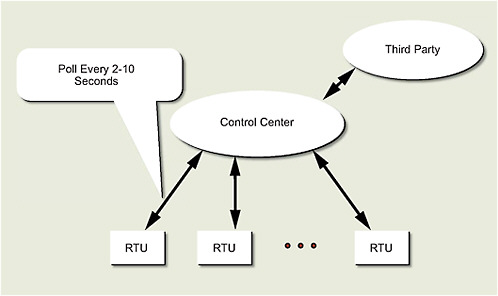
FIGURE 9.A.5 The SCADA at the control center collects real-time data from each substation remote terminal unit (RTU) every few seconds.
(Figure 9.A.5). This configuration remains the architecture of most control centers in place today.
More recently, most modern high-voltage substation control and protection systems are digital and the connectivity is through a local area network (LAN). Most of the recent and all future controllers and protection systems in the substation are based on digital processing. In fact, all the recording systems—for example, fault recorders and sequence of events recorders—are also based on digital processors.
Given that the currents and voltages measured are all AC, the phase differences between these values reveal the stability of the power flow in the transmission system. Phase differences were not a problem to measure within one substation when the measurements were hardwired and continuous. However, the values sent to the control center were limited to current and voltage magnitudes, as there was no way to measure phase differences between values at widely separated substations. This situation has recently changed because of the availability of GPS signals, which can provide an absolute time reference to all substations on
the continent. Thus both magnitudes and phase angles of AC currents and voltages can be measured and stored today, although the number of measurements taken that incorporate phase (phasor measurements) in the first place is still very low. However, the availability of digitized phasor measuring at high sampling rates raises the possibility of many new and fast control applications not previously available.
The modern transmission system should have all of its high-voltage sub stations equipped with measurement systems that will be sampling critical data at rates of 30 to 120 times per second (and even faster for localized applications) with an absolute GPS time reference, allowing a more complete picture to be created of the current real-time state stability of the system. Although the hardware costs of these measurement units themselves are modest, they have to be retrofitted into the thousands of existing substations at significant cost. In this regard, developing countries such as China have an advantage over more established industrialized countries. They are able to leapfrog directly to the latest technologies for substation automation as they expand their electric grids.
On the distribution side, there are about four times as many lower-voltage substations as there are transmission substations. Distribution systems can use measurement instrumentation with slower sampling rates than those needed for transmission systems, but the flood of data requires high-bandwidth communication to use these data for control. Also, synchronizing measurements by using GPS at the low-voltage substations is not yet considered cost-effective. With regard to end users, there is a move toward replacing the existing kilowatt-hour meters for billing with intelligent (i.e., microprocessor-based) meters that can provide the customer with new buying options, such as time-of-day pricing. These meters can also bring control signals from the power company directly into appliances and other equipment on the customer side.
The ubiquity of more and faster measurements throughout the T&D system raises the issue of how to handle this proliferation of measurement data. Certainly they can be stored at the substations where they are collected and then used for various local engineering analyses as needed. However, a higher value of these real-time measurements is in helping to monitor and control the overall T&D system more efficiently and reliably. Such applications require the development of real-time data-handling software that can collect and move these data where they are needed.
Integrated Communications
The Eastern Interconnection has approximately 10,000 high-voltage (above 100 kV) substations, overseen by about 100 control centers. If fully instrumented, each substation could have about 100 measurement points (currents, voltages, powers, switch statuses), each of which may be sampled about 100 times per second. This arrangement would require each control center to process about a million data points per second. In addition, the center should be aware of what is going on in the neighboring parts of the T&D system and perhaps in the whole interconnection.
The Eastern Interconnection also has about 10 second-level control centers, known as reliability coordinators, that supervise larger areas of the T&D systems; each of these facilities has to process data at rates that are an order of magnitude higher than those of the substations. But these data rates cannot be handled by the communication system used today between control centers and substations.
A basic problem is that the existing communication channels between high-voltage substations and the control center, many dating from the 1960s, are slow. They are being replaced with high-bandwidth optical fiber. But even with the high bandwidth, the present architecture—wherein all data from substation RTUs are collected at the control center’s SCADA—cannot handle the expected proliferation of real-time measurement data. Moreover, it does not make sense to centralize this large amount of data. Automatic controllers need not be physically located in one place either but can be sited conveniently according to their input sources and output destinations.
The actual data needs for particular applications to monitor and control the transmission network will vary widely. For example, there will always be control centers where human operators are monitoring a region of the system. The number of measurement data points needed at such a control center will be very large, but the sampling of the data can be as slow as once a second, as the human eye cannot follow much faster changes. However, the processing of these data for checking limits, warning, predicting, and visualization at the control center will be very large. And while an automatic control such as a special protection scheme for islanding a portion of the electric T&D system to keep a disturbance from cascading will require only a few measurements, they involve very high sampling rates and speeds.
On the distribution side, the communication needs are localized to neighborhoods, but the sheer number of substations, feeders, and customers requires low-
cost alternatives such as radio-frequency and power-line carrier systems. Smart meters, time-varying rates, the handling of customer generation, demand-side management, and other such applications require ubiquitous communications.
Thus the communication system for both the transmission and the distribution system will need to be able to handle a wide range of speed and quantity requirements. Although such systems exist today—for example, cellular telephone networks—the communication needs of the power grid are unique; its software will thus have to be custom designed and developed. The cost of this communication infrastructure, which can begin to be deployed by 2020, is partly for the physical fiber-optic cables and switching computers, but mostly for the software.
Costs of Modernizing an Electric T&D System
The AEF Committee’s cost estimates are based on a study published by the Electric Power Research Institute (EPRI) in 2004 (EPRI, 2004). EPRI’s projected costs are summarized in Tables 9.A.1 and 9.A.2.5 The committee modified EPRI’s estimates to reflect its conclusion that superconducting cables, which account for $30 billion of the total in Table 9.A.1, are unlikely to be deployed during the next 20 years. If indeed they are not available, the costs of alternative technologies are likely to be higher than that amount and/or the benefits of modernizing the grid could be lower.
The committee also considered the investment that would be required to meet load growth and replace aging equipment. The annual level of investment in transmission over the 20 years prior to 1985 averaged around $5 billion per year, but from 1985 to 1999 only about $3 billion per year was invested. That $30 billion shortfall meant that the transmission system failed to keep pace with load growth. EPRI assumes that load growth will continue in the future, as it has in recent decades, and that an investment of $5 billion per year continues to be needed to meet it. In addition, $1.5 billion per year for 20 years will be required to make up for the 1985–1999 investment shortfall. Thus EPRI estimates that $6.5 billion (in 2002 dollars) will annually be needed for transmission systems over the next 20 years simply to meet load growth and to correct deficiencies in the current system, in addition to implementing advanced technologies to modernize the transmission system.
TABLE 9.A.1 EPRI Cost Estimates for Modernizing the Transmission System
|
Technology Category |
Cost (billion 2002$) |
|
Communications and sensors |
4 |
|
Hardware improvements to substations (includes transformers and other substation equipment) |
5 |
|
Substation automation |
10 |
|
Other equipment (power electronics, storage, HV lines and equipment, superconducting lines) |
55 |
|
Emergency operation and restoration tools and equipment |
12 |
|
IDSTa software |
3 |
|
Dynamic thermal circuit rating |
1 |
|
Predictive maintenance |
20 |
|
Total |
110 |
|
a IDST = Improved decision-support technology. Source: EPRI, 2004. |
|
TABLE 9.A.2 EPRI’s Cost Estimates for Modernizing Distribution Substations and Feeders
|
|
|
Component Cost per Substation Feeder (2002$) |
Individual Cost per Substation Feeder (billion 2002$) |
Number to Be Upgraded |
Total Cost (billion 2002$) |
|
Upgrading distribution substations |
600,000 |
40,000 |
24 |
||
|
|
Communications |
75,000 |
|
|
|
|
|
Hardware improvements |
350,000 |
|
|
|
|
|
Sensors and monitoring |
75,000 |
|
|
|
|
|
Advanced controls and diagnostics |
100,000 |
|
|
|
|
Upgrading distribution feeder circuits |
540,000 |
320,000 |
173 |
||
|
|
Communications |
60,000 |
|
|
|
|
|
Hardware improvements |
170,000 |
|
|
|
|
|
Sensors and monitoring |
100,000 |
|
|
|
|
|
Advanced controls and diagnostics |
210,000 |
|
|
|
|
Integrating consumer systems with the grid |
|
|
62 |
||
|
Total |
|
|
|
|
259 |
|
Source: EPRI, 2004. |
|||||
As shown in Table 9.A.1, EPRI projects the cost to modernize the transmission system to be $110 billion over 20 years, or approximately $5.5 billion per year. Similarly, EPRI estimated the expenditures for the distribution system over 20 years to be $340 billion to meet load growth, $6 billion to correct deficiencies, and $259 billion to modernize the distribution system. Table 9.A.2 summarizes the costs to modernize distribution.
Summing the T&D system expenditures needed to meet load growth and to correct deficiencies with the expenditure needed for the modern T&D system is likely to overestimate the total investment needed. When new lines are built (or rebuilt) to meet load growth, the additional investment to install modern technologies is less significant. In addition, technologies can meet multiple purposes. For example, dynamic thermal circuit rating can help to meet load growth by increasing the capacity of existing lines, but this is also an important part of a modern transmission system. Correcting for such overlaps (synergies), EPRI’s estimate of the total investment needed in the T&D system is shown in Table 9.A.3.
It should be noted that in order to achieve the full benefits of synergies on the transmission side, equipment throughout the system would need to be deployed in an integrated way. This is unlikely to occur until after 2020. EPRI estimated the synergies for T&D to be $72 billion and $132 billion, respectively, over the 20-year time horizon of their study. The AEF Committee (as previously stated) dropped $30 billion from the $110 billion to modernize the transmission system (by eliminating superconducting cables), which also required dropping $30 billion from the transmission synergies. The net result was that the committee estimated $80 billion to modernize the transmission system, with synergies of $42 billion when incorporating the expenditures to meet load growth and to correct deficiencies. The elimination of superconducting cables was assumed to negate an equal benefit (synergies) in meeting load growth and correcting deficiencies. These details are shown in Table 9.A.3.
In the committee’s analysis, EPRI’s cost estimates were escalated to 2007 dollars. The committee accounted for recent real escalation in materials and construction costs by using the national average T&D indexes.6 In 2007 dollars, the investment needed in the T&D systems over the next 20 years will be about $225 billion for transmission and $640 billion for distribution. These estimates
TABLE 9.A.3 Costs to Implement Modern T&D Systems
|
|
EPRIa |
Brattle Groupb |
AEF Committee Adjusted |
|||
|
Transmission (billion 2002$) |
Distribution (billion 2002$) |
Transmission (billion 2007$) |
Distribution (billion 2007$) |
Transmission (billion 2007$) |
Distribution (billion 2007$) |
|
|
Investment to meet load growth |
100 |
330 |
|
|
|
|
|
Investment to correct deficiencies |
30 |
6 |
233 |
675 |
175c |
470c |
|
Modern T&D systems |
80 |
259 |
N/Ad |
N/Ad |
105e |
365e |
|
Total |
210 |
595 |
233d |
675d |
280 |
835 |
|
Synergies |
42 |
132 |
N/A |
N/A |
55 |
195 |
|
Total minus synergies |
168 |
463 |
N/A |
N/A |
225 |
640 |
|
aEPRI, 2004. bBrattle Group, 2008. cEPRI’s estimates, originally in 2002 dollars, were escalated to 2007 dollars for the committee’s analysis. Recent real escalations in materials and construction costs were accounted for by using the national average T&D indexes (33 percent for transmission, 40 percent for distribution). dBrattle Group numbers include investments needed for the business-as-usual case but do not identify costs of deploying the modern T&D systems. eThe $30 billion (in 2002 dollars) that EPRI estimated for investment in superconducting cables has been removed from the total investment needed for the transmission system. This quantity has also been removed from the synergies calculation. |
||||||
include investments needed to meet load growth, to replace aging equipment, and, additionally, to implement modernization. Implementation of the modern T&D system alone makes up a small portion of this total, as shown in Table 9.A.3: $50 billion for transmission and $170 billion for distribution.7
The committee assumed that 40 percent of the transmission improvements involved in implementing the modern grid, meeting load growth, and correcting deficiencies would be made before 2020, while the remaining 60 percent would need to be implemented between 2020 and 2030. Thus an investment of $9 billion per year would be needed in the transmission system from 2010 to 2020
($2 billion per year for modernizing the grid). From 2020 to 2030, approximately $13.5 billion per year would be needed ($3 billion for the modernization alone).
On the distribution side, as with the transmission system, the committee has assumed that 40 percent of the improvements would be made by 2020 and the remaining 60 percent from 2020 to 2030. Thus an investment of $26 billion per year would be needed for the distribution system from 2010 to 2020 ($7 billion per year for modernization). From 2020 to 2030, approximately $38 billion per year would be needed ($10 billion for modernization), and an investment of $32 billion per year would be needed for the distribution system over the 20 years beyond 2030. Such an investment would be more than returned in the form of benefits from the improved system.
References for Annex 9.A
Bjelovuk, G. 2008. Presentation to the AEF Committee, Washington, D.C., February 21.
Brattle Group. 2007. Rising Utility Construction Costs: Sources and Impacts. Prepared by M.W. Chupka and G. Basheda for the Edison Foundation. September. Available at www.edisonfoundation.net/Rising_Utility_Construction_Costs.pdf. Accessed July 2009.
Brattle Group. 2008. Transforming America’s Power Industry: The Investment Challenge 2010-2030. Prepared by M.W. Chupka, R. Earle, P. Fox-Penner, and R. Hledik for the Edison Foundation. Available at www.edisonfoundation.net/Transforming_Americas_Power_Industry.pdf. Accessed July 2009.
CECA (Consumer Energy Council of America). 2003. Positioning the Consumer for the Future: A Roadmap for an Optimal Electric Power System. Washington, D.C. Available at www.cecarf.org/publications/RestExecSummary.pdf. Accessed July 2009.
DOE (U.S. Department of Energy). 2007. 10 CFR 431. Energy Conservation Program for Commercial Equipment: Distribution Transformers Energy Conservation Standards, Final Rule. Federal Register 72(197), October 12. Available at www1.eere.energy.gov/buildings/appliance-standards/commercial/pdfs/distribution-transformers_fr_101207.pdf. Accessed July 2009.
EPRI (Electric Power Research Institute). 2004. Power Delivery System of the Future: A Preliminary Study of Costs and Benefits. Palo Alto, Calif.
EPRI. 2008. Compressed Air Energy Storage Scoping Study for California. Prepared for the California Energy Commission. CEC-500-2008-069. Available at www.energy.ca.gov/2008publications/CEC-500-2008-069/CEC-500-2008-069.pdf. Accessed July 2009.
EWIS (European Wind Integration Study). 2007. Towards a Successful Integration of Wind Power into European Electricity Grids. European Transmission System Operators. Brussels, Belgium.
McDonald, John (General Electric Co.). 2008. Discussion of electric T&D technologies and costs. Presentation to the T&D Subgroup of the AEF Committee, April 24.
NETL (National Energy Technology Laboratory). 2007a. A Systems View of the Modern Grid. Prepared for the U.S. Department of Energy. Available at www.netl.doe.gov/moderngrid/resources.html. Accessed July 2009.
NETL. 2007b. A Systems View of the Modern Grid. Appendix A1: Self-Heals. Prepared for U.S. DOE. Available at www.netl.doe.gov/moderngrid/resources.html. Accessed July 2009.
NETL. 2007c. A Systems View of the Modern Grid. Appendix A2: Motivates and Includes the Consumer. Prepared for U.S. DOE. Available at www.netl.doe.gov/moderngrid/resources.html. Accessed July 2009.
NETL. 2007d. A Systems View of the Modern Grid. Appendix A6: Enables Markets. Prepared for U.S. DOE. Available at www.netl.doe.gov/moderngrid/resources.html. Accessed July 2009.
NETL. 2007e. A Vision for the Modern Grid. Available at www.netl.doe.gov/moderngrid/docs/A%20Vision%20for%20the%20Modern%20Grid_Final_v1_0.pdf.resources.html. Accessed July 2009.
NRC (National Research Council). 2002. Making the Nation Safer: The Role of Science and Technology in Countering Terrorism. Washington, D.C.: The National Academies Press.
PNNL (Pacific Northwest National Laboratory). 2007. Testbed Demonstration Projects. Part II: Grid Friendly Appliance Project. October. Available at www.gridwise.pnl.gov/docs/gfa_project_final_report_pnnl17079.pdf. Accessed July 2009.


