


Below is the uncorrected machine-read text of this chapter, intended to provide our own search engines and external engines with highly rich, chapter-representative searchable text of each book. Because it is UNCORRECTED material, please consider the following text as a useful but insufficient proxy for the authoritative book pages.
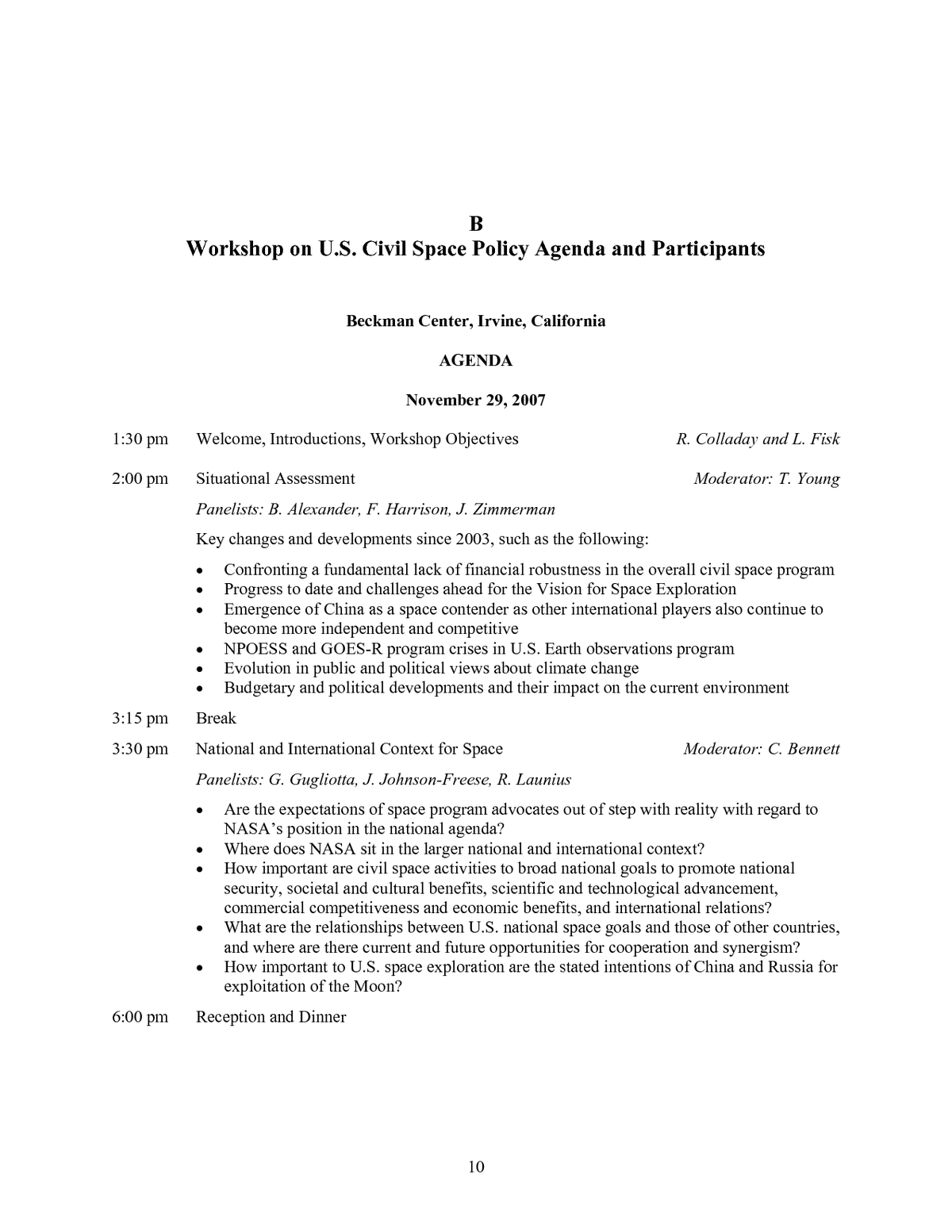
B Workshop on U.S. Civil Space Policy Agenda and Participants Beckman Center, Irvine, California AGENDA November 29, 2007 1:30 pm Welcome, Introductions, Workshop Objectives R. Colladay and L. Fisk 2:00 pm Situational Assessment Moderator: T. Young Panelists: B. Alexander, F. Harrison, J. Zimmerman Key changes and developments since 2003, such as the following: ⢠Confronting a fundamental lack of financial robustness in the overall civil space program ⢠Progress to date and challenges ahead for the Vision for Space Exploration ⢠Emergence of China as a space contender as other international players also continue to become more independent and competitive ⢠NPOESS and GOES-R program crises in U.S. Earth observations program ⢠Evolution in public and political views about climate change ⢠Budgetary and political developments and their impact on the current environment 3:15 pm Break 3:30 pm National and International Context for Space Moderator: C. Bennett Panelists: G. Gugliotta, J. Johnson-Freese, R. Launius ⢠Are the expectations of space program advocates out of step with reality with regard to NASAâs position in the national agenda? ⢠Where does NASA sit in the larger national and international context? ⢠How important are civil space activities to broad national goals to promote national security, societal and cultural benefits, scientific and technological advancement, commercial competitiveness and economic benefits, and international relations? ⢠What are the relationships between U.S. national space goals and those of other countries, and where are there current and future opportunities for cooperation and synergism? ⢠How important to U.S. space exploration are the stated intentions of China and Russia for exploitation of the Moon? 6:00 pm Reception and Dinner 10
November 30, 2007 8:30 am Sustainability Issues and Options for Solutions: Moderator: J. Pawelczyk Affordability, Public Interest, and Political Will Panelists: P. Carliner, G. Paulikas, R. Truly, G. Whitesides ⢠How can expansive expectations for the total content of the civil space program be reconciled with realistic expectations for total program resources? ⢠What is required to ensure that national goals for human space exploration are sustainable? ⢠Are there proven strategies for ensuring sustainability for large federal programs? 10:15 am Break 10:30 am Balance Issues and Options for Solutions Moderator: C. Bolden Panelists: T. Jernigan, C. Kennel, L. Garver ⢠How should decision makers assess an appropriate balance between NASAâs programs (or do we mean âresponsibilitiesâ or âinvestmentsâ?) in human spaceflight versus science versus aeronautics? ⢠Is âbalanceâ the same as âinvestment portfolio mixâ? ⢠What are appropriate criteria or metrics for achieving âbalanceâ? ⢠Roles of NASA versus roles of others â¯What are the appropriate roles of NASA vis-à -vis other government agencies? â¯What are the appropriate roles of the federal government vis-à -vis the private sector? 12:15 pm Lunch 1:30 pm Civil Government Missions in Earth Observations Moderator: J. Fellows Panelists: J. Loschnigg, B. Moore, S. Sorooshian ⢠What should be NASAâs role in helping NOAA acquire the data needed to assess global climate change? ⢠What are the appropriate roles and responsibilities of NASA, NOAA, and other agencies in Earth observations from space? 2:15 pm Capabilities and Infrastructure Moderator: R. Colladay Panelists: J. Klineberg, T. Zurbuchen, I. Pryke ⢠Are there critical unmet needs or anticipated needs that should be addressed to give the United States the capability to achieve its civil space goals, and what strategies are needed to meet expected long-term needs? â¯U.S. space industrial base, NASA centers, and academia â¯Access to space â¯Technology development 3:15 pm Break 3:30 pm Synthesis and Wrap-up: Summary Comments Moderator: R. Colladay by a Small Panel of Speakers Plus Plenary Discussion 11
PARTICIPANTS Space Studies Board Members Lennard A. Fisk, University of Michigan, Chair A. Thomas Young, Lockheed Martin Corporation (retired), Vice Chair Spiro K. Antiochos, Naval Research Laboratory Daniel N. Baker, University of Colorado Steven J. Battel, Battel Engineering Charles L. Bennett, Johns Hopkins University Elizabeth R. Cantwell, Los Alamos National Laboratory Alan Dressler, Observatories of the Carnegie Institution Jack D. Fellows, University Corporation for Atmospheric Research Fiona A. Harrison, California Institute of Technology Tamara E. Jernigan, Lawrence Livermore National Laboratory Klaus Keil, University of Hawaii Molly K. Macauley, Resources for the Future, Inc. Berrien Moore III, University of New Hampshire James A. Pawelczyk, Pennsylvania State University Soroosh Sorooshian, University of California, Irvine Richard H. Truly, National Renewable Energy Laboratory (retired) Joan Vernikos, Thirdage, LLC Charles E. Woodward, University of Minnesota Gary P. Zank, University of California, Riverside Aeronautics and Space Engineering Board Members Raymond S. Colladay, Lockheed Martin Astronautics (retired) Charles F. Bolden, Jr., Jack and Panther, LLC John M. Klineberg, Space Systems/Loral (retired) Invited Participants and Attendees Gale Allen, NASA Headquarters Marc S. Allen, NASA Headquarters Bretton Alexander, X Prize Foundation Steven Beckwith, Space Telescope Science Institute (director emeritus) Steven Benner, Foundation for Applied Molecular Evolution Jacques Blamont, University of Paris Roger Bonnet, International Space Sciences Institute Paul Carliner, Independent Consultant John Casani, Jet Propulsion Laboratory Alphonso V. Diaz, University of California, Riverside Ed Feddeman, House Subcommittee on Space and Aeronautics, Committee on Science and Technology Lori B. Garver, The Avascent Group Daniel S. Goldin, The Intellisis Companies Guy B. Gugliotta, Journalist and Author Joan Johnson-Freese, Naval War College Gerhard Haerendel, Max Planck Institute, Garching Charles F. Kennel, Scripps Institution of Oceanography, University of California, San Diego Roger D. Launius, National Air and Space Museum 12
Matt Mountain, Space Telescope Science Institute Richard Obermann, Subcommittee on Space and Aeronautics, House Committee on Science and Technology George A. Paulikas, The Aerospace Corporation (retired) Angela Phillips-Diaz, NASA Ames Research Center Ian W. Pryke, George Mason University Amy Scott, Association of American Universities George T. Whitesides, National Space Society Jennifer Wiseman, NASA Goddard Space Flight Center James V. Zimmerman, International Space Services, Inc. Thomas H. Zurbuchen, University of Michigan National Research Council Staff Barbara S. Akinwole, Space Studies Board Joseph K. Alexander, Space Studies Board Carmela J. Chamberlain, Space Studies Board Arthur A. Charo, Space Studies Board Dwayne A. Day, Space Studies Board Brian D. Dewhurst, Board on Physics and Astronomy Sandra J. Graham, Space Studies Board Johannes Loschnigg, Space Studies Board Celeste Naylor, Space Studies Board Tanja E. Pilzak, Space Studies Board Robert L. Riemer, Board on Physics and Astronomy Christina O. Shipman, Space Studies Board David H. Smith, Space Studies Board Kerrie Smith, Aeronautics and Space Engineering Board Marcia S. Smith, Space Studies Board Victoria Swisher, Space Studies Board 13
