
Reform of Patent System in Japan and Challenges
Sadao Nagaoka1
Hitotsubashi University
1.
INTRODUCTION
Intellectual property rights (IPR) protection in Japan has been significantly strengthened since the early 1990s.2 Initially, the impetus for such change came from abroad. Under the U.S.-Japan agreement in 1994, which resulted from the IPR policy dialogue in the framework of structural impediments initiative, both governments agreed to make important policy changes. In 1994, the Japanese government switched from the pre-grant opposition system to the post-grant opposition system. It also pledged not to invoke compulsory licensing to resolve a blocking relationship unless it was for the purpose of correcting anticompetitive conduct or for public or noncommercial use. Furthermore, it expanded the fast track system of patent examination to allow an applicant with an application to a foreign patent office to enjoy a fast track too. The U.S. government in turn pledged to introduce an early disclosure system for patent applications and a re-examination system and to continue refraining from the use of compulsory licensing.
|
1 |
Naka Kunitachi Tokyo, Japan 186-8603. Fax: 81-425-80-8410. E-mail address: <nagaoka@iir.hit-u.ac.jp>. |
|
2 |
Japan has a long history of intellectual property rights protection. The first full-fledged patent law was enacted in 1885. The first full-fledged copyright law was enacted in 1899 in the same year as Japan acceded to the Berne convention. |
Following this agreement, there was the TRIPs (trade-related aspects of intellectual property rights) agreement in 1995. It requires its member countries, among others, to make patent protection available for any inventions, whether products or processes, in all fields of technology, with only with a few specified exceptions, and to make the term of protection at least as long as twenty years from the filing date.
Subsequently, Japan has taken the initiative by making patent reform one of the cornerstones of its domestic reform initiative. Japanese policymakers and industrialists have recognized the increasing importance of intellectual property system in an economy where investments in intangibles have become very substantial. Many of them also believe that stronger protection of intellectual property rights in the United States since the beginning of the 1980s has been an important factor in the impressive recovery of the U.S. economy, which was fueled substantially by innovations in information technology (IT) and biotechnology, which depend significantly on IPR (although not necessarily on patents). The reform in Japan has become deep and extensive in the 2000s, including the implementation of the series of action plans coordinated by the Intellectual Property Policy Headquarters headed by the prime minister beginning in 2002, the enactment of the Basic Law on Intellectual Property in 2003, and the establishment of the Intellectual Property High Court in 2005.
Although it is too early to evaluate the economic effects of the overall reform of the intellectual property system, the experiences of the past decade or so have highlighted new challenges as well as provided useful policy experiments. This paper analyzes three major challenges facing patent systems in Japan and in the United States for the purpose of promoting innovations. Section 2 provides a brief discussion of the patent system reform in Japan in recent years. Section 3 covers the need for efficient patent examination to handle the rapidly growing number of patent applications and their growing complexity as well as to ensure high patent quality. Section 4 discusses efficient use of information disclosed in patent documents for industrial research. The question is how efficiently a firm is using this information in its R&D and patenting behavior. Section 5 discusses the patent thicket problem in standard development and other cumulative technology areas. This section clarifies how more patents may actually hamper innovation. Each section discusses brief policy directions for the future.
2.
REFORM OF PATENT SYSTEM IN JAPAN SINCE THE EARLY 1990s
Although this section focuses on the changes since the early 1990s, it is worthwhile to note that important measures were already taken in the 1970s and the 1980s. The first measure was the introduction of product patent in 1976, and the second one was the liberalization of multiple claims for a patent in 1988. Before the change, a patent could accommodate only one claim, which made it difficult to protect the parts as well as the whole of an invention. The effect of
this change has unfolded gradually and significantly in the 1990s, as will be seen in the next section.
Stronger deterrence against infringement was clearly one of the major policy changes. The government strengthened the private damage system, criminal sanctions, and the power of a patentee to collect evidence of infringement. The damage compensation awarded in the case of infringement used to be low in Japan. In addition to the high standard required for proving the causal link between infringement and lost profit, the opportunity cost was not included in estimating the lost profit. While the patentee would incur only incremental cost to achieve the output that he would be able to achieve if there were no competing entry infringing his patent, the average cost was used in determining the lost profit due to such infringement. The court rulings, however, began to adopt the concept of opportunity cost since the middle of 1990s.3 A similar problem existed in the determination of royalties as damage. When the causality between infringement and damage is not proven, the damage is calculated as a royalty for a license. The basis of such royalty, however, used to be a standard rate such as the royalty rate of a government-owned patent, partly because the patent law provision on damage (Article 102) used to characterize it as “the value to be ordinarily received.” Thus, it was not based on the hypothetical ex-ante royalty negotiation between the two parties as in the United States, which could reflect the profit made by an infringing firm.
The patent law was revised in 1998 to address these problems. The amendment introduced a new provision that allows a patentee to presume the amount of damages due to infringement based on the sales made by an infringer and on the profit rate of the patentee. It also dropped the term “ordinarily” in its stipulation of royalty damage and strengthened criminal sanctions. The law was further amended in 1999, strengthening the power of a patentee to collect evidence for showing the infringement of his patent, covering the submission by an accused party of the relevant documents.
Second, there was the expansion of patentable subject matter in the field of computer programs. The problem, which the United States resolved in the 1980s, was how an algorithm or mathematical formula that is not patentable can be separated from the patent claim.4 A major constraint in Japan was that the patent law defines an invention eligible for patent as a “technical idea utilizing natural laws.”5 Reflecting this qualification, a computer program per se was not patentable until 1993, unless it was a part of an invention using hardware. It became patentable in 1997, when recorded in a computer-readable storage medium. In
2000 a computer program itself became fully patentable as a product patent, and this was affirmed in the 2002 patent law amendment, although the legal definition of an invention was not modified.
Third, the Supreme Court affirmed the “doctrine of equivalents” in 1998. The strength of patent protection critically depends on how broadly the court recognizes the equivalence of patented claims, since it determines, in particular, how much a firm has to spend to invent around an existing patent. The Supreme Court ruled, among other things, that “equivalence” should be determined based on technologies available at the time of infringement, not at the time of patent grant. Thus, the modifications that are obvious given the technologies available at the time of infringement keep equivalence. After this ruling, 140 litigations involving the issue of equivalence were initiated from 1998 to 2003, and equivalence was recognized by the courts in 15 cases in this period.
Fourth, in 1994 there was a switch from a pre-grant opposition system to a post-grant opposition system. The pre-grant opposition system allowed any person to oppose a patent before its grant. It was one source for the delay in the patent examination in Japan in the early 1990s. Even though it also provided a mechanism for a third party to add valuable information on prior art, it also opened the possibility for a competitor to file opposition without substantial merit. The post-grant opposition system was replaced by the enhanced invalidation trial system introduced in 2004 (see section 3.3 for further details).
Finally, based on the 1994 U.S.-Japan Agreement, the Japanese government made it clear that it would not order a compulsory licensing in order to resolve a blocking relationship (based on Article 92) unless it is for the purpose of correcting an anticompetitive conduct or for public or noncommercial use.6 Such a blocking relationship can occur, for example, between a basic patent and an improvement patent and will usually be settled privately through unilateral or cross license. However, if a licensor refuses to give a license or demands an extremely high royalty rate, a potential licensee might ask the government to intervene under Article 92. Although there was not even a single case of the government actually ordering the compulsory license, there were at least 23 applications that were later settled privately. The threat of a government intervention itself has the effect of reducing royalty rates for blocking patents.
3.
EFFICIENT PATENT EXAMINATIONS
The basic objective of a patent system is to promote innovation. Although patent protection is important for this objective, granting more patents does not necessarily promote innovations, if it occurs through protecting more low quality,
inventions, which do not adequately meet the patentability standards. The system has to be designed to make the patent system effective for promoting innovations. In the following, we discuss three issues from this perspective.
3.1
Increasing Patent Examination Requests and Increasing Complexity of a Patent
There has been a significant increase in the number of patent examinations requested as well as in the number of claims per patent in Japan for the past decade or so, as seen in Figure 1. Unlike the United States, Japan has not seen a significant increase in the number of patent applications relative to the level of real industrial R&D spending. However, the number of patent examinations relative to the level of real industrial R&D spending increased significantly over time,7 even if we ignore the jump in 2004 (to be discussed later). As a result, the number of patent examinations doubled between 1990 and 2003 and increased by an additional 30 percent in 2004. Moreover, the average number of claims per patent applications has increased gradually but significantly from around three in 1990 to around nine in recent years. Thus, whereas industrial R&D increased by 30 percent for the period from 1990 to 2003, the number of requested patent examinations increased by 90 percent and the number of claims almost tripled in the same period.
The increase in the number of claims was made possible by the 1988 reform, which substantially liberalized the use of multiple claims per patent. The significant increase in requests for patent examinations relative to industrial R&D expenditure could have been caused by the increase in the value of a patent due to multiple claims of a patent and new measures enhancing the protection of a patent as well as the emergence of new opportunities for technology development in such fields as information technology, biotechnology, and nanotechnology.
In addition, the 1999 patent law amendment that forces a firm to decide whether it will seek a patent examination within 3 years after application caused a sharp increase in patent examination requests in 2004. A firm could postpone such decision up to seven years after application until September 2001. Under the old system, only one-third of patent examinations went to the examination process within three years after application. Thus, forcing a firm to make an examination request decision within three years after application seems to have resulted not only in a temporary acceleration in patent examination requests but
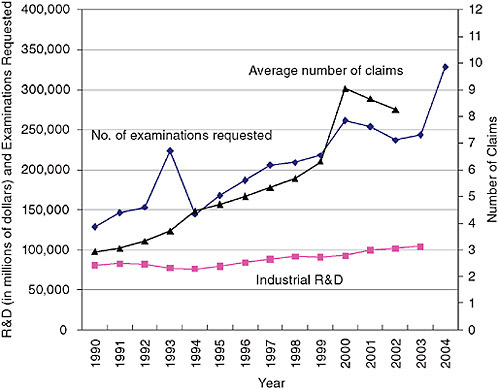
FIGURE 1 Increasing patent examination requests and increasing number of claims per patent.
SOURCE: The numbers of examinations requested are from the annual reports of Japanese Patent Office. The average numbers of claims per patent application are from the IIP patent database. Industrial R&D numbers are from the Science and Technology White Paper (Real industrial R&D expenditure in 1995 prices, Millions of dollars; [1 dollar=118 yen]).
also in its significant increase on a permanent basis, since a firm values the option value of a patent.8
The increasing complexity of a patent and increasing requests for patent examinations are putting strong pressure on the scarce examination capacity of the Japanese Patent Office (JPO). The pressure is reflected in the recent increase in the waiting period for examination, which increased from 19 months at the end of 1998 to 26 months at the end of 2004, as well as the increase in the “inventory” of the patents to be examined from 350,000 at the end of 1998 to 610,000 at the end of 2004. In order to prioritize the examinations, however, fast track examination have
been available since 1984 for those who will use their patented inventions in the near future, those who will file foreign patent applications, university and public research institutions, and small and medium enterprises, including individuals.
3.2
Inventive Step and Patent Quality
Ensuring high patent quality in the sense of meeting the patentability criteria well has been an important issue in Japan, in the midst of the increasing number of patents with more complex structure. The grant rate of patents (the ratio of granted patent applications to the sum of granted and rejected patent applications, including abandoned patent applications) declined significantly in recent years to around 50 percent, compared to more than 60 percent in the late 1990s, as shown in Figure 2. Such a decline of the grant rate was due to the stricter standards applied by the JPO since 2000, in particular with respect to the inventive step.9 Tightening the standards reflected the complaints of Japanese industry over the deterioration of patent quality in earlier years. The effect of a stricter application of the inventive step was especially substantial in the area of business-method related software patents, where the grant rate declined from more then 30 percent in late 1990s to 8 percent in 2004. Stricter standards are also apparent in the significant decline in the success rate of complaint trials against rejections and the significant increase in the success of invalidation trials.
Although international comparison is difficult to make due to the difference of the structure of patent applications across jurisdictions, industry observers often suggest that the JPO standard is higher than that of the U.S. Patent and Trademark Office (USPTO) but lower than that of the European Patent Office (EPO). The grant rate was 50.5 percent for the JPO, 59 percent for the EPO and 64 percent for the USPTO in 2003 (see JPO 2005). Such difference seems to be based significantly on the basic policy difference across jurisdictions. The U.S. system as a whole is designed to be favorable to inventors, which is reflected in the non-obviousness test, which sets a higher hurdle for an examiner to reject an application than does the inventive step test; no restrictions on continuation practices; and the presumption of validity.
3.3
Searching for the System of Efficient Examination
The JPO has taken a number of steps to address the challenge of achieving adequate patent quality and timeliness. The first measure was to increase the number of examiners significantly (500 over a 5-year period) and to expand outsourcing in patent search. This has reduced the growth in the inventory of patent applications waiting for review.
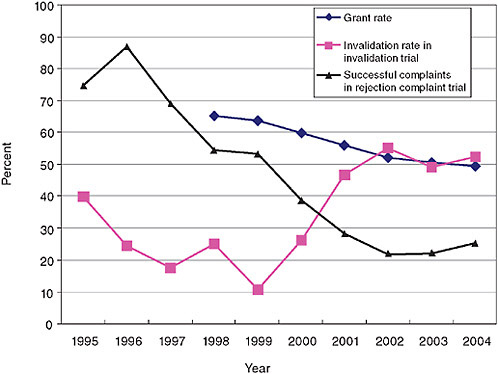
FIGURE 2 Application of stricter novelty standards since late 1990s.
NOTE: Grant rate equals the ratio of the granted patent applications relative to the sum of granted and rejected patents, including abandoned patents.
SOURCE: Derived from Japanese Patent Office Annual Reports.
The second measure was to double patent examination fees so that they would at least cover direct costs. In the past, the examination fee was significantly below cost and had to be heavily subsidized by the maintenance fees. The fee increase should have the additional effect of improving patent quality because it increases the threshold of the internal selection by a firm for examination requests. It is too soon to know if the increased fee, which was introduced in April 2004, is having the significant effect.
The third measure was to reform utility-model protection, which covers the technical ideas related to the shape of a product, its structure, and the way parts are combined. The inventive step requirement for this type of protection is lower than that for a patent. Utility-model protection was revised fundamentally in 1994 by adopting a registration system without examination and requiring technical evaluation by the JPO only when an applicant enforces it. The length of protection was 6 years and intended to provide quick protection for products with a short product cycle. However, the applications for utility-model protection fell dramatically after the change from 77,000 in 1993 to 7,983 in 2004. The applica-
tions for a utility-model protection were already decreasing before 1993, due to the introduction of a multiple claim system. The reform measures effective as of April 2005 include the extension of the term of protection to 10 years and the provision of the option for the firm to switch a utility-model to a patent application. How significantly such measures will work for channeling patent applications to utility-model applications remains to be seen.
There is a general question of how intensively and how swiftly ex-ante examination of patent applications is to be done. Compared to the U.S. system, the Japanese system allows an applicant more discretion. The applicant has the option of requesting an examination for three years. It can request a fast-track examination and can use a utility-model protection. Lemely (2001) suggests in the context of U.S. patent reform that the society would be better off spending its resources more in judicial inquiry into the validity of those few cases in which it matters rather than in the examination of all patents applications ex ante and actually suggests that “the hybrid system along the [lines of the] Japanese system in which a patentee would register his invention” but one where “it would not be examined unless the patentee elects examination. However, the patentee could not enforce the patent against a third party unless it first has the patent examined.” His idea of the hybrid system is actually a mixture of the patent and utility-model protection of Japan. On the other hand, Jaffee and Lerner (2004) argue that the United States should retain presumption of validity by strengthening the re-examination system, so that uncertainty does not deter investment for the development of innovations.
Although there is no solid empirical basis to evaluate whether the U.S. or Japanese system of patent examination is more efficient, we may be able to draw some useful observations from the experiences of both countries. First, Japan’s experience with utility-model protection since 1994 suggests that the hybrid system of postponing the examination of an invention until the enforcement stage may not work. Inventing firms have preferred patent protection because they want to obtain a solid basis for protecting their inventions when necessary by asking the patent office to examine their inventions before they actually use them.10 The availability of technical evaluation for a utility model does not help much.
Second, many firms value significantly the option to postpone the request for examination. Two-thirds of the requests for examination were made during the period from the fourth to the seventh year (final year) after application and the requests for examination were made for only half of the applications. This indicates that numerous uncertainties exist with respect to the commercial applicability of an invention and a long time is necessary for their resolution.
Forfeiting the option to postpone the request for examination as in the United States would probably not make sense. It would force a patent office to examine
a patent that may not be used at all in the future, especially given the scarcity of its examination capacity. The recent Japanese reform to restrict this option from seven years to three years may also turn out to be counterproductive on the same grounds.11
Third, the participation of a third party in post-grant opposition system tends to improve patent examination quality significantly. A non-negligible number of patents were challenged (on the average 3.3 percent of the granted patents for the period from 1997 to 2003) and a substantial proportion of the oppositions were upheld (on the average 30 percent for the period from 1997 to 2003), even though the JPO has a relatively high standard of patent examination. It remains to be seen how the integration of the post-grant opposition system into the invalidation trial will work in Japan. Although such integration reduces some redundancy between the two systems and therefore improves efficiency, it may reduce the incentive for a third party to immediately challenge a granted patent, since there is no fixed window of opportunity for such challenge as was the case for the post-grant opposition system.
Fourth, international collaboration among U.S., Japanese, and European patent offices for mutual recognition of search results and examination results would significantly leverage the examination resources globally. Currently, applications from the United States and Europe to Japan add up to around 45,000 per year, which was around one-fifth of the examination requests to the JPO in 2004. Thus, even if foreign examination results for all of these patent applications are accepted by the JPO, it would not substantially reduce the examination burden of the JPO. However, in the long run, there will be more international applications in each jurisdiction, so that the benefit of mutual recognition will substantially increase. Deep collaboration would obviously require the significant convergence of patentability standards.
4.
EFFICIENT UTILIZATION OF DISCLOSED INFORMATION IN LIGHT OF PRIORITY RULE
All patent applications are laid open in 18 months after application in the Japanese patent system. In addition, the first to file is the priority rule, which gives a strong incentive for a firm to file a patent early in the process of invention and innovation. Thus, we expect that the Japanese patent system has forced a firm to disclose technical information in a relatively early stage so that the information specified in patent applications may well be enhanced. According to the comparative survey by Cohen, Goto, Nagata, Nelson, and Walsh (2002), Japanese firms regard patents as the most important source of information on rivals’ R&D.
The situation seems to be quite different in the United States, where a patent used to be disclosed only when it was granted and the first inventor to file rule
TABLE 1 Unexamined or Non-granted Prior Patent Applications Used for Rejecting Patent Applications
|
IPC Sections |
Number of Cited Patents |
Unexamined (%) |
Nongranted (%) |
|
|
A |
Human Necessities |
27,981 |
26.1 |
49.3 |
|
B |
Performing Operations: Transporting |
87,715 |
28.2 |
51.9 |
|
C |
Chemistry, Metalurgy |
62,307 |
27.3 |
45.4 |
|
D |
Textiles, Paper |
11,704 |
27.6 |
48.1 |
|
E |
Fixed Constructions |
10,684 |
23.5 |
45.9 |
|
F |
Mechanical Engineering, Lighting, Heating, Weapons, Blasting |
32,845 |
29.9 |
52.8 |
|
G |
Physics |
143,020 |
32.1 |
60.7 |
|
H |
Electricity |
115,305 |
33.2 |
61.4 |
|
|
Total |
491,561 |
30.3 |
55.6 |
|
|
For ultimately granted patents total |
582,737 |
27.8 |
49.3 |
|
SOURCE: Sadao Nagaoka, “How Does Priority Rule Work? Evidence from the patent examination records in Japan,” Paper presented for Patent Statistics and Innovation Research Workshop, Research Center for Advanced Science and Technology, University of Tokyo, November 25, 2005. |
||||
governs the priority. U.S. firms have regarded patents as less important than academic publications as a source of information, according to the above study. The recent introduction of a disclosure system for patent applications in the United States may enhance the value of technical information disclosed in patents. The report of the National Research Council edited by Stephen A. Merrill, Richard C. Levin, and Mark B. Myers (2005), however, point out the two constraints: less than full disclosure (11 percent of the applications are withheld from disclosure) and the doctrine of willful infringement. To read patents may increase the risk of being exposed to the claims of willful infringement, which is quite contrary to the basic principles of the patent law.
The value of the disclosure of all patent applications, including those not granted, is indicated by the fact that the patent examiners in Japan cite only non-granted patents as the basis of rejection on novelty and/or inventive-step grounds in 50 percent of the ultimately rejected patents as shown in Table 1 (See Nagaoka 2005). That is, non-granted patent applications provide very important priority information for the examiners. This in turn implies that the availability of such information would significantly help firms to avoid duplicative R&D efforts.
If a firm efficiently exploits the information contained in disclosed patent documents in its patent application decision and/or in its R&D decision, we would expect that a rejection based on novelty and/or inventive-step grounds would be based on relatively recent patent documents. However, this is not the case. The median age of the prior patent applications cited for ultimately rejected patent applications based on novelty and/or an inventive-step reason is 4.8 years on
average for the patent applications in the period from 1985 to 1993. It is younger for physics and electricity sections, where technological progress is relatively rapid, and older for fixed constructions and textiles & paper, where technological progress is relatively slow. A patent application that was almost five years old would surely have been available to a firm before it started preparing a patent application and even before its initiation of research in most cases. Furthermore, 10 percent of the patent applications rejected on novelty or inventive-step grounds have prior blocking patent applications that are 10 years old or older. These data suggest the possibility that a firm may not fully incorporate the information available in disclosed patent documents in its patent applications and/or research and development decision.
Exploiting patent information for choosing R&D projects would help a firm to avoid duplicative R&D, so that both private and social returns from R&D would increase. That is, a firm that can swiftly absorb the disclosed information from patents and can quickly undertake its research is more likely to be successful not only in getting a patent but also in obtaining a patent with broader scope. A firm with a shorter citation lag, thus presumably with higher R&D speed, does obtain more valuable patents evaluated in terms of the number of forward citations at the firm level.12 Avoiding duplicative R&D would also help improve efficient use of R&D resource in the economy as a whole, enhancing its R&D productivity. Thus, it would be very important for the disclosed information of patents to be easily searchable and accessible to firms. Given that the marginal cost of making the search database and search tools of the patent office available for the public would be low and that its patent database is an important knowledge infrastructure for invention and innovation, it would be very important for the patent offices to facilitate the access to these databases and search tools, exploiting IT technology fully.
5.
AMELIORATING THE PATENT THICKET PROBLEM
The proliferation of patents and the other intellectual property rights can deter innovation. First, the proliferation of patents in a given technology field and their stronger enforceability can deter a firm from using the developed technology efficiently, due to the “patent thicket” of high transaction costs, hold-up risk, inefficiency of the chains of vertical monopolies, and the difficulty of coalition formation (see Heller and Eisenberg 1988; Shapiro 2001; Lerner and Tirole 2002; and Aoki and Nagaoka 2004, 2005). The risk of hold-up encourages a firm to obtain a patent for a defensive reason, but not for appropriating returns from its inventions (Hall and Ziedonis 2001).
Second, in the context of cumulative innovation in which an invention provides knowledge input for the next stage of R&D, easy patentability of second-generation products may erode the incentive for pioneer inventions and thus the efficiency of the entire innovation process, assuming that efficient ex-ante licensing is feasible for second-generation R&D (Scotchmer 1996 and 2004). On the other hand, in the context of a perpetual R&D competition model in which there is no distinction between a pioneer and a follower, the wider scope of protection, which makes the use of an invention for improving its subject matter an infringement, would increase the transaction costs for cumulative innovation so that innovation can be deterred. Although the problem of patent thicket is not new and firms have dealt with them using unilateral or cross-licensing agreements and non-assertion of patents (NAP) agreements, it may have become more serious in recent years due to the increase of patent rights. The problem looks to be most acute in IT-related standards areas, since network externality is significant in IT standards adoption so that the hold-up problem is most serious.
The basic problems can be illustrated by looking at the structure of essential patents for standards such as MPEG2, DVD, and 3G standards for mobile phones. First, standards can have many essential patents, which are owned by many firms with different interests, including vertically integrated firms and the firms with no manufacturing assets. In the case of MPEG2, at least 23 organizations own 127 essential patents (see Nagaoka, Tsukada, and Shimbo 2006). In the case of DVD, at least ten firms own more than 300 essential U.S. patents. The large number of essential patent holders and their heterogeneity exacerbates the patent thicket problem, given that each firm has an incentive to increase its license fees at the expense of others once its technology is incorporated in a standard.
Second, it is often possible, especially in the United States, for a firm to apply for new patents by using continuations and divisions even after the standard specification is set. A firm designs patent claims so as to cover the standard if it can find enough supports in the specifications of its patents applied for before the standard was published. The fact that this is not exceptional is shown by the fact that a substantial proportion of the patents were applied for after the standard specifications were set in the case of MPEG2, DVD, and W-CDMA as shown in Figure 3 (based on Nagaoka et al. 2006).13 Third, the disclosure policy of the standard bodies typically covers only granted patents and applied patents, but not future applications. Even if patents are disclosed, the standard bodies provide no precise definitions of what reasonable and non-discriminatory licensing (RAND) means for a licensing decision of a firm. Fourth, the non-granted patent applications may not be published in the United States. Thus, it
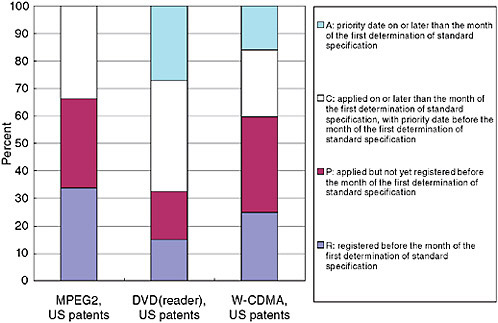
FIGURE 3 Time profile of the essential patents of three standards.
SOURCE: Based on Sadao Nagaoka, Naotoshi Tsukada, and Tomoyuki Shimbo, “The Emergence and Structure of Essential Patents of Standards: Lessons from Three IT Standards,” IIR Working Paper WP#06-08, Institute of Innovation Research, Hitotsubashi University, 2006.
is possible for a firm to hold up the firms using a standard by obtaining a patent based on old (unpublished) patent applications, as is demonstrated by such cases as Symbol/Cognex v. Lemelson on bar code-scanning and FTC vs. Rambus on the DRAM JEDEC standard.
Several measures could be taken to address the patent thicket problem. First, raising the inventive-step standard would clearly help. This is demonstrated by a recent cross-licensing deal between two oil refining firms in Japan: Shin-Nihonn Sekiyu and Idemitsu. They agreed in 2005 to engage in royalty-free cross licensing of their patents in gasoline, kerosene, and other fuel products, all of which use relatively mature technologies. According to the news report,14 the main motivation of such deal is to end the patent-acquisition and invalidation wars between the two firms, which has continued since the late 1980s when it was discovered that even minor technical improvement could be patented. A high standard of patentability would make such deals unnecessary. In addition, it would also shift patenting activities to pioneering inventions.
Second, the continuations and division practices that allow a firm to enjoy the benefit of the earlier filing date of its patents could be more disciplined, complemented with full disclosure of patent applications. The danger that ex-post extension of the claims cover new technologies that are not the subject of an earlier invention increases as the lag between the earlier invention and the claim extension becomes long. Besides, such extension, which is not anticipated at the stage of the patent application of the earlier invention, would not significantly improve the ex-ante profitability of R&D, since it would be heavily discounted by the firm.
Third, the intellectual property policy of the standard bodies could be strengthened in terms of both the rule of disclosure and the rule with respect to the RAND conditions. The price of each patent has to be reasonable in light of the total royalty for related technologies as a whole. It should also be set ex-ante when inter-standard competition exists and before standard-users sink their investments. For this purpose, a standard body may wish to ask the group of firms sponsoring a standard to announce not only the technology specifications of the standard but also the maximum price of the standard before the standard is set. Such a requirement will force essential patent holders to focus on the pricing of the standard itself and to commit to it before the adoption of the standard.
Fourth, in order to introduce certainty for cumulative research the exemption for the use of the patented invention for improving its subject matter could becould be globally established. The patent law is very comprehensive in excluding the use of invention by others. It conceivably covers the use of invention for the research improving or leap-frogging it. There is an explicit provision for research and experimentation exemption in Europe and Japan, which gives (or is interpreted to give) such exemption on research on subject matter, but there is no corresponding legal provision in the U.S. patent law. Thus, there is a risk that merely experimenting with the invention of other firms for the purpose of improvement or inventing-around is an infringement, whereas forcing a firm to get a license for such use would significantly harm cumulative research.
REFERENCES
Aoki, Reiko, and Sadao Nagaoka. 2005. “Coalition Formation for a Consortium Standard through a Standard Body and a Patent Pool: Theory and Evidence from MPEG2, DVD and 3G.” IIR Working Paper WP#05-01. February.
Aoki, Reiko, and Sadao Nagaoka. 2004. “The Consortium Standard and Patent Pools.” The Economic Review (Keizai Kenkyu) 55(4):345-356.
Cohen, Wesley M., Akira Goto, Akiya Nagata, Richard R. Nelson, and John P. Walsh. 2002. “R&D Spillovers, Patents and the Incentives to Innovate in Japan and the United States.” Research Policy 1425:1-19.
Hall, Bronwyn H., Adam Jaffe and Manuel Trajtenberg. 2005. “Market Value and Patent Citations.” RAND Journal of Economics 36:16-38.
Hall, Bronwyn H., and Rosemarie Ham Ziedonis. 2001. “The Patent Paradox Revisited: An Empirical Study of Patenting in the U.S. Semiconductor Industry, 1979-1995.” RAND Journal of Economics 32(1).
Jaffe, Adam B., and Josh Lerner. 2004. Innovation and its Discontents. Princeton, NJ: Princeton University Press.
Lemley, Mark. 2000. “Rational Ignorance at the Patent Office.” Berkeley Program in Law and Economics Working Paper Series No. 19.
Lerner, Joshua, and Jean Tirole. 2004. “Efficiency of Patent Pools.” American Economic Review 94(3):691-711.
Merges, Robert P. 1996. “A Comparative Look at Intellectual Property Rights and the Software Industry” in David C. Mowery, ed., The International Software Industry, New York: Oxford University Press.
Merges, Robert P. 1999. “As Many as Six Impossible Patents before Breakfast: Property Rights for Business Concepts and Patent System Reform.” Berkeley Technology Law Journal.
National Research Council. 2005. A Patent System for the 21st Century, Merrill Stephen A., Richard C. Levin, and Mark B. Myers, eds. Washington, D.C.: The National Academies Press.
Nagaoka Sadao. 2005. “How Does Priority Rule Work? Evidence from the Patent Examination Records in Japan.” A Paper Presented for Patent Statistics and Innovation Research Workshop, November 25. Research Center for Advanced Science and Technology, University of Tokyo.
Nagaoka, Sadao. 2007. “Assessing the R&D Management of Firms by Patent Citation: Evidence from the U.S. Patents.” Journal of Economics & Management Strategy 16(1).
Nagaoka, Sadao, Naotoshi Tsukada, and Tomoyuki Shimbo. 2006. “The Emergence and Structure of Essential Patents of Standards: Lessons from Three IT standards.” IIR Working Paper WP#06-08. Institute of Innovation Research, Hitotsubashi University. (Forthcoming in the Conference volume of 2006 International Schumpeter Society Conference.)
Scotchmer, Suzanne. 1996. “Protecting Early Innovators: Should Second-Generation Products Be Patentable?” RAND Journal of Economics 27:322-331.
Scotchmer, Suzanne. 2004. Innovation and Incentives. Cambridge, MA: The MIT Press.
Shapiro, Carl. 2001. “Navigating the Patent Thicket: Cross License, Patent Pools and Standard-Setting.” In Adam Jaffe, Joshua Lerner, and Scott Stern, eds. Innovation Policy and the Economy. Cambridge, MA: The MIT Press.


