
Industry-University R&D Partnerships in the United States
Irwin Feller
American Association for the Advancement of Science
INTRODUCTION
The appellation of the U.S. economy (as has happened in other nations) as a “knowledge economy” attests to the widespread assessment that a capacity for generating, absorbing, and implementing scientific and technological advances, both basic and applied, is essential to the economic competitiveness of firms, regions, and nations. Almost reflexively, this emphasis on knowledge has led to heightened attention to the role of research universities as sources of new scientific and technological discoveries and of the skilled scientific, engineering, and technical personnel who will populate the new occupations and positions needed to transform ideas and blueprints into processes, products, and services. This heightened attention has led to numerous efforts to develop and strengthen linkages between and among universities, industry, and government to accelerate the transformation of academic research findings (and inventions) into commercially viable technological innovations.
This chapter reviews selected trends and issues in university-industry R&D partnerships in the United States that bear on these linkages.1 Learning, as high-
lighted in the preface of the book, is indeed the proper way to characterize the past decade and the larger set of changes that have occurred in industry-university relationships since at least 1980. Firms and universities have each adapted their behaviors to previous experiences in R&D partnerships and to each other’s evolving behaviors. Some of these experiences have been positive, others less so, and still others negative.
The specific issues affecting industry-university R&D relationships also have shifted over time. In the 1970s and 1980s, forums focused on cultural compatibility, timeliness of deliverables, and ivory tower syndromes. Present-day symposia center on disagreements relating to the monetary provisions of licenses and litigation about the ownership and validity of academic patents. Highly publicized and costly (for both winners and losers) university-industry patent suits (e.g., University of California and Eolas v. Microsoft; Florida State v. American BioScience) and the continuing legal dispute between the University of California and Microsoft now awaiting a second trial in the U.S. District Court about an earlier $521 million judgment on behalf of the university have changed the terms of the dialogue between the two sectors from how to consummate a courtship to how to live together in a generally mutually beneficial but at times fractious relationship
The controlling contemporary lesson from these experiences is the recognition by each sector of the need for an agreed-upon set of principles that would guide their future relationships. One example, occurring as this chapter is being written, is the statement of principles agreed to by four information technology companies (Cisco, HP, IMB, and Intel) and seven U.S. universities (Carnegie-Mellon University, Georgia Institute of Technology, Rensselaer Polytechnic Institute, Stanford University, University of California at Berkeley, University of Illinois-Urbana-Champaign, and the University of Texas-Austin) to accelerate collaborative research on open source software. Additional activities aimed at establishing guiding principles are in progress. The Industrial Research Institute (IRI), representing R&D-intensive U.S. firms, and the National Council of University Research Administrators (NCURA), representing research universities, have formed a working partnership toward this end, with their work to be capped by a university-industry summit entitled “Re-engineering the Partnership.”
This chapter outlines the specific tensions in research agreements and technology transfer agreements that have led to the above endeavors. For beneath the aggregate national science indicators that point to viable, indeed robust, relationships in industrial funding of academic R&D and the outpouring of patents, licenses, license revenues, and startup firms proudly reported by university representatives, something is obviously not going well. The very title of the forthcoming IRI-NCURA summit is itself symptomatic of problems. As used in discussions of economic competitiveness, re-engineering implies some combina-
TABLE 1 U.S. R&D Data
|
tion of existing design flaws, production problems, or challenges from competitors with better technologies. What needs to be re-engineered and why?
First, I need to make some introductory comments about data, time periods, and analytical framework to better place and highlight the national context for the detailed analysis below.
NATIONAL INNOVATION DATA
As background, summary data on the facets of the U.S. innovation system explored in this chapter are presented in Table 1. The central characteristics of the U.S. system are well known: the federal government finances the largest portion of the nation’s basic research; industry is the major source of funding and performer of R&D; universities are the major performer of basic research; industry’s share of the funding of academic research, after rising in the 1980s and 1990s, has essentially stabilized at about 7 percent, down from its peak share of 7.4 percent in 1999; funds for academic research are a minor portion of self-financed industry R&D; and there has been a surge in university activity in patenting, licensing, and related measures. Perhaps the single least-known fact is that industry philanthropy to universities and colleges amounted to $1.5 billion in 2003.
As is well understood, the connection among these data sets is that the “frontiers of science” quality of academic research, at least in some fields and at some institutions, makes partnering with them of interest to industry. Industry support of academic research in effect represents economically efficient leveraging of much larger federal government investment in basic research for relatively modest sums. Also underlying the data is a national science and technology policy arrangement in which federal funding for academic research is allocated primarily to universities rather than to other performers such as government laboratories or state-supported research institutes. This arrangement provides for the co-location of basic research and doctoral education within a university setting, a distinctive if no longer unique feature of U.S. higher education (Clark 1995).2
TIME FRAMES
A convenient and customary way to describe the recent past is as the post-Bayh-Dole era. To do so, however, tends to make patents and licenses the centerpiece of university-industry R&D partnerships, and unintentionally (and undeservedly) reinforces the view that patents and licenses are the necessary and most important means by which academic knowledge is transferred into commercially important technological innovations. This is not my intention. The chapter ’s use of a quarter-century rather than a decade as the time period of interest is intended instead to highlight (1) the continuing evolution of university-industry R&D partnerships—for one can readily identify collaborative undertakings that started well before 1980 (Rosenberg and Nelson 1994); (2) that the lessons learned during the past decade were themselves responses to the experiences of the immediately preceding 15 years or so; and (3) the importance of adopting a longer-term, more holistic view of the evolving nature of these partnerships than suggested by concentration on best practices and/or salient issues of the moment (or decade).
These propositions would hold if the chapter ’s focus were exclusively about the United States and directed at a U.S. audience. They are of greater importance when presented in a bilateral U.S.-Japan symposium, for what appear to be special achievements or problems of the moment in university-industry R&D relationships may actually represent shifts in the less visible but more fundamental substructures of a nation’s innovation system.
Placing these relationships into a broader framework also helps highlight two emerging lessons. First, university-industry R&D partnerships emerge out of and are continuously influenced by the actions of the federal government and to a lesser but not unimportant extent by state governments, especially for public research universities. Second, R&D partnerships constitute only one portion of a larger and more diverse set of interactions, ranging from purchases of goods and services and student placements to the formation of political coalitions.
PARTNERSHIPS AND RELATIONSHIPS
Examples of what is meant by these lessons may be seen in two events that occurred even as this chapter was being written (and indeed required a considerable amount of just-in-time rewriting). The first was the brief report in the Chronicle of Higher Education that Andrew Grove, a Hungarian immigrant who cofounded Intel Corporation, had recently given City University of New York a $26-million gift, the largest single philanthropic contribution ever received by the university. There are many themes worthy of development from this episode: the economic gains that the United States historically has realized from being a haven for political refugees; the economic gains that it has realized from providing wide low-cost access to higher education; and the emergence of high-tech entrepreneurs as major philanthropic contributors to U.S. universities (Grove 2001).
Viewed historically, Grove’s contribution is an extension of industrialist behaviors that have significantly contributed to the formation and performance of U.S. research universities. Many of today’s leading U.S. research universities, especially those founded in the later part of the 19th and early 20th centuries, owe their initial establishment to private benefactors: Stanford, Cornell, Johns Hopkins, Chicago, and the California Institute of Technology come immediately to mind (Geiger 1986, 1993; Thelin 2004). Private philanthropy has helped to finance state-of-the-art plant and equipment, make faculty salaries competitive with those in alternative occupations, subsidize tuition and related costs to students from low-income backgrounds, and diversify the institution’s funding base, reducing their dependence on and subordination to the political dictates or volatility of national and/or state governments.
Endowments, the accumulation of past philanthropy, currently constitute a sizeable portion of the annual operating incomes of several of the most prestigious private research universities in the United States (Ehrenberg 2000). Capital campaigns likewise are becoming increasingly important to public research universities as they seek to offset the decline in the portion of their general operating budgets that they receive from state governments. Philanthropy also is projected to become even more important as a source of revenue over time, according to several of the most esteemed leaders of U.S. research universities (Vest 2005).
The relevance of this episode to an examination of trends in industry-university R&D partnerships is the interconnection between the market economy and the gift or grant economy. Grove’s gift was totally discretionary. The Chronicle report notes several previous unsuccessful efforts by CUNY’s president to elicit a gift. Only after Grove reached the conclusion that the City College, after a period of academic drift, was “heading in the right direction, with the right leadership,” did he make a gift (Strout 2005, p. A27).
Abstracting from the influence of the U.S. tax code, which provides incentives to firms and individuals to make both in-kind and monetary contributions to universities, philanthropic contributions by firms to universities reflect industry’s view that it has an interest in the advancement of U.S. science and technology and the training of advanced degree students in science, mathematics, and engineering. Philanthropy is an expression of belief in the public goods nature of the knowledge outputs of research universities. If, however, university-industry relationships are seen as competitive, as can arise in reaction to university efforts to incubate new, potentially rival firms, or adversarial, as can arise in the case of patent litigation, incentives for “free will” gifts may be reduced. The more universities are seen by industry to be operating as profit-maximizers with respect to industry-funded R&D agreements or subsequent technology transfer activities, the more likely this reduction is to happen.
Alternatively, as a polar opposite case, one could envision industry-university relationships as a series of discrete market transactions in which firms contract with universities for the performance of specific research projects, receiving
a report as the primary contract deliverable. Likewise, when it comes to technology transfer, the transaction might consist primarily of universities marketing their intellectual property to firms entering into one-time, possibly competitive negotiations for access to the protected technology. In such cases, the “relationship” would consist of buyer-seller transactions akin to most other economic transactions, but not a partnership.
To speak then about university-industry R&D partnerships implies a form of interaction that extends beyond buyer-seller transactions. The concept of partnership focuses on mutually beneficial interactions that are directed at generating positive outcomes (in both economic and noneconomic objectives). A partnership arrangement implies trust in working through the language of initial agreements and resolution of any subsequent disagreements. In terms of the essential features of academic R&D, it accords weight to best efforts rather than to specific tangible deliverables. It also points to the prospects for repeated, continuing exchanges. These aspects of the interaction are what elevate a partnership above a transaction. But partnerships as used here represent something less than a “relationship.” The latter terms imply a fuller, even longer-term set of interactions, both market and nonmarket.
Just as the transition from interactions based on transactions to partnership arrangements denotes changes in the time horizons and utility-maximizing behavior of each party, so too does the transition from managing R&D partnerships to managing the fuller relationship imply changes in how the parties engage with one another. In particular, the transition implies optimizing behavior over a larger set of transactions, which in turn means willingness to trade-off less than maximum gains to be garnered from any single transaction for the prospect of higher gains from another.
Figure 1 depicts these different levels of relationship as nested circles.
What makes all of this both interesting to the analyst and challenging to the practitioner is that the trade-offs relate to uncertain outcomes: the gains, say, from forceful university claims of ownership of intellectual property rights in industry-sponsored R&D being traded off for the economic and legal terms of licensing agreements, being traded off in turn for the prospects of future philanthropy from appreciative alumni. This is true in almost every case where the unit of analysis is an industry-sponsored agreement for academic research or the acquisition by a firm of a university’s intellectual property, whether purchase of a patent or a running license.
The second recent event may be said to represent a paradigmatic example of the most mutually beneficial features of industry-industry R&D partnerships. In a news article titled, “3 Technology Rivals Join to Finance Research at Berkeley” (New York Times, December 15, 2005), there was a report on the formation of a new computer laboratory at the University of California-Berkeley. The laboratory is to be funded by Google, Microsoft, and Sun Systems, with each firm providing $500,000 annually for 5 years, for a total of $7.5 million. Underscoring the value
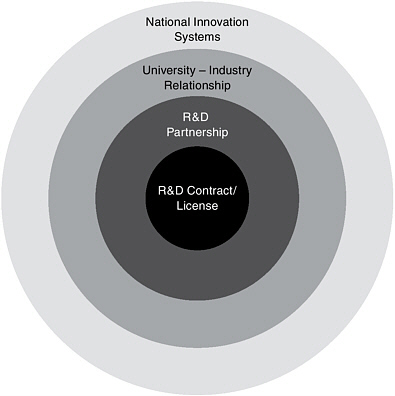
FIGURE 1 Levels of relationship.
to industry of universities as performers of precompetitive generic research, the article noted that the three sponsoring companies “are frequently rivals and only occasionally allies,” but each has concluded that it “can operate most effectively by bringing technology innovations to market quickly.”
Three other aspects of this partnership warrant emphasis. First, echoing the above observation about the joint production of new knowledge and human capital formation within the U.S. research university, the laboratory will have six faculty members and as many as 30 graduate students. Second, the “fruits of the research will be nonproprietary and freely licensed,” reinforcing the earlier statement that patents and licenses are neither the only nor necessarily the best means of transferring academic research.3
A third aspect of the founding of this laboratory also is important. Motivation for securing industrial funding is described as flowing from the need of the UC-Berkeley researchers to seek industry support when they realized that the Defense Advanced Research Projects Agency (DARPA) was reducing its computer science support at universities. The faculty response in seeking industrial funding is consistent with the larger pattern of university-industry collaborative R&D ventures, especially those organized around centers, institutes, or laboratories. As detailed in the Cohen, Florida, and Goe 1992 survey, most of the initiative for these collaborations emerges out of the efforts of universities to secure industrial funding. These events also indicate that industry support of academic R&D represents more than a leveraging of federal R&D, as was described above. Instead, it may be a critical independent alternative source of basic research funding.
CURRENT ISSUES IN INDUSTRY-UNIVERSITY R&D PARTNERSHIPS4
The past decade, or again the post-1980 period, has seen the heightening and surfacing of a diverse set of issues in industry-university R&D partnerships. Generically, the issues relate to the terms of industry-sponsored research agreements and the terms of patent and licensing agreements, but they also cluster into several distinct subdivisions. Among the most important of these subdivisions are size of firm, industrial sector, and source of R&D funding. Table 2 presents a typology of these issues.
What follows are brief statements about several of these issues and about selective steps being taken by each party to redress recent confrontations. In the aggregate, they may be seen as constituting the problems that are causing national representatives of major U.S. corporations and leading U.S. research universities to step back and call for a new set of guiding principles.
-
Displeasure is building in the high-tech industrial sector about what are perceived to be overly assertive university claims to ownership of intellectual property generated under industry-funded research as well as about the “unrealistic” or “excessive” economic terms being sought by universities. (As voiced by one industrial representative in an industry-university workshop in which I participated, “universities have gone from if they invent it, they own it, to if they touch it, they own it.”)
-
As experience mounts over time about the technical and economic risks of commercializing academic patents, the divide between firms and universities about the form of payment for access to academic patents seems to be widening. Firms state a preference for contingent, back-end payments tied to technical and economic milestones proportionate to the levels of risk and investment each party contributes to the eventual commercial introduction and success of a university
TABLE 2 Typology of Issues
|
Size of Firm |
Industry Funded R&D |
Federal/Other Funded R&D |
|
Large |
|
|
|
Small |
|
|
-
patent. University representatives continue to favor high upfront payments, in part to ensure a firm’s commitment to further development efforts.
These differences are evident in a comparison of position papers put out by the respective parties “Technology Transfer in U.S. Research Universities: Dispelling Common Myths” (2000), by the Council on Government Relations (COGR), and “Industry-University Intellectual Property “(2002) by IRI’s External Research Directors Network. The COGR document seeks to dispel what it terms several myths about university technology transfer. Among these myths are that (1) universities are doing too much patenting and that it would be better for economic growth to put more inventions into the public domain, and (2) “Universities over-inflate the value of their inventions, setting rates too high.” To the first charge, the document states that “it is difficult to quantify how much patenting is ‘too much’” and that the “real measure of useful patenting for universities is whether patenting encourages commercial licensing.” After noting that in FY1998 universities issued 3,668 licenses/options, the authors of the position paper observe that “Whether companies would have picked up the 3,668 new university technologies to commercialize from the public domain is highly questionable” (p. 13). As to the second “myth” about royalty rates being excessive, the document states that, “Royalty rates are dependent upon market forces and determined through negotiation” (p. 7).
The perspective of large firms with specialized R&D operations that constitute IRI’s primary membership is quite different. The IRI document notes that “Ownership and/or the rights to developing technology are probably the most contentious issues in the preparation of agreements between universities and industrial companies. When ownership and IP rights issues interfere with industry’s aim to gain competitive advantage, then these issues impede open communications and collaboration” (p. 2). Further, in discussing how compensation should be calculated, the paper notes that the road to commercialization is a path requiring multiple—8 steps are identified—steps involving costs and risks. It then argues that “In most collaborations, the university participates only in the
very first step (idea generation) with little or no cost or risk. It is not attractive to an industrial partner to share a large royalty after assuming all of the risk and executing most of the work, while the university is responsible for only the basic research” (p. 6).
Part of the explanation for industry’s increasingly open challenge to university policies is that patents and intellectual property have recently taken on new strategic and economic saliency. Several earlier studies had pointed to the “modest” role that patents played as a source of intellectual property rights protection for most industries, with the notable exception of pharmaceuticals. This role has increased. Nationally, the number of patents granted annually tripled between 1983 and 2002 (Hall 2004). This increase in part reflects strategic changes in how firms view patents, with these changes, in turn, attributed to changes in the institutional and legal environment within which patents are granted and rights associated with them enforced. Although cross-licensing continues to be an important feature of many inter-firm exchanges in selected industries, firms have also increasingly taken to viewing their patent portfolios as revenue centers. Moreover, the increased frequency of patent infringement suits (some accompanied by sizeable damage awards) also has made firms increasingly vigilant in seeking to make sure that their “access” to a specific patent is not “blocked” by claims of a prior patent.5 Indeed, according to some observers, the U.S. patent system is broken and sorely in need of repair. Indeed, a major undertaking of the National Research Council has been to formulate a “patent system for the 21st century” (National Research Council 2004).
These changes and the problems they are held to have caused stem essentially from causes independent of Bayh-Dole. Nevertheless, industry’s changed general stance towards patents spills over to affect its relationships with universities. For example, it is seen in some cases as leading firms to demand rights to background patents held by the university, whether by the same faculty inventor or others. These demands in turn create new problems for universities in managing their holdings of patents. Since most university patent policies provide that a share of net intellectual property income be distributed to faculty, acquiescence to industry demands on background patents can raise legal and political questions about dispensing income claims of inventors. Faculty are not bashful about pursuing these claims, including suing their current or erstwhile employers.
Industry’s concerns about ownership of patents and licensing terms are well known to university officials. Senior academic administrators, though, tend to see industry’s challenge to university claims to ownership of intellectual property from industry-sponsored research grants as reflecting a confounding of industrial and university performance of industrially sponsored research. Contractual R&D
agreements between firms typically are cast as “work for hire” arrangements in which the purchaser has paramount claims to ownership of intellectual property. Industry’s sponsorship of research at a university, although at times cast as a contract, is not viewed by university officials as necessarily conveying such rights, especially if work on a project involves commingling of the firm’s support with resources provided by federal government agencies.
University officials also see themselves as being caught at times in a crossfire between different industrial sectors. As a general proposition, firms in the biomedical and biotechnology industries prefer that universities assert patent claims under Bayh-Dole; differences tend to arise over specific payment, milestone, and related clauses. In the information technology and electronics industries, in which patented technologies more typically serve as components of larger technological systems, firms tend to prefer to work in an environment unconstrained by university claims to intellectual property, especially if the alternative is to have the university transfer technology via exclusive licenses. Accepting different terms for different agreements is not always an easy matter to administer or to explain either to faculty or influential external observers, such as state government officials or the local media.
Perhaps the most troublesome area in the current state of industry-university R&D relationships is the emerging divergence in the perspectives of firm and university representatives about the financial terms of licenses to academic inventions. Industry, as highlighted in the IRI statement above, including both venture capital firms and established industrial firms, is increasingly pushing for flexible and contingent payments tied to technical, legal, and economic milestones. Besides whatever financial pressure or incentive they may have for guaranteed revenue streams to meet annual office expenses, university technology transfer representatives tend to view payment of patent filing costs, upfront fees, and running royalties as a form of earnest money. This earnest money is intended to foster serious efforts by firms to bring a university technology to commercial feasibility and to achieve the university’s paramount objective of “getting the technology into the public’s hands” via the private sector. Upfront fees and annual maintenance payments are seen as needed incentives to move the licensee to make the additional investments necessary to transform the license into a product. Also of concern to university officials is that without some modicum of upfront and early payments, firms could use licenses, especially if granted on an exclusive basis, to block or retard the commercialization of a university invention. Technology transfer staff are also aware that the university’s patent likely competes for resources and attention with other prospective technologies within the R&D portfolio of firms, especially large firms, and that without some monetary cost attached to inattention, the patent might remain on the firm’s “to-be-developed” shelf.
As indicated in the above typology, the issues that emerge differ between agreements with small or large firms and between industry and government
funding. For the most part, large firms that sponsor university research are concerned about ownership issues and licensing issues on both industrially funded and federally funded research. In effect, they contend that their sponsorship of the research either entitles them to sole or partial ownership or to “preferential” treatment in licensing. In terms of license payments, equity is a nonstarter. Small firms, in general, are less apt to sponsor academic research, but when they do, ownership of intellectual property also surfaces as an issue. The more important issue in negotiations is the mix of payments that require early or ready cash in the form of upfront fees, royalties, etc., relative to equity.
Outsourcing of industrial R&D also has taken on new meaning in recent years and appears to be a new competitive tactic in industry’s negotiations with universities. U.S.-based high-tech international conglomerates now report turning to non-U.S. universities and research institutes because of what these sources offer in the way of specialized or competitive scientific expertise, lower cost structures, and less-insistent claims for ownership of intellectual property.
University concerns about these incipient trends are compounded by what they also regard as the wavering commitment of federal agencies to the “spirit” of Bayh-Dole. Some federal agencies are seen by university representatives as turning to contracting procedures other than grants and contracts that have the effect of attenuating university claims to intellectual property ownership. In 2004, additional challenges surfaced to Bayh-Dole in the form of proposals to have the National Institutes of Health exercise the federal government’s march-in rights in an effort to reduce the price of drugs. This proposal elicited a strong defensive response from the university community. The Council on Government Relations (COGR) and the Association of University Technology Managers submitted written testimony opposing the proposal on the grounds that it would diminish the value of academic patents (Malakoff 2004).6
More recently, an article in Fortune (“The Law of Unintended Consequences,” September 19, 2005) claiming that Bayh-Dole’s encouragement of academic patenting had stifled inventive activity, especially in the development of new drugs, raised a tempest among advocates of academic patenting and licensing. This response included an angry letter from Senator Birch Bayh to Fortune’s editor, claiming that the Act had indeed stimulated drug development, and in particular had benefited small businesses, described as the holders of more than 80 percent of university licenses. Universities also have to deal with the explosive growth in invention disclosures, now estimated at 15,000, that has resulted from their revised patent policies, increased staffing of technology transfer offices, and active promotion of faculty patenting. The Americanism that “too much of good thing is
wonderful” holds only in a world without costs or budget constraints. Universities typically cannot now file all the invention disclosures they receive and have been forced to develop procedures to select the most promising, with still-undetermined effects on faculty behavior and university-industry relationships.
Several other trends during the past 10-15 years also point to a more complex environment within which firms and universities form R&D partnerships. Briefly, these trends include the increasing use of equity as payment for university licenses (Feldman, Feller, Bercovitz, and Burton 2002), increases in the number of university-based startup firms, increasing university willingness to invest in the prototype development of early stage inventions and patents, and consolidation by universities of their sponsored research and technology transfer offices in order to provide one-stop shopping to firms.
Another noticeable trend is the growth of master R&D agreements between firms and universities. These contracts generally provide for a commitment of a minimum amount of firm funding of research, periodic solicitations of proposals for faculty to work on topics related to the firm’s interest, and perhaps most important, blanket agreements on intellectual property rights and related contractual terms. Master agreements are intended to reduce time, cost, and uncertainties. More generally, they reflect the assessment by a firm that a specific university or set of universities possesses useful scientific and technical expertise as well as a cooperative culture. The move to master agreements also suggests that firms are consolidating their search efforts to a smaller number of universities. My former academic home, Pennsylvania State University, is among the leading university performers of industrially funded R&D, and thus I cite it here as an example of what’s occurring at the leading edge of university-industry R&D relationships (Figure 2).
Finally, increased recognition also is evident within university-sponsored research and technology transfer offices that most industry-sponsored research agreements produce little in the way of intellectual property, so that protracted negotiations insistent on ownership rights gain little in the way of future revenues, while detracting from the research interests of the faculty who are waiting for the funds to conduct the research (and support their graduate students), as well as possibly a larger relationship with the firm. Recently announced and pending principles calling for open, royalty-free dissemination of university intellectual property, again within the bounds of selected technologies and industries, is the larger manifestation of this recognition.
THIRD-PARTY PERSPECTIVE
Exclusive focus on industry-university R&D relationships (even with the federal government briefly noted as a background player) runs the risk of omitting other important societal effects of academic research. Even as technology transfer becomes a routine university practice, concern continues to be expressed
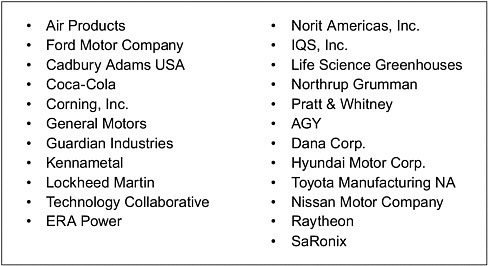
FIGURE 2 Industry master agreements.
about the harmful effects of academic patenting on the “public goods” character of academic research. Aggressive university policies toward promoting invention disclosures, patenting, and licensing are also seen as threatening the communal characteristics of science; in short, an anti-commons in science is held to be displacing traditional institutional and individual behaviors that have treated basic research findings as common pool resources. Competing evidence and perspectives, as detailed in Mowery et al., also exist about the need for universities to establish property rights in faculty discoveries in order to foster their conversion to market products.
CONCLUSION
The past decade-plus of industry-university R&D partnerships has produced benefits for each party while at the same time giving new force to long-recognized tensions in these relationships and giving birth to new ones that constitute serious impediments to the continuation and expansion of these relationships. The recently announced Google-Microsoft-Sun Systems agreement with UC-Berkeley likewise symbolizes the continuing high value placed by industry on academic research, especially pre-competitive generic research, as well as highlighting the importance to universities of industrial funding in maintaining and furthering leading-edge academic research. That this agreement provides for open licensing suggests that, at least for some industries, negotiations about patent ownership and licensing terms need not be an agonizing and fractious encounter. The agreement also is an important reminder that data on patents, licenses, and startups are
neither complete measures of the economic value of academic research nor the full account of processes of technology transfer.
A useful indicator of the continuing importance placed by firms and universities on continuing R&D partnerships as well as likely a good guide to the discourse pervading future negotiations about sponsored research contracts and intellectual property agreements is the effort under way by IRI and NCURA to re-engineer the partnership. I interpret these efforts as both a reaffirmation of the importance of these relationships and recognition that they are beset by the problems outlined above. At the core of these efforts is the promulgation of a set of principles that would guide specific negotiations and interactions. In its present forms, these principles are as follows:
-
A successful university-industry collaboration should support the mission of each partner. Any effort in conflict with the mission of either party will ultimately fail.
-
Institutional practices and national resources should focus on fostering appropriate long-term relationships between universities and industry.
-
Universities and industry should focus on the benefit to each party that will result from collaborations by streamlining negotiations to ensure timely conduct of the research and the development of the research findings.
Important as I consider the substance and spirit of these principles to be, analytical rigor and a reading of history suggest the need for detached objectivity. The influences of these principles on actual behaviors cannot be stated at this time; as is often the case, the devil is in the details.
Set against the articulation of broad principles for cooperative and collaborative relationships are other influences that serve to keep or push the two sectors apart. U.S. R&D-intensive firms are increasingly scouring the globe for sources of fundamental research. Numerous science indicators point to the increased globalization of leading-edge research with a corresponding decline in the U.S.’s relative position. The effects of restrictions on the entry of foreign graduate students to U.S. universities, and thus their enrollments in leading universities in other predominantly English-speaking countries, cannot but further erode the U.S.’s standing in academic research in coming years. Also, in almost symmetrical fashion, pressures on firms to meet short-term profit or stock price targets and on university technology-licensing offices to meet revenue targets can lead either or both parties to push for sponsored research or licensing terms that vitiate the substance of these principles.
In all, even as U.S. firms and universities distill their recent experiences and work assiduously and in good faith to (re)build strong R&D partnerships for the 21st century, industry’s self-interest will lead them to widen their search for the jointly produced knowledge outputs—research findings and graduate students—generated by U.S. research universities. Relatedly, even under the best,
or least fractious, conditions affecting sponsored research agreements and intellectual property rights agreements, the scientific and technological importance of these R&D agreements (including possibly their number and dollar value) will decline unless U.S. universities continue to remain among the world leaders in basic research and graduate education.
REFERENCES
Clark, B. 1995. Places of Inquiry. Berkeley, CA: University of California Press.
Cohen, W., R. Florida, and R. Goe. 1992. University-Industry Research Centers in the United States. Pittsburgh, PA: Carnegie-Mellon University.
Cohen, W., R. Nelson, and J. Walsh. 2002. “Protecting Their Intellectual Assets: Appropriability Conditions and why U.S. Manufacturing Firms Patent (or Not).” NBER Working Paper 7552. Cambridge, MA: National Bureau of Economic Research.
Council on Government Relations. 2000. “Technology Transfer in U.S. Research Universities: Dispelling Common Myths.” Washington, D.C.: Council on Government Relations.
Ehrenberg, R. 2000. Tuition Rising. Cambridge, MA: Harvard University Press.
Feldman, Maryann, Irwin Feller, Janet Bercovitz, and Richard Burton. 2002. “Equity and the Technology Transfer Strategies of American Research Universities.” Management Science 48(1):105–121.
Feller, Irwin. 1994. “University-Industry R&D Relationships.” In J. Schmandt and R. Wilson,eds., Growth Policy in the Age of High Technology. Boston, MA: Unwin Hyman.
Feller, Irwin. 1997. “Technology Transfer from Universities.” In John Smart, ed., Higher Education: Handbook of Theory and Research, Vol. XII. New York: Agathon Press.
Feller, Irwin. 2004. A Comparative Analysis of the Processes and Organizational Strategies Engaged in by Research Universities Participating in Industry-University Research Relationships. Final Report submitted to the University of California Industry-University Cooperative Research Program. Agreement No. M-447646-19927-3.
Geiger, R. 1986. To Advance Knowledge. New York: Oxford University Press.
Geiger, R. 1993. Research and Relevant Knowledge. New York: Oxford University Press.
Grove, A. 2001. Swimming Across. New York: Warner Books.
Hall, B. 2004. “Exploring the Patent Explosion.” NBER Working Paper 10605. Cambridge, MA: National Bureau of Economic Research.
Hane, G. 1999. “Comparing University-Industry Linkages in the United States and Japan.” In L. Branscomb, F. Kodama, and R. Florida, eds. Industrializing Knowledge. Cambridge, MA: The MIT Press.
Hashimoto, T. 1999. “The Hesitant Relationship Reconsidered: University-Industry Cooperation in Postwar Japan.” In Lewis M. Branscomb, Fumio Kodama, and Richard Florida, eds. Industrializing Knowledge: University-Industry Linkage in Japan and the United States. Cambridge, MA: The MIT Press.
Industrial Research Institute, Inc. 2001. “Industry-University Intellectual Property.” Position Paper. External Research Directors Network. April.
Markoff, J. 2005. “3 Technology Rivals Join to Finance Research at Berkeley.” New York Times December 15. P. C5.
Mowery, D., R. Nelson, B. Sampat, and A. Ziedonis. 2003. The Ivory Tower and Industrial Innovation. Stanford, CA: Stanford University Press.
National Research Council. 2004. A Patent System for the 21st Century. Stephen A. Merrill, Richard C. Levin, and Mark B. Myers, eds. Washington, D.C.: The National Academies Press.
National Science Board. 2004. Science & Engineering Indicators. Washington, D.C.: National Science Foundation.
Odagari, H. 1999. “University-Industry Collaboration in Japan: Facts and Interpretations.” In Lewis M. Branscomb, Fumio Kodama, and Richard Florida, eds. Industrializing Knowledge: University-Industry Linkage in Japan and the United States. Cambridge, MA: The MIT Press.
Rosenberg, N., and R. Nelson. 1994. “American Universities and Technical Advance in Industry.” Research Policy 23:325-348.
Rosenzweig, R. and B. Turlington. 1982. The Research Universities and Their Patrons. Berkeley, CA: University of California Press.
Shane, S. 2004. Academic Entrepreneurship. Cheltenham, UK: Edward Elgar Publishing.
Stephan, P. 2001. “Educational Implication of University-Industry Technology Transfer.” Journal of Technology Transfer 26:199-205.
Strout, E. 2005. “Gift of a Book Was a Key to Intel Founder’s Big Donation to City College of New York.” Chronicle of Higher Education December 2. P. A27.
Thelin, J. 2004. A History of American Higher Education. Baltimore, MD: Johns Hopkins University Press.
Thursby, J. and M. Thursby. 2004. “Industry Perspectives on Licensing University Technologies: Sources and Problems.” AUTM Journal. P. 2000.
Vest, C. 2005. “Industry, Philanthropy and Universities-The Roles and Influences of the Private Sector in Higher Education.” 2005 Clark Kerr Lecture. University of California at Berkeley. September 13.


