
Technology Policies in Japan: 1990 to the Present
Akira Goto
University of Tokyo
Kazuyuki Motohashi
University of Tokyo and Research Institute of Economy, Trade and Industry (RIETI)
1.
INTRODUCTION
The purpose of this paper is to review Japan’s technology policies and their relation to economic conditions during the 1990s and the first half of the 2000s. After the collapse of the so-called bubble economy in 1992, the Japanese economy went into a long and severe recession, which lasted more than a decade. As shown in the Figure 1, in contrast to the booming 1980s, the 1990s was really a “lost decade.”1
The seemingly obvious cause of this prolonged stagnation was the excess capacity built up during the boom years of 1980s and the resulting sharp decline of investments in plants and equipments in the 1990s,2 which led to a steep decline in asset prices and to loan defaults. However, the “real side of the economy” may also be responsible. According to Hayashi and Prescott (2002), the real cause of the lost decade was the decline of productivity.3 Other researchers confirmed that
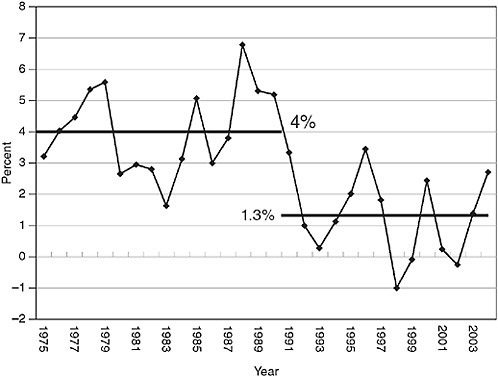
FIGURE 1 GDP growth ratio.
SOURCE: K. Motohashi, Empirical Analysis of IT Innovation: Has IT Changed Long-term Japanese Economic Performance? Toyokeizai, 2005.
productivity did decline to some degree in the 1990s and that this decline was greater than one would expect even in years of low economic growth.
The natural question concerns why productivity declined in the 1990s and several experts have proposed answers. One possible cause is the misallocation of resources, or “unnatural selection”4; efficient firms exited while inefficient firms, or “zombies,” remained with the help of government and the banks, which wanted to prevent bankruptcies. Peck, Levin, and Goto (1988) show that this has happened in the past.
Another popular explanation, held mostly by management theorists, business people, and policy makers, is the reduced technological capability of the Japanese firms.5 They contend that still-high R&D expenditures in the 1990s seem not to have produced the new products and processes that would have generated profits. The large market share once held by technology-intensive Japanese industries
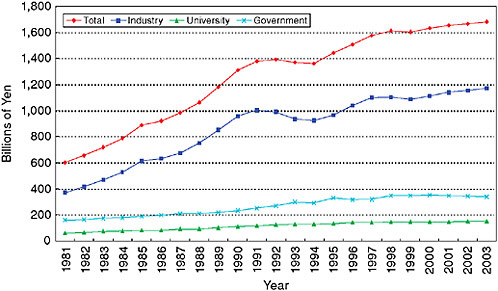
FIGURE 2 R&D expenditure in Japan.
SOURCE: Statistics Bureau, Report on the Survey of Research and Development.
such as semiconductors and semiconductor manufacturing equipment industries eroded significantly, and Japan was not able to keep pace with the United States in the newly emerging high technology industries such as biotechnology and information technology. These analysts believe that something seems to have gone wrong with Japan’s once-successful innovation system.
An assessment of the state and effect of Japan’s innovative capability is beyond the scope of this paper,6 but the data in Figures 2, 3, 4 and 5, suggest that there was no significant drop in R&D activities in the 1990s. The amount of R&D expenditure and the number of patents remained high in the 1990s. The exports of technology actually increased sharply in the latter 1990s, probably reflecting the increased outward foreign direct investments, and Japanese scientists increased their output of highly cited papers beginning the late 1990s.
Still, some argue that there may be a mismatch between Japan’s innovation system, which worked well for large manufacturing firms in industries such as automobiles and electric appliances. And the new requirements of biotechnology and information technology, where small startups and universities play a larger role.7 This might be a part of a larger and more long-term problem: how to design a “post-catch-up” innovation system in Japan.
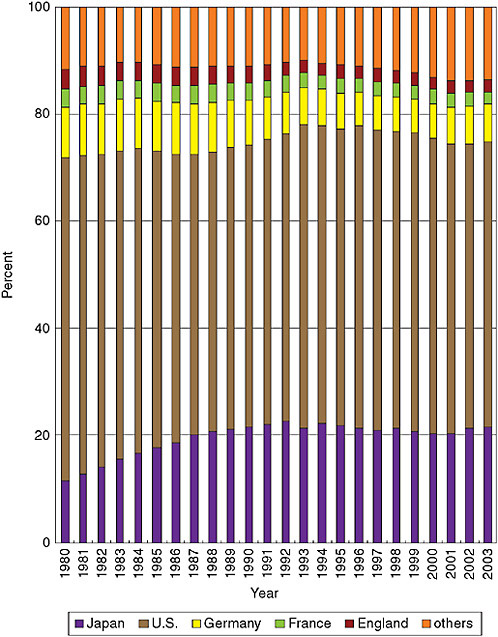
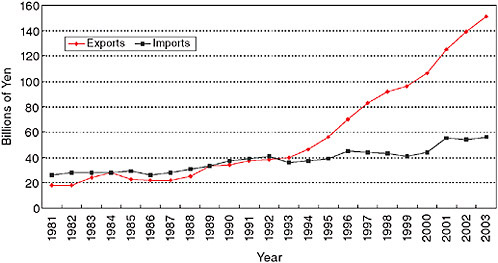
FIGURE 4 Japan’s technology balance of payments.
SOURCE: NISTEP, Science and Technology Indicators.
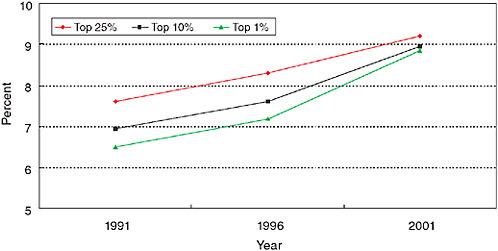
FIGURE 5 Japan’s share among most highly cited papers.
SOURCE: NISTEP.
Our aim is to provide an overview of how Japanese technology policy responded to the economic and technological challenges described above. It will examine Japan’s new framework of technology policymaking, government R&D programs, the R&D tax credit, technology policy toward small and medium enterprises (SMEs), and efforts to promote links between university and government labs and industry.
2.
REVIEW OF TECHNOLOGY POLICIES
2.1
New Framework of S&T Policymaking
In 1995, Japan enacted the “Basic Law on Science and Technology,” under which the government’s Council for Science and Technology Policy develops the 5-year Science and Technology Basic Plan. The first Plan covered 1996-2000, and two additional plans have followed.
Under the first Basic Plan, government spent 17 trillion yen on science and technology during the 1996-2000 period. The Second Plan (2001-2005) called for spending 24 trillion yen, and Third Plan (2006-2010) predicts that the government will spend 25 trillion yen.
All these new policy frameworks and actual policy planning reflect the strong commitment of the government to science and technology. The feeling is generally shared by the business community and the public, as science and technology are considered the only way for resource-poor Japan to maintain its high standard of living with a rapidly aging and eventually declining population and the challenges from other Asian countries, notably China.
Under the Basic Plans, universities received funding to modernize their old equipments and facilities, an increase in the budget for competitive research grants, and additional positions for postdoctoral fellows. Thus, not only was funding increased, but the system of supporting researched was changed to become more like the U.S. system with its reliance of peer review and evaluation. These changes will be discussed in more detail below.
The Basic Plans designated the following four fields as the important and promising areas that deserve increased support: life-science, information and communication, environment, and nanotechnology. One important side effect of this new S&T policy planning scheme was that it practically forced the S&T community to review and reflect on Japan’s national innovation system in a major way every five years. The National Institute of Science and Technology Policy played a key role in providing basic data for the review and discussion.
Still, each ministry pays a key role in planning and enforcing its own S&T policy. Of the government’s 3,626-billion yen FY2004 budget, 63 percent was spent by the Ministry of Education, Culture, Sports, Science and Technology (MEXT), mostly on basic science, 17 percent by the Ministry of Economy Trade and Industry (METI), mostly on industrial technology, 5 percent by the Defense Agency, and 4 percent by the Ministry of Health, Labor, and Welfare.
2.2
Government R&D Programs; METI’s R&D Projects
METI is in charge of organizing R&D programs for industrial innovation, and a typical project involves a group of companies working on a large-scale R&D initiative. The research funding is provided by METI, and public research institutions such as AIST can also be involved. The very large scale integrated circuit
(VLSI) project is one of METI’s most successful R&D projects. It started in 1976 to improve the technological capabilities of Japanese semiconductor manufacturers, which were lagging substantially behind U.S. firms. In this project, the of AIST also played an important role, and This three-year project, which also involved AIST’s Electro Technical Laboratory, pushed Japanese electronics companies to world leadership in LSI technology. Other METI projects focused on advanced materials, mechanical engineering, energy development, and environmental technologies.
However, due to the advancement of technological complexity, it became difficult to identify common technological targets among participating companies. In addition, as Japanese firms have gained their own technological capabilities, the government’s role in supporting their industrial competitiveness became marginal. As a result, most of METI’s R&D projects in 1980s and 1990s did not achieve substantial results.
Therefore, METI revised the style of R&D projects in 2000. Under the new system, the R&D projects are organized to meet specific social and policy needs, instead of focusing on specific technological development. For example, “assuring longer and healthy life” is one of the important social needs. In order to meet this need, METI organized an R&D program in medical services. And in recognition of the fact that technological progress alone is not enough to achieve social needs, the government instituted a parallel package of regulatory reforms of the healthcare industry.
2.3
R&D Tax Credit
Among the fiscal measures to promote private sector R&D, the R&D tax credit was considered to be more market friendly because it allows firms, not government, to choose research projects. The tax credit, which was granted for annual increases in R&D spending, was effective when the economy was growing, but as the recession continued after 2000, companies found it difficult to maintain, never mind increase, R&D spending. In 2003, Japan revised the R&D tax credit system to provide incentives that are more generous and to base it on total R&D spending rather than annual increases. The new system also included the special provision to increase the tax reduction for three years, from 2003 to 2005, as a temporary measure to counter recession.
The introduction of the new system resulted in 600 billion yen of corporate income tax reduction. With the help of this new measure, and thanks largely to the recovery of the economy, private sector R&D spending has begun to recover from its long slump.
2.4
Innovation Promotion Policy Toward SMEs
SME innovation promotion policy is managed by METI’s Small and Medium Enterprise Agency. To understand recent developments in SME innovation policy,
it is important to be aware of the fundamental revision of the SME policy framework that occurred in 1999, along with the revision of the SME Basic Law. Before this revision, SMEs had been treated as “weak enterprises” in the economy, and the SME policy goal was to improve the performance of SMEs as a whole so that they could compete with large firms. The main point of revision of the SME Basic Law is to throw out this social welfare style of SME policy and to treat SMEs as the source of entrepreneurship, innovation, and job creation. Rather than protecting SMEs from large firms, the new policy aims to stimulate SME innovation. The components include special R&D grants, greater tax incentives than for large firms, and special debt-guarantee insurance for innovative activities.
One example of an SME innovation-promotion scheme is the Japanese SBIR (Small Business Innovation Research) program, named after the U.S. program. This system was established in 1999 to help SMEs enhance their technology-development capability and to support their creative business activities. Specifically, ministries in charge of R&D grants and nonprofit special corporations, such as the Small and Medium Enterprise Corporation, a nonprofit funding agency for SMEs, are to allocate a designated share of their R&D grant funding for SMEs. As Figure 6 shows, from 1999 to 2005, this amount has been increased three times, and actual appropriation of budget has also been rising very quickly.
Under the scheme of the Japanese SBIR, SMEs receiving a grant by designated subsidies are also entitled to the following favorable treatment for the commercialization activities related to the technologies developed with the grant:
-
Expansion of debt-guarantee lines by the special debt insurance for SMEs.
-
Expansion of debt size by the Law on Subsidy for Facility Introduction Funds for Small-Scale Enterprises.
-
Special loan system of the Japan Finance Corporation for Small Business.
2.5
Public Research Infrastructure Reforms and Linkages with Industry
In the course of the 2001 national government reform, most national research institutes, which used to be part of the national government, have become independent administrative institutions (IAIs). IAIs are granted more management flexibility in the hope that they will be able to enhance their efficiency and productivity.
The ministry in charge of each IAI has to provide a mid-term objective over three to five years, and the IAI has to draft a mid-term plan based on the objective. This plan is evaluated by an committee with external members and must be authorized by the ministry. In addition, the IAI has to delineate its planning and checking process in an annual plan and an annual report, both of which are reviewed by the evaluation committee. An annual budget will be provided to each IAI based on the results of the mid-term plan evaluation as well as the annual planning and checking process.
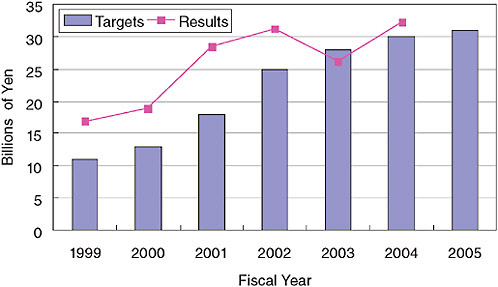
FIGURE 6 Implementation of SBIR.
SOURCE: METI.
At the same time, an IAI is given freedom in its management of financial and human resource allocation. Corporate accounting rules are applied, which allows it to carry over an annual surplus to the next year, in contrast to the government budget rule in which such carry-over is strictly regulated. In addition, it does not have to comply with the seniority-based pay scale of government officials, making it possible to offer higher salaries to outstanding scientists.
In 2004, all national universities, which used to be considered government organizations, were converted to National University Corporations, which are similar to IAIs. Since then, national universities in Japan have been given more autonomy, Block funding for the universities has been decreased, while the pool of competitive funding has been increased to provide an incentive for universities to compete on the basis of the quality of educational services and research activities.
Thanks to such institutional reforms in government laboratories and national universities, commercialization activities of public research results have been progressed substantially. In addition, the Japanese government has introduced incentives to promote linkages between researchers and industry. In 1998, the Law for Promotion of University-Industry Technology Transfer was enacted to support technology licensing offices (TLOs) at universities and research institutes. Under this law, the registered TLOs can receive financial support for their activities as well as other special treatment such as reduced patent application fees. Before this law was enacted, patent applications by national universities were almost
nonexistent, because as governmental institutions the national universities were not allowed to hold patent rights. However, now that TLOs have been established in many universities, the number of patent application and loyalty revenue has increased dramatically.
In 1999, Japan enacted the Industrial Revitalization Law, which includes a “Bayh-Dole” clause to encourage patenting of research results. Since then, Japanese universities and public research institutions, which receive most of their R&D funding from government, have been eligible to claim the ownership right of most of their research outputs.
In terms of university-industry linkages, joint research centers have been established at universities since fiscal 1987 as the footholds for the promotion of industry-academia cooperation. These centers provides physical places to conduct collaborative research projects between university and private firms, as well as an inside-university focal point of interaction with industry representatives. There were 62 centers as of the end of October 2003.
Finally, the spin-offs from university are increasing. 1,503 new firms had been spun off by the end of fiscal year 2005. Biotech firms have the greatest share (37.8 percent), and IT hardware companies come next (30.3 percent). With biotechnology accounting for more than half of the firms established in 2005, the industry’s hare is continuing to grow. Although the number of university spin-offs is steadily increasing, their average size is still small (10.9 employees and 132 million yen in sales). These average figures include 16 IPO firms, so that there are many firms with very small scale of operation.
3.
CONCLUSION
In the late 1980s, when the Japanese economy was booming, technology policy started to emphasize the importance of science. There was a rather widely held view that the catch-up era was finally ending, that science was becoming even more important for innovation, and that Japan’s research system lacked the human resources, equipment, and management structure to thrive in this new environment.
This policy orientation was somehow maintained after the collapse of the bubble economy, and the enactment of the Basic Law on Science and Technology was the manifestation of this determination. In the face of the severe and prolonged recession, technology policy actions such as the temporary increase in the R&D tax credit were used as a tool to boost the economy. Although in principle science and technology policy should take a long-term perspective, the pursuit of short-term stimuli was understandable given the severity and length of the recession.
Two major changes occurred in the 1990s through 2000s and could have a long-lasting impact on Japan’s national innovation system were the enactment of the Basic Law and university reform. The introduction of the Basic Law strength-
ened the role of Council for Science and Technology Policy (CSTP). Even though each ministry still maintains strong influence on technological development in its area, overall technology policy planning and coordination at the CSTP became visible and important. The long-term consequences of this remain to be seen.
The reform of higher education began with the rather short-term focus of encouraging universities to work more closely with industries as a means of revitalizing the economy. In response to the prominent role that universities played in strengthening the U.S. information technology and biotechnology industries, Japan placed an early emphasis on the creation of technology licensing offices at the universities, Bayh-Dole type arrangements to encourage patenting, and efforts to stimulate the creation of spin-offs. It is needless to say that the basic roles of universities in a national innovation system are creating and pooling knowledge and educating students. From this viewpoint, the early policies were not enough. More policy emphasis should be directed to strengthening these fundamental functions of universities.
REFERENCES
Fukao, Kuoji, and Hyeog Ug Kwon. 2005. “Why Did Japan’s TFP Growth Slow Down in the Lost Decade? An Empirical Analysis Bases on Firm- Level Data of Manufacturing Firms” RIETI Discussion Paper Series 05-E-004.
Hayashi, Fumio, and Edward C. Prescott. 2002. “The 1990s in Japan: A Lost Decade.” Review of Economic Dynamics 5(1):206-235.
Hoshi, Takeo, and Anil Kashyap. 2004. “Japan’s Economic and Financial Crisis: An Overview.” The Journal of Economic Perspectives Winter.
Jorgenson, Dale W., and Kazuyuki Motohashi. 2003. “The Role of Information Technology in the Economy: Comparison between Japan and the United States.” Prepared for RIETI/KEIO Conference on Japanese Economy: Leading East Asia in the 21st Century? Keio University. May 30.
Kawamoto, Takuji. 2004. “What Do the Purified Solow Residuals Tell Us about Japan’s Lost Decade?” Bank of Japan IMES Discussion Paper Series. No. 2004-E-5. Tokyo, Japan: Bank of Japan.
Nishimura, Kiyohiko, Takanobu Nakajima, and Kozo Kiyota. 2003. “Does the Natural Selection Mechanism Still Work in Sever Recessions? Examination of the Japanese Economy in the 1990s.” Journal of Economic Behavior and Organization 58:53-78.
Peck, M. J., Levin, R. C., and Goto, Akira. 1988. “Picking Losers: Public Policy Toward Declining Industries in Japan.” In J. B. Shoven, ed. Government Policy Toward Industry in the United States and Japan. Cambridge, UK: Cambridge University Press. Pp. 165-239.
Peek, Joe, and Eric S. Rosengren. 2005. “Unnatural Selection: Perverse Incentives and the Misallocation of Credit in Japan.” The American Economic Review 95(4):114-1166.
Porter, M. E., and M. Sakakibara. 2004. “Competition in Japan.” The Journal of Economic Perspectives 18(1).
Posen, Adam. 1998. Restoring Japan’s Economic Growth. Washington, D.C.: Peterson Institute for International Economics.


