
Government Programs to Encourage Innovation by Startups & SMEs: The Role of Innovation Awards
Charles W. Wessner1
National Research Council
Policymakers in the United States and Japan share the recognition that innovation remains the key to international competitiveness in the twenty-first century. Policymakers in both countries increasingly recognize that equity-financed small firms are an effective means of capitalizing on new ideas and bringing them to the market. Small firms, however, face a variety of obstacles as they seek to bring new products and processes to the market.2 In this context, public policies that reduce the structural and financial hurdles facing such innovative small firms can play a useful role in enhancing a nation’s innovative capacity. In the United States, innovation awards such as the Small Business Innovation Research program and the Advanced Technology Program, have proven effective in helping small innovative firms overcome these hurdles while also enhancing networking among U.S. universities, large firms, and small innovative companies.
Success in innovation has helped the United States and Japan become the world’s leading economies. Remaining innovative requires, as Dr. Mary Good
notes, “a strategy that provides resources to talented people in an atmosphere that promotes creativity—focused on outcomes ranging from new products to customer satisfaction to new scientific insights to improved social programs—to create wealth and/or improve the human condition.”3 In this information age, continuing economic leadership requires that nations adapt such a strategy to the new realities of globalized research, development, and manufacturing. As we see below, while the innovation systems in United States and Japan reflect major strengths, they also face new challenges in remaining competitive.
U.S. ASSETS AND CHALLENGES IN INNOVATION
Competitive advantages enjoyed by the United States include a large and integrated domestic market, and an economic and institutional infrastructure able to quickly redeploy resources to their most efficient use. These are buttressed by a strong higher education infrastructure, deep and flexible capital and labor markets, and strong S&T institutions. Flexible managerial and organizational structures and a willingness to adopt innovative management practices and products are distinguishing features of the U.S. economy. A major asset is an entrepreneurial culture that accepts failure as a byproduct of new entrepreneurial initiatives and a willingness of investors to provide second opportunities to experienced, if initially unsuccessful, managers. This cultural and business perspective on failure of a startup is buttressed by bankruptcy laws that limit the liability entrepreneurs face when new ventures fail. The combination of these features generates an adaptive and rapidly changing innovation ecosystem that creates many successful small companies and enables some to grow into new large firms.
Some of these competitive advantages are the result of substantial and sustained public investments in education and research and development (R&D), many of which date to policies adopted in the cold war period. Although overall economic prospects in the United States today remain healthy, business leaders, senior academics, and experienced policymakers believe that the country is now facing major challenges to its technological leadership. Many point, for example, to inadequacies in the education system, especially at the secondary level where U.S. students score below their peers abroad in science and mathematics. These concerns have spawned recent studies that highlight troubling trends in publications, foreign-student retention, high-technology exports, and the production of information technology products. It is also true that fewer U.S. students are pursuing science careers and that the United States may be losing some of its attraction as a destination for the best students from around the world.4
The role of foreign students in the U.S. innovation system is generating growing concern. Although the United States remains the major destination for students from around the world to pursue advanced training and high-skill employment, these individuals are increasingly offered new opportunities at home and elsewhere. A recent study by the National Academies found that as countries such as China and India develop their own public and private research infrastructures and as multinational companies outsource more of their R&D abroad, there are more opportunities for talented scientists and engineers to pursue world class research in their own countries.5 Post-9/11 reductions in visas for foreign students may have accelerated this dispersal by making it more difficult for many scholars to stay and work in the United States, a trend deplored in the reports noted above.6
In part, the falloff in U.S. students pursuing careers in science and engineering may be an unanticipated byproduct of a falloff in R&D funding levels following the end of the cold war as federal agencies adjusted to new mission priorities. The falloff in R&D funding, documented by the Board on Science, Technology, and Economic Policy of the National Academies, shows that funding for physics, chemistry, and engineering suffered significant cutbacks.7 (See Figure 1.) These reductions in funding have arguably prompted fewer students to pursue science and engineering degrees.8 In any case, the lag effects of these reductions will take years to be fully manifest.
Responding to this and other concerns about the nation’s innovation capacity, the U.S. Congress recently requested the National Academies to assess the nation’s competitive situation and identify concrete steps to ensure its economic leadership. The resulting National Academies report, Rising Above the Gathering Storm notes that weakening federal commitments to science and technology place the future growth and prosperity of the United States in jeopardy:
Although many people assume that the United States will always be a world leader in science and technology, this may not continue to be the case, inasmuch as great minds exist throughout the world. We fear the abruptness with which a
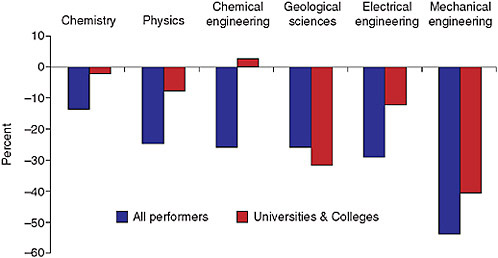
FIGURE 1 Changes in federal research obligations for all performers and university/college performers, FY1993-FY1999 (constant 1999 dollars).
SOURCE: National Research Council, Trends in Federal Support of Research and Graduate Education, Stephen A. Merrill, ed., Washington, D.C.: National Academy Press, 2001.
lead in science and technology can be lost—and the difficulty of recovering a lead one lost, if indeed it can be regained at all.9
To overcome this growing vulnerability, the report calls for (among other measures) expanding the U.S. talent pool by providing greater incentives for science and mathematics teachers. The report also calls for increasing federal investments in long-term basic research by 10 percent per annum over the next seven years. In addition, it recommends a variety of steps to make the United States a more attractive place for foreign students to study and perform research, including actions to increase the number of visas that permit U.S.-trained foreign students to remain and work in the United States after their studies are completed.10
SOME STRENGTHS AND CHALLENGES IN INNOVATION FACING JAPAN
Like the United States, Japan also faces a competitive challenge from China and other Asian countries. Yet, despite reports about the sclerotic state of the Japanese economy, its relatively closed innovation system, and its aging popula-
TABLE 1 Turning Japanese: Top U.S. Patent Award Recipients, 2004
|
|
Number of Patents |
2003 Rank |
|
IBM |
3,248 |
1 |
|
Matsushita Electric |
1,934 |
4 |
|
Canon |
1,805 |
2 |
|
Hewlett-Packard |
1,775 |
5 |
|
Micron Technology |
1,760 |
6 |
|
Samsung Electronics |
1,604 |
9 |
|
Intel |
1,601 |
7 |
|
Hitachi |
1,514 |
3 |
|
Toshiba |
1,310 |
13 |
|
Sony |
1,305 |
10 |
|
SOURCE: U.S. Patent and Trademark Office, as reported in The Economist, “Competing through Innovation,” December 17, 2005. |
||
tion, Japan remains one of the world’s technology powerhouses. A distinguishing feature of the Japanese economy is the large proportion of R&D carried out in the laboratories of large companies, a system that is by definition more proprietary and therefore less open than university-based systems.
The Japanese approach is enormously productive. As Table 1 shows, Japanese companies are world leaders in patents, representing five of the top ten U.S. patent award recipients.
Most of these patents, moreover, pertain to advanced technologies such as telecommunications and electronics. Japan is also a leader in integrated manufacturing, producing some of the world’s best machine tools, automobiles, and high-end electronics.11 Japan is also making substantial investments and progress in areas such as aerospace and solar technologies. Solar panels for residential use have seen regular price declines resulting from economies of scale and incremental improvements in efficiency, a proven Japanese approach to bringing new technologies to the market.12
Despite these considerable strengths, concern remains that Japan’s “innovative genius is more suited to constant improvements in integrated manufacturing than to blue-sky inventions.”13 The worry is that even if Japan remains competitive in the present, it may not have the necessary agility to adapt rapidly to future trends. Whereas traditional Japanese strengths in corporate innovation have rested within the traditional Keiretsu structure, this tight integration among suppliers, manufacturers, distributors, and retailers can make it very difficult for innovative
new firms to break into established markets.14 An additional challenge is that institutional links between universities and industry have traditionally been weak in Japan, making it difficult for new ideas born outside corporate laboratories to find sponsorship.15
The good news, however, is that Japanese policymakers, leading analysts, and others have recognized the need to strengthen this element of the innovation system. A variety of measures to improve Japan’s innovation potential were adopted over the past decade. For example, Japan’s 1995 S&T Basic Law encourages university-industry partnerships.16 Recent legislation has also encouraged more public investment in universities as well the creation of new graduate programs that avoid the hierarchical limitations of traditional universities.17 Spurred by this new policy environment, Japanese and foreign venture capitalists are seeking in greater numbers to provide funding for new, entrepreneurial firms.18 The number of university-based startups is showing substantial progress as well.19
Increasingly, the importance of greater openness is also recognized as important for Japan’s future innovative potential. For example, in a recent presentation, the OECD’s Director for Science, Technology, and Industry, Nobua Tanaka, drew attention to the fact that a more open economy has positive consequences for national innovative capacity.20 He noted that international collaboration in science and technology, which entails encouraging foreign students to study at domestic universities, welcoming foreign professors, and encouraging more foreign direct investment, can contribute to an atmosphere of greater openness within public research organizations, universities, and businesses, spurring creativity, innovation, and growth. To support this point, Tanaka cites recent research by the OECD that finds that openness has significant positive impacts on the economy, notably that the marginal return on foreign R&D is three time higher than that generated by business R&D and more than twice as high as that from public R&D.21
|
14 |
Henry S. Rowen and A. Maria Toyoda, “From Kiretsu to Start-ups: Japan’s Push for High-Tech Entrepreneurship,” Asia-Pacific Research Center Working Paper, Stanford, CA, 2002. |
|
15 |
The Economist, “Competing Through Innovation,” op. cit. |
|
16 |
Access the English text of the 1995 S&T Basic Law at <http://www.mext.go.jp/english/kagaku/scienc04.htm>. |
|
17 |
Yamada Reiko, “University Reform in the Post-massification Era in Japan: Analysis of Government Education Policy for the 21st Century,” Higher Education Policy 14(4):277-291, 2001. |
|
18 |
The Economist, “Competing Through Innovation,” op. cit. |
|
19 |
The Economist reports that between 2000 and 2003 the number of startups created to commercialize discoveries at Japanese universities rose from 315 to 800. Ibid. |
|
20 |
Presentation by Mr. Nobua Tanaka, Director, DSTI/OECD at the International Forum on Technology Foresight and National Innovation Strategies, Seoul, Republic of Korea, November 4, 2005. |
|
21 |
Recent OECD research finds that 1 percent more in business R&D generates 0.13 percent in productivity gains and 1 percent more in public R&D generates 0.17 percent in productivity gains, while 1 percent more in foreign R&D generates 0.45 percent gain in productivity growth. See Dominique Guellec, and Bruno van Pottelsberghe de la Potterie, “R&D and Productivity Growth: Panel Data Analysis of 16 OECD Countries,” Organisation for Economic Co-operation and Development, DSTI Working Papers 2001/314, June 2001. |
Such a policy of openness to foreign researchers and investment has served the United States well. Despite oft-cited (and often justified) fears about intellectual theft and national security vulnerabilities related to sensitive research topics, the United States has on balance benefited from its relatively open innovation system.22
With the postwar internationalization of its university research system, the United States has welcomed many of the best students in the world, many of whom stayed and contributed to the U.S. economy following graduation. Even students who returned home after completing their degrees in the United States have in many cases proved to be a source of future research collaboration, business relationships, and political support as well as a significant source of innovation and growth in their home countries. The international exchange has also been of benefit to many U.S. students, exposing them to foreign perspectives and practices and thus preparing them to function more effectively in the increasingly integrated world of science and technology.23
This value of openness is increasingly appreciated in Japan. Recognizing that the nation’s traditional industry-based research laboratories are prone to be closed (given that private firms have an incentive to protect proprietary information that is the basis of their competitive advantage), Japanese policies have increasingly encouraged more university-based research and small business research. They have also increased the emphasis on the transfer mechanisms needed to help usher non-corporate innovation to the marketplace.24
SMALL INNOVATIVE BUSINESS IS A KEY SOURCE OF INNOVATION
In seeking to broaden Japan’s innovation base, Japanese policymakers seem to have recognized that equity-financed small firms are an effective mechanism for capitalizing on new ideas and bringing them to the market.25 In the United States, small firms are also a leading source of employment growth, generating 60-80 percent of net new jobs annually over the past decade. These small businesses also employ nearly 40 percent of the U.S. science and engineering workforce.26 Scientists and engineers working in small businesses produce 14 times
more patents than do their counterparts in large firms and these patents tend to be of higher quality and are twice as likely to be cited.27
In the United States, firms like Microsoft, Intel, AMD, FedEx, Qualcomm, and Adobe, all of which grew rapidly in scale from small beginnings, have transformed how people everywhere work, transact, and communicate. This record supports the encouragement of new equity-based high-technology firms so that some may develop into larger, more successful firms that create the technological base for future competitiveness.
… YET SMALL BUSINESS WILL FACE MAJOR CHALLENGES ON THE ROAD TO COMMERCIAL SUCCESS
Even so, commonly held myths in the United States about the innovation process pose major obstacles to developing and even maintaining policies that encourage small firms with valuable new ideas to persevere. Many U.S. policymakers have a belief in the primacy of the market and a reluctance to recognize its limitations. For example, a common U.S. myth, at least among Washington policymakers, is that “if it’s a good idea, the market will fund it.” In reality, there is no such thing as “The Market.” Unlike the market model found in introductory economics texts, real world markets always operate within specific rules and conventions that lend unique characteristics to particular markets, and nearly all markets suffer from seriously imperfect information. Indeed, the problem of imperfect capital markets is particularly challenging for fledgling entrepreneurs. The knowledge that an entrepreneur has about his or her product is normally not fully appreciated by potential customers—a phenomenon that economists call asymmetric information. This asymmetry can make it hard for small firms to obtain funding for new ideas because, as Michael Spence (a recent Nobel Prize winner) points out, new ideas are inherently hard to understand.28
Market entry is thus a challenge for new entrepreneurs, especially those with new ideas for a potentially disruptive product. These entrepreneurs are also likely to be unfamiliar with government regulations and procurement procedures, and academic researchers may be unacquainted with commercial accounting and business practices. Many small firms are therefore at a disadvantage vis-à-vis incumbents in the defense-procurement process and face especially high challenges with regard to finance.29
Innovators in large firms also face a similar problem, where multiple options, established hurdle rates, and technological and market uncertainties militate against even promising technologies. As Dr. Bruce Griffing, the laboratory manager responsible for developing mammography diagnostic technology for General Electric, has noted, “there is a valley of death for new technologies, even in the largest companies.” 30
Another hurdle for entrepreneurs is the “leakage” of new knowledge that escapes the boundaries of firms and intellectual property protection. The creator of new knowledge can seldom fully capture the economic value of that knowledge for his or her own firm. This spillover can inhibit investment in promising technologies for large as well as small firms, but it is especially important for small firms focused on a particularly promising product or process.31
The challenge of incomplete and insufficient information for investors and the problem for entrepreneurs of moving quickly enough to capture a sufficient return on “leaky” investments pose substantial obstacles for new firms seeking private capital. The difficulty of attracting investors to support an imperfectly understood, still-undeveloped innovation is especially daunting. Indeed, the term “Valley of Death” has come to describe the period of transition when a developing technology is deemed promising but is too new to validate its commercial potential and thereby attract the capital necessary for its development.32 This simple image of the valley of death captures two important points. The first is that although there are substantial national R&D investments in the United States, Japan, and elsewhere, the path to transitioning these investments in research to create valuable products is not self-evident, given the informational and financial constraints noted above. A related point is that technological value does not lead inevitably to commercialization. Many good ideas perish on the way to the market. The challenge for policymakers is to help firms create additional market-relevant information by supporting the development of promising ideas through this difficult early phase.
|
30 |
Bruce Griffing, “Between Invention and Innovation, Mapping the Funding for Early Stage Technologies,” Presentation at the Carnegie Conference Center, Washington, D.C., January 25, 2001. |
|
31 |
Edwin Mansfield, “How Fast Does New Industrial Technology Leak Out?” Journal of Industrial Economics 34(2):217-22, 1996. |
|
32 |
See the schematic of the Valley of Death in the paper by Stephanie Shipp and Marc Stanley, “Government’s Evolving Role in Supporting Corporate R&D in the United States: Theory, Practice and Results in the Advanced Technology Program,” in this volume. For a discussion of the Valley of Death, see Vernon J. Ehlers, Unlocking Our Future: Toward a New National Science Policy: A Report to Congress by the House Committee on Science, Washington, D.C.: U.S. Government Printing Office, 1998, Accessed at <http://www.access.gpo.gov/congress/house/science/cp105-b/science105b.pdf>. |
Notwithstanding the reality of these early-stage financing hurdles, many believe that the U.S. venture capital markets are so broad and deep that entrepreneurs can readily access the capital needed to cross the valley of death. In actual fact, venture capitalists not only have limited information on new firms but are also prone to herding tendencies, as witnessed in the recent dot.com boom and bust.33 Venture capitalists are also, quite naturally, risk averse. Their primary goal, after all, is not to develop the nation’s economy but to earn significant returns for their investors.34 Accordingly, most funds tend to focus on later stages of technology development because there is more information at this stage in the process about the commercial prospects of the innovation (and hence less risk to their investment.) The result is that the U.S. venture capital market, although large, is not focused on early-stage firms: In 2004, startups in the United States received only $346 million or 1.65 percent of the $20.9 billion of available venture capital.
What’s more, the amount of venture capital made available varies enormously with the vigor of the stock market, the normal outlet for initial public offerings, which are the primary means by which venture capitalists recoup their fund’s investments. The collapse of venture capital investment beginning in the second quarter of 2000, for example, followed the dramatic stock market declines of March 2000.35 Venture funding fell from an unsustainable $94.6 billion in 2000 to $18.9 billion in 2003. Since then, there has been a modest up-tick in funding commitments, with $20.9 billion in funding in 2004, and a similar amount expected in 2005. First-round funding for new companies remains limited as venture firms continue to invest further downstream, where risks are more manageable.
FILLING THE FUNDING GAP
The limitations of the market for venture capital require that small innovative firms seek funding from a variety of sources.36 In addition to pursuing business angels and venture capital firms, early stage technology firms also seek development funding from industry, federal and state governments, and universities. Indeed, the diversity of these sources for early-stage funding represents one of the strengths of the U.S. system. There are longstanding state programs such as the Ben Franklin program in Pennsylvania and more recent innovation efforts such as TEDCO in Maryland. Both provide early-stage loans on a limited scale.
|
33 |
See Tom Jacobs, “Biotech Follows Dot.com Boom and Bust,” Nature 20(10):973, October, 2002. |
|
34 |
The goal of venture capitalists is to make money for our fund investors—not to develop the economy.” Personal communication with David Morgenthaler, founder Morgenthaler Ventures and past President of the National Venture Capital Association. |
|
35 |
William L. Megginson, “Towards a Global Model of Venture Capital?” Journal of Applied and Corporate Finance 16(1), 2004. |
|
36 |
Lewis M. Branscomb and Philip E. Auerswald, Between Invention and Innovation: An Analysis of Funding for Early-Stage Technology Development, Gaithersburg, MD: NIST GCR 02–841, November 2002. |
Surprisingly, among these funding sources, the role of the federal government is significant for its size and importance. Research by Branscomb and Auerswald estimates that the federal government provides 20-25 percent of all funds for early-stage technology development—a substantial role by any measure and one often surprising to Americans in its dimensions.37 This federal contribution is rendered more significant in that competitive government awards address segments of the innovation cycle that private institutional investors often (quite rightly) find too risky.
The availability of early-stage financing and its interaction with other elements of the U.S. innovation process are the focus of growing analytical efforts.38 As we examine below, the Small Business Innovation Research Program (SBIR) is the largest example of the government’s public-private partnership efforts to draw on the inventiveness of small, high-technology firms though competitive innovation awards. The potential of SBIR in this regard underscores the need to understand how it strengthens the nation’s innovation capacity.
THE SMALL BUSINESS INNOVATION RESEARCH PROGRAM (SBIR)
The SBIR program, created in 1982 through the Small Business Innovation Development Act, designed to stimulate technological innovation among small private-sector businesses while providing the government new, cost-effective, technical and scientific solutions to challenging mission problems. SBIR was also designed to encourage a role for small businesses in federal R&D and facilitate the development of innovative technologies in the private sector, helping to stimulate the U.S. economy.39
|
37 |
It is important to remember that these are estimates. The authors stress the “limitations inherent in the data and the magnitude of the extrapolations …” and urge that the findings be interpreted with caution. They note further that while the funding range presented for each category is large, these approximate estimates, nonetheless, provide “valuable insight into the overall scale and composition of early-stage technology development funding patterns and allow at least a preliminary comparison of the relative level of federal, state, and private investments.” For further discussion of the approach and its limitations, see Lewis M. Branscomb and Philip E. Auerswald Between Invention and Innovation: An Analysis of Funding for Early-Stage Technology Development, op. cit., pp. 20-24. |
|
38 |
The growth and subsequent contribution of venture capital have begun to attract the serious study needed to illuminate the dynamics of high-technology firm evolution. See for example, the work of Jeffrey Sohl and colleagues and the University of New Hampshire’s Center for Venture Research, described at <http://www.unh.edu/cvr>. |
|
39 |
The SBIR legislation drew from a growing body of evidence, starting in the late 1970s and accelerating in the 1980s, which indicated that small businesses were assuming an increasingly important role in both innovation and job creation. This evidence gained new credibility with the empirical analysis by Zoltan Acs and David Audretsch of the U.S. Small Business Innovation Data Base, which confirmed the increased importance of small firms in generating technological innovations and their growing contribution to the U.S. economy. See Zoltan Acs and David Audretsch, Innovation and Small Firms, op. cit. |
The SBIR concept has several significant advantages:
-
The program is focused on helping small companies bring their ingenuity to focus on government and societal needs in domains as diverse as health, security, the environment, energy efficiency, and alternative energy sources.
-
The needs are articulated by government agencies, and the proposals are initiated by individual companies, often new to government R&D programs.
-
A two-phase filter is employed with fewer than 15 percent of applicants being accepted in the first phase and approximately half in the second phase.
-
The program has no budget line, requires no new funds, and is therefore both politically viable and relatively impervious to the whims of the budget process.
-
The program is decentralized across the government. Program ownership rests with many agencies quite different in size and with dramatically different missions. The program is not the responsibility of a single “innovation agency.”
Since its establishment in 1982, the SBIR program has grown to some $2 billion per year and includes eleven federal agencies that are currently required to set aside 2.5 percent of their extramural R&D budget exclusively for SBIR contracts for small companies (fewer than 500 employees).40 Each year these agencies identify various scientific and technical problems to which might be able to provide innovative solutions. These topics are published as individual agency “solicitations,” which are now normally made available through Web postings. A small business can identify an appropriate topic it wants to pursue from these solicitations and offer a proposal for an SBIR grant. The required format for submitting a proposal is different for each agency. The proposals are reviewed and evaluated on a competitive basis by technical experts, sometimes drawn from the federal laboratories or research centers. Since 1992 more emphasis has been given to commercialization potential. Each agency then selects the best proposals. Given the different agency missions, the instruments vary, with the Department of Defense and the National Aeronautics and Space Administration awarding contracts and agencies such the National Institutes of Health and the National Science Foundation awarding grants to the most highly qualified small businesses with the most innovative solutions.
Program Structure
As conceived in the 1982 Act, SBIR’s grant-making process is structured in three phases:
-
Phase I grants essentially fund a feasibility study in which award winners undertake a limited amount of research aimed at establishing an idea’s scientific and commercial promise. The 1992 legislation prescribed Phase I grants as high as $100,000.41
-
Phase II grants are larger—typically about $750,000—and fund more extensive R&D to develop the scientific and technical merit and the feasibility of research ideas. 42
-
Phase III. This phase does not involve SBIR funds but is the stage at which grant recipients should be obtaining additional funds either from a procurement program at the agency that made the award, from private investors, or from the capital markets. The objective of this phase is to move the technology from the prototype stage and into the marketplace.
Phase III of the program is often fraught with difficulty for new firms. In practice, agencies have developed different approaches to facilitating this transition to commercial viability; not least of which are additional SBIR awards. While some firms with more experience with the program have become skilled in obtaining additional SBIR awards, a wide variety of firms interact with the program. Nearly a third of the recipients of SBIR awards are new to the program each year. As noted, other firms have received multiple awards—sometimes many awards—over a sustained period. Normally this reflects agency satisfaction with the quality of the research and/or product being provided. It is important to keep in mind that not all proposals call for commercialization, and not all successful SBIR products can be commercialized.43
Motivation among firms varies. Previous National Research Council research has shown that different firms have quite different objectives in applying to the program. Some seek to demonstrate the potential of promising research. Others seek to fulfill agency research requirements on a cost-effective basis. Still others seek a certification of quality (and the investments that can come from such recognition) as they push science-based products toward commercialization.44
Features that make SBIR grants attractive from the firm’s perspective, aside from the funding itself, include the fact that there is no dilution of ownership or repayment required. Importantly, grant recipients retain rights to intellectual property developed using the SBIR award, with no royalties owed to the government. The government retains royalty-free use for a period, but this is very rarely exercised. Selection to receive SBIR grants also tends to confer a certification effect, a signal to private investors of the technical and commercial promise of the technology.45
From the perspective of the government, the SBIR program helps officials draw on private sector ingenuity to achieve their respective agency missions.46 By providing a bridge between small companies and the federal agencies, especially for procurement, SBIR serves as a catalyst for the development of new ideas and new technologies to meet federal missions in health, transport, the environment, and defense. In the case of defense procurement, the program offers a valuable bypass to the heavily encumbered defense procurement process with its “mil-spec” requirements that often impede the adoption of new performance-enhancing technologies. In short, if effectively managed and above all integrated closely with current mission requirements, SBIR can be a win-win opportunity for both the entrepreneur and the government agency, with further benefits to society from the efficiencies and innovations that the program can introduce.
SBIR AND THE UNIVERSITY CONNECTION
SBIR also provides a bridge between universities and the marketplace. An important percentage of SBIR awards involve university researchers either as firm founders or as participants in the research, in the latter case as principal investigators or subcontractors. This substantial university involvement is somewhat ironic. When the SBIR program was created in the early 1980s, universities strongly objected to the program, seeing it as a source of competition for federal R&D funds. In the course of the decade of the 1990s, this perception of the program significantly evolved. In the commercialization-sensitive environment created by the Bayh-Dole Act, SBIR awards were increasingly seen by researchers and the university leadership as a source of early-stage financial support for university researchers with promising ideas. The catalytic role of SBIR awards is described in Figure 2.
The role of SBIR in encouraging professors to found companies based on their research appears to be growing in importance.47 Importantly, the avail-
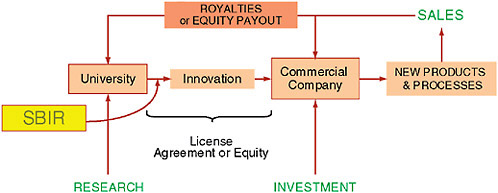
FIGURE 2 How ideas are commercialized: Transferring university technology to firms.
SOURCE: Adapted from Christina Gabriel, Carnegie Mellon University.
ability of the awards and the fact that a professor can apply for an SBIR award without quitting his or her university post or actually having a firm, encourages applications from academics who could not otherwise tolerate the risk involved in commercializing their own technologies. Initial National Academy of Sciences research has shown that SBIR awards directly cause the creation of new firms, with positive benefits in employment and growth for the local economy.48
Contrary to what one might expect, the awards generally do not seem to detract from the teaching role of the university professor. On the contrary, the real-life application of research with the attendant recognition in academic, technical, and financial terms can serve as a source of inspiration for students to pursue the real-world applications of their studies to societal needs in health, the environment, or national security. Similarly, well-constructed agreements can provide access to otherwise cost-prohibitive technological resources, thus enhancing the relevance of the students’ educational experience.49 University innovation along with early-stage funding by the government have spurred the growth of many successful technology companies, promoting a positive symbiotic relationship between the university and the regional economy.50
|
48 |
National Research Council, The Small Business Innovation Research Program: An Assessment of the Department of Defense Fast Track Initiative, op cit., p. 35. |
|
49 |
Cooperation with private companies is not without risk and requires careful management; yet even controversial agreements like the 1998 Berkeley agreement with Novartis seemed to have provided significant benefits to the university with no loss to academic freedom. See Gordon C. Rausser, Letter to the Editor, Atlantic Monthly May 19, 2000. Accessed at <http://www.cnr.berkeley.edu/pdf/dean_rausser/Atl_ltr_edt_5_2000.pdf>. |
|
50 |
Jennifer A. Henderson and John J. Smith, “Academia, Industry, and the Bayh-Dole Act: An Implied Duty to Commercialize,” White Paper, Center for the Integration of Medicine and Innovative Technol |
SBIR AND ATP
Along with the SBIR Program, the Advanced Technology Program (ATP) is a key example of programs designed to help bring high-risk, enabling, and innovative civilian technologies to market.51 As described in the paper in this volume by Shipp and Stanley, ATP’s mission is to provide funds for the development of generic technologies that are often too risky for individual firms but, if successful, can offer high payoffs for society as a whole.
The ATP and SBIR programs complement each other. The larger award sums offered by ATP, its focus on next-stage commercialization, as well as the synergies it creates between small and large firms make ATP, in effect, an SBIR Phase III—helping to commercialize successful prototypes funded by the SBIR program.
Together, the SBIR and ATP innovation award programs illustrate the best practice principles behind successful partnerships. Their awards are limited in time and limited in amount, and they require industry to take ownership through risk and cost sharing. They also foster collaboration among small companies, large companies, and (increasingly) universities. The dissemination of enabling technologies made possible by these programs makes both small and big firms more competitive, helps accomplish government missions faster and at lower costs, and improves the nations’ productivity, enabling all citizens to enjoy the fruits of technological advances and economic growth.
CONCLUSIONS: LEARNING FROM EACH OTHER
Learning from each others’ experience is a pathway for mutual progress. Given the cultural norms in Japan, SBIR-type awards would perhaps work best with existing firms but could also be used to encourage cooperation between small firms and universities.52 An ATP-type program could also have a broader application, bringing large Japanese firms together with universities and small companies. For these programs to be effective, some of the management principles successful in the United States could be applicable in the Japanese context as well.
While our national innovation systems differ in scale and flexibility, both Japan and the United States face similar challenges in innovation. We have to address these new challenges by becoming more innovative and productive, and we have to justify R&D expenditures by creating new jobs and new wealth. To do this, our countries have to reform existing institutions and create new ones. Rather than merely announce the need for change, we have to craft new mechanisms that shift incentives in a positive way.
REFERENCES
Acs, Zoltan J., and David B. Audretsch. 1990. Innovation and Small Firms. Cambridge, MA: MIT Press.
Branscomb, Lewis M., and Philip E. Auerswald. 2001. Taking Technical Risks: How Innovators, Executives, and Investors Manage High-Tech Risks. Boston, MA: The MIT Press.
Branscomb, Lewis M., and Philip E. Auerswald. 2002. Between Invention and Innovation: An Analysis of Early-Stage Technology Development. NIST GCR 02-841. Gaithersburg, MD: National Institute of Standards and Technology.
Council on Competitiveness. 2005. Innovate America: Thriving in a World of Challenge and Change. Washington, D.C.: Council on Competitiveness.
Ehlers, Vernon J. 1998. Unlocking Our Future: Toward a New National Science Policy, A Report to Congress by the House Committee on Science. Washington, D.C.: U.S. Government Printing Office.
Good, Mary. 2005. Presentation at the National Academies Conference, “Accelerating Innovation.” Washington, D.C. October 19.
Griffing, Bruce. 2001. “Between Invention and Innovation, Mapping the Funding for Early-Stage Technologies.” Presentation at Carnegie Conference Center. Washington, D.C. January 25.
Guellec, Dominique, and Bruno van Pottelsberghe de la Potterie. 2001. “R&D and Productivity Growth: Panel Data Analysis of 16 OECD Countries.” Organisation for Economic Co-operation and Development. DSTI Working Papers 2001/314. June.
Henderson, Jennifer A., and John J. Smith. 2002. “Academia, Industry, and the Bayh-Dole Act: An Implied Duty to Commercialize.” White Paper. Center for the Integration of Medicine and Innovative Technology. Harvard University. October.
Jacobs, Tom. 2002. “Biotech Follows Dot.com Boom and Bust.” Nature 20(10):973.
Lebra, Takie Sugiyama. 1971. “The Social Mechanism of Guilt and Shame: The Japanese Case.” Anthropological Quarterly 44(4):241-255.
Mansfield, Edwin. 1996. “How Fast Does New Industrial Technology Leak Out?” Journal of Industrial Economics 34(2):217-224.
Megginson, William L. 2004. “Towards a Global Model of Venture Capital?” Journal of Applied and Corporate Finance 16(1).
National Academy of Sciences/National Academy of Engineering/Institute of Medicine. 2007. Rising Above the Gathering Storm: Energizing and Employing America for a Brighter Economic Future. Washington, D.C.: The National Academies Press.
National Research Council. 1982. Scientific Communication and National Security. Washington, D.C.: National Academy Press.
National Research Council. 1987. Balancing the National Interest: U.S. National Security Export Controls and Global Economic Competition. Washington, D.C.: National Academy Press.
National Research Council. 1999. The Small Business Innovation Program: Challenges and Opportunities. Charles W. Wessner, ed. Washington, D.C.: National Academy Press.
National Research Council. 2000. The Small Business Innovation Research Program: An Assessment of the Department of Defense Fast Track Initiative. Charles W. Wessner, ed. Washington, D.C.: National Academy Press.
National Research Council. 2001. Trends in Federal Support of Research and Graduate Education. Stephen A. Merrill, ed. Washington, D.C.: National Academy Press.
National Research Council. 2004. SBIR: Program Diversity and Assessment Challenges. Charles W. Wessner, ed. Washington, D.C.: The National Academies Press.
National Research Council. 2005. Policy Implications of International Graduate Students and Postdoctoral Scholars in the United States. Washington, D.C.: The National Academies Press.
President’s Council of Advisors on Science and Technology. 2004. “Sustaining the Nation’s Innovation Ecosystems.” Washington, D.C.: Executive Office of the President. January.
Rausser, Gordon C. 2000. Letter to the Editor. Atlantic Monthly. May 19. Accessed at <http://www.cnr.berkeley.edu/pdf/dean_rausser/Atl_ltr_edt_5_2000.pdf>
Reiko, Yamada. 2001. “University Reform in the Post-massification Era in Japan: Analysis of Government Education Policy for the 21st Century.” Higher Education Policy 14(4).
Rowen, Henry S., and A. Maria Toyoda. 2002. “From Kiretsu to Start-ups: Japan’s Push for High Tech Entrepreneurship.” Asia-Pacific Research Center Working Paper. Stanford, CA.
Siegel, Donald, David Waldman, and Albert Link. 2004. “Toward a Model of the Effective Transfer of Scientific Knowledge from Academicians to Practitioners: Qualitative Evidence from the Commercialization of University Technologies.” Journal of Engineering and Technology Management 21(1-2):115-142.
Skolnikoff, Eugene B. 1993. “Knowledge Without Borders? Internationalization of the Research Universities.” Daedalus 122(4).
Spence, Michael. 1974. Market Signaling: Informational Transfer in Hiring and Related Processes. Cambridge, MA: Harvard University Press.
Tanaka, Nobua. 2005. Presentation at the International Forum on Technology Foresight and National Innovation Strategies. Seoul, Republic of Korea. November 4.
The Economist. 2005. “Competing through Innovation.” December 17.
The Financial Times. 2005. “World Leader in Patents Focuses on Incremental Innovations.” October 12.
U.S. Small Business Administration. 2004. “Small Business by the Numbers,” Office of Advocacy. Washington, D.C.: U.S. Small Business Administration. June.


