
Summary
In January 2004, President George W. Bush announced new elements of the nation’s space policy by issuing the Vision for Space Exploration (VSE),1 which instructed NASA to “extend human presence across the solar system, starting with a human return to the Moon by the year 2020, in preparation for human exploration of Mars and other destinations.” NASA was also directed to “develop the innovative technologies, knowledge, and infrastructures both to explore and to support decisions about the destinations for human exploration,” among other objectives. As acknowledged in the VSE, significant technology development will be necessary to accomplish the goals that it articulates.
In the past 4 years, NASA has mobilized and focused its resources on the critical new tasks assigned, including the maturing of the technologies necessary for exploration. NASA’s Exploration Technology Development Program (ETDP) is designed to support, develop, and ultimately provide the necessary technologies for the agency’s new Constellation flight program.
The Committee to Review NASA’s Exploration Technology Development Program is broadly supportive of the intent and goals of the VSE and finds that the ETDP is making progress toward the stated goals of technology development, but that it is operating within significant constraints that limit its ability to successfully accomplish those goals. The constraints include the still-dynamic nature of the Constellation Program requirements, the constraints imposed by a limited budget, the aggressive timescale of early technology deliverables, and the desire within NASA to fully employ the NASA workforce.
The ETDP is composed of 22 technical projects; each was assessed by the committee in terms of the quality of the research, the effectiveness of transitioning research findings into the flight program, and the degree of alignment of the project with the VSE. The committee found that in 20 of the 22 ETDP projects, corrective action leading to project improvement was either warranted or required. However, the committee believes that the ETDP contains a range of technologies that will, in principle, enable the realization of many of the early endeavors currently imagined in the Exploration Systems Architecture Study.2 The committee concluded that the ETDP, if adequately and stably funded and executed in a manner consistent with the planning process, would likely make available the required technology on schedule to its customers in the Constellation Program.
Because of the constraints cited above, the ETDP as created by NASA is a supporting technology program very closely coupled to the near-term needs of the Constellation Program. The ETDP is focused on only incremental gains in capability, and it has two programmatic gaps (integration of the human system, and nuclear thermal propulsion). NASA has in effect suspended research in a number of technology areas traditionally within the agency’s scope and has in many areas essentially ended support for longer-term technology research traditionally carried out within NASA and with strong university collaboration. These actions could have important consequences for aspects of the VSE beyond the initial, short-duration lunar missions—including an extended human presence on the Moon and human exploration of Mars and beyond.
With respect to the management of the ETDP, the program incorporates good processes for tracking Constellation Program requirements, for dealing with the mechanics of formal technology transfer, and for managing the programmatic risk of its own technology developments. However, there is a lack of clarity and completeness in the Constellation Program requirements as perceived by ETDP project personnel, as well as a need to improve the human side of the technology transfer process and to clarify how technology developments can contribute to a reduction in exploration (i.e., Constellation) programmatic risk.
Also, in general, the ETDP has not taken advantage of many external resources that could potentially reduce cost or schedule pressure, aid in the development of the NASA proposed technology, and/or provide alternative and backup technologies. Nor, in many cases, has the ETDP taken advantage of external peer reviews.
Finally, the present ETDP lacks an integrated, systematic test program. Of particular importance is that several ETDP projects, as currently formulated, do not include mission-critical tests—that is, system or subsystem model or prototype demonstrations in an operational environment—that are needed to advance the technology to technology readiness level (TRL) 6.
ASSESSMENT OF THE PROJECTS OF THE EXPLORATION TECHNOLOGY DEVELOPMENT PROGRAM
The 22 research projects of the ETDP are on subjects ranging from thermal protection systems to research on the International Space Station (ISS). The committee evaluated each of the 22 ETDP projects on the basis of the following:
-
The quality of the research effort, taking into account the research team, contacts with appropriate non-NASA entities, and the plan for achieving the objectives;
-
The effectiveness with which the research is carried out and transitioned to the exploration program, including progress to date, facilities, apparent gaps in the program, and the likelihood that the required TRL will be reached3 (the committee decided that simply noting gaps, as requested in the study statement of task, was too narrow an objective and that gauging “effectiveness” as defined here was more appropriate); and
-
The degree to which the research is aligned with the Vision for Space Exploration (since the VSE includes the wording “in preparation for human exploration of Mars,” the committee chose to highlight any project that did not appear to have considered plans that included this aspect).4
|
3 |
See Appendix D for definitions of technology readiness levels. |
|
4 |
The committee notes that after the completion of its assessments of the 22 individual projects in late 2007, the Congress passed the fiscal year 2008 Omnibus Appropriations Bill, which contained a provision prohibiting NASA from funding any activities devoted solely to preparing for the human exploration of Mars. The committee chose not to modify its findings on alignment with the VSE based on this language for several reasons. First, the committee interpreted as dominant its statement of task, which includes reference to the entire Vision for Space Exploration, explicitly including the human exploration of Mars. Second, by and large, on this alignment criterion the committee was critical of technology projects that did not consider extensibility of their technology to Mars. An example of potentially extensible technology is the Orion thermal protection system for Earth reentry. The committee did not criticize in the assessment of the 22 projects the absence of a Mars-unique technology, an example of which is a martian aerodynamic entry descent and landing system. |
The committee’s rating of each ETDP project is indicated by its assignment of a flag whose color represents the committee’s consensus view, as follows:
-
Gold star. Quality unmatched in the world; on track to deliver or exceed expectations.
-
Green flag. Appropriate capabilities and quality, accomplishment, and plan. No significant issues identified.
-
Yellow flag. Contains risks to a project/program. Close attention or remedial action is warranted.
-
Red flag. Threatens the success of the project/program. Remedial action is required. (This level was not used in assessing a project’s degree of alignment with the VSE.)
The ratings are summarized in Table S.1 and are discussed more fully in Chapter 2 in the committee’s observations on the individual projects. A few projects were given two ratings because of major distinctions between elements within a given project.
TABLE S.1 Summary of the Committee’s Ratings for Each ETDP Project with Regard to Quality, Effectiveness in Developing and Transitioning Technology, and Alignment with the Vision for Space Exploration
|
|
|
NOTE: A few projects were given two ratings because of major distinctions between elements within a given project. |
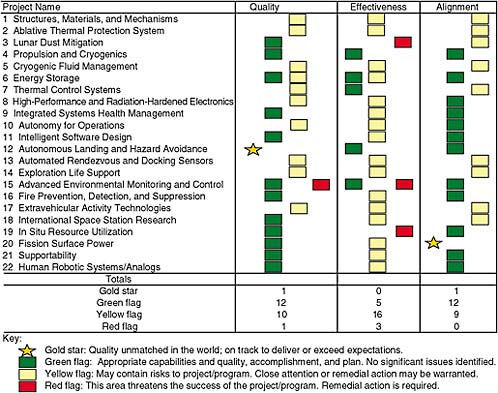
Finding: The committee evaluated the 22 individual ETDP projects and rated the quality of the research, the effectiveness with which the research is carried out and transitioned to the exploration program, and the degree to which the research is aligned with the VSE. The committee found that, with two exceptions, each project has areas that could be improved.
Recommendation: Managers in the Exploration Systems Mission Directorate and Exploration Technology Development Program should review and carefully consider the committee’s ratings of the individual ETDP projects and should develop and implement a plan to improve each project to a level that would be rated by a subsequent review as demonstrating “appropriate capabilities and quality, accomplishment, and plan” (green flag).
Finding: The range of technologies covered in the 22 ETDP projects will, in principle, enable many of the early endeavors currently imagined in NASA’s Exploration Systems Architecture Study architecture,5 but not the entire VSE.
In examining the projects and the scope of the ETDP, the committee found two significant technology gaps and also identified several crosscutting issues that are characteristic of many of the 22 ETDP projects or of the overall management of the ETDP. A fundamental concern that reflects all of these issues is that the ETDP is currently focused on the short-term challenges of the VSE and is addressing the near-term technologies needed to meet these challenges. Although it is clear that much of this focus results from the constraints on the program, the committee is concerned that the short-term approach characteristic of the current ETDP will have long-term consequences and result in compromised long-term decisions. Extensibility to longer lunar missions and to human exploration of Mars is at risk in the current research portfolio.
GAPS IN THE SCOPE OF THE EXPLORATION TECHNOLOGY DEVELOPMENT PROGRAM
In evaluating the 22 ETDP technology research thrusts, the committee identified two areas requiring greater emphasis: (1) integration of the human system and (2) nuclear thermal propulsion.
Integration of the Human System
Finding: The committee did not find a high degree of awareness of the interdependencies between the ETDP technology projects and associated human health risks and human-factor design considerations.
The integration of human-related requirements and engineering is essential for ensuring mission success and safety. However, none of the presentations given to the committee called out as design drivers the detailed human health/human factor risks or requirements identified in what NASA regards as controlling documents (such as the Human Research Program Requirements Document6 or the NASA Space Flight Human Systems Standards7). Some presenters were unaware of the existence of human system risk and requirements documents.
Recommendation: Exploration Technology Development Program (ETDP) project managers should clearly identify the interrelationships between human health and human factor risks and requirements8 on the one hand
and technology development on the other and should ensure that those risks and requirements are addressed in their project plans. Each ETDP project manager should be able to show clearly where that project fits within the integrated Exploration Systems Mission Directorate Advanced Capabilities Program (which includes the ETDP, the Lunar Precursor Robotic Program, and the Human Research Program), and this integrated program plan should include all elements necessary to achieve the Vision for Space Exploration.
Recommendation: Exploration Technology Development Program (ETDP) project managers should systematically include representatives of the Human Research Program on the ETDP technology development teams.
Nuclear Thermal Propulsion
Finding: NASA has no project for examining the fundamental issues involved in recovering the nuclear thermal rocket (NTR) technology even though the utility and the technical feasibility of the NTR have been established.
Recommendation: The Exploration Technology Development Program should initiate a technology project to evaluate experimentally candidate nuclear thermal rocket (NTR) fuels for materials and thermal characteristics. Using these data, the Exploration Systems Mission Directorate should assess the potential benefit of using an NTR for lunar missions and should continue to assess the impact on Mars missions.
MANAGEMENT AND EXECUTION OF THE EXPLORATION TECHNOLOGY DEVELOPMENT PROGRAM
Context of the Program
On the basis of its examination of the context in which the ETDP operates, the committee presents three findings:
Finding: In general, the ETDP is making progress toward its stated goals. It has a technology development planning process responsive to the needs of the Constellation Program, and if adequately and stably funded and executed in a manner consistent with the planning process, the ETDP would probably make the required technology available on schedule to its customers in the Constellation Program.
Finding: The ETDP is operating within significant constraints. These constraints include the still-dynamic nature of the requirements handed over from the Constellation Program; the constraints imposed by a limited budget, both from a historical perspective and relative to the larger exploration goals; the aggressive timescale of early technology deliverables; and the desire within NASA to fully employ the NASA workforce at its “ten healthy centers.” These constraints have posed many management and programmatic challenges, which in some cases have impeded the efficiency and effectiveness of the ETDP.
Finding: The ETDP has become NASA’s principal space technology program. It is highly focused and is structured as a supporting technology program to the Constellation Program, designed to advance technologies at TRL 3 and above toward TRL 6. Because of this shift toward the relatively mature end of the technology investment spectrum, which is very closely coupled to the near-term needs of the Constellation Program, NASA has also in effect suspended research in a number of technology areas traditionally within the agency’s scope, and it has in many areas essentially ended support for longer-term (TRL 1-2) technology research.
Program Management and Implementation Methodology
The ETDP spans the full spectrum of elements that are part of large-systems design, planning, and engineering—from requirements and risk mitigation to systems testing. It is thus imperative that systems engineering principles be applied and integrated across the ETDP. The three main areas in which the committee identified issues related
to effective systems engineering application were risk reduction, requirements roadmaps and management, and effective technology transfer.
Finding: Although the ETDP has a well-conceived process for managing the programmatic risk of its own technology development, the committee found a lack of clarity in the way that the ETDP accounts for the contributions of its technology developments to reducing exploration (i.e., Constellation) program risk, to reducing operational and human health risks, and to considering human-design-factor issues in operations.
Finding: Recognizing the well-established annual process of reviewing and revising the requirements levied on the ETDP by the Constellation Program, the committee nevertheless found a lack of clarity and completeness in the requirements as perceived by ETDP project personnel and a lack of integration of technology requirements (as would be expressed, for example, in a technology roadmap).
Finding: While the ETDP has a good administrative process for determining the formal mechanics of technology transfer, it could improve the effectiveness of the human side of the process by reviewing and adopting effective practice in this area, with the objective of developing a methodology of technology transfer from the development project to the flight project that ensures the successful infusion of the technology.
Recommendation: The Exploration Systems Mission Directorate (EMSD) should review its process for the management of technology development to ensure the timely delivery of technologies for seamless integration into its flight programs. In particular, the ESMD should (1) review and incorporate the considerable expertise in the management and transfer of technology in the larger aerospace, government, and industrial communities; (2) strengthen its management approach by, for instance, appointing a program-level system engineer to ensure that requirements are developed, maintained, and validated in a consistent and complete manner across the entire program; and (3) address the following three issues in particular: (a) the need for a careful assessment of the impact of its technologies on human and operational risk, (b) the need for definition and management of technology requirements, and (c) the importance of recognizing the human elements in the eventual effective transfer and infusion of technology.
Balance Between Near-Term and Far-Term Technology Investments in the ETDP Portfolio
A challenge to the ETDP is to strike the proper balance between near-term investments that serve a specific mission, often resulting in incremental advances, and long-term investments that may lead to innovations with a potential to be enabling at some time in the distant future.
Finding: The ETDP is currently focused on technologies at or above TRL 3, a focus driven by the need to bring together all of the available resources of NASA to reduce nearer-term Constellation mission risk and at the same time reduce potential Constellation Program schedule slippages within the assigned budget profile.
Finding: Most ETDP projects represent incremental gains in capability, which is not inconsistent with the focus on projects at TRL 3 and above. NASA has largely ended investments in longer-term space technologies that will enable later phases of the VSE, allow technology to “support decisions about … destinations,” in the words of the VSE, and in general preserve the technology leadership of the United States. In assessing the balance between near-term and far-term technology investments, the committee found that the current balance of the ETDP is too heavily weighted toward near-term investments.
Recommendation: The Exploration Systems Mission Directorate should identify longer-term technology needs for the wider Vision for Space Exploration (VSE) that cannot be met by the existing projects in the Exploration Technology Development Program (ETDP) portfolio, which are currently at technology readiness level (TRL) 3 or above. To meet longer-term technology needs, the committee recommends that the ETDP seed lower-TRL concepts
that target sustainability and extensibility to long-term lunar and Mars missions, thus opening the TRL pipeline, re-engaging the academic community, and beginning to incorporate the innovation in technology development that will be necessary to complete the VSE.
Involvement of the Broader Community
One of the ESMD’s requirements for the ETDP is that projects “engage national, international, commercial, scientific, and public participation in exploration to further U.S. scientific, security, and economic interests.”9 Interaction with external peers can take a number of forms and should occur throughout the research life cycle. Because of limited budgets and the pressure to fully employ the NASA workforce at “ten healthy centers,” the ETDP has emphasized internal endeavors. Although in many cases technology development internal to NASA is most appropriate because of NASA’s unique capabilities, infrastructure, and superior skills, there are other cases in which academia, research laboratories, or industry may be better suited to performing the research. However, even when research is performed outside NASA, it is critical that NASA develop and maintain subject-matter expertise so that it can effectively direct and interact with these external research efforts.
Finding: Some ETDP projects have made alliances with others in the broader community that will add to the effectiveness or efficiency of the project. However, the committee observes that in general, the ETDP has not taken advantage of many external resources that could potentially reduce cost or schedule pressure, aid in the development of NASA’s proposed technology, and/or provide alternative and backup technologies.
Finding: In many cases, ETDP projects do not take advantage of external technical peer review.
Finding: While many ETDP projects are technically or programmatically led by distinguished NASA personnel, certain other projects would benefit significantly from having a nationally recognized technical expert on the leadership team.
Finding: In the transition to the ETDP’s current structure, NASA has terminated support for hundreds of graduate students. The development of human resources for future space activities may be significantly curtailed by reductions in NASA support for university faculty, researchers, and students.
Recommendation: The Exploration Technology Development Program should institute external advisory teams for each project that (1) undertake a serious examination of potential external collaborations and identify those that could enhance project efficiency, (2) conduct peer review of existing internal activities, and (3) participate in a number of significant design reviews for the project.
Recommendation: The Exploration Systems Mission Directorate should implement cooperative research programs that support the Exploration Technology Development Program (ETDP) mission with qualified university, industry, or national laboratory researchers, particularly in low-technology-readiness-level projects. These programs should both support the ETDP mission and develop a pipeline of qualified and inspired future NASA personnel to ensure the long-term sustainability of U.S. leadership in space exploration.
Testing
Testing is needed to address specifically the risks inherent with any new technology. The lack of testing in the current ETDP poses the threat that the technologies will not ultimately be available to be integrated into the Constellation Program, which increases the overall programmatic risk.
|
9 |
National Aeronautics and Space Administration, Exploration Systems Mission Directorate Implementation Plan, p. 5. Available at www1.nasa.gov/pdf/187112main_eip_web.pdf. |
Finding: The present ETDP lacks an integrated, systematic test program. Of particular importance is that several ETDP projects, as currently formulated, do not include mission-critical tests—that is, system or subsystem model or prototype demonstrations in an operational environment—that are needed to advance the technology to TRL 6.
Recommendation: The Exploration Systems Mission Directorate should evaluate its test capabilities and develop a comprehensive overall integrated test and validation plan for all Exploration Technology Development Program (ETDP) projects. All ETDP projects should be reviewed for the absence of key tests (ground and/or flight), especially those that are required to advance key technologies to technology readiness level (TRL) 6. Where new facilities or flight tests are required, conceptual designs for the facilities or flight tests should be developed in order to establish plans and resource requirements needed to include the necessary testing in all ETDP projects.
CONCLUSION
At the conclusion of its study, the committee had developed an appreciation of the enormity of the task faced by the NASA workforce engaged in the ETDP, especially in light of the significant constraints under which the ETDP operates. These include the following:
-
The constraints imposed by a limited budget relative to the exploration goals,
-
The still-dynamic nature of the requirements handed over from the Constellation Program,
-
The timescale laid out to meet the requirements of the VSE, and
-
The desire within NASA to fully employ the NASA workforce at all of its centers.
In spite of these constraints, the committee was impressed with the intensity of the effort and with the dedication and enthusiasm that personnel showed for playing a part in contributing to the VSE. The committee was particularly impressed with the degree to which cooperation between NASA’s field centers has developed and the fact that all 10 NASA centers are engaged in the program.
The committee hopes that the observations, findings, and recommendations offered in this report will contribute to the ultimate success of the ETDP and to eventual success in a program to explore the solar system and beyond.


