
7
Culture, Diversity, and Equity
Native Waters: Sharing the Source, a traveling exhibit developed by the Native Waters project at Montana State University, has a double message. Its goal is to share cultural views about water held by the tribal peoples of the Missouri River Basin as well as scientific concepts about the Missouri River and its watershed. The exhibit accomplishes its double-pronged goal through its design, informative text panels, and interactive features.
The exhibit is set up like an Indian tipi, with the inside space designated as a place to hear stories about native culture. A sculpture of a spring takes center stage, with four banners, pointing in the four cardinal directions (north, south, east, and west) emanating from the spring. Each banner is illustrated with native drawings and includes quotes from Missouri Basin elders and tribal members. Visitors learn about sunrise and sunset on the east and west banners and about the phases of the moon, which cut across geographical boundaries. On the tipi wall is the story of the Missouri River. It begins in the Rocky Mountains and travels east until it reaches Cohokia, a native settlement that once had a population of 50,000.
The story of the river is told as a blend of scientific and native elements. As the river moves eastward and downhill, seasonal changes affect its size, creating what often is referred to as its pulse. According to native lore, the movements of the river also represents the idea that while traveling forward, one should also remember one’s past, just as the river carries remnants of its origins.
This example illustrates one strategy for closing the gaps that can exist between the beliefs, values, and practices of some communities and those embodied in Western science. By incorporating elements of native culture into a science exhibit, the designers are blurring the border between Western and native approaches to understanding the natural world, requiring all visitors to examine their own worldviews.
An important value of informal environments for science learning is being accessible to all people. However, social, economic, cultural, ethnic, historical, and systemic factors all influence the types of access and opportunities these environments provide to learners.1 Learning to participate in science—that is, developing the necessary knowledge and skills, as well as adopting the norms and practices associated with doing science—is difficult for many people. It can be especially challenging for members of traditionally underrepresented (or nondominant) groups.
The challenges of engaging nondominant groups in the sciences are reflected in studies showing that (1) inadequate science instruction exists in most elementary schools, especially those serving children from low-income and rural areas; (2) girls often do not identify strongly with science or science careers; (3) students from nondominant groups perform lower on standardized measures of science achievement than their peers; (4) although the number of individuals with disabilities pursuing postsecondary education has increased, few pursue academic careers in science or engineering; and (5) learning science can be especially challenging for all learners because of the specialized language involved.2 Addressing these challenges requires rethinking what it means to provide equal access to science.
RETHINKING EQUITY
Striving for equity in science education has often resulted in attempts to provide better access to opportunities already available to dominant groups, without consideration of the cultural or contextual issues that must be taken into account. Science instruction and learning experiences in informal environments often privilege the science-related practices of middle-class whites and may fail to recognize the science-related practices associated with individuals from other groups. In informal settings for learning science, such as museums, some initiatives are aimed at introducing new audiences to existing science content by offering reduced-cost admission or bringing existing science programming that is already offered to mainstream groups to nondominant communities.
The logic of this view is that individuals from particular groups or communities have simply not had sufficient access to science learning experiences. To remedy that situation, educators deliver to nondominant groups the same kinds of learning experiences that have served dominant groups. However, simply exposing individuals to the same learning environments may not result in equity, because the environments themselves are designed using the lens of the dominant culture.
|
“Promoting collaboration, partnership, and diversity in power and ownership may provide greater opportunities for nondominant groups to see their own ways of thinking and meaning-making—or making sense of what they are seeing and experiencing—reflected in informal settings.” |
For example, the signs and labeling of an exhibition or the content of a program may be in English only, or a program for families may be designed to accommodate the one- or two-parent family structure typical of many middle-class, white families, rather than the multigenerational, extended family structures that may be prevalent among other groups.
To achieve equity, practitioners must consider ways to connect the home and community cultures of diverse groups to the culture of science. Angela Calabrese Barton, professor of science education at Michigan State University, argues for allowing connections between learners’ life worlds and science to be made more easily and “providing space for multiple voices to be heard and explored.”3
An important first step toward designing more inclusive and genuinely equitable learning experiences in science is for educators and designers to recognize that they may be acting under assumptions that reflect the dominant culture of middle-class whites. As a result, the programs, activities, and exhibits they design may have narrow appeal and lead people from nondominant cultures to perceive them as directed by and designed for the dominant group. Cecilia Garibay, principal of the Garibay Group, points to a number of indicators identified through research that can support this perception, including the lack of diverse staff, a feeling that the content is not culturally relevant, and the unavailability of bilingual or multilingual resources. In fact, recent research with various cultural groups suggests that these issues result in nondominant communities feeling unwelcome in museums.4
Approaching these problems with outreach efforts may inadvertently reinforce the image of informal settings as being part of the dominant culture. The term outreach itself implies that some communities may be external to the institution. Promoting collaboration, partnership, and diversity in power and ownership may provide greater opportunities for nondominant groups to see their own ways of thinking and meaning-making—or making sense of what they are seeing and experiencing—reflected in informal settings.
To this end, making adjustments such as providing labels or program content in multiple languages has been shown to make a significant difference. Not only does this practice help members of other cultures identify key elements in an informal experience, but it also facilitates conversation and enhances learning among intergenerational groups.5 That said, it is important to point out that providing content in multiple languages is a big undertaking for a museum or other provider of informal science learning experiences. It requires adjustments to the exhibition or program development process and incurs costs for translation, proofing, and production. It may also require tough choices regarding which languages and cultures to include. However, the additional investment is an important step toward providing more equitable learning experiences. Electronic labels on touchscreens equipped to display multiple languages, while expensive, can address a variety of challenges, including the option of providing more detailed information on request. Alternatively, another way to accomplish the same goal is to have a non-English-speaking mediator available to “talk through” the experience with the visitors. Again, a non-trivial investment.
Attention to language differences is only one component of designing for equity. It also is important to consider variation in beliefs, values, and norms of social interaction, such as variability in family structure, gender roles, and patterns of discourse (e.g., the role of questioning in a conversation). Many informal institutions nationwide are addressing these issues and modifying exhibitions to reflect these differences. The next case study is one such example. It describes how a large children’s museum, Children’s Discovery Museum in San Jose, California, established an ongoing relationship with the city’s growing Vietnamese population; through this partnership, the museum was able to develop a significantly more inclusive learning experience. The museum’s work in this area highlights both its challenges and rewards.
|
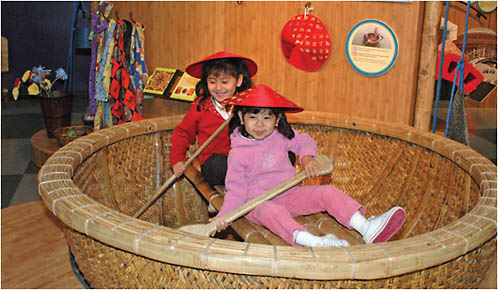
for some families to communicate, contributing to their lack of comfort. It also appears that perceptions of museums were a barrier. The word “museum” seemed to carry negative connotations for a lot of families. Respondents saw museums as passive, old, and academic versus interactive and engaging. In their minds, museums were associated with places that display old historical artifacts for visitors to view but not necessarily touch and interact with. Many focus group participants did not see how CDM provided more educational and fun experiences; in some cases, they weren’t even sure what the goals of the museum were, despite having visited the museum before participating in the focus group discussions. Values related to education more broadly may have played a role in these perceptions. Traditionally education is highly valued in Vietnamese culture and is perceived as being the sole responsibility of the school system and the teachers. Parents tend to keep some distance from their children’s education. In addition, to some extent play and learning are seen as two distinct activities. This perception may be one of the reasons that focus group participants were not clear on the goals of the children’s museum, which is intended to be both fun and educational. Generational differences in the Vietnamese community also emerged. First-generation members, or those born outside the United States, tend to speak Vietnamese in the home and tend to live in more insular communities. They value their cultural traditions and enjoy sharing and talking about their memories of life and traditions in Vietnam. Individuals who immigrated to the United States as children (referred to as 1.5 generation) and second-generation members (those born in the United States) are more likely to be acculturated, may speak the Vietnamese language but have limited reading and writing abilities, and in general are less tied to Vietnamese customs. They enjoy seeing their traditions reflected in their community and like the idea of exposing their children to the traditions. However, they also value multicultural perspectives and seek to instill in their children respect for all cultures. Planning an Exhibition for the Vietnamese Community One of the first major projects for the partners in the initiative was to plan a museum exhibition on mathematics and science called Secrets of Circles. The goal of the exhibition was to introduce young children to the concept of a circle as a geometric shape seen in nature and their everyday life. The exhibition included stations at which visitors can use a compass to draw circles; explore the rolling and spinning patterns of three-dimensional circles; and observe spinning circles that change into cylinders, a sphere, and a torus. Throughout the exhibition, children and their caregivers learn about the math, science, and beauty of this shape. Based on feedback from the community and their own research, museum designers incorporated some key Vietnamese cultural icons into the exhibition. For example, bamboo was selected as the main building material for the exhibition, and the Vietnamese round boat and a rice sieve were used as examples of circular objects. Museum staff also deliberated about whether to translate the labels into Vietnamese. Despite their awareness that younger Vietnamese people may not read the language, they decided to move forward with the translations. “It was a good decision,” says Martin. “In particular, first-generation Vietnamese were glad to see the text and graphics in their language.” According to the summative evaluation of Secrets of Circles completed by Allen and Associates, many of the exhibition’s elements succeeded in helping families feel more comfortable at the museum.6 |
|
Vietnamese: “I love the look of it, coming in to the bamboo makes it really comfortable…. Sometimes science exhibits are more professional or academic, and less inviting. But this one with the umbrellas, it’s a really fun place to be in. And it reminds me of Vietnam, just the different bamboo that I’ve seen in my life, it makes me really comfortable. And the fabrics and colors feel very rich.” Progress Made, More Work Ahead From the outset, the initiative brought in advisers from the Vietnamese community to build long-term relationships and to help with exhibition and program planning. The evaluation of the initiative indicated that museum staff have developed very strong and solid relationships with community advisers. Advisers noted that they felt the partnership was a positive one, in which everyone’s ideas were heard and which gave them an opportunity to share their knowledge and experiences. What’s more, the advisers expressed great appreciation for being invited to participate and partner with CDM. The strong relationships forged with advisers have resulted in a cadre of people deeply committed to the mission of the museum and the vision of better serving the Vietnamese community. These advisers mentioned that their ongoing involvement emerged from the museum staff’s commitment to diversity, manifested in the open, collaborative way they worked with the advisers. While relationships with the advisers are strong overall, the most active and supportive partners were those who worked at organizations whose mission closely aligned with that of CDM. These partners not only understood what the museum offers, but also noted that their own organizations are working toward similar goals, such as education; as a result, these organizations were invested in the project. Because of the crucial role that partners play in the initiative and the fact that many are already stretched in terms of time and money, advisers commented on the need to expand community relationships beyond the current team. The experience working on the exhibition and the initiative as a whole has been an eye-opening one for the museum staff. For one thing, the staff discovered that developing an understanding of and competence with a culture is an ongoing process. In fact, according to the Garibay Group’s final evaluation, even after working on the project for several years, many staff members still felt tentative about their decisions and were concerned that they may inadvertently offend Vietnamese community members. One recommendation made by the evaluator that may help considerably is to hire Vietnamese staff who can serve as “cultural translators” for the museum staff who are not Vietnamese, helping to bridge the gap between the museum’s culture and that of the Vietnamese community. Although staff members learned a lot from the initiative, they recognize they still have a long way to go. “Being involved in the Initiative has raised many questions for me,” says Martin. “I’m still not completely satisfied that we have been successful in our work with the Vietnamese community. We would like to continue to build that relationship.”7 |
This case study illustrates the value of drawing on participants’ cultural practices when designing informal learning environments. This can be accomplished by incorporating everyday language, linguistic practices, and local cultural experiences. While designers of informal programs and spaces for science learning have long recognized the importance of building on participants’ prior knowledge and experiences, the integral role of culture in shaping knowledge and experience is not always appreciated. There are many challenges to forming true collaborations resulting in programs, exhibitions, and activities that integrate traditional knowledge, beliefs, and practices with the knowledge and practices of Western science. However, the CDM’s Vietnamese initiative demonstrates that success is possible.
Indeed, research and evaluation on other efforts in museums to better address diversity show that the resulting enhancements can improve learning. For example, bilingual interpretive labels in English and Spanish in communities with large Latino populations allowed adult members who were less proficient in English to read the labels and discuss the content with their children, directly increasing attention and improving learning outcomes.8 In another case, providing a Spanish-speaking mediator promoted more scientific dialogue. Finally, in a bilingual summer science camp at an aquarium offered in English and Spanish, participating girls were very positive about the experience in part because they learned science terminology and concepts in both languages and thus could better communicate with their parents (who were predominantly Spanish-speaking) about what they were doing and learning. This increased their confidence and helped bridge the program and home environments.9
|
“There are many challenges to forming true collaborations resulting in programs, exhibitions, and activities that integrate traditional knowledge, beliefs, and practices with the knowledge and practices of Western science.” |
DESIGNING INFORMAL SCIENCE EXPERIENCES FOR PEOPLE WITH DISABILITIES
Another group that is often excluded in informal science settings is people with disabilities. With the number of people with cognitive, physical, and sensory disabilities currently making up a significant portion (18 percent) of the population, this group also needs to be considered in the planning and development of informal science experiences.
People with disabilities face multiple obstacles when trying to take advantage of these opportunities. Some issues are physical; for example, navigating a space can be problematic for people in wheelchairs and for those who are blind. Other issues, however, are related to a culture gap that must be bridged, much like cultural differences between various ethnic groups and informal science settings. Removing cultural barriers, however, is much more difficult than addressing physical ones.
Exhibit and program designs that serve visitors who face physical, sensory, or cognition challenges tend to benefit all visitors: larger font sizes and improved lighting are essential for vision-impaired visitors but also make any visitor less tired from reading. “Universal design,” the practice of accommodating all visitors regardless of their ability levels, tends to make designed learning spaces accessible and useful for all.
The following case study explains how designers at the Museum of Science, Boston, went about this task as they planned and developed an exhibition called Making Models. As planners at CDM did, Museum of Science staff worked closely with members of the targeted communities to make the experience both accessible and equitable.
|
KEY STEPS TO BUILDING RELATIONSHIPS WITH COMMUNITIES If there is one lesson that can be learned from the experience of the CDM, it is the importance of building strong relationships with communities of nondominant groups. The museum accomplished this goal by forming an advisory committee at the beginning of the project, and its assistance proved essential to the program. But even with the committee’s guidance, subtle differences within the community, such as differences in attitudes between first and subsequent generations, were not recognized until after important decisions had already been made. Other institutions have also begun their work with different cultural groups by starting at the community level. At the Exploratorium, for example, museum staff recognized how little they knew about both the Latino and Asian communities that visited the museum or could potentially visit. As a result, they set out to learn more about these communities before doing any program planning. In 2004, the Exploratorium began the learning process by going out into both communities to conduct informational interviews and recruit members for their advisory committee. Through collaboration with these leaders, the Exploratorium discovered that overcoming the language barrier is essential, along with developing a program that has some cultural significance. As the first step in reaching out to these two communities, the Exploratorium developed a series of public programs. The first of the three, Ancient Observatories: Chichen Itza, used a compelling science topic as its starting point. The program was enriched through the addition of cultural activities and interpretation. It was conducted in two languages—English and Spanish. The next effort, Science of Dragon Boats, began with a cultural topic that was enhanced through the addition of science activities and demonstrations. The third program, Magnitude X: Preparing for the Big One, emphasized the relevance of a science topic to daily life and added activities and demonstrations to make this point. This program was conducted in three languages staggered over the course of the day. There was an English session, a Chinese one, and a Spanish one. “This was not easy to pull off,” notes Garibay, who worked with the Exploratorium on its front-end evaluation. “It was an indication that museum staff took this work very seriously.” The experiences of both CDM and the Exploratorium point to several strategies that could be applied to other informal science environments. These strategies are summarized below.
|
|
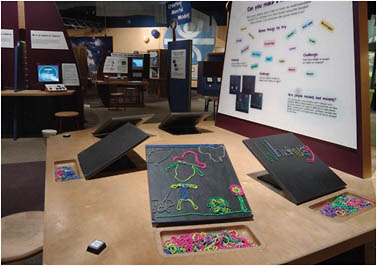
the model-making station,” explains Reich, “people with limited reach could create a model using beaded metal chains on a magnetic board. At another station, they could build a model by pressing buttons.” Two particularly innovative options allowed visitors to build models using light or sound. On a stage, visitors could manipulate color, the position of light, and its intensity to create a seasonal image, such as a sunset in winter or a sunrise on a summer day. The buttons and knobs that manipulated the light were easily reachable without moving, and there were places where visitors could rest their wrists. At the sound station, visitors could select sounds from a series of electronic files to create a scene. Sounds included snoring, meowing, an alarm going off, or people chatting. Like the light stage, the sound models were created by pressing buttons and turning knobs. Throughout the exhibition, visitors had access to audio and text labels, so learning was possible through either mode. The availability of multiple modalities for learning also meant that a sighted visitor could explore the exhibition with a friend with low vision, or that parents could have different ways to explain ideas related to the science to their children. The exhibition area also was easy for individuals in wheelchairs to navigate. The Impact of the Exhibition Did these adaptations increase the ability of disabled visitors to engage with the exhibits and to learn the science? According to the summative evaluation report,10in many ways, they did. For example, those with mobility impairments—wheelchair and scooter users and amputees—could get around without any trouble. One obstacle reported, however, was that objects in a case were hard to see, and an amputee noted the need to have more places to sit down. Blind and low-vision visitors, however, did find some parts of the exhibition difficult to access. Some expressed disappointment that they couldn’t touch the objects described in the audio, while others were frustrated if they had trouble getting the sound to work. One blind visitor suggested the following: “The exhibit needs an overall orientation, and a Braille map would be helpful, too. Some of the stations need to provide more feedback to blind visitors in order to be accessible…. Some type of clearer pathway would benefit some disabled visitors.” The report also revealed that even though it is extremely difficult to make every exhibit accessible to every visitor, enough options were available, making the experience equitable in the opportunities it provided for learning. According to the evaluation report, about one-third of these visitors said their understanding of models changed as a result of the exhibition, a response rate similar to that of able-bodied visitors. Yet there was still room for improvement. “The goal is to make sure that there are enough experiences so that all visitors feel included,” says Reich. “And some exhibits carry more weight than others. If people are excluded from ‘landmark exhibits,’ they feel like they missed out on the experience.” Moving forward, Reich notes that many museums, including the Science Museum of Minnesota and the North Carolina Museum of Life Sciences, are working hard on issues of accessibility and equity. But there is much to learn. “Professionals want a checklist, a list of items they can check off and then say that they have done everything right,” says Reich. “But that’s not the way this works. What is really involved is a willingness to engage in a process of involvement and engagement, a change in mindset, and a re-assessment of what is ‘normal.’ Then people will realize that they need to tend to all these issues in order to reach everyone.”10 |
INTEGRATING NATIVE AMERICAN CULTURE WITH SCIENCE
In our discussion of the importance of culture in science learning, we have focused on how informal learning institutions can partner with members of the community, particularly those who represent nondominant groups, to rethink the way the institutions approach designing programs, exhibits, and other activities. When successful, these kinds of initiatives integrate elements drawn from the nondominant culture with scientific ideas and practices and offer access points to science that may previously have been unavailable to members of the group.
The role of culture and the need for collaboration are particularly important when the beliefs, language, and cultural practices of a particular group have historically been devalued or even suppressed. The experience of many Native American tribes provides one such example. Native Americans have long been disenfranchised from their land and culture, and they have even been discouraged from speaking their languages and carrying out traditional ceremonies. As a result, the value of native knowledge and their beliefs about the natural world have often gone unrecognized; in fact, many people perceive a conflict between native understanding of the natural world and scientific understanding.
The need to make science education meaningful for Native Americans has long been recognized by respected leaders in the field. Thirty years ago, the American Association for the Advancement of Science (AAAS) called for using an ethnoscientific as well as bilingual approach to teaching science in particular contexts.11 In response, scholars called for science education that directly relates to the lives of native students and tribal communities. Scholars such as Glen Aikenhead, who is an expert in this field, agree that to be most effective, learning environments must be connected and relevant to each particular Native American tribe.12
Native Science Field Centers, supported by the efforts of the Hopa Mountain program, strive to create such environments in their year-round programs for elementary and middle school students. These programs connect traditional culture and language with Western science. Currently there are three Native Science Field Centers—one on the Blackfeet Reservation in collaboration with Blackfeet Community College (Montana), one on the Wind River Reservation in collaboration with Fremont County School District No. 21 (Wyoming), and one on the Pine Ridge Reservation in collaboration with Oglala Lakota College (South Dakota). The following case study focuses on the Blackfeet Native Science Field Center.

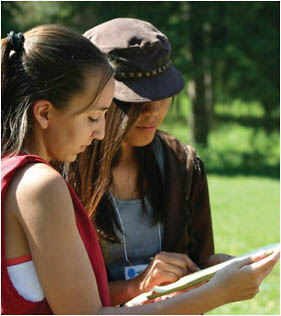
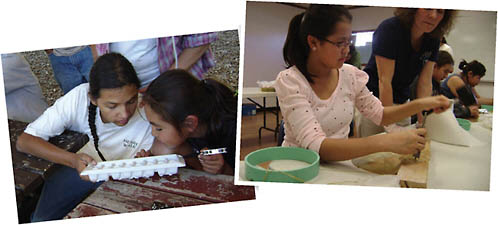 A big part of the program is introducing participants to the land by monitoring sites and collecting data about culturally significant plant and animal species. “We went to tribal leaders to ask them what animals to include,” says Augare. “Then we explain how they are part of the ecosystem, which they have a responsibility to care for.” To reinforce the importance of care for the land and the plants and animals that depend on it, the group worked with community members to put on a skit about climate change. A teacher fluent in the native language wrote the skit and helped the kids learn their lines—all in the Blackfeet language. The show emphasized how lessons can be learned from animal behavior and by observing the balance of the four elements—wind, fire, water, and land. Learning these lessons is meant to allow the Blackfeet to adapt to climate change and keep mother Earth healthy. Over the long term, the program is working to build an interest among native people in pursuing careers in science. With professionals from the community serving as role models, this generation has opportunities not available to their grandparents. Because of improved education systems and positive learning environments, there are a growing number of Native Americans studying science and selecting careers in different disciplines. More and more, native students feel proud of their heritage and celebrate the contributions to science made by their ancestors. They also are motivated to work toward the advancement of their tribal nation. The Blackfeet program is still quite new, and its leaders are currently working on evaluation tools that reflect the indigenous perspective. Their goal is to be able to demonstrate how the spiritual connection can be a motivating factor in learning. “The Blackfeet are proud of their culture and proud of their history,” says Bonnie Sachatello-Sawyer, executive director of the Hopa Mountain Program. “This program, rooted in their values, will help give today’s children the foundation they need to make informed decisions about their land and water when, as adults, they are called upon to do so.”13 |
The Blackfeet Native Science Field Center program shows the potential power of informal learning experiences in science for engaging individuals from groups that are historically underrepresented in the field. In fact, several studies suggest that informal environments for science learning may be particularly effective for youth from historically nondominant groups—groups with limited sociopolitical status in society, who are often marginalized because of their cultural, language, and behavioral differences.
Evaluations of museum-based and after-school programs such as the Blackfeet Native Science Field Center suggest that these experiences can support academic gains for children and youth from nondominant groups. Programs and experiences that are successful often draw on local issues. Several case studies of community science programs targeting youth document their influence on participants’ engagement with science and on their course selections and career choices. In these programs, children and youth play an active role in shaping the subject and process of inquiry, which may include local health or environmental issues about which they subsequently educate the community.

Informal institutions concerned with science learning are making efforts to address inequity and encourage the participation of diverse communities. However, these efforts typically stop short of more fundamental and necessary changes to the organization of content and experiences to better serve diverse communities. Much more attention needs to be paid to the ways in which culture shapes knowledge, orientations, and perspectives. A deeper understanding is needed of the relations among cultural practices in families, practices preferred in informal settings for learning, and the cultural practices associated with science. The conceptions of what counts as science need to be examined and broadened in order to identify the strengths that those from nondominant groups bring to the field.
We highlight two promising insights into how to better support science learning among people from nondominant backgrounds. First, informal environments for learning should be developed and implemented with the interests and concerns of community and cultural groups in mind: project goals should be
mutually determined by educators and the communities and cultural groups they serve. Second, the cultural variability of social structures should be reflected in educational design. For example, developing peer networks may be particularly important to foster sustained participation of nondominant groups. Designed spaces that serve families should include consideration of visits by extended families.
Things to Try
To apply the ideas presented in this chapter to informal settings, consider the following:
-
Think about how to design environments and materials that are compatible with different cultural groups you are serving. For example, would it be helpful to design an exhibition or a program for one specific group, or would incorporating cultural icons into an existing exhibition be more effective in your setting? Would adding multilingual labels be useful for your multiple audiences? Would programs in other languages be important to offer? Would it be useful to involve bi- or multilingual interpreters or docents?
-
Explore and nurture partnerships with local communities. Determine which groups you want to work with and then invite representatives from these groups to partner with you to define goals and serve as advisers throughout the project. Cooperate or collaborate early to ensure true partnership on equal grounds. Allow yourself to question cultural assumptions.
-
Learn more about the cultural ramifications of learning. Invite a local expert in this field to come to your venue to discuss how culture affects the work being done there. What do you need to learn about visitors to your setting? How can you make your environment more culturally relevant? Contact colleagues in your field who may already have garnered considerable expertise.
-
Be informed about and coordinate approaches with neighboring venues. Contact nearby informal science learning environments to discuss their strategies for working with different members of the community. Can you work together to develop a joint program or activity that will be particularly meaningful to the different groups you are trying to serve?
For Further Reading
Calabrese Barton, A. (1998). Reframing “science for all” through the politics of poverty. Educational Policy, 12, 525-541.
National Research Council. (2009). Diversity and equity. Chapter 7 in Committee on Learning Science in Informal Environments, Learning Science in Informal Environments: People, Places, and Pursuits. P. Bell, B. Lewenstein, A.W. Shouse, and M.A. Feder (Eds.). Center for Education, Division of Behavioral and Social Sciences and Education. Washington, DC: The National Academies Press.
Web Resources
Children’s Discovery Museum of San Jose: http://www.cdm.org/index.asp?f=0
Cosmic Serpent: http://www.cosmicserpent.org
Exploratorium: http://www.exploratorium.edu/
Hopa Mountain: http://www.hopamountain.org/nativeScience.html
Making Models: http://www.exhibitfiles.org/making_models
Museum of Science: http://www.mos.org/


