
2
Science and Science Learning
A first step in understanding how to promote science learning in informal environments is to develop a full picture of what it means to do and learn science. Over the past few decades, historians, philosophers of science, and sociologists have taken a much closer look at what scientists actually do and have found that the reality differs from common stereotypes. In the conventional view, the lone scientist, usually male and usually white, toils in isolation to understand some aspect of the natural world through a series of controlled experiments. He is removed from the real world, operates in a cerebral realm, and experiences breakthroughs that reveal some “truth” about how the world works.
Studies of what scientists actually do belie these stereotypes. Scientists approach problems in many different ways with many different preconceptions. There is no single “scientific method” universally employed by all. Instead, scientists use a wide array of methods to investigate and describe phenomena and develop hypotheses, models, and formal and informal theories. Nonetheless, they share a common commitment to gathering and using empirical evidence derived from examination of the natural world.
SCIENCE AS A SOCIAL AND CULTURAL ENTERPRISE
Studies also show that science is fundamentally a social enterprise. Science is often conducted by groups or even widespread networks of scientists, and an increasing number of women and minorities are scientists. Scientists communicate frequently with their colleagues, both formally and informally, and most active researchers are involved in multiple scientific associations or societies, along with multiple collaboration or work groups. They exchange e-mails, engage in discussions at con-
ferences, and present and respond to ideas through publications in journals and books, in print and online. Scientists also make use of a wide variety of cultural tools, including technological devices, mathematical representations, and methods of communication. These tools not only determine what scientists see, but also shape the kinds of observations they make.
In fact, the scientific community has its own core values, habits of mind, knowledge, language, and tools. These values include common commitments to questions, research perspectives, and ideas about what a viable scientific stance involves. Making progress in science depends on scientists being open to revising their ideas if called for by the evidence. The complex exchange of information and ideas and eventual evolution in thinking occurs in a community in which scientists also have developed a shared language. This language is added to or modified by scientists from specific disciplines as they work toward their own shared goals.
Scientists from different disciplines sometimes develop their own vocabularies, often by giving common words new meanings or by inventing words to describe a new scientific idea or discovery. Biologists, for example, talk about cells and DNA and genetics, and physicists have developed new meanings for such familiar words as energy, force, and work. Scientists in each discipline also depend on specialized tools to carry out their work. Biologists may use tools such as optical or electron microscopes to collect information, and astronomers may rely on different kinds of telescopes. Despite these differences, all share the larger goal of accumulating empirical evidence to explore or test their ideas.
Some scholars refer to this collective set of norms, practices, language, and tools as the culture of science. This includes specialized practices for exploring questions through evidence, such as the use of statistical tests, mathematical modeling, and instrumentation, and social practices, such as peer review, publication, and debate. In order to “do” science, people must learn these norms and practices.
There is also another sense in which science is cultural or even political—science reflects the cultural values of those who engage in it. The choices about what is worthy of attention, different perspectives on how to approach certain problems, and so on are shaped by the cultural values scientists bring with them and sometimes the political and economic environments in which scientific endeavors are funded and sustained. From this latter perspective, as is the case with any cultural endeavor, differences in norms and practices within and across fields reflect not only the varying subject matters of interest, but also the identities and values of the participants. The recognition that science is a cultural enterprise implies that there is no cultureless or neutral perspective on science, nor on learning science—
|
“Learning to communicate in and with a culture of science is a much broader undertaking than mastering a body of discrete conceptual or procedural knowledge.” |
any more than a photograph or a painting can be without perspective. Recognition of both aspects of culture in science is critical for promoting science learning.
Learning to communicate in and with a culture of science is a much broader undertaking than mastering a body of discrete conceptual or procedural knowledge. One observer, for example, describes the process of science education as one in which learners must engage in “border crossings” from their own everyday world culture into the subculture of science.1 The subculture of science is in part distinct from other cultural activities and in part a reflection of the cultural backgrounds of scientists themselves. By developing and supporting experiences that engage learners in a broad range of science practices, educators can increase the ways in which diverse learners identify with and make meaning from their informal science learning experiences.
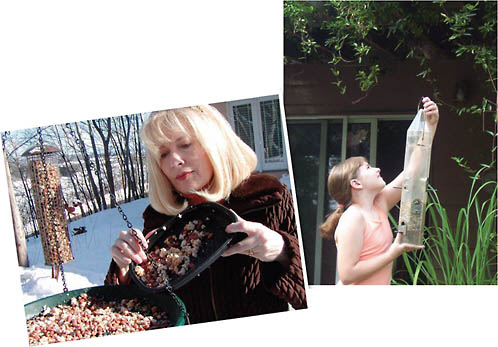
To illustrate how nonscientists can learn to participate in science, we consider the case of Project FeederWatch. This project was specifically designed to help birdwatchers make more scientific and credible observations of birds that appear in their backyards. By interacting with scientists and using the tools of science, birders fine-tuned their observation skills, became more comfortable with the culture of science, and, in some instances, were able to make contributions to the field.
|
Since its inception, thousands of people have participated in this and similar programs. Over the years, staff at the Cornell Lab of Ornithology have worked to perfect these programs by conducting regular participant surveys, which are used to develop a profile of the participants and determine which aspects of the program are most popular and how best to ensure that participants are able to make valuable scientific contributions and are themselves well served. The surveys reveal that typical participants tended to be college-educated white women over the age of 50 who, despite having watched or fed birds for years, still see themselves as intermediate birders. The vast majority of the participants make use of the website features, such as Rare Bird Reports, the Map Room, the Top 25 list of birds, the Personal County Summaries, or the State/Province Summaries. More than half of participants use such scientific tools as creating trend graphs for specific bird species. When participants were asked if they have learned about birds from this project, the results were encouraging. About 50 percent said that they learned there was a greater diversity of species than they had known about before; 64 percent said that they had learned to identify more species; 74 percent said that they observed interesting behaviors; and 70 percent said that they learned how birds change throughout the seasons. Only 6 percent of the participants said that they didn’t learn anything as a result of their involvement in the project. Comments also show that the project added value to an existing hobby by providing tools that allowed participants to deepen their experience. A participant from North Carolina remarked, “I loved feeding and watching the birds before, but now it is so much more interesting and useful.” A birdwatcher from New Mexico described how the project improved basic birdwatching skills: “After participating in Project FeederWatch for several seasons, my bird identification skills have improved immensely. This winter, I found myself identifying birds by their behavior: how they fly into the feeding site, where they land, if they sit or take right off again, and which feeder they choose.” |
|
Challenging Enthusiastic Birders Because so many participants return to the program year after year, lab staff have developed additional research projects to give them a chance to engage in deeper inquiry. One project, called the “Seed Preference Test,” was designed to find out which of three kinds of seeds ground-feeding birds liked best—sunflower, millet, or milo. The hypothesis developed by the lab staff was that sunflower was the preferred seed, but participants from the Southwest discovered otherwise. The birds in their region loved milo, also referred to as sorghum. Staff were intrigued by this surprising observation and wanted to find out if milo had been getting a bad rap. So they extended the experiment for 1 additional year. The research project resulted in a small media buzz. It was featured on Good Morning America, boosting enrollment to more than 17,000 participants. About 5,000 people completed the observations, documenting half a million bird visits and showing seed preferences for more than 30 species. The findings confirmed the reports from the Southwest about seed preferences for birds in that area, proving that the lab staff’s original hypothesis was incorrect. Another research project added to FeederWatch was the House Finch Eye Disease Survey. This project was initiated by FeederWatch participants, who observed house finches with puffy eyes during the winter months. Since then, participants have noted how the disease, identified as conjunctivitis, has spread throughout North America’s house finch population, causing their numbers to decline. Citizen scientists have proven to be an integral part of the scientific research team, documenting a serious population decline that could help in the understanding of disease outbreaks in other animal populations. What is particularly interesting about this phase of the project is the number of questions staff received about the experimental process. Many of these queries focused on hypotheses that participants were developing to help explain their results. This kind of activity showed that not only were participants fully engaged in the project, but also they were taking scientific inquiry to the next level. They were using scientific methods and applying them appropriately to answer their research questions. As a result, participants were learning about science in the context of real scientific research. Citizen scientists are becoming indispensable to the research efforts of the Cornell Lab of Ornithology. They are contributing to scientific knowledge about ecology and bird-feeding patterns in their regions. In fact, their findings have been included in articles published in peer-reviewed journals. “We are not just being nice in letting the public participate in these projects,” says Bonney. “Their scientific data are extremely important. Increasingly, the scientific community is depending on this work to further our understanding of North American birds.”2 |
This project is a powerful illustration of how an informal experience can provide rich and meaningful opportunities for people to participate in and learn about science. With some guidance from staff, the participants used the tools of science as they learned the practices, goals, and habits of mind of the culture of science. Similarly, the scientific community responded to participants, modifying their project design as a result of feedback and continued interest in the project.
For example, staff added the Seed Preference Test because participants were looking for a new challenge. Through observation over a long period of time, the citizen scientists documented that a hypothesis developed by lab staff was inaccurate. As is done in the scientific community, their findings were shared in articles published in peer-reviewed journals. Through this fruitful collaboration, the relationship between scientists and citizen scientists evolved, resulting in all members contributing and gaining valuable scientific knowledge.
A sustained citizen-science experience like Project FeederWatch provides an ideal opportunity for science novices to become familiar with the process and culture of science and even to become engaged participants in the scientific enterprise. Short-term or one-time informal science education experiences will be more challenged to acquaint learners with the culture of science in the fullest sense. Nonetheless, it is still possible to portray the social, lived, and dynamic aspects of science as part of a science exhibition and short programming.3
WHAT IS SCIENCE LEARNING?
Research on learning science makes clear that it involves development of a broad array of interests, attitudes, knowledge, and competencies. Clearly, learning “just the facts” or learning how to design simple experiments is not sufficient. In order to capture the multifaceted nature of science learning, we adopt the “strands of science learning” framework developed in Learning Science in Informal Environments that articulates the science-specific capabilities supported by informal environments. This framework builds on a four-strand model developed to capture what it means to learn science in school settings.4 The two additional strands incorporated for learning in informal environments, Strands 1 and 6, reflect the special commitment to interest, personal growth, and sustained engagement that is a hallmark of informal settings. The strands provide a framework for thinking about elements of scientific knowledge and practice.
An important aspect of the strands is that they are intertwined, much like the strands of a rope. Research suggests that each strand supports the others, so that progress along one strand promotes progress in the others. It is important to note that, although the strands reflect conceptualizations developed in research, they have not yet been tested empirically. Nonetheless, they provide a useful framework for helping educators, exhibit designers, and other practitioners in the informal science education community articulate learning outcomes as they develop programs, activities, exhibits, and events.
Strand 1:
Sparking Interest and Excitement
The motivation to learn science, emotional engagement, curiosity, and willingness to persevere through complicated scientific ideas and procedures over time are all important aspects of learning science.5 Learners in informal settings experience excitement, interest, and motivation to learn about phenomena in the natural and physical world. Interest includes the excitement, wonder, and surprise that learners often experience. Recent research shows that the emotions associated with interest are a major factor in thinking and learning, helping people learn as well as helping them retain and remember.6 Engagement can trigger motivation, which leads a learner to seek out additional ways to learn more about a topic. For example, after a field trip to the local planetarium, young people could become so excited that they decide to join a local astronomy club. In that setting, not only will they learn more about this topic, but also they will meet other people with similar interests.
Strand 2:
Understanding Scientific Content and Knowledge
This strand includes knowing, using, and interpreting scientific explanations of the natural and physical world. Learners in informal environments come to generate, understand, remember, and use concepts, explanations, arguments, models, and facts related to science. Learners also must understand interrelations among central scientific concepts and use them to build and critique scientific arguments. While this strand includes what is usually categorized as content, it focuses on concepts and the link between them rather than on discrete facts. It also involves the ability to use this knowledge in one’s own life.
|
STRANDS OF INFORMAL SCIENCE LEARNING
Experiencing excitement, interest, and motivation to learn about phenomena in the natural and physical world.
Generating, understanding, remembering, and using concepts, explanations, arguments, models, and facts related to science.
Manipulating, testing, exploring, predicting, questioning, observing, and making sense of the natural and physical world.
Reflecting on science as a way of knowing, including the processes, concepts, and institutions of science. It also involves reflection on the learner’s own process of understanding natural phenomena and the scientific explanations for them.
Participation in scientific activities and learning practices with others, using scientific language and tools.
Coming to think of oneself as a science learner and developing an identity as someone who knows about, uses, and sometimes contributes to science. |

For example, after watching a large format IMAX movie about the Galapagos Islands, viewers could be challenged to apply what they learned about natural selection to another environment. After noticing a particular species in that environment, the learner could hypothesize about how a naturally occurring variation led to the organism’s suitability to the environment.
Strand 3:
Engaging in Scientific Reasoning
This strand encompasses the knowledge and skills needed to reason about evidence and to design and analyze investigations. It includes evaluating evidence and constructing and defending arguments based on evidence. The strand also includes recognizing when there is insufficient evidence to draw a conclusion and determining what kind of additional data are needed. Many informal environments provide learners with opportunities to manipulate, test, explore, predict, question, observe, and make sense of the natural and physical world. In fact, most science and nature centers are built around the concept of exploration. Visitors are not given a correct scientific explanation of a natural phenomenon. Rather, they are presented with a phenomenon and then led through a process of asking questions and arriving at their own answers (which may then be verified against current scientific explanations).

The generation and explanation of evidence is at the core of scientific practice; scientists are constantly refining theories and constructing new models based on observations and empirical data. Understanding the connections, similarities, and differences between the ways people evaluate evidence in their daily lives and the practice of science is also part of this strand (e.g., looking at nutrition labels to decide which food items to purchase, understanding the impact of individual and collective decisions related to the environment, diagnosing and addressing personal health issues, diagnosing and testing different possible causes of a broken appliance).
On a small scale, visitors to science centers have an opportunity to engage in scientific reasoning. In these settings, visitors can interact with phenomena, see what happens, and then develop their own explanations for what they just experienced. For example, after experimenting with different objects to see which ones float and which ones sink, visitors can see that shape is just as important a variable as weight in determining buoyancy.
Through trial and error and by asking questions, people can begin to develop a deeper understanding of the world. The process of asking questions and then
determining ways to answer them is often the way that people of all ages learn new ideas. This process can take place in many settings, including the home, a community center, a museum, a lecture, or an informal event such as a Science Café.
Strand 4:
Reflecting on Science
The practice of science is a dynamic process, based on the continual evaluation of new evidence and the reassessment of old ideas. In this way, scientists are constantly modifying their view of the world. Learners in informal environments reflect on science as a way of knowing; on processes, concepts, and institutions of science; and on their own process of learning about phenomena. This strand also includes an appreciation of how the thinking of scientists and scientific communities changes over time as well as the learners’ sense of how his or her own thinking changes.
Research shows that, in general, people do not have a very good understanding of the nature of science and how scientific knowledge accumulates and advances.7 This limited understanding may be due, in part, to a lack of exposure to opportunities to learn about how scientific knowledge is constructed.8 It is also the case that simply carrying out scientific investigations does not automatically lead to an understanding of the nature of science. Instead, experiences must be designed to communicate this explicitly.
Informal learning environments and programming are well suited to providing opportunities for people to experience some of the excitement of participation in a process that is constantly open to revision. Developing an understanding of how scientific knowledge evolves can be conveyed in museums and by media through the creative reconstruction of the history of scientific ideas and the depiction of contemporary advances. Also compelling are the human stories behind great scientific discoveries. Such scientists as Galileo Galilei, Benjamin Franklin, Charles Darwin, Marie Curie, James Watson and Francis Crick, and Barbara McClintock are just a few people whose stories provide examples of how scientific ideas evolve.
The nature of science can also be reflected in documentary-style entertainment shows. For example, the reality TV program MythBusters investigates assumptions about the nature of particular phenomena and the TV drama CSI: Crime Scene Investigation depicts evidence as sometimes fragile and temporary in nature.
Strand 5:
Using the Tools and Language of Science
The myth of science as a solitary endeavor is misleading. Science is a social process, in which people with knowledge of the language, tools, and core values of the community come together to achieve a greater understanding of the world. The story of how the human genome was mapped is a good example of how scientists with different areas of expertise came together to accomplish a Herculean task that no single scientist could have completed on his or her own. Even small research projects are often tackled by teams of researchers.
Through participation in informal environments, nonscientists can develop a greater appreciation of how scientists work together and the specialized language and tools they have developed. In turn, learners also can refine their own mastery of the language and tools of science. For example, kids participating in a camp about forensic science come together as a community to solve a particular problem. Using the tools of science, such as chemical tests to identify a substance found at the crime scene, students become more familiar with the means by which scientists work on their research problems.
By engaging in scientific activities, participants also develop greater facility with the language of scientists; terms like hypothesis, experiment, and control begin to appear naturally in their discussion of what they are learning. In these ways, nonscientists begin to gain entry into the culture of the scientific community.
Strand 6:
Identifying with the Scientific Enterprise
Through experiences in informal environments, some people may start to change the way they think about themselves and their relationship to science. They think about themselves as science learners and develop an identity as someone who knows about, uses, and sometimes contributes to science. When a transformation such as this one takes place, young people may begin to think seriously about a career in a health field, in an engineering firm, or in a research laboratory.
Older adults, who have more leisure time after retirement, may take up hobbies that help give them a new identity at this time of their lives. For example, in addition to spending many hours outside cultivating his beds, an amateur gardener also may pursue another passion, such as growing orchids in a greenhouse. To become more knowledgeable, he or she could seek out information in books, online, or at the local botanical garden club. After becoming somewhat of an
expert on orchids, the gardener may be asked to talk to senior citizens at an intergenerational center about his hobby, or become a volunteer docent or gardener at a local botanic garden or park. At this point, the gardener has assumed a new identity—as an expert in the field and as a teacher. Changing individual perspectives about science over the life span is a far-reaching goal of informal learning experiences.

Sustaining existing science-related identities may be more common than creating new ones. For example, in one study, visitors to the California Science Center already expressed a strong sense of connection to science, and their visit reinforced their self-image as someone with interest in or connections to science.
Using the Strands Framework
The strands are statements about what learners do when they learn science, reflecting the practical as well as the more abstract, conceptual, and reflective aspects of science learning. The strands also represent important outcomes of science learning. That is, they encompass the knowledge, skills, attitudes, and habits of mind demonstrated by learners who are fully proficient in science. The strands serve as an important resource for guiding the design of informal learning experiences and especially for articulating desired outcomes for learners. Throughout this book, we return to the strands as a way to highlight the learning described in the numerous case studies.

Learning science is a multifaceted endeavor. It involves developing positive science-related attitudes, emotions, and identities; learning science practices; appreciating the social and historical context of science; and understanding scientific explanations of the natural world. Informal environments have often been viewed as particularly important for developing learners’ positive science-specific interests, attitudes, and identities.
Designers and educators can realize these goals and make science more accessible to people of all ages when they portray it as a social, lived experience relevant to the lives of the learners. Project FeederWatch is an example of such a project. Participants become part of a community of scientists and make their contributions while engaging in science in a familiar context.
As a way to think about the range of possible outcomes for science learning in informal settings, this chapter introduced a strands framework. The strands provide a way to describe learning outcomes specifying the content, skills, and ideas people are striving to master in these varied environments.
In the next chapter, we look closely at strategies designers can use to make science more accessible to a range of participants. These include interactivity and the importance of presenting information in multiple ways to reflect the needs and interests of a wide range of learners. Their strategies are supported by research about how people learn.
Things to Try
To apply the ideas presented in this chapter to informal settings, consider the following:
-
What is the culture of your community? This chapter explores the practices, values, and language that are part of culture. With these ideas in mind, bring together your staff to discuss what elements make up the culture of your environment. Do these elements attract visitors, keep them away, or both?
-
Think about how the strands may apply to your setting. In this chapter, we introduced six strands as a model that can be used to describe learning outcomes. Consider how the strands may be applied to the learning that takes place in your setting. Do your current offerings encompass all of the strands? Which strands are covered most frequently? Are there any strands that are
-
rarely touched on? Are there any strands that seem particularly important for your setting, but have not been programmed in?
-
Involve local learning researchers or educators. Make use of other resources available in your community to discuss learning and learning outcomes. You could create an advisory group of knowledgeable experts.
-
Join online communities of peers. There are a variety of listservs and blogs that provide informal science educators with connections and opportunities to discuss learning with peers (e.g., ISEN-ASTC-L for science museums and science centers).
-
Discuss evaluation data with an outside consultant. Reviewing evaluation data with an outside expert may help you see the information with fresh eyes. The consultant also may have good ideas of how to use the data more effectively.
-
Complete an informal survey of your setting as a way to better understand those who visit. Staff at the Cornell Lab of Ornithology modified their program based on information they learned through surveying participants. Consider surveying participants in your program to learn more about their preferences and what could be modified in your setting to expedite learning.
For Further Reading
National Research Council. (1999). Executive summary. How People Learn (pp. xi-xvii). Committee on Developments in the Science of Learning, Division of Behavioral and Social Sciences and Education. Washington, DC: National Academy Press.
National Research Council. (2007). Goals for science education. Chapter 2 in Committee on Science Learning, Kindergarten Through Eighth Grade, Taking Science to School. R.A. Duschl, H.A. Schweingruber, and A.W. Shouse (Eds.). Center for Education, Division of Behavioral and Social Sciences and Education. Washington, DC: The National Academies Press.
National Research Council. (2009). Introduction. Chapters 1 and 2 in Committee on Learning Science in Informal Environments, Learning Science in Informal Environments: People, Places, and Pursuits. P. Bell, B. Lewenstein, A.W. Shouse, and M.A. Feder (Eds.). Center for Education, Division of Behavioral and Social Sciences and Education. Washington, DC: The National Academies Press.
Yager, R.E., and Falk, J. (Eds.). (2008). Exemplary Science in Informal Education Settings: Standards-Based Success Stories. Arlington, VA: NSTA Press.
Web Resources
Center for the Advancement of Informal Science Education (CAISE): http://caise.insci.org/
Citizen Science: http://www.citizenscience.org


