
4
Learning with and from Others
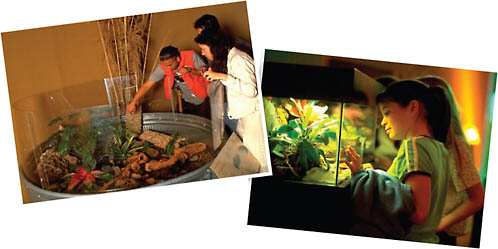
One of the first stops at the Exploratorium’s Frogs exhibition is a large open tank with a small stream, a stony beach, and dense vegetation. At first glance, the tank appears to be empty, causing visitors to pause and wonder why the Exploratorium would put an empty tank on display. But after looking at it for a while, visitors notice that frogs and toads do in fact live inside. It is because these animals are nocturnal that they are so difficult to see during the day.
This process of puzzlement, surprise, and discovery brings about animated conversation. Below is a sample of the reactions of a child and an adult:
Child: I don’t see that many frogs there.
Adult: Do you see any at all? I don’t see any at all.
Child: I don’t see any. I don’t see any frogs. Do you see them?
Adult: Does anybody see any frogs?
Child: I don’t see any.
Adult: I don’t see any frogs.
Child: I don’t see them either. Maybe they’re hiding.
Adult: No, I don’t see any. OK.
Child: I see that one, frogs and toads. Do you see that one?
Adult: Is that a real one?
Child: Yes, that’s a real one.
Adult: Looks like a big one, my heaven.
Child: Is that a toad?
Adult: Yes, I guess that would be a toad. It’s sort of on dry land.
Child: It’s a pretty one. There’s only one in there.
Adult: That’s true. They’re really wonderful to touch. They have this …
Child: I only touched a frog once.
Adult: I know, it’s kind of slippery.
Child: They’re hard to hang on to.
Adult: Yea, they’re hard to hang on to. But it’s like touching a live, well it is touching a live creature that ordinarily isn’t used to being touched, like a cat or dog.
Child: That’s a pretty, that’s a beautiful frog.1
Reactions like these, showing curiosity, discovery, and personal responses to an informal science experience, are what museum designers are striving for. These responses reflect Strand 1, and they are essential to the learning process.
In this chapter we explore how interaction with other people plays a role in learning. There are converging reasons to look at learning from and with others as a foundational part of the whole process of science learning. First, individual learning is supported through interaction with more knowledgeable others and through a dynamic exchange of ideas and reflection. Second, as highlighted in Strand 5, science itself involves specialized norms for interacting and specialized forms of language. Learning science therefore involves learning those norms and language. Third, people very often participate in informal science learning experiences with other people. Therefore, the experiences should be designed with groups in mind and in a way that capitalizes on opportunities to engage with other people.
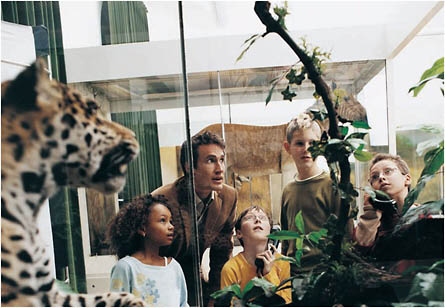
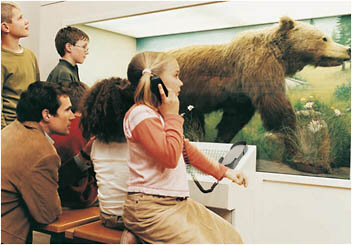
Parents, adult caregivers, peers, educators, facilitators, and mentors play critical roles in supporting science learning. There is ample evidence that children and adults reason about issues that are important to them while interacting with other people. Studies of dinner table conversations, visits to the zoo, and other everyday activities have uncovered rich conversations on a myriad of scientific topics and using scientific forms of discourse.2 Families of all backgrounds engage in everyday conversations about a broad range of topics, including physics, biology, politics, and religion.3 Through these kinds of interactions, children engage with others in questioning, explaining, making predictions, and evaluating evidence.4 Thus, in a
variety of ways, including family activities and conversation, children may begin to learn about topics that are relevant to science, even when “learning science” is not an explicit goal of the activity.5
As an example, consider the case of watching television. Although most people think of watching television as a solitary activity, when adults or older siblings become involved, the activity can become social, conversational—and more productive. A study with 23 3- and 4-year-old white, middle-class children conducted by Robert Reiser and his colleagues focused on the value of adult-facilitated sessions of Sesame Street.6 During the show, the adults in the experimental group intervened and asked the children to name the letters and numbers shown on the screen, while the control group did not have such conversations. Three days later, the children in the experimental group were better able to name the letters and numbers, suggesting that adult involvement can support learning.
In another study, Margaret Haefner and Ellen Wartella, both researchers in communications studies, found that older siblings could help their younger brothers and sisters understand plot elements in educational programming. Through explanations and laughter, “older children did influence the younger children’s general evaluations of the program characters.”7 Even though these studies were not on science programming, their results suggest that active engagement during viewing could have a positive impact for science learning as well. Even an intrinsically passive medium such as television can become interactive when a social, conversational element is introduced. Through conversation and questioning, the ideas embedded in television programs can resonate for young viewers.
Older children and adults also benefit from interaction with others. In group interactions during museum visits, individuals with more knowledge about a particular exhibit may play an important role in facilitating the learning of others by pointing out critical elements or information and by providing input and structure for a more focused discussion of science.8 In a small study of an exhibit about glass, adults with high prior knowledge and interest in glass tended to discuss how or why something happened more often than those with less prior knowledge or interest.9 In another example from the museum context, visitors’ activities at an exhibit were affected by other visitors’ behavior, even when the other visitors are strangers. In one study, adult visitors in particular were more likely to touch or manipulate an exhibit if they had previously witnessed a person silently modeling these behaviors.10
The importance of more knowledgeable others is reflected in the roles of mentors or scientists in many informal experiences. In citizen-science experiences, for example, the relationship between the scientists and volunteers is critical to the
volunteers’ learning. In the citizen-science case study in Chapter 2 (the Cornell Lab of Ornithology), volunteers learned so much from their mentors that they developed enough expertise to contribute to scientific journals. Similar relationships between experts and novices are important elements of many after-school programs. For example, in a program called “Service at Salado,” middle school students, undergraduate student mentors, and university-based scientists worked together to learn about an urban riverbed habitat through classroom lessons and service and learning activities. At the end of the program the undergraduate mentors worked with the middle school students on products to benefit the urban riverbed habitat.11
In The Mind exhibition described in Chapter 3, museum designer Thogersen discovered that social interaction was key to learning about a concept as abstract as the mind. He notes that two friends could “prod the mind of the other,” creating a powerful learning experience for both visitors. Similarly, the benches at Cell Lab are organized in such a way to encourage dialogue, building on what research has confirmed—learning is enhanced through social interactions and conversation.
CONVERSATIONS AND LANGUAGE
Conversations are a kind of social interaction that has been studied extensively, especially in museums and classrooms. Engaging in conversation and discussion promotes learning as well as provides a window into the thinking of individuals or groups. By listening to what people say, researchers can find out what learners know and understand, what emotions have been evoked by an experience, and what gaps in learning may remain. The importance of discourse in learning is broadly acknowledged across a range of subject areas and settings.12 In the classroom context, researchers have found that successful science education depends on the learners’ involvement in forms of communication and reasoning that models those of scientific communities.13 There is increasing interest in designing science programs, exhibitions, and other informal experiences that explicitly support conversation and use of scientific language.
Studying conversation in informal settings poses many challenges. Among the challenges are determining appropriate ways to record conversations (for example, setting up microphones at selected places throughout the setting versus asking visitors to wear microphones), determining where visitors are in the museum while they are talking (some researchers use “trackers” to follow visitors in the study to identify their movements), and obtaining clear recordings in a noisy
|
PROVOCATIVE TOPICS, PRODUCTIVE DIALOGUE In some instances, informal science platforms bring up provocative topics, encouraging responses that are revealed through verbal or written discussions. For example, postings on websites and blogs, as well as newspaper articles on such topics as genetic testing and stem cell research, prod readers to think about, discuss, and write about their own views and positions. At the Science Café in Chapter 1, participants were encouraged to articulate their own opinions about the scientific evidence related to global warming. While museum exhibitions often do not give visitors an opportunity to think about science in this way, an exception is the Ontario Science Center’s A Question of Truth exhibition. The purpose of the exhibition is to consider the cultural and political influences that affect scientific activity. The exhibition focuses on three themes: frames of reference (e.g., sun-centered versus earth-centered), bias (concepts of race, eugenics, and intelligence testing), and science and community (interviews with diverse groups of scientists). After conducting interviews with visitors to this exhibition, Erminia Pedretti found that most of them thought the exhibition contributed to their understanding of science and society, “applauding the science center’s effort to demystify and deconstruct the practice of science while providing a social cultural context.” For example, a visiting student commented, “The exhibit makes us think a lot about our beliefs and why we think in certain ways…. I didn’t think that the gene that affects the color of your skin was so small and unimportant. Most people don’t think of things like that.” Another student challenged the view of science as being amoral: “We view science as often being separate from morals, and it’s kind of negative because it allows them to do all sorts of things like altering human life, and it may not necessarily be beneficial to our society…. Some scientists are saying, should we actually be doing this?” According to Pedretti, such comments indicate that exhibitions like these are encouraging visitors to reflect on the processes of science, politics, and personal beliefs and articulate their views. They achieve this goal by personalizing the subject matter, evoking emotion, and stimulating debate through the presentation of information from multiple perspectives.14 |
|
“By listening to what people say, researchers can find out what learners know and understand, what emotions have been evoked by an experience, and what gaps in learning may remain.” |
environment with notoriously poor acoustics. Transcribing the conversations, the next step in the process, is difficult, time-consuming, and expensive.
The most demanding part of such a study by far, however, is interpreting what the conversations mean. Sue Allen, a researcher at the Exploratorium, points out that not only is the museum environment dense and complex, but also many variables can influence what visitors say and don’t say. For example, visitors come from different backgrounds and bring to the visit a range of experiences and varying levels of interest in science, along with diverse attitudes, expectations, group dynamics, and even energy and comfort levels. In addition, aspects of the physical space (lighting and ambient noise, for example), as well as issues related to the design of the exhibit—height, coloration, physical accessibility, interface, display style, label content, and tone—must be taken into account.
Despite these challenges, Allen and other researchers have been able to identify features of conversation that reveal specific kinds of learning. These studies provide insight into participants’ thinking and ideas about how informal experiences can be designed to facilitate learning with and from others.

|
exception was visitors’ responses to an audio-based multimedia exhibit of frog calls. After listening, the visitors could record their imitations of the calls. Visitors comments included much commentary on how they did: “You have to do it before the red line disappears or it doesn’t record,” and “This was right, except I made it too long.” Allen proposed that several features of this particular exhibit probably accounted for the high frequency of evaluative talk: high overall appeal of the exhibit, a challenging interface to work with, and computer-generated graphs that supported visitors’ efforts to visually compare their vocalizations with the standard frog calls. Affective Talk This kind of talk refers to emotional responses, such as pleasure, displeasure, and intrigue, evoked by an exhibit. Overall, about 40 percent of visitors’ responses were emotional, with the tank of the African clawed frog generating the most frequent expressions of pleasure and a dead frog displayed to show internal organs generating the most frequent expressions of displeasure. Conversation as a Tool to Understand Learning This case study presents a snapshot of what people said while exploring the Frogs exhibition and how their conversations were categorized and explained. Allen notes that “hearing or reading visitors’ complete conversations is a vivid experience that brings one right into the arena where real museum learning occurs. The transcripts are detailed, dense, and at times brutally honest, providing readers (be they developers, evaluators, or researchers) with a gritty sense of what engages and what doesn’t. Personally, I found it a striking reminder of the power of choice in informal environments: visitors are choosing where to spend every second of their time, and exhibits that do not engage or sustain them are quickly left behind, however ‘potentially educational’ they may be.”15 Although Allen recognizes the power of this method, she also acknowledges how difficult it is to collect, transcribe, and interpret the data. She concludes, “Analyzing real-time visitor conversations in exhibitions is a fertile but costly complement to more traditional methods. Its strength is in bringing the researcher into the heart of the learning ‘action’ of the museum visit, and emphasizing learning as a process rather than merely an outcome.”15 |
EXPLANATION: A LEARNING TOOL BETWEEN PARENTS AND CHILDREN
Allen provides insights into conversations that occur as pairs of any combination (two adults, a parent and a child, a grandparent and a child, for example) explore an exhibit. Other researchers have focused on how parents and children interact at a museum, with an emphasis on the role of explanation in enhancing the experience for the child. For example, developmental psychologists Maureen Callanan and Jennifer Jipson noted that parents often refer to prior experiences as a way to make an exhibit more relevant and meaningful. Overall, when parents mediate the exhibit for their children, the experience tends to be more beneficial.16
A study by Kevin Crowley and his colleagues further illustrates the influence of parents on children in informal science learning environments. The researchers observed 91 families with children ranging in age from 4 to 8 years old as they explored an exhibit at the Children’s Discovery Museum in San Jose, California. The exhibit focused on the zoetrope, a device that produces an illusion of action from a series of static images. The investigators found that children who engaged with their parents during their visit viewed the exhibit with more perceptive eyes. Their exploration was “longer, broader, and more focused on relevant comparisons” than that of children exploring the exhibit on their own. These results point to the key role that parents play in helping children select and identify appropriate details.17
In addition, parents who have a background in science may be comfortable enough to use an exhibit as a starting point for sharing their knowledge. Below is an example of how a father, knowledgeable about simple machines, uses a Pulley Table to demonstrate for his son how this device works:
Well, mostly I was explaining to my son what it was doing. Showing that—for instance, there was one pulley that powered and the difference in putting the string on the smaller wheel as compared to the larger wheel, what it does to the other wheels…. Another boy walked up as well, and so I showed them the faster you turn it, the faster it plays, depending on the size of the pulley you use will also determine the power.18
Sometimes, however, parents may become too involved in the museum experience, which may in some ways limit children’s access to cognitively complex tasks, as documented by researchers Mary Gleason and Leona Schauble. When 20 highly educated parents and their children (working in pairs) were asked to design
and interpret a series of experimental trials to determine what factors cause a boat to be towed quickly through a canal system, the parents became immersed in the activity, looking up the results of previous trials and expressing their conclusions aloud. Although the parents did support and advance their children’s reasoning, they tended to do the more challenging conceptual parts of the activity, while delegating to the children the logistical components, such as releasing the boat into the canal and operating the stopwatch. As a result, it was the parents and not the children who made the greater gains in understanding the relationship between the boat and the canal system.19
Other researchers have found that parent-child interaction not only can undermine children’s engagement in the more challenging aspect of an activity, but also can lead to misinterpretations of underlying phenomena. Parents can be aided in facilitating their children’s learning by providing them with good lead-in questions, parent guides and similar types of resources, support, and guidance.
To examine more closely the dynamic between a parent and a child at a science museum, consider the following case study from research conducted by Kevin Crowley and Melanie Jacobs at the Pittsburgh Children’s Museum. The case illustrates how parent-child teams interact and identifies the different types of rhetorical devices used.

|
Do you have a … You have an Oviraptor in your game! You know the egg game on your computer? [Mom makes several gestures similar to the hunt-and-peck typing that a child might do on a computer keyboard.] That’s what it is, an Oviraptor. Mom: [Turns back to the card and points to the text on the card. She again starts speaking in her “teacher” voice.] And that’s from the Cretaceous period. [pause] And that was a really, really long time ago. Throughout this conversation, the mother is going back and forth between “teaching” her child about the fossil and expressing pride that he is so knowledgeable. Her change in tone was particularly noticeable before and after she read the first label to him. She thought her son was wrong about the fossil—which accounted for the “teachy” tone before she read the card—but when she realized he was right, her voice switched to that of a proud mom. The researchers noticed the change in tone from formal to informal throughout this pair’s visit to the museum. The mother mediated the experience in several ways. First, to help her son place this experience in context, she reminded him about a dinosaur computer game that he played at home. Second, by “acting out” the way he types, she was giving a physical demonstration of the connection she was trying to establish to another family learning experience. Finally, she also changed some of the words on the card to make the explanation easier for a 4-year-old to understand. For example, the card had labeled the time frame as “Cretaceous Period, approximately 65 to 135 million years ago.” The mother modified this explanation by simply saying that the Cretaceous Period was “a really, really long time ago.” The researchers noticed these same mediating strategies among other participants in the study. They also observed that other parents discussed each fossil’s observable properties, its value and authenticity, and its anatomy. In addition, other parents made inferences about the size and function of the dinosaur based on the fossil they were examining. At the end of each session, all the children involved in the study were asked to identify each of the nine fossils. To determine whether success in completing this task was associated with different levels of mediation, the researchers analyzed their findings in terms of how many fossils the children could identify based on their age and whether their parents provided high or low levels of mediation. The results indicate that older children (ages 7-12) found the task of identifying fossils relatively easy. But even with this group, the more mediation they received, the better they did: children whose parents provided a low level of mediation identified 85 percent of the fossils correctly, and children whose parents provided a high level of mediation identified all of the fossils correctly. A similar trend was found among younger children (ages 4-6). Based on these data, it appears that higher levels of mediation, especially for younger children, result in more learning, defined as “the ability to identify fossils after going through the exhibit.” What’s more, further analysis of the data showed that, in particular, identifying what the object is and relating it to the child’s past experiences had the greatest impact on learning. This study makes a strong case for the value of parental guidance and mediation during informal science experiences. In particular, making connections to past experiences appears to solidify learning. Moving forward, professionals working in informal settings, including museums and out-of-school-time programs, can consider how to use these findings to strengthen the quality of their offerings.20 |
ROLES THAT SUPPORT LEARNING
Just as informal settings for learning vary tremendously, so do the practices in which facilitators, educators, and parents engage to support it. Even in everyday settings, facilitators can enhance learning. For example, a child’s cause-seeking “why” questions are an expression of an everyday, intense curiosity about the world. Parents, older peers, facilitators, and teachers can and often do support these natural expressions of curiosity and sense-making, as revealed through studies about television watching discussed earlier. Evidence indicates that the more support parents and others offer, the greater the possibility that children will learn. Though too much guidance may limit learning. Recognizing expressions of curiosity and sense-making supports and encourages learning and reinforces learners’ efforts (e.g., by listening to learners, helping them inquire into and answer their own questions, and involving them in regular activities that place them in contact with natural and designed phenomena and scientific concepts).
Roles that support learning can range from simple, discrete acts of assistance to long-term, sustained relationships, collaborations, and apprenticeships. Just by interacting with children in everyday routine activities (e.g., preparing dinner, gardening, watching television, making health decisions) parents, caretakers, and educators are often helping them learn about science. In addition, family and social group activities often involve learning and the application of science as part of daily routines. Agricultural communities regularly analyze environmental conditions and botanical issues. Even facilitators who are not experts in science (e.g., in after-school and community-based programs) can serve as intermediaries to informal science learning experiences. In some instances, the enthusiasm and assistance of a facilitating Girl Scout leader can encourage members of the troop to pursue a science badge.
|
“Roles that support learning can range from simple, discrete acts of assistance to long-term, sustained relationships, collaborations, and apprenticeships.” |
Productive science learning relationships frequently involve sustained individual inquiry but also intensive social interaction with interest groups and in mentoring relationships with experts, as revealed through Diane Miller’s commitment to the teens in the program sponsored by the St. Louis Science Center in Chapter 3. In some cases, learners may develop a relationship with experts, who help them refine their science understanding and skill deliberately over sustained time periods. Seasoned science enthusiasts may serve as de facto mentors for newcomers in hobby groups (e.g., amateur astronomy, gardening). Distributed and varied expertise in groups allows less knowledgeable individuals to interact with more knowledgeable peers and mentors. Frequently, the roles of expert and novice shift back and forth over time, on the basis of specific aspects of the inquiry in question.

Research shows that learning is a social process, heightened by conversation and engagement with other people. In designed settings such as museums, studies have illustrated how parents and other caregivers can mediate the experience for their children, making it more meaningful. With the knowledge that social interactions help facilitate learners, designers of informal science experiences can develop activities that encourage interactivity, discussion, and reflection.
Everyday experiences such as watching television, an intrinsically passive experience, can result in more learning when children engage with others in questioning, explaining, making predictions, and evaluating evidence.21 Thus, in a variety of ways, including family social activities and conversation, children may begin to learn about topics that are relevant to science, even when learning science is not an explicit goal of the activity.22
In the next chapter, we focus more closely on the interest and motivations that learners bring to each informal science experience. Understanding how these variables impact learning can lead educators to develop more compelling exhibits, activities, or programs.
Things to Try
To apply the ideas presented in this chapter to informal settings, consider the following:
-
Is there an informal way to “listen in” to the kinds of conversations people are having in your setting? If so, pay attention to what they focus on. Are they revealing how social interaction enhances learning or how parents and other caregivers can mediate an experience for children?
-
Have you noticed that one type of exhibit or experience seems to elicit more conversation than others? If so, is there a way to incorporate those features into other exhibits?
-
A graphic representation from Frog and Toad Are Friends elicited a strong response from exhibit visitors. Are there ways to include artifacts from popular culture in your setting that would be recognizable to large numbers of people and could stimulate personally meaningful conversation?
-
Are there tools in place to help parents and other caregivers mediate the experience for their children? Are the objects clearly labeled, with easy-to-read explanations? Are there guides for caregivers to help them deepen the experience of their children? Does the layout of the experience make it easy for adults to discuss the exhibit’s ideas with their children? Is it possible to have staff people available to help parents engage in conversation with their children?
-
Are experiences in your setting designed to be explored together? In programs, is interaction with other people an integral part of the experience? In exhibits, is there enough room for groups to explore? If an exhibit is designed for one user or visitor, can others observe and engage in other ways, such as through conversations? In programs, is cooperation and collaboration made part of the experience itself? Does the experience encourage group reflection, conversation, joint problem solving, and other forms of social interaction and cooperation? Are these experiences designed to elicit learning about the others in a group and thereby allow for strengthening interpersonal relationships?
For Further Reading
Allen, S. (2002). Looking for learning in visitor talk: A methodological exploration. In G. Leinhardt, K. Crowley, and K. Knutson (Eds.), Learning Conversations in Museums (pp. 259-303). Mahwah, NJ: Lawrence Erlbaum Associates.
Crowley, K., and Galco, J. (2001). Family conversations and the emergence of scientific literacy. In K. Crowley, C. Schunn, and T. Okada (Eds.), Designing for Science: Implications from Everyday, Classroom, and Professional Science (pp. 393-413). Mahwah, NJ: Lawrence Erlbaum Associates.
Crowley, K., and Jacobs, M. (2002). Building islands of expertise in everyday family activity. In G. Leinhardt, K. Crowley, and K. Knutson (Eds.), Learning Conversations in Museums (pp. 333-356). Mahwah, NJ: Lawrence Erlbaum Associates.
Ellenbogen, K.M., Luke, J.J., and Dierking, L.D. (2007). Family learning in museums: Perspectives on a decade of research. In J.H. Falk, L.D. Dierking, and S. Foutz (Eds.). In Principle, in Practice: Museums as Learning Institutions (pp. 17-30). Lanham, MD: AltaMira Press.
Gleason, M.E., and Schauble, L. (2000). Parents’ assistance of their children’s scientific reasoning. Cognition and Instruction, 17(4), 343-378.
Web Resources
Center for the Advancement of Informal Science Education (CAISE): http://caise.insci.org/
Exploratorium: http://www.exploratorium.edu
Informal Science: http://www.informalscience.org/
Pittsburgh Science of Learning Center: http://www.learnlab.org/


