
3
Energy Efficiency in Transportation
Energy efficiency in the U.S. transportation sector merits special attention from the standpoint of energy security and the environment because this sector is almost solely dependent on a single fuel—petroleum—about 60 percent of which is imported. Moreover, the transportation sector is responsible for about 30 percent of U.S. emissions of greenhouse gases.
3.1
SCOPE AND CONTENT OF THIS CHAPTER
This chapter describes the U.S. transportation system and its energy consumption. It identifies near-term (through 2020) opportunities for energy efficiency and the technologies that could capitalize on them. (See Box 3.1 for definitions of fuel efficiency, fuel economy, and fuel consumption.) It considers technologies that could improve energy efficiency in the medium term (through 2030–2035), as well as longer-term opportunities that could stem from technologies that are now at an early stage of research and development (R&D). Finally, it touches on the possibilities for broader changes in transportation systems.
Reflecting the charge to the Panel on Energy Efficiency Technologies, the transportation technologies covered here are described in terms of their performance (improvements in energy efficiency and fuel consumption), their costs, and their effects on the environment (mainly reductions in greenhouse gas emissions). This review is not an in-depth study of all the factors that could improve technology performance, cost, or deployment, or associated environmental effects. Hence, the potential improvements discussed here should be considered as first-step technology assessments rather than as forecasts.
|
BOX 3.1 Fuel Efficiency, Fuel Economy, and Fuel Consumption “Energy efficiency” in transportation is generally discussed using terminology specific to this sector of the economy, as defined below. The primary terms used to quantify the fuel consumed by a vehicle as it is driven are “fuel economy” (or “fuel efficiency”) and “fuel consumption.” Fuel efficiency is a relative term used to describe how effectively fuel is used to move a vehicle. Thus, a heavy and a light vehicle, using the same technology in the same ways, would have the same fuel efficiency but very different fuel economy. Note that fuel-efficiency improvements do not necessarily result in increased fuel economy, as they are often offset by the negative effects of increases in vehicle power and weight. Thus, fuel efficiency is related to the amount of useful work that is derived from the combustion of fuel. Whether that useful work is applied to increase the number of miles that can be traveled per gallon of fuel or to provide other amenities (such as size and power) is a separate question. Fuel economy is expressed as miles per gallon of fuel consumed; it is the term most commonly used in the United States in discussing vehicle fuel consumption. Fuel consumption is the inverse of fuel economy. It refers to the fuel consumed by the vehicle as it travels a given distance. Widely used in the Europe (expressed in liters per 100 km), this metric is a clearer measure of fuel use than is fuel economy. The amount of fuel consumed in driving from one place to another (say, New York City to Washington, D.C.) is what matters to consumers. In U.S. units, fuel consumption is usually expressed as gallons per 100 miles. To illustrate: A vehicle with fuel economy of 50 miles per gallon (mpg), which corresponds to fuel consumption of 2 gallons per 100 miles, is twice as fuelefficient as a vehicle of the same size, weight, and power that gets 25 mpg, corresponding to 4 gallons per 100 miles. |
Passengers and freight are transported by land vehicles, aircraft, and waterborne vessels through vast networks of land, air, and marine infrastructure. For this report, the panel partitioned this sector into passenger transport and freight transport and separated each of these into highway transportation and nonhighway transportation.
Highway transportation is responsible for 75 percent of the energy used in transportation and has the greatest potential for energy efficiency; it is therefore the focus of this chapter. Nonetheless, nonhighway modes of transportation (aviation, railroad, and marine) together account for about 17 percent of the energy used in the sector and are an important potential source of energy savings collec-
tively. Efficiency improvements in these transport modes are also discussed. Transport modes such as mass transit and intercity rail have important roles in bringing about more energy-efficient passenger and freight transportation, particularly if they shift traffic to modes that can be more energy-efficient. However, they are not treated in detail here.
Section 3.2 outlines energy use for U.S. transportation overall. Passenger and freight transport are covered in Sections 3.3 and 3.4, respectively. Section 3.5 briefly discusses the effects of alternative fuels on the efficiency of highway vehicles.
Much of the discussion in this chapter is “vehicle-centric” in the sense that it focuses on opportunities for boosting energy efficiency through the engineering of highway vehicles (and aircraft) and their subsystems and equipment (e.g., engines, transmissions, body designs, and tires). Indeed, a great deal of R&D attention has been given to vehicle engineering for energy efficiency.
The energy required for transportation, however, is greatly influenced by the performance of the systems in which these vehicles operate. “Systems” refer to the physical networks of infrastructure through which vehicles move, as well as the underlying logistic, institutional, commercial, and economic considerations that influence the mix of vehicles used, how they are used, and how the infrastructure itself performs. For example, congestion management that allows vehicles to operate at more constant speeds, with fewer starts and stops and less idling, could increase overall transportation efficiency. System energy efficiency can also be improved through the more direct routing of trucks and aircraft, the optimization of operating speeds, more intense use of infrastructure, and changes in land-use density and patterns. Similarly, energy use in air transportation is influenced by air-traffic-management requirements. The degree to which the underlying systems operate effectively, therefore, can foster—or in some cases, hinder—energy efficiency. Some of these system-level issues are discussed briefly in Section 3.6.
Energy use in transportation is also influenced by factors that give rise to the demand for travel and that affect the amount or type of travel. Change in these areas, however, is a complex topic that can only be touched on in this chapter. The demand for transportation comes from individuals and businesses pursuing social and economic activities. Reducing these activities may save energy, but may or may not be otherwise desirable. The panel did not examine possibilities for saving energy by reducing the activities that spur demand for transport. It focused instead on the use of more energy-efficient modes of transportation as a means of achieving energy savings (for example, using mass transit or freight rail in place of
individual vehicles or trucks), although this chapter does at times point to some of the system-level requirements, such as changes in land-use patterns and density, that may be needed to support such improvements.
In examining opportunities for energy efficiency in transportation, the panel considered the three time periods set out in the America’s Energy Future (AEF) project:
-
Early deployment: through 2020;
-
Medium-range deployment: 2020 through 2030–2035;
-
Longer-range deployment: beyond 2030–2035.
Current technologies offer many improvements in fuel economy that become increasingly competitive and attractive as fuel prices rise. For the early period of its assessment (through 2020), the panel focused primarily on opportunities to improve the energy efficiency of mainstream power trains and vehicles. Reductions in fleet fuel consumption through 2020 are likely to come primarily from improving today’s spark-ignition engine, compression-ignition (diesel) engine, and hybridelectric vehicles fueled with petroleum, biofuels, and other nonpetroleum hydrocarbon fuels.1 Annual, incremental improvements in engines and transmissions are expected to continue. When coupled with changes in the deployment fractions of these propulsion systems, as well as substantial vehicle weight reductions, these improvements could reduce average vehicle fuel consumption steadily over this time period.
In the medium-term (2020 through 2030–2035), changes in power-train and vehicle technologies that go beyond incremental changes become feasible. Plugin hybrid-electric vehicles using electricity plus any of the above fuels may well become a significant fraction of new-vehicle sales. Their deployment may be followed by substantial numbers of (fully) battery-electric vehicles.
Over the longer term (beyond 2030–2035), major sales of hydrogen fuel-cell vehicles and the necessary hydrogen supply and distribution infrastructure may develop.
Only when a sizable fraction of in-use vehicles incorporates efficiency improvements and new power trains can the effect of these changes on the nation’s energy use and greenhouse gas emissions reach significant levels. The panel constructed some illustrative scenarios of vehicle and technology deployment as a means of estimating the potential overall effects of improved passenger vehicles and technologies on fuel consumption and the environment. The results are discussed in Section 3.3.
Finally, Section 3.7 outlines the challenges that will have to be met and the impediments that will have to be overcome to improve energy efficiency in transportation, and Section 3.8 presents the panel’s findings for the sector.
3.2
ENERGY USE IN TRANSPORTATION
Energy use for transportation in the United States has experienced tremendous growth over the past several decades, although the trend registered brief pauses during the economic recessions of 1974, 1979–1982, 1990–1991, and 2001.
In 2007 the United States consumed 29 quads (quadrillion British thermal units, or Btu) of energy for transportation, or about 28 percent of total U.S. energy use. Moreover, the sector used more than 70 percent of the petroleum consumed in the United States.
Energy use in each mode of transportation reflects its degree of use as well as its energy efficiency characteristics. Figure 3.1 breaks down total U.S. transportation energy use into components, by mode, for the year 2003. As shown, passenger travel is dominated by automobiles and by air transport for longer distances.2 Mass transit and scheduled intercity rail and bus services have important roles in some locations but account for only a small proportion of total passenger-miles.3 On the freight side, the major transport modes are by truck, rail, water, pipeline, and air. Trucking dominates in terms of tons and value of shipments.
In 2006, petroleum accounted for 96 percent of the energy used for transportation; gasoline accounted for 62 percent of the energy used (EIA, 2006).
|
2 |
Bureau of Transportation Statistics, National Transportation Statistics, Transportation Energy Data Book, available at http://www.bts.gov/publications/national_transportation_statistics/. |
|
3 |
One passenger carried for 1 mile is referred to as a “passenger-mile.” For example, an automobile carrying four people 8 miles is responsible for 32 passenger-miles of travel. |
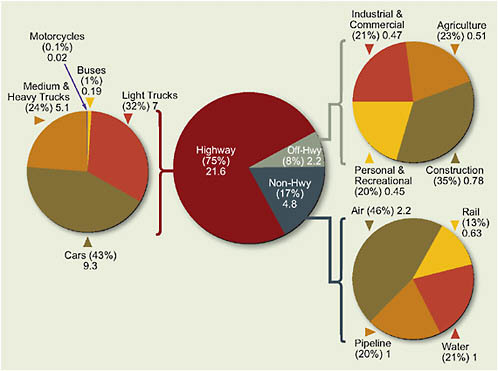
FIGURE 3.1 U.S. transportation energy consumption (quads) by mode and vehicle in 2003.
Note: Total U.S. energy consumption = 98.2 quads.
Light-duty vehicles (LDVs), defined as passenger cars and light trucks, are the primary users of gasoline. Heavy-duty vehicles (HDVs), defined as heavy trucks and buses and medium-duty trucks, accounted for most of the diesel fuel consumed, about 17 percent of the energy used. LDVs and HDVs accounted for about 60 percent and 20 percent of transportation sector carbon dioxide (CO2) emissions, respectively.
3.2.1
Public Transit
Although public transit consumes a relatively small fraction of overall transportation energy, it serves several important roles in urban transportation systems.
Today, the energy required for mass transit in the United States is less than 2 percent of the total energy used for transport (Davis et al., 2008). However, transit buses on average consume about the same amount of energy per passenger-mile as that consumed by LDVs, largely because of low average ridership, especially during non–rush hours (Davis et al., 2008). Rail transit is somewhat better in terms of energy use per passenger-mile, but apart from New York City and a few other densely populated cities that have heavy ridership during both peak and nonpeak hours, transit rail is also characterized by light usage for much of the day and thus high average energy use per rider. These averages mask the specific times (rush hours) and corridors during which public transit uses less energy per passengermile than passenger cars do and where targeted promotion of transit use could contribute to a reduction in total energy use. It merits noting that the run-up in gasoline prices in 2007–2008 coincided with increases in public transit ridership and that public transit ridership has grown by one-third in the United States over the past 12 years (APTA, 2008).
Although the panel did not analyze the potential for energy efficiency gains in public transit per se, it does consider in Section 3.6 how energy efficiency can be improved through system-level improvements in the provision, use, and operation of transportation systems. In so doing, the panel mentions how changes in the provision of transit services and in the operation of the highway and aviation infrastructure can boost energy efficiency.
3.2.2
Commercial Versus Private Transportation
The drivers for energy efficiency in commercial transportation differ from those for private transportation. Lifetime operating costs, and thus energy efficiency, are important to companies supplying passenger and freight transportation. The commercial transportation sector is so highly competitive that even small cost differentials among firms can have a major influence on their relative profitability and growth.
In contrast, fuel is a small fraction of the lifetime cost of owning a motor vehicle for private transportation. For many consumers, vehicle comfort, style, and operating performance are more important than fuel consumption. The time period over which the costs of driving are considered (relative to initial vehicle costs) also tends to be shorter for passenger transport than for freight transport.
3.3
THE POTENTIAL FOR ENERGY EFFICIENCY IMPROVEMENT IN PASSENGER TRANSPORTATION
Automobiles, light trucks, and aviation are the main modes of passenger transportation in the United States. Private automobiles account for the vast majority of local and medium-distance passenger-trips4 (those under 750 miles), and airlines account for longer trips (BTS, 2006).
3.3.1
Light-Duty Vehicles—Efficiency Trends
The major factors driving vehicles to become more (or less) fuel-efficient are the price of fuel (including taxes), regulations, and consumer preferences for particular vehicle attributes. This section reviews experience with these factors.
3.3.1.1
International Experience
Europe has historically had high fuel and vehicle taxes that raise owner and user costs. Moreover, diesel fuel has often been taxed at a rate lower than that for gasoline. High prices have pushed consumers to demand fuel-efficient vehicles, giving a larger market share to diesel engines. The average fuel economy of new lightduty vehicles in Europe today approaches 40 miles per gallon (mpg), 60 percent higher than in the United States.5
Vehicle fuel economy in Japan is similar to that in Europe. In 2006, Japan revised its fuel economy standard to 47 mpg, to be achieved by 2015 (ICCT, 2007b).
3.3.1.2
U.S. Experience
In contrast to the trend in Europe, from 1980 until recently, real gasoline prices had been falling in the United States, encouraging consumers to buy larger, heavier, more powerful vehicles and to drive more, rather than to seek greater fuel economy. During periods of high fuel prices (such as those prevailing in mid-2008), U.S. consumers have demonstrated more interest in fuel economy. The average fuel economy of recently sold new vehicles in the United States is about 25 mpg. The U.S. Energy Independence and Security Act of 2007 (EISA; Public
Law 110-140) requires that corporate average fuel economy (CAFE) standards be set for LDVs for model years 2011 through 2020 which will ensure that, by 2020, the industry-wide CAFE for all new passenger cars and light trucks, combined, is at least 35 mpg.6 This is a 40 percent increase over today’s average fuel economy.
Although fuel economy has not improved, fuel efficiency has improved. Owing to relatively low fuel prices and static fuel-economy standards between the mid-1980s and the early 2000s, increases in vehicle size and performance have offset energy efficiency gains in vehicles (Lutsey and Sperling, 2005; An and DeCicco, 2007). As a result, average new-vehicle fuel-economy levels have stagnated for nearly two decades, and total vehicle fleet use and greenhouse gas emissions have increased steadily owing to the increasing fleet size and vehicle-miles traveled (VMT).7
Before discussing specific energy-saving technologies for LDVs, the panel notes that energy prices will have a significant impact on the pace of the development and introduction of these technologies. The effects of fuel costs on driving and demand for motor fuel have been studied extensively. Recent work by Small and Van Dender (2007) suggests that, as U.S. incomes have risen, the dominant effect of increases in fuel prices has been more demand for vehicle fuel economy rather than reduced driving. In other words, people are more likely to drive vehicles with higher fuel economy than to sacrifice making trips in the face of rising gasoline prices. Small and Van Dender (2007) estimate that, in the short term, each 10 percent increase in fuel costs results in a 0.1 percent reduction in VMT but a 0.3 percent increase in realized miles per gallon, often achieved through more intensive use of the vehicles with the highest fuel economy in the household.8 In the longer term, when consumers have time to choose among alternative vehicle technologies and types, realized fuel economy increases by a full 2 percent for each 10 percent increase in fuel prices, while travel falls by 0.5 percent. (Figure 3.2 illustrates how recent increases in fuel prices have increased the fraction of new vehicles sold that are automobiles rather than light trucks, since cars average 27.5 mpg compared with 22.3 mpg for light trucks, and how the subsequent fall in prices has reversed this trend.) The response in the direction of
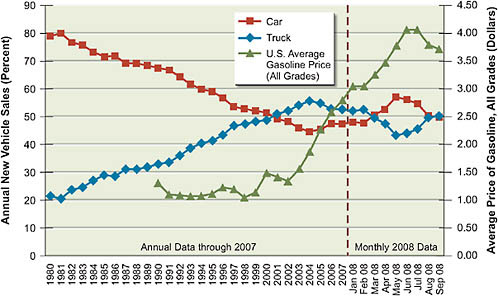
FIGURE 3.2 U.S. car and light truck percentage of new vehicle sales versus average price of gasoline (all grades).
Source: Gasoline prices (2007$) for 1980–2007 are from able 5.24 in EIA (2008). For 2008, the monthly nominal gas prices are from EIA (2009). Light truck and car percentages from 1980 to 2006 are from Table 4.6 of the Transportation Energy Data Book, Edition 27 (Davis et al., 2008). Light truck and car percentages for 2007 and 2008 are from Ward’s Automotive Group, a division of Prism Business Media, Inc., Ward’s U.S. Light Vehicle Sales Summary, Ward’s AutoInfoBank, available at http://wardsauto.com.
improved fuel economy suggests that as incomes and energy prices rise, they will spur demand for the kind of energy-saving technologies discussed next.
3.3.2
Light-Duty Vehicles—Technologies
Long-standing concern with oil imports and greenhouse gas emissions has led to several studies by the National Research Council (NRC), examining ways to reduce both of these. In particular, three studies have had as their main focus technologies that could improve fuel efficiency in light-duty vehicles (NRC, 1992, 2002, 2008b). Two other studies on hydrogen technologies and the hydrogen economy (NRC, 2008c and 2004a, respectively) also considered conventional vehicle technologies that could have an effect by 2020. Moreover, energy centers at leading U.S. universities and federal laboratories, as well as private consultants,
have recently carried out in-depth studies of transportation energy efficiency technologies and their potential to reduce petroleum use and greenhouse gas emissions through about 2030 (e.g., Bandivadekar et al., 2008; Lutsey, 2008). The following review of vehicle efficiency technologies draws on these and other studies; their quantitative estimates are in general agreement.
The review is organized as follows: engine improvements, transmission improvements, and other (nonpropulsion system) improvements. A brief overview of the possibilities for each of these to increase fuel efficiency in LDVs is given first. This is followed by a summary of the overall decrease in petroleum consumption that could result from these changes.9 Many of these technologies are already being used in a limited number of vehicles, but their use is expected to expand to satisfy the higher fuel-economy standards specified in EISA.
3.3.2.1
Engine Improvements
Gasoline Spark-Ignition Engine
The gasoline spark-ignition (SI) engine efficiency improvements that could be deployed in large volume in the next decade include but are not limited to the following: variable valve timing, two- and three-step variable valve lift, cylinder deactivation, direct injection turbocharging with engine downsizing, enginefriction reduction, and smart cooling systems. Many of these are already in lowvolume production. In the medium-term (15–20 years), technologies such as camless valve actuation, continuously variable valve lift, and homogeneous-charge compression ignition (HCCI)10 could be deployed in increasing numbers. A survey of recent technology assessments shows that the above technologies have the potential to reduce vehicle fuel consumption, on average, by approximately 10–15 percent in the new-vehicle sales mix11 in the nearer term (by 2020) and by
an additional 15–20 percent in the medium term (by 2030) (EEA, 2007; Kasseris and Heywood, 2007; Ricardo, Inc., 2008; NRC, 2008b). Turbocharged, downsized gasoline engines, which are some 10–15 percent more efficient than equalperformance, naturally aspirated gasoline engines, are expected to steadily replace a significant fraction of naturally aspirated (nonturbocharged) gasoline engines, improving energy efficiency and contributing to meeting future fuel-economy standards.
Diesel Compression-Ignition Engine
Owing to their high compression ratios and reduced pumping losses, turbocharged diesel engines currently offer approximately a 20–25 percent efficiency benefit over gasoline SI engines when adjusted for the higher energy density of diesel fuel. Efficiency improvements in compression-ignition (CI) engines are likely to come primarily from increased power density, improved engine-system management, more sophisticated fuel-injection systems, and improved combustion processes. New technologies are emerging for after-treatment to reduce emissions of particulate matter and oxides of nitrogen to levels comparable to those of SI engines. The primary challenges for diesel engines in the United States are the added costs and fuel penalties (of about 3–6 percent) associated with the after-treatment systems required to reduce these emissions (Bandivadekar et al., 2008; Johnson, 2008, 2009; Ricardo, Inc., 2008). By 2020, improvements in energy and after-treatment technologies have the potential to reduce the fuel consumption of new dieselengine vehicles relative to current diesel vehicles by about 10 percent, and by an additional 10–15 percent by 2030.
Gasoline Hybrid-Electric Vehicle
Hybrid vehicles combine an internal combustion engine (ICE) with electric drive from a battery-electric motor/generator system. Usually both systems can drive the vehicle, and the ICE recharges the batteries. (Hence, these vehicles are also called “charge-sustaining” hybrids.) The primary fuel-consumption benefits of a gasoline hybrid-electric vehicle (HEV) derive from regenerative braking, engine downsizing, the active management of energy use to maintain the most efficient engine operating conditions, and the elimination of idling.
Hybrid vehicles are increasingly being classified on the basis of the extent of the functions offered by the electric motor/generator. Relative to equivalent gaso-
line SI engines, belt-driven starter-generator systems can eliminate engine idling, reducing fuel consumption by 4–6 percent; integrated starter-generator systems that can recover energy from regenerative braking, along with eliminating engine idling (a mild hybrid), can reduce fuel consumption by 10–12 percent. A parallel full hybrid with power assist, such as Honda’s Integrated Motor Assist system, can increase this benefit to more than 20–25 percent, whereas more complex systems using two motors, such as Toyota’s Hybrid Synergy Drive, can reduce fuel consumption by more than 30 percent.
Some prototype diesel HEVs are under development and could be in limited production volumes within a few years. These could have about 10 percent higher efficiency (which corresponds to 20 percent lower diesel fuel consumption due to higher fuel density) than that of an equivalent gasoline hybrid. The cost for a diesel HEV would be significantly higher than for a gasoline-fueled version.
Plug-In Hybrid Electric Vehicle
Plug-in hybrid-electric vehicles (PHEVs) are hybrid vehicles that can be recharged from an external source of electricity. The liquid-fuel savings that can be realized is directly related to the amount of electricity stored in the battery.
PHEVs require substantially larger battery packs than those used in conventional HEVs. Depending on the nature of the HEV being redesigned as a PHEV, the redesigned vehicle will likely require a larger electric motor and higher-capacity power electronics. The larger battery and, if needed, larger components increase propulsion system size, weight, and cost. As with the chargesustaining hybrids discussed above, they also use an onboard ICE to recharge the batteries.
Batteries for these vehicles are usually sized to obtain an all-electric driving range of 20 to 60 miles. Compared with a gasoline SI-engine-powered vehicle, PHEVs could reduce petroleum consumption by up to 75 percent, depending on the onboard battery size and (thus) range, and on how these vehicles are driven (Kromer and Heywood, 2008). The corresponding reduction in greenhouse gas emissions depends on the greenhouse gas intensity of the electricity used to charge the battery. Although PHEVs are likely to be introduced in modest numbers into the U.S. market over the next 5 years, the development of a mass market for PHEVs will require low-cost, lightweight batteries that can store the needed electricity and last for 10 years or more (Anderman, 2007). The current status of battery performance and development is summarized in Box 3.2.
|
BOX 3.2 Status of Advanced Battery Technology Lead acid batteries were invented in the 19th century and are still the standard battery technology in vehicles today. The GM EV1, a production battery-electric vehicle (BEV), used this battery technology as recently as 1999, and then transitioned to the nickel-metal hydride (NiMH) battery. The next generation of batteries, based on lithium-ion chemistry, is widely deployed in consumer electronic devices. Of course, the power and energy storage requirements of these devices are much smaller than those of electric vehicles. Hybrid-electric vehicles (HEVs) require batteries with high power (commonly stated in units of watts per kilogram). Plug-in HEVs (PHEVs) and BEVs require significant energy storage (along with sufficient power). Today’s batteries have an energy storage capacity of 150–200 Wh/kg. A typical vehicle consumes approximately 0.25 kWh per mile in all-electric mode. Typical electric motors that can propel a vehicle require power ranging between 50 and 150 kW. Chemistries Table 3.2.1 summarizes the promising advanced battery chemistries and their performance characteristics. Significant amounts of research and development are being devoted to promising new versions of the chemistries of cathode materials, anode materials, and electrolytes, as well as to manufacturing processes. TABLE 3.2.1 Lithium-ion Battery Cathode Chemistries
|
|||||||||||||||||||||||||||||||||||||||||||||
|
Performance and Cost Targets The U.S. Advanced Battery Consortium (USABC) has established a set of long-term performance goals for electrochemical energy storage devices:
In addition, goals were established for battery life in terms of the number of 80 percent discharge cycles. Meeting these goals is likely to be required for widespread commercialization of electrically powered vehicles. Lithium-ion batteries currently lead in energy density (Wh/kg) metric and have an average annual improvement rate of 3.7 percent. Lead-acid batteries lead in the cost of stored energy ($/kWh) at $50/kWh and have an average annual reduction rate of around 3 percent. However, lead-acid batteries are unable to satisfy the battery life requirements for PHEVs and BEVs. Today’s lithium-ion batteries that have the cycle life desired for automotive applications cost between $500/kWh and $1000/kWh. The cost target (in $/kWh) is currently viewed as the greatest challenge for lithium-ion battery technology. Industry Developments The lithium-ion consumer electronics market is currently at around 2 billion units annually. The volume of lithium-ion batteries in automotive applications, however, is very small. Frost & Sullivan (2008) predict a 19.6 percent compound annual growth rate for shipments of HEV batteries, as well as a smaller but rapidly growing market for PHEV and BEV batteries. An auto battery alliance has been promoted by the U.S. Department of Energy’s Argonne National Laboratory and includes 3M, ActaCell, All Cell Technologies, Altair Nanotechnologies, EaglePicher, EnerSys, Envia Systems, FMC, Johnson Controls-Saft, MicroSun, Mobius Power, SiLyte, Superior Graphite, and Townsend Advanced Energy. All major vehicle manufacturers have partnered with major battery manufacturers: Ford with Johnson Controls-Saft, General Motors with LG Chem, Chrysler with General Electric, Toyota with Panasonic/Sanyo, Nissan with NEC via the Automotive Energy Supply joint venture, and Honda with GS Yuasa. Specialists anticipate that it may be 10 to 20 years before advanced battery technology can reach the USABC performance and cost targets. |
Battery-Electric Vehicle
The successful development and deployment of PHEVs enabled by developments in advanced battery technology might also lead to batteries suitable for batteryelectric vehicles (BEVs) (see Box 3.2).
Although several models of BEVs are being introduced into the market today in limited production volumes, in the near-term those BEVs that are commercially viable are likely to be small cars with modest performance capabilities, such as “city BEVs.”
Hydrogen Fuel-Cell Vehicle
Fuel-cell technology, in a hybrid system with hydrogen as the fuel, offers the promise of significantly higher propulsion system efficiency than that of ICE technology, as well as zero vehicle tailpipe greenhouse gas emissions. Several scientific, engineering, and business challenges must be overcome before hydrogen fuelcell vehicles (HFCVs) can be commercialized successfully (NRC, 2004a, 2008c, 2008d; Crabtree et al., 2004). As discussed in the studies just cited and in other references, the principal challenges are increasing the durability and lowering the costs of fuel cells, achieving cost-effective storage of hydrogen in fueling stations and on board the vehicle, and reducing the environmental impacts from deploying a hydrogen supply and fueling infrastructure with low greenhouse gas emissions.
The NRC’s recent study on the transition to a hydrogen-based transportation system (NRC, 2008c) discusses scenarios for the introduction of HFCVs. As these scenarios show, there is significant potential for reducing oil imports and CO2 emissions with HFCVs in the long term (2035–2050), but little opportunity for impact in the near term (by 2020) because of the time required to overcome existing technical challenges, to provide the fueling infrastructure, and to ramp up to high-volume vehicle production.
3.3.2.2
Transmission Improvements
Automatic transmissions are popular in the United States primarily because of their ease of use and smooth gearshift. Transmission efficiency is likely to improve in the near- to midterm through increasing the number of gears and reducing losses in bearings, gears, sealing elements, and the hydraulic system. While fourspeed transmissions have dominated the U.S. market, five-speed transmissions are becoming standard as well (EPA, 2007). Six-speed automatic transmissions, as well as automated manual transmissions, are already used in some cars and
TABLE 3.1 Expected Transmission System Efficiencies
|
Transmission |
Efficiency (%) |
|
Current automatic transmission (4- and 5-speed) |
84–89 |
|
Automatic transmission (6- or 7-speed) |
93–95 |
|
Dual clutch transmission (wet-clutch) |
86–94 |
|
Dual clutch transmission (dry-clutch) |
90–95 |
|
Continuously variable transmission (CVT) |
87–90 |
|
Source: Ricardo, Inc., 2008, and EEA, 2007. |
|
are likely to become more widely used over the next decade. Manufacturers have begun incorporating seven- and eight-speed transmissions into some luxury vehicles, and the penetration of these transmissions can be expected to increase in the midterm (2020–2035). Energy and Environmental Analysis, Inc., estimates that each additional gear results in a retail price increase of approximately $50 (EEA, 2007).
Table 3.1 lists the efficiencies that can be expected from various transmission systems in the near- to midterm. As shown, improvements of 2–9 percent are realizable and provide equivalent percentage reductions in vehicle fuel consumption. Note that, although a continuously variable transmission (CVT) allows the engine to operate near its maximum efficiency, the estimated efficiency of CVTs is lower than the corresponding estimate for six- and seven-speed automatic transmissions.12 CVTs have been in low-volume production for well over a decade.
3.3.2.3
Nonpropulsion System Improvements
Vehicle Weight and Size Reduction
Reducing vehicle weight is one obvious way to reduce fuel consumption. A commonly used rule of thumb is that a 10 percent reduction in vehicle weight can reduce fuel consumption by 5–7 percent, when accompanied by appropriate engine downsizing at constant performance (Bandivadekar, 2008). Vehicle simulation results suggest that the relative benefits of weight reduction may be smaller than this in some types of hybrid vehicles because the hybrid propulsion system
actively manages engine use to stay in areas of higher and more uniform efficiency and also to recoup vehicle energy during braking (An and Santini, 2004; Wohlecker et al., 2007).
Weight reduction can be achieved by substituting lighter-weight materials (such as aluminum) for heavier ones, by redesigning vehicles, and by downsizing vehicles and components. For example, downsizing a passenger car by one Environmental Protection Agency (EPA) size class (e.g., from large to midsize) can reduce vehicle weight by between 9 and 12 percent (Cheah et al., 2007). Unlike vehicle weight, however, vehicle size is an attribute that consumers value.
The cost of reducing vehicle weight through the use of lighter-weight materials is estimated to be about $3/kg ($1.40/lb) (Bandivadekar et al., 2008). Secondary weight reduction (e.g., using a smaller engine because the vehicle is lighter) and weight reduction due to vehicle redesign are usually assumed to occur when a vehicle is redesigned, so the cost is assumed to be small.
Rolling Resistance Reduction
A recent NRC report on tires and passenger-vehicle fuel economy (NRC, 2006) agrees with earlier estimates in the literature (Schuring and Futamura, 1990) that each reduction of 0.001 in the coefficient of the rolling resistance of passenger tires—equivalent to a 10 percent reduction in overall rolling resistance—can reduce vehicle fuel consumption by 1–2 percent. After examining the fuel-saving technologies and designs that are being developed for original-equipment tires (those supplied with new vehicles) to assist in meeting U.S. CAFE standards, the NRC report also concludes that such a 10 percent reduction in the average rolling resistance of passenger tires is possible over the next decade because many of these technologies can be introduced, not only into the new-vehicle market, but also into the much larger market of replacement tires. The incremental cost of such lower rolling resistance tires is expected to be small.
Aerodynamic Drag Reduction
In the EPA highway driving cycle13 with an average speed of 48 miles per hour, approximately half of the energy required to propel the vehicle is used to over-
come aerodynamic drag. Thus, body designs that reduce aerodynamic drag can achieve meaningful reductions in fuel consumption. The aerodynamic drag on a vehicle is the product of a drag coefficient (CD), the vehicle frontal area, the vehicle velocity squared, and the air density (divided by 2). Thus drag increases significantly as vehicle speeds increase, especially above 60 miles per hour. A 10 percent reduction in the drag coefficient can lower average vehicle fuel consumption by up to 2 percent. Demonstration vehicles built during the U.S. Department of Energy’s Partnership for a New Generation of Vehicles achieved a coefficient of drag as low as 0.22—a 35 percent reduction from the then-current vehicle (NRC, 2000). The cost of reducing the vehicle’s drag coefficient, since it would occur when the vehicle is redesigned or a new vehicle is developed, is assumed to be small.
Lubricants
Engine friction has a substantial negative impact on engine efficiency. Friction can be and is being reduced through improvements in engine design and the use of new materials and surface coatings. It can also be influenced by engine lubricant properties, and lower viscosity oils are increasingly being used. The most commonly used engine oils or lubricants are mineral oils that contain additives to improve viscosity, inhibit engine oxidation and corrosion, act as dispersants and detergents, and reduce surface friction. There are strong pressures to reduce both the consumption of engine oil and the additive components that produce ash, in order to minimize the degradation of the exhaust system’s emission-control technologies, such as catalysts and particulate traps. Effective and low-cost diesel emission control technologies are critical to any major expansion of diesel engine vehicles in the U.S. LDV market. The use of synthetic engine oils rather than mineral oils is growing: although their cost is higher, they can reduce engine friction and thus improve fuel economy by a few percent. Improvements in mineral oil properties could increase vehicle fuel economy by about 1 percent (NRC, 2008b).
3.3.2.4
Summary of Potential LDV Efficiency Improvements: Performance and Environmental Impacts
Table 3.2 shows the panel’s estimates for the potential reductions in petroleum consumption and greenhouse gas emissions that could result over the next 25 years from the adoption of both the evolutionary and the new-vehicle technologies discussed above. These estimates assume that vehicle size and performance are held constant.
TABLE 3.2 Potential Relative Vehicle Petroleum Use and Greenhouse Gas Emissions from Vehicle Efficiency Improvements Through 2035
|
Propulsion System |
Petroleum Consumption (gasoline equivalent) |
Greenhouse Gas Emissionsa |
||
|
Relative to Current Gasoline ICE |
Relative to 2035 Gasoline ICE |
Relative to Current Gasoline ICE |
Relative to 2035 Gasoline ICE |
|
|
Current gasoline |
1.00 |
|
1.00 |
|
|
Current turbocharged gasoline |
0.90 |
|
0.90 |
|
|
Current diesel |
0.80 |
|
0.80 |
|
|
Current hybrid |
0.75 |
|
0.75 |
|
|
2035 gasoline |
0.65 |
1.00 |
0.65 |
1.00 |
|
2035 turbocharged gasoline |
0.60 |
0.90 |
0.60 |
0.90 |
|
2035 diesel |
0.55 |
0.85 |
0.55 |
0.85 |
|
2035 HEV |
0.40 |
0.60 |
0.40 |
0.60 |
|
2035 PHEV |
0.20 |
0.30 |
0.35–0.45 |
0.55–0.70 |
|
2035 BEV |
None |
|
0.35–0.50 |
0.55–0.80 |
|
2035 HFCV |
None |
|
0.30–0.40 |
0.45–0.60 |
|
Note: These estimates assume that vehicle performance (maximum acceleration and power-to-weight ratio) and size remain the same as today’s average new-vehicle values. That is, the improvements in propulsion efficiency are used solely to decrease fuel consumption rather than to offset increases in vehicle performance and size. Estimates have been rounded to the nearest 0.05. BEVs and HFCVs are expected to have shorter driving ranges than PHEVs between rechargings or refuelings. BEV, battery-electric vehicle; HEV, hybrid-electric vehicle; HFCV, hydrogen fuel-cell vehicle; ICE, internal combustion engine; PHEV, plug-in hybrid vehicle. aGreenhouse gas emissions from the electricity used in 2035 PHEVs, 2035 BEVs, and 2035 HFCVs are estimated from the projected U.S. average electricity grid mix in 2035. Greenhouse gas emissions from hydrogen production are estimated for hydrogen produced from natural gas. Source: Bandivadekar et al., 2008. Estimates based on assessments by An and Santini, 2004; Wohlecker et al., 2007; Cheah et al., 2007; NPC, 2007; and NRC, 2004. |
||||
These estimates are based on studies that have evaluated the fuel-consumption reduction potential of many plausible improvements in power train and vehicle technology. The studies have aggregated these improvements through vehicle simulations and drive-cycle analysis, or by appropriately compounding realizable combinations of these improvements. Each entry in Table 3.2 is the fuel consumption of each technology (gasoline equivalent) relative to that of the average vehicle in either the current or the 2035 new-vehicle sales mix, and thus reflects an attempt to incorporate the extent to which these improvements have
been deployed across the sales mix. Relative fuel consumption for cars and light trucks is comparable. These numbers are for vehicles with performance levels and interior size essentially the same as those of today’s new vehicles, and with a 20 percent vehicle weight reduction, a 25 percent reduction in vehicle drag coefficient, and a 33 percent reduction in the tire rolling-friction coefficient. These reductions in relative fuel consumption are indicative of what could be achieved on average in vehicles by these improvements and changes in power train and vehicle technologies.
Taken together, these engine and transmission improvements, reductions in weight, and other nonpropulsion system improvements could reduce the fuel consumption of a gasoline ICE vehicle by up to 35 percent by about 2035.
Although current diesel-engine vehicles have a 20 percent gasoline-equivalent fuel-consumption advantage over current ICE gasoline-engine vehicles, this gap is likely to narrow (e.g., to 15 percent by 2035), as there is greater improvement potential in the gasoline engine.
Because their technology is relatively new and thus can deliver deeper cuts in vehicle fuel consumption, HEVs and PHEVs have greater potential for improved fuel consumption (e.g., 47 percent and 73 percent, respectively) than do ICE power trains. Note, however, that they continue to depend on petroleum or other liquid fuels.
Reductions in greenhouse gas emissions from gasoline and diesel ICEs, HEVs, and PHEVs are proportional to the reductions achieved in petroleum consumption. Further reductions in greenhouse gas emissions could be achieved by motor vehicles if the effective carbon content of fuels were lowered through the addition of biofuels having low net carbon emissions (NAS-NAE-NRC, 2009b).
BEVs and HFCVs are two longer-term technologies that need not depend on petroleum or alternative hydrocarbon fuels and could have zero tailpipe emissions of criteria pollutants and CO2.
For PHEVs, BEVs and HFCVs, the well-to-tank emissions produced during the generation of electricity and hydrogen determine the full potential for these vehicle technologies to reduce greenhouse gas emissions. Efficiency improvements in the vehicles themselves, together with low- or zero-emissions generation of the electricity and hydrogen that they require, offer the potential for dramatic reductions in total greenhouse gas emissions. If implemented, these improvements could give the PHEV the edge over the HEV in terms of reducing both petroleum consumption and greenhouse gas emissions.
The panel judges that the estimates shown in Table 3.2 can be realized if
manufacturers devote all future improvements in vehicle efficiency to reducing actual fuel consumption such that vehicle performance and size (acceleration and power-to-weight ratio) are kept essentially constant at today’s levels. Also, the electricity used to recharge PHEVs and BEVs is assumed to come from the anticipated average U.S. electricity supply mix (Kromer and Heywood, 2008). There are significant regional variations in the greenhouse gas emissions from the electricity supply system, as well as uncertainty about how large a fraction of the future supply will come from nuclear or renewable-energy sources, or will employ effective carbon capture and storage technology. The greenhouse gas emissions for HFCVs are based on the assumption that, in this transition timeframe (through 2035), hydrogen is produced by steam reforming of natural gas, currently the most economic and developed hydrogen production process.
Because vehicle manufacturers compete on—and consumers expect—everbetter performance, resolving the performance, size, and fuel-consumption trade-off is a critical policy challenge. As noted earlier, due to relatively low fuel prices and static fuel-economy standards between the mid-1980s and the early 2000s, vehicle size and performance increases have offset energy efficiency gains in vehicles (Lutsey and Sperling, 2005; An and DeCicco, 2007). Sales of more fuel-efficient vehicles have fluctuated with recent increases in fuel prices (see Figure 3.2). It is unlikely that future energy efficiency improvements will be realized in decreased fuel consumption unless appropriate fiscal, regulatory, or other policies are implemented to promote or require reduced fuel consumption over increased power or performance.
3.3.3
Light-Duty Vehicles—Costs
The estimation of technology costs is more uncertain than is the estimation of the relative benefit of individual technologies. This is particularly the case under the volatile economic conditions of 2008–2009.
The results of the panel’s evaluation, carried out under the economic conditions prevailing in mid-2008, are given in Table 3.3. The price increments given are relative to a 2005 gasoline vehicle. The cost estimates shown represent the approximate incremental retail price of future vehicle types (including the cost of emission-control systems), compared with current gasoline-fueled ICE vehicles (EEA, 2007; Bandivadekar et al., 2008).
These future (2035) vehicles incorporate improved engines of the type indicated, more efficient transmissions, a 20 percent reduction in vehicle weight (two-
TABLE 3.3 Estimated Additional Cost to Purchaser of Advanced Vehicles Relative to Baseline 2005 Average Gasoline Vehicle
|
Propulsion System |
Additional Retail Price (2007 dollars) |
|
|
Car |
Light Truck |
|
|
Current gasoline |
0 |
0 |
|
Current diesel |
1,700 |
2,100 |
|
Current hybrid |
4,900 |
6,300 |
|
2035 gasoline |
2,000 |
2,400 |
|
2035 diesel |
3,600 |
4,500 |
|
2035 hybrid |
4,500 |
5,500 |
|
2035 PHEV |
7,800 |
10,500 |
|
2035 BEV |
16,000 |
24,000 |
|
2035 HFCV |
7,300 |
10,000 |
|
Note: Cost and price estimates depend on many assumptions and are subject to great uncertainty. For example, different companies may subsidize new vehicles and technologies with different strategies in mind. Costs listed are additional costs only, relative to baseline average new car and light truck purchase prices (in 2007 dollars) that were calculated as follows: —Average new car: $14,000 production cost × 1.4 (a representative retail price equivalent factor) = an average purchase price of $19,600. —Average new light truck: $15,000 × 1.4 = $21,000. These are not meant to represent current average costs. Rather, they are the costs used in this analysis. See Box 3.3 for more information on the assumptions underlying the estimates. For the purpose of these estimates, the PHEV all-electric driving range is 30 miles; the BEV driving range is 200 miles. Advanced battery and fuel-cell system prices are based on target battery and fuel-cell costs from current development programs. Source: Bandivadekar et al., 2008. |
||
thirds from materials substitution at a cost of $3/kg), and moderate reductions in tire rolling resistance and aerodynamic drag. They have the same size and performance as those of today’s vehicles.
These prices are based on the costs associated with producing a vehicle at the manufacturing plant gate. Note that if the demand for new materials in these vehicles raises material costs significantly, then manufacturing costs would increase accordingly. To account for distribution costs and manufacturer and dealer profit margins, production costs were multiplied by a representative factor of 1.4 to provide representative retail price estimates (Evans, 2008).
More information on the assumptions behind the estimates in Table 3.3 is provided in Box 3.3.
Note that the timescales indicated for these future-technology vehicles are not precise. The rate of price reduction will depend on the rate at which these
|
BOX 3.3 Estimating the Cost of Advanced Vehicles The cost estimates in Table 3.3 in this chapter are from Bandivadekar et al. (2008). The estimates are based on an extensive review of existing studies assessing the costs and fuel-consumption benefits of future vehicle technologies. The cost estimates assume high-volume production of 500,000 to 1 million vehicles per year. For conventional internal combustion engines, future technology costs were estimated on a component-by-component basis in proportion to the improvement in fuel consumption, based on a comparison of the costs and fuel-consumption benefits of 11 studies. Alternative power train costs—for hybrid, plug-in hybrid, battery-electric, and fuel-cell vehicles—were estimated by aggregating the results of several studies based on a component-by-component assessment. The costs for pre-commercial and emerging technologies (in particular, those for fuel-cell systems and batteries) assume additional cost reductions resulting from continued technology development. These cost reductions are over and above those realized as a result of high production volumes. Battery costs assume that the material costs decrease by 30 percent relative to a present-day, high-volume estimate; this assumption is consistent with technology-development assumptions in Anderman et al. (2000). Costs for fuel-cell systems were estimated using the cost models developed in Carlson et al. (2005) and the assumptions summarized in Kromer and Heywood (2008).1 In addition, since the more recent Massachusetts Institute of Technology report (Bandivadekar et al., 2008) was released, updated fuel-cell and battery data have been made publicly available and provide a more recent assessment. See the following:
|
technologies are taken up by the market (Bandivadekar et al., 2008; Evans, 2008). Wide and rapid deployment could bring costs down more quickly.
The results in Table 3.3 show that power trains entering the fleet today, such as improved diesel engines and hybrid vehicles, cost the purchaser from 10 percent to 30 percent more than a current gasoline vehicle costs. This price difference (in constant dollars) is expected to drop to 5–15 percent in the midterm (by 2035) because the increase comes from incorporating new technology whose cost is expected to drop more rapidly, owing to in-use experience, than will the costs of well-established technologies. Longer-term options such as plug-in hybrid and fuel-cell vehicles are estimated to cost between 25 percent and 30 percent more than this 2035 gasoline vehicle. Battery-electric vehicles with standard vehicle performance and size remain costly, approaching double the cost of a future gasoline vehicle. As noted earlier, a more plausible market opportunity for BEVs is small, city cars with reduced range. However, these also will need significantly improved battery performance and reduced battery costs to become competitive.
Retail price increases from technologies that reduce fuel consumption are largely offset by fuel savings over a vehicle’s lifetime, but not in all cases. The extent to which this is the case depends on how the more efficient technology is used. As noted earlier, efficiency improvements can be directed toward reducing actual fuel consumption or toward moderating the increase in fuel consumption that would otherwise accompany increased vehicle size and power. An estimate of the full cost of reducing fuel consumption would account for how changes in vehicle attributes such as fuel efficiency, power, and size affect the value that consumers derive from these products.
The net economic benefit of reduced fuel consumption derived by vehicle purchasers obviously depends on the fuel price, the discount rate, and the time period over which the benefit is assessed. It also depends, of course, on the vehicle price increment and the amount of fuel saved. With full emphasis on reducing actual fuel consumption rather than on increasing vehicle performance and size, at a fuel price of $2.50 per gallon and a 7 percent discount rate over 15 years (the average vehicle lifetime) and 150,000 miles, improved gasoline engines fully pay back the retail price increase (relative to a current vehicle) (Bandivadekar et al., 2008). Hybrid and diesel power trains pay back 60 percent and 90 percent of the up-front retail price increase, respectively, under similar discounting assumptions. Longer-term options such as PHEVs and HFCVs are estimated to pay back 50 percent to 70 percent of the increase in retail price at a fuel price of $2.50 per gallon. At a higher fuel price of $5.00 per gallon, the discounted fuel savings of
all the technologies listed in Table 3.3, except diesel vehicles and standard-sized BEVs, fully pay back the initial retail price increase. (Battery packs in these future hybrid and electric vehicles are assumed to last for a vehicle’s lifetime, so battery replacements are not included in these costs.)
Note that it is widely accepted that consumers discount their fuel savings over a much shorter period—typically 3 to 4 years. This reduces the benefit of the fuel savings significantly. Reductions in the price of future hybrid systems could allow these vehicles to break even. Diesel engines could lose ground relative to future gasoline vehicles owing to the greater potential for increased efficiency of the gasoline ICE and also resulting from the anticipated higher diesel fuel cost over gasoline due to rising diesel fuel demand for freight transportation.
The estimates in Table 3.3, when combined with the estimated fuel-consumption reductions in Table 3.2, indicate that evolutionary improvements in gasoline ICE vehicles are likely to prove the most cost-effective choice for reducing petroleum consumption and greenhouse gas emissions. These vehicles will be sold in large quantities in the near term, so if the overall cost of reducing fuel consumption and greenhouse gas emissions from motor vehicles is to be kept as low as possible, it is critical that efficiency improvements in these vehicles be used primarily to reduce on-the-road fuel consumption.
While current HEVs appear to be less competitive than improved gasolineand diesel-fueled ICE vehicles, over time they are likely to become a more costeffective choice in many applications as a consequence of their substantial and increasing fuel efficiency advantage and the anticipated reduction in their price premium.
PHEVs, BEVs, and HFCVs appear to be more costly alternatives for reducing petroleum consumption and greenhouse gas emissions. Among these three technologies, PHEVs are likely to become more widely available in the near term to midterm, whereas BEVs and HFCVs are midterm to long-term alternatives for high-volume production.
3.3.4
Light-Duty Vehicles—Deployment
To have a significant effect on the petroleum use and greenhouse gas emissions of the entire vehicle fleet, the market share of vehicles that are significantly more fuel efficient must become sizable. Common barriers to achieving such a market share include but are not limited to higher initial cost, safety concerns, fuel availability (or lack thereof), reliability and durability concerns, and a lack of consumer
awareness. Because the advanced-technology (non-ICE) vehicles are competing against steadily improving gasoline ICE vehicles, the market penetration of such vehicles may be slow unless aided by high fuel prices or by fiscal, regulatory, or other policies.
Even if sufficient market demand exists for certain technologies, time and capital constraints affect how quickly the demand can be satisfied. Typical development times for automotive products are 3–5 years. Then to deploy these new products, vehicle manufacturers and their suppliers must be able to make adequate capital investments to bring new production capacity online, and the supply of critical components (such as advanced batteries) must be assured. Generally, a decade or more is required between the development of a technology to a stage at which it can be deployed, its introduction on a commercial vehicle, and then the achievement of significant sales. For example, it has taken 10–15 years or more for major new technologies such as automatic transmissions to reach significant deployment levels; the same has been the case for the spread of small, high-speed diesel engines in cars in Europe (now some 50 percent of the market) (Bandivadekar et al., 2008).
Currently, there are no quantitative methods that can estimate possible vehicle market shares based on the constraints outlined above. Moreover, there are the technical constraints discussed earlier. For example, both PHEVs and HFCVs will need significant technical breakthroughs to become competitive in the market.
If high energy-storage battery technology progresses sufficiently (see Box 3.2), PHEVs could be deployed more rapidly than could HFCVs and the hydrogen distribution infrastructure, with production volumes building over the 2020–2035 timeframe. The infrastructure issues associated with supplying electricity to PHEVs can be dealt with incrementally as production volumes start to increase over the next decade. In the midterm, beyond about 2020—when PHEV sales volumes could increase to significant levels—the impact on the electrical supply and distribution system would then become more substantial. In contrast, a new infrastructure is needed to supply hydrogen to HFCVs. Thus, PHEVs are increasingly being viewed as a promising midterm to long-term option.
A recent NRC report (NRC, 2008c) concludes that, although “the maximum practicable number of HFCVs that could be on the road by 2020 is around two million,” it would take decades—e.g., until 2050—for this technology to have a major impact on oil use and greenhouse gas emissions.
Table 3.4 shows the panel’s judgment, based on all these constraints, of the extent to which these advanced-technology vehicles could penetrate the new
TABLE 3.4 Plausible Share of Advanced Light-Duty Vehicles in the New-Vehicle Market by 2020 and 2035 (percent)
light-duty vehicle (LDV) market in the United States. The estimates are intended as illustrations of achievable deployment levels, based on historical case studies of comparable technology changes which suggest that relative annual increases of 8–10 percent in the deployment rate are plausible. With changes in the factors that affect vehicle attributes or purchases, such as stricter fuel-economy standards or high fuel prices, the timeline for reaching these market shares could be shortened.
Note that the panel’s estimates are not meant to imply that all of these technologies would necessarily be deployed together. It may turn out that some technologies do not prove to be marketable. Others that are more appealing could then capture a higher fraction of new-vehicle sales.
Vehicles with major changes in technology, or with new technology, face many hurdles on their way to market acceptance. Of course, they must be more appealing to a significant fraction of the market than the vehicles that they are intended to replace. That attractiveness has many attributes: for example, performance, capacity, utility, style, fuel consumption, and especially price. The panel’s judgment is that none of the alternatives to steadily improving mainstream technology vehicles currently appears attractive enough to guarantee market acceptance.
3.3.5
Total Light-Duty Vehicle Fleet Fuel Consumption—Estimates
As stated above, the Energy Independence and Security Act of 2007 requires that the corporate average fuel economy standard be 35 mpg in 2020.
The panel examined two scenarios to explore how the deployment of the advanced technologies listed in Table 3.2, together with vehicle efficiency improvements (such as reductions in vehicle weight, aerodynamic drag, and tire rolling
resistance), could reduce the petroleum consumption of the U.S. in-use vehicle fleet. The methodology used for the analysis follows that described in Cheah et al. (2007) and Bandivadekar et al. (2008). The two scenarios—termed “optimistic” and “conservative”—are described in Box 3.4.
Note that these scenarios are not predictions or forecasts of what the future vehicle fleet would be like, but instead are intended as illustrative examples of the degree of change to the vehicle fleet required to improve fleet average fuel economy. In these scenarios, the panel examined the effects on fleet fuel consumption of the fuel-economy improvements that may be achieved by 2020. It then extrapolated the associated improvement rates (over 2006–2020) out through 2035 (see Box 3.4). The scenarios reflect the relative petroleum consumption of vehicle technologies as shown in Figure 3.3. These values are closely comparable to the rounded numbers on consumption based on more than one source in Table 3.2. The values were estimated assuming that vehicle performance and size are held constant and that all power train and vehicle efficiency improvements are used to reduce fuel consumption rather than to offset increases in performance and size.
Based on the estimated fuel-consumption characteristics of individual vehicle types shown in Figure 3.3 and the fleet efficiency improvements represented in the scenarios, Table 3.5 shows examples of the sales mixes and weight reduction that would be required to meet the CAFE targets and to extend that rate of improvement beyond 2020. Achieving the “optimistic” targets would require that the efficiency improvements provided by these technology changes be used largely to decrease actual fuel consumption. In this case, the emphasis on reducing fuel consumption, or ERFC, parameter would have to be 75 percent, which allows only a modest increase in average vehicle performance (a reduction in the 0-to-60 mph acceleration time of about 1 second from its current average value of about 9 seconds). For the conservative scenario, only half of the efficiency gains that could be made by 2035 are realized in decreased fuel consumption—the rest of the efficiency improvement is used to offset the fuel-consumption impacts of additional increases in vehicle power, weight, and size.
The relative proportions of the various power trains are based on the panel’s judgments as to their relative attractiveness (including cost), the degree of change from the baseline technology, and the historically observed limit of about 10 percent in the annual increase in production volumes when attractive changes in power train technology occur (such as the transition from manual to automatic transmissions in the United States, and the buildup of diesel engines in passenger cars in Europe). Note that the emphasis on reducing fuel consumption rather than
|
BOX 3.4 Future Vehicle Scenarios Optimistic Scenario The optimistic scenario assumes that the new vehicle sales mix in 2020 meets the Energy Independence and Security Act (EISA; Public Law 110-140) corporate average fuel economy (CAFE) target of 35 mpg (a 40 percent increase from today’s value). It then assumes that fuel efficiency continues to improve at the same rate through 2035. A full 75 percent of this improvement potential is assumed to be devoted to decreasing actual fuel consumption; the rest is assumed to be offset by increased vehicle performance, size, and weight.1 This assumption is represented by introducing a factor called “emphasis on reducing fuel consumption,” or ERFC. In this case, the value of ERFC is 75 percent. The result is that, by 2035, average new-vehicle fuel economy would reach 50 mpg—double today’s value. Conservative Scenario The conservative scenario assumes that the 2020 CAFE target is met 5 years later, in 2025. It then assumes that fuel efficiency continues to improve at this rate (a lower rate than in the optimistic scenario). However, it also assumes that only half of this improvement is used to decrease actual fuel consumption (an ERFC value of 50 percent), and the rest is assumed to be offset by gains in vehicle performance, size, and weight. The result is that, by 2035, average new-vehicle fuel economy has increased to only 40 mpg—about 60 percent above today’s values. No-Change Baseline The two scenarios above are compared with a no-change baseline. This baseline extrapolates the history of the past 20 years, during which power train efficiency improvements essentially offset the negative impacts on fuel consumption of increasing vehicle performance, size, and weight (i.e., the no-change baseline assumes an ERFC value of zero). |
on increasing performance and size assumes a significant shift in U.S. vehicle purchasers’ choices. ERFC is currently low (about 10 percent) in the United States, whereas it averages 50 percent in Europe. The weight-reduction estimates come from a shift from light trucks to cars (the mix in the United States is about 50 percent light trucks); more extensive use of lighter-weight materials such as aluminum; the redesign of components and vehicles; and some reduction in vehicle size, in both light trucks and cars. These weight-reduction estimates (of 700–1050 lb)
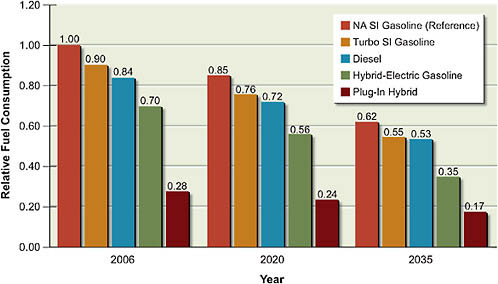
FIGURE 3.3 Relative fuel consumption (tank to wheels) of future cars by power train, assuming that all efficiency improvements go to raising fuel economy.
Source: Cheah and Heywood, 2008.
are based on assessing the specific weight-reduction opportunities and aggregating plausible combinations of these other improvements that would also meet these fuel-economy objectives. These sales mix illustrations were selected so as to make comparable the degree of challenge in all the areas where improvements are needed. See Bandivadekar et al. (2008) and Cheah and Heywood (2008) for additional details.
This analysis indicates that achieving the CAFE target and continuing that rate of improvement beyond 2020 will require substantial changes in engine and vehicle technology, as well as significant weight reduction (part of which could result from size reduction) and changes in consumer preferences and purchasing behavior.
Figure 3.4 shows, for the conservative and optimistic scenarios, the corresponding annual gasoline consumption of the U.S. in-use LDV fleet from the present out to 2035. A no-change baseline assumes that all of the efficiency improvements go to vehicle size, weight, and power, as has occurred since 1982. The cumulative fuel savings under each scenario compared with this no-change base-
TABLE 3.5 Illustrative Vehicle Sales Mix Scenarios
|
|
Percent Emphasis on Reducing Fuel Consumptiona |
Percent Light Trucks vs. Cars |
Percent Vehicle Weight Reduction |
Market Share by Power Train (percent) |
Percent Fuel Efficiency Increase from Today |
|||||
|
Naturally Aspirated SI |
Turbo SI |
Diesel |
Hybrid |
Plug-in Hybrid |
Total Advanced Power Train |
|||||
|
Optimisticb |
|
|
|
|
|
|
|
|
|
|
|
2020 |
75 |
40 |
17 |
52 |
26 |
7 |
15 |
0 |
48 |
+38 |
|
2035 |
75 |
30 |
25 |
36 |
26 |
9 |
20 |
9 |
64 |
+100 |
|
Conservativec |
|
|
|
|
|
|
|
|
|
|
|
2025 |
50 |
40 |
17 |
55 |
24 |
7 |
14 |
0 |
45 |
+38 |
|
2035 |
50 |
40 |
20 |
49 |
21 |
7 |
16 |
7 |
51 |
+62 |
|
Note: Assumed average new-vehicle weight (cars and light trucks) currently is 1900 kg (4180 lb). Thus, average weight reductions of 700–1050 lb per vehicle would be required. Neither of these scenarios includes BEVs or FCVs. aThe amount of the efficiency improvement that is dedicated to reducing fuel consumption (i.e., that is not offset by increases in vehicle power, size, and weight). bThe optimistic scenario meets the new CAFE target of 35 mpg in 2020, and then extrapolates this rate of improvement through 2035. In this case, the average fuel economy in 2035 reaches 52 mpg, roughly double today’s value. cThe conservative scenario achieves the new CAFE target of 35 mpg only in 2025 (5 years later) and extrapolates this rate of improvement through 2035, when the average fuel economy reaches only 60 percent above today’s value. |
||||||||||
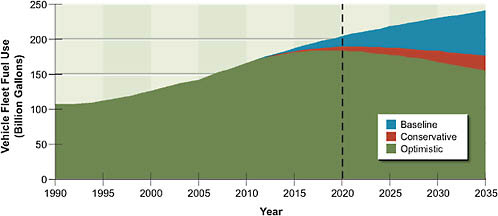
FIGURE 3.4 Fuel use for the U.S. in-use light-duty vehicle fleet out to 2035.
Source: Cheah and Heywood, 2008.
line are indicated. Note that this no-change baseline includes some growth in overall fleet size and miles driven, but no resulting change in vehicle fuel consumption.
Table 3.6 shows the corresponding cumulative fuel savings of the U.S. in-use LDV fleet through 2035. The cumulative, fleetwide fuel savings can be substantial, so long as the proposed fuel-economy standards are met and the rate of improvement is sustained.
Table 3.7 gives the corresponding annual fuel savings from the no-change baseline in 2020 and 2035.
These illustrative scenarios show that substantial changes in vehicle weight and size, significant improvements in the efficiency of ICE power trains, and the increasing production over time of hybrid systems will all be needed to reduce the in-use fuel consumption of the U.S. LDV fleet. The market will need to respond by purchasing these improved vehicles in steadily growing volumes despite their higher price, and it will need to forgo expectations of ever-increasing vehicle performance. If the trends indicated by these scenarios are to occur, the assumed production-vehicle changes (or their equivalents) will need to start soon. If all this does happen, then in-use U.S. LDV gasoline consumption would level off by about 2020, offsetting the fuel-consumption growth path that the United States has been following over the past few decades. Fuel consumption could then decline back to 2007–2008 levels by 2035.
TABLE 3.6 Cumulative Fuel Savings from the Baseline Shown in Figure 3.4
TABLE 3.7 Annual Fuel Savings in 2020 and 2035 from the No-Change Baseline Shown in Figure 3.4
3.3.6
Environmental Impacts of Light-Duty Vehicles—Life-Cycle Context
A full assessment of the effects on the environment of an LDV would cover energy consumption and all environmental effects, including greenhouse gas emissions, over the entire vehicle lifetime, which includes the vehicle manufacturing and disposal stages as well as vehicle use. Currently, the energy use and greenhouse gas emissions associated with manufacturing are each some 10 percent of the total fuel use and emissions over the vehicle life cycle. This fraction rises as vehicles become more fuel efficient: for hybrid and fuel-cell vehicles, the fraction is 15–20 percent.14
For a full life-cycle assessment, the energy and greenhouse gas emissions involved in fuel supply would also be included. The energy required to produce gasoline or diesel fuel ranges from 20 to 25 percent of the fuel energy delivered to the vehicle fuel tank, depending on the petroleum source and the refining details
(Bandivadekar et al., 2008). For biofuels, electricity, and hydrogen, this component is more complex and depends strongly on how these other sources of energy are generated.
When the energy consumption and emissions from all four life-cycle stages—manufacturing, use, disposal, and fuel supply—are added together, the relative benefits (of one vehicle type over another) are diminished, because the energy and greenhouse gas emissions associated with supplying petroleum-based fuels are proportional to the amount of fuel used, whereas the manufacturing effects are not.
The need discussed above to assess the environmental impacts of transportation in a full life-cycle context goes beyond the scope of this chapter. The World Business Council for Sustainable Development reviewed these broader issues in its study Mobility 2030, which describes the major challenges that future transportation systems must address. These involve reducing emissions of greenhouse gases and other air pollutants, mitigating ecological damage, lowering traffic-related deaths and injuries, reducing noise, easing congestion, and enhancing mobility opportunities. This broader set of challenges is the context in which an assessment of transportation’s energy consumption and greenhouse gas emissions must be grounded (WBCSD, 2004).
3.3.7
Passenger Aircraft for Air Transportation
As shown in Figure 3.1, air transportation represents almost half of nonhighway transportation energy use, or about 10 percent of total transportation energy use in the United States. Several studies have examined opportunities for increasing energy efficiency in commercial passenger aircraft (see Kahn Ribeiro et al., 2007). Airline investment decisions are driven by fuel efficiency, since fuel expenditures are the largest operating cost for most airlines. For example, Boeing’s and Airbus’s newest generation of airliners, the Boeing 787 Dreamliner and 747-8 and the Airbus A350-XWB, employ weight-reducing carbon composite structural materials and less energy-intensive electrical systems. These aircraft represent a 15–20 percent improvement in fuel efficiency over the aircraft that they replace.
As shown in Figure 3.5, there have been many energy-saving technological improvements in commercial aircraft since the introduction of jet airliners, spanning the 1960s-era Boeing 707 to the Boeing 777. The new 787 Dreamliner and Airbus’s forthcoming A350 are extending these improvements. Business jets are likewise becoming more energy-efficient. Fuel performance has become a major selling point for makers of these aircraft. For example, Honda Motor Company is
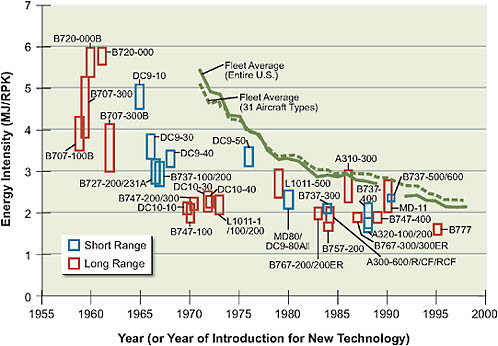
FIGURE 3.5 Commercial aircraft efficiency trends. The dotted line is the fleet average for only the 31 aircraft types shown.
Note: RPK, revenue passenger-kilometer; 1 million joules is about 0.95 thousand Btu.
Source: Lee et al., 2004, adapted from Lee et al., 2001. Reprinted with permission from Elsevier.
developing a six-seat jet aircraft that the automaker plans to market for business aviation. This aircraft has a number of features aimed at reducing weight and drag (lightweight engines, all-composite fuselage, and over-the-wing engine mount) and thus fuel burn.
Commercial aircraft must satisfy a number of demands and constraints, including performance with respect to safety, noise, passenger comfort, and emissions of air pollutants. As noted in Lee et al. (2001), as the fuel efficiency of commercial airliners has increased, some of these gains have been used to provide additional passenger amenities (e.g., more luxurious first-class seating, sophisticated entertainment systems) as well as to reduce noise. This fractional ERFC parallels the experience with automobiles discussed above.
In addition to the design of the aircraft themselves, the systems in which they operate have a major influence on energy efficiency. The efficient use of aircraft, along with choosing the most suitable aircraft to fulfill market service requirements, is critical to improving system energy efficiency. Figure 3.6 shows
the historical trends in aircraft seating capacity and load factors (passengers per available seat). As noted in Lee et al. (2001), “Load factor gains have been attributed to deregulation in the U.S. and global air travel liberalization, both of which contributed to the advent of hub-and-spoke transportation systems” (p. 185). While hub-and-spoke services may lead to more circuitous trips than are required with point-to-point service (necessitating additional miles traveled and operations to and from the connecting hub airport), on balance they can boost energy efficiency because they enable more intense utilization of aircraft. Likewise, air-traffic-control and management procedures influence energy efficiency. Air-traffic management that leads to more precise and less circuitous flight paths, reduced taxiing and idling, and more efficient climbs and descents will reduce fuel burn. Next-generation, satellite-based air navigation systems and new air-traffic-control procedures, such as continuous descent approaches, promise to shorten flights and yield further gains in operational efficiency. These gains will complement those from advances in aircraft engines, materials, and wing designs (such as raked wing tips that reduce cruise drag).
Thus, energy efficiency in air transportation must be viewed on a comprehensive, systems basis that considers the energy performance of aircraft designs as well as how they are used. According to Lee et al. (2001), the energy intensity
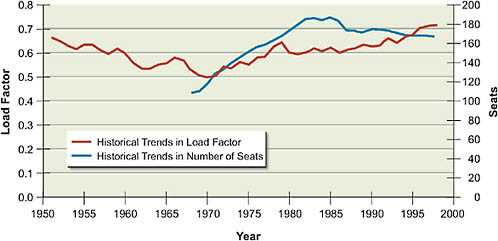
FIGURE 3.6 Historical trends in aircraft seating capacity and load factors for flights operated by U.S. carriers.
Source: Lee et al., 2001. © 2001. Reprinted with permission from Elsevier.
of new aircraft (measured by energy consumed per seat-mile flown) declined by 60 percent during the first 40 years of jet travel. The authors estimate that 57 percent of this decline stemmed from increases in engine efficiency, 22 percent from increases in aerodynamic performance, 17 percent from increased load factors, and 4 percent from operational changes such as flight time efficiency (that is, reduced time on the ground or in noncruise portions of the flight). They anticipate energy efficiency improvements of 1–2 percent per year for the next two decades, yielding a total improvement of more than 30 percent over this period. The Federal Aviation Administration expects air travel demand (in passenger emplanements) to grow about 3 percent per year over the next several decades.15
This presents a major challenge to efforts to reduce fuel consumption in this sector, because energy efficiency per passenger emplanement is expected to improve by only 1–2 percent per year (Lee et al., 2004). This energy efficiency improvement will not be enough to counter the expected growth in demand.
3.4
FREIGHT TRANSPORTATION
The United States spends about 6–7 percent of its gross domestic product (GDP) on the movement of freight. According to the Federal Highway Administration (FHWA, 2007), about 21 billion tons of freight were moved in 2006 (including 4 billion tons in pipeline movements).16 The FHWA expects U.S. freight transport to continue to grow by 2 percent per year over the next two to three decades as the economy grows and domestic and international trade increases, resulting in an 85 percent increase in freight tonnage by 2035 (to 37 billion tons). Factoring in 0.5 percent annual growth in energy efficiency in the freight sector means that total energy use for freight movement will grow by 40 percent or more.
Table 3.8 shows projections of freight tonnage by mode for 2035. These projections are based in large part on assumptions for GDP growth, as freight volumes have historically tracked economic growth.
Trucking dominates freight shipment in the United States in terms of both tonnage and shipment value (on the latter measure, it accounts for 95 percent of shipments). The dominance of the truck mode is not expected to change during
TABLE 3.8 Weight of Freight Shipments by Mode: 2007 and 2035 (millions of tons)
|
|
2007 |
2035 |
||||||
|
Total |
Domestic |
Exportsa |
Importsa |
Total |
Domestic |
Exportsa |
Importsa |
|
|
Total |
21,225 |
19,268 |
619 |
1,338 |
37,210 |
33,666 |
1,112 |
2,432 |
|
Truck |
12,896 |
12,691 |
107 |
97 |
22,813 |
22,230 |
262 |
320 |
|
Rail |
2,030 |
1,872 |
65 |
92 |
3,525 |
3,292 |
57 |
176 |
|
Water |
682 |
575 |
57 |
57 |
1,041 |
874 |
114 |
54 |
|
Air |
14 |
4 |
4 |
6 |
61 |
10 |
13 |
38 |
|
Intermodalb |
1,505 |
191 |
379 |
935 |
2,598 |
334 |
660 |
1,604 |
|
Pipeline and unknownc |
4,091 |
3,934 |
6 |
153 |
7,172 |
6,926 |
5 |
240 |
|
aData do not include imports and exports that pass through the United States from a foreign origin to a foreign destination by any mode. bMail and courier shipments and all intermodal combinations except air and truck. cPipeline and unknown shipments are combined because data on region-to-region flows by pipeline are statistically uncertain. Source: U.S. Department of Transportation, Federal Highway Administration, Office of Freight Management and Operations, Freight Analysis Framework, Version 2.2, 2007. Available at http://www.ops.fhwa.dot.gov/freight/freight_analysis/nat_freight_stats/docs/08factsfigures/table2_1.htm. See also http://ops.fhwa.dot.gov/freight/freight_analysis/nat_freight_stats/docs/07factsfigures/table 2_1.htm. |
||||||||
the next 25 years. It is important to note, however, that this forecast was made before the run-up in diesel prices to more than $5 per gallon in 2008. Sustained higher diesel prices may lead to some marginal shifts in traffic to other modes and perhaps to lower overall growth in freight traffic.
3.4.1
Heavy-Duty Vehicles
The trucking sector is the main user of heavy-duty vehicles, defined as trucks and buses having gross vehicle weights exceeding 10,000 lb. HDVs consume about 25 percent of the fuel used in the highway sector, the vast majority diesel (Figure 3.7). The largest HDVs used in transportation—those having gross vehicle weights in excess of 33,000 lb—account for half of the energy used by the HDV fleet. These vehicles include the tractor-trailer combinations that are dominant for long-haul freight transportation. It merits noting that HDVs are used for construction, mining, agriculture, and other nontransportation purposes. Although these off-road vehicles are not examined further in this section, they do use a large portion of total HDV energy.
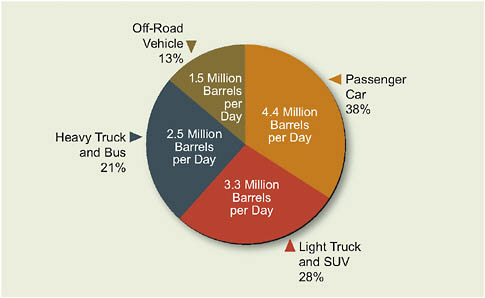
FIGURE 3.7 Total U.S. highway and off-road vehicle fuel use in 2003 (diesel and gasoline only), in million barrels per day.
Source: Transportation Energy Data Book, Edition 25 (Davis and Diegel, 2006).
Fuel efficiency is an important factor in diesel-engine and truck design because fuel costs account for a major portion of HDV operating costs. It is not uncommon for a tractor used intensely for long-distance freight transportation to travel more than 800,000 miles in its service life. Some tractors get about 5 mpg with diesel fuel; maintaining the engine, improving tires and aerodynamics, and limiting speed could boost their performance by 1–2 mpg. Over an 800,000-mile life, a tractor getting 5 or 7 mpg would use 160,000 and 114,000 gallons of diesel fuel, respectively. The more efficient tractor would save 46,000 gallons of diesel fuel, or $230,000 at $5 per gallon. This example shows how high diesel fuel prices create an environment that compels carriers to focus on vehicle efficiency, both in their vehicle purchase decisions and in their fleet maintenance and operations.
HDV energy efficiency is a complex issue, however, because trucks perform a wide variety of duties and operate in many environments. Measuring energy efficiency across this sector is therefore complicated. For example, one truck moving a 30-ton payload 500 miles may average only 5 mpg, while another operating over the same distance carrying a 10-ton payload may average 7 mpg. The former truck will be more energy-efficient on a ton-mile basis, whereas the latter will appear to be more energy-efficient when considered on a vehicle-mile basis. The nature of the payload (e.g., whether it consists of weight-limited, high-density
freight or space-limited, low-density freight) is therefore an important factor in measuring energy efficiency—and the expected payload is a factor in the design of the vehicle. Likewise, HDVs used mainly for local deliveries and services, such as tanker trucks and refuse and dump trucks, will appear to have low energy efficiency because they operate in congested, stop-and-go environments that are inherently fuel intensive.
Many factors influence HDV energy use. Vehicle design factors include the energy consumed by driveline friction, air resistance, the use of auxiliaries, and tire rolling resistance. Operating variables such as speed, road type, idling, and weather conditions also influence energy use, in addition to payload characteristics and whether the truck is fully or partially loaded. Trailer characteristics are also important factors in HDV efficiency, affecting aerodynamic drag and rolling resistance. Truck operators often do not own the trailers—shippers frequently own them—and these fleets can have long service lives. Trailer efficiency improvements, therefore, tend to lag tractor improvements.
The pressure to reduce fuel costs has led truck manufacturers to make continuous improvements in engine efficiency through various technological improvements, including more sophisticated fuel injection systems, improved combustion, and higher cylinder pressures due to increased turbocharging. Automated manual systems are an example of transmission improvements that yield energy savings. Technologies that are on the horizon include CVT and power-shift transmissions, as well as hybrid-electric systems that can be used to modulate auxiliaries (pumping, fans, compressors, air-conditioning, and power steering) and reduce idling. Reducing idling can be especially important in urban duty cycles and for sleeper cabs, where idling alone can account for 5–10 percent of vehicle fuel use (Davis et al., 2008). More efficient auxiliary power units could increase fuel economy, as could the use of utility-supplied electricity when an HDV is parked at a truck stop.
The aerodynamic designs of the tractors in operation today are far better than those of a decade or more ago. Many more tractors are equipped with side skirts, roof fairings, and aerodynamic fronts. At common highway speeds (60–70 mph), overcoming aerodynamic drag represents about 65 percent of the total energy expenditure for a modern Class 8 combination truck. The drag coefficient is defined as the drag/(dynamic pressure × projected area). The EPA estimates that this coefficient has been reduced from 0.8 to 0.65 during the past two decades (EPA, 2004). The EPA believes that the implementation of known technologies and techniques to improve aerodynamics can lead to a further 20 percent reduc-
tion in the drag coefficient. As an example, a Kenworth T2000 tractor, designed with a built-in aerodynamic shield, small radiator, rounded corners, and recessed lamps and tanks, is approximately 15 percent more fuel efficient than the “classic” Kenworth W900L tractor, designed without an aero shield and having a large radiator, many corners, and protruding lamps, tanks, and pipes (Jensen, 2006).
The U.S. Department of Energy’s (DOE’s) Project on Heavy Vehicle Aerodynamic Drag (McCallen et al., 2003) anticipates that continued research on truck aerodynamics, aided by wind tunnels and computer simulations, can lead to even further reductions in today’s drag coefficients, perhaps by as much as 50 percent. Although the authors do not specify a timeframe for this outcome, such a reduction would reduce HDV fuel use by approximately 25 percent when traveling at highway speeds.
Rolling resistance has been reduced through rigorous tire-maintenance programs by carriers, automated tire-pressure monitoring and refilling systems, and the advent of “super single” tires. Further reductions in the weight of tractors represent an area of opportunity, and more gains can be made through improvements in trailer aerodynamics, mass, and rolling resistance characteristics.
With regard to truck and carrier operations, there are numerous areas where energy savings can be achieved. Many, however, involve factors outside the direct control of truck operators, such as government size and weight limits for trucks, highway congestion, and road speed limits. Operational areas that are under operator control include route optimization (congestion avoidance and distance minimization), the reduction of empty mileage, more aggressive fleet management and maintenance, travel speed and acceleration control, “smart” gearing, and cruise management through global positioning systems (anticipating grade and speed-limit changes). Speed governors are designed into most new tractors but often go unused or are disabled by drivers. Greater use of these existing controls could save fuel.
Table 3.9 summarizes the potential for fuel efficiency gains in long-haul trucking from various near-term options discussed above, as estimated by the vice president of advanced engineering for Volvo Powertrain.17
Looking farther out in time, the U.S. DOE’s 21st Century Truck Program examined the prospects for alternative fuels in HDV applications, including trucks that fall into lighter classes than the long-haul tractor-trailer combinations of
TABLE 3.9 Largest Near-Term Opportunities for Improving the Fuel Efficiency of Long-Haul Trucks
|
Opportunity |
Estimated Fuel Efficiency Gaina |
Technology Readiness |
Issues/Obstacles |
|
Low-rolling-resistance tires (super singles) on tractors and trailers |
3% |
Available for high-volume use. Increasingly deployed. |
Cost and life factors Skepticism by operators Trailer ownership split Road damage concernsb |
|
Turbo compound |
3%–5% |
Concept proven with some production, but outside the United States. |
Cost and reliability Package space |
|
Trailer side skirts |
4% |
Commercially available. |
Trailer/truck ratio >3 Trailer ownership split Skirt damage Knowledge/incentives |
|
Mandatory limit of road speed to 65 mph (controlled via truck software) |
5% average |
Available in all Class 8 trucks since the mid-1990s. |
Drivers paid by mile Car traffic meshing/safety Congressional action needed |
|
Elimination of idling in sleeper mode |
5%–7% |
Available: APU, battery, storage systems, shore power in some stops, engine stop-start systems, IdleAire system. |
Storage system performance Shore power availability IdleAire system availability and cost Cost and weight for onboard systems California APU DPF requirement Stop/start cycle disturbs sleep |
|
Increase in weight, length, and trailer combination limits |
Fewer trucks needed on road |
None required. |
Safety concerns Road damage concerns State variations |
|
Optimization of power train and engine to duty cycle |
2%–5% |
Available. |
Customer awareness Adequate sales engineering support Variation in duty cycle |
|
Trailer gap reduction |
3% |
Commercially available. Deployed in some fleets. |
Mix of trailers hauled Turning-radius reduction DPF size |
|
aThe percentage reductions are not intended to be additive because some of the changes, if made, would reduce the impact of those that follow. b“Super single” tires show promise but may have drawbacks, such as pavement wear, under some circumstances. Source: Estimates from A. Grezler, vice president of advanced engineering for Volvo Powertrain. Presentation to the Transportation Research Board, May 1, 2008. |
|||
TABLE 3.10 Summary of Commercial Truck Greenhouse Gas Reduction Measures
|
Measure |
Description |
Phase-in Scenario |
Primary Studies Referenceda |
|
Class 2b efficiency |
25% CO2 g/mi reduction |
Logistical S-curve for new truck deployment from 2010 to 2020 |
Austin et al., 1999; DeCicco et al., 2001; EEA, 2001; NRC, 2002; Plotkin et al., 2002; Weiss et al., 2000 |
|
Class 3–6 efficiency |
40% CO2 g/mi reduction |
Logistical S-curve for new truck deployment from 2010 to 2020 |
Vyas et al., 2002; An et al., 2000; Lovins et al., 2004; Langer, 2004 |
|
Class 7–8 efficiency |
34% CO2 g/mi reduction |
Logistical S-curve for new truck deployment from 2010 to 2020 |
Vyas et al., 2002 ; Muster, 2001; Lovins et al., 2004; Schaefer and Jacoby, 2006; Langer, 2004 |
|
Ethanol fuel substitution |
Increase mix of ethanol to 15% by volume of gasoline by 2020 |
Phased in linearly from 8% in 2010 to 15% in 2020 (all new additions above baseline are from cellulosic feedstock) |
Bowman and Leiby, 1998; Wang et al., 1999 |
|
Biodiesel fuel substitution |
Increase mix of biodiesel to 5% by volume of diesel by 2020 |
Phased in linearly from ~0% in 2010 to 5% in 2020 |
Sheehan et al., 1998; Hill et al., 2006; Farrell and Sperling, 2007; EPA, 2007 |
|
a See Kasseris and Heywood, 2007, for references. |
|||
Classes 7 and 8 (DOE, 2006). The measures examined for reducing greenhouse gas emissions by trucks are summarized in Table 3.10. Their projected influence on new truck fuel economy through 2030 is shown in Figure 3.8.
3.4.2
Air Freight
The NRC report Potential Impacts of Climate Change on U.S. Transportation (NRC, 2008a) notes that commercial aircraft account for 12 percent of transport energy use worldwide and 8 percent of that in the United States. The vehicle-centric energy efficiency technology for air freight is essentially the same as that for passenger-based airliners; such technologies are discussed in Section 3.3.7.
3.4.3
Railroads
Railroads account for about 2.5 percent of transport energy use in the United States (Davis et al., 2008). Freight railroads in this country are nearly all diesel powered, compared with Japanese and European systems, which are electrified
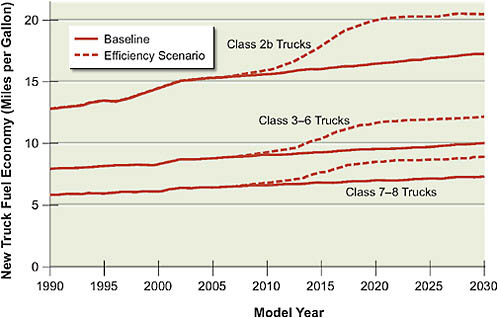
FIGURE 3.8 Trends in the fuel economy of new commercial trucks. Historical and projected trends in the fuel economy of Class 2b (light) trucks; Classes 3–6 (medium) trucks; and Classes 7 and 8 (heavy) trucks. Class 2b trucks are those with gross vehicle weights (GVWs) of 8,500–10,000 lb; trucks in Classes 3–6 have GVWs of 10,000–26,000 lb; a trucks in Classes 7 and 8 have GVWs of more than 26,000 lb.
Source: Lutsey, 2008.
through much of their systems. Improvements in railroad technology offer modest opportunities for gains in U.S. transportation energy efficiency. Areas of opportunity include advanced high-efficiency locomotive engines, reductions in aerodynamic drag, track lubricants, lower train weight, regenerative braking, hybrids for switching engines in yards, and higher-efficiency propulsion systems.18
Railroad operations represent another area in which energy efficiency gains can be achieved. Opportunities include increased railcar capacity (from 286,000 to 315,000 lb) and train length (e.g., 8,500-foot-long intermodal trains), optimized line-haul speeds enabled by technologies such as positive train control, and further structural changes in railroad economics such as a continued shift to larger and more uniform shipments (e.g., ”retail” to ”wholesale” railroading such as unit trains) that permit more efficient operations generally.
Examining freight from an intermodal perspective suggests further opportunities to save fuel by shifting some freight from truck to rail. The candidates for diversion to rail include truckload trailers of commodities that are not time sensitive and that are traveling more than 500 miles, as well as less-than-truckload long-haul freight. By and large, however, railroads have difficulty competing with trucks for freight whose delivery is time sensitive, such as overnight mail. Because trucks consume 10 times more energy than rail (and waterborne) per ton of freight moved, a 10 percent diversion of freight from truck to rail could produce a 9 percent energy savings. This is a substantial amount of traffic diverted, however. Even a small percentage shift in freight from truck to rail would require a considerable increase in railroad capacity. Increasing miles of track would be expensive and would likely be opposed by nearby residents, especially if new routes are needed.
3.4.4
Waterborne Shipping
Waterborne shipping makes use of oceans, inland and coastal waterways, and the Great Lakes. These routes use different vessels, require different infrastructure, and transport different commodities. The main fuels used are diesel oil (about 70 percent) and heavy fuel oil (about 30 percent).
Measured in tonnage, the oceangoing segment of this sector accounts for about half of the freight moved on water into or within the United States. Oil tanker traffic is, of course, one important reason for this share. Another is the increase in manufactured goods shipped in international trade by container ships. More than 75 percent of the U.S. international trade (in dollar value) is with five countries: Canada, Mexico, Japan, China, and Germany (NRC, 2004b). Most of the trade with Canada and Mexico is by truck and rail, whereas most of the goods traded with Japan, China, and Germany are transported by container ships and other oceangoing vessels. In March 2007, the International Council on Clean Transportation concluded that “carbon dioxide emissions from shipping are double those of aviation and increasing at an alarming rate, which will have a serious impact on global warming, according to research by the industry and European academics” (ICCT, 2007a). However, measured in terms of the CO2 emitted or energy consumed per ton-mile or per value of freight moved, ocean shipping is highly efficient, since the vessels carry very large payloads over long distances.
On the domestic inland rivers, the Great Lakes, and coastal waterways, tugboats, barges, and self-propelled vessels are used to move (mostly) bulk commodities, such as petrochemicals, coal, grain, lumber, and minerals. They are important
modes of transportation for these commodities in the specific regions in which the water routes are available. The energy efficiency of domestic marine shipping is comparable to that of railroads on a ton-mile basis (Davis et al., 2008).
Various opportunities exist in the near term to improve the energy efficiency of waterborne transportation. On the technology side, they include better shore power management and electrification, high-efficiency propulsion technology, improved hull design, and the use of alternative fuels. The potential for technical measures to reduce CO2 emissions from diesel fuel has been estimated at 5–30 percent in new vessels and 4–20 percent in older ones. On the operations side, near-term opportunities include improved terminal operations to reduce idling, queues, and delays; improved vessel-loading and -unloading operations; better hull maintenance; and speed reduction or optimization. Increasing vessel size will also reduce energy use per ton of freight shipped, especially for container ships. Marintek (2000) estimated that these operational measures could provide up to a 40 percent increase in energy efficiency.
In analyzing measures that can be taken to improve energy efficiency, Kromer and Heywood (2008) estimated the potential gains in energy efficiency in marine shipping to be 20–30 percent by 2020. Speed reduction was found to offer the greatest potential, followed by implementation of new and improved technology. Speed reduction, however, would require strong incentives to achieve, in view of the incentives to move shipments rapidly. Moreover, because of continued growth in commerce and waterborne traffic, it is likely that total energy use will continue to rise (Marintek, 2000).
3.5
FUELS OLD AND NEW
Current U.S. transportation systems—land, water, and air—overwhelmingly use petroleum-based hydrocarbon fuels. These fuels dominate because they are liquid at ambient temperature, have very high energy density, and fit well with today’s engine technologies: spark-ignition engines, diesels, and gas turbines. As an illustration of their attractiveness, when refueling a car today, the fuel’s chemical energy flows through the nozzle in one’s hand at the rate of 570,000 Btu per minute, providing another 400 miles of driving with a 5-minute refueling time.
Current U.S. fuels and engine technologies have evolved together over many decades. Thus, U.S. petroleum extraction, delivery, refining, and distribution systems are cost-effective, and these fuels are well matched to what end-users—
vehicle owners and operators—need. The current U.S. petroleum-based fuelsupply system is vast in scale and does its job well. A major problem, of course, is that these established fuels—gasoline, diesel fuel, aviation kerosene—are some 86 percent carbon by weight and when burned in engines emit almost all this carbon as CO2. The discussion below summarizes the current status of and anticipated developments in mainstream petroleum-based and alternative fuels. It also discusses whether these fuels offer any useful opportunities for augmenting the energy efficiency of the fuel-supply system as well as the tank-to-wheels efficiency of the vehicle. A more complete discussion can be found in the parallel effort of the America’s Energy Future Panel on Alternative Liquid Transportation Fuels (NAS-NAE-NRC, 2009b).
Transportation fuels affect internal-combustion-engine performance and efficiency directly through their combustion characteristics (knock resistance, or octane rating, for gasolines; self-ignition, or cetane rating, for diesel). They have indirect effects through their energy density and therefore weight for a given vehicle’s driving range, and through constraints imposed on engine operation because fuel composition affects vehicle air pollutant emissions control. The issue of fuel energy density is especially critical in the longer term for jet aircraft. Also, in a broader, life-cycle context, the energy consumed and the greenhouse gas emissions released during fuel production affect the overall energy and emissions impacts of the total vehicle-plus-fuels system. Lubricants affect engine energy efficiency through their role in engine friction.
3.5.1
Petroleum-Based Fuels
The characteristics of petroleum-based fuels have developed to match the needs of today’s land-based spark-ignition and diesel engines, marine use in boats and large ships, and the requirements of aviation’s jet engines. For reliable and efficient end use, a broadly based set of fuel-property requirements must be met. Current challenges are the rising cost of these fuels as demand grows rapidly; concerns about their long-term availability in ever-growing (and very large) volume; the need for cleaner fuels with decreasing levels of contaminants owing largely to ever-more stringent air pollutant emissions requirements; and much tighter fuel specifications (also for emissions control reasons). An exacerbating factor is that a growing proportion of the crude oils used is heavier (more dense), and these oils have higher inherent levels of contaminants.
Changes in gasoline and diesel fuel specifications are currently being explored that could reduce refinery energy requirements and permit useful—
though modest—improvements in energy performance and efficiency. Fuel characteristics that would aid the development of new engine combustion concepts such as HCCI are also being explored.
Since petroleum-based fuels dominate the transportation sector, they have developed very large-scale refining and distribution systems. More than 300 billion gallons of refinery products are distributed across the nation each year. The ability of alternative fuel streams to be compatible with and integrated into these refining and distribution systems is an important aspect of their attractiveness.
3.5.2
Natural Gas
The use of natural gas (methane) in road transportation varies around the world, but it is typically about 1 percent of the amount of petroleum-based fuel use. In a few countries (for example, Argentina and Italy) where tax policies make it an economically attractive fuel, its use is about 10 percent of transportation fuel consumption (Yeh, 2007). In the 1990s, natural gas made inroads into U.S. municipal bus fleets in order to achieve lower air pollutant emissions. However, diesel engines with effective exhaust cleanup technology are now proving to be a cheaper option in that market (Cohen, 2005; Cohen et al., 2003). Natural gas has a higher octane rating than that of typical gasolines, and it has good combustion characteristics, and thus could improve spark-ignition engine efficiency. Despite these advantages, methane is a gaseous fuel that must be compressed and stored on the vehicle in high-pressure tanks that are bulky, heavy, and costly. There are additional concerns over safety issues associated with compressed natural gas (which also constrain vehicle use), and uncertainty as to whether a secondary market for reselling natural gas vehicles used by fleet operators would develop.
Based on the available evidence, the panel’s overall assessment of natural gas as a transportation fuel is that the drawbacks of a gaseous fuel (e.g., lower specific engine power, reduced driving range, a significant energy penalty for compression in vehicle fueling, the loss of vehicle interior space owing to fuel-storage tanks, extra cost, and methane emissions) currently more than offset the attraction of the lower carbon-to-hydrogen ratio of this fuel and its potential for improving efficiency. Moreover, demand for natural gas in other applications is rising rapidly, threatening to increase its price and make it less attractive as a vehicle fuel. Recently, technologies for extracting natural gas from shales have raised the prospect of significant increases in domestic production at moderate prices. If domestic natural gas supplies expand significantly and the cost of natural gas
remains significantly lower than the cost of liquid petroleum-based fuels, its overall attractiveness as a transportation fuel relative to other applications will need to be reconsidered.
3.5.3
Nonpetroleum Hydrocarbon Fuels
Oil sands (e.g., in Canada) and heavy oils (from Venezuela) are already contributing a growing fraction (about 5 percent) to liquid transportation fuels. Over time, other nonpetroleum sources of hydrocarbon fuels, such as gas-to-liquids, oil shale, and coal, are likely developments. These pathways can either produce high-quality transportation fuels directly or provide an input stream to appropriately modified refineries. These high-quality fuels can be blended with petroleum products to improve overall fuel quality and thus petroleum refinery efficiency. Such sources of transportation fuels are expected to steadily increase in volume. However, with current technology, the energy used in the production of nonpetroleum-based fuels is higher, and the amount of greenhouse gases emitted during their production is also higher, than is the case for petroleum-based fuels (NAS-NAE-NRC, 2009a).
3.5.4
Biomass-Based Fuels
Liquid transportation fuels derived from biomass have the potential to contribute significantly to supplying energy for vehicles. Sources of biomass include corn grain, corn stover, switchgrass, miscanthus, forest wastes, and other dedicated fuel crops. End-products include ethanol (and possibly other alcohols), biodiesel and, potentially, gasoline- and diesel-like fuels. Also important are the life-cycle greenhouse gas emissions that result from growing and harvesting the biomass and producing and distributing the specific biofuels. Critical questions that still need to be resolved are the availability of suitable land for these crops, fertilizer and water requirements, land degradation over time, water pollution issues, and the net energy requirements during production. These issues are discussed extensively in the NRC report on alternative liquid transportation fuels (NAS-NAE-NRC, 2009b). Biofuels would, of course, displace petroleum-based fuels.
Biofuels—currently about 3 percent of land transportation fuel supply—could potentially grow in volume to some 10 percent on an energy-equivalent basis over the next 10 or so years (NAS-NAE-NRC, 2009b). The current biofuels are ethanol, about 80 percent, and the rest biodiesel. Integrating these new fuels into the petroleum fuel production and supply system creates logistical problems that need to be resolved (e.g., because of its water-absorbing
and solvent characteristics, ethanol cannot be transported in existing pipelines used for oil). Currently, the basic issues with biofuels are their delivered costs relative to those of petroleum fuels and their compatibility with the existing petroleum-based fuel production and distribution system.
From a broader perspective, the critical question is the life-cycle greenhouse gas emissions that result from growing and harvesting the biomass and producing and distributing the specific biofuels produced, and whether the advantageous characteristics of the fuel (e.g., ethanol with its greater knock resistance, which could be used to increase the engine compression ratio) can be used to improve efficiency. The substantial potential of biofuel as an important contributor to greater efficiency in the U.S. transportation sector still needs extensive evaluation.
3.5.5
Electricity
Plug-in hybrids and battery-electric vehicles draw electricity from the electric grid. Their impact on the electric grid obviously depends on the number of these vehicles, on how much they are driven each day, and on when and where they recharge their batteries and how rapidly they recharge. Limited numbers of these vehicles will be available over the next few years. It is plausible that, as has happened with today’s conventional hybrids, production volumes will slowly expand over the next decade as these technologies are tested and improved and the significant cost premium is reduced. This introduction and initial growth phase can likely be accommodated by the electric grid with modest adjustments, although consumers will likely be restricted in their recharging options.
It is useful to consider how the impacts on the electric grid would evolve if sales volumes became increasingly larger. (See, for example, Samaras and Meisterling, 2008.) The electrical energy that must be supplied per mile traveled in a future PHEV or BEV is about one-third of the gasoline energy that would be supplied in an equivalent ICE vehicle. In the extreme case in which all LDVs in the United States were electric and the annual VMT were the same as that of standard vehicles today, the annual electricity demand would be about 30 percent of the total amount of electricity currently generated each year. If all this recharging were done overnight (which is unlikely), then current U.S. generating capacity would be able to recharge about half of these vehicles, although the variation from state to state would be substantial (6 percent to 63 percent) (Samaras, 2008). Growth in travel and electricity demand would also have to be factored in. However, the power requirements for recharging are significant; for example, a 30-mile
battery recharge requires about 15 kWh, which is 3 kW for 5 hours, and at 110 volts would require close to 30 amps for this time period.
There are many longer-term system issues with PHEVs or electric vehicles. These include the plausible fraction of total vehicles that would satisfy the recharging location, time of day, and charging-power-level constraints; and how the consumer vehicle purchase and use patterns would be affected by the range and recharging limitations of vehicles having different operating characteristics. It is too early in the development of electric-vehicle technology to be able to project how large a fraction of the vehicle market might eventually be met by such vehicles. Note that the impact on greenhouse gas emissions of using electricity as an energy source in transportation will depend on how much electricity is produced, distributed, and used for that purpose and how that energy is generated (i.e., what the primary energy source is, and—if it is fossil fuels—whether carbon capture and storage technology is effectively deployed).
3.5.6
Hydrogen
Hydrogen fuel presents an especially challenging set of issues, since there is currently no hydrogen distribution system. A recent NRC study, Transition to Alternative Transportation Technologies: A Focus on Hydrogen (NRC, 2008c), examines what would be needed to implement such a transition and the timescales involved. It concludes that reductions in petroleum use and greenhouse gas emissions could grow steadily over the 2020–2050 timeframe but that substantial government actions and assistance would be needed for this to happen. Establishing a hydrogen production, distribution, and refueling system that provides a sufficiently widespread availability of the fuel so as not to impede the growth in fuelcell vehicle deployment is a challenging (but doable) task.
3.6
SYSTEM-LEVEL ISSUES
The history of transportation is one of continuous innovation. Most innovations are small and incremental. Some innovations accumulate and lead to a restructuring and reorganization of activities. Energy costs and supply often play a role in motivating innovation—for instance, the transition from sailing ships to steamships—but usually system innovations and changes are motivated by other factors. Major changes in transportation systems are costly and are complicated to
bring about for many reasons, including the difficulty of coordinating the interests of businesses (such as vehicle and energy companies); the difficulty of overcoming the inertia of business practices; the existence of government rules dealing with safety, interstate commerce, and so on that were promulgated for previous practices and products; the nonuniformity of government rules across jurisdictions; and the need to blend new and old infrastructures and technologies. However, when major system transitions do occur, they may provide opportunities to boost the overall energy efficiency of the transportation sector.
The freight sector offers examples. The development of standard, 20- and 40-ft (6.1- and 12.2-meter) shipping containers, for example, has stimulated intermodal transfers among trucks, rail, ships, and even cargo airplanes. These containers can be collected by truck at factories and transported to rail terminals where they are carried for the long-haul portion of a trip, often to a seaport for loading onto specially designed container ships. By facilitating the transfer of cargo among modes, the “container revolution” has led to dramatic changes in logistics and in patterns of trade. Because of the greater energy efficiency of rail and water transport compared with trucking, containerization has presumably led to significantly lower energy use per ton-mile of freight. The impact on total energy use, however, is unclear, as the utility of containers has enabled far more extensive, international logistics systems.
In passenger transport, opportunities for increasing fuel efficiency through system-level changes may be greater, if only because of the current pattern of largely single-occupant vehicle usage. One catalyst is the use of information and communication technologies, referred to in the transportation community as intelligent transportation systems (ITSs). The preponderant ITS effort has been incremental in nature. Local governments have learned to use information to manage the use of roads better, and travelers have gained access to navigation devices and information services that ease driving tension, reduce destination search times, and can be used for emergency services. The net effect is a small reduction in driving and energy use—from smoother vehicle flow and reduced vehicle-miles traveled. More ambitious initiatives include using wireless and advanced information technologies to offer new mobility services such as demand-responsive jitney (inexpensive small bus) services, dynamic ridesharing (“smart carpooling”), smart car sharing, smart parking, and so on. These services have the potential for significant reductions in vehicle use and therefore in energy use and greenhouse gas emissions. But there are many barriers to their successful adoption, including consumer resistance, the difficulty of competing against subsidized conventional transit ser-
vices, opposition from entrenched interests such as taxis and transit operators, and insurance costs. Companies are emerging to offer these services, but their market share is very small.
Still more innovative are automated highway lanes for cars and trucks, using advanced control technologies, sensors, and wireless communication technologies. But these efforts have faltered in the face of litigation and safety concerns. And even as these automation technologies enter the market, initially as “smart” cruise control, automated vehicle parking, and automated emergency braking, they will have minimal effects on energy use. Furthermore, as they are fully implemented, they might even increase vehicle travel and energy use, as the ease of “driving” induces people to live farther from work and to drive longer distances.
Bus rapid transit service, which makes use of dedicated lanes and fare collection before bus entry (Levinson et al., 2002), combines the speed of subways with the flexibility of buses. For more personal service, smart paratransit, real-time carpools, and car-sharing services could reduce VMT.19
ITS and other advanced technologies may be used to create broader system changes with potentially much larger energy and greenhouse gas emission benefits. When transportation and land use are considered together, it is possible to imagine how new transportation systems could be developed that bring about improvements in energy efficiency. While a shift toward dense urban corridors would be at odds with long-term trends, changes in individual preferences (e.g., interest in urban amenities) and values (e.g., environmental concerns) may foster such a movement.
For such a diversified system to evolve, numerous changes would need to occur, not only in people’s preferences but also in policies and institutions that govern land-use management and the provision of transportation services. The panel cannot delve into these broader topics in this report. When taking a longer-range view of options, however, if the goal is to reduce overall energy use and greenhouse gas emissions, the interconnections among land use, transportation, and life styles should not be neglected. For instance, while some new transit services might by themselves consume more energy per passenger-mile traveled than single-occupant vehicles, the net effect of greater mobility and locational choices could be an overall reduction in energy use and greenhouse gas emissions.
|
19 |
See Chapter 2 of Sperling and Gordon (2009). |
It is thus important to explore, at this still early stage of ITS development and implementation, how ITS can be used to address the multiple needs and problems associated with surface transportation in a synergistic manner.
Note that for any of the above-described changes to have a significant impact on U.S. transportation’s fuel consumption and greenhouse gas emissions, they would have to be implemented on a substantial scale.
This brief overview identifies many opportunities for reducing vehicle energy use and greenhouse gas emissions through changes in the ways that the U.S. transportation infrastructure is managed and used. However, major insights and improvements will come from a broader, deeper understanding of transportation system issues for all transportation modes. Developing better data and tools that can be used to further that understanding is an important task.
3.7
CHALLENGES AND BARRIERS
-
In the United States, many factors, including a century of falling energy prices and rising incomes, together with personal preferences and various government policies, have contributed to decentralized land-use patterns and a transportation-intensive economy.
-
Low-priced energy led to consumer purchasing behavior, vehicle designs, and operating decisions that emphasized convenience, style, and speed over fuel economy in automobiles and light trucks, and with added emphasis on cost-effectiveness in medium- and heavy-duty trucks, ocean shipping, and the air transport of passengers and freight.
-
The primary barriers to realizing greater energy efficiency in the transportation sector are the expectations of individuals and companies about future energy prices, fuel availability, and government policies. Although an extensive menu of technologies exists for saving energy in transportation, before decision makers choose to invest in these technologies, they must be convinced that energy price increases (or other factors that stimulate market demand) will persist.
-
A barrier to rapid changes in the mix of LDV annual sales is the capacity of the automotive industry to change both power trains and platforms rapidly, across all models, and its ability to set up a high-volume supplier base in high-risk items such as high-energy-storage batteries.
-
The vehicle design cycle can be 3–5 years if the change involves major new technologies or materials.
-
Even when new or improved vehicle technologies are available on the market, barriers to purchase include high initial cost, safety concerns, reliability and durability concerns, and lack of awareness. For new technologies to reach a substantial fraction of vehicle sales usually takes more than a decade unless mandated by law or consumers clearly demand the new or improved technology.
3.8
FINDINGS
|
T.1 |
In the transportation sector, the potential for energy savings and petroleum displacement resides both in increasing the efficiency with which liquid fuels (especially petroleum) are used and in shifting some of the vehicle fleet’s energy demand to electricity (including hydrogen fuel-cell vehicles). The overall energy use and greenhouse gas emissions (and other environmental effects) associated with such a shift depend on how the electricity or hydrogen is generated. |
|
T.2 |
An extensive menu of technologies exists today for increasing energy efficiency in transportation. Achieving the average new-vehicle fuel economy targets for 2020 set by the Energy Independence and Security Act of 2007 (EISA; P.L. 110-140), which represent a 40 percent increase over today’s value (and a 30 percent reduction in average fuel consumption), is thus a feasible, although challenging, objective. Reaching the EISA targets, and continuing to decrease fuel consumption, will require a shift from the historic U.S. emphasis on ever-increasing vehicle power and size to an emphasis on using efficiency improvements to improve vehicle fuel consumption. |
|
T.3 |
In the near term, fuel-consumption reductions will come predominantly from improved gasoline and diesel engines, improved transmissions, and reduced vehicle weight and drag. Through at least 2020, evolutionary improvements in vehicles with gasoline internal-combustion engines are likely to prove the most cost-effective approach to reducing petroleum consumption. Gasoline-electric hybrids will likely play an increasingly important role as their production volume increases and their cost, relative to that of conventional vehicles, decreases. Meeting the EISA |
|
|
standards is likely to require that, over the next decade or two, an everlarger fraction of the new vehicle fleet be hybrids or plug-in hybrids. |
|
T.4 |
Beyond 2020, continuing reductions in fuel consumption are possible. Plausible efficiency improvements in light-duty vehicles, alongside weight reduction and more extensive use of hybrid and plug-in hybrid (and possibly battery-electric) vehicles, could reduce transportation fuel consumption to below the levels implied by the higher 2020 fueleconomy standards mandated by the EISA. An especially important R&D focus is developing marketable vehicles that use electricity, which will require improving the performance and reducing the cost of highenergy-storage batteries. |
|
T.5 |
A parallel longer-term prospect is fuel cells with hydrogen as the energy carrier. To be attractive, major improvements, especially in reducing costs, are needed. Widespread implementation requires significant investment in efficient, low-greenhouse-gas-emissions hydrogen supply and distribution systems. Onboard hydrogen storage is a key R&D issue. Establishing a new propulsion system technology and new fuel infrastructure on a large scale is a formidable task, and significant deployment of fuel-cell vehicles is unlikely before 2035. |
|
T.6 |
There are opportunities to reduce energy use in freight transportation by improving both vehicle efficiency and freight system logistics and infrastructure. Reductions of 10–20 percent in the fuel economy of heavy- and medium-duty vehicles appear feasible over a decade or so. A broad examination is needed of the potential for improving the effectiveness of the freight system to reduce energy consumption further. |
|
T.7 |
Air transport and waterborne shipping have become more energyefficient in response to higher fuel prices. Jet engine and aircraft technology has the potential to improve the efficiency of new aircraft by up to 35 percent over the next two decades. However, improvements in aviation efficiency for passenger transport are unlikely to fully offset projected growth in air travel. Major additional issues are the full greenhouse gas and other environmental impacts of aviation fuel use at high altitude and of growing airline travel; the potential for using biomass-based fuels in jets; and whether the use of low-grade residual fuel in oceangoing vessels will continue. |
|
T.8 |
Most transportation efficiency studies and proposals have focused on the considerable energy efficiency gains that could be achieved with |
|
|
improved vehicles rather than in the transportation system as a whole. This emphasis is appropriate given the potential for and impact of such gains. However, major insights and improvements can result from a broader and deeper understanding of transportation system issues. The potential overall impact of such broader, system-based changes, such as densifying and reorganizing land use and collective modes of travel, needs further exploration and quantification. Developing better data and tools that can be used to analyze and forecast how different policies and investments might affect vehicle use and travel is thus an important task. |
3.9
REFERENCES
Alamgir, M., and A.M. Sastry. 2008. Efficient batteries for transportation applications. SAE Paper 2008-21-0017. SAE Convergence, Detroit, Mich. October.
An, F., and D. Santini. 2004. Mass impacts on fuel economies of conventional vs. hybrid electric vehicles. SAE Technical Paper 2004-01-0572. Warrendale, Pa.: SAE International.
An, F., and J. DeCicco. 2007. Trends in technical efficiency trade-offs for the U.S. light vehicle fleet. Technical Paper Series No. 2007-01-1325. Warrendale, Pa.: SAE International. April.
Anderman, M., F.R. Kalhammer, and D. MacArthur. 2000. Advanced Batteries for Electric Vehicles: An Assessment of Performance, Cost, and Availability. Sacramento, Calif.: California Air Resources Board, Year 2000 Battery Technology Advisory Panel.
Anderman, M. 2007. Status and Prospects of Battery Technology for Hybrid Electric Vehicles, Including Plug-in Hybrid Electric Vehicles. Briefing to the U.S. Senate Committee on Energy and Natural Resources, January 26.
APTA (American Public Transportation Association). 2008. 2008 Fact Book. Washington, D.C.: APTA.
Bandivadekar, A.P. 2008. Evaluating the Impact of Advanced Vehicle and Fuel Technologies in the U.S. Light-Duty Vehicle Fleet. Ph.D. Thesis, MIT Engineering Systems Division. Cambridge, Mass.: Massachusetts Institute of Technology.
Bandivadekar, A.P., K. Bodek, L. Cheah, C. Evans, T. Groode, J. Heywood, E. Kasseris, K. Kromer, and M. Weiss. 2008. On the Road in 2035: Reducing Transportation’s Petroleum Consumption and GHG Emissions. Laboratory for Energy and the Environment Report No. LFEE 2008-05 RP. Cambridge, Mass: Massachusetts Institute of Technology. July.
BTS (Bureau of Transportation Statistics). 2006. Long distance transportation patterns: Mode choice. America on the Go. Findings from the National Household Travel Survey. May. Washington, D.C.: BTS. May. Available at http://www.bts.gov/publications/america_on_the_go/. May.
Carlson, E.J., P. Kopf, J. Sinha, S. Sriramulu, and Y. Yang. 2005. Cost Analysis of PEM Fuel Cell Systems for Transportation. NREL/SR-560-39104. Golden, Colo.: National Renewable Energy Laboratory.
Cheah, L., and J. Heywood. 2008. Meeting CAFE Standards by 2020 and Beyond. Research Brief, Sloan Automotive Laboratory. Cambridge, Mass.: Massachusetts Institute of Technology. November. Available at http://web.mit.edu/sloan-auto-lab/research/beforeh2/reports.htm. November.
Cheah L., C. Evans, A. Bandivadekar, and J. Heywood. 2007. Factor of Two: Halving the Fuel Consumption of New U.S. Automobiles by 2035. LFEE Report 2007-04 RP. MIT Laboratory for Energy and the Environment. Cambridge, Mass: Massachusetts Institute of Technology. Available at http://web.mit.edu/sloan-auto-lab/research/beforeh2/files/cheah_factorTwo.pdf.
Cohen, J.T. 2005. Diesel vs. compressed natural gas for school buses: A cost-effectiveness evaluation of alternative fuels. Energy Policy 33(13):1709-1722.
Cohen, J.T., J.K. Hammitt, and J.I. Levy. 2003. Fuels for urban transit buses: A cost-effectiveness analysis. Environmental Science and Technology 37:1477-1484.
Crabtree, G., M. Dresselhaus, and M. Buchanan. 2004. The hydrogen economy. Physics Today 57(12):39-44.
Davis, S.C., and S.W. Diegel. 2006. Transportation Energy Data Book: Edition 25. ORNL-6974. Oak Ridge, Tenn.: Oak Ridge National Laboratory.
Davis, S.C., S.W. Diegel, and R.G. Boundy. 2008. Transportation Energy Data Book: Edition 27. ONRL-6981. Oak Ridge, Tenn.: Oak Ridge National Laboratory.
DOE (Department of Energy). 2006. 21st Century Truck Partnership: Roadmap and Technical White Papers. Report 21CTP-0003. Washington, D.C.: DOE. Available at http://www1.eere.energy.gov/vehiclesandfuels/pdfs/program/21ctp_roadmap_2007.pdf.
EEA (Energy and Environmental Analysis, Inc.). 2007. Update for Advanced Technologies to Improve Fuel Economy of Light Duty Vehicles. Draft Final Report. Submitted to U.S. Department of Energy. Arlington, Va.: EEA. August.
EIA (Energy Information Administration). 2006. Emissions of Greenhouse Gases in the United States 2005. DOE/EIA-0573(2005). Washington, D.C.: Department of Energy, Energy Information Administration.
EIA. 2008. Annual Energy Review 2007. DOE/EIA-0384(2007). Washington, D.C.: Department of Energy, Energy Information Administration.
EIA. 2009. Monthly Energy Review (February). Washington, D.C.: Department of Energy, Energy Information Administration.
EPA (Environmental Protection Agency). 2004. A Glance at Clean Freight Strategies: Improved Aerodynamics. Report EPA420-F-04-012. Washington, D.C.: Office of Transportation Air Quality. February. Available at http://www.epa.gov/smartway/documents/aerodynamics.pdf.
EPA. 2007. Light-Duty Automotive Technology and Fuel Economy Trends: 1975 Through 2007. EPA420-R-07-008. Washington, D.C. September. Available at http://www.epa.gov/OTAQ/cert/mpg/fetrends/420r07008.pdf.
Evans, C. 2008. Putting Policy in Drive: Coordinating Measures to Reduce Fuel Use and Greenhouse Gas Emissions from U.S. Light-Duty Vehicles. M.S. Thesis, Technology and Policy Program. June. Cambridge, Mass.: Massachusetts Institute of Technology.
FHWA (Federal Highway Administration). 2007. Freight Facts and Figures 2007. Washington, D.C. Available at http://ops.fhwa.dot.gov/freight/freight_analysis/nat_freight_stats/docs/07factsfigures.
Frost & Sullivan. 2008. World Hybrid/Electric Vehicle Battery Markets. MC1812769. June 26.
Hughes, J., C. Knittel, and D. Sperling. 2008. Evidence of a shift in the short-run price elasticity of gasoline demand. Energy Journal 29(1):113-134.
ICCT (International Council on Clean Transportation). 2007a. Air Pollution and Greenhouse Gas Emissions from Ocean-going Ships: Impacts, Mitigation Options and Opportunities for Managing Growth. Washington, D.C.: ICCT. March.
ICCT. 2007b. Passenger Vehicle Greenhouse Gas and Fuel Economy Standards: A Global Update. Washington, D.C.: ICCT. July. Available at http://www.lowcvp.org.uk/assets/reports/ICCT_GlobalStandards_2007.pdf.
Jensen, J. 2006. Go with the Flow—Truck Aerodynamics. ExpeditersOnline.com. September. Available at http://www.expeditersonline.com/artman/publish/truckaerodynamics.html.
Johnson, T. 2008. Diesel Emission Control Technology in Review. SAE Technical Paper 2008-01-0069. Warrendale, Pa.: Society of Automotive Engineers. April.
Johnson, T. 2009. Diesel Emission Control in Review. SAE Technical Paper 2009-01-0121. Warrendale, Pa.: Society of Automotive Engineers. April.
Kahn Ribeiro, S., S. Kobayashi, M. Beuthe, J. Gasca, D. Greene, D.S. Lee, Y. Muromachi, P.J. Newton, S. Plotkin, D. Sperling, R. Wit, and P.J. Zhou. 2007. Transport and its infrastructure. In Climate Change 2007: Mitigation. Contribution of Working Group III to the Fourth Assessment Report of the Intergovernmental Panel on Climate Change (B. Metz, O.R. Davidson, P.R. Bosch, R. Dave, and L.A. Meyer, eds.). Cambridge, U.K., and New York, N.Y.: Cambridge University Press.
Kasseris, E., and J. Heywood. 2007. Comparative Analysis of Automotive Powertrain Choices for the Next 25 Years. SAE Technical Paper 2007-01-1605 SP-2091. Warrendale, Pa.: SAE International.
Kromer, M., and J. Heywood. 2008. A comparative assessment of electric propulsion systems in the 2030 U.S. light-duty vehicle fleet. SAE Technical Paper 2008-01-0459. Warrendale, Pa.: SAE International.
Lee, J., S. Lukachko, I. Waitz, and A. Schafer. 2001. Historical and future trends in aircraft performance, cost, and emissions. Annual Review of Energy and the Environment 26:167-200.
Lee, J.J., S.P. Lukachko, and I.A. Waitz. 2004. Aircraft and energy use. In Encyclopedia of Energy, Volume 1. Amsterdam, The Netherlands: Elsevier.
Levinson, H., S. Zimmerman, J. Clinger, and S. Rutherford. 2002. Bus rapid transit: An overview. Journal of Public Transportation 5(2):1-30.
Lutsey, Nicholas P. 2008. Prioritizing Climate Change Mitigation Alternatives: Comparing Transportation Technologies to Options in Other Sectors. Research Report UCDITS-RR-08-15. Institute of Transportation Studies, University of California, Davis. Available at http://pubs.its.ucdavis.edu/publication_detail.php?id=1175.
Lutsey, N., and D. Sperling. 2005. Energy efficiency, fuel economy, and policy implications. Transportation Research Record 1941:8-25.
Marintek. 2000. Study of Greenhouse Gas Emissions from Ships. Final Report to the International Maritime Organization. Prepared by a consortium run by the Norwegian Marine Technology Institute—Marintek. Available at http://unfccc.int/files/methods_and_science/emissions_from_intl_transport/application/pdf/imoghgmain.pdf.
McCallen, R., K. Salari, J. Ortega, L. DeChant, C. Roy, J. Payne, B. Hassan, W. Pointer, F. Browand, M. Hammache, T.-Y. Hsu, J. Ross, D. Satran, J. Heineck, S. Walker, D. Yaste, R. Englar, A. Leonard, M. Rubel, and P. Chatelain. 2003. FY2003 Annual Report: DOE Project on Heavy Vehicle Aerodynamic Drag. November. UCRL-TR200618. Berkeley, Calif.: Lawrence Livermore National Laboratory. Available at https://e-reports-ext.llnl.gov/pdf/301858.pdf.
NAS-NAE-NRC (National Academy of Sciences-National Academy of Engineering-National Research Council). 2009a. America’s Energy Future: Technology and Transformation. Washington, D.C.: The National Academies Press.
NAS-NAE-NRC. 2009b. Liquid Transportation Fuels: Technological Status, Costs, and Environmental Impacts. Washington, D.C.: The National Academies Press.
NPC (National Petroleum Council). 2007. Technologies for Transportation Efficiency. Topic paper of the Transportation Efficiency Subgroup. Council Committee on Global Oil and Gas. Washington, D.C.: NPC. July.
NRC (National Research Council). 1992. Automotive Fuel Economy: How Far Should We Go? Washington, D.C.: National Academy Press.
NRC. 2000. Review of the Research Program of the Partnership for a New Generation of Vehicles: Sixth Report. Washington, D.C.: National Academy Press.
NRC. 2002. Effectiveness and Impact of Corporate Average Fuel Economy (CAFE) Standards. Washington, D.C.: National Academy Press.
NRC. 2004a. The Hydrogen Economy: Opportunities, Costs, Barriers, and R&D Needs. Washington, D.C.: The National Academies Press.
NRC. 2004b. The Marine Transportation System and the Federal Role. Transportation Research Board Special Report 279. Washington, D.C.: The National Academies Press.
NRC. 2006. Tires and Passenger Vehicle Fuel Economy. Transportation Research Board Special Report 286. Washington, D.C.: The National Academies Press.
NRC. 2008a. Potential Impacts of Climate Change on U.S. Transportation. Transportation Research Board Special Report 290. Washington, D.C.: The National Academies Press.
NRC. 2008b. Assessment of Technologies for Improving Light Duty Vehicle Fuel Economy: Letter Report. Washington, D.C.: The National Academies Press.
NRC. 2008c. Transitions to Alternative Transportation Technologies—A Focus on Hydrogen. Washington, D.C.: The National Academies Press.
NRC. 2008d. Review of the Research Program of the FreedomCar and Fuel Partnership: Second Report. Washington, D.C.: The National Academies Press.
Ricardo, Inc. 2008. A Study of Potential Effectiveness of Carbon Dioxide Reducing Vehicle Technologies. Prepared for EPA Office of Transportation and Air Quality. Washington, D.C. January. Available at http://www.epa.gov/OMS/technology/420r08004a.pdf.
Samaras, C. 2008. PHEVs, electricity demand and infrastructure. Memorandum to Lester Lave, Carnegie Mellon University, November.
Samaras, C., and K. Meisterling. 2008. Life cycle assessment of greenhouse gas emissions from plug-in hybrid vehicles: Implications for policy. Environmental Science and Technology 42:3170-3176.
Schipper, L. 2006. Automobile fuel economy and CO2 emissions in industrialized countries: Troubling trends through 2005/6. Washington, DC: EMBARQ, The World Resources Institute Center for Sustainable Transport. Available at http://pdf.wri.org/automobilefuel-economy-co2-industrialized-countries.pdf.
Schuring, D., and S. Futamura. 1990. Rolling loss of pneumatic highway tires in the eighties. Rubber Chemistry and Technology 62(3):315-367.
Small, K., and K. Van Dender. 2007. Fuel Efficiency and Motor Vehicle Travel: The Declining Rebound Effect. Working Paper 05-06-03. Irvine, Calif.: Department of Economics, University of California.
Sperling, D., and D. Gordon. 2009. Two Billion Cars: Driving Towards Sustainability. Cambridge, U.K.: Oxford University Press.
Vidal, J. 2007. CO2 output from shipping twice as much as airlines. The Guardian. March 3. Available at http://www.guardian.co.uk/transport/Story/0,,2025723,00.html.
Wang, M., C. Saricks, and D. Santini. 1999. Effects of fuel ethanol use on fuel-cycle energy and greenhouse gas emissions. ANL-38. Argonne, Ill.: Department of Energy, Argonne National Laboratory, Center for Transportation Research.
WBCSD (World Business Council on Sustainable Development). 2004. Mobility 2030: Meeting the Challenges to Sustainability. Sustainable Mobility Project Report. 180 pages. Available at http://www.wbcsd.org/DocRoot/fI3llMAvneJpUcnLgSeN/mobilityfull.Pdf.
Winebrake, J.J., J.J. Corbett, and P.E. Meyer. 2007. A total fuel life-cycle analysis of energy use and emissions from marine vessels. Transportation Research Board 2007 Annual Meeting, Washington, D.C.
Wohlecker, R., M. Johannaber, and M. Espig. 2007. Determination of weight elasticity of fuel economy for ICE, hybrid and fuel cell vehicles. SAE Technical Paper 2007-010343. Warrendale, Pa.: SAE International.
Yeh, S. 2007. An empirical analysis on the adoption of alternative fuel vehicles: The case of natural gas vehicles. Energy Policy 35(11):5865-5875.


