
Summary
Energy from fossil fuels and nuclear and renewable sources provides power for the myriad activities that take place in residences and commercial buildings, the transportation of people and goods, and both light and heavy industrial manufacturing. In 2008, U.S. primary energy use totaled 99.4 quadrillion Btu (Figure S.1), making the United States the world’s largest consumer of energy. Yet although energy is essential to the U.S. economy, technologies exist today that can help make it possible to achieve significant energy savings and still maintain current lifestyles. The 1973–1974 oil embargo and each subsequent energy crisis prompted studies showing that the United States could save energy and money by investing in energy efficiency. But although U.S. energy use per dollar of GDP has declined over the past 30 years (EIA, 2008b), many of the energy efficiency technologies identified in those studies have not been implemented.
Today, efficiency in energy use has taken on special urgency. Price fluctuations, national security concerns over U.S. dependence on imported oil, and growing recognition of the need to reduce emissions of greenhouse gases have transformed energy efficiency from an option to a necessity.
The Panel on Energy Efficiency Technologies, convened as part of the National Academies’ “America’s Energy Future” project (see Appendix A), was asked to examine the potential for technologies available today or soon to enable Americans to use energy more efficiently; the costs of accomplishing this; and the hurdles and barriers that impede adoption of the technologies. Because saving energy and mitigating the environmental impacts of energy production and use—especially, emission of greenhouse gases—is a long-term challenge and technology
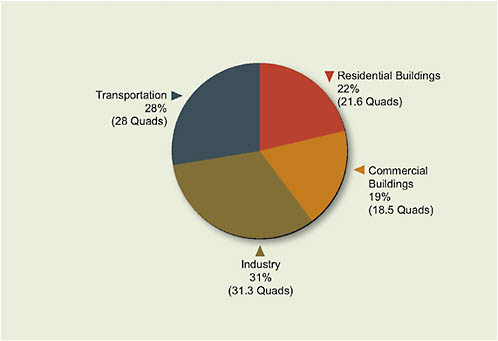
FIGURE S.1 Total U.S. energy use by sector, 2008 (in quadrillion Btu, or quads). For each sector, “total energy use” is direct (primary) fuel use plus purchased electricity plus apportioned electricity-system losses. Economy-wide, total U.S. primary energy use in 2008 was 99.4 quads. Totals may not equal sum of components due to independent rounding.
Source: EIA 2009a, as updated by EIA, 2009b.
continues to develop, the panel was also asked to look beyond 2035 in assessing the technological potential for increasing U.S. energy efficiency.
Although the terms “energy efficiency” and “energy conservation” are often used interchangeably, they refer to different concepts. Improving energy efficiency involves accomplishing an objective—such as heating a room to a certain temperature—while using less energy. Energy conservation can involve changing one’s behavior so as to use less energy—e.g., driving a smaller car, or lowering the thermostat in winter. The panel’s work focused on technology and energy efficiency, rather than energy conservation.
As a result of its broad look at energy use in other nations (Chapter 1); a detailed examination of the buildings (Chapter 2), transportation (Chapter 3), and industrial (Chapter 4) sectors and of numerous studies of energy use and poten-
tial savings in each; and its review of experience with and lessons learned from U.S. federal and state policies and programs (Chapter 5), the panel concluded that the potential for U.S. energy savings is large. Synthesizing the discussions and details presented across the chapters, the panel developed four overarching findings, which are presented below. The sector-specific findings given in Chapters 2 through 4 are also listed.
THE POTENTIAL FOR ENERGY SAVINGS
Table S.1 gives the panel’s conservative and optimistic estimates of potential cost-effective annual energy savings in U.S. buildings, transportation, and industry for 2020 and 2030. These estimates represent technology assessments, not projections—that is, the estimates are assessments of the potential energy savings achievable with the use of energy efficiency technologies, assuming a rapid rate of deployment, but one nevertheless consistent with past deployment rates.
As indicated in Table S.1, the panel found that energy efficiency in buildings offers the greatest possibility for U.S. energy savings; by 2020, in the optimistic scenario, buildings would account for 53 percent of the total estimated savings,
TABLE S.1 Panel Estimate of the Potential for Cost-Effective Annual U.S. Energy Savings (in quads) Achievable with Energy Efficiency Technologies in 2020 and 2030
|
|
Conservative Estimate |
Optimistic Estimate |
||
|
2020 |
2030 |
2020 |
2030 |
|
|
Buildings, primary (source) electricity |
9.4 |
14.4 |
9.4 |
14.4 |
|
Residential |
4.4 |
6.4 |
4.4 |
6.4 |
|
Commercial |
5.0 |
8.0 |
5.0 |
8.0 |
|
Buildings, natural gas |
2.4 |
3.0 |
2.4 |
3.0 |
|
Residential |
1.5 |
1.5 |
1.5 |
1.5 |
|
Commercial |
0.9 |
1.5 |
0.9 |
1.5 |
|
Transportation, light-duty vehicles |
2.0 |
8.2 |
2.6 |
10.7 |
|
Industry, manufacturing |
4.9 |
4.9 |
7.7 |
7.7 |
|
Total |
18.6 |
30.5 |
22.1 |
35.8 |
|
Note: Savings are relative to the reference scenario of the EIA’s Annual Energy Outlook 2008 (EIA, 2008a) or, for transportation, a similar scenario developed by the panel. See Table 1.2 for more information on the baselines used in the panel’s analysis of the buildings, transportation, and industry sectors. |
||||
industry for 35 percent, and transportation for 12 percent.1 If all the potential energy savings the panel identified for residential and commercial buildings could be achieved, the effects on U.S. electricity generation needs could be dramatic.
Instead of increasing from 99 quadrillion Btu (99 quads) in 2008 (EIA, 2009a,b), to 111 quads in 2020, and then to 118 quads in 2030 (EIA, 2008a), U.S. energy use could, with full deployment of cost-effective, energy-efficient technologies, fall to 89–92 quads in 2020 and 82–88 quads in 2030.
The importance of the values in Table S.1, however, is not the specific numbers; rather, the point is that taking advantage of technologies that save money as well as energy to produce the same mix of goods and services could reduce U.S. energy use to 30 percent below the 2030 forecast level, and even significantly below 2008 energy use. The result would be lower costs and a more competitive economy that uses less fossil fuel, has lower emissions of greenhouse gases, and puts less pressure on environmental quality.
OVERARCHING FINDINGS
Overarching Finding 1
Energy-efficient technologies for residences and commercial buildings, transportation, and industry exist today, or are expected to be developed in the normal course of business, that could potentially save 30 percent of the energy used in the U.S. economy while also saving money. If energy prices are high enough to motivate investment in energy efficiency, or if public policies are put in place that have the same effect, U.S. energy use could be lower than business-as-usual projections by 19–22 quadrillion Btu (17–20 percent) in 2020 and by 30–36 quadrillion Btu (25–31 percent) in 2030.2,3
Saving this amount of energy by using energy-efficient technologies would reverse the growth in energy use forecasted by the U.S. Department of Energy’s (DOE’s) Energy Information Administration (EIA, 2008a) and thus have a positive impact on needed U.S. electricity generation capacity.
As the report America’s Energy Future: Technology and Transformation (NAS-NAE-NRC, 2009) points out, energy efficiency costs less than building new energy production facilities, which typically take years longer to start up than do energy efficiency measures and also have substantial environmental impacts (e.g., increased CO2 emissions).
Overarching Finding 2
The full deployment of cost-effective, energy-efficient technologies in buildings alone could eliminate the need to add to U.S. electricity generation capacity. Since the estimated electricity savings in buildings from Table S.1 exceeds the EIA forecast for new net electricity generation in 2030, implementing these efficiency measures would mean that no new generation would be required except to address regional supply imbalances, replace obsolete generation assets, or substitute more environmentally benign generation sources.
As indicated by the differences between the conservative and optimistic estimates presented in Table S.1, there are considerable uncertainties in projections of both the timing and the quantity of potential energy savings. Formidable barriers impede the deployment of energy-efficient technologies, even if their adoption is projected to save money over time. These barriers include potentially high up-front costs; alternative uses for investment capital that are deemed more attractive; volatility of energy prices, leading to uncertainty in the payback time; and the lack of information available to consumers about the relative performance and costs of technology alternatives.
Although the panel was not able to review all the barriers to implementing energy-efficient technologies, it did review some of the experience gained at the national level with policies and programs aimed at overcoming the barriers. Many policy initiatives have been effective, including efficiency standards (for vehicles and appliances) combined with DOE research and development; promotion of combined heat and power (largely through the Public Utilities Regulatory and Policy Act of 1978); the ENERGY STAR® product-labeling program; building energy codes; and utility- and state-sponsored end-use efficiency programs (see
Chapter 5). Large states such as California and New York have also succeeded in overcoming many of the barriers to use of energy-efficient technologies, achieving high levels of energy savings (Chapter 5).
Overarching Finding 3
The barriers to improving energy efficiency are formidable. Overcoming these barriers will require significant public and private support, as well as sustained initiative. The experience of leading states provides valuable lessons for national, state, and local policy makers in the leadership skills required and the policies that are most effective.
The long lifetimes of buildings and some capital equipment present a particularly important barrier to implementing energy-efficient technologies. These investments—particularly buildings—can last for decades or even centuries, blocking the implementation of more efficient substitutes. Hence, actions now and over the next decade to use (or not use) energy-efficient technologies and design practices that are available today have long-term consequences for energy use.
Overarching Finding 4
Long-lived capital stock and infrastructure can lock in patterns of energy use for decades. Thus, it is important to take advantage of opportunities (during the design and construction of new buildings or major subsystems, for example) to insert energy-efficient technologies into these long-lived capital goods.
SECTOR ANALYSIS AND FINDINGS
Buildings
As shown in Figures S.1 and S.2, the myriad activities associated with residential and commercial buildings consumed about 40 quads, or 41 percent of the primary energy used in 2008 in the United States, including three-quarters of the electricity and half of the natural gas. Space heating, cooling, and ventilation are the largest consumers of energy in buildings, followed by lighting.
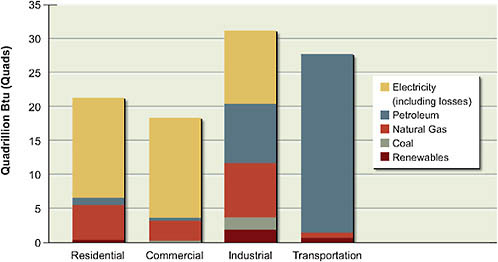
FIGURE S.2 Total energy consumption in the United States in 2008, by sector and fuel. Shown are electricity consumption—with the losses in generation, transmission and distribution allocated to the end-use sectors—and the fuels used on-site in each sector. Electricity is generated off-site using fossil, renewable, and nuclear energy sources.
Source: EIA 2009a, as updated by EIA, 2009c.
Many studies cited in Chapter 2 that have evaluated the quantity of realistically achievable savings as a function of the cost of saved energy show consistent results, despite differences in assumptions and approaches. As determined by the panel from its review of such studies, median predictions of achievable and cost-effective energy savings are 1.2 percent per year for electricity and 0.5 percent per year for natural gas, amounting to a 25–30 percent energy savings for the U.S. buildings sector as a whole over 20 years. If this level of savings were to be achieved, it would offset the EIA (2008a) projected increase in energy use in the buildings sector.
Conservation supply curves are a tool for displaying the results of detailed assessments of the energy savings that could be achieved with specific technologies as a function of cost. The curves developed for buildings in this report (see Chapter 2) indicate that the projected baseline energy use in 2030 (EIA, 2008a) can be reduced by about 30 percent at a cost less than current average retail energy prices.
TABLE S.2 Estimated Average Cost of Conserved (Saved) Energy in Residential and Commercial Buildings Compared with National Average Retail Energy Prices, 2007
|
|
Average Cost of Conserved (Saved) Energy |
National Average Retail Energy Price |
|
Residential |
|
|
|
Electricity |
2.7¢/kWh |
10.6¢/kWh |
|
Natural gas |
$6.9/million Btu |
$12.7/million Btu |
|
Commercial |
|
|
|
Electricity |
2.7¢/kWh |
9.7¢/kWh |
|
Natural gas |
$2.5/million Btu |
$11.0/million Btu |
|
Note: For the specific savings, see Figures 2.8 and 2.9. Source: Brown et al., 2008. Energy prices are from EIA, 2008c. |
||
As shown in Table S.2, the estimated average costs of the energy saved (usually termed the “cost of conserved energy,” or CCE) in residential and commercial buildings for electricity and natural gas use as a result of energy efficiency measures were dramatically lower than the corresponding average retail prices for electricity and natural gas in 2007, indicating that large savings in energy costs were available.
Not reflected in Table S.2 are the results of integrated approaches designed to yield system-wide or building-wide savings. These approaches can involve integrating the design of the heating, ventilation, and air-conditioning system with that of the envelope system and the lighting system and its controls, all at the beginning of the design process. A small but growing number of new commercial buildings incorporate these design approaches to reach a 50 percent savings in energy use—mainly in heating, cooling, air-conditioning, water heating, and lighting—compared with prevailing building codes. With appropriate policies and programs in place, such energy-efficient buildings could become the norm in new construction.
Beyond the savings that could be realized through wider use of existing, energy-efficient technologies, advanced technologies, including light-emitting diode (LED) lamps, innovative window systems, new types of cooling systems, and power-saving electronic devices, are under development and are likely to become commercially available within the next decade.
Findings for Buildings
|
B.1 |
Studies assessing the potential for energy savings in buildings take several different approaches, looking at whole-building results as well as results by end-use and technology. Nevertheless, their results tend to be consistent. |
|
B.2 |
The potential for large, cost-effective energy savings in buildings is well documented. Median predictions of achievable, cost-effective savings are 1.2 percent per year for electricity and 0.5 percent per year for natural gas, amounting to a 25–30 percent energy savings for the buildings sector as a whole over the next 20–25 years. If this level of savings were to be achieved, it would offset the EIA (2008a) projected increase in energy use in this sector over the same period. |
|
B.3 |
Studies of energy efficiency potential are subject to a number of limitations and biases. On the one hand, factors such as not accounting for new and emerging energy efficiency technologies can lead such studies to underestimate energy-savings potential, particularly in the midterm and long term. On the other hand, some previous studies were overly optimistic about the cost and performance of certain efficiency measures, thereby overestimating energy-savings potential, particularly in the short term. Although these limitations must be acknowledged, they do not affect the panel’s overall finding that the potential for energy savings in buildings is large. |
|
B.4 |
Many advanced technologies under development and likely to become commercially available within the next decade—including LED lamps, innovative window systems, new types of cooling systems, and power-saving electronic devices—will further increase the energy-savings potential in buildings. In addition, new homes and commercial buildings with relatively low overall energy use have been demonstrated throughout the country. With appropriate policies and programs, they could become the norm in new construction. |
|
B.5 |
Despite substantial barriers to widespread energy efficiency improvements in buildings, a number of countervailing factors could drive increased energy efficiency, including rising energy prices, growing concern about global climate change and the resulting willingness of consumers and businesses to take action to reduce emissions, a movement toward “green buildings,” and growing recognition of the significant nonenergy benefits offered by energy efficiency measures. |
Transportation
The 28 percent of the nation’s primary energy used for transportation comes almost entirely (97 percent) from petroleum (see Figure S.2). Transportation consumes 14 million of the 20 million barrels per day of petroleum used in the United States. Since 12 million barrels per day of petroleum are imported, the energy used for transportation is a major factor in national security. Moreover, transportation accounts for 30 percent of all U.S. carbon emissions arising from energy use, as well as for significant fractions of other air pollutants.
The potential for displacing petroleum in U.S. transportation resides both in increasing the efficiency with which liquid fuels (especially petroleum) are used and in shifting some of the vehicle fleet to alternative fuels such as electricity (including that generated using hydrogen fuel cells) and biofuels.
Most of the energy used in transportation—some 75 percent—is consumed in moving passengers and goods on highways, leading to a focus on highway vehicles. An extensive menu of technologies is available today (see Chapter 3)—and additional technologies will likely be available in the future—that could reduce highway fuel consumption by cars and light trucks (light-duty vehicles; LDVs).4 Improvements in internal-combustion engines (ICEs) and transmissions, reductions in rolling resistance and aerodynamic drag, and reductions in vehicle weight and size are all achievable with technologies that are available now but are used only at a low level, or with technologies that will be available soon.
If the energy savings from improvements in passenger vehicles are to be large, Americans’ penchant for increasing vehicle size and performance will have to give way to the goal of reducing fuel consumption—that is, improvements in fuel efficiency must have priority over increases in vehicle size and performance.
The panel found that evolutionary improvements in gasoline vehicles using ICEs are likely to prove the most cost-effective technology for improving fuel efficiency and reducing petroleum consumption, at least through 2020. Because changing the manufacturing, servicing, and fuel infrastructure to serve electric or fuel cell vehicles would be expensive and time-consuming, the new technology would have to offer major advantages. For the medium term, plug-in hybrid-electric vehicles (PHEVs) and the associated electricity fueling infrastructure could be deployed more rapidly and more cheaply than hydrogen fuel-cell vehicles and the associated hydrogen fuel production and distribution infrastructure. Thus, if
high-energy-storage battery technology progresses sufficiently, PHEVs would be a promising mid- to long-term option. In contrast, it would take decades—perhaps until 2050—for hydrogen fuel-cell vehicles (HFCVs) to have a major impact on U.S. oil use.
Table S.3 shows plausible reductions in fuel consumption and CO2 emissions stemming from evolutionary improvements in LDVs as well as the use of new vehicle types, assuming that most of the gain does not go to increases in vehicle size and performance. As shown, evolutionary improvements could reduce the fuel
TABLE S.3 Potential Relative Vehicle Petroleum Use and Greenhouse Gas Emissions from Vehicle Efficiency Improvements Through 2035
|
Propulsion System |
Petroleum Consumption (gasoline equivalent) |
Greenhouse Gas Emissionsa |
||
|
Relative to Current Gasoline ICE |
Relative to 2035 Gasoline ICE |
Relative to Current Gasoline ICE |
Relative to 2035 Gasoline ICE |
|
|
Current gasoline |
1.00 |
|
1.00 |
|
|
Current turbocharged gasoline |
0.90 |
|
0.90 |
|
|
Current diesel |
0.80 |
0.80 |
|
|
|
Current hybrid |
0.75 |
0.75 |
|
|
|
2035 gasoline |
0.65 |
1.00 |
0.65 |
1 |
|
2035 turbocharged gasoline |
0.60 |
0.90 |
0.60 |
0.90 |
|
2035 diesel |
0.55 |
0.85 |
0.55 |
0.85 |
|
2035 HEV |
0.40 |
0.60 |
0.40 |
0.60 |
|
2035 PHEV |
0.20 |
0.30 |
0.35–0.45 |
0.55–0.70 |
|
2035 BEV |
None |
0.35–0.50 |
0.55–0.80 |
|
|
2035 HFCV |
None |
0.30–0.40 |
0.45–0.60 |
|
|
Note: These estimates assume that vehicle performance (maximum acceleration and power-to-weight ratio) and size remain the same as today’s average new-vehicle values. That is, the improvements in propulsion efficiency are used solely to decrease fuel consumption rather than to offset increases in vehicle performance and size. Estimates have been rounded to the nearest 0.05. BEVs and HFCVs are expected to have shorter driving ranges than PHEVs between rechargings or refuelings. BEV, battery-electric vehicle; HEV, hybrid-electric vehicle; HFCV, hydrogen fuel-cell vehicle; ICE, internal combustion engine; PHEV, plug-in hybrid vehicle. aGreenhouse gas emissions from the electricity used in 2035 PHEVs, 2035 BEVs, and 2035 HFCVs are estimated from the projected U.S. average electricity grid mix in 2035. Greenhouse gas emissions from hydrogen production are estimated for hydrogen produced from natural gas. Source: Bandivadekar et al., 2008. Estimates based on assessments by An and Santini, 2004; Wohlecker et al., 2007; Cheah et al., 2007; NPC, 2007; and NRC, 2004. |
||||
consumption of gasoline ICE vehicles by up to 35 percent over the next 25 years. Hybrid-electric vehicles—both HEVs and PHEVs—could deliver deeper reductions in fuel consumption, although they would still depend on gasoline or other liquid fuels. Vehicles powered by batteries and hydrogen fuel cells need not depend on hydrocarbon fuels; if they ran on electricity or hydrogen, they could have zero tailpipe emissions of CO2 and other pollutants. If the electricity or hydrogen were generated without CO2 emissions, they would have the potential to reduce total life-cycle CO2 emissions dramatically.
To have a significant effect, advanced-technology vehicles must garner a sizable share of the market. Generally, a decade or more is required to develop a technology to the stage that it can be deployed, to introduce it on a commercial vehicle, and then to achieve significant sales. There are also technical constraints on the speed with which the market shares of advanced technologies can grow, such as the need for breakthroughs in battery performance and for a hydrogen-distribution infrastructure.
The panel examined the available literature to assess how the performance and costs of LDV technologies might change over time. It then developed both conservative and optimistic scenarios for technology penetration and examined their impacts on fuel consumption in the U.S. LDV fleet. Annual fuel savings in the conservative scenario could reach 16 billion gallons in 2020 and 66 billion gallons in 2035; in the optimistic scenario, the savings could be 21 billion gallons and 86 billion gallons, respectively.
The panel also examined other forms of highway transportation, as well as aircraft, railroad, and marine transport. Because ships and railroads are highly efficient, substantial efficiency improvements are unlikely. Jet aircraft efficiency improved 70 percent from 1960 to 2000 with promises of continuing improvement. For example, the new designs for the Boeing 747 and 787 are 20–25 percent more efficient. In addition, minimizing fuel costs has been a high priority for trucking companies, and reductions of 10–20 percent in the fuel economy of heavy- and medium-duty vehicles appear feasible over the next decade or so as a result of improved technology. Further opportunities to save fuel are presented by shifting some long-haul freight from truck to rails. A broad examination of the potential for improved freight system effectiveness is needed.
Findings for Transportation
|
T.1 |
In the transportation sector, the potential for energy savings and petroleum displacement resides both in increasing the efficiency with which liquid fuels (especially petroleum) are used and in shifting some of the vehicle fleet’s energy demand to electricity (including hydrogen fuel-cell vehicles). The overall energy use and greenhouse gas emissions (and other environmental effects) associated with such a shift depend on how the electricity or hydrogen is generated. |
|
T.2 |
An extensive menu of technologies exists today for increasing energy efficiency in transportation. Achieving the average new-vehicle fuel economy targets for 2020 set by the Energy Independence and Security Act of 2007 (EISA; P.L. 110-140), which represent a 40 percent increase over today’s value (and a 30 percent reduction in average fuel consumption), is thus a feasible, although challenging, objective. Reaching the EISA targets, and continuing to decrease fuel consumption, will require a shift from the historic U.S. emphasis on ever-increasing vehicle power and size to an emphasis on using efficiency improvements to improve vehicle fuel consumption. |
|
T.3 |
In the near term, fuel-consumption reductions will come predominantly from improved gasoline and diesel engines, improved transmissions, and reduced vehicle weight and drag. Through at least 2020, evolutionary improvements in vehicles with gasoline internal-combustion engines are likely to prove the most cost-effective approach to reducing petroleum consumption. Gasoline-electric hybrids will likely play an increasingly important role as their production volume increases and their cost, relative to that of conventional vehicles, decreases. Meeting the EISA standards is likely to require that, over the next decade or two, an ever-larger fraction of the new vehicle fleet be hybrids or plug-in hybrids. |
|
T.4 |
Beyond 2020, continuing reductions in fuel consumption are possible. Plausible efficiency improvements in light-duty vehicles, alongside weight reduction and more extensive use of hybrid and plug-in hybrid (and possibly battery-electric) vehicles, could reduce transportation fuel consumption to below the levels implied by the higher 2020 fuel-economy standards mandated by the EISA. An especially important R&D focus is developing marketable vehicles that use electricity, which will require improving the performance and reducing the cost of high-energy-storage batteries. |
|
T.5 |
A parallel longer-term prospect is fuel cells with hydrogen as the energy carrier. To be attractive, major improvements, especially in reducing costs, are needed. Widespread implementation requires significant investment in efficient, low-greenhouse-gas-emissions hydrogen supply and distribution systems. Onboard hydrogen storage is a key R&D issue. Establishing a new propulsion system technology and new fuel infrastructure on a large scale is a formidable task, and significant deployment of fuel-cell vehicles is unlikely before 2035. |
|
T.6 |
There are opportunities to reduce energy use in freight transportation by improving both vehicle efficiency and freight system logistics and infrastructure. Reductions of 10–20 percent in the fuel economy of heavy- and medium-duty vehicles appear feasible over a decade or so. A broad examination is needed of the potential for improving the effectiveness of the freight system to reduce energy consumption further. |
|
T.7 |
Air transport and waterborne shipping have become more energy-efficient in response to higher fuel prices. Jet engine and aircraft technology has the potential to improve the efficiency of new aircraft by up to 35 percent over the next two decades. However, improvements in aviation efficiency for passenger transport are unlikely to fully offset projected growth in air travel. Major additional issues are the full greenhouse gas and other environmental impacts of aviation fuel use at high altitude and of growing airline travel; the potential for using biomass-based fuels in jets; and whether the use of low-grade residual fuel in ocean-going vessels will continue. |
|
T.8 |
Most transportation efficiency studies and proposals have focused on the considerable energy efficiency gains that could be achieved with improved vehicles rather than in the transportation system as a whole. This emphasis is appropriate given the potential for and impact of such gains. However, major insights and improvements can result from a broader and deeper understanding of transportation system issues. The potential overall impact of such broader, system-based changes, such as densifying and reorganizing land use and collective modes of travel, needs further exploration and quantification. Developing better data and tools that can be used to analyze and forecast how different policies and investments might affect vehicle use and travel is thus an important task. |
Industry
Figure S.1 shows that U.S. industry consumes almost one-third of the energy used in the United States. Between 1985 and 2004, real GDP in U.S. industry increased by nearly 45 percent while total energy use was virtually unchanged, leading to a decrease in energy intensity by nearly one-third. However, much of this improvement in energy intensity was due to a change in the composition of manufacturing in the United States. The share of industrial GDP accounted for by energy-intensive industries such as petroleum refining and paper manufacturing declined and was replaced by less-energy-intensive sectors such as computers and electronics.
Independent studies (cited in Chapter 4) using various approaches show that the economic potential for improved energy efficiency in industry is large. On the basis of its assessment of those studies, the panel concluded that of the 34.3 quads of energy forecasted to be consumed by U.S. industry in 2020 (EIA, 2008a), 14–22 percent (4.9–7.7 quads) could be saved through cost-effective energy efficiency improvements (those with an internal rate of return of at least 10 percent or that exceed a company’s cost of capital by a risk premium). A large part of this savings—2 quads at the upper end of the range—would be supplied by further use of combined heat and power systems. Table S.4 summarizes the potential for energy savings in industry as estimated by various studies.
Beyond 2020, a wide array of advanced industrial technologies could make significant contributions to reducing industrial energy consumption and CO2 emissions. Possible revolutionary changes include novel heat and power sources, as well as innovative processes for new products that take advantage of developments in nanotechnology and micro-manufacturing. Examples include the microwave processing of materials and nano-ceramic coatings, which show great potential for boosting the efficiency of industrial processes. In addition, advances in resource recovery and utilization—e.g., aluminum recycling—could reduce the energy intensity of U.S. industries.
Findings for Industry
|
I.1 |
Independent studies using different approaches agree that the economic potential for improved energy efficiency in industry is large. Of the 34.3 quads of energy forecasted to be consumed by U.S. industry in 2020 (EIA, 2008a), 14–22 percent could be saved through cost-effective energy efficiency improvements (those with an internal rate of return of at least 10 percent or that exceed a company’s cost of capital by a risk |
TABLE S.4 Economic Potential for Energy Efficiency Improvements in Industry in the Year 2020: Sector-wide and by Selected Subsectors and Technologies
|
|
Estimates for U.S. Industry |
Global Estimates from IEA (2007) (%) |
||
|
CEF Study (IWG, 2000) Scaled to AEO 2008 (quads) |
McKinsey and Company (2008) (quads) |
Other U.S. Studies (quads) |
||
|
Petroleum refining |
n.a. |
0.3 |
0.61–1.21 to 1.40–3.28a |
13–16 |
|
Pulp and paper |
0.14b |
0.6 |
0.37 to 0.85c |
15–18 |
|
Iron and steel |
0.21d |
0.3 |
0.79e |
9–18 |
|
Cement |
0.08f |
0.1 |
0.29g |
28–33 |
|
Chemical manufacturing |
n.a. |
0.3 |
13–16 |
|
|
Combined heat and power |
2.0 |
0.7 |
4.4–6.8j |
|
|
Total, industrial sector |
7.7 (22.4%) |
4.9 (14.3%) |
|
18–26 |
|
Note: This table appeared in Lave (2009) before this report was completed. The data in Table S.4 have been updated since the Lave (2009) article was published. CEF study, Scenarios for a Clean Energy Future (IWG, 2000); AEO 2008, Annual Energy Outlook 2008, with Projections to 2030 (EIA, 2008a); n.a., not available. aBased on a range of 10–20 percent savings (LBNL, 2005) to 23–54 percent savings (DOE, 2006a) from a baseline forecast of 6.08 quads. b6.1 percent of the 2.31 quads of energy consumption forecast for the paper industry in 2020 by the Annual Energy Outlook 2008 (EIA, 2008a). cBased on 16 percent savings (Martin et al., 2000a) and 37 percent savings (DOE, 2006b) from the baseline forecast of 2.31 quads. d15.4 percent of the 1.36 quads of energy consumption forecast for the iron and steel industry in 2020 by the Annual Energy Outlook 2008 (EIA, 2008a). eBased on 58 percent savings (AISI, 2005) from the baseline forecast of 1.36 quads. f19.1 percent of the 0.43 quads of energy consumption forecast for the cement industry in 2020 by the Annual Energy Outlook 2008 (EIA, 2008a). gBased on 67 percent savings (Worrell and Galitsky, 2004) from the baseline forecast of 0.43 quads. hNational Renewable Energy Laboratory, 2002. iDOE, 2007. jBailey and Worrell, 2005. |
||||
|
|
premium). These innovations would save 4.9–7.7 quads annually by 2020. |
|
I.2 |
Additional efficiency investments could become cost-competitive through energy RD&D. Enabling and crosscutting technologies, such as advanced sensors and controls, microwave processing of materials, nanoceramic coatings, and high-temperature membrane separation, can provide efficiency gains in many industries as well as throughout the |
|
|
energy system—for example, in vehicles, feedstock conversion, and electricity transmission and distribution. |
|
I.3 |
Industry has experienced a significant shift to offshore manufacturing of components and products. If the net energy embodied in imports and exports is taken into account, the energy consumption attributable to industry would be increased by 5 quads. |
|
I.4 |
Energy-intensive industries such as aluminum, steel, and chemicals have devoted considerable resources to increasing their energy efficiency. For many other industries, energy represents 10 percent or less of costs and is not a priority. Energy efficiency investments compete for human and financial resources with other goals such as increased production, improved productivity, introduction of new products, and compliance with environment, safety, and health requirements. Outdated capital depreciation schedules, backup fees for combined heat and power systems, and other policies also hamper energy efficiency investment. |
|
I.5 |
More detailed data, collected more frequently, are needed to better assess the status of and prospects for energy efficiency in industry. Proprietary concerns will have to be addressed to achieve this. |
|
I.6 |
Drivers for energy efficiency in industry include rising and volatile energy prices, intense competitive pressure to lower costs, and an increased focus on corporate sustainability. |
RELATED CONSIDERATIONS
Experience with Policies and Programs
As noted above, the most cost-effective energy efficiency policies and programs of the last three decades (see Chapter 5) were vehicle and appliance efficiency standards, regulatory reforms to promote the adoption of combined heat and power systems, ENERGY STAR® product labeling and promotion, building energy codes, and utility and state end-use efficiency programs. Common characteristics of the most effective policies include:
-
Periodic analysis and revision to assess effectiveness and to account for new technologies and opportunities;
-
Financial incentives (if used) structured so that they reward performance and stimulate further action by consumers and businesses, rather than simply subsidize “efficiency” indiscriminately; and
-
Integration of policies into market transformation strategies that address the full range of barriers present in a particular situation.
Research and Development
Finally, the panel concluded that, based in part on a prior National Research Council study (NRC, 2001), U.S. DOE-funded R&D on energy-efficient technologies has been highly productive.
Energy efficiency is a dynamic resource. Basic and applied research can continue to develop technologies that deliver large energy savings. If the potential for energy efficiency technologies is to be realized beyond the next decade, the dynamic nature of the resource must be recognized and supported.
REFERENCES
American Iron and Steel Institute (AISI). 2005. Saving One Barrel of Oil per Ton. Washington, D.C. October.
An, F., and D. Santini. 2004. Mass impacts on fuel economies of conventional vs. hybrid electric vehicles. SAE Technical Paper 2004-01-0572. Warrendale, Pa.: SAE International.
Bailey, O., and E. Worrell. 2005. Clean Energy Technologies: A Preliminary Inventory of the Potential for Electricity Generation. Report LBNL-57451. Berkeley, Calif.: Lawrence Berkeley National Laboratory. September.
Bandivadekar, A., K. Bodek, L. Cheah, C. Evans, T. Groode, J. Heywood, E. Kasseris, K. Kromer, and M. Weiss. 2008. On the Road in 2035: Reducing Transportation’s Petroleum Consumption and GHG Emissions. Laboratory for Energy and the Environment Report No. LFEE 2008-05 RP. Cambridge, Mass: MIT. July.
Brown, R., S. Borgeson, J. Koomey, and P. Biermayer. 2008. U.S. Building-Sector Energy Efficiency Potential. Berkeley, Calif.: Lawrence Berkeley National Laboratory.
Cheah L., C. Evans, A. Bandivadekar, and J. Heywood. 2007. Factor of Two: Halving the Fuel Consumption of New U.S. Automobiles by 2035. LFEE Report 2007-04 RP. MIT Laboratory for Energy and the Environment. Cambridge, Mass: Massachusetts Institute of Technology. Available at http://web.mit.edu/sloan-auto-lab/research/beforeh2/files/cheah_factorTwo.pdf.
DOE (Department of Energy). 2006a. Energy Bandwidth for Petroleum Refining Processes. Prepared by Energetics Inc. Washington, D.C. October. Available at http://www1.eere.energy.gov/industry/petroleum_refining/bandwidth.html.
DOE. 2006b. Pulp and Paper Industry Energy Bandwidth Study. Prepared by Jacobs Engineering Group and the Institute of Paper Science and Technology for the American Institute of Chemical Engineers and DOE. Washington, D.C. August.
DOE. 2007. Energy and Environmental Profile of the U.S. Petroleum Refining Industry. Prepared by Energetics, Inc., for the U.S. Department of Energy, Industrial Technologies Program. Washington, D.C. November. Available at http://www1.eere.energy.gov/industry/petroleum_refining/analysis.html.
EIA (Energy Information Administration). 2008a. Annual Energy Outlook 2008. DOE/EIA-0383(2008). Washington, D.C.: Department of Energy, Energy Information Administration.
EIA. 2008b. Annual Energy Review 2007. DOE/EIA-0384(2007). Washington, D.C.: Department of Energy, Energy Information Administration.
EIA. 2008c. Monthly Energy Review (April). DOE/EIA-0035(2008/04). Washington, D.C.: Department of Energy, Energy Information Administration. Available at http://tonto.eia.doe.gov/FTPROOT/multifuel/mer/00350804.pdf.
EIA. 2009a. Annual Energy Review 2008. DOE/EIA-0384(2008). Washington, D.C.: Department of Energy, Energy Information Administration.
EIA. 2009b. Monthly Energy Review (June). Washington, D.C.: Department of Energy, Energy Information Administration.
EIA. 2009c. Monthly Energy Review (October). Washington, D.C.: Department of Energy, Energy Information Administration.
IEA (International Energy Agency). 2007. Tracking Industrial Energy Efficiency and CO2 Emissions. Paris, France: IEA.
Lave, L.B. 2009. The potential of energy efficiency: An overview. The Bridge 39(2):5-14.
LBNL (Lawrence Berkeley National Laboratory). 2005. Energy Efficiency Improvement and Cost Saving Opportunities for Petroleum Refineries, An ENERGY STAR® Guide for Energy and Plant Managers. LBNL-57260-Revision. Prepared by C. Galitsky, S. Chang, E. Worrell, and E. Masanet. Berkeley, Calif.: LBNL. February.
Martin, N., N. Anglani, D. Einstein, M. Khrushch, E. Worrell, and L.K. Price. 2000. Opportunities to Improve Energy Efficiency and Reduce Greenhouse Gas Emissions in the U.S. Pulp and Paper Industry. LBNL-46141. Berkeley, Calif.: Lawrence Berkeley National Laboratory.
McKinsey and Company. 2008. The Untapped Energy Efficiency Opportunity of the U.S. Industrial Sector: Details of Research, 2008. New York: McKinsey and Company.
NAS-NAE-NRC (National Academy of Sciences-National Academy of Engineering-National Research Council). 2009. America’s Energy Future: Technology and Transformation. Washington, D.C.: The National Academies Press.
NPC (National Petroleum Council). 2007. Technologies for Transportation Efficiency. Topic paper of the Transportation Efficiency Subgroup. Council Committee on Global Oil and Gas. Washington, D.C.: NPC. July.
NRC (National Research Council). 2001. Energy Research at DOE: Was It Worth It? Washington, D.C.: National Academy Press.
NRC. 2004. The Hydrogen Economy: Opportunities, Costs, and R&D Needs. Washington, D.C.: The National Academies Press.
NREL (National Renewable Energy Laboratory). 2002. Chemical Industry of the Future: Resources and Tools for Energy Efficiency and Cost Reduction Now. DOE/GO-102002-1529; NREL/CD-840-30969. October. Available at http://www.nrel.gov/docs/fy03osti/30969.pdf.
Wohlecker, R., M. Johannaber, and M. Espig. 2007. Determination of weight elasticity of fuel economy for ICE, hybrid and fuel cell vehicles. SAE Technical Paper 2007-01-0343. Warrendale, Pa.: SAE International.
Worrell, E., and C. Galitsky. 2004. Energy Efficiency Improvement and Cost Saving Opportunities for Cement Making—An ENERGY STAR (R) Guide for Energy and Plant Managers. LBNL-54036. Berkeley, Calif.: Lawrence Berkeley National Laboratory.


