
Future of Space and Earth Robotic Exploration: Scientific and Technological Challenges and Opportunities
Charles Elachi
NASA Jet Propulsion Laboratory
California Institute of Technology
INTRODUCTION
Throughout the ages humans have explored the world around them to gain more knowledge and apply it to better our physical as well as intellectual life. From the early cave dwellers, to the Phoenicians, Greeks, Ptolemy, Zheng He, Marco Polo, Ibn Battuta, da Gama, Columbus, Magellan, Cartier, Cook, Lewis, Clark, Powell, Sir Hillary, Hubble, Hale, Armstrong, you, me and each one of us have been driven to explore for a variety of reasons, be it economical, intellectual, military, survival, or just the pure joy of expanding our horizon. All of these quests were limited to our planet or using observations of the heavens from Earth bound tools until half a century ago when advances in rocketry freed us to explore beyond our “Blue dot” and to look back at our own world in a whole different way.
Today’s generations take it for granted to “Google™” any location on Earth (and in the sky) and get detailed images acquired by satellites. You can access weather satellites data on the Web. Use digital coding techniques on our cell phone, which have been developed for deep space communications. Apply image enhancement techniques in the doctor’s office which were developed for planetary images analysis. Purchase medical thermometers and scanning devices with infrared detectors developed for orbital telescopes. These are just few examples of technological payoffs which were first developed in our adventure of space exploration, and now are embedded in our daily lives.
Fifty years ago, two small satellites, Sputnik and Explorer 1, changed our world from then to now. As of now, just NASA alone, has more than 58 robotic scientific explorers across the solar system, not counting the Space Station, and satellites developed by other U.S. agencies and other nations. We are in a Golden Age of Exploration, but we have only barely got a glimpse of the first chapter of the “Book of the History and Future of Our Universe.”
EXPLORING OUR SOLAR SYSTEM
Many people are surprised when they hear that the United States has had continuous robotic presence on or around Mars. Since the arrival of the Mars Global Surveyor a decade ago, orbiting scientific spacecraft and surface rovers have been providing us with information about the surface and atmosphere of our neighboring planet in order to better understand its evolution and why it took a different path than our home planet, even though we share the same “solar system neighborhood.” Technological advances in electronics, light weight structures, heat shields, imaging systems, and so on, have enabled us to put “robotic geologists” on another planet to explore on our behalf, and within the next decade we will have “robotic chemists” and “robotic biologists” roving on Mars to enable us to better understand the past, present or future potential habitability of another world which is the same size of the landmass on Earth, and prepare for future human expeditions.
Mars tends to get a lot of public attention due to being a popular topic for science fiction writers, and because of the two long-lived explorers Spirit and Opportunity. But the solar system has a wide variety
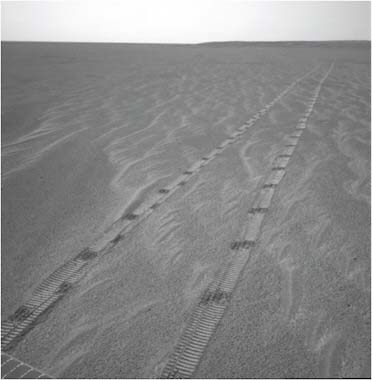
FIGURE 8.1 Opportunity tracks in Meridiani Planum. SOURCE: Courtesy of NASA/JPL.
of exciting targets to explore and better understand planetary evolution and potential habitability.
The Jovian and Saturnian systems are effectively miniature planetary systems with disks of particles (rings) and a wide spectrum of satellites which have volcanic, tectonics, geyser-like, atmospheric and weather activities, among others. Europa and Enceladus seem to have subsurface oceans directly expressed in surface activities or morphology. Io has present volcanic activity that is reshaping its surface. Titan has a methane cycle similar to our planets’ hydrologic cycle and its North pole has numerous large lakes of hydrocarbon. Enceladus is ejecting water particles from its surface in a geyser-like fashion. We are truly having a first glimpse at a wide variety of other worlds. This was done with a small number of flyby and/or orbiting spacecraft which are the Lewis and Clark of the solar system. Over the next few decades we will be sending more sophisticated orbiters, balloons, landers, penetrators, submarines, and so on, which will explore in depth these new worlds.
Every time we send a mission to a new celestial object, we are surprised, and in the process gain new knowledge, be it from the analysis of the particles in comet tails acquired by Stardust, to the unexpected larger ejecta from Tempel 1 Deep Impact encounter. In addition to its eight planets (nine if you count Pluto), and their satellites, the solar system has thousands of small objects which can give us clues of how we came here. These includes active comets, main belt asteroids, dead comets, Trojan objects, Kepler belt objects, Earth crossing objects, and so on. With our technology we will be able to encounter, observe, land and possibly nudge some of these objects to better decipher the history of our solar system, and in some rare but important cases, avoid a major catastrophic impact.
Mercury, Venus, Uranus, Neptune and Pluto are also key pieces in the puzzle of the history of our
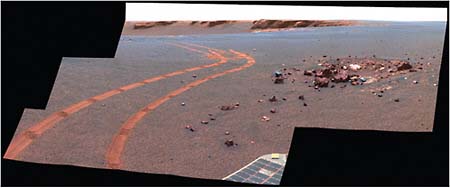
FIGURE 8.2 Opportunity tracks at Victoria Crater. SOURCE: Courtesy of NASA/JPL-Caltech/Cornell University.
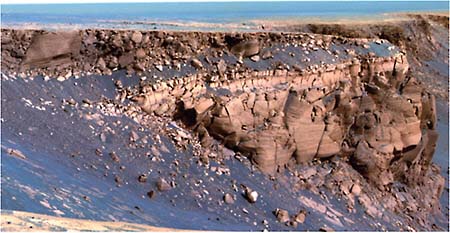
FIGURE 8.3 Opportunity Image of Cape Vincent in Victoria Crater. SOURCE: Courtesy of NASA/JPL/Cornell University.
neighborhood. For example, why is Venus, a planet similar in size to ours, have such a different atmospheric environment and a hellish temperature and pressure at its surface? Is our planet heading in that direction
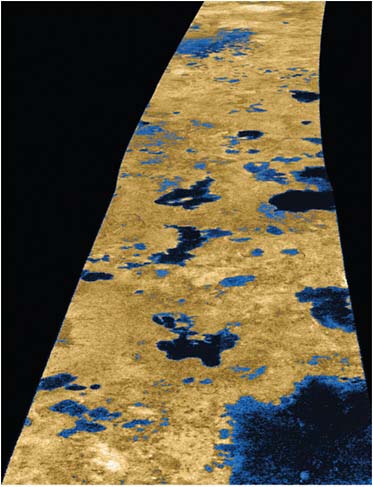
FIGURE 8.4 Methane lakes on Saturn’s moon Titan (Cassini Radar). SOURCE: Courtesy of NASA/JPL/USGS.
as we dramatically increase the amount of greenhouse gases in our atmosphere? Missions planned in the next decade with sophisticated remote sensing instruments, balloons, probes, and possible surface stations will hopefully shed more light on its evolution path.
NEIGHBORING SOLAR SYSTEMS
A decade ago, the topics of the presence and, if so, characteristics of planets around other stars was left to few science fiction writers and “fringe” scientists. Today, the field of “Exoplanet” studies is one of the most active and exciting scientific fields of research and has captured the public imagination. Detection of planets around
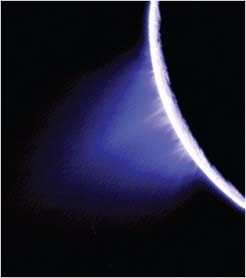
FIGURE 8.5 Geysers on Saturn’s moon Enceladus (from Cassini). SOURCE: Courtesy of NASA/JPL/Space Science Institute.

FIGURE 8.6 Saturn’s rings (Cassini). SOURCE: Courtesy of NASA/JPL/Space Science Institute.
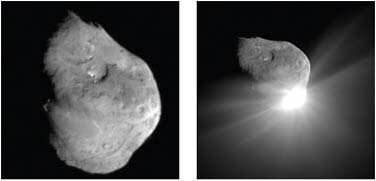
FIGURE 8.7 Comet Temple 1 before and after Deep Impact. SOURCE: Courtesy of NASA/JPL-Caltech/University of Maryland.
other stars with what seems to be exoteric astrometric techniques, makes front cover headlines. More than a hundred planets have been detected and their properties (mass, orbit, composition) are turning upside down our models of how planetary systems look like, showing significant differences from the simple orderly model of our own solar system.
Within the next decade, we will be able to get “family portraits” of the neighboring few thousands planetary systems and statistical assessment of how common they are in our galaxy and beyond. This will
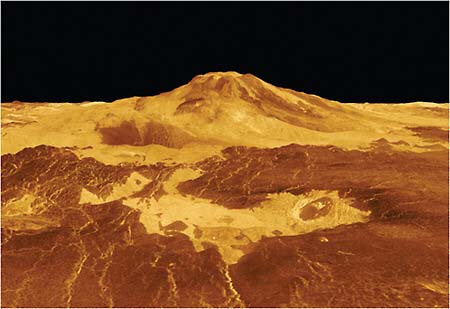
FIGURE 8.8 Venus surface perspective view (Magellan). SOURCE: Courtesy of NASA/JPL.
be done through a series of techniques which require continuous advances in technology ranging from very large arrays of detectors (for transit surveys like on Kepler), very high accuracy metrology (for astrometric missions), advanced adaptive optical systems (for direct imaging coronographs), and very accurate formation flying (for interferometric direct imaging). Acquiring significant information about other planets can be done even if we detect them as single points of light. Their mass, orbit, size, temperature, atmospheric composition and some temporal variation can be determined without resolving the planet beyond one pixel. Getting resolvable planet images might be a herculean endeavor, but it is not any more far fetched than having rovers on Mars as viewed by the technologists of 1958 who were working on Sputnik or Explorer 1.
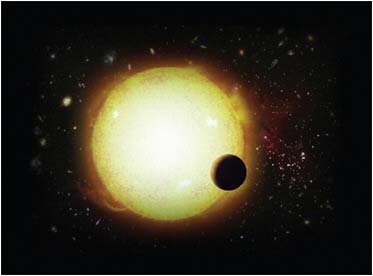
FIGURE 8.9 Kepler will observe transits of exoplanets. SOURCE: Courtesy of NASA/JPL.
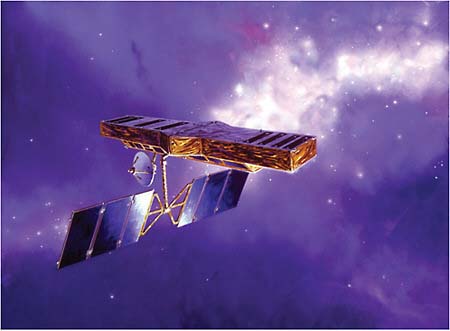
FIGURE 8.10 Exoplanet Astrometric Mission (Planet Quest). SOURCE: Courtesy of NASA/JPL.
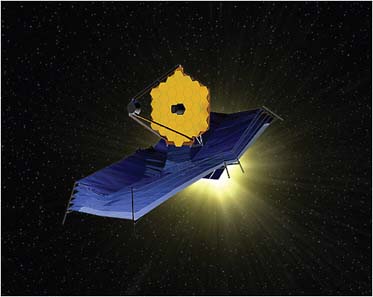
FIGURE 8.11 James Webb Space Telescope. SOURCE: Courtesy of NASA/GSFC.
ADVANCES IN ASTRONOMY
Advances in astronomy has been always driven by technological advances. Getting better resolution simply requires larger optics. Deeper viewing requires more sensitive detectors. Mitigating the atmospheric “blurring” requires adaptive optics or getting above the atmosphere. The advent of space telescopes, with large light weight optics, large high sensitivity focal planes across the spectrum, have been a critical element in advancing our knowledge of the universe around us. Images from the Hubble Telescope, Spitzer, Chandra and other space telescopes are now embedded in our textbooks, used by artists and advertisers, and are common front cover news. Over the next decade, the advent of the James Webb Space Telescope (JWST), Herschel, Planck, NuSTAR, GLAST, and other telescopes presently under study (Con-X, LISA, JDEM, and so on) will allow us to see back to the early dawn of our universe, trace its evolution, and better understand its composition and detect gravitational waves emanating from violent astronomical events. The recent discovery that we do not even understand what most of the universe is made of clearly shows that our quest of space exploration still has many discoveries to be made.
OBSERVING OUR PLANET
It is hard to believe that only a century ago we could only observe to the horizon at any time. Today we routinely can observe, monitor and study our planet on a global and continuous basis. We now regularly moni-
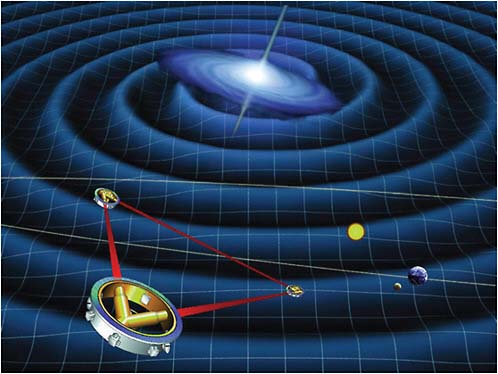
FIGURE 8.12 Laser Interferometer Space Antenna (LISA). SOURCE: Courtesy of NASA.
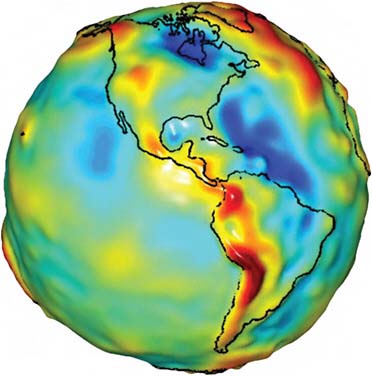
FIGURE 8.13 View of Earth’s gravity field acquired with the Gravity Recovery and Climate Experiment (GRACE). SOURCE: Courtesy of University of Texas Center for Space Research and NASA.
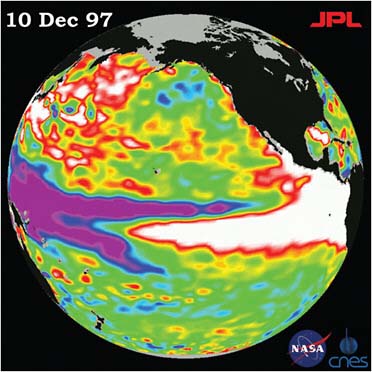
FIGURE 8.14 Topex/Poseidon and Jason missions ocean elevation monitoring. SOURCE: Courtesy of NASA/JPL.
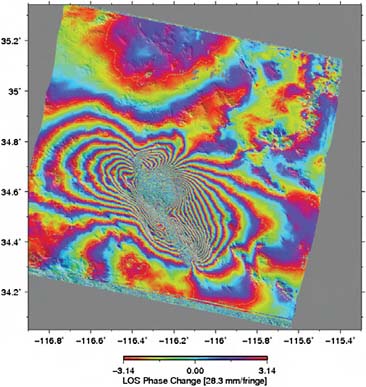
FIGURE 8.15 Interferometric synthetic aperture radar mapping of earthquake displacement. SOURCE: Courtesy of Andrew Newman, Georgia Institute of Technology, http://geophysics.eas.gatech.edu.
tor the ocean temperature and currents, wind patterns under the cloud cover of hurricanes, changes of the ice cover at both poles, the dynamics of the ozone layer that protects life on Earth, the changes in the vegetation cover, among many other environmental elements. Within the next decade we will be able to measure the ocean salinity from space, map in three dimensions the emissions, circulation and absorption of carbon dioxide, the subtle tectonic motion of plates leading to assessment of high risk areas, monitor the changes in biomass and the full inventory of atmospheric gases, detect subtle changes in the surface water (with altimetric changes), and subsurface water (with gravity changes). Our ability to monitor from space almost all the “health symptoms” of our planet is putting us at the threshold of being able to provide the public and the policymakers with scientifically based knowledge of the present and future impact that we are having on our planet. As we better understand, improve and verify our global model, we will then be able to assess the impact of specific actions that are proposed to be a better custodian of our home planet.


