
Explorer 1: Gateway to the Never Ending Wonders of Space Science
The Space Studies Board Van Allen Lecture
delivered by
Frank B. McDonald
Institute for Physical Science and Technology
University of Maryland
PREFACE
On June 26, 2008, on the occasion of the 50th anniversary of the Space Studies Board, Dr. Frank McDonald delivered the first Space Studies Board Van Allen Lecture. The following is excerpted from the transcript of this lecture and is intended to convey, in his words, the thoughts that Dr. McDonald shared with us on that evening.
Lennard A. Fisk
Chair, Space Studies Board
(2003–2008)
INTRODUCTION
I am very pleased to accept the Van Allen Award of the Space Studies Board, and to deliver the Van Allen Lecture this evening. I received my Ph.D. in 1953 from the University of Minnesota and then joined Van Allen’s group at the University of Iowa from 1953 through 1959. Van Allen was an exceptional mentor. He paid close attention not only to me but all the other people that were in his group and gave us the support that we needed. He kept encouraging me to follow the right path in spite of a tendency I had to wander about a bit.
I remember a great deal about those early days in the space program, and the impact and advice that I received from Van Allen. I am pleased to be able to share some of those experiences with you tonight. NASA has been one of the great adventures in my life. I am so lucky to have seen the beginning of the space age with Van Allen. I saw Explorer 1 and 3. I was able to get my own programs going at the Goddard Space Flight Center, starting in 1959 when Goddard first opened. Even today, I am still looking at Voyager data. NASA has been really one of the world’s most exciting places to be, and so in addition to describing how we began, I want to share some thoughts concerning where the space program is going in the immediate future.
I have also witnessed, as we all have, the tremendous impact of satellites on our lives. If we looked out tonight and we could count the satellites in the sky, we would find on the order of 875 satellites. Most are communications satellites, 15 percent are used for scientific purposes: Earth sciences, astrophysics, space physics, and planetary physics. If we consider only Earth and space science satellites by country, we find that from Europe there is on the order of 40 satellites. Here in the United States there are 52. China comes in third, with 21. Space science is predominantly an American and European endeavor.
Satellites have had an enormous impact on our lives. Just imagine if you would take them away, how the military would function and how other areas of our society would function. It would be a great loss. These 875 satellites are a routine part of our lives, so much so that when there is a major launch you might read about it in the trade journals, e.g., in Aviation Week, but you probably will not find a mention of it in the Washington Post.
THE EARLY PIONEERS
Let us begin in the beginning and trace the activities of the people who put the space age into motion.
In the very beginning there was Isaac Newton, who taught us the Laws of Motion. Force equals mass times acceleration; to every action there is always opposed an equal reaction. Newton’s objective was to understand Kepler’s Laws, to understand the motion of planets and the Moon. To make his life easier, he also invented calculus.
The modern day icons of the space age were Konstantin Tsiolkovsky, Herman Oberth, and Robert Goddard, who are shown in Figure 9.1, along with their immediate scientific descendants: Sergey Korolyov in the case of Tsiolkovsky; Wernher Von Braun in the case of Oberth, and all the American space program, symbolized by NASA/JPL, from Goddard.
Tsiolkovsky was born in a small village south of Moscow; he had a Polish father and Russian mother. He was left profoundly deaf at the age of 10 from scarlet fever, but he still read widely. At age 16, his parents sent him to Moscow for study, where he existed on brown bread. The librarian at the main library provided him with a place for him to work, so that at age 19 he was able to become a high school teacher. In the early 1900s, he published a number of articles, science fantasies. However, in 1903, he published his significant article in a Russian science journal: Exploring Space with Reactive Devices.
In the center of Figure 9.1 is Herman Oberth, who at the age of 12 read Jules Vern and was strongly influenced by him; indeed all three of the space icons were influenced by Jules Vern. Oberth’s parents sent him off to study Medicine at the University of Munich. He did not like that, so he went to Heidelberg, where he wrote a Ph.D. thesis on interplanetary travel. It was not accepted by Heidelberg so he never officially got his degree. In 1923, he wrote a book, Rockets into Interplanetary Space, which sold surprisingly well. Oberth Konstantin Tsiolkovsky
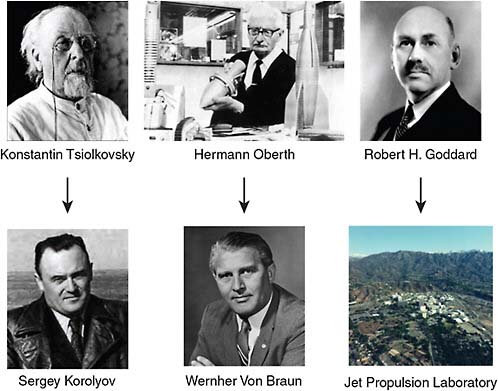
FIGURE 9.1 The three icons and their descendents. Left to right, top row: Konstantin Tsiolkovsky (NASA), Hermann Oberth (courtesy of the Hermann-Oberth-Spaceflight Museum, Feucht, Germany), and Robert H. Goddard (NASA). Left to right, bottom row: Sergey Korolyov (NASA), Wernher Von Braun (courtesy of NASA/MSFC), and the Jet Propulsion Laboratory (NASA).
had a great effect on Wernher Von Braun, who we will discuss later.
Robert Goddard, on the right of Figure 9.1, was also very interested in space. He received his Ph.D. from Clark University, after which he went to Princeton University where he developed tuberculosis and then returned home to continue his research at Clark. He submitted a proposal to the Smithsonian, which awarded him $5,000 to support his research. He published his research in 1921: A Method of Reaching Extreme Altitudes. Interestingly, he discussed at the end of that paper how he might send an object to the Moon, and then impact it with some flash powder that you could see from Earth. JPL is shown in Figure 9.1 as a descendant of Goddard, but in reality there was a very negative interaction between the two. JPL could never work with Goddard; he simply wanted to have his own show.
Oberth wrote to Goddard and asked him for a copy of his 1921 paper, a Method of Reaching Extreme Altitudes. Goddard reluctantly sent it, but gradually there emerged a conflict. The Germans claimed that Oberth had done it before Goddard, for which there is no evidence. The Russians pointed out that Tsiolkovsky published back in 1903, two decades before Goddard and Oberth, and to reinforce their point they raised the status of Tsiolkovsky, who had lived in total obscurity up to that point. The Soviets elected him to the forerunner of the Soviet Academy of Sciences, gave him a generous pension, and he was supremely happy.
A famous New York Times editorial on January 13, 1920 made the cutting statement that Goddard did not know the relation of action to reaction, stating that you have to have something better than a vacuum against which to react. It noted that Goddard should have learned this in high school. It was one of the most cutting editorials and damaged Goddard’s self-esteem greatly. At least in July 1969 when Apollo 11 was making its way to the Moon, the New York Times put out a retraction and said, “Further investigation and experimentation have confirmed the findings of Isaac Newton and it is now definitely established that a rocket can function in a vacuum as well as in an atmosphere.” One can argue that the media should stay out of things they do not understand.
Goddard did receive support from Charles Lindburgh who was very impressed with what Goddard was doing. Lindburgh went to Harry and David Guggenheim and got funding for Goddard, at the rate of $25,000 a year for 4 years. Back in the early 1930s, $100,000 was a lot of money, so Goddard picked up and moved from Massachusetts to Roswell, New Mexico, before we had all the flying saucers there. There he developed the liquid propellant rocket, occasionally blowing it up, but eventually getting it to reach an altitude around 9,000 feet. The Caltech folks and Frank Malina from JPL went to visit Goddard, but he would not show Malina the rockets that he had. He did let Malina into his shop but would not uncover the rocket that he was putting together. Goddard just did not play well with others, but he was a great pioneer of the space age.
THE GERMAN ROCKET PROGRAM OF WORLD WAR II AND THE BEGINNING OF THE U.S. ROCKET PROGRAM
In the meantime, back in 1929, the Germans made a decision that they wanted to have what would come to be known as Intermediate Range Ballistic Missiles. They turned the task over to Captain Walter Domberger, who recruited Wernher Von Braun, and they put together a rocket team and opened up a rocket test sight in Peenemunde, in September 1941. The war at that time was going well for the Germans, and so Hitler cut back on their budget and they limped along, developing what would become the A7.
However, as the war worsened for the Germans, they received increased funding for a production rocket, the V2 shown in the center panel of Figure 9.2, which they produced by using concentration camp labor. The rockets were reasonably successful in their flight history. The V2 rockets did some damage to England, and some 5500 people were killed. More than 12,000 of the concentration camp laborers died. It was really an inhumane exploitation of these people that went beyond anything I think we can imagine.
The development of the V2 was the beginning of the modern Intermediate Range Ballistic Missile. At the end of the war, the U.S. scooped up the rockets, the parts, the drawings, and the people, in Operation Paperclip. They brought 100 rockets to Whitesands and the Naval Research Laboratory (NRL) convinced the U.S. Army that they should launch payloads—that the Army had a need to learn about what the upper
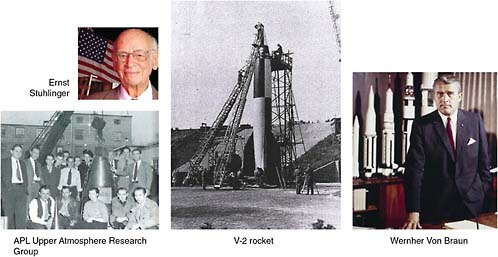
FIGURE 9.2 Ernst Stuhlinger (courtesy of Patricia Miklik Doyle); Applied Physics Laboratory (APL) Upper Atmospheric Research Group (courtesy of Johns Hopkins University APL); V2 rocket (courtesy of NASA Glenn Research Center); Wernher Von Braun (courtesy of NASA/MSFC).
atmosphere was like. Ernst Stuhlinger, also shown in Figure 9.2, was part of Von Braun’s group and had done his PhD thesis on the development of Geiger counters. He became the scientific liaison to the scientific community.
Shown in the lower left hand corner of Figure 9.2 is Jim Van Allen, looking as young as always, with a large group. At that time, he was with the Johns Hopkins University Applied Physics Laboratory and, as one might expect, when he came to town to fly the first rocket, he had his experiment ready and he flew it. Unfortunately, the rocket failed, but he did eventually get a successful flight, number 33. At the same time, Eric Crowther organized a rocket panel to distribute the V2 resources but he left shortly to go into industry. Van Allen took over as chairman of the group that evolved into the Rocket Upper Atmospheric Research Panel, finally the Rocket and Satellite Research Panel. Van Allen remained Chairman until NASA was established, and then the group dissolved. The Rocket Panel did not receive support from anybody. It met roughly three times a year and it was made up of people from universities, government laboratories, and industry.
This was Operation Paperclip and its successor programs. In the end some 67 V2s were fired. The V2s were followed by the Aerobee rocket, which could take a 100-pound payload through a 76-kilometer trajectory. The Aerobees were made by Aerojet under the supervision of Von Kármán and Frank Malina of JPL, and were eventually operated by NRL. The Aerobee was a revised version of the Corporal rocket. It steadily improved over the years and some 1037 Aerobees were fired.
VAN ALLEN AND ROCKOONS
Let’s return now to Van Allen. On the left of Figure 9.3 is Van Allen as a graduate student, at what is now the University of Iowa. The middle shot, shows him as a Lieutenant in New Guinea. Van Allen worked first at the Carnegie Institute on the proximity fuse, and so he was one of the people who was sent to the Pacific to introduce the rocket to the Navy. The photo on the right is Van Allen at his desk at the University of Iowa at the end of his career.
One of the technologies that Van Allen developed
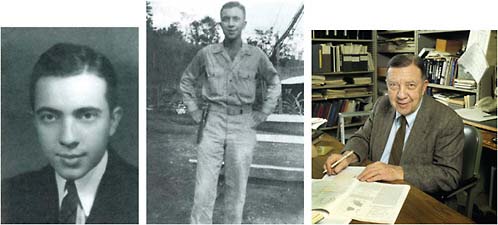
FIGURE 9.3 Dr. Van Allen (left to right) as a graduate student (NASA), as a lieutenant in the Navy (NASA), and at his desk (courtesy of Tom Jorgensen, University of Iowa Office of University Relations, 1990).
while in the Navy, an idea he got from Lee Lewis, a Commander in the Navy, was the Rockoons. As shown in Figure 9.4, these were rockets that were launched from a balloon. The balloon takes the rocket to about 70,000 feet, and you are able to achieve 350,000 feet when the rocket fired.
The Rockoon program was great fun, but it had its moments that established that we really were not rocket scientists. The photo on the right shows some idiot up there (me) holding a two-stage rocket that we decided to try. We used the same nose cone and the same tail fins that we used on smaller rocket flights. The rocket
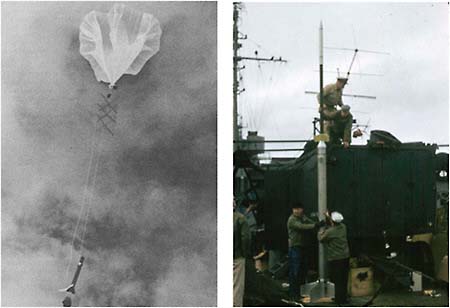
FIGURE 9.4 Rockoons. SOURCE: Courtesy of NASA.
was carried by the balloon to 70,000 feet. It fired, the second stage fired, and everything went blank. We did that twice. Then JPL told us that although the rocket may be at 150,000 feet or so, it still has a great deal of heating that will burn through the tail fins and the nose cone.
Three or four days later, the small rocket that is on the top of the rocket exploded on deck, severely injuring our Navy representative who is up there, right behind me. We got him to shore, he made a complete recovery but I had to come down to Washington and face the Navy. I must say in all of my years, I have never been dressed-down quite as strongly as they did. And with me already feeling very badly about the whole thing. There were roughly 100 Rockoon flights in six expeditions started in 1952, and they were great fun. A lot of the experiments were done, ionization chambers, single Geiger counters, double and the shielded Geiger counters; the same experiments that we would later fly on satellites.
THE FIRST SATELLITES
There was a very interesting study done in 1946 by the RAND project that stated that although the crystal ball into the future is cloudy, two things seem clear: “A satellite vehicle with appropriate instrumentation can be expected to be one of the most potent scientific tools for the 20th century. The achievement of a satellite craft by the United States would inflame the imagination of mankind, and would probably produce repercussions in the world comparable to the explosion of the atomic bomb.” Neither of these statements were over-statements by any stretch of the imagination, as proved to be the case when the Soviets launched a satellite first, and there were worldwide repercussions that the Soviets were ahead of us.
Starting in 1954, with the development of ICBMs, it became obvious that a satellite could be launched if you had the will to do it. The U.S. proposed through its International Geophysical Coordination (IGY ) committee that they would launch a satellite during the IGY period in 1957 to 1958, and the Soviets came back saying they too were going to launch a satellite. We were distinctly told what their intentions were. They were going to launch Sputnik, as shown in Figure 9.5. Our reaction was one of surprise and dismay, as shown by the strong reaction in Life Magazine.
The Soviet who made Sputnik happen was Sergey Korolyov, who had spent World War II in a Soviet
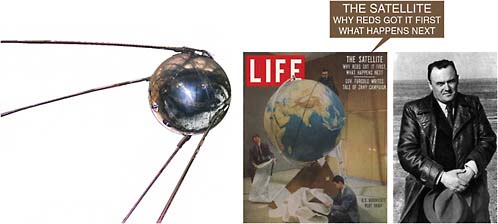
FIGURE 9.5 Left to right: Sputnik 1 (courtesy of NASA National Space Science Data Center); Smithsonian Observatory scientists working at Massachusetts Institute of Technology trying to calculate Sputnik’s orbit, cover of LIFE magazine, October, 21, 1957 (photo by Dmitri Kessel/Life Magazine, Copyright Time Inc./Time Life Pictures/Getty Images); and Sergey Korolyov (courtesy of NASA).
Gulag. One of his so-called friends but really rivals had claimed he was giving information to the enemy. He was sentenced to the Gold Mines in Siberia. His thesis advisor arranged for him to be assigned to the place where they were doing design work for rockets, and he put together the ICBM, the R7 that was flown twice successfully as an ICBM before Sputnik.
There were many people in Washington who worried what would happen if the U.S. launched a satellite first and over-flew Russia. They did not know what the Soviet reaction would be. It was convenient that the Soviets used an ICBM to launch Sputnik. However, the appreciation of letting the Soviets clear up the policy issues was lost on the general public, who were alarmed by the Soviet success.
In the U.S., the Vanguard rocket to be built by NRL had been selected to launch the first U.S. satellite. The Germans, under Von Braun, were now safely ensconced and happy in Huntsville. They were initially denied the opportunity to launch a satellite, and kept their program alive by doing re-entry studies. After Sputnik, and the failure of Vanguard, they were given the go-ahead to launch the first U.S. satellite. General Maderas, who was in charge of the Huntsville effort, made a deal with William Pickering, the Director of JPL, for JPL to build the spacecraft. There was thus a JPL spacecraft and upper stage, Van Allen’s University of Iowa experiment, and the main rocket provide by von Braun. This was Explorer 1, launched on January 31, 1958, shown in Figure 9.6 beside the famous celebratory photo of Pickering, Van Allen, and von Braun.
Shown in Figure 9.7, in the upper left hand corner, is the counting rate of Van Allen’s Geiger counter on Explorer 3. Explorer 1 did not have a tape recorder, since the spin rate was too high. George Ludwig had to redesign the tape recorder, and is shown in the figure with his redesigned tape recorder, along with Ed Foran, the main machinist at Iowa. It is curious that Ed Foran’s father had worked for Robert Goddard back in New Mexico; hence a second generation of space engineers. In the lower right-hand corner of Figure 9.8 is shown the main team at Iowa, the gang of four: Van Allen, Carl McIIwain, George Ludwig, and Ernie Ray. George is currently doing a detail history of this period, which I hope will be published shortly
Within the 14-month period of Explorer 1, the principle scientific instruments for nine space missions were provided by Van Allan and his group in a period Van Allen said was his busiest and the happiest period of his life. The missions were Explorers 1 through 5,
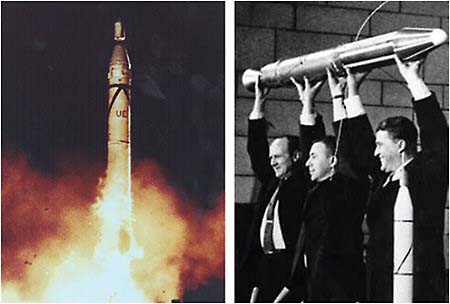
FIGURE 9.6 Explorer 1 was launched on January 31, 1958. SOURCES: (left) U.S. Centennial of Flight Commission, image courtesy of NASA; (right) courtesy of NASA/JPL.
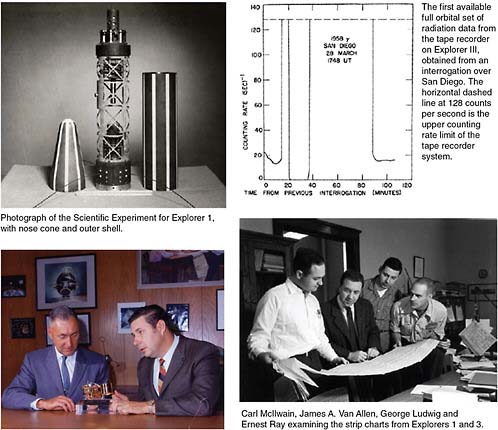
FIGURE 9.7 Iowa. Clockwise from top left: Photograph of the Scientific Experiment for Explorer 1, with nose cone and outer shell; the first available full orbital set of radiation data from the tape recorder on Explorer 3, obtained from an interrogation over San Diego. The horizontal dashed line at 128 counts per second is the upper counting rate limit of the tape recorder system; Carl McIlwain, James A. Van Allen, George Ludwig, and Ernest Ray examining the strip charts from Explorers 1 and 3; Van Allen presented to the Smithsonian Institution a miniaturized tape recorder that is the flight spare for the one that flew on Explorer 3. All images courtesy of NASA.
and Pioneers 1 through 4. Some of these missions were partial launch failures but they did gain enough altitude to obtain orbit. Iowa obtained very useful radiation belt data from seven out of the nine missions. Imagine here at the beginning of the Space Age, Explorer 4 had two Geiger counters, and an iodide scintillation counter. It was incredible that these instruments could be assembled so rapidly. There was, however, nobody to look over ones shoulder. There was no quality control, just your own good engineering sense.
Explorer 4 was interesting in that there were two concurrent H-bomb explosions connected with the Argus test on Johnson’s Island: Two 5-mega-ton blasts and a couple of smaller A-bomb tests. The Iowa group noticed that there was a launch opportunity, and they convinced the Army, who was in charge, to launch their
experiments. The H and A bomb tests generated a temporary electron belt, which was useful in establishing some of the properties of the radiation belt. This was perhaps the first example of active experimentation in space.
The gang of four at Iowa split up shortly after this string of early missions. Ludwig and eventually Ernie Ray went to Goddard. Carl McIIwain went to UCSD to start up a group. Van Allen kept going at Iowa. Iowa had shown what a University could do and the impact it could have, and that approach to research in space determined how science in NASA would be done. Goddard would shortly become the center of space science research, but it was Van Allen’s approach that would guide the development of Goddard’s space science activities.
In December 1958, JPL formally transferred to NASA while remaining part of Caltech. This decision was facilitated by William Pickering, the Director of JPL, who decided that JPL would get out of developing rockets, since this was not what Caltech should be doing. JPL felt the Moon and the planets were out there for them and that is where they were going. JPL had a very rocky start for the first few years, but now, as we will discuss later, it has turned into quite a success story.
The Army ballistic missile activities in Huntsville transferred to NASA in July 1960, to become the Marshall Space Flight Center. They developed larger Redstone rockets for Alan Shepard’s and Gus Grissom’s suborbital manned flights and they began work on the Saturn V rocket for the manned missions to the Moon. Jupiter C was a direct descendent of the V2, and the Saturn V was simply eight Jupiter C’s put together in a package, to give you the necessary huge lift to go to the Moon.
When you add the Manned Space Flight Center, now Johnson, to Goddard, JPL, and Marshall, you have the main ingredients of today’s NASA. And it was Iowa and its profound impact on space science, together with the Army ballistic missile activities and JPL, and what they achieved with Explorer 1 and 3, that paved the way for the new NASA.
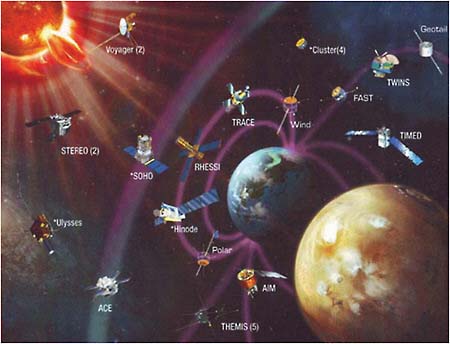
FIGURE 9.8 Heliophysics. The older and current missions in flight are used as an extended observatory, enabling end-to-end surveillance of the Sun–Earth Connection. SOURCE: Courtesy of NASA.
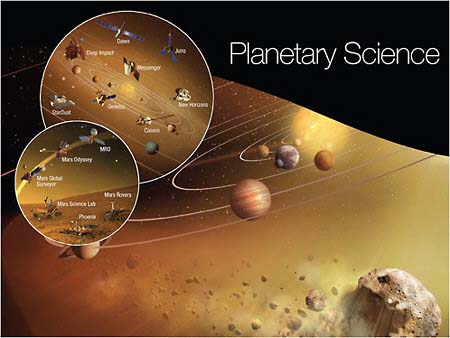
FIGURE 9.9 Planetary science missions. SOURCE: Courtesy of NASA.
THE ROAD AHEAD
The story to date has been inspiring. Let us now consider what lies ahead for us.
As is illustrated in Figure 9.8, there are some 24 missions currently studying the Sun and the heliosphere it creates—the discipline of heliophysics. NASA has been very generous in supporting this disciple. There are the Voyagers now exploring the outer heliosphere; an outstanding array of solar observatories such as SOHO, RHESSI, and TRACE; along with precision measurements from the near-Earth, the ACE mission. Ulysses, which has been orbiting about the poles of the Sun, is now near its end.
The extended observatory in heliophysics provides an end-to-end look at the connection between the Sun and Earth. The Solar Dynamics Observatory will launch in 2009 and replace SOHO. As we look to the future, Solar Orbiter is to be placed in an orbit that is only a few tenths of an AU from the Sun, where the Sun is some 25 times brighter and very detailed measurements of solar phenomena can be made. There is also to be a Solar Probe, a mission that will penetrate to within about 10 solar radii of the Sun, through a series of complex orbits using Venus flybys. Solar Probe will provide us with the first direct measurements of the acceleration region of the solar wind and of the energetic particles that control our heliospheric environment.
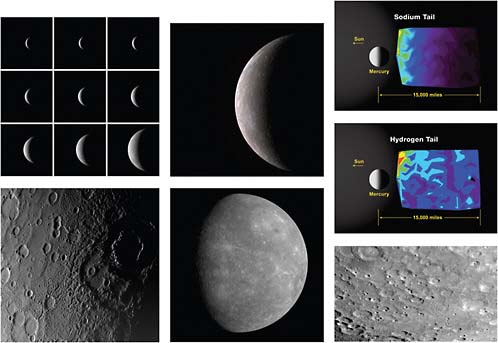
FIGURE 9.10 Some results from MESSENGER’s Mercury fly by. SOURCE: Courtesy of NASA/Johns Hopkins University Applied Physics Laboratory/Carnegie Institution of Washington.
Planetary science is also doing very well, as illustrated in Figure 9.9. There is the Dawn mission currently en route to an asteroid, and the Juno mission to be launched to Jupiter. Deep Impact collided with a comet to study its nucleus. New Horizon is on its way to Pluto. Stardust returned material from a comet. Cassini is orbiting about Saturn.
MESSENGER has flown by Mercury twice and is about to be placed into orbit. The results from the most recent flyby are shown in Figure 9.10.
Finally there are all the missions to Mars, shown in Figure 9.11—rovers on the surface, Phoenix in the polar regions, and the orbiters. My favorite mission is Phoenix, which is shown in Figure 9.12 descending to the martian surface, as observed by a high-resolution telescope from a mission in orbit about Mars. Phoenix will provide definitive proof of water on Mars.
One of the greatest accomplishments of the space age, and of the Goddard Space Flight Center, was the Cosmic Background Explorer (COBE), which, as illustrated in Figure 9.13, made very precise measurements of the 3° black body radiation from the beginning of the universe. As stated by John Mather, the Principle Investigator on COBE, and winner of the Nobel Prize in Physics for this measurement, it is all very simple: Just a giant, very uniform explosion that started the whole universe.
In 2009, the Hubble Space Telescope will be up
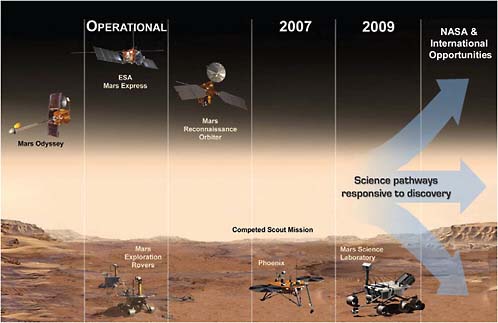
FIGURE 9.11 Current Mars missions. SOURCE: Courtesy of NASA.
graded for the last time, as illustrated in Figure 9.14. We are using Hubble exactly as astronomers have used ground-based telescopes, such as 200 inch at Palomar. They keep upgrading the instrumentation, making it much better, with new instruments that have 20 times the resolving power. Hubble can look at the architecture of the universe, the life story of galaxies, and the birth and death of stars. Hubble as some people describe it is the world’s most successful explorer, and it is. Repairing Hubble is a very difficult thing, but if all goes well, we will have an outstanding new observatory.
Swift, which is a Goddard mission and illustrated in Figure 9.15, allows you to detect gamma-ray bursts, find their precise positions, which in turn allows ground-based observatories to study the afterglow of the bursts and identify their origins. Short gammaray bursts are from neutron star-neutron star mergers; long gamma-ray bursts are from massive star core collapses.
Finally, there is the James Webb Space Telescope, to be launched in 2013—a 6.5-meter-diameter telescope illustrated in Figure 9.16. I think it is very appropriate to name this mission after James Webb. Although not an astronomer, he was one of the best NASA Administrators, back in the 1960s. Webb maintained a very balanced program of space exploration, aeronautics, and science. The James Webb Space Telescope will be placed at the L2 point, a stable location near enough to Earth so that it can make effective infrared observations. It will observe the very early
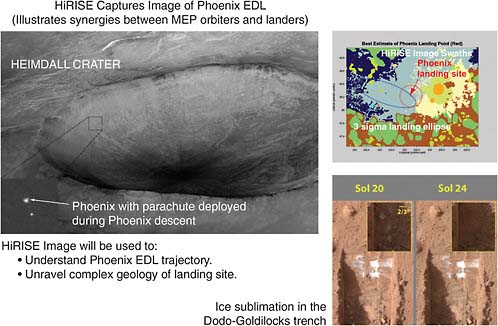
FIGURE 9.12 Clockwise from left: HiRISE will be used to understand Phoenix EDL trajectory and unravel complex geology of landing site (MRO-HiRISE/NASA/JPL/University of Arizona); ice sublimation in the Dodo-Goldilocks trench on Mars (NASA/JPL-Caltech); HiRISE captures image of Phoenix EDL; illustrates synergies between MEP orbiters and landers (NASA/JPL-Caltech/University of Arizona/Texas A&M University).
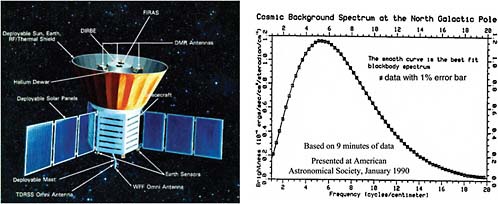
FIGURE 9.13 Cosmic Background Explorer (COBE). Significance of spectrum: Old data were wrong! Old theories explaining bad data were wrong too! Hot Big Bang explains everything here. Steady state theory (main alternative) doesn’t. It was all very “simple”—just a single, giant, very uniform “explosion” of the whole universe! SOURCES: (Left) Courtesy of NASA/GSFC. (Right) Courtesy of NASA and the COBE Science Working Group.
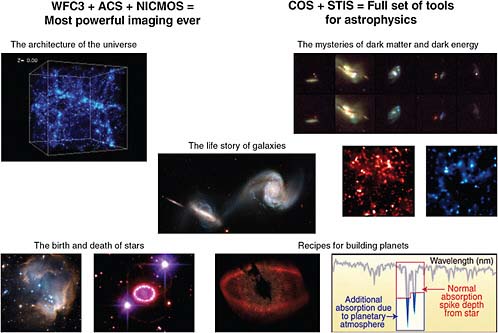
FIGURE 9.14 When the astronauts leave Hubble for the last time, it will be at the apex of its capabilities—better than it has ever been before. The architecture of the universe (NASA/ESA/Hubble Heritage Team (STScI/AURA)/Hubble Collaboration); the birth (NASA/ESA/Hubble Heritage Team (STScI/AURA)/Hubble Collaboration) and death of stars (NASA/ESA/P. Challis and R. Kirshner (Harvard-Smithsonian Center for Astrophysics); the life story of galaxies (NASA/ESA/Hubble Heritage Team (STScI/AURA)); the mysteries of dark matter and dark energy (left to right, NASA/ESA/A. Riess (STScI); NASA/ESA/R. Massey (California Institute of Technology); NASA/ESA/R. Massey (California Institute of Technology)); recipes for building planets (left, NASA/ESA/P. Kalas, J. Graham, E. Chiang, E. Kite (University of California Berkeley)/M. Clampin (NASA Goddard Space Flight Center)/M. Fitzgerald (Lawrence Livermore National Laboratory)/K. Stelfeldt and J. Krist (NASA Jet Propulsion Laboratory); right, NASA).
universe, and see the end of the dark period and first light. It will see the assembly of the first galaxies, and the birth of stars and protoplanetary systems. It will be a truly incredible mission.
CLOSING REMARKS
Let me close with some remarks on the Pioneer and Voyager missions to the outer heliosphere, shown in Figure 9.17. There is a picture of Van Allen at the press conference for the Pioneer encounter with Jupiter. Van Allen was a driving force behind the Pioneer missions, and subtlety led the fight to redirect Pioneer 11 from Jupiter, back across the solar system, to Saturn. I was also one of the principle investigators on Pioneer. I soon learned after one or two of these press conferences that the press had only two interests. They wanted to see Tom Gerald’s pictures of Jupiter
![FIGURE 9.15 Swift. Clockwise from top left: Swiftís three scientific instruments work together to learn as much as possible about gamma-ray bursts (NASA/GSFC); long GRBs (Pi of the Sky collaboration); short GRBs (Reprinted by permission from Macmillan Publishers Ltd: Nature, S.D. Barthelmy, G. Chincarini, D.N. Burrows, N. Gehrels, S. Covino et al., An origin for short [gamma]-ray bursts unassociated with current star formation, Nature 438:994-996, copyright 2005).](/openbook/12675/xhtml/images/p2001dcd3g141001.jpg)
FIGURE 9.15 Swift. Clockwise from top left: Swiftís three scientific instruments work together to learn as much as possible about gamma-ray bursts (NASA/GSFC); long GRBs (Pi of the Sky collaboration); short GRBs (Reprinted by permission from Macmillan Publishers Ltd: Nature, S.D. Barthelmy, G. Chincarini, D.N. Burrows, N. Gehrels, S. Covino et al., An origin for short [gamma]-ray bursts unassociated with current star formation, Nature 438:994-996, copyright 2005).
and Saturn and they wanted to hear what Van Allen had to say.
Also shown in Figure 9.17 is data from the LECP experiment on Voyager 1, low-energy ion data that shows that Voyager has crossed the termination shock of the solar wind, where the supersonic flow of the solar wind goes subsonic to begin the process of merging with the local interstellar medium. We have also recently crossed the termination shock with Voyager 2, each Voyager spacecraft now penetrating into the heliosheath, the subsonic region that is the outermost reach of the region in interstellar space carved out by the Sun. The heliosheath is probably 30–60 AU wide, and at its current speed Voyager 2 could cross the heliopause into the true interstellar medium in a decade or so.
We live in times of unprecedented exploration. Fifty years ago Van Allen and his co-workers began the exploration of space with a simple experiment to understand the near-space environment of Earth. Since
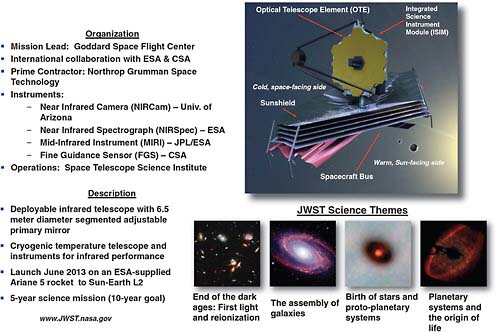
FIGURE 9.16 Finding our origins with the James Webb Space Telescope (JWST) and the JWST Science Themes. Top: JWST (NASA). Bottom row, left to right: End of the dark ages—first light and reionization (NASA/ESA/S. Beckwith(STScI)/HUDF Team). The assembly of galaxies (NASA). Birth of stars and proto-planetary systems (M.J. McCaughrean (Max-Planck-Institute for Astronomy), C.R. O’Dell (Rice University), and NASA). Planetary systems and the origin of life (NASA).
then we have extended our presence to the farthest reaches of our solar system; we have explored all the planets; we have made detailed observations of our Sun and the space environment it creates; we have observed the wonders of the universe.
I would like to thank the Space Studies Board again for the honor of being able to give the Van Allen Lecture.
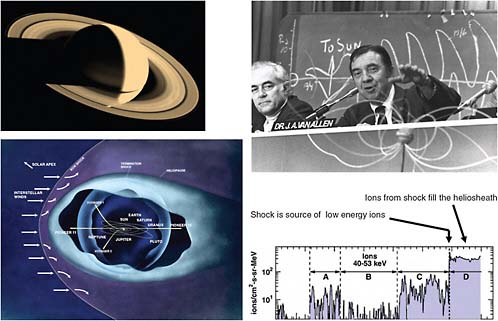
FIGURE 9.17 Pioneer/Voyager. Top left: Saturn (NASA/JPL, PIA01969). Top right: Pioneer 10 news release image (NASA/ARC). Bottom left: Heliopause schematic (NASA). Bottom right: Termination shock; showing 5-day smoothed V1 40–53 ion (with kind permission from Springer Science+Business Media: J.D. Richardson and E.C. Stone, The solar wind in the outer heliosphere, pp. 7-20 in From the Outer Heliosphere to the Local Bubble, Springer New York, Copyright 2009, Figure 4a).
ACKNOWLEDGMENTS
Dr. McDonald acknowledges the assistance of Victoria Swisher in assembling the figures for the lecture and paper, and also Joe Alexander for looking over her shoulder. Also, George Gloeckler and Randy Jokipii deserve special thanks for their help in preparing the lecture.


