




Below is the uncorrected machine-read text of this chapter, intended to provide our own search engines and external engines with highly rich, chapter-representative searchable text of each book. Because it is UNCORRECTED material, please consider the following text as a useful but insufficient proxy for the authoritative book pages.
Summary ________________________________________________________________________ PURPOSE OF THE WORKSHOP Social Network Analysis (SNA) is the identification of the relationships and attributes of members, key actors, and groups that social networks comprise. The National Research Council (NRC), at the request of the Department of Homeland Security (DHS), formed an ad hoc committee to plan a two-day workshop on the use of SNA for the purpose of building community disaster resilience. The workshop, held February 11-12, 2009, was designed to provide guidance to the DHS on a potential research agenda that would increase the effectiveness of SNA for improving community disaster resilience. Explored were the state of the art in SNA and its applications in the identification, construction, and strengthening of networks within U.S. communities. Workshop participants discussed current work in SNA focused on characterizing networks; the theories, principles and research applicable to the design or strengthening of networks; the gaps in knowledge that prevent the application of SNA to the construction of networks; and research areas that could fill those gaps. Elements of a research agenda to support the design, development, and implementation of social networks for the specific purpose of strengthening community resilience against natural and human-made disasters would be discussed. Box S-1 provides definitions of terms commonly used during the workshop. WORKSHOP PLANNING A planning committee designed the workshop to explore how SNA could be applied during all phases of the disaster cycle. The planning committee invited researchers with expertise in resilience science and in SNA for a variety of applications (e.g., anti- terrorism and public health) to participate in the workshop and discuss the states of the art and science in their respective fields. Emergency management practitioners with experi- ence responding to disasters were invited so that the needs of community leaders with their âboots on the groundâ could be considered. The committee included 1
2 APPLICATIONS OF SNA FOR BUILDING COMMUNITY DISASTER RESILIENCE participants from different geographical regions and with varying disaster experiences so that a broad range of issues and perspectives could be explored. Sessions of the workshop were devoted to specific themes. In the context of disaster preparedness, the roles of SNA and communication in enhancing the functional, struc- tural, and interactional connections between networks were discussed. Barriers to the use of SNA for planning activities that decrease the impact of disasters (e.g., interventions) were also discussed. Workshop participants considered how SNA could be used to make network ties between organizations more productive, and how SNA could be applied during and following a disaster to make improvisational responsesâthose planned once needs and resources are identifiedâmore flexible. How individuals and communities could be engaged to promote collective behavior when preparing for, responding to, and recovering from disasters was considered. BOX S-1 Definitions of Key Workshop Terms The following are definitions of key terms used in the study of social networks, social network analysis, resiliency science, and research translation used during this workshop. Resilience. The response to stress at individual, institutional, and societal levels categorized as the characteristics that promote successful adaptation to adversity. Social network. The interactions between people and organizations, including who knows, works with, or communicates with whom, that can be mapped. The data and information found on tools such as Facebook and the Enron Email Corpus are examples of social networks. Social network analysis. The process of analyzing a social network and identifying key actors, groups, vulnerabilities, and redundancies as well as the changes in these variables. Social networking. The process of creating, maintaining, or altering oneâs network and to oneâs advantage by using the network to gain resources or influence, or to mobilize activity. Social network analysis tools. The set of tools, technologies, metrics, models, and visualization techniques used for social network analysis. These may include data extraction tools, link analy- sis, statistical techniques, and graph theory techniques using programs such as AutoMap, ORA, UCINET, and Pajek. Social network theory. The set of theories for forecasting, reasoning about, and understanding how social networks form, are maintained, and evolve, and the role of variables such as social networking tools, media, and stress in affecting the emergence, utilization, management, and change in social networks. Social network tools. A set of computational techniques that enable individuals and groups to engage in social networking by monitoring and interacting within the networks with which they are connected. Facebook, MySpace, and Twitter are examples of social networking tools. Translation research. The research aimed at enhancing the movement of research results from the scientific to the applied realms.
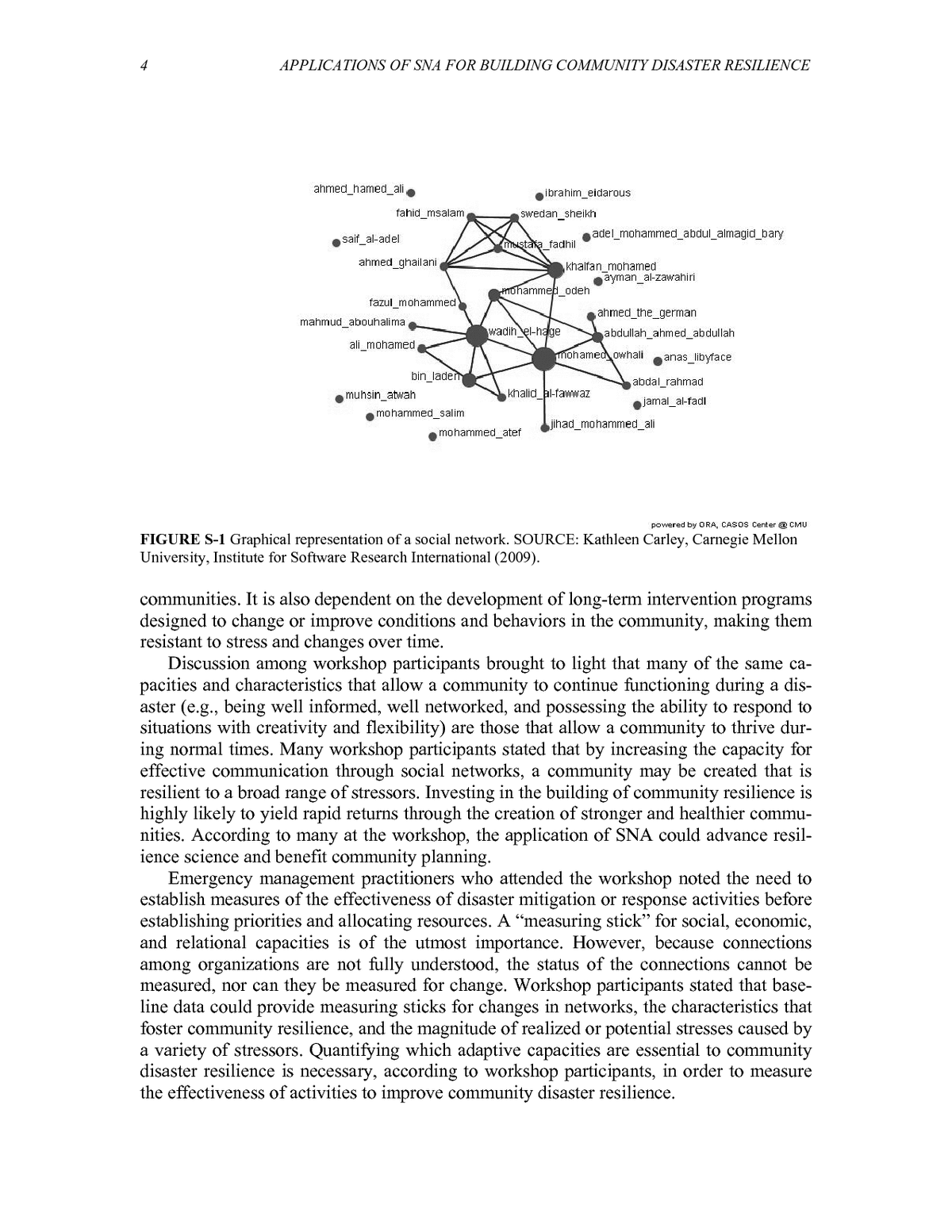
SUMMARY 3 WORKSHOP SUMMARY This document summarizes the major points and ideas expressed during the workshop as documented by the rapporteur. As such, the summary reflects the specific topics em- phasized by workshop presentations and discussions and may not be a comprehensive summary of all relevant topics and issues. Viewpoints expressed in this summary do not necessarily represent the views of the workshop planning committee or the NRC, nor does the summary contain conclusions or recommendations. GENERAL WORKSHOP THEMES A robust scientific literature on SNA exists, and literature in disaster and community resilience is emergent. However, workshop participants noted that disjunctions exist be- tween SNA theory and its application, and between the SNA research and emergency management communities. Workshop participants discussed how properly targeted re- search in networking theory, the social and resiliency sciences, and research translation, conducted in parallel with the development of SNA tools designed specifically for and with emergency management practitioners, could facilitate the adoption of SNA by the emergency management community. The adoption of SNA has the potential to revolu- tionize the way organizations and communities function in general, and prepare and re- spond to disasters in specific. SNA allows study of complex human systems through the visualization and charac- terization of relationships between people, groups, and organizations. A graphical repre- sentation of a social network that shows individual network members (defined as nodes) and their linkages (defined as ties) could be a product of the analysis (see Figure S-1). The impact of information or activities on individuals and the network as a whole may be analyzed and predicted for different scenarios and options. Because SNA can reveal the characteristics, composition, and structure of networks at a given time and over time, SNA could be an important tool for understanding how parts of the community work or could work together to plan for and respond to disasters. SNA has been used to inform policy in areas such as terrorism prevention and public health improvement, and could facilitate decision making related to the improvement of community disaster resilience. Community resilience, in sociological terms, is the ability of a community or social unit to withstand external shocks, such as disasters, to its infrastructure. Community re- silience emerges from a communityâs ability to adapt to stress and return to healthy func- tioning. The speed with which a community can mobilize and use resources during and following a disaster is strongly dependent on its abilities to adapt to change. The strength of its social networks is a factor. Building community resilience is a process that devel- ops the capacities that allow communities to adapt. The building of disaster resilience can be considered a strategy for disaster readiness. Incremental improvements in resilience can significantly improve the capacity of a community to prepare for, respond to, and re- cover from disasters. However, just as a community may change with time, a commu- nityâs response to a disaster may change with time. A disaster that has little impact on a community at one time may have a devastating impact on it at another time. An understanding of the dynamic nature of resilience is essential for good planning. Successful building of resilience is dependent on the reduction of risk to individuals and
4 APPLICATIONS OF SNA FOR BUILDING COMMUNITY DISASTER RESILIENCE FIGURE S-1 Graphical representation of a social network. SOURCE: Kathleen Carley, Carnegie Mellon University, Institute for Software Research International (2009). communities. It is also dependent on the development of long-term intervention programs designed to change or improve conditions and behaviors in the community, making them resistant to stress and changes over time. Discussion among workshop participants brought to light that many of the same ca- pacities and characteristics that allow a community to continue functioning during a dis- aster (e.g., being well informed, well networked, and possessing the ability to respond to situations with creativity and flexibility) are those that allow a community to thrive dur- ing normal times. Many workshop participants stated that by increasing the capacity for effective communication through social networks, a community may be created that is resilient to a broad range of stressors. Investing in the building of community resilience is highly likely to yield rapid returns through the creation of stronger and healthier commu- nities. According to many at the workshop, the application of SNA could advance resil- ience science and benefit community planning. Emergency management practitioners who attended the workshop noted the need to establish measures of the effectiveness of disaster mitigation or response activities before establishing priorities and allocating resources. A âmeasuring stickâ for social, economic, and relational capacities is of the utmost importance. However, because connections among organizations are not fully understood, the status of the connections cannot be measured, nor can they be measured for change. Workshop participants stated that base- line data could provide measuring sticks for changes in networks, the characteristics that foster community resilience, and the magnitude of realized or potential stresses caused by a variety of stressors. Quantifying which adaptive capacities are essential to community disaster resilience is necessary, according to workshop participants, in order to measure the effectiveness of activities to improve community disaster resilience.
SUMMARY 5 Workshop participants expert in the field considered SNA theory and applications to be quite advanced, but participants stated that SNA is not being applied in ways that assist local communities and practitioners. From the scientific perspective, more and better data about networks are required for the development of the tools needed to advance the science and practice of SNA. Additionally, the means to test the validity of social science models resulting from SNA have yet to be developed. From the practitionerâs perspective, explanations of SNA and its tools need to be made more meaningful to gain acceptance in everyday practice. Innovations and a proliferation of networking technologies (e.g., wireless technologies and networking software) are easily accessible. Awareness of both the positive and negative issues associated with the use of networking technologies to support social networking, however, would benefit the emergency management community. RESEARCH THEMES Several research areas were identified by workshop participants as prerequisite to ad- vancing the use of SNA for building community disaster resilience. Disaster management decision making depends on numerous factors including the phase of the disaster, avail- able resources, and the level of authority at which decisions are made. SNA could im- prove situational awareness by emergency management practitioners by allowing them to understand and measure the status of networks within their communities. Using what is learned from SNA, necessary interventions and the conditions and network associations required for their success can be identified. The best means of communicating and im- plementing interventions can also be developed. Numerous useful research topics were discussed by workshop participants and are de- scribed in the main body of this document. Recurring research themes discussed during the workshop are synthesized in the following sections. Workshop participants stated that addressing these themes could stimulate the use of SNA to build community disaster resilience. Barriers to conducting and applying the research are also discussed. Areas of Research Baseline Data Many workshop participants indicated that a certain level of baseline information re- garding networks is necessary to determine the resilience of a community to extreme events. Baseline data describe the starting conditions by which change can be measured and include all manner of data regarding networks and their members. These data are fed into SNA to produce baseline models. Little, for instance, is presently known about who populates the formal, governmental networks responsible for a regionâs disaster man- agement or how they may integrate with other social networks that reside in civil society for emergency management purposes. Without this baseline level of knowledge, it is dif- ficult to evaluate the evolution of the composition of social networks and how these changes relate to resilience levels. However, collection and management of baseline data,
6 APPLICATIONS OF SNA FOR BUILDING COMMUNITY DISASTER RESILIENCE according to participants, is not currently feasible given research funding practices. Workshop participants repeatedly stressed that the accuracy of network analysis, moni- toring, and intervention design cannot be certain without baseline data. Validation Techniques Mechanisms to validate new data, network models, and decisions made using SNA and related tools would also benefit practitioners and scientists. Practitioners described the need for mechanisms that can vet for accuracy the data traveling through a network, and indicate if the data require action or response. New networking technologies allow large amounts of data to travel quickly through networks. Practitioners need a means to sort which data are good, bad, redundant, and actionable. Understanding Network Dynamics Networks are likely to change quickly during a disaster as infrastructure fails or is re- structured, people relocate, or the availability of resources change. Building resiliency into social networks requires an understanding of how networks evolve during normal times, and during times of stress. Understanding how networks change when stressed, and how to promote positive changes that allow the networks to function during a dis- aster, is important. Some workshop participants suggested that new methods for studying network dynamics are needed. It is essential that network models be constantly updated. SNA tools would be more useful to practitioners if they allowed quick visualization of the changing nature and uncertainties in linkages within and between networks. This would allow more effective diffusion of information during all stages of the disaster cycle. Better Data Gathering Techniques New and more refined data gathering techniques could result in better social network models. For example, workshop participants repeatedly stressed how SNA could be more effective if the means of obtaining proprietary and personal data for SNA while preserv- ing the privacy of individuals and institutions were developed. Such data as who within and between private sector organizations communicates with whom and what kinds of people receive certain medical treatment under certain circumstances provide real in- sights into the nature of networks and their members. Workshop participants stressed the importance of maintaining privacy. Legal and ethical barriers are an issue. Government and Community Interaction Workshop participants discussed that greater understanding of the ways individuals, organizations, locales, and agencies are connected to social networks and how these components are used would likely result in more effective use of networks to build
SUMMARY 7 community resilience. An understanding of how connectivity to networks may change under stress would also be valuable. Additionally, the skill sets and attributes of network members need to be understood in order to identify members that may emerge as trusted opinion leaders within their communities. These are individuals who could be enlisted to effectively disseminate information to their communities. Research on emergent behav- iorsâbehaviors that arise as a consequence of a disasterâand the promotion of pro- response emergent behaviors among private individuals and individuals within organiza- tions could also lead to better planning and the promotion of resilience. Exploring SNA in other Contexts Study of how SNA is applied in areas such as network centric warfare, counter ter- rorism, and public health would aid in the application of SNA for improving community disaster resilience. The vocabulary of network-centric warfare is different from that used by social scientists, but the goals are similar: to understand and improve how information is sought and exchanged; and to develop action instruments that enable decision making. According to workshop participants, practitioners who collect, analyze, understand, model, and incorporate network data into their decision-making processes may be better poised to help their communities become more resilient. Building resilience is not only about preparation for disasters. Studying how networks deal with broader social issues would also be useful. Research on how communities deal with issues such as ethnic oppression may yield a rich and pertinent literature on community resilience from which to draw. New Research Paradigms Barriers to SNA research and use of SNA tools by practitioners for building community disaster resilience were often discussed during the workshop. Although addressing these barriers is not directly part of the charge given the workshop planning committee, many participants noted that these barriers could affect the effectiveness of a future research agenda and the adoption of SNA tools in practice. Suggested strategies to overcome these barriers are summarized below. Participants pointed out that current strategies for funding research and moving re- search results into practice are not adequate to address the large-scale and complex social science issues. New funding frameworks that accommodate larger and longer-term studies would benefit both the research and practice communities. For example, better baseline data from which progress can be benchmarked would probably result. Incentives to encourage rapid-response investigations immediately following an event, and multidisciplinary research in general, could lead to more immediately useful results for practitioners including information on topics such as intervention methodologies that have proven successful. Collaborative research conducted with practitioners, and between public and private entities, could make the adoption of SNA techniques among practitioners more likely. Removing barriers of access to infrastructure and data may also result. Workshop participants noted that the most relevant research, tools, and data for
8 APPLICATIONS OF SNA FOR BUILDING COMMUNITY DISASTER RESILIENCE decision making would be those identified jointly by researchers and practitioners, with input received from the private sector. Some practitioners and researchers at the workshop expressed concern that current homeland security priorities tend to encourage a focus on antiterrorism activities within the emergency management community. Some suggested that sources of community stress need to be adequately assessed to confirm whether a focus on antiterrorism is locally warranted. A better understanding of community stressors could allow for more informed allocation of resources. Several workshop participants stated that researchers needed incentives to collaborate with practitioners. Placing more value within the university and research cultures in moving research into practice might foster such incentives. For example, the medical community has begun to support translational research (e.g., research on how to enhance the adoption of research products into practice) and translational activities (e.g., the training in the use of research results). These incentives have also encouraged universities to consider translational work in their decisions to award tenure to faculty. Adoption of similar policies in other research communities could encourage younger researchers (those most likely to be familiar with social networking technologies) to engage in translational work. Workshop participants discussed the idea of developing regional collaboratives among local universities, agencies, and businesses. For example, local, state, and federal resources could be used to establish collaboratives to encourage thorough baseline exper- tise on regional social networks and adaptive capacities. The regions could be consistent with the 10 regions into which Federal Emergency Management Agency divides the United States. Each collaborative could be a repository for regional baseline data and serve as a resource for federal and local response agencies during crises. Longitudinal and rapid response investigations could tap those resources and be conducted within the collaborative framework.
