
2
Role of STEM Capabilities in Achieving the Air Force Vision and Strategy
Among the general public and across the service itself, the Air Force is seen as the high-technology branch of the military. Its people, missions, and systems are indeed among the most technically sophisticated anywhere in the world. There is, however, growing evidence that the foundation of this technological prowess has eroded and that current trend indicators give cause for concern about the future. Product, test, and logistics center commanders reported to the committee that it is becoming more challenging to hire and retain technically skilled (in the committee’s terms, STEM-educated or STEM-cognizant,) military and civilian personnel.1 Overall, the available pool of technically skilled and experienced personnel seems to be diminishing. As noted in Chapter 1, various studies from the National Academies, the Defense Science Board, the Government Accountability Office, and others have concluded that this situation has contributed to problems for development and acquisition across the Air Force (NAS, NAE. IOM, 2007; DSB-AFSAB, 2003; GAO, 2008).
This chapter first discusses how the Air Force uses the STEM skills and expertise of its workforce today in key mission and functional areas across the service, including emerging requirements for STEM capabilities in the newer domains and mission areas. It then describes the contribution of STEM-degreed and STEM-cognizant personnel in development, acquisition, and sustainment activities. The third major section focuses more specifically on STEM-degreed personnel–both officers and civilians—and their presence across the Air Force workforce, as well as in positions that currently require a STEM degree. The fourth section examines how all these roles for STEM capability relate to recent formal statements about Air Force core competencies and the priorities, goals, and objectives of the latest Air Force Strategic Plan. The chapter ends with findings and recommendations based on the entire chapter.
STEM NEEDS ACROSS AIR FORCE MISSIONS AND DOMAINS
Sustaining adequate STEM capability throughout the workforce is critical to the Air Force’s priorities and goals across its missions. The following subsections highlight areas where STEM-degreed or STEM-cognizant personnel are of particular importance.
Airpower and Nuclear Deterrence
The Air Force must sustain its historical preeminence in airpower and nuclear deterrence. The weapon systems essential to accomplishing these missions—fighters, bombers, transports, intercontinental ballistic missiles, munitions—have undergone continued rapid technological advancement. F-22 and F-35 stealth aircraft are marvels of sophisticated technology that will
demand deep technical competence to master, in terms of sustainment as well as in tactics, techniques, and procedures (TTPs). New aircraft, such as a new tanker, and technology upgrades and modifications, as are necessary for all extended-life aircraft such as the venerable B-52 and C-5, will likewise demand technical competence for employment and sustainment. STEM-degreed or STEM-cognizant personnel are critical for this technical competence.
One current concern is Air Force management of its nuclear forces, both air-launched and intercontinental ballistic missiles, which came under criticism in 2008 because of missteps in nuclear operational and logistics areas. The Air Force is reviewing force-wide processes, procedures, systems, personnel training, and management and is taking significant action by refocusing the mission into a new command structure. The Air Force is also playing an important role in an ongoing national review of the role of new nuclear weapons and supporting infrastructures. In keeping with these developments, and in recognition of existing Air Force missions, there is no question that maintaining credible deterrence in an evolving environment requires robust STEM capabilities in the workforce.
Emerging Technologies
Since the end of the Cold War, the Air Force has evolved to be an expeditionary air warfare force capable of (1) projecting precise lethal force anywhere on the globe, (2) rapid mobility, and (3) continuous global monitoring and movement of information to enable joint operations. New operating concepts and missions have been achieved through innovative use of existing systems and technologies and through the introduction of new capabilities. The development of responsive and dynamic operational-level command and control capabilities has dramatically improved the planning and execution of theater air operations and the integration of joint operations. ”Reachback”2 via satellite and other information links from lean in-theater forces to robust in-place resources in the continental United States has changed the nature of deployed operations. Today, airborne reconnaissance and strike missions are executed from thousands of miles away, telemedicine enables rapid stabilization and transport of casualties from the battlefield, and agile logistics and maintenance support allow forces to operate at a high tempo with a minimum “footprint” in theater. Optimal operation and sustainment of these still-emerging yet increasingly mission-critical capabilities require substantial STEM capabilities among the personnel involved.
Such dramatic new capabilities as unmanned air systems, day-night/all-weather operations, and the ubiquitous use of the Global Positioning System for precision operations across the battlefield have transformed Air Force forces and operations. These new systems and the missions they enable have demanded rapid advancement and new technical understanding in such areas as data links, anti-jam techniques, multispectral sensors, and low-light operations. Beyond developing these new technical operational capabilities, their real power is in using them effectively on the battlefield, which increasingly depends on STEM-degreed or STEM-cognizant warriors.
Space
In some ways, space operations may seem to be a simple extension of air flight. But space is a hostile environment in which physical conditions differ markedly from those within the atmosphere. These differences, in turn, have marked effects on the design and operation of systems that must operate in this domain. The Air Force has excelled in developing and operating military space capabilities from the earliest days of the space age, shepherding their rapid
evolution from limited, short-lived, experimental prototypes to reliable, highly capable operational systems critical to modern military strategy.
Today, operational space systems primarily provide information sensing and transmission, but space control and new space applications are rapidly maturing. By their very nature, development and operation of such systems require high-level STEM capabilities. More recently, as both technology and needs have matured, the Air Force has emphasized integration of space capabilities and effects in joint operations and the deliberate, requirements-driven development and acquisition of future systems.
Individual Air Force space missions may be unique, but all are interconnected in some way. So, in 2001, the Air Force aligned all its space acquisition operations under a single major command, the Air Force Space Command (AFSPC), and began to coordinate leadership of these operations with other national security space organizations.
Space has historically been viewed as an “enabling utility” or as a “silent sentinel.” Increasingly, as space is being integrated into joint military operations, it is becoming a key element of “finding, fixing, and finishing” targets on the battlefield. Unfortunately, as recent foreign antisatellite tests and electromagnetic attacks have demonstrated, space is also becoming a contested domain. Thus, while U.S. dependence on space in military operations is growing, potential adversaries are seeking to attack or disrupt use of it by the United States. All this suggests that the Air Force must treat space as it does the air and cyber domains, which require both warrior and technical (STEM-degreed or STEM-cognizant) skills.
Launch vehicles, satellite systems, mission payloads, ground control, mission processing, and surveillance sensors demand technical competence in many particular disciplines and specialties, such as astrodynamics, launch and space propulsion, attitude control systems, power and thermal control, data links, radars and optics, ground networks, and complex planning and control software. Further, because these often one-of-a-kind systems operate continuously (24 hours a day, 7 days a week), no system maintenance, upgrades, or new system launches can be allowed to affect ongoing operations and the systems must remain continuously compatible with users and their equipment. As emphasis on the integration and employment of space capabilities in joint operations has grown, so has demand for STEM-degreed and STEM-cognizant developers and operators3 to support the space users who deliver dynamic and responsive tactical support to warfighters on the battlefield.
Competitors and potential adversaries are also increasing their use of space. Air superiority is a key objective in all military campaigns and operations, and so must space superiority be. This objective demands increasing capabilities and investments for space situational awareness and defensive measures, much of which will incorporate new technical components and systems requiring STEM capabilities with a focus on the relevant advanced technologies.
All these realities point to the increased need for people who have STEM training at the appropriate level and in the necessary special areas. Many of these people will also require experience in the development, acquisition, fielding, and employment of future space forces. Although there are no stated requirements for STEM education in the space operations career field, the growing need for greater technical skills and experience across the space mission area, both in terms of acquisition and operation, is clear.4 The necessary skills and experience can be
developed through formal education, focused systems and mission training, and deliberate career field management and leadership development.
Cyberspace
Cyberspace is distinctly different from the traditional domains of air, land, and sea. Some might think it does not even constitute a physical presence—yet it has direct and potent effects on our physical systems. Furthermore, the cyber domain depends on a human-made physical network of sophisticated workstations, communications links (including space resources), cables, switches, computers, software applications, databases, etc. All this hardware and software creates a virtual environment for the movement and processing of data, the transfer of information, and the creation of knowledge.
Cyberspace shares important characteristics with the space domain, especially in terms of the highly STEM-dependent nature of its systems, threats, and employment. That its nature is both physical and virtual, however, demands unique skills and thinking.
At the physical level, cyberspace consists of complex and highly interconnected computing, communications, networking, and software systems, most of which are commercial products and services with easy access and penetrability. The Defense Advanced Research Projects Agency originally created what is now the Internet for the Department of Defense as a science data-sharing network. Now, in the globally connected world of the 21st century cyberspace, this network has become ubiquitous as a part of global infrastructure. Dependence on cyberspace for commercial enterprise, governmental processes, and national security continues to grow exponentially. The skills to use the network have become widespread across the public at large and within the military in particular. Cyber capabilities are embedded in every area of military operations and maintenance.
Military forces and their operations and administration depend on commercial services and network systems, which demand increased protection and assurance measures. Hardware, software, connections, and protective measures undergo nearly continuous upgrades because of business decisions and in response to vulnerabilities and attacks. Likewise, exploiting and attacking the cyber systems of adversaries require highly sophisticated skills to penetrate, exfiltrate, and disrupt adversary use in both undetectable and acknowledged ways. The capability to protect critical U.S. cyber infrastructures against exploitation and attack is an increasingly important national security responsibility.
The Air Force has been developing its cyber capabilities for over a decade. It is currently formulating its organization, career field, training, equipage, doctrine, and tactics for cyberspace operations as a distinct force component (i.e., a numbered major unit or “air force”) within the Air Force. Cyber operations include protecting friendly capabilities and exploiting or attacking hostile cyber systems. Such operations require sophisticated systems, techniques, and expertise. Further, the Air Force is one of many departments and agencies involved in cyber operations, and there is a growing need to integrate capabilities, share information, and leverage authorities for the successful execution of coordinated and joint cyber operations.
All these factors point to the need for an increased community of technically and operationally skilled “cyberwarriors” to execute the Air Force’s mission. While the full scope of this mission and the organization to conduct it are still evolving, it is clear the Air Force will need more people having extensive cyber skills and competence to develop, field, and employ both defensive and offensive operations in cyberspace.
STEM Capability in Other Air Force Domains
Other areas that value STEM-degreed and STEM-cognizant personnel include force planning, resource decision making, and operational employment and evaluation. These activities take advantage of operations research and other analytic skills. Developmental testing and operational testing of weapon systems require combined test forces consisting of large numbers of engineers, operators, and support personnel with STEM education and training. Moreover, significant numbers of technically trained and skilled personnel at the Air Force Warfare Center develop the TTPs for all operational weapon systems to ensure their optimal employment. Sustaining and maintaining complex flight systems and software, investigating mishaps and accidents, and implementing corrective actions all require strong technical skills across many mission systems and career fields.
Military operations today frequently require the integration of diverse platforms and systems with an ever-increasing reliance on sophisticated sensors, data links, processors, and command and control centers—often across joint, allied, and coalition forces. Advanced information technology enables this integration but also places a greater premium on technical competence and the qualifications of the developers, operators, and support personnel who must employ and leverage these powerful capabilities. Aside from its operational value, information technology has brought the same revolution in Air Force business management that it did to the private sector. Lean logistics, automated tests, geographic information systems, online personnel management and finance, network security, and numerous other advanced business applications have made literacy and basic competency in information technology necessary for all members of the Air Force.
STEM SKILLS AND EXPERIENCE IN THE ACQUISITION LIFE CYCLE
Although industry builds the Air Force’s weapon systems, STEM-degreed and STEM-cognizant Air Force personnel play a critical role in weapon system acquisition. Their skills and competencies are applied across the entire life cycle of each system:
-
exploration of advanced technologies;
-
definition of operational needs and system solutions;
-
development, fielding, maintenance, and sustainment of weapon systems; and
-
development and employment of the full tactical, operational, and strategic capabilities and potential of the fielded systems.
Although the Air Force Materiel Command (AFMC) and AFSPC have the largest concentrations of STEM-degreed personnel among the major commands, STEM-degreed and STEM-cognizant personnel in the operational commands and in the Air Force Operational Test and Evaluation Center play crucial roles in defining requirements, testing systems for operational suitability, and operationally maturing TTPs for all Air Force weapon systems.
It is important to realize the importance of STEM-degreed and operationally experienced officers in the statement of operational requirements. Without the ability of operational users to translate operational needs into technical terms, the acquisition community is left to do that job on its own. This lack of operational input often results in flawed need statements and misdirects contractors in their bidding efforts. The iterative process of balancing operational requirements against technical feasibilities and financial imperatives is best accomplished by a team representing both the operational and acquisition communities, and this requires STEM capability on both sides of the team. Putting officers who are neither STEM-degreed nor STEM-cognizant in the highest management positions can also result in shortfalls in the oversight of important defense acquisition programs. Adept oversight of major acquisitions is crucial—for example,
during the past seven years, 35 Air Force programs have experienced Nunn-McCurdy breaches: cost overruns that triggered a program review in accordance with the Nunn-McCurdy Amendment to the Defense Authorization Act of 1982 (10 USC §2433).
Concept Refinement and Requirements Definition
Engineers, operators, logisticians, and operations analysts in the AFMC and at Headquarters U.S. Air Force work closely with operators in the major commands to define and analyze the requirements for new weapon systems and for improving existing weapon systems, to analyze alternatives, and to translate these needs through a systems engineering methodology into concepts and technical requirements that industry can understand and eventually produce. This highly iterative process is the principal determinant of the total cost of a weapon system. Acquisition officers reported to the committee that the process is more efficient when operators have the critical reasoning and analysis skills associated with a STEM degree or STEM cognizance. These abilities allow them to communicate effectively and reach common understandings with the acquisition community.
Science and Technology Development
Scientists and engineers in the Air Force Research Laboratory lead the discovery and advanced development of technologies in all areas critical to the Air Force, including basic research, air and space vehicles, propulsion and power, sensors, materials and manufacturing, human effectiveness, information, munitions, and directed energy, as well as emerging technologies such as nanotechnology. This work leads to development of future weapon system concepts, collaboration with system acquirers on technology risk reduction for insertion into current and developmental weapon systems, and collaboration with both operators and system acquirers on quick-response solutions to urgent warfighter needs.
During system development and acquisition, engineers in the AFMC and AFSPC program offices conduct technology readiness assessments, identify the highest technology risk areas, establish technology risk-reduction plans, and actively evaluate the efforts of industry to ensure that the technology risk has been reduced or that lower-risk alternatives have been identified. Product center commanders, program managers, and retired senior acquisition officials interviewed by the committee all pointed out that having personnel with STEM skills provides greater understanding of the underlying technology and its inherent issues.5 They possess the skills and experience necessary to analyze and interpret data and make recommendations. While engineers do the detailed work, program managers must make critical judgments and decisions based on the data and recommendations presented to them. A STEM degree, or at least STEM cognizance, enhances their ability to do this.
System Development and Demonstration
During this phase of acquisition, industry develops technical requirements, system designs, subsystem definitions, prototypes, and test plans and reviews them in coordination with Air Force developmental and operational test organizations. Program office engineers ensure the adequacy of the contractor’s proposed design against performance specifications, prepare or review ground-and flight-test plans, and actively evaluate industry’s progress. Technical expertise is needed across all key subsystems: structures, propulsion, sensors, flight control, etc. In addition, expertise
is needed in software development and systems integration, including system reliability and sustainability. Air Force test engineers work closely with program office engineers and their counterparts in industry to develop test plans, collect and analyze test data, and identify issues. All test pilots are STEM-degreed, which enables them to participate actively in test planning, execution, and data interpretation.
Production and Deployment
Air Force engineers skilled in manufacturing processes and logistics play a key role in weapon system production and deployment. Manufacturing issues inevitably arise, and Air Force engineers often lead integrated product teams: groups of experts gathered from across the Air Force, industry, and academia to solve these problems. Fielding advanced weapon systems involves building new facilities, deploying test and maintenance equipment, generating and validating procedures, and training personnel. All these activities depend on technically skilled and experienced government program personnel working with contractors, operators, and system maintainers.
Operations and Support
STEM-degreed or STEM-cognizant operators are especially valued in operational testing and development of TTPs for upgraded and improved weapon systems. Critical thinking skills, innovative ideas, and a technical understanding of weapon systems are essential to the constantly evolving play of employment of new technology and system capabilities against enemy systems and tactics.
Field and depot maintenance of weapon systems requires maintenance engineers able to analyze equipment failures, determine root causes, and recommend both immediate and long-term solutions. Because the Air Force aircraft fleet is aging, the need for these system-maintaining skills is increasing. Two recent examples that illustrate this need are (1) the grounding of more than half the A-10 fleet on October 3, 2008, due to wing cracks, and (2) the grounding of the F-15 fleet following the November 2, 2008, crash of an F-15 for longeron failure. In such situations, STEM-degreed experts in the Air Force Safety Center, depots, product centers, and Air Force Research Laboratory conduct incident analysis and accident investigation boards, all of which also require STEM-cognizant personnel to engage and interact effectively with the STEM-degreed experts.
STEM-DEGREED PERSONNEL IN THE CURRENT AIR FORCE WORKFORCE
The preceding sections of this chapter have argued for the pervasive value of STEM-degreed and STEM-cognizant personnel across Air Force missions and domains—with particular emphasis on the essential role that STEM capabilities play throughout the acquisition life cycle. This section focuses on current requirements for STEM-degreed personnel specifically and on the value of STEM-degreed personnel throughout the Air Force workforce, whether or not they are in a position that requires a STEM degree.
Current Occupational Requirements for a STEM Degree
Only five Air Force officer career fields currently require a STEM degree: Weather (15W), Civil Engineer (32E), Communications and Information (33S), Scientist (61S), and Developmental Engineer (62E). All other officer career fields, such as pilot, navigator, air battle manager, maintenance, space and missiles, and program management, have no stated requirements for STEM education, but a significant percentage of officers in these career fields
do hold STEM degrees. For example, 45 percent of pilots have science or engineering degrees. While the committee found no direct data showing cause and effect, current and former Air Force officials who interacted with or were members of the committee believe the high degree of technical expertise among its pilots contributes significantly to the U.S. Air Force’s operational and tactical excellence.6
STEM-Degreed Officers Across the Workforce
The Air Force has traditionally accessed technical workforce capacity and capability by tracking technical and nontechnical degree holders. Figure 2-1 shows the proportion of technical degree holders among key officer career fields of interest to this study for four promotion phase points between 1994 and 2009.7 A caveat in interpreting this graph and others based on the Air Force’s Personnel Database is that the definition of a technical degree in that database does not correspond exactly to the list of majors or fields of study in the committee’s delineation of STEM degrees in Table 1-1. Nonetheless, the match is close enough to use these statistics, provided in Air Force briefings to the committee, as indicators of trends and issues.
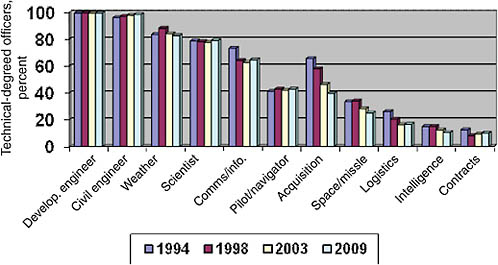
FIGURE 2-1 Officers with Technical Degrees in Career Fields with STEM Needs. Develop. engineer = developmental engineer; Comms/Info. = communications/ information officer; Space/missile = space or missile operations officer. SOURCE: Headquarters U.S. Air Force, Personnel Database, data extracted in September 2008.
The trends in Figure 2-1 highlight several areas of concern. First, while the proportion of technical degree holders has remained relatively constant in traditional technical fields such as
developmental engineering and civil engineering, technical degree holders in other career fields have declined notably over the past 14 years. Communications and information dropped 9 percentage points, and logistics dropped 10 percentage points. Of particular concern to this study is the large decline in acquisition and contracting from 65 percent to 40 percent. Incidentally, although they lack specific requirements for technical degrees, two career fields whose importance has increased recently also suffered rather large declines. The first is space and missiles, in which technical-degreed officers declined by 9 percentage points.8 The second is intelligence, which has been facing sweeping challenges related to cyberspace and cybersecurity issues; the technical-degreed officers in this field declined by 4 percentage points from an already low level.
Figure 2-2 shows that the inventory of officers with technical degrees in the Air Force is not confined to the career fields requiring a STEM degree. Sizable populations that may qualify as STEM-degreed are present in other career fields.
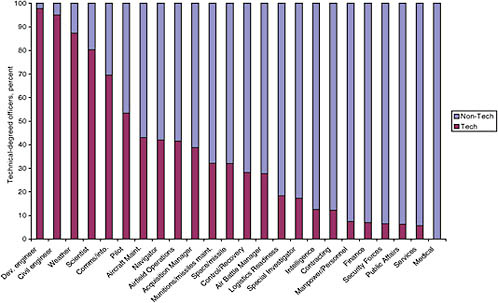
FIGURE 2-2 Percentage of Officers with Technical Degrees by Career Field. Note that not all technical degrees as defined by this source are STEM degrees. Dev. Engineer = developmental engineer; Comms/info = communications/information officer; maint. = maintenance; Space/missile = space or missile operations officer. SOURCE: Col. James D. Fisher, Chief, Engineering and Technical Management Division, SAF/AQRE, briefing to the committee on August 26, 2008.
STEM-Degreed Civilian Personnel Across the Workforce
Only three civilian occupational series in the Air Force require a STEM degree: Engineering (0800), Physical Sciences (1300), and Mathematics (1500). However, as with STEM-degreed officers, STEM-degreed civilians work in many occupations that do not formally require a STEM degree. Figure 2-3 shows the percentage of civilians with technical degrees in a range of occupational series. Note that the caveat about the difference between “technical degree” and the committee’s definition of a STEM degree applies here as well. Acquisition managers are included in the Business and Industry occupational series.
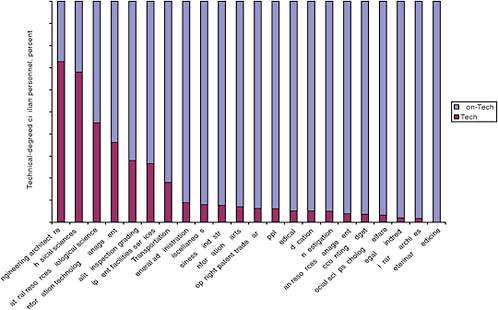
FIGURE 2-3. Percentage of Civilians with Technical Degrees by Occupational Series. Note that not all technical degrees as defined by this source are STEM degrees. SOURCE: Col. James D. Fisher, Chief, Engineering and Technical Management Division, SAF/AQRE, briefing to the committee on August 28, 2008.
PERCEIVED ROLE OF STEM CAPABILITY IN AIR FORCE CORE COMPETENCIES AND THE AIR FORCE STRATEGIC PLAN
Since 2003, the Air Force has had three formally established core competencies: Developing Airmen, Technology-to-Warfighting, and Integrating Operations. These three core competencies are described as “making possible” the Air Force’s six “distinctive capabilities”: Air and Space Superiority, Global Attack, Rapid Global Mobility, Precision Engagement, Information Superiority, and Agile Combat Support. (Jumper, 2003; Krisinger, 2003; USAF, 2009).9 In his commentary on Air and Space Core Competencies for the Chief’s Sight Picture of 15 January
2003, Chief of Staff of the Air Force (CSAF) Gen. John Jumper gave the following description of the Technology-to-Warfighting core competency:
Our Air Force has a proud legacy of continually bringing cutting-edge technological capabilities to bear to confront threats to our nation’s security. This legacy started a century ago with the dawn of aviation. It continues today, as our wielding of air power pushes the limits of not only the sky, but of outer space and cyberspace. We combine the tremendous technological advancements of stealth, global communications connectivity, global positioning, and more, to put cursors on targets and steel on the enemy. It is our unique ability to apply various technologies in unison so effectively that allows us to translate our air and space power vision into decisive operational capability.
The Predator unmanned aerial vehicle is today’s perfect example of this core competency in action. It combines the dynamics of manned aviation with the remote operation techniques of unmanned satellites and the information connectivity of networks into a single system capable not only of collecting and disseminating information, but of producing combat effects (Jumper, 2003).
Of the three 2003 core competencies, Technology-to-Warfighting is the one most clearly dependent on the STEM capabilities discussed earlier in this chapter, which extend across the operational domains of the Air Force and to every stage of the acquisition-to-employment life cycle.
Although the three 2003 core competencies are still cited on the Air Force’s homepage to the global Internet community (USAF, 2009), the Air Force Strategic Plan, 2006–2008 does not specifically mention them (USAF, 2006a). The only reference to core competencies occurs once, in Objective 1.3: “Develop cyberspace as an Air Force core competency.” Otherwise, the Strategic Plan is couched in terms of three priorities, seven goals, and a range of objectives to support these priorities and goals. Another reference to cyberspace as an emerging Air Force core competency can be found in CSAF Gen. T. Michael Moseley’s 2007 white paper, The Nation’s Guardians: America’s 21st Century Air Force: “We will continue to develop and implement plans for maturing cyber operations as an Air Force core competency” (Moseley, 2007, pg. 8).
There are a number of passages in the Strategic Plan that can be read as implying a need for STEM capabilities in the Air Force workforce. However, Gen. Jumper’s 2003 description of the Technology-to-Warfighting core competency relates more clearly than the Strategic Plan to the STEM contributions to Air Force roles and missions described in this chapter. Similarly, the discussion of cyberspace in this chapter argues for the essential role that STEM capabilities will play in an emerging fourth Air Force core competency in cyber operations.
FINDINGS AND RECOMMENDATIONS
The preceding exploration of current and future Air Force missions and roles points to the Air Force’s substantial needs for the technical skills and expertise provided by STEM-degreed or STEM-cognizant personnel in the development, operation, and sustainment of current Air Force systems and in the fielding and operations of new capabilities, including those in the emerging missions of the space and cyber domains, which are both technology intensive. These domains are on the innovative edge of global technology where actual and potential U.S. adversaries hope to reduce the asymmetric advantage of the United States and take advantage for themselves of the historical “sanctuary” provided in those domains. Consequently, it is essential that the Air Force maintain and enhance its technical competency—a competency provided by the Air Force’s STEM-degreed and STEM-cognizant personnel.
While the Air Force sees itself as a “technical Service” and indeed develops, acquires, operates, and sustains some of the most sophisticated military systems in the world, its strategic
vision, mission, and plan do not specifically identify these as core Service competencies. Based on the presentations to the committee, senior level Air Force assessments, and the national-level reports cited in Chapters 1 and 2, the committee concludes that the Air Force’s continuing problems with acquisition of new systems are attributable in significant measure to the Service’s loss of STEM skills and experience. In addition to sustaining historical missions of airpower and nuclear deterrence, new missions and emerging warfare domains, specifically space and cyberspace, will engender even greater demand for STEM skills and experience across the Air Force.
Within the Air Force, STEM-degreed and STEM-cognizant personnel are found in all major commands. They work in all 26 of the officer career fields identified by Air Force Specialty Codes (AFSCs).10 However, only 5 of the 26 career fields have stated requirements for a STEM-degreed individual. Most STEM-degreed personnel who work in the R&D and acquisition specialties are found in the AFMC or AFSPC. Civil engineers and communications specialists are found in all of the major commands. Within the five career fields with stated STEM-degreed requirements, personnel are managed within their AFSC. Other STEM-degreed personnel within the Air Force are not managed as an entity.
Finding 2-1a. STEM-degreed and STEM-cognizant personnel are critical to operational missions and roles across the Air Force and to the entire life cycle of Air Force weapon systems, from basic through applied research, requirements determination, definition, concept development, technology and system development, and test, production, deployment, operations, and sustainment.
Finding 2-1b. The ability to conceive, develop, acquire, operate, and sustain advanced weapon systems has been addressed in Air Force descriptions of its Technology-to-Warfighting core competency. However, the Air Force Strategic Plan, 2006–2008 neither references this core competency directly nor includes a priority, goal, or objective that unequivocally supports the Air Force’s current and future needs for STEM-degreed and STEM-competent personnel.
Recommendation 2-1. The Air Force should incorporate in its Strategic Plan as an eighth goal the ability to conceive, develop, acquire, operate, and sustain advanced weapon systems. The Strategic Plan should state that this goal is essential to maintaining and advancing the existing Technology-to-Warfighting core competency and the emerging core competency in Cyber Operations. The Strategic Plan should set out recruiting, developing, employing, and retaining STEM skills and experience as key enabling objectives for this goal.
Finding 2-2a. Assessments of future missions and the future operating environment, suggest that Air Force missions will become more technologically intensive and will require a proportionally larger STEM workforce in many career fields across the Air Force.
Finding 2-2b. Most officer career fields include STEM-degreed personnel to varying degrees. However, only five military officer career fields have stated requirements for STEM education; other officer career fields have no stated requirement for STEM-degreed or STEM-cognizant personnel.
Finding 2-2c. As discussed in Chapter 1, the Air Force does not have a consistent definition of its STEM workforce. The baccalaureate majors and the fields of study for postbaccalaureate degrees that count for a STEM degree are not specified. Furthermore, there is no uniform concept
corresponding to STEM cognizance as used in this report. The committee believes that it is essential that the Air Force identify those personnel with STEM degrees and those with STEM cognizance and identify what the Air Force’s requirements are for STEM-degreed and/or STEM-cognizant personnel across all career fields.
Finding 2-2d. Only about 40 percent of the officers in the Acquisition Management career field have technical degrees, and fewer than 10 percent of civilians in the Business and Industry occupational series, which includes acquisition managers, have technical degrees.
Recommendation 2-2. The Air Force should review and revise as appropriate its current requirements and preferences for personnel with STEM capabilities in every career field and occupational series.
-
The Air Force need not adopt the specific list of STEM majors/disciplines used by the committee (Table 1-1), but an explicit demarcation of what counts as a STEM degree is necessary.
-
The Air Force should define a level of STEM capability broader than having a STEM degree, similar to (albeit not necessarily identical with) the concept of STEM-cognizant used in this report.
-
The Air Force should review, and revise or establish as appropriate, requirements and preferences for STEM-degreed and STEM-cognizant personnel in every career field and occupational series. Particular attention should be given to supporting the needs of the acquisition community and to developing such mission areas as intelligence and the emergent domains of space and cyberspace. This review should include identifying positions requiring STEM-degreed people and setting goals for appropriate numbers of personnel in other positions to be STEM-cognizant (with appropriate education, training, and experience) throughout the officer career fields and civilian occupational series.
REFERENCES
DSB-AFSAB (Defense Science Board; Air Force Science Advisory Board). 2003. Acquisition of National Security Space Programs. May 2003. Washington, DC: Office of the Secretary of Defense for Acquisition, Technology, and Logistics.
GAO (Government Accountability Office). 2008. Defense Acquisitions Assessments of Selected Weapon Programs. GAO-08-467S. March 2008. Washington, DC: Government Accountability Office.
Jumper, John P. 2003. Chief’s Sight Picture. 15 January 2003. Available online at http://leadership.au.af.mil/af/csaf_core_comps.pdf.
Krisinger, C. J. 2003. Who we are and what we do: The evolution of the Air Force’s core competencies. Air and Space Power Journal. Fall 2003. Available online at http://www.airpower.maxwell.af.mil/airchronicles/apj/apj03/fal03/krisinger.html.
Moseley, T. Michael. 2007. The Nation’s Guardians: America’s 21st Century Air Force. CSAF White Paper, 29 December 2007. Available online at http://www.af.mil/shared/media/document/AFD-080207-048.pdf.
NAS, NAE, IOM. 2007. Rising Above the Gathering Storm: Energizing and Employing America for a Brighter Economic Future. Committee on Prospering in the Global Economy of the 21st Century, Committee on Science, Engineering, and Public Policy, The National Academies. Washington, D.C.: National Academies Press. Available online at http://www.nap.edu/catalog.php?record_id=11463.
Ryan, Michael E., and F. Whitten Peters. 2000. The Aerospace Force: Defending America into the 21st Century. USAF White Paper. Available online at http://www.af.mil/shared/media/document/AFD-060726-029.pdf.
Tritten, James T. 1997. Joint mission-essential tasks, Joint Vision 2010, core competencies, and global engagement: Short vs. long view. Airpower Journal. Fall 1997. Available online at http://www.airpower.maxwell.af.mil/airchronicles/apj/apj97/fal97/tritten.html.
USAF (United States Air Force). 2006a. Air Force Strategic Plan 2006–2008. www.airforcestrategynet.mil.
USAF. 2006b. Classifying Military Personnel (Officer and Enlisted). Air Force Instruction 36-2101. 7 March 2006. Available online at http://www.e-publishing.af.mil/shared/media/epubs/AFI36-2101.pdf
USAF. 2009. The Official Web Site of the U.S. Air Force: Welcome Available online at http://www.af.mil/main/welcome.asp. Accessed 25 March 2010.


