
Panel IV
Economics of Photovoltaics
in the United States
Moderator:
Richard Bendis
Innovation America
GLOBAL MANUFACTURING OF PHOTOVOLTAICS: WHERE DOES THE UNITED STATES STAND?
Ken Zweibel
George Washington University
Professor Zweibel said that he would begin with the current position of the United States in manufacturing PV modules and then examine its competitive position. “And they are quite different,†he noted, “because we are much more competitive than our production volume would indicate.†He said he would also make the “somewhat controversial†point that government policy in each region has been the most important determinant of the state of photovoltaics worldwide.
He summarized this country’s position by saying that “the United States trails in manufacturing modules and in installing modules.†Of world market PV demand of 5.95 gigawatts in 2008, Spain has installed 2.46 GW of capacity, Germany 1.86 GW, and the U.S. only 0.36 GW. But it is no surprise that the United States trails, he said, because the U.S. has not created incentives for the installation of systems, as others have, or for manufacturing. In the few places where there is manufacturing activity, such as Michigan, he said, the states have provided the incentives.18 “The biggest barriers are the absence of a major U.S. market and whether there are incentives or not,†he said. “When the U.S. market becomes available, there will be U.S. manufacturing.†He added that both the
____________________
18UniSolar, which makes photovoltaic laminates for commercial and residential roofing applications, receives major incentives from the state of Michigan.
mainstream U.S. industry and most of the U.S. government have taken PV less seriously than the rest of the world “because it hasn’t been a top energy or environmental priority. Manufacturing will occur in the United States once we have adequate markets, unless something else drives or attracts it away.â€
Technological Competence in the United States
Professor Zweibel reviewed the technological competitiveness of the United States. “There are a number of technologies in PV,†he said, “and the United States has someone in a leadership role in each: crystalline silicon, SunPower; cadmium telluride, First Solar; thin-film or amorphous silicon, Unisolar and Applied Materials; and copper indium diselenide alloys (CIS), Solyndra, and many start-ups. No other place has that.†He added that China has little technological expertise beyond crystalline silicon.
He noted a great deal of progress in U.S. manufacturing. “Thin films have come from pretty much nowhere to start taking a bigger role,†he said. “First Solar has come from no production in 2004 to be the second largest PV company in the world in 2008, an innovative thin-film company in cadmium telluride. This is an example of how disruptive leadership technologies in the United States, which benefited from the DoE’s support for applied PV research, have a major role in today’s photovoltaics.†He also praised SunPower for its technological leadership.
He said that these leading companies are in the United States for several reasons. First, their technologies were developed at home. Second, in using an innovative technology, a company needs to keep its researchers and engineers close to the manufacturer the first time its scales up manufacturing. The first factories were built here, he said, because it was too risky to send them abroad.19 However, future factories will go where the markets and incentives exist.
Professor Zweibel then listed the U.S. position vis-à -vis the leading technologies. The United States and First Solar dominate thin-film cadmium telluride, which is the lowest-cost PV technology for any system above residential size. No company yet dominates the copper indium diselenide (CIS) process because the technology is new and has not yet reached economies of scale. However, he said, it is expected to be competitive with cadmium telluride. The first company to announce a major plant is Showa Shell, a Japanese company, which has announced plans to open a 1-GW manufacturing facility in 2011. “We’ll know then a great deal more,†he said, “about whether the CIS technology can bring together its great efficiency with its difficulty of manufacturing to reach a product that is competitive.†In crystalline silicon, he called the U.S. position “thin,†with only SunPower, Advent, and Evergreen as representatives, “but the United States is definitely in the hunt in every major technology.†Since this report, Evergreen
____________________
19An example is First Solar, which built its first manufacturing plant in Perrysburg, Ohio. Subsequent factories have been sited abroad.
closed its Massachusetts factory and moved it to China, and Advent was forced to sell its assets to Applied Material. Both events were a result of the recent downturn in PV module prices, which caused them competitive disadvantage.
How Government Shapes the PV Landscape
Professor Zweibel said that today’s technological landscape, including the locations of manufacturing and installation, is defined by past R&D funding and market incentives. “It isn’t much of a leap,†he said. “Government policy has defined the landscape of photovoltaics worldwide. Photovoltaics isn’t a cost-competitive technology. It is a societal contract with manufacturers and technologists and scientists to develop a non-CO2 source of energy, one that can diversify us away from fossil fuels. When we reach cost competitiveness, that might change, but that’s not the case yet. DoE emphasized thin films from 1979 to 2005. Among its emphases was cad-tel [cadmium telluride], and that’s why the United States is a leader in thin-film cad-tel. Most other nations emphasized crystalline silicon and thin-film silicon, where the United States is competitive but not a leader. So every region can be clearly defined by what its government technology program emphasized or left out.â€
He noted that the original thin-film R&D partnerships (e.g., the Thin Film PV Partnership at NREL) pursued product development through every step: materials research, solar cells, module development, process area scale-up, pilot production, reliability testing, and first-time manufacturing. This brought the necessary confidence that the entire process of module manufacturing was understood. He called this process “applied research and manufacturing,†and said that it was necessary to understand what these “almost infinitely complex semiconductors are like, especially in manufacturing, but also in solar cell design.†He emphasized that “solar cells are really strange. Very similar techniques may produce cells that are terrible or cells that are great. You have to have some subtle sense in how those cells are made to make them successfully. That’s why a solar cell scientist these days can walk out the door at NREL and earn a million dollars in stock by starting a new PV company. You can’t start a manufacturing company except for that expertise. Very few people can make these new manufacturing companies work, and there is a dearth of them.â€20
The Great Risks of First-Time Manufacturing
Professor Zweibel recalled that in the early days of PV research, companies could afford very little R&D, compared to funding now available. “We didn’t get a chance to tame the complexity of those semiconductors, because we could only afford one-of-a-kind experiments. We’d make a small area cell, or three of them, then
____________________
20Dr. Margolis is credited with directing the early success of PrimeStar Solar.
turn the machine off. We’d come back to it a week later and try it again, assuming the machine still worked. Sometimes minor, unmeasured calibration changes would occur. These were irreproducible results where you followed your intuition toward a better and better result. We never had a robust R&D program in this field. We simply couldn’t afford it on the $10 million-$15 million dollar budget we had for applied research in thin films. First-time manufacturing is still a time of very great risk. In fact, some of the new technologies like CIS are still fighting the first-time manufacturing problem. It doesn’t mean they’re not worthy technologies, it just means it’s harder, and needs more time, money, and patience.â€
Professor Zweibel emphasized the importance of the module manufacturing feedback loop. “Yes,†he said, “you’re trying to increase efficiency, but you’re also trying to reduce area cost, raise throughput, and make device refinements while you’re manufacturing. You’re simplifying a process to bring down the cost while you’re still trying to get high efficiency. You’re increasing the area of your machine because machine costs go up as the log of the width. You’re checking the stability of the semiconductor layers. PV semiconductor research is excruciatingly hard, which is rarely appreciated by those who lack experience in doing it.â€
Technologies vary in their difficulty, he said. Silicon technology requires less new fundamental knowledge (because it is widely understood from other uses, e.g., in computers) than CIGS, for example, where manufacturing consistency is still elusive. Cadmium telluride has advanced further, but still awaits understanding on a foundational level. Much research can still be done, he said, to accelerate these new technologies down their learning curve. This is often not appreciated, because to most outside the field, technology development appears to be a “black box.â€
He concluded with as summary of other lessons he had learned working in at NREL and the industry:
• Cells and modules are the drivers of photovoltaics, because they drive both module cost and balance of system cost. They are also the overwhelmingly most challenging aspect of PV development.
• The continuity of research matters. Avoid jumping from one challenge to another. Define a worthy success (e.g., stabilizing CdTe contacts) and do it. Avoid unimportant issues.
• Complementary competencies matter. Problems are easier to solve if different talents are brought to bear on the same question. But people must be committed to applied research and not simply acting out their academic discipline’s interest.
• Investors and strategic partners are wise to fund smaller, dynamic companies. Such one-product companies are likely to work harder, he said, because their survival depends on it. Solar units that started within larger companies must compete for the attention of upper management. He said that all of the leading
firms in the United States—SunPower, Unisolar, and First Solar—are one-product companies.
• The government should fund research challenges that are “one step ahead of companies’ comfort zones.†Research directors generally respond with enthusiasm if asked to tackle a challenge that is not just their next fire drill. But make these practical research activities, not diversions or red herrings. This also advances the technologies generally. Avoid funding “far out†ideas if you think you are funding technology development.
• Include a process for differences of opinion. Reduce hierarchical barriers, especially in government, to speed knowledge sharing. Organized debate that includes decision makers creates new opportunities.
FINANCING PHOTOVOLTAICS IN THE UNITED STATES
Steve O’Rourke
Deutsche Bank Securities
Mr. O’Rourke said he would discuss the photovoltaic industry from a financial perspective. “I like to think that if we can distill an issue to a math problem,†he began, “we can define a solution. The solution might be unpalatable, and if that is the case, we can begin to define boundary conditions that we can use.â€
He offered a snapshot of the industry, first at the manufacturing level. For solar PV, he said, the cost of producing electricity is declining more rapidly than anticipated, “to the credit of the companies driving this technology.†At the same time, the cost of grid-supplied electricity is going up. The next stage of development, he said, will be determined by forces of supply and demand. The PV industry is in a state of oversupply, which will last for several years.
Financing Challenges
Mr. O’Rourke foresaw three challenges from a financing perspective. First, the overcapacity situation in the industry needs to be reduced—the industry needs to be rationalized. This, he said, would likely “happen more slowly than we would like.†Second, the industry needs to finance a capacity base for future growth. Third, financing must be found for the installations that will drive the market overall. Meeting all of these challenges, he said, requires better positioning the industry within the energy market. “This is being done in other countries,†he said, “and it can be done here.â€
He said he would suggest three steps to begin to address what will be needed over the next few years: (1) define the investment required, (2) define the competitiveness gap, and (3) suggest some ways to close the gap. Addressing these steps would have “a lasting impact for the long term,†he said. “And if we’re right
about what happens in this industry, demand will be enormous 5, 10, and 15 years in the future. But this requires preparation now.â€
He turned to the PV value chain for both crystalline and thin-film approaches. Upstream is manufacturing, he said, and downstream are installations. “If we parse this,†he said, “far upstream we have polysilicon and precursors of polysilicon. This is a manufacturing industry long-since established in this country, which has done a remarkable job of keeping it here. It’s not going away. The percentage of the industry in the United States declines because of growth by incumbents elsewhere, with some contribution from start-ups in Asia. I’m not too worried about this part of the industry.â€
The Biggest Issue: Taxes
Next, Mr. O’Rourke looked at manufacturing in the United States. This upstream portion of the value chain extends from raw materials all the way to modules, the energy generating assets. The United States has very little domestic manufacturing between polysilicon and the module “Manufacturing migrates to where companies are most profitable,†he said, “and the single biggest issue in this analysis is taxes.â€
Continuing downstream to solar PV energy generation, he said, one sees a small market in the United States. “If we define the efficacy of incentive programs based on the size of the market,†he said, “we have a problem. It’s not enough.†The solution requires overcoming several issues in project design and management, he said. To install a project and move it forward requires several conditions. Project returns need to be adequate, cash flows need to be acceptable, and risks need to be accommodated. Without all three, he said, a project does not move forward.
He looked ahead to the next two decades in manufacturing as it expands globally. Within that period, he said, global capacity could increase by 22 GW in the single biggest year of growth. The total installed capacity in 20 years could exceed 200 GW. PV would then produce about 4-4.5 percent of total electricity generated. “What we would need to spend to put this in place is upwards of $100 billion.â€
A Manufacturing Site Abroad Versus a Site in the United States
Next, Mr. O’Rourke quantified the gap between what companies can earn if they site their manufacturing abroad and what they can earn when they locate in the United States. Currently, most manufacturing is done in Asia, with some in Germany, some in the United States, and some elsewhere. What would happen, he asked, if a company with a majority of assets located in Asia moved approximately 20 percent of its future manufacturing capacity to the United States? Such
a move, he answered, would bring down net margins by a meaningful amount because of taxes, reducing profitability by as much as 14 percent for the best companies. “That’s the biggest issue to resolve from a financial perspective when we think about where to site a manufacturing plant,†he said.
He proposed another example, for a company that did no manufacturing in the United States. He repeated the exercise of moving a modest amount of capacity from Asia to the United States. Net margins are affected, with taxes as the primary input, and profits reduced by 4 percent. “That’s meaningful,†he said—“almost insurmountable. In order to accommodate this with taxes alone, you would need to lower taxes in the United States to below 10 percent from what is now a corporate tax rate of 35 percent.â€
He looked at the situation in other countries. “In instances in China we deal with companies that have very low cost of capital—3.5 percent on average—and instead of paying taxes, they get tax credits. That is difficult to overcome here.†He went through the same exercise for Germany, finding declines in net margins, with taxes as the primary impact. “You often need a negative tax rate to make manufacturing work in the United States,†he said. “All other things being equal, that’s the problem. That’s the quantified issue and now we have to surmount it.â€
Suggestions on Incentives
Mr. O’Rourke experimented with some steps to improve this disadvantage, beginning with the worst-case scenario, in which a company moves operations from a high-incentive country to the United States. The impact on profits is understood—but what can be done about it? He began with installing some incentives for the U.S. operation, such as a modestly lower tax rate that could stay in place for a reasonable period. This, he said, could account for about a third of the impact. Then he proposed a manufacturing credit of 27 cents per watt for equipment manufactured in the United States. Finally, he included a capital spending subsidy, like that provided in Germany. “This,†he said, “is an example of what can be done with direct incentives to resolve a very difficult issue that is caused predominantly by taxes that reduce the profitability of companies.â€
Another factor that must be considered in manufacturing, he said, are indirect impacts. “I cannot emphasize this enough, even though it’s been said over and over today: If we had a rapidly growing end market in this country, it would draw manufacturing. It would not be 70 percent of the manufacturing base—that’s unrealistic—but rather than the current 5 percent, we could have 20 percent.â€
He turned to the solar PV energy market and the issue of what must be financed over the next one to two decades. If the solar PV industry in the United States grows as it could as much as $150 billion per year, he said, it will require forms of financing that don’t yet exist for this industry. For a simple crystalline silicon system that costs $5.50 per watt installed, the levelized cost of electricity
today ranges from ~$0.20/kWh to ~$0.40/kWh depending on location. This can be reduced via several mechanisms, including an investment tax credit or grant, accelerated depreciation, and state incentives. The final cost has to compete with other sources of electricity: wind, combined cycle natural gas peaking power plants. In order to get explosive growth in the industry the levelized cost of energy should be close to $0.10/kWh, which would equate to an installed system cost of ~$2.00 per watt, he said.
Closing the Gap in ROI
Among various ways to discuss the closing of this gap, Mr. O’Rourke said he would first look at financing. When a project is evaluated in terms of return on investment, several assumptions are needed. He said he would begin with a 1-MW system in the Midwest and if he also assumed no incentives, a long-term power purchase agreement return would bring a return on investment of about minus 20 percent. With today’s existing incentives, both federal and those offered by some states, the ROI for the project would climb to about 6 percent; this constituted a base case scenario. He assumed a desirable ROI target of 10 percent. The ROI for plants in Germany is about 8 percent today, he said, with some growth in the industry. He then looked at the two most important variables, which he said are system price and the cost of capital. To meet the 10 percent ROI target without subsidies, either the system price would have to be cut in half, or the financing would have to be essentially free. “This would be a difficult challenge to overcome in the near term,†he said.
He suggested some single-point solutions to overcome this challenge. Feed-in tariffs, he said, had been shown to promote industry growth. They are simple, and easily built into financing arrangements. If the base case were supplemented with a very modest feed-in tariff, on top of what would be paid for the power under a power purchase agreement, the ROI begins to resemble the figures seen under feed-in tariffs in Germany and Spain today.
Mr. O’Rourke then looked at a different approach from the perspective of cash flows over 20 years, and added an up-front grant at a certain percentage of those cash flows. This would require a significant up-front investment to generate a reasonable ROI. Then he raised the issue of the how sensitive the ROI is to any changes in system prices or costs of capital. For this reason, analysis would have to be done on a case-by-case basis. This sensitivity, he said, must be kept in mind when looking at alternative solutions that are supplemental to the base case. These might include additional grants, a lower cost of capital, additional feed-in tariffs, or an up-front profit match. He said these were potential incremental solutions to solve the project return issue, which is “the first issue to resolve.†“If the return does not meet a threshold, investors walk away and the project doesn’t happen.â€
The Next Concern: Cash Flow
The next concern that must be resolved, Mr. O’Rourke said, is cash flows. “The other issue that can make investors walk away,†he said, “is an out-of-pocket amount up front that is too high.†To solve this, he considered the typical case of a 30 percent grant to fund the system, which leaves a need for 70 percent financing. “Is there a way to eliminate an up-front cash outflow for the project owner, maintain the project ROI, and maintain this same net outflow of cash from the government over a 20-year term?†he asked. “The answer is yes, but it’s difficult to do.†His suggestion: Keep the 30 percent up-front grant, provide 70 percent in additional funding that flows from the government to a government-sponsored entity—an energy infrastructure bank of sorts. This could then be allocated as a below market rate loan to fund the project. The owner would then pay back the loan with interest on the entire system price. This would provide a means to repay the government-sponsored entity and the government over 20 years. This would lower the near-term return on the project from 6 percent to 2 percent, but still provide an 8.5 percent return on a 30-year term, the useful life of the system. This is not perfect, he said, but it solves the issues of project return and cash-flow mismatch.
Addressing Primary Risks
Two more primary risk issues can derail projects early, Mr. O’Rourke said. The first is stranded assets. For example, an investor places a 1-MW PV installation on a building. The tenant of the building, who pays for PV electricity and building rental under an agreement, disappears. This leaves the asset but no one to pay for it. However, the PV asset (and free sunlight) continues to generate electricity, which has a value that can be monetized in an ongoing fashion; it must be sold. This differs from a house with a traditional mortgage; if the owner defaults, it no longer has value that can be monetized. One kind of arrangement to address this risk, he suggested, would specify an account that could be funded initially by a government-sponsored entity, and administered by the utility. This could evolve into an account that would be funded on a rate-adjusted basis. In the event of customer default, it would allow the owner to sell the energy back to the utility through the grid at the PPA rate, allowing up to two years to repurpose the asset.
A second primary risk is the risk of new technology. If very high financing premiums are attached to cover this risk, they can prevent new projects from moving forward. One solution is to guarantee warranties, he said, which is costly. A second is to create an insurance product that compensates the owner of the project with a higher return in the event of technology failure. He said that this, too, may initially be expensive, but must be examined in more detail. Although he cited some uncertainties in this overall analysis, he suggested that the major issues surrounding PV energy could be solved, including expanding the market and using structured finance to solve the ROI, cash flow, and primary risk issues.
Mr. O’Rourke also advocated a structure that allows the public sector to shift these functions to the private sector over time. The natural intermediaries, he said, would be banks. Funds would move from the DoE to the banks at low cost, allowing the banks to make a profit by lending at a higher rate, creating liquidity for the industry and providing a reasonable return. Gradually this would be accompanied by the mandated sale of those assets to private investors, who would purchase them on leverage and earn reasonable returns. This, he said, would be the first step of a securitization process, engaging the private sector to finance the PV industry. Over time, banks would assume the responsibility for loan origination, stewardship of the industry would shift from government to the private sector, and the industry could become self-sustaining.
A Possible Solution in Structured Finance
Although this process would take years, Mr. O’Rourke concluded, it can be initiated now and take effect within the next several years by properly structuring the financing. Structured finance requires more subsidy money up front, but that money can be recouped over a 20-year term. Most importantly, it can allow the industry to develop projects and the market to grow. He noted that the financial structuring would need to be accompanied by improved manufacturing subsidies to overcome the tax issue and directly bring more manufacturing to the United States. However, he also stated that the best way to build a manufacturing industry in the United States would be to incentivize a large end market. Manufacturing could also be driven by expanding the U.S. market, he said, which could be accomplished by greater up-front priming of the pump by government.
Mr. O’Rourke ended on an optimistic note about renewable energy in general. He noted that he had talked about photovoltaics in isolation, but said that he did not believe that this was the right perspective. “My inclination is to believe that over the next few years solar PV should not be viewed as a point solution,†he said. “We have to look at overall renewable energy solutions, of which solar PV is a part. To end on a qualitative note, I would be willing to bet that when we really start to do the math, the returns on renewable energy solutions are going to be better than most people think. But that’s a whole different discussion.â€
THE TOLEDO, OHIO, SOLAR CLUSTER
Norman Johnston
Solar Fields LLC, Calyxo GmbH, and Ohio Advanced Energy (OAE)
Dr. Johnston reviewed the efforts of a determined group of people to develop a photovoltaic industry in the state of Ohio. They began in coordinated fashion in 2003, said Dr. Johnston, when it was “all but certain†that the economic strength of the automobile industry in Ohio would diminish. That was also the year of the
Northeast Blackout of 2003, which began in Ohio and advanced the debate about alternative sources of electricity.21
There were both specific and general arguments for supporting a PV industry in the region. First, the Toledo area had been a center of expertise in glass technologies for more than a century.22 “It used to be known as the glass city,†said Dr. Johnston. “We’re working on making it the solar city.†More generally, northwestern Ohio, like many other regions, had high electricity costs that were rising at about 7 percent a year. At that rate, the current cost, now about 12.8 cents per kilowatt-hour, will be 51.2 cents in 2026. Northwestern Ohio was also a region of high unemployment of displaced automotive and glass industry employees who had many transferable skills.
PV Pioneers from Toledo
The plan to initiate a PV industry in Ohio was not without precedent. In fact, it was a direct outgrowth of decades of work by a determined inventor and entrepreneur named Harold McMaster.23 A lifelong resident of the region, Dr. McMaster and a group of colleagues founded Glasstech Solar in 1984 and invested generously in manufacturing and basic research at the University of Toledo and other institutions. These pioneering efforts gave rise to several of the companies and much of the research expertise that characterize the region today.
Dr. Johnston, an engineer and heir to Dr. McMaster’s enthusiasm for solar energy, was in 2003 founding his own firm, Solar Fields LLC, in a business incubator at the University of Toledo. He points to substantial achievements for northwestern Ohio in the field of PV development over the last few years:
• Organizational support: The group of PV enthusiasts that included Dr. Johnston formalized its identity and mission as the Northwest Ohio Alternative Energy, or NOAE. This title has now broadened into Ohio Advanced Energy, or OAE, a business trade association promoting the interests of advanced and renewable technology industries statewide.
• Extramural funding: After slow initial progress, the state recognized the
____________________
21The Northeast Blackout of 2003, according to the U.S.-Canada power System Outage Task Force, began with the entry of inaccurate input data by an Ohio utility and continued in a series of cascading human and system errors that illustrated numerous weaknesses in grid management <http://www.nerc.com/docs/docs/blackout/ch5.pdf>. One appeal of PV is its flexibility—it can power a self-contained system immune to grid system failures or feed power directly to a grid.
22Pioneering Toledo firms included Edward Ford Plate Glass Company (1899-1930), Toledo Glass Company (1895-1931), and Libbey-Owens Glass Company (1916-1933).
23Harold McMaster (1916-2003), one of 13 children of a tenant farmer, was once called “The Glass Genius†by Fortune magazine. In 1939 he became the first research physicist ever employed by Libbey Owens Ford Glass in Toledo and went on to found four glass companies. These included Glasstech Solar, in 1984, and Solar Cells, Inc., formed to develop thin-film cadmium telluride technology. Solar Cells was later bought and renamed First Solar, currently a world leader in thin-film PV.
progress being made in Toledo, and in 2007 the Ohio Department of Development awarded $18.6 million in state funding to the OAE to establish the Wright Center for Photovoltaics Innovation and Commercialization (PVIC). The PVIC now has three research locations: the University of Toledo, Ohio State University, and Bowling Green State University. Matching contributions from federal agencies, universities, and industrial partners have raised this amount to $50 million.
• State legislation: OAE, chaired by Dr. Johnston, worked hard to help shape Ohio’s Advanced Energy Portfolio Standard, which mandates that at least 25 percent of Ohio’s electricity come from clean and renewable sources by 2025. This standard is expected to advance several other clean energy technologies as well, including wind power. For example, National Wind LLC recently announced the formation of Northwest Ohio Wind Energy LLC that plans to develop 300 MW of community-owned wind power projects. Half the renewable energy—about 800 MW—is to be provided by Ohio assets.
• Demonstration projects: U.S. Congresswoman Marcy Kaptur succeeded in securing $6.4 million to fund two demonstration projects in Ohio, at the 180th Fighter Wing at Toledo Airport and Camp Perry. The first is a 1-MW field, the largest in Ohio, designed for simplicity and low cost of operation. Installation began in June 2008 and is now being evaluated by the University of Toledo as the prototype of a “solar kit†that produces low-cost electricity.
Dr. Johnston reviewed the founding and early progress of his own firm, Solar Fields LLC, and its new technology. Solar Fields, like First Solar, uses cadmium telluride thin-film modules, but it was formed to develop its own atmospheric pressure deposition method of manufacture. The concept was first demonstrated using a four-inch-square atmospheric generator in a laboratory at the University of Toledo. The company was formed and financed by private investors in the Toledo area to move the concept from the bench top to a larger facility in Toledo, where in 2003 a two-foot continuous manufacturing line was demonstrated. This drew the interest of the German firm Q Cells, the world’s largest supplier of silicon solar modules, and in 2007 Solar Fields entered a licensing arrangement with Q Cells and then a joint venture known as Calyxo. After a four-foot-wide production machine was able to demonstrate cost reductions, the manufacturing research was shifted to Germany while the R&D work of Calyxo USA continues in Perrysburg, Ohio. Dr. Johnston expects that the technique will have many advantages over other CdTe technologies, including lower capital requirements, faster production, higher material utilization, and less downtime.
Despite these achievements, the market for solar energy products in the region has barely begun to develop, especially when compared to markets in Germany, Spain, and Japan. Dr. Johnston reviewed the reasons why PV technologies have moved so rapidly elsewhere, focusing on the feed-in tariffs discussed earlier and the utility cost differences. Using a chart of electricity costs in 1999, he showed that average cost per kilowatt-hour was 21.2 cents in Japan, 15.2
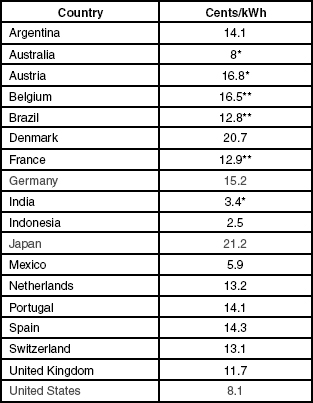
FIGURE 4 Cost of electricity in 1999.
SOURCE: Norman Johnston, Presentation at April 23, 2009, National Academies Symposium on “The Future of Photovoltaics Manufacturing in the United States.â€
cents in Germany, and 8.1 cents in the United States. The low cost in the United States effectively blocked investment in solar technologies, which were not yet cost-competitive.
The U.S. Sunlight Advantage
When and if solar power gains a significant foothold in the United States, it will benefit from the abundance of sunlight. Dr. Johnston noted that even chilly Ohio has more sun than Berlin or Munich, while Florida and other warm states have far more, and even the northernmost states have adequate insolation. A typical home in Los Angeles, he said, needs only 234 square feet of roof space to meet one-half its typical electricity needs using a solar power system with a conservative 12 percent conversion efficiency. A typical home in Maine would need just 25 percent more roof space. “There is sun in every state,†he said. “It just varies by about 25 percent.â€
Nor is the expansion of a solar industry in the United States limited by production capacity, he said. In northwestern Ohio alone, he said, the production capacity of First Solar is already 100 MW/yr, and will soon expand to 170 MW/ yr. Xunlight Corp., which is developing wide-web, roll-to-roll thin-film modules in Toledo, will be producing about 100 MW/yr of capacity by 2010. Calyxo is producing 100 MW/yr in Germany, and is expected to complement this with U.S. production. Another CdTe start-up firm, Willard & Kelsey Solar Group, plans to begin production in Perrysburg in late 2009. By now, he said, northwest Ohio has more CdTe and glass expertise than any other region in the world. A larger U.S. market would quickly stimulate additional production.
Dr. Johnston emphasized another advantage of a PV industry, which is job creation. The projected number of jobs created per megawatt of PV power, he said, is 15, compared with 4.8 jobs for geothermal energy, 4.2 for biomass-dedicated steam, and 3.4 for wind power. He also described the economic ripple effect of a PV solar business chain that could include building construction with advanced glass, a 100 MW solar module plant employing 650 people, construction of the plant employing 250 people, solar fields connected to the grid, and new homes with fiberglass insulation.
For the time being, he said, the advantages of new solar construction have become moot in the face of the worldwide economic crisis. He estimated that over 1 gigawatt of PV material is now stored in warehouses, and solar manufacturers are beginning to reduce employment. Six months earlier, he said, customers had difficulty finding enough PV material; “now it’s the other way. The industry is stagnant.â€
The Continuing Issue of Low Demand
Beyond the economic depression, Dr. Johnston said, looms the continuing issue of low demand in the United States. “We need funded solar projects,†he said, “and I can’t figure out how to do that.†He suggested that building Ohio solar farms would be an appropriate use for federal stimulus funds, for example. Out-of-work automobile workers could be retrained “in two weeks, and in two months we could have tens of thousands of people putting in product that’s already here in warehouses.†Almost all of this product is available from U.S. manufacturers, he said, which was demonstrated during construction of the solar field at the Toledo airport, 93 percent of whose materials were made in Ohio. “The only thing we didn’t have was an inverter company,†he said. “So we started one, Nextronics, which is in Toledo.â€
Making Use of Brownfields
An additional advantage of Ohio and other rust belt states, Dr. Johnston said, is the enormous supply of abandoned industrial space, or “brownfields,†available
through a variety of grants and partnerships. Toledo alone, he said, has some 830 acres of brownfields, and some 10 to 30 solar farms could be built on brownfields around the state. “Look at all the sites that are shut down,†he said. “Many of them are paved and have power lines already in place.†He has calculated that these new solar farms would provide a market for some 56 million square feet of glass, used 4,263 miles of wire and 18 million feet of aluminum frames, create 1,500 direct jobs, and produce 300 MW of electricity. “The idea of funding this up front is a good one,†he said.
Other conditions are favorable to PV projects, he said. They would qualify for school installation, for which all-Ohio content would be available. Parts of brownfields could be sold or leased to lower or reclaim costs. Utilities would be able to make use of tax credits, private investors could use grants or tax credits, and additional support is available from the Ohio Dept of Development to build solar farms. He listed a community of local companies capable of building complete solar farms, including the modules, installation, glass, R&D, land reclamation, contracting, frames, electrical systems, and inverter. “And yet the only one we’ve installed is the demonstration field at the airport that Congresswoman Kaptor helped arrange,†he said.
Dr. Johnston concluded that despite enormous effort to launch a PV industry, it still has not arrived. “We’ve built our field of solar dreams and they haven’t come,†he said. “My message to the federal government is: If you’re going to give billions of dollars to industries that have failed, you can certainly invest in one that has a bright future.â€
DISCUSSION
A questioner asked Mr. O’Rourke when Deutsche Bank might be ready to invest in solar companies such as those described at the symposium. Mr. O’Rourke replied that although he could not speak directly for Deutsche Bank, the problem for banks as he understood it was not a lack of good investments but balance sheets that had to be revamped. He said that the balance sheets of big banks are very complex, with many classes of assets. When the banking crisis struck in November 2008, these banks had to begin examining all of those assets and begin the process of derisking balance sheets. Every item on their books had to be examined and then disposed of or retained, so that the balance sheet could be returned to the right degrees of risk and leverage. “It’s not that a Deutsche Bank or any other bank doesn’t want to lend, or doesn’t see value in renewable energy projects,†he said. “These are very safe investments for the most part. But until bank balance sheets are reconstituted, there will be no lending. It’s as simple as that.â€
Mr. O’Rourke was asked whether this was why he had suggested the mechanisms of government incentives and tax incentives, rather than loans. He agreed
that on the manufacturing side, one issue to overcome is taxes. “Right now the playing field is not level,†he agreed. “But it’s possible that even if there are tax incentives to bring manufacturing to the U.S., you will find another country in Asia that’s willing to forego taxes for 15 years in order to bring industry. One of the ways around that is some incentives up front that may not recover everything you would lose in profitability. We have to make these kinds of choices that determine whether we have a stagnant market, a growing market, or a rapidly growing market. The best solution to all of this is to somehow get to that rapidly growing end market.â€
Mr. O’Rourke added a comment about the situation in Europe. Many companies had offers that included tax exemptions for long periods. Other factors, however, such as the cost of shipping glass long distances, or the benefits of a local presence, can play a significant role in cost and siting analyses. “Once fuel costs go back up,†he said, “shipping is going to be more important. So when considering how to bring manufacturing to a region, I cannot think of anything more important than having a strong local market for your product.
A questioner asked what a demonstration project would cost and what metrics could be used to evaluate it. Dr. Johnston referred to the $5 million Air Force base demonstration project that produces over 3.4 MW of power for under $4 per kWh of installed cost. “I would like to see Congressman Kaptur use her influence to help not just northwestern Ohio but the United States,†he said, “and help get some of this incentive money in every state to do the same kinds of projects. We still have bridges and hotels built in the 1930s; it would be nice to look at solar fields in 30 years that still produce power.â€
Mr. Zweibel reiterated his belief “that the next dollar spent on PV should be spent to leverage technology leadership.†He said that R&D money and technology development produce leadership, which is “right now the only thing the United States has. For everything else we have to beat someone else at tax issues or other incentives. We should not forget that we have no PV R&D program in the United States with the kind of leverage we need to move these technologies forward.†He said he was referring to established technologies: crystalline silicon, amorphous silicon, thin-film microcrystalline silicon, cadmium telluride, and copper indium diselenide. “I’m not talking about plastic solar cells,†he said, “or 5th-generation solar cells that are in proposals from single professors at various universities playing with beakers. I am talking about technologies that are out there in gigawatts, which have an opportunity to be half or less of today’s already nearly cost-competitive cost. Avoid diversions in mainstream applied research programs. Right now, we are funding more R&D diversions than actions that will actually accelerate success.â€


