
CHAPTER EIGHT
Freshwater Resources
Humans and ecosystems rely on water for life. The availability of water depends on both the climate-driven global water cycle and on society’s ability to manage, store, and conserve water resources. Climate change is affecting both the quantity and quality of Earth’s water supplies. Already, precipitation amounts and patterns are changing, and these trends are expected to continue or intensify in the future. This creates significant challenges for water resource management, especially where current water rights and consumption patterns were established under climate conditions different from the conditions projected for the future. Moreover, climate change is not the only problem putting demands on water supplies. Growing populations and consumptive use may cause shortages in some regions. Responding to these challenges will require better data and modeling as well as a better understanding of both the impacts of climate change and the role of water governance on water resources.
Questions water managers and other decision makers are asking, or will be asking, about climate change include the following:
-
Given the relatively large uncertainties in model projections of future precipitation, what actions can we take now that we will not regret in 20 or 30 years?
-
How robust are different long-term water management strategies under various scenarios of future climate change?
-
Are there management and decision-support tools that can help us balance the water needs for urban, agricultural, energy, and in-stream environmental requirements, improve time-dependent decisions, and illuminate the relevant trade-offs?
-
How can water institutions and legal mechanisms be modified to improve flexibility and fit changing baseline conditions? What can we learn from other regions and countries about flexible and fair water use?
-
How can we develop tools to assess preparedness and develop capacity to respond to extreme water-related events such as flooding or drought?
Scientific research has steadily increased our understanding of how climate change is affecting freshwater resources. Changes in freshwater systems are expected to create significant challenges for flood management, drought preparedness, water supplies, and many other water resource issues. The research summarized in this chapter
provides an overview of freshwater resources and what is known about how climate change will affect freshwater availability. We also indicate research needs and outline some of the fundamental challenges of making projections of climate impacts on water resources and governance strategies.
SENSITIVITY OF FRESHWATER RESOURCES TO CLIMATE CHANGE
Historically, the United States has relied heavily on surface water, and to a lesser extent groundwater, to meet its freshwater needs. It would be easy to assume that precipitation is the most critical factor in determining surface water availability, and thus future water supplies will be controlled almost entirely by changes in average annual precipitation. In reality, however, the relationship between climate change and water supplies is more complex. For example, climate change directly affects temperatures, and hence evaporation from soil and water surfaces, plant transpiration, and mountain snowmelt. The average intensity, seasonality, mode (i.e., rain or snow), and geographic distribution of precipitation are also important for water management decisions. All of these characteristics are closely connected to storm patterns, which are modulated by regional and global patterns of variability on a range of time scales, and both storm patterns and patterns of variability may shift as climate change progresses (e.g., Kundzewicz et al., 2007; Lemke et al., 2007; Trenberth et al., 2007). Moreover, water cycling through soils, land cover, and geologic formations, as well as rainfall intensity and amount, all affect the volume of surface runoff as well as infiltration rates and groundwater recharge, making the response of water resource systems to climate change complex. Changes in land cover and land use will complicate projections of water resource availability as well as the detection and attribution of climate-driven trends; for example, land degradation with accompanying vegetation changes can be a dominant driver of changes in stream flow (Wilcox et al., 2008). In many coastal regions, sea level rise (see Chapter 7) will affect surface and groundwater resources.
The complex processes involved in the water cycle, combined with uncertainties in model projections of future precipitation changes, prevent any easy conclusions about how climate change will affect regional water supplies. Even if model projections do not show any significant changes in total precipitation, for example, shifts in seasonal precipitation patterns or average storm intensity may be critical for water-dependent sectors like agriculture. As discussed in Chapter 6 and the next section below, a higher fraction of rainfall is expected to fall in the form of heavy precipitation events as temperatures increase, and in many locations such a shift has already been observed (see also CCSP, 2008f; Bates and Kundzewicz, 2008). Higher temperatures are also projected to increase soil and surface water evaporation, producing overall drier conditions even
if total precipitation remains constant. Higher temperatures and runoff from intense rainfall can both negatively affect the physical and chemical characteristics of freshwater and thus water quality.
Despite considerable improvements in modeling, significant uncertainties remain in projections of precipitation—including its distribution, intensity, frequency, and other characteristics—as well as in related variables such as land use and land cover change. These uncertainties are compounded by uncertainties in our technical capacity to store, manage, and conserve water resources, as well as in socioeconomic, cultural, and behavioral issues that shape the use of water. Multisectoral planning and sophisticated decision-support tools can help water resource managers avoid the most undesirable consequences of climate change in their areas of responsibility (Bates and Kundzewicz, 2008; Gleick, 2000; Vorosmarty et al., 2000). Adaptive water management approaches at operational time scales will be particularly important (e.g., Georgakakos et al., 2005), and long-term strategic decisions need to be robust—that is, able to meet water management goals under a range of plausible future climate conditions (e.g., Dessai and Hulme, 2007; Lempert, 2002; Lempert and Collins, 2007; Lempert et al., 2003).
HISTORICAL AND FUTURE CHANGES IN FRESHWATER
Precipitation: Frequency, Intensity, Storminess
Observed changes in precipitation are broadly consistent with theoretical expectations and reasonably simulated by global climate models (Bates and Kundzewicz, 2008; Trenberth et al., 2007; Zhang et al., 2007a). While total precipitation in the United States has increased by about 5 percent over the past 50 years, there are significant regional differences, with generally wetter conditions in the Northeast and generally drier conditions in the Southeast and particularly the Southwest (Figure 8.1) (see also Field et al., 2007b). A wide range of climate models using different emissions scenarios predict that these regional trends will continue, with generally robust model results for the north and with high uncertainty for the south (Christensen et al., 2007; USGCRP, 2009a). Other factors in addition to temperature influence precipitation. Specifically, uncertainty remains in our understanding of the effects of aerosols on cloud formation and precipitation. For example, climate models underestimate the magnitude of the observed global land precipitation response to 20th-century volcanic forcing (Hegerl and Solomon, 2009) as well as human-induced aerosol changes (Gillett et al., 2004; Lambert et al., 2005).
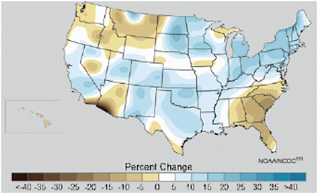
FIGURE 8.1 Observed annual average precipitation changes in the United States between 1958 and 2008. Blue indicates areas that have gotten wetter, while brown indicates areas that have gotten drier. SOURCE: USGCRP (2009a); data from NOAA/NCDC (2008).
Historical data also show an increase in precipitation intensity. In the United States, the fraction of total precipitation falling in the heaviest 1 percent of rain events increased by about 20 percent over the past century (Gutowski et al., 2008). Most climate models project that this trend will continue (Bates and Kundzewicz, 2008) and also project a strong seasonality, with notable summer drying across much of the Midwest, the Pacific Northwest, and California (Hesselbjerg and Hewitson, 2007).
Changes in major storm events are of interest both because a significant fraction of total U.S. precipitation is associated with storm events and because storms often bring wind, storm surges, tornadoes, and other threats. Tropical storms, which become hurricanes if they grow to a certain intensity, are of particular interest because of their socioeconomic impacts (e.g., Hurricane Katrina; see Box 4.3). Changes in the intensity of hurricanes have been documented and attributed to changes in sea surface temperatures (Emanuel, 2005; Trenberth and Fasullo, 2008), but the link between these changes and climate change remains uncertain (Knutson et al., 2010). Recent model projections indicate growing certainty that climate change could lead to increases in the strength of hurricanes, but how their overall frequency of occurrence might change is still an active area of research (Bender et al., 2010; Knutson et al., 2010). Extratropical storms, including snowstorms, have moved northward in both the North Pacific and the North Atlantic (CCSP, 2008f), but the body of work analyzing current and projected future changes in the frequency and intensity of these storms is somewhat inconclusive (Albrecht et al., 2009; Hayden, 1999). Historical data for thunder-storms and tornadoes are insufficient to determine if changes have occurred (CCSP, 2008f).
Snowpack, Glaciers, and Snowmelt
Worldwide, snow cover is decreasing, although substantial regional variability exists (Lemke et al., 2007; Slaymaker and Kelly, 2007). Since the 1920s, Northern Hemisphere snow cover has steadily declined (Figure 8.2), despite increased precipitation. Between 1966 and 2005, the total area of Northern Hemisphere snow cover shrank by approximately 1.4 percent per decade. In the Southern Hemisphere, there has been no significant trend in South American snow cover, and data are sparse and inconclusive in Australia and New Zealand.
In the United States, snowpack changes in the West currently represent the best-documented hydrological manifestation of climate change (e.g., Barnett et al., 2008; Pierce et al., 2008). About half of the observed decline in western snowpack, and resulting changes in the amount and seasonality of river discharge, can be linked to a warming climate. The largest losses in snowpack are occurring in the lower elevations of the mountains of the Northwest and California, because higher temperatures are causing more precipitation to fall as rain instead of snow. Moreover, snowpack is melting as much as 20 days earlier than the historical average in many areas of the West (Kapnick and Hall, 2009; Kim and Waliser, 2009; Stewart et al., 2005). Snow is expected
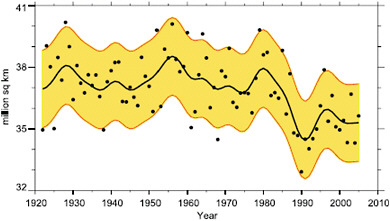
FIGURE 8.2 Area of Northern Hemisphere covered by snow in the spring. There is an overall trend toward a decrease in the area covered by snow for the entire period (1922-2005). The black dots correspond to individual years, the smooth black line shows decadal variations, and the yellow area indicates the 5 to 95 percent confidence range associated with decadal variations. SOURCE: Lemke et al. (2007).
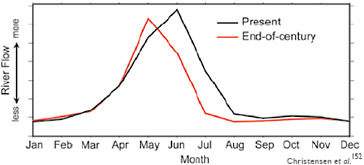
FIGURE 8.3 An example of how the timing and amount of runoff is projected to change following warming in the 21st century. The black line shows the amount of stream flow occurring in the Green River, which is part of the Colorado River Basin. The stream flow of the Green River is dominated by the timing and amount of snowmelt, and peak flows historically have occurred around June. Warming in the twenty-first century would tend to decrease snowfall during the winter and accelerate the timing and pace of snowmelt, leading to earlier peak flows and overall less stream flow (red line). SOURCE: USGCRP (2009a); data from Christensen et al. (2004).
to melt even earlier under projections of future climate change, resulting in reduced later-summer stream flows (Figure 8.3). This change would have major implications for ecosystems, hydropower, urban and agricultural water withdrawals, and requirements for other water uses. In regions where the summer growing season is the dry season, as in much of the western United States, this concentration of runoff in the spring and reduction in summer will stress water supply systems and could lead to summer water shortages (Barnett et al., 2005b; Cayan et al., 2009).
Finally, as discussed in Chapter 7, nearly all of the world’s glacier systems are shrinking, and in many cases their rate of ice loss has been accelerating. Disappearing glaciers are ultimately expected to lead to reductions in river flows during dry seasons and lost water resources for the hundreds of millions of people who rely upon glacier-fed rivers worldwide (Barnett et al., 2005b). Changes in glacier-stream flow interactions are also expected to lead to changes in ecosystems and in water quality (Milner et al., 2009).
Elements of the Terrestrial Water Cycle: Surface and Groundwater Resources
Analyses of stream flow records for the United States over the past several decades show primarily increases, which is consistent with trends in precipitation (Lins and Slack, 2005). However, these observed changes in stream flow are due in large part to
the aggregate effects of many human influences, of which climate change is only one (Gerten et al., 2008). Of the world’s 200 largest rivers, 22.5 percent showed downward trends over the period 1948 to 2004, and 9.5 percent showed upward trends, both mostly as a result of climate variations (Dai et al., 2009). While projections of runoff changes generally mimic precipitation trends, such projections are uncertain in part because runoff is influenced by rates of evapotranspiration—the sum of evaporation of water from the surface and transpiration of water though the leaves of plants. The effects of temperature change and changes in CO2 on plant processes can in turn affect evapotranspiration, and thus the magnitude of runoff (Gedney et al., 2006; Piao et al., 2007; Wolock and Hornberger, 1991).
Extreme conditions, namely floods and droughts, are generally of greatest concern to water managers. In addition to climate change, these events and can be magnified by human-influenced factors such as urbanization, streambed alterations, and deforestation. It is not clear whether the frequency of extreme runoff events has increased during the last several decades. Milly et al. (2002) reported a measurable increase in large floods, but Kundzewicz et al. (2005) found 27 increases, 31 decreases, and 137 with no significant trend in 195 catchments worldwide. These differences reflect both the regional nature of precipitation shifts as well as the multiple changes occurring in any individual region. For example, catchment-specific land use changes and streambed modifications may have occurred over the period of record and may mask or enhance the climate change signal. Such challenges suggest that adaptive water management decisions will require regional climate information and may differ in their specific application from one river basin to another. Given the observed increases in heavy precipitation events and the expectation that this intensification will continue, assessments indicate that generally, the risk from floods will increase in the future. However, local water, land use, and flood risk-management decisions can modify the actual flood vulnerability of communities and built infrastructure (Kundzewicz et al., 2007). Flood-control measures themselves can be a primary reason for changes in intensity of flooding (Pinter et al., 2008).
Long-term records do not exist for evapotranspiration. Trends in pan evaporation, a standard measurement of water loss to the atmosphere from an exposed pan of water at some meteorological stations, are actually negative for the past several decades in the United States (Golubev et al., 2001), which is the opposite of what would be expected under a warming climate. Several explanations are possible. Brutsaert and Parlange (1998) argue that pan evaporation reflects potential rather than actual evapotranspiration and that actual evapotranspiration and pan evaporation should have opposite signs due to feedbacks caused by the heat transferred during the transformation of water from liquid to vapor. An alternate explanation is that net surface
radiation actually decreased in the United States during the past several decades due to increased cloudiness, and hence actual evapotranspiration decreased (Huntington, 2004). Discerning trends and making projections for evapotranspiration is complicated further by the indirect effect of increased CO2 concentrations, which can alter plants’ water-use efficiency (Betts et al., 2007). Thus, although evapotranspiration is a critically important process in the water cycle, our ability to understand trends and to predict the impacts of climate change on it is limited (Fu et al., 2009; Kingston et al., 2009).
Groundwater
Some regions of the United States rely partially—and others, such as Florida, mainly—on groundwater for drinking, residential use, and agriculture. According to the U.S. Geological Survey (USGS, 2004), total groundwater withdrawals in the country in 2000 amounted to 84,500 million gallons per day—about one quarter of total freshwater withdrawals. In the central United States, usage of the Ogalalla aquifer, mainly for agriculture, is withdrawing groundwater much faster than it can be recharged (Alley et al., 1999) and other aquifer systems are also being depleted (USGS, 2003). Significant changes in future rainfall rates will create additional vulnerabilities associated with groundwater usage.
The impacts of climate change on groundwater are far from clear; in fact, little research effort has been devoted to this topic. Changes in precipitation and evaporation patterns, plant growth processes, and incursions of seawater into coastal aquifers will all affect the rate of groundwater recharge, the absolute volume of groundwater available, groundwater quality, and the physical connection between surface and ground-water bodies (USGCRP, 2009a). Already, as climate change-driven impacts and other pressures on water resources unfold, water managers in drier regions of the United States find themselves confronted with the need to expand groundwater withdrawal and develop groundwater recharge schemes and infrastructure. The inconsistent regulation of groundwater and surface water from state to state and the lack of readily available legal mechanisms to link ground- and surface-water management—even where they are physically linked—makes comprehensive, integrated water management difficult.
Drought
Drought is a complex environmental impact and is affected strongly by the balance between precipitation and evapotranspiration and the concomitant effect on soil moisture. Global climate models predict increasing summer temperatures and decreasing summer precipitation in many continental areas, implying reductions in soil moisture. Long-term records of soil moisture are sparse, and the records that do exist do not show depletion of soil moisture, possibly due to reductions in solar radiation reaching the Earth’s surface due to increased cloudiness (Robock et al., 2005). A surrogate indicator, derived from land-surface models, is the Palmer Drought Severity Index, which measures the duration and intensity of long-term drought-inducing patterns through thousands of data points such as rainfall, snowpack, stream flow, and other water supply indicators.1 The historical record of the Palmer Index from 1870 to 2002 shows that very dry areas have more than doubled globally since the 1970s, and the expansion after the 1980s is associated with surface warming (Dai et al., 2004). However, there are considerable year-to-year variations in soil moisture associated with the El Niño-Southern Oscillation and other modes of climate variability, and model projections of soil moisture for the 21st century do not provide a consistent indication of future changes (Trenberth et al., 2007). This uncertainty in future soil moisture projections leads to uncertainties about ecosystem dynamics and projections of agricultural productivity and, thus, presents a challenge for farmers, natural resource managers, and others trying to plan adaptation measures.
Attributing increases in severe droughts to human causes using observed data is difficult (e.g., Seager et al., 2009) and cannot currently be done unambiguously (Seager et al., 2007; Sun et al., 2007). For the United States, trend analyses indicate that droughts decreased in intensity, duration, and frequency over the period from 1915 to 2003, except in the Southwest (Andreadis and Lettenmaier, 2006; Sheffield and Wood, 2008). However, other analyses (Groisman and Knight, 2008) suggest increases in extended dry periods over the past 40 years. Model projections indicate that the area affected by drought will probably increase in the decades ahead (Bates and Kundzewicz, 2008) and that the number of dry days annually will also increase (Kundzewicz et al., 2007). In snowmelt-dominated systems, the risk of drought is expected to increase (Barnett et al., 2005b).
Water Quality
Changes in the water temperature of lakes and rivers have consequences for freshwater quality (Bates and Kundzewicz, 2008). Increased temperatures generally have a negative impact on water quality, typically by stimulating growth of nuisance algae. Changes in heavy precipitation, runoff, and stream flow can impact a diverse set of water quality variables (Kundzewicz et al., 2007). Water quality will also be negatively affected by saline intrusion into coastal aquifers as sea levels rise (Kundzewicz et al., 2009; Alley et al., 1999; see also Chapter 7). In general, however, the water quality implications of climate change are less well understood than its impacts on water supply.
MANAGING FRESHWATER IN A CHANGING CLIMATE
In the face of the many, and sometimes uncertain, impacts on freshwater resources outlined above, water managers face a variety of challenges. For example, new infrastructure construction (e.g., large dams) is expected to be limited, so water managers will have to develop and implement approaches to increase the efficiency of water use (Gleick, 2003a,b). On the other hand, existing water infrastructure (e.g., reservoirs, conveyer pipes, sewage lines, and treatment plants) will need to be maintained and upgraded, which offers opportunities for taking account of current and projected impacts of climate change (e.g., ASCE, 2009; EPA, 2008; King County, 2008). Projections of freshwater supply as well as climate change impacts on water infrastructure itself are uncertain, so water managers will need more information about risks and about managing water in the face of uncertainty (Beller-Simms et al., 2008; CDWR, 2008; Delta Vision Blue Ribbon Task Force, 2007; EPA, 2008; Wilby et al., 2009). In addition to tools and models that expand their range of response options, managers and policy makers will need governance flexibility in order to increase adaptive capacity and resilience in water systems (Adger et al., 2007; Huitema et al., 2009; Zimmerman et al., 2008).
Two options for dealing with these challenges are governance frameworks such as Integrated Water Resources Management and adaptive management. Integrated Water Resources Management often involves reforming broader institutional structures of water governance including decentralization, integration, participatory/collaborative management, and social learning. Adaptive management involves organizational and management processes that maintain flexibility (see Box 3.1). While these frameworks could increase the adaptive capacity of freshwater management, there is still a need for more information about water institutions and governance structures and how they affect human and institutional behavior (Engle and Lemos, 2010; Huitema et al., 2009; Norman and Bakker, 2009; Urwin and Jordan, 2008).
RESEARCH NEEDS
Significant gaps remain in the knowledge base that informs both projections of climate change impacts on water resources and governance strategies that can curb demand and build adaptive capacity of water systems. Critical research needs include the following.
Improved projections of changes in the water cycle at regional and seasonal time scales. Because water most directly affects society at the watershed or regional level, improved regional-scale projections of changes in precipitation, soil moisture, runoff, and groundwater availability on seasonal to multidecadal time scales are needed to inform water management and planning decisions, especially decisions related to long-term infrastructure investments. Likewise, projections of changes in the frequency and intensity of severe storms, floods, and droughts are critical both for water management planning and for adapting the natural and human systems that depend on water resources. This will require new multiscale modeling approaches, such as nesting cloud-resolving climate models into regional weather models and then coupling these models to land surface models that are capable of simulating the hydrologic cycle, vegetation, multiple soil layers, ground water, and stream flow. These models will also need to reliably project changes in storm paths and modes of regional climate variability.
Long-term observations for measuring and predicting hydrologic changes and planning management responses. Improved physical observations are needed to monitor the impacts of climate change on water systems and to support model development and adaptation planning. Improved observations would also improve short-term hydrological forecasts. New technologies are needed to allow continuous high-precision measurements of inventories and fluxes of water, including precipitation, groundwater, soil moisture, snow, evapotranspiration, and stream flow. Time-series data related to human demographics, economic trends, vulnerabilities to changes in water quantity and quality, and human exposures and sensitivities to water contamination are also important, and should be made available in an integrated framework with physical observations to support integrated analysis and decision making.
Improved tools and approaches for decision making under uncertainty and complexity. Water resource managers are faced with making many important and complex decisions under uncertainty. To support more robust and effective decisions and strategies, further advances are needed in ensemble and integrated approaches to modeling, scenario building and comparison, and identification of no-regrets options. To improve the use and usability of climate knowledge in decision making,
research is also needed on effective decision-support tools, such as forecasts, climate services, and methods for making complex trade-offs under uncertainty (see Chapter 4 for additional details).
Impacts of climate change on diverse water uses. Climate change will affect many water-related activities and sectors, including navigation, recreation, tourism, human health, drinking water, agriculture, hydroelectric power generation, and the ecological integrity of aquatic and terrestrial ecosystems. Continued and expanded research in all of these areas, and on the economics of water supply, demand, and costs of adaptation, is needed across and between different water-dependent sectors. The potential for local, state, and international disputes over water resources is also an area where further study is warranted (see Chapter 16). Another need is for better understanding of how institutions and behavior shape vulnerability and offer opportunities to adapt to changing water regimes.
Develop vulnerability assessments and integrative management approaches to respond effectively to changes in water resources. Changes in water resources are anticipated to affect coupled human-environment systems in a variety of ways and in interaction with many other environmental stresses. Assessing which water supplies and human-environment systems are most vulnerable to climate change will require analysis of place-based environmental conditions as well as social conditions and management needs. Frameworks need to be developed and tested for such assessments, and new integrative water resource management and adaptation approaches are needed for managing water in the context of climate change. Finally, the effects of actions taken to limit the magnitude of climate change (or adapt to other impacts)on water resources need to be more systematically assessed and accounted for in climate-related decision making.
Increase understanding of water institutions and governance, and design effective systems for the future. Water institutions of the future will have to deal with the complexity of multiple and interacting stresses as well as equity and economic issues related to water use. Reconciling water entitlements across different water systems, making water systems more flexible in the face of change, and shaping an institutional environment that encourages water conservation and reuse are only some of the challenges facing water resource institutions as climate change progresses. To improve our ability to design and deploy water institutions, more research is needed on governance mechanisms such as water markets, public-private partnerships, and community-based management. Evaluation of legacy effects of past infrastructure and management decisions will assist in understanding path-dependent effects, but only to the extent that such lessons are relevant to constantly evolving conditions.
Improve water engineering and technologies. Many water management systems are currently constrained by existing water infrastructures, many of which are old and need replacement. Thus, attention needs to be given to the development and implementation of more efficient water delivery systems. New technologies for water storage, supply, treatment, and recycling will also be needed, as will more efficient residential, commercial, and agricultural end-use technologies.
Evaluate effects of water resource use on climate. Changes in land and water use affect local and regional climate through effects on land-atmosphere interaction, particularly changes in evapotranspiration. The role of ecosystems in recycling precipitation, influencing stream flow, and mitigating droughts is particularly important. Improving our understanding of the effects of water and land use on regional climate will be an important component of developing local and regional integrated climate change responses.


