
CHAPTER TEN
Agriculture, Fisheries, and Food Production
Meeting the food needs of a still-growing and more affluent global population—as well as the nearly one billion people who already go without adequate food—presents a key challenge for economic and human security (see Chapter 16). Many analysts estimate that food production will need to nearly double over the coming several decades (Borlaug, 2007; FAO, 2009). Recent trends of using food crops for fuel (e.g., corn ethanol) or displacing food crops with fuel crops, along with potential opportunities for reforesting land for carbon credits, may amplify the food security challenge by increasing competition for arable land (Fargione et al., 2008). Climate change increases the complexity of meeting these food needs because of its multiple impacts on agricultural crops, livestock, and fisheries. The potential ability of agricultural and fishery systems to limit climate change adds yet another dimension to be considered.
Questions that farmers, fishers, and other decision makers are asking or will be asking about agriculture, fisheries, and food production in the context of climate change include the following:
-
How will climate change affect yields?
-
How will climate change affect weeds and pests, and will I need more pesticides or different technology to maintain or increase yields?
-
Will enough water be available for my crops? Will the risk of flooding or drought increase?
-
Should I change to more heat-resistant or slower-growing crop varieties?
-
What new market opportunities should I take advantage of? How will competitors in other regions be affected?
-
What adjustments do I need to make to guarantee the sustainability of the fisheries under my management?
-
How will climate change affect my catch? Will I need new equipment and technology? Will regulations change?
-
How will climate change affect the availability of food in domestic and international markets? Will food become more expensive? Will food security increase or decrease?
-
How can changes in agricultural production and practices contribute to reduc-
-
tions in greenhouse gas emissions or dampen regional-scale impacts related to climate change?
The scientific knowledge summarized in this chapter illustrates how agriculture will be influenced by climate change, and it explores the less well understood impacts of climate change on fisheries. The chapter also indicates how agricultural management may provide opportunities to reduce net human greenhouse gas (GHG) emissions, and it offers insight into the science needed for adaptation in agriculture systems as well as food security issues. Finally, the chapter provides examples of a broad range of research that is needed to understand the impacts of climate change on food production systems and to develop strategies that assist in both limiting the magnitude of climate change through management practices and reducing vulnerability and increasing adaptive capacity in regions and populations in the United States and other parts of the world.
CROP PRODUCTION
Crop production will be influenced in multiple ways by climate change itself, as well as by our efforts to limit the magnitude of climate change and adapt to it. Over the past two decades, numerous experimental studies have been carried out on crop responses to increases in average temperature and atmospheric CO2 concentrations (often referred to as carbon fertilization), and mathematical models depicting those relationships (singly or in combination) have been developed for individual crops. Fewer experiments and models have evaluated plant responses to climate-related increases in air pollutants such as ozone, or to changes in water or nutrient availability in combination with CO2 and temperature changes. A recently published report of the U.S. Climate Change Science Program (CCSP, 2008e) summarized the results from experimental and modeling analyses for the United States. Results of experimental studies, for example, indicate that many crop plants, including wheat and soybeans, respond to elevated CO2 with increased growth and seed yield, although not uniformly so. Likewise, elevated CO2 also reduces the conductance of CO2 and water vapor through pores in the leaves of some plants, with resulting improvements in water use efficiency and, potentially, improved growth under drought conditions (Leakey et al., 2009). On the other hand, studies carried out in the field under “free air CO2 enrichment” environments indicate that growth response is often smaller than expected based on more controlled studies (e.g., Leakey et al., 2009; Long et al., 2006). The response of crop plants to carbon fertilization in field environments hence remains an important area of research (see Research Needs section at the end of the chapter).
Some heat-loving crop plants such as melons, sweet potatoes, and okra also respond positively to increasing temperatures and longer growing seasons; but many other crops, including grains and soybeans, are negatively affected, both in vegetative growth and seed production, by even small increases in temperature (Figure 10.1). Many important grain crops tend to have lower yields when summer temperatures increase, primarily because heat accelerates the plant’s developmental cycle and reduces the duration of the grain-filling period (CCSP, 2008b; Rosenzweig and Hillel, 1998). In some crop plants, pollination, kernel set, and seed size, among other variables, are harmed by extreme heat (CCSP, 2008b; Wolfe et al., 2008). Studies also indicate that some crops such as fruit and nut trees are sensitive to changes in seasonality, reduced cold periods, and heat waves (Baldocchi and Wong, 2008; CCSP, 2008e; Luedeling et al., 2009).
Most assessments conclude that climate change will increase productivity of some crops in some regions, especially northern regions, while reducing production in others (CCSP, 2008b; Reilly et al., 2003), an expected result given the range of projected climate changes and diversity of food crops around the world. The Intergovernmental Panel on Climate Change (IPCC) suggests, with medium confidence, that moderate warming (1.8°F to 5.4°F [1°C to 3°C]) and associated increases in CO2 and changes in precipitation would benefit crop and pasture lands in middle to high latitudes but decrease yields in seasonally dry and low-latitude areas (Easterling et al., 2007). This response to intermediate temperature increases would generate a situation of midlatitude “winners” in developed countries and low-latitude “losers” in developing coun-
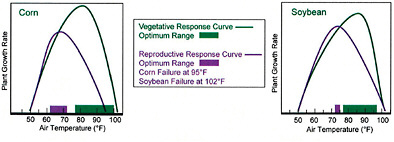
FIGURE 10.1 Growth rates (green) and reproductive response (purple) versus temperature for corn (left) and soybean (right). The curves show that there is a temperature range (colored bars) within which the plants can optimally grow and reproduce, and that growth and reproduction are less efficient at temperatures above this range. The curves also show that, above a certain temperature, the plants cannot reproduce. SOURCE: USGCRP (2009a).
tries, thus magnifying rather than reducing existing inequities in food availability and security. The IPCC also concludes with medium to low confidence that, on the whole, global food production is likely to decrease with increases in average temperatures above 5.4°F (3°C).
Regional assessments of agricultural impacts in the United States (e.g., CCSP, 2008b, and references therein) suggest that over the next 30 years, the benefits of elevated CO2 will mostly offset the negative effects of increasing temperature (see below for limits in modeling conducted to date). In northern regions of the country, many crops may respond positively to increases in temperature and atmospheric CO2 concentrations. In the Midwest corn belt and more southern areas of the Great Plains, positive crop responses to elevated CO2 may be offset by negative responses to increasing temperatures; rice, sorghum, and bean crops in the South would see negative growth impacts (CCSP, 2008b). In California, where half the nation’s fruit and vegetable crops are grown, climate change is projected to decrease yields of almonds, walnuts, avocados, and table grapes by up to 40 percent by 2050 (Lobell et al., 2007). As temperatures continue to rise, crops will increasingly experience temperatures above the optimum for growth and reproduction. Adaptation through altered crop types, planting dates, and other management options is expected to help the agricultural sector, especially in the developed world (Burke et al., 2009; Darwin et al., 1995). However, regional assessments for other areas of the world consistently conclude that climate change presents a serious risk to critical staple crops in sub-Saharan Africa, where adaptive capacity is expected to be less than in the industrialized world (Jones and Thornton, 2003; Parry et al., 2004). Parts of the world where agriculture depends on water resources from glacial melt, including the Andean highlands, the Ganges Plain, and portions of East Africa, are also at risk due to the worldwide reduction in snowpack and the retreat of glaciers (Bradley et al., 2006; Kehrwald et al., 2008; also see Chapter 8).
While models of crop responses to climate change have generally incorporated shifts in average temperature, length of growing season, and CO2 fertilization, either singly or in combination, most have excluded expected changes in other factors that also have dramatic impacts on crop yields. These critical factors include changes in extreme events (such as heat waves, intense rainfall, or drought), pests and disease, and water supplies and energy use (for irrigation). Extreme events such as heavy downpours are already increasing in frequency and are projected to continue to increase (CCSP, 2008b; Rosenzweig et al., 2001). Intense rainfalls can delay planting, increase root diseases, damage fruit, and cause flooding and erosion, all of which reduce crop productivity. Drought frequency and intensity are likely (Christensen et al., 2007) to increase in several regions that already experience water stress, especially in developing
countries where investments have focused on disaster recovery more than adaptive capacity (e.g., Mirza, 2003).
Changes in water quantity and quality due to climate change are also expected to affect food availability, stability, access, and utilization. This will increase the vulnerability of many farmers and decrease food security, especially in the arid and semiarid tropics and in the large Asian and African deltas (Bates and Kundzewicz, 2008). As noted in Chapter 8, freshwater demand globally will grow in coming decades, primarily due to population growth, increasing affluence, and the need for increased production of food and energy. Climate change is exacerbating these issues, and model simulations under various scenarios indicate that many regions face water resource challenges, especially in regions that depend on rainfall or irrigation from snowmelt (Hayhoe et al., 2007; Kapnick and Hall, 2009; Maurer and Duffy, 2005). As a result, many regions face critical decisions about modifying infrastructure and pricing policies as climate change progresses.
Many weeds, plant diseases, and insect pests benefit from warming (and from elevated CO2, in the case of most weed plants), sometimes more than crops; as temperatures continue to rise, many weeds, diseases, and pests will also expand their ranges (CCSP, 2008b; Garrett et al., 2006; Gregory et al., 2009; Lake and Wade, 2009; McDonald et al., 2009). In addition, under higher CO2 concentrations, some herbicides appear to be less effective (CCSP, 2008b; Ziska, 2000; Ziska et al., 1999). In the United States, aggressive weeds such as kudzu, which has already invaded 2.5 million acres of the southeast, is expected to expand its range into agricultural areas to the north (Frumhoff, 2007). Worldwide, animal diseases and pests are already exhibiting range extensions from low to middle latitudes due to warming (CCSP, 2008b; Diffenbaugh et al., 2008). While these and other changes are expected to have negative impacts on crops, their impact on food production at regional or national scales has not been thoroughly evaluated.
Similar to crop production, commercial forestry will be affected by many aspects of climate change, including CO2 fertilization, changes in length of growing season, changing precipitation patterns, and pests and diseases. Models project that global timber production could increase through a poleward shift in the locations where important forest species are grown, largely as a result of longer growing seasons. Enhanced growth due to carbon fertilization is also possible (Norby et al., 2005). However, experimental results and models typically do not account for limiting factors such as pests, weeds, nutrient availability, and drought; these limiting factors could potentially offset or even dominate the effects of longer growing seasons and carbon fertilization (Angert et al., 2005; Kirllenko and Sedjo, 2007; Norby et al., 2005).
LIVESTOCK PRODUCTION
Livestock respond to climate change directly through heat and humidity stresses, and they are also affected indirectly by changes in forage quantity and quality, water availability, and disease. Because heat stress reduces milk production, weight gain, and reproduction in livestock, production of pork, beef, and milk is projected to decline with warming temperatures, especially those above 5.4°F (3°C; Backlund et al., 2008) (Figure 10.2). In addition, livestock losses due to heat waves are expected to increase, with the extreme heat exacerbated by rising minimum nighttime temperatures as well as increasing difficulties in providing adequate water (CCSP, 2008b).
Increasing temperatures may enhance production of forage in pastures and rangelands, except in already hot and dry locations. Longer growing seasons may also extend overall forage production, as long as precipitation and soil moisture are sufficient; however, uncertainty in climate model precipitation projections makes this difficult to determine. Although CO2 enrichment stimulates production on many rangelands and pastures, it also reduces forage quality, shifts the dominant grass species toward those with lower food quality, and increases the prevalence of nonforage weeds (CCSP, 2008b; Eakin and Conley, 2002). In northern Sonora, Mexico, for example, buffelgrass, which was imported from Africa and improved in the United States, is increasingly planted as livestock pasture in arid conditions. However, the grass has become an
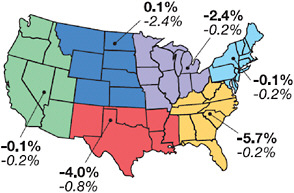
FIGURE 10.2 Percent change in milk yield from 20th-century (1850 to 1985) climate conditions to projected 2040 climate conditions made using two different models of future climate (bold versus italicized numbers) in different regions of the United States. The bold values are associated with the model that exhibits more rapid warming. SOURCE: CCSP (2008e).
aggressive invader, spreading across the Sonoran Desert landscape and into Arizona and overrunning important national parks and reserves (Arriaga et al., 2004). Overall, changes in forage are expected to lead to an overall decline in livestock productivity.
FISHERIES AND AQUACULTURE PRODUCTION
Over one billion people around the world rely on seafood as their primary source of protein, and roughly three billion people obtain at least 15 percent of their total protein intake from seafood (FAO, 2009). Global demand for seafood is growing at a rapid rate, fueled by increases in human population, affluence, and dietary shifts (York and Gossard, 2004). While demand for seafood is increasing, the catch of wild seafood has been declining slightly for 20 years (Watson and Pauly, 2001). Meeting the growth in demand has only been possible by rapid growth in marine aquaculture. The United States consumes nearly five billion pounds of seafood a year, ranking it third globally behind China and Japan. This large consumption, however, comes primarily from fish caught outside the nation’s boundary waters. Nearly 85 percent of U.S. consumption is imported, and that fraction is increasing (Becker, 2010). Therefore, consumption of food from the sea links the United States to nearly all the world’s ocean ecosystems.
Marine Fisheries
The impacts of climate change on marine-based food systems are far less well known than impacts on agriculture, but there is rapidly growing evidence that they could be severe (see Chapter 9). This is especially problematic given that a sizeable fraction of the world’s fisheries are already overexploited (Worm et al., 2009) and many are also subject to pollution from land or under stress from the decline of critical habitats like coral reefs and wetlands (Halpern et al., 2008; Sherman et al., 2009).
Year-to-year climate variability has long been known to cause large fluctuations in fish stocks, both directly and indirectly (McGowan et al., 1998; Stenseth et al., 2002), and this has always been a challenge for effective fisheries management (Walters and Parma, 1996). Similar sensitivity to longer time-scale variations in climate has been documented in a wide range of fish species from around the globe (Chavez et al., 2003; Steele, 1998), and this portends major changes in fish populations under future climate change scenarios. Successful management of fisheries will require an improved ability to forecast population fluctuations driven by climate change; this in turn demands significant new investments in research, including research on various management options (e.g., Mora et al., 2009). Fundamental shifts in management prac-
tices may be needed. For example, restoration planning for depleted Chinook salmon populations in the Pacific Northwest needs to account for the spatial shift in salmon habitat (Battin et al., 2007). An added complexity is that, because most of the fish catch comes from open oceans under international jurisdiction, any management regime will need to be negotiated and accepted by multiple nations to be effective.
Fished species tend to be relatively mobile, either as adults or young (larvae drifting in the plankton). As a result, their distributions can shift rapidly compared to those of land animals. In recent decades, geographical shifts toward the poles of tens to hundreds of kilometers have been documented for a wide range of marine species in different areas (Grebmeier et al., 2006; Lima et al., 2006; Mueter and Litzow, 2008; Sagarin et al., 1999; Zacherl et al., 2003). Model projections for anticipated changes by 2050 suggest a potentially dramatic rearrangement of marine life (Cheung et al., 2009). Although such projections are based upon relatively simple models and should be treated as hypotheses, they suggest that displacements of species ranges may be sufficiently large that the fish species harvested from any given port today may change dramatically in coming decades. Fishers in many Alaskan ports are already facing much longer commutes as distributions of target species have shifted (CCSP, 2009b).
Such projected shifts in fisheries distributions are likely to be most pronounced for U.S. fisheries in the North Pacific and North Atlantic, where temperature increases are likely to be greatest and will be coupled to major habitat changes driven by reduced sea ice (CCSP, 2009b). Abrupt warming in the late 1970s, which was associated with a regime shift in the Pacific Decadal Oscillation, greatly altered the marine ecosystem composition in the Gulf of Alaska (Anderson and Piatt, 1999). Rapid reductions in ice-dominated regions of the Bering Sea will very likely expand the habitat for subarctic piscivores such as arrowtooth flounder, cod, and pollock. Because there are presently only fisheries for cod and pollock, arrowtooth flounder may experience significant population increases with broad potential consequences to the ecosystem (CCSP, 2009b).
The effects of ocean acidification from increased absorption of CO2 by the sea (see Chapters 6 and 9) may be even more important for some fisheries than other aspects of climate change, although the overall impact of ocean acidification remains uncertain (Fabry et al., 2008; Guinotte and Fabry, 2008). Many fished species (e.g., invertebrates such as oysters, clams, scallops, and sea urchins) produce shells as adults or larvae, and the production of shells could be compromised by increased acidification (Fabry et al., 2008; Gazeau et al., 2007; Hofmann et al., 2008). Many other fished species rely on shelled plankton, such as pteropods and foraminifera, as their primary food source. Projected declines in these plankton species could have catastrophic impacts
on fished species higher in the food chain. Finally, acidification can disrupt a variety of physiological processes beyond the production of shells. Hence, the potential impacts of acidification—especially in combination with other climate changes on marine fish-eries—is potentially enormous, but the details remain highly uncertain (NRC, 2010f).
Aquaculture and Freshwater Fisheries
Today, approximately a third of seafood is grown in aquaculture, and that number rises to half if seafood raised for animal feed is included. As the fastest growing source of animal protein on the planet, aquaculture is widely touted as critical for meeting growing demands for food. Although aquaculture avoids some of the climate impacts associated with wild fish harvesting, others (e.g., ocean acidification) are equally challenging. Indeed, the current predominance of aquaculture facilities in estuaries and bays may exacerbate some of the impacts of ocean acidification (Miller et al., 2009). In addition, since different forms of aquaculture may require a variety of other natural resources such as water, feed, and energy to produce seafood, there may be much broader indirect impacts of climate change on this rapidly growing industry.
Freshwater fisheries face most of the same challenges from climate change as those in saltwater, as well as some that are unique. Forecasting the consequences of warming on fish population dynamics is complicated, because details of future climate at relatively small geographic scales (e.g., seasonal and daily variation, regional variation across watersheds) are critical to anticipating fish population responses (Littell et al., 2009). Yet, as noted in Chapter 6, regional and local aspects of climate change are the hardest to project. Expected effects include elevated temperatures, reduced dissolved oxygen (Kalff, 2002), increased stratification of lakes (Gaedke et al., 1998; Kalff, 2002), and elevated pollutant toxicity (Ficke et al., 2007). Although the consequences of some of these changes are predictable when taken one at a time, the complex nature of interactions between their effects makes forecasting change for even a single species in a single region daunting (Littell et al., 2009). In addition to altering these physical and chemical characteristics of freshwater, climate change will also alter the quantity, timing, and variability of water flows (Mauget, 2003; Ye et al., 2003; Chapter 8). Climate-driven alterations of the flow regime will add to the decades or even centuries of alterations of stream and river flows through other human activities (e.g., urbanization, water withdrawals, dams; Poff et al., 2007). Finally, changes in lake levels that will result from changed patterns of precipitation, runoff, groundwater flows, and evaporation could adversely affect spawning grounds for some species, depending on bathymetry. While the full ramifications of these changes for freshwater fish require further analysis, there is evidence that coldwater fish such as salmon and trout will be especially
sensitive to them. For example, some projections suggest that half of the wild trout population of the Appalachians will be lost; in other areas of the nation, trout losses could range as high as 90 percent (Williams et al., 2007).
Globally, precipitation is expected to increase overall, and more of it is expected to occur in extreme events and as rain rather than snow, but anticipated regional changes in precipitation vary greatly and are highly uncertain (see Chapter 8). As a result, major alterations of stream and lake ecosystems are forecast in coming decades, but the details remain highly uncertain (Ficke et al., 2007). Although freshwater fish and invertebrates are typically as mobile as their marine counterparts, their ability to shift their range in response to climate change may be greatly compromised by the challenges of moving between watersheds. In contrast to the rapid changes in species ranges in the sea (Perry et al., 2005), freshwater fish and invertebrates may be much more constrained in their poleward range shifts in response to climate change, especially in east-west stream systems (Allan et al., 2005; McDowall, 1992).
In the United States, per capita consumption of fish and shellfish from the sea and estuaries is more than 15 times higher than consumption of freshwater fish (EPA, 2002); nevertheless, freshwater fish are important as recreation and as food for some U.S. populations. Globally, however, freshwater and diadromous fish (fish that migrate between fresh- and saltwater) account for about a quarter of total fish and shellfish consumption (Laurenti, 2007) and in many locations serve as the predominant source of protein (Bayley, 1981; van Zalinge et al., 2000). Given the large uncertainty in how climate change impacts on freshwater ecosystems will affect the fisheries they support, this important source of food and recreation is at considerable risk.
SCIENCE TO SUPPORT LIMITING CLIMATE CHANGE BY MODIFYING AGRICULTURAL AND FISHERY SYSTEMS
Food production systems are not only affected by climate change, but also contribute to it. Agricultural activities release significant amounts of CO2, methane (CH4), and nitrous oxide (N2O) to the atmosphere (Cole et al., 1997; Paustian et al., 2004; Smith et al., 2007). CO2 is released largely from decomposition of soil organic matter by microorganisms or burning of live and dead plant materials (Janzen, 2004; Smith, 2004); decomposition is enhanced by vegetation removal and tillage of soils. CH4 is produced when decomposition occurs in oxygen-deprived conditions, such as wetlands and flooded rice systems, and from digestion by many kinds of livestock (Matson et al., 1998; Mosier et al., 1998). N2O is generated by microbial processes in soils and manures, and the flux of N2O into the atmosphere is typically enhanced by fertilizer use,
especially when applied in excess of plant needs (Robertson and Vitousek, 2009; Smith and Conen, 2004). The 2007 IPCC assessment concluded, with medium certainty, that agriculture accounts for about 10 to 12 percent of total global human-caused emissions of GHGs, including 60 percent of N2O and about 50 percent of CH4 (Smith et al., 2007). The Environmental Protection Agency (EPA) estimates that about 32 percent of CH4 emissions and 67 percent of N2O emissions in the United States are associated with agricultural activities (EPA, 2009b).
Typically, the projected future of global agriculture is based on intensification—increasing the output per unit area or time—which is typically achieved by increasing or improving inputs such as fertilizer, water, pesticides, and crop varieties, and thereby potentially reducing agricultural demands on other lands (e.g., Borlaug, 2007). Given this projected intensification, global N2O emissions are predicted to increase by about 50 percent by 2020 (relative to 1990) due to increasing use of fertilizers in agricultural systems (EPA, 2006; Mosier and Kroeze, 2000). If CH4 emissions grow in direct proportion to increases in livestock numbers, then global livestock-related CH4 production is expected to increase by 60 percent up to 2030 (Bruinsma, 2003); in the United States, the EPA (2006) forecasts that livestock-related CH4 emissions will increase by 21 percent between 2005 and 2020. Projected changes in CH4 emissions from rice production vary but are generally smaller than those associated with livestock (Bruinsma, 2003; EPA, 2006).
The active management of agricultural systems offers possibilities for limiting these fluxes and offsetting other GHG emissions. Many of these opportunities use current technologies and can be implemented immediately, permitting a reduction in emissions per unit of food (or protein) produced, and perhaps also a reduction in emissions per capita of food consumption. For example, changes in feeds and feeding practices can reduce CH4 emissions from livestock, and using biogas digesters for manure management can substantially reduce CH4 and N2O emissions while producing energy. Changes in management of fertilizers, and the development of new fertilizer application technologies that more closely match crop demand—sometimes called precision or smart farming—can also reduce N2O fluxes. It may also be possible to develop and adopt new rice cultivars that emit less CH4 or otherwise manage the soil-root microbial ecosystem that drives emissions (Wang et al., 1997). Alternatively, organic agriculture or its fusion into other crop practices may reduce emissions and other environmental problems. To date, however, there has been little research on the willingness of farmers and the agricultural sector in general to adopt practices that would reduce emissions, or on the kinds of education, incentives, and institutions that would promote their use.
Beyond limiting the trace gases emitted in agricultural practice, there are opportunities for offsetting GHG emissions more broadly by managing agricultural landscapes to absorb and store carbon in soils and vegetation (Scherr and Sthapit, 2009). For example, minimizing soil tillage yields multiple benefits by increasing soil carbon storage, improving and maintaining soil structure and moisture, and reducing the need for inorganic fertilizers, as well as reducing labor, mechanization, and energy costs. Such practices may also have beneficial effects on biodiversity and other ecosystem services provided by surrounding lands and can be made economically attractive to farmers (Robertson and Swinton, 2005; Swinton et al., 2006). Incorporating biochar (charcoal from fast-growing trees or other biomass that is burned in a low-oxygen environment) has also been proposed as a potentially effective way of taking carbon out of the atmosphere; the resulting biochar can be added to soils for storage and improvement of soil quality (Lehmann and Joseph, 2009), although there has been some debate about the longevity of the carbon storage (Lehmann and Sohi, 2008; Wardle et al., 2008). Shifting agricultural production systems to perennial instead of annual crops, or intercropping annuals with perennial plants such as trees, shrubs, and palms, could also store carbon while producing food and fiber. Biofuel systems that depend on perennial species rather than food crops could be an integral part of such a system. Research is needed to develop these options and to test their efficacy. Most important, a landscape approach would be required in order to plan for carbon storage in conjunction with food and fiber production, conservation, and other land uses and the ecosystem services they provide.
Land clearing and deforestation have been major contributors to GHG emissions over the past several centuries, although as fossil fuel use has grown, land use contributions have become proportionally less important. Still, tropical deforestation alone accounted for about 20 percent of the carbon released to the atmosphere from human activities from 2000 to 2005 (Gullison et al., 2007) and 17 percent of all long-lived GHGs in 2004 (Barker et al., 2007). Reducing deforestation and restoring vegetation in degraded areas could thus both limit climate change and provide linked ecosystem and social benefits (see Chapter 9). It is not yet clear, however, how such programs would interact with other forces operating on agriculture to affect overall land uses and emissions. Finally, as with all proposed emissions-limiting land-management approaches, it is critical that attention be paid to consequences for all GHGs, not just a single target gas (Robertson et al., 2000), and to all aspects of the climate system, including reflectivity of the land surface (Gibbard et al., 2005; Jackson et al., 2008), as well as co-benefits in conservation, agricultural production, water resources, energy, and other sectors.
SCIENCE TO SUPPORT ADAPTATION IN AGRICULTURAL SYSTEMS
The ability of farmers and the entire food production, processing, and distribution system to adapt to climate change will contribute to, and to some extent govern, the ultimate impacts of climate change on food production. Adaptation strategies may include changes in location as well as in-place changes such as shifts in planting dates and varieties; expansion of irrigated or managed areas; diversification of crops and other income sources; application of agricultural chemicals; changes in livestock care, infrastructure, and water and feed management; selling assets or borrowing credit (Moser et al., 2008; NRC, 2010a; Wolfe et al., 2008). At the broadest level, adaptation also includes investment in agricultural research and in institutions to reduce vulnerability. This is because the ability of farmers and others to adapt depends in important ways on available technology, financial resources and financial risk-management instruments, market opportunities, availability of alternative agricultural practices, and importantly, access to, trust in, and use of information such as seasonal forecasts (Cash, 2001; Cash et al., 2006a). It also depends on specific institutional arrangements, including property rights, social norms, trust, monitoring and sanctions, and agricultural extension institutions that can facilitate diversification (Agrawal and Perrin, 2008). Not all farmers have access to such strategies or support institutions, and smallholders—especially those with substantial debt, and the landless in poor countries—are most likely to suffer negative effects on their livelihoods and food security. Smallholder and subsistence farmers will suffer complex, localized impacts of climate change (Easterling et al., 2007).
Integrated assessment models, which combine climate models with crop models and models of the responses of farmers and markets, have been used to simulate the impacts of climate changes on productivity and also on factors such as farm income and crop management. Some modeling studies have included adaptations in these integrated assessments (McCarl, 2008; Reilly et al., 2003), for example by adjusting planting dates or varieties and by reallocating crops according to changes in profitability. For the United States, these studies usually project very small effects of climate change on the agricultural economy, and, in some regions, positive increases in productivity and profitability (assuming adaptation through cropping systems changes). As noted earlier with regard to climate-crop models, assessments have not yet included potential impacts of pests and pathogens or extreme events, nor have they included site- and crop-specific responses to climate change or variations. Moreover, even integrated assessment models that include adaptation do not include estimates of rates of technological change, costs of adaptation, or planned interventions (Antle, 2009). Thus, our understanding of the effects climate change will have on U.S. agriculture and on
international food supplies, distribution, trade, and food security remains quite limited and warrants further research.
As they have in the past, both autonomous adaptations by farmers and planned interventions by governments and other institutions to facilitate, enable, and inform farmers’ responses will be important in reducing potential damages from climate change and other related changes. Investments in crop development, especially in developing countries, have stagnated since the 1980s (Pardey and Beintema, 2002), although recent investments by foundations may fill some of the void. Private-sector expenditures play an important role, especially in developed countries, and some companies are engaging in efforts to develop varieties well suited for a changing climate (Burke et al., 2009; Wolfe et al., 2008).
Government investments in new or rehabilitated irrigation systems (of all sizes) and efficient water use and allocation technologies, transportation infrastructure, financial infrastructure such as availability of credit and insurance mechanisms (Barnett et al., 2008; Gine et al., 2008; World Bank, 2007), and access to fair markets are also important elements of adaptation (Burke et al., 2009). Likewise, investments in participatory research and information provision to farmers have been a keystone of past agricultural development strategies (e.g., through extension services in both developed and developing countries) and no doubt will remain so in the future. Finally, the provision of social safety nets (e.g., formal and informal sharing of risks and costs, labor exchange, crop insurance programs, food aid during emergencies, public works programs, or cash payments), which have long been a mainstay of agriculture in the developed world, will remain important (Agrawal, 2008; Agrawal and Perrin, 2008). These considerations need to be integrated into development planning.
It is important that agriculture be viewed as an integrated system. As noted above, the United States and the rest of the world will be simultaneously developing strategies to adapt agriculture to climate change, to utilize the potential of agricultural practices and other land uses to reduce the magnitude of climate change, and to increase agricultural production to meet rising global demands. With careful analysis and institutional design, these efforts may be able to complement one another while also enhancing our ability to improve global food security. However, without such integrated analysis, various practices and policies could easily work at cross purposes, moving the global food production system further from, rather than closer to, sustainability. For example, increased biofuel production would decrease reliance on fossil fuels but could increase demand for land and food resources (Fargione et al., 2008).
FOOD SECURITY
Food security is defined as a “situation that exists when all people, at all times, have physical, social, and economic access to sufficient, safe, and nutritious food that meets their dietary needs and food preferences for an active and healthy life” (Schmidhuber and Tubiello, 2007). The four dimensions of food security are availability (the overall ability of agricultural systems to meet food demand), stability (the ability to acquire food during income or food price shocks), access (the ability of individuals to have adequate resources to acquire food), and utilization (the ability of the entire food chain to deliver safe food). Climate change affects all four dimensions directly or indirectly; all can be affected at the same time by nonclimatic factors such as social norms, gender roles, formal and informal institutional arrangements, economic markets, and global to local agricultural policies. For example, utilization can be affected through the impact of warming on spoilage and foodborne disease, while access can be affected by changing prices in the fuels used to transport food. Most studies have focused on the first dimension—the direct impact of climate change on the total availability of different agricultural products. Models that account for the other three dimensions need to be developed to identify where people are most vulnerable to food insecurity (Lobell et al., 2008; see also Chapter 4).
Because the food system is globally interconnected, it is not possible to view U.S. food security, or that of any other country, in isolation. Where food is imported—as is the case for a high percentage of seafood consumed in the United States—prices and availability can be directly affected by climate change impacts in other countries. Climate change impacts anywhere in the world potentially affect the demand for agricultural exports and the ability of the United States and other countries to meet that demand. Food security in the developing world also affects political stability, and thereby U.S. national security (see Chapter 16). Food riots that occurred in many countries as prices soared in 2008 are a case in point (Davis and Belkin, 2008). Over the past 30 years, there has been dramatic improvement in access to food as real food prices have dropped and incomes have increased in many parts of the developing world (Schmidhuber and Tubiello, 2007). Studies that project the number of people at risk of hunger from climate change indicate that the outcome strongly depends on socioeconomic development, since affluence tends to reduce vulnerability by enlarging coping capacity (Schmidhuber and Tubiello, 2007). Clearly, international development strategies and climate change are inextricably intertwined and require coordinated examination.
RESEARCH NEEDS
Given the challenges noted in the previous section, it is clear that expanded research efforts will be needed to help farmers, development planners, and others engaged in the agricultural sector to understand and respond to projected impacts of climate change on agriculture. There may also be opportunities to limit the magnitude of future climate change though changes in agricultural practices; it will be important to link such strategies with adaptation strategies so they complement rather than undermine each other. Identifying which regions, human communities, fisheries, and crops and livestock in the United States and other parts of the world are most vulnerable to climate change, developing adaptation approaches to reduce this vulnerability, and developing and assessing options for reducing agricultural GHG emissions are critical tasks for the nation’s climate change research program. Focus is also needed on the developing world, where the negative effects of climate change on agricultural and fisheries production tend to coincide with people with low adaptation capacity. Some specific research areas are listed below.
Improve models of crop response to climate and other environmental changes. Crop plants and timber species respond to multiple and interacting effects—including temperature, moisture, extreme weather events, CO2, ozone, and other factors such as pests, diseases, and weeds—all of which are affected by climate change. Experimental studies that evaluate the sensitivity of crops to such factors, singly and in interaction, are needed, especially in ecosystem-scale experiments and in environments where temperature is already close to optimal for crops. Many assessments model crop response to climate-related variables while assuming no change in availability of water resources, especially irrigation. Projections about agricultural success in the future need to explicitly include such interactions. Of particular concern are assumptions about water availability that include consideration of needs by other sectors. The reliability of water resources for agriculture when there is competition from other uses needs to be evaluated in the context of coupled human-environment systems, ideally at regional scales. Improved understanding of the response of farmers and markets to production and prices and also to policies and institutions that affect land and resource uses is needed; incorporation of that information in models will aid in designing effective agricultural strategies for limiting and adapting to climate change.
Improve models of response of fisheries to climate change. Sustainable yields from fisheries require matching catch limits with the growth of the fishery. Climate variation already makes forecasting the growth of fish populations difficult, and future climate change will increase this critical uncertainty. Studies of connections between
climate and marine population dynamics are needed to enhance model frameworks for fisheries management. In addition, there is considerable uncertainty about differences in sensitivity among and within species to ocean acidification (NRC, 2010f). This inevitable consequence of increasing atmospheric CO2 is poorly understood, yet global in scope. Most fisheries are subject to other stressors in addition to warming, acidification, and harvesting, and the interactions of these other stresses need to be analyzed and incorporated into models. Finally, these efforts need to be linked to the analysis of effective institutions and policies for managing fisheries.
Expand observing and monitoring systems. Satellite, aircraft, and ground-based measures of changes in crops yields, stress symptoms, weed invasions, soil moisture, ocean productivity, and other variables related to fisheries and crop production are possible but not yet carried out systematically or continuously. Monitoring of the environmental and social dynamics of food production systems on land and in the oceans is also needed to enable assessments of vulnerable systems or threats to food security. Monitoring systems will require metrics of vulnerability and sustainability to provide early warnings and develop adaptation strategies.
Assess food security and vulnerability in the context of climate change. Effective adaptation will require integration of knowledge and models about environmental as well as socioeconomic systems in order to project regional food supplies and demands, understand appropriate responses, to develop institutional approaches for adapting under climate variability and climate change, and to assess implications for food security (NRC, 2009k). Scenarios that evaluate implications of climate change and adaptation strategies for food security in different regions are needed, as are models that assess shifting demands for meat and seafood that will influence price and supply. Approaches, tools, and metrics are needed to assess the differential vulnerability of various human-environment systems so that investments can be designed to reduce potential harm (e.g., through interventions such as the development of new crop varieties and technologies, new infrastructure, social safety nets, or other adaptation measures). A concerted research effort is needed both for conducting assessments and to support the development and implementation of options for adaptation. Surprisingly, relatively little effort has been directed toward identification of geographic areas where damages to agriculture or fisheries could be caused by extreme events (hurricanes, drought, hypoxia); where there is or will be systematic loss of agricultural area due to sea level rise, erosion, and saltwater intrusion; or where there will be changes in average conditions (e.g., extent of sea ice cover, and warming of areas that are now too cold for agriculture) that could lead to broad-scale changes—positive or negative—in the type and manner of agricultural and fisheries production.
Evaluate trade-offs and synergies in managing agricultural lands. Improved integrated assessment approaches and other tools are needed to evaluate agricultural lands and their responses to climate change in the context of other land uses and ecosystem services. Planning approaches need to be developed for avoiding adaptation responses that place other systems (or other generations) at risk—for example, by converting important conservation lands to agriculture, allocating water resources away from environmental or urban needs, or overuse of pesticides and fertilizers. Integrated assessments would help to evaluate both trade-offs (e.g., conservation versus agriculture) and co-benefits (e.g., increasing soil carbon storage while also enhancing soil productivity and reducing erosion) of different actions that might be taken in the agricultural sector to limit the magnitude of climate change or adapt to its impacts.
Evaluate trade-offs and synergies in managing the sea. The oceans provide a wide range of services to humans, but conflicts over use of the oceans are often magnified because of the absence of marine spatial planning and relatively weak international marine regulatory systems. Efforts to limit the magnitude of climate change are causing society to consider the sea for new sources of energy (e.g., waves, tides, thermal gradients), while the opening of ice-free areas in the Arctic is encouraging exploration of offshore reserves of minerals and fossil fuels. Without analyses of the looming tradeoffs between these emerging uses and existing services, such as fisheries and recreation, conflicts will inevitably grow. New approaches for analyses of such trade-offs are needed as an integral component of marine spatial planning.
Develop and improve technologies, management strategies, and institutions to reduce GHG emissions from agriculture and fisheries and to enhance adaptation to climate change. Research on options for reducing emissions from the agricultural sector is needed, including new technologies, evaluation of effectiveness, costs and benefits, perceptions of farmers and others, and policies to promote implementation. Technologies such as crop breeding and new cropping systems could dramatically increase the sector’s adaptive capacity. Research on the role of entitlements and institutional barriers in influencing mitigation or adaptation responses; the effectiveness of governance structures; interactions of national and local policies; and national security implications of climate-agriculture interactions are also needed.


