
CHAPTER FOURTEEN
Energy Supply and Use
Energy is essential for a wide range of human activities, both in the United States and around the world, yet its use is the dominant source of emissions of CO2 and several other important climate forcing agents. In addition to total demand for energy, the type of fuel used and the end-use equipment affect CO2 emissions. The diversity of ways in which energy is supplied and used provides ample opportunities to reduce energy-related emissions. However, achieving reductions can be very difficult, especially because it involves considerations of human behavior and preferences; economics; multiple time frames for decision making and results; and myriad stakeholders.
Questions decision makers are asking, or will be asking, about energy supply and consumption in the context of climate change include the following:
-
What options are currently available for limiting emissions of greenhouse gases (GHGs) and other climate forcing agents in the energy sector, and what are the most promising emerging technologies?
-
What are the major obstacles to widespread adoption of new energy technologies that reduce GHG emissions?
-
What are the best ways to promote or encourage the use of energy-conserving and low-GHG energy options?
-
What impacts will climate change have on energy production, distribution, and consumption systems, and how should possible impacts be accounted for when designing and developing new systems and infrastructure?
-
What are the possible unintended consequences of new energy sources for human and environmental well-being?
This chapter focuses on what is already known about energy and climate change and about what more needs to be known. Strategies to limit emissions of CO2 and other GHGs through changes in agriculture practices, transportation, urban planning, and other approaches are addressed in other chapters, and policy approaches that span these strategies are discussed in Chapter 17. Because America’s Energy Future was the focus of a recent suite of National Research Council reports (NRC, 2009a,b,c,d), and energy-related GHG emissions reductions are a major point of emphasis in the companion volume Limiting the Magnitude of Future Climate Change (NRC, 2010c), this chapter
provides only a brief summary of critical knowledge and research needs in the energy sector.
ENERGY CONSUMPTION
Globally, total energy consumption grew from 4,675 to 8,286 million tons of oil equivalent between 1973 and 2007 (IEA, 2009). The United States is still the world’s largest consumer of energy, responsible for 20 percent of world primary energy consumption. The next largest user, China, currently accounts for about 15 percent. Energy consumption in the United States has increased by about 1 percent per year since 1970, although there is no longer a direct relationship between energy use and economic growth. Between 1973 and 2008, for example, U.S. energy intensity, measured as the amount of energy used per dollar of gross domestic product (GDP), fell by half, or 2.1 percent per year (EIA, 2009). Despite this trend, the United States still has higher energy use per unit of GDP and per capita than almost all other developed nations. For example, Denmark’s per capita energy use is about half that of the United States (NRC, 2009c).
A nation’s energy intensity reflects population and demographic and environmental factors as well as the efficiency with which goods and services are provided, and consumer preference for these goods and services. Comparison of the energy intensity of the United States with that of other countries indicates that about half of the difference is due to differences in energy efficiency (NRC, 2009c). The differences also reflect structural factors such as the mix of industries (e.g., heavy industry versus light manufacturing1) and patterns of living, working, and traveling, each of which may have developed over decades or even centuries.
Today, about 40 percent of U.S. energy use is in the myriad private, commercial, and institutional activities associated with residential and commercial buildings, while roughly 30 percent is used in industry and the same amount in the transport of goods and passengers (see Chapter 13). Most significantly for GHG emissions, 86 percent of the U.S. energy supply now comes from the combustion of fossil fuels—coal, oil, and
|
1 |
In accounting for the energy or environmental implications of shifts in the mix of products produced and consumed in the economy, it is important to consider trade flows. For example, if a reduction in domestic production of steel is offset by an increase in steel imports, domestic GHG emissions may appear to decline but there may be no net global reduction in GHG emissions (and emissions may even increase, given the possibility of differences in production-related emissions and the energy expended in transporting the imported product). This concept is an important factor in negotiations over international climate policy (see Chapter 17). |
natural gas (Figure 14.1). The transportation sector is 94 percent reliant on petroleum, 56 percent of which is imported (EIA, 2009).
There are important economic and national security issues related to the availability of fossil fuel resources, as well as significant environmental issues associated with their use—including, but not limited to, climate change. For example, the recent report
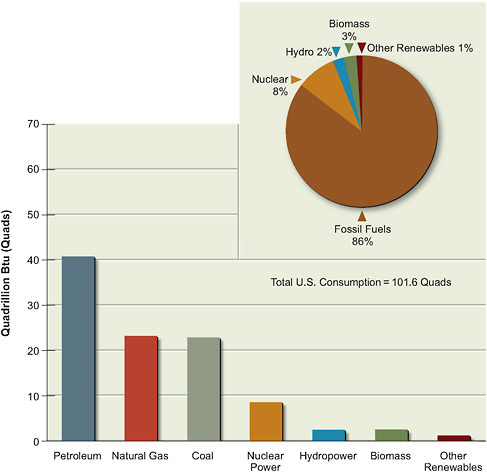
FIGURE 14.1 Energy consumption in the United States in 2007 by fuel source, in quadrillion Btu (bars) and as a percentage of total energy consumption (pie chart). Fossil fuels serve as the primary source of energy. SOURCE: NRC (2009d).
Hidden Costs of Energy: Unpriced Consequences of Energy Production and Use (NRC, 2009f) estimated that the damages associated with energy production and use in the United States totaled at least $120 billion in 2005, mostly through the health impacts of fossil fuel combustion (and not including damages associated with climate change or national security, which are very difficult to quantify in terms of specific monetary damages). While this is undoubtedly a small fraction of the benefits that energy brings, it reinforces the message that there are significant benefits associated with reducing the use of energy from fossil fuels.
As discussed above and in Chapter 6, limiting the magnitude of future climate change will require significant reductions in climate forcing, and GHGs emitted by the energy sector are the single largest contributor. Hence, many strategies to limit climate change typically focus on reducing GHG emissions from the energy sector. These strategies can be grouped into four major categories: (1) reductions in demand, typically through changes in behavior that reduce the demand for energy; (2) efficiency improvements, or reducing the amount of energy needed per unit of goods and services produced (also called energy intensity) through changes in systems, behaviors, or technologies; (3) development and deployment of energy systems that emit few GHGs or other climate forcing agents, or at least emit fewer GHGs per unit energy consumed than traditional fossil fuel-based technologies; and (4) direct capture of CO2 or other GHGs during or after fossil fuel combustion. These general strategies are discussed briefly in subsequent sections.
REDUCTIONS IN ENERGY DEMAND
The price mechanism can be an important part of any policy intended to reduce energy consumption. Prices encourage efficiency, discussed in the next section, but they can also change behavior. For example, if gasoline prices rise, whether from taxes or market forces, people who commute long distances may buy a more efficient vehicle or they may switch to public transportation or move closer to work. Nevertheless, the impact of prices on consumers and the economy are an important area for further research. It should be noted that prices are not the only feature involved in consumer choice, and the response to increased energy prices (the elasticity of demand) is often modest. There are many possible explanations for this: modest changes in price are not noticed, consumers cannot easily change some aspects of their consumption (for example, it is not always feasible to sell a car with low gas mileage to buy one with higher mileage when gas prices rise, at least in the short run), and there are many other factors that influence decisions that affect energy consumption and in some
circumstances may have more influence than prices (Carrico et al., 2010; Stern et al., in press; Wilson and Dowlatabadi, 2007).
ENERGY EFFICIENCY IMPROVEMENTS
Although energy intensity has declined in the United States over the past 30 years (EIA, 2009; NRC, 2009d), per capita consumption in the United States still exceeds that of almost all other developed countries. In addition, a considerable fraction of the intensity improvements in the United States may be due to the changing nature of demand (e.g., the shift away from manufacturing toward a service- and information-based economy) as well as increased imports of energy-intensive products and materials, which simply shift emissions to other locations. The recent report Real Prospects for Energy Efficiency in the United States (NRC, 2009c), part of the America’s Energy Future suite of activities, carried out a comprehensive review of methods to improve energy efficiency in industry, buildings, and transportation sectors. The report concludes that energy efficient technologies in those sectors exist today that could be implemented without major changes in lifestyles and could reduce energy use in the United States by 30 percent by 2030. The companion report Limiting the Magnitude of Future Climate Change (NRC, 2010c) also discusses energy efficiency at length.
The building sector offers the greatest potential for energy savings through efficiency; options range from simple approaches like insulation and caulking, to the use of more efficient appliances and lighting, to changing patterns of building use. Investments in these areas could reduce energy use in residences by one-third, although systematic estimates that take account of both technological and behavioral changes have not been made. For example, participation in programs that subsidize weatherization with identical financial incentives can differ by an order of magnitude depending on how the programs are presented to the public (Stern et al., 1986). Efficiency improvements can be made through the development and use of more efficient devices, with more efficient systems for managing devices, and with changing patterns of use—all of which require both technological innovation and a better understanding of human behavior and institutions.
While implementation of current technologies holds immediate opportunities for reducing energy use and GHG emissions, new technological and scientific advances are likely to yield longer-term benefits. For example, the development of new materials for insulation, new kinds of lighting, fundamental changes in heating and cooling systems, computational technologies for energy systems management, and landscape architecture and materials for natural cooling could all contribute to major improve-
ments in energy efficiency. As noted in Chapter 13, energy efficiency advances are also possible in the next decade in the transportation sector due to improved vehicle technologies and behavior changes. However, simply developing and making a new technology available is not sufficient to ensure its adoption; to be effective, research on all energy technologies, including efficiency technologies, needs to include analysis of the barriers to adoption of innovation and of public acceptance of new technology.
ENERGY SOURCES THAT REDUCE EMISSIONS OF GREENHOUSE GASES
Technologies that reduce the amount of GHGs emitted during the production of usable energy include renewable energy sources such as solar, wind, bioenergy, geothermal, hydropower, as well as nuclear power and carbon capture and storage (CCS) applied to fossil fuels or biomass. Even switching among fossil fuels can reduce carbon emissions per unit of energy produced. The America’s Energy Future study (NRC, 2009d) evaluated the near- and intermediate-term potential of each of these technologies and concluded that fossil fuels are likely to retain their dominant position in energy production over the next several decades; however, the study also identified numerous areas where investments in technologies and policy changes could hasten the transition to a low-GHG energy economy. Some of these areas are briefly summarized below, with an emphasis on the research needed to accelerate technology development and deployment.
Fuel Switching
Natural gas is the cleanest of the fossil fuels, with the lowest GHG emissions per unit of energy, emitting about half of the CO2 of coal when burned for electricity generation, as well as generally lower emissions of other pollutants. Shifting electric generation from coal to natural gas could significantly reduce emissions. Such a shift would be useful but would not by itself reduce emissions sufficiently for a low-emissions future to minimize climate change. Thus, natural gas is more likely to be a bridge than a final solution. Additionally, the feasibility of natural gas as a bridge fuel will depend on the stringency of any emissions-limiting policies that are adopted.
Until recently, resources of natural gas were thought too small to support a transition. Recent improvements in technology have made economic unconventional gas resources, such as shale, leading to higher resource estimates. If these estimates are confirmed, natural gas could be a long-term option. However, there is some concern that shale gas development may have negative impacts on the local freshwater
resources and land resources (DOE, 2009a). Another possible future source is natural gas hydrates found on the ocean floor, which are estimated to contain from one to a hundred times the world resource of conventional natural gas. Methods for recovery of hydrates are under investigation, but it is unlikely that hydrates would contribute significantly to the production of natural gas in the near term without major breakthroughs in the recovery process (NRC, 2010h).
Solar Energy
The total solar energy incident on the surface of the earth averages about 86,000 terawatts (TW), which is more than 5,000 times the 15 TW of energy currently used by humans (of which roughly 12 TW now comes from fossil fuels) and more than 100 times larger than the energy potential of the next largest renewable source, wind energy (Hermann, 2006). Hence, the potential resource of solar energy is essentially limitless, which has led many to conclude that it is the best energy resource to rely on in the long run. Currently, this resource is exploited on a limited scale—total installed worldwide solar energy production totaled 15 gigawatts (GW) in 2008,2 or just 0.1 percent of total energy production, with similar penetration in the United States (EIA, 2009). Solar energy can be used to generate electricity and heat water for domestic use. Passive solar heating can be used in direct heating and cooling of buildings.
There are two main classes of solar energy technology used to generate electricity: concentrating solar power (CSP) and photovoltaics (PVs). CSP technologies use optics (lenses or mirrors) to concentrate beam radiation, which is the portion of the solar radiation not scattered by the atmosphere. The radiation energy is converted to high-temperature heat that can be used to generate electricity or drive chemical reactions to produce fuels (syngas or hydrogen). CSP technologies require high-quality solar resources, and this restricts its application in the United States to the southwest part of the country. However, CSP technologies are commercially available and there are a number of upcoming projects in the United States, particularly in California. The CSP industry estimates 13.4 GW could be deployed for service by 2015 (WGA, 2006). In the short term, incremental design improvements will drive down costs and reduce uncertainty in performance predictions. With more systems installed, there will be increased economies of scale, both for plant sites and for manufacturing. However, new storage technologies, such as molten salt, will be needed in the longer term to make wide-
spread CSP deployment feasible. The global research community is studying the use of concentrated solar energy to produce fuels through high-temperature chemical processing (Fletcher, 2001; Perkins and Weimer, 2004, 2009; Steinfeld, 2005). At the international scale, the SolarPACES organization is working to further the development and deployment of CSP systems.3 This organization brings experts from member countries together to attempt to address technical issues associated with commercialization of these technologies.
While incremental improvements in CSP performance are anticipated, there is the potential for large improvements in PV electricity generation technologies. Over the past 30 years, the efficiency of PV technologies has steadily improved, though commercial modules achieve, on average, only about 10 to 15 percent efficiency (that is, only 10 to 15 percent of the solar energy incident on the cell is converted into electricity), which is 50 percent or less of the efficiency of the best research cells (NRC, 2009d). Most current PV generation is produced by technologies that rely on silicon wafers to convert photons to electrons (Green, 2003; Lewis, 2007). Recent shortages of polycrystalline silicon have increased prices for PV modules and spurred increases in the use of thin-film solar PV technologies that do not require as much or any silicon. Thin-film solar PV technologies have about a 40 percent market share in the United States (EIA, 2009). In the short term, research is continuing on PV technologies; most of the work on improving these cells has focused on identifying new materials, new device geometries (including thin films), and new manufacturing techniques (Ginley et al., 2008).
The overall costs of a PV system, not just the costs of PV cells, determine its competitiveness with other sources of electricity. For example, approximately 50 percent or more of the total installed cost of a rooftop PV system is not in the module cost but in the costs of installation, and of the inverter, cables, support structures, grid hookups, and other components. These costs must come down through innovative system-integration approaches, or this aspect of a PV system will set a floor on the price of a fully installed PV system. In the medium term, new technologies are being developed to make conventional solar cells by using nanocrystalline inks as well as semiconducting materials. Thin-film technologies have the potential for substantial cost reduction over current wafer-based crystalline silicon methods because of factors such as lower material use, fewer processing steps, and simpler manufacturing technology for large-area modules. Thin-film technologies have many advantages, such as high throughput and continuous production rate, lower-temperature and nonvacuum processes, and ease of film deposition. Even lower costs are possible with plastic organic solar
cells, dye-sensitized solar cells, nanotechnology-based solar cells, and other new PV technologies.
If next-generation solar technologies continue to improve and external costs associated with emissions from fossil fuel-based electricity are incorporated into the cost of electricity, it is possible that solar technologies could produce electricity at costs per kilowatt-hour competitive with fossil fuels. This transition could be accelerated through carefully designed subsidies for solar energy, as several other countries have done, or by placing a price on carbon emissions (Crabtree and Lewis, 2007; Green, 2005). Modifications to the energy distribution network along with energy storage would also improve the ability to exploit solar energy resources (see the section Energy Carriers, Transmission, and Distribution in this chapter). However, it should be noted that a bifurcated market for PV systems exists, depending on whether the system is installed on a customer’s premises (behind the meter) or as a utility-scale generation resource. Behind-the-meter systems compete by displacing customer-purchased electricity at retail rates, while utility-scale plants must compete against wholesale electricity prices. Thus, behind-the-meter systems can often absorb a higher overall system cost structure. In the United States, much of the development of solar has occurred in this behind-the-meter market (NRC, 2009d).
There are several potential adverse impacts associated with widespread deployment of solar technologies. Utility-scale solar electricity technologies would require considerable land area. When CSP is used with a conventional steam turbine, the water requirements are comparable to fossil fuel-fired plants, making water availability a concern and, in some cases, a limiting factor. For PV technology, there are also concerns associated with the availability of raw materials (particularly a few rare earth elements; NRC, 2008f) and with the potential that some manufacturing processes might produce toxic wastes. Finally, the energy payback time, which is a measure of how much time it takes for an energy technology to generate enough useful energy to offset energy consumed during its lifetime, is fairly long for silicon-based PV.
In addition to electricity generation, nonconcentrating solar thermal technologies can displace fossil fuels at the point of use, particularly in residential and commercial buildings. The most prevalent and well-developed applications are for heating swimming pools and potable water (in homes and laundries). Systems include one or more collectors (which capture the sun’s energy and convert it into usable heat), a distribution structure, and a thermal storage unit. The use of nonconcentrating solar thermal systems to provide space heating and cooling in residential and commercial buildings could provide a greater reduction of fossil fuels than do water heaters, but at present it is largely an untapped opportunity. Recently there has been limited deployment of
liquid-based solar collectors for radiant floor-heating systems and solar air heaters, but the challenge with these applications is the relatively large collector area required in the absence of storage. Solar cooling can be accomplished via absorption and desiccant cycles, but commercial systems are not widely available for residential use.
Wind Energy
Wind electricity generation is already a mature technology and approximately cost competitive in many areas of the country and the world, especially with electricity generated from natural gas. The installed capacity for electricity generated from wind at the end of 2009 was approximately 159 GW, or about 2 percent of worldwide energy usage (WWEA, 2010). Wind turbine size has been increasing as technology has developed, and offshore wind farms are being constructed and proposed worldwide. As with solar power, wind energy alone could theoretically meet the world’s energy needs (Archer and Jacobson, 2005), but a number of barriers prevent it from doing so, including dependence on location, intermittency, and efficiency. Other estimates of the resource base are not as large, but also indicate the United States has significant wind energy resources. Elliott et al. (1991) estimate that the total electrical energy potential for the continental U.S. wind resource in class 3 and higher wind-speed areas is 11 million GWh per year. As noted in NRC (2009d), this resource estimate is uncertain, however, and the actual wind resource could be higher due to the low altitude this estimate was developed at, or lower due to the inaccuracy of point estimates for assessing large-scale wind-power extractions (Roy et al., 2004). Assuming an estimated upper limit of 20 percent extraction from this base, an upper value for the extractable wind electric potential would be about 2.2 million GWh/yr, equal to more than half of the total electricity generated in 2007. This estimate does not incorporate the substantial offshore wind resource base. Development of offshore wind power plants has already begun in Europe, but progress has been slower in the United States. Though offshore wind power poses additional technical challenges, these challenges are being addressed by other countries. However, political, organizational, social, and economic obstacles may continue to inhibit investment in offshore wind power development in the United States, given the higher risk compared to onshore wind energy development (Williams and Zhang, 2008).
The key technological issues for wind power focus on continuing to develop better turbine components and to improve the integration of wind power into the electricity system, including operations and maintenance, evaluation, and forecasting. Goals appear relatively straightforward: taller towers, larger rotors, power electronics, reducing the weight of equipment at the top and cables coming from top to bottom, and
ongoing progress through the design and manufacturing learning curve (DOE, 2008a; Thresher et al., 2007). Basic research in materials and composites is expected to lead to improved and more efficient wind energy systems, for example by improving the efficiency of turbines for use in low-windspeed areas (DOE, 2009c). Research on materials reliability and stabilizing control systems could help reduce maintenance requirements and further enable wind machines to survive extreme weather events. Continued research on forecasting techniques, operational and system design, and optimal siting requirements would improve the integration of wind power into the electricity system. As with solar energy technologies, modifications to the electricity transmission and distribution system along with energy storage capacity would also improve the ability to exploit wind energy resources (see the section Energy Carriers, Transmission, and Distribution in this chapter).
Along with technology advances, research on policy and institutional factors affecting the widespread implementation of wind systems is needed, as well as continued assessment of the potential adverse impacts of wind energy systems—for example, past research has shown that adverse impacts on flying animals, especially birds and bats, can be reduced both with advanced turbine technologies and by considering migration corridors when siting wind farms (NRC, 2007e). Siting is also critical in order to reduce potential negative effects on the viewscape, effects on noise, and unintended consequences on local wind and perhaps weather patterns (Keith et al., 2004). Concerns with the adverse effects of wind farms have led to substantial public opposition on some areas (Firestone et al., 2009; Swofford and Slattery, 2010). Further research and analysis of these factors would help decision makers evaluate wind energy plans and weigh alternative land uses—for agriculture, transportation, urbanization, biodiversity conservation, recreation, and other uses—to maximize co-benefits and reduce unintended consequences.
Bioenergy
Bioenergy refers to liquid or solid fuels derived from biological sources and used for heat, electricity generation, or transportation. Electricity generation using biomass is much the same as that from fossil fuels; it generally involves a steam turbine cycle. The key difference is that typical output for a wood-based biomass power plant is about 50 MW, while conventional coal-fired plants generally produce anywhere from 100 to 1,500 MW (NRC, 2009a).
In the United States, interest in biomass for energy production is usually in the form of liquid transportation fuels. Such biofuels currently take several forms, including
biodiesel, the sugarcane-based ethanol systems used widely in Brazil, and the corn-based ethanol system that has been encouraged through subsidies in the United States. While the sugarcane system has an energy output that is more than five times greater than the energy input, corn ethanol has an energy output that on average is slightly greater than its input, and thus does not significantly reduce GHG emissions (Arunachalam and Fleischer, 2008; Farrel et al., 2006). Ongoing research into cellulosic feedstocks, algae-based fuels, and other next-generation biofuel sources could lead to more favorable bioenergy effects and economics. Other areas of research include improving the productivity of current bioenergy crops through genetic engineering (Carroll and Sommerville, 2009), reducing the environmental impact of bioenergy crops by growing native species on marginal lands (McLaughlin et al., 2002; Schmer et al., 2008), and developing biofuels that can be used within the current, petroleum-based fuel infrastructure (NRC, 2009b).
Many different disciplines are contributing to the development of new bioenergy strategies, including biochemistry, bioenergetics, genomics, and biomimetics research. For example, research in plant biology, metabolism, and enzymatic properties will support the development of new forms of biofuel crops that could potentially have high yields, drought resistance, improved nutrient use efficiency, and tissue chemistry that enhances fuel production and carbon sequestration potential. Significant research is also being directed toward strategies for cellulose treatment, sugar transport, and the use of microbes to break down different types of complex biomass, as well as on advanced biorefineries that can produce biofuels, biopower, and commercial chemical products. Many developments in biofuels have been recently summarized (see DOE, 2009c; NRC, 2008a, 2009b).
Widescale development of bioenergy crops could have significant unintended negative consequences if not managed carefully. Conversion of solar energy to chemical energy by ecosystems is typically less than 0.5 percent efficient, yielding less than 1 W/m2, so relatively large land areas would be required for biomass to be a major source of energy (Larson, 2007; Miyamoto, 1997; NRC, 1980a). If the land required to grow bioenergy crops comes from deforesting or converting natural lands, there could be a net increase in GHG emissions as well as losses of biodiversity and ecosystem services. If grown on marginal lands, increased emissions of N2O, a potent GHG, may result as a side effect of nitrogen fertilizer use (Wise et al., 2009b). If bioenergy crops are grown on existing agricultural areas, food prices and food security could be compromised (Crutzen et al., 2008; Searchinger et al., 2008). Production of bioenergy crops also has the potential to negatively impact water quality and availability for other uses (NRC, 2008i), and methods are needed to more fully assess their potential impacts on ecosystem services (Daily and Matson, 2008). The recent report Liquid Transportation
Fuels from Coal and Biomass (NRC, 2009b) contains a more detailed discussion of the potential environmental and ecosystem impacts and provides recommendations for sustainable methods for increased bioenergy use. Focused interdisciplinary research efforts are needed to develop such methods and more fully assess the full spectrum of possible benefits and side effects associated with different bioenergy production strategies.
Geothermal Energy
There are three components to the geothermal resource base: (1) geothermal heating and cooling, or direct heating and cooling by surface or near-surface geothermal energy; (2) hydrothermal systems involving the production of electricity using hot water or steam accessible within approximately 3 km of Earth’s surface; and (3) enhanced geothermal systems (EGS) using hydraulic stimulation to mine the heat stored in low-permeability rocks at depths down to 10 km and use it to generate electricity. Currently, geothermal heating provides approximately 28 GW of energy (mainly for heating and industrial applications). For example, municipalities and smaller communities provide district heating by circulating the hot water from aquifers through a distribution pipeline to the points of use. The barriers to increased penetration of direct geothermal heating and cooling systems are not technical, but with the high initial investment costs and the challenges associated with developing appropriate sites. The resource for direct heating is richest in the western states, and geothermal heat pumps have extended the use of geothermal energy into traditionally nongeothermal areas of the United States, mainly the Midwestern and eastern states. A geothermal heat pump draws heat from the ground, groundwater, or surface water and discharges heat back to those media instead of into the air. The electric heat pump is standard off-the-shelf equipment available for installation in residences and commercial establishments. There are no major technical barriers to greater deployment. The United States currently has 700,000 installed units and the rate of installation is estimated to be 10,000 to 50,000 units per year (NRC, 2009d). One barrier to growth is the lack of sufficient infrastructure (i.e., trained designers and installers) and another is the high initial investment cost compared to conventional space-conditioning equipment.
In terms of electricity generation, hydrothermal systems are mature systems relying on conventional power-generating technologies. Technology is not a major barrier to developing conventional hydrothermal resources, but improvements in drilling and power conversion technologies could result in cost reductions and greater reliability. There is some potential for expanding electricity production from hydrothermal resources and thus providing additional regional electricity generation. For example,
a study of known hydrothermal resources in the western states found that 13 GW of electric power capacity exists in identified resources within this region (WGA, 2006). However, in general the potential for major expansion of electricity produced from hydrothermal resources in the United States is relatively small and concentrated in the western states.
Enhanced geothermal systems represent the much larger resource base—the theoretical potential EGS resource below the continental United States is over 130,000 times the total 2005 U.S. energy consumption (MIT, 2006). Though this resource is vast, it exists at great depths and low fluxes. Accessing the stored thermal energy would first require stimulating the hot rock by drilling a well to reach the hot rock, and then using high-pressure water to create a fractured rock region. Drilling injection and production wells into the fractured region would follow next, and the stored heat would then be extracted, using water circulating in the injection well. The heat extraction rate would depend on the site. EGS reservoirs can cool significantly during heat-mining operations, reducing extraction efficiency with time and requiring periodic redrilling, fracturing, and hydraulic stimulation. Even so, the MIT report assumes that the individual reservoirs would only last around 20 to 30 years. Other challenges include a general lack of experience in drilling to depths approaching 10 km, concerns with induced seismicity, the need to enhance heat transfer performance for lower-temperature fluids in power production, and improving reservoir-stimulation techniques so that sufficient connectivity within the fractured rock can be achieved. Further research and demonstration projects will thus be needed before EGS is deployed on large scales.
Hydropower
Technologies for converting energy from water to electricity include conventional hydroelectric technologies and emerging hydrokinetic technologies that can convert ocean tidal currents, wave energy, and thermal gradients into electricity. Conventional hydroelectricity or hydropower, the largest source of renewable electricity, comes from capturing the energy from freshwater rivers and converting it to electricity. Hydroelectric power supplies about 715,000 megawatts (MW), or 19 percent, of world electricity. In the United States, conventional hydropower provides approximately 7 percent of the nation’s energy (USGS, 2009). Hydropower is regionally important, providing about 70 percent of the energy used in the Pacific Northwest (PNWA, 2009).
Since this resource has been extensively exploited, most prime sites are no longer available. Furthermore, there is increasing recognition of negative ecosystem conse-
quences from hydropower development. Future hydropower technological developments will relate to increasing the efficiency of existing facilities and mitigating the dams’ negative consequences, especially on anadromous fish. Existing hydropower capacity could be expanded by increasing capacity at existing sites; installing electricity-generating capabilities at flood-control, irrigation, or water supply reservoirs; and developing new hydropower sites (EPRI, 2007a). Turbines at existing sites also could be upgraded to increase generation. None of these strategies require new technologies.
Because use of the conventional hydroelectric resource is generally accepted to be near the resource base’s maximum capacity in the United States, further growth will largely depend on nonconventional hydropower resources such as low-head power4 and on microhydroelectric generation.5 A 2004 Department of Energy (DOE) study of total U.S. water-flow-based energy resources, with emphasis on low-head/low-power resources, indicated that the total U.S. domestic hydropower resource capacity was 170 GW of electric power (DOE, 2004). However, these numbers represent only the identified resource base that was undeveloped and was not excluded from development. A subsequent study assessed this identified resource base for feasibility of development (DOE, 2006). After taking into consideration local land use policies, local environmental concerns, site accessibility, and development criteria, this value was reduced to 30 GW of potential hydroelectric capacity (DOE, 2006). A report from the Electric Power Research Institute (EPRI) determined that 10 GW of additional hydroelectric resource capacity could be developed by 2025 (EPRI, 2007). Of the 10 GW of potential capacity, 2.3 GW would result from capacity gains at existing hydroelectric facilities, 2.7 GW would come from small and low-power conventional hydropower facilities, and 5 GW would come from new hydropower generation at existing non-powered dams.
New technologies to generate electricity from ocean water power include those that can harness energy from currents, ocean waves, and salinity and thermal gradients. There are many pilot-scale projects demonstrating technologies tapping these sources, but only a few commercial-scale power operations worldwide at particularly favorable locations. In general, there is no single technological design for converting energy in waves, tides, and currents into electricity. For example, approaches for tapping wave energy include floating and submerged designs that tap the energy in the impacting wave directly or that use the hydraulic gradient between the top and bottom of a wave (MMS, 2006). One such device concentrates waves and allows them
to overtop into a reservoir, generating electricity as the water in the reservoir drains out through a turbine. Other approaches include long multisegmented floating structures that use the differing heights to drive a hydraulic pump that runs a generator or subsurface buoys that generate electricity through their up-down motion. Over the next 10 years, many large-scale demonstration projects will be completed to help assess the capabilities of these technologies, though it will take at least 10 to 25 years to know whether these technologies are viable for the production of significant amounts of electricity (NRC, 2009d). Over the longer term, other significant potential technologies that use ocean thermal and salinity gradients to generate electricity may also be investigated. However, these technologies currently only exist as conceptual designs, laboratory experimentation, and field trials. In general, even though waves, currents, and gradients contain substantive amounts of energy resources, there are significant technological and cost issues to address before such sources can contribute significantly to electricity generation. Storms and other metrological events also pose significant issues for hydrokinetic technologies.
Nuclear Power
Nuclear power is an established technology that could meet a significant portion of the world’s energy needs. France obtains roughly 78 percent of its electricity from nuclear sources and Japan obtains 27 percent (EIA, 2007). About 20 percent of U.S. electricity comes from nuclear reactors, by far the largest source of GHG-free energy (EIA, 2009).6 The reliability of U.S. reactors has increased dramatically over the past several decades, but no nuclear power plants had been ordered for over 30 years, largely because of high costs, uncertain markets, and public opposition. Improved availability and upgrades have kept nuclear power’s share of generation constant at 20 percent despite the growth of other generation technologies. A nuclear revival has been initiated recently, largely because of concerns over limiting the magnitude of climate change. The U.S. government is providing loan guarantees for the first set of plants now being planned to compensate for uncertainties in costs and regulation. If these plants are successful in coming online at reasonable cost, their numbers could grow rapidly.
While nuclear power does not emit GHGs, there are other serious concerns associated with its production, including radioactive wastes (especially long-term storage of certain isotopes), safety, and security concerns related to the proliferation of nuclear
weapons (MIT, 2003). The absence of a policy solution for the disposal of long-lived nuclear wastes, while not technically an impediment to the expansion of nuclear power, is still a concern for decision makers. New reactor construction has been barred in 13 U.S. states as a result, although several of these states are reconsidering their bans. Safety concerns stem from the potential for radioactive releases from the reactor core or spent fuel pool following an accident or terrorist attack. Nuclear reactors include extensive safeguards against such releases, and the probability of one happening appears to be very low. Nevertheless, the possibility cannot be ruled out, and such concerns are important factors in public acceptance of nuclear power. Proliferation of nuclear weapons is a related concern, but after 40 years of debate, there is no consensus as to whether U.S. nuclear power in any way contributes to potential weapons proliferation. A critical question is whether there are multilateral approaches that can successfully decouple nuclear power from nuclear weapons (Socolow and Glaser, 2009). Finally, public opinion is less skeptical of nuclear power in the abstract than it once was, but a majority of Americans oppose the location of nuclear (and coal or natural gas) power plants near them (Ansolabere and Konisky, 2009; Rosa, 2007). Some evidence suggests that the lack of support for nuclear power is based in part on a lack of trust in the nuclear industry and federal regulators (Whitfield et al., 2009).
Current U.S. nuclear power plants were built with technology developed in the 1960s and 1970s. In the intervening decades, ways to make better use of existing plants have been developed, along with new technologies that improve safety and security, decrease costs, and reduce the amount of generated waste—especially high-level waste. These technological innovations include improvements or modification of existing plants, alternative new plant designs (e.g., thermal neutron reactor and fast neutron reactor designs), and the use of alternative (closed) nuclear fuel cycles. The new technologies under development may allay some of the concerns noted above, but it will be necessary to determine the functionality, safety, and economics of those technologies through demonstration and testing.
Finally, research on nuclear fusion has been funded at several hundred million dollars per year since the 1970s. Fusion promises essentially unlimited, non-GHG energy, but harnessing it has proved to be extremely difficult. Most research addresses magnetic confinement (e.g., Tokamak reactors), but laser fusion (inertial confinement) also has promise. While fusion research and development is still worthwhile, it is uncertain whether a workable, cost-effective, power-producing reactor can be developed.
CARBON DIOXIDE REMOVAL APPROACHES
Fossil fuel sources are likely to remain an important part of the U.S energy system for the near future (NRC, 2009d), in part because of their abundance and the legacy of infrastructure investments. Hence, it makes sense to consider options for capturing the GHGs emitted during or after fossil fuel combustion. Virtually all of these approaches have focused on removing CO2, as it is by far the most abundant GHG contributing to human-caused global warming. While there have been pilot projects and small commercial-scale projects to demonstrate the feasibility of some of these approaches, for the most part they remain in the research stage, and many involve important legal, practical, and governance concerns, as well as further technical research. Additional details about these approaches can be found in the companion report Limiting the Magnitude of Future Climate Change (NRC, 2010c).
Carbon Capture and Storage
Approaches for capturing the CO2 released from coal- and gas-fired power plants and compressing and storing it underground (either in geological formations or via mineralization) are an important subject of research. While many of the component processes needed for this form of CCS are already used—for example, CO2 injection is often used to improve yield or extend the lifetime of oil fields—there is currently only one demonstration CCS facility integrated with electrical power production in the United States,7 and there are only a handful worldwide. As a result, many questions remain about the technological feasibility, economic efficiency, and social and environmental impacts of this approach.
Much of the needed research to support further development and, if proven feasible, widespread deployment of CCS has been outlined by the Intergovernmental Panel on Climate Change (IPCC, 2005). Research on the storage component focuses on the assessment of potential geologic reservoirs where CO2 could be stored safely for long amounts of time, on the efficacy of carbon adsorption in geologic formations, and on monitoring techniques that would allow tracking of CO2 once underground. Research on carbon capture focuses on improved methods for separating CO2 from power plant waste, including analysis and development of approaches to feasibly (both
technologically and economically) retrofit existing plants with new technology. In addition, research is needed on environmental and social impacts of CCS (for example, its potential impacts on freshwater resources) and on the issues of adoption of new technology and public resistance to technologies that are perceived to be hazardous, all of which are critical to sound decision making about CCS.
The America’s Energy Future committee highlighted the need for technical, cost, risk, environmental impact, legal, and other data to assess the viability of CCS in conjunction with fossil fuel-based power generation. It judged that the period between now and 2020 could be sufficient for acquiring the needed information, primarily through the construction and operation of full-scale demonstration facilities (NRC, 2009d).
Direct Air Capture
While conventional CCS is an attractive option for centralized power stations, there may be opportunities for other CCS technologies that may be more economic or environmentally preferable in certain situations (e.g., Rau et al., 2007) or could be used to remove CO2 released by many small sources (e.g., Lackner et al., 1999). There have been many initial forays into the possibility of capturing GHGs directly from the atmosphere via technological means, but research in this area is generally only in preliminary stages. The only strategy for direct air capture that has emerged thus far involves physical or chemical absorption from airflow passing over some recyclable sorbent such as sodium hydroxide. A few research groups are developing and evaluating prototypes of such systems (Rau, 2009; Stolaroff et al., 2006). Major challenges remain in making such systems viable in terms of cost, energy requirements, and scalability. Direct capture approaches must also deal with the same challenges of long-term storage of the captured CO2 as conventional CCS.
Other proposed approaches to direct capture from air involve fertilizing the ocean or modifying agricultural or ecosystem management practices (see Chapters 9 and 10). Further details and discussion about direct air capture approaches can be found in the companion report Limiting the Magnitude of Future Climate Change (NRC, 2010c). As noted in Chapter 15, sometimes direct air capture approaches are grouped together with solar radiation management approaches under the rubric of geoengineering (e.g., The Royal Society, 2009).
ENERGY CARRIERS, TRANSMISSION, AND STORAGE
Fossil fuels have come to dominate our energy system because they are dense energy sources that can be transformed into easily transportable and storable fuels and have historically been readily available at relatively low market prices. Moving to an energy system that produces fewer GHG emissions will require examination of issues involving integrating intermittent renewable energy sources from remote sites, smarter transmission and distribution grids, storage, and flexible/manageable loads, among others. As the America’s Energy Future committee noted, the U.S. electricity transmission and distribution system is in urgent need of modernization to meet growing demand and to accommodate ever-larger amounts of intermittent sources of energy, especially wind and solar power. Moreover, many of the best areas for wind and solar generation are far from centers of energy demand and, on the other end, there is likely to be an increased need for accommodating distributed generation and two-way metering (e.g., for homes with PV panels). Finally, many of the renewable technologies discussed above have higher direct land use requirements than fossil fuels. These land use impacts have led to (and will presumably continue to generate) instances of local opposition to the siting of renewable electricity-generating facilities and associated transmissions lines.
Improvements in energy transmission efficiency and “intelligence” are needed for these resources to most effectively meet energy needs. Linking together many stable, intermittent, and distributed resources as well as grid-based storage in an extensive “smart” grid is needed to smooth out the fluctuations experienced at individual installations and improve the overall efficiency of transmission (Arunachalam and Fleischer, 2008). Grid intelligence involves extensive use of advanced measurement, communications, and monitoring devices together with decision-support tools. Taken together, the elements of a smart grid would also increase grid resilience, reducing the risk of widespread collapse following a local disruption or damage from natural events (such as storms and flooding) as well as physical and cyber attacks. Improved two-way information flows form the foundation of new ways for consumers to understand and control their electricity consumption (Denholm et al., 2010).
Improving energy storage technology and finding new ways to store energy is critical for addressing the intermittency of many renewable energy sources. Storage in compressed air systems has been under development, as well as improved battery technologies, focusing on improvements in storage capacity, charge time, power output, and cost. For further discussion of the role of storage, see Denholm et al. (2010).
SCIENCE TO SUPPORT TECHNOLOGY DEPLOYMENT
Substantial reductions in CO2 emissions from the energy sector will require integrated deployment of multiple technologies: energy efficiency, renewables, coal and natural gas with CCS, and nuclear. Widespread deployment is expected to take on the order of years to decades. Such system-level implementation and integration require not only technology research and development but also research on potential hidden costs of implementation, the barriers to deployment, and the infrastructure and institutions that are needed to support implementation. All technologies have multiple impacts that require analysis and trade-offs in making choices among them. For example, impacts associated with the manufacturing and ultimate disposal of technologies can be substantial, even in comparison to the impacts of the operation of the technology. Life-cycle analysis and other analytical approaches (discussed in Chapter 4) can help identify the full set of impacts associated with a technology and thus can be an important tool for technology-related decision making.
Research is also needed to understand and address barriers to implementation. A full discussion of the strategies for, and barriers of, deployment of the technologies outlined above is beyond the scope of this chapter; however, Tables 14.1 and 14.2 provide a summary of issues as outlined by the U.S. Climate Change Technology Program. Analyses and approaches that identify and address these issues will be critical to implementation strategies (see America’s Energy Future [NRC, 2009a,b,c,d] and Limiting the Magnitude of Future Climate Change [NRC, 2010b]). Finally, for some deployment challenges, full-scale demonstrations are critical precursors to implementation. America’s Energy Future (NRC, 2009d) identified two kinds of demonstrations that should be carried out in the next decade: assessing the viability of CCS for sequestering CO2 from coal and natural gas-fired electricity generation, and demonstrating the commercial viability of evolutionary nuclear plants in the United States. Such demonstration projects can provide research testbeds for understanding and evaluating the full suite of issues related to implementation.
LIKELY IMPACTS OF CLIMATE CHANGE ON ENERGY SYSTEM OPERATIONS
In addition to producing climate-forcing agents, the U.S. energy sector itself is expected to be affected by climate change and will need to adapt to the accompanying changes. Research on the possible impacts on energy system operations is still in its infancy; therefore, the examples noted below are merely illustrative of the ways climate change could affect energy systems (see the companion report Adapting to the Impacts of Climate Change [NRC, 2010a]).
TABLE 14.1 Summary of Activities for Deploying New Energy Technologies and Strategies
|
Coalitions & partnerships |
International cooperation |
Market conditioning, including government procurement |
Technology demonstration |
Codes and standards |
Legislative act of regulation |
Risk mitigation |
|
24 |
15 |
16 |
12 |
10 |
7 |
1 |
|
22 |
15 |
20 |
5 |
14 |
5 |
3 |
|
28 |
13 |
4 |
6 |
2 |
1 |
2 |
|
11 |
12 |
4 |
6 |
1 |
3 |
1 |
|
8 |
14 |
5 |
6 |
2 |
1 |
1 |
|
2 |
5 |
3 |
4 |
3 |
0 |
1 |
|
19 |
19 |
18 |
11 |
7 |
7 |
2 |
|
3 |
7 |
2 |
2 |
0 |
0 |
2 |
|
4 |
6 |
2 |
4 |
0 |
0 |
1 |
|
4 |
7 |
2 |
3 |
1 |
1 |
1 |
|
7 |
8 |
5 |
2 |
0 |
0 |
1 |
|
7 |
9 |
1 |
1 |
0 |
2 |
1 |
|
1 |
6 |
1 |
0 |
0 |
0 |
2 |
|
15 |
6 |
1 |
0 |
2 |
0 |
1 |
|
10 |
7 |
2 |
3 |
6 |
5 |
1 |
|
165 |
149 |
86 |
65 |
48 |
32 |
21 |
TABLE 14.2 Summary of Major Barriers to Deployment of New Energy Technologies

-
Increases in energy demands for cooling and decreases in energy demands for heating can be expected across most parts of the country. These changes could drive up peak electricity demands, and thus capacity needs, but could also reduce the use of heating oil and natural gas in winter.
-
Even as electricity demand increases in many regions, climate change may affect energy production. For example,
-
Water availability for cooling is a critical resource at thermal electric power plants (e.g., gas, coal, oil, CSP, bioenergy, and nuclear plants). Water limitations in parts of the country, and increased demand for water for other uses, may result in less water for use in energy production.
-
Increased water temperatures may reduce the cooling capacity of available water resources.
-
Water flows at hydropower sites may increase in some areas and decrease in others.
-
-
Changes in river flows and sea levels may affect ship and barge transportation of coal, oil, and natural gas (as well as hydrokinetic energy sources).
-
Changes in circulation and weather patterns may change the efficiency of electricity generation by solar and wind farms. For example, increased cloudiness could reduce solar energy production, and wind energy production could be reduced if wind speeds increase above or fall below the acceptable operating range of the technology. Not all of the possible impacts on intermittent renewable energy sources are well understood.
-
Large-scale deployment of bioenergy may cause large new stresses on water supplies for growing the biofuel crops and processing them into usable liquid, gaseous, or solid fuels.
-
Changes in the severity and frequency of extreme weather events—including hurricanes, floods, droughts, and ice storms—may disrupt a wide range of energy system operations, including thermal power plants, transmission lines, oil and gas platforms, ports, refineries, wind farms, and solar installations. Changes in sea levels (together with subsidence) could also threaten coastal energy system operations.
As with the other impacts of climate change discussed in this report, most of these impacts on energy production and use will be highly variable and place-dependent.
SCIENCE TO SUPPORT ADAPTING TO CLIMATE CHANGE
Potential actions to help the energy sector adapt to the effects of climate change include increasing electric power generating capacity, accounting for changing patterns
of demand (summer-winter, north-south); increasing the energy efficiency of heating and cooling technologies; hardening infrastructures to withstand increased floods, wind, lightning, and other storm-related stressors; developing electric power generation strategies that use less water; instituting contingency planning for reduced hydropower generation; and increasing resilience of fuel and electricity delivery systems and of energy storage capacity. For more details, see the companion report Adapting to the Impacts of Climate Change (NRC, 2010a).
RESEARCH NEEDS
The remainder of this chapter focuses on what we still need to know—what we need research to tell us—in order to optimize strategies to both reduce emissions and adapt to climate changes in energy supply and use.
Develop new energy technologies and implementation strategies. Numerous scientific and engineering disciplines will need to contribute to the development of energy technology options and their effective implementation. Some key areas include materials science, electrochemistry and catalysis, biological sciences, and social and behavioral sciences. For example, materials science research could lead to advanced materials that could increase efficiency and offer other improvements in energy use, while research into photochemistry could provide the basis for engineering systems that mimic photosynthesis at higher efficiencies and rates. Technology assessment and portfolio analysis methods based on sequential decision making and risk-management paradigms need to be improved to help better set research priorities. Environmental, behavioral, and institutional analyses are essential to address obstacles and avoid unintended negative consequences. Of particular importance will be assessments of economic and technical performance of new technologies as well as full life-cycle environmental impacts.
Develop improved understanding of behavioral impediments to adopting new technologies, at both individual and institutional levels. New methods and increased research efforts are needed to develop understanding of the determinants of consumer choice and institutional decision making. Factors such as market failures and hidden costs could have important consequences on energy use and adoption of new energy technologies. Understanding possible impediments, and developing behavioral and policy interventions that circumvent them at both the individual and institutional level, are critical to rapid adjustments in energy consumption
Research on development of analytical frameworks for evaluating trade-offs and avoiding unintended consequences. Analytical frameworks are needed for evaluat-
ing trade-offs and synergies among efforts to limit the magnitude of climate change and efforts to adapt to climate change. There are many possible co-benefits associated with some of the technologies and strategies discussed in this chapter and the companion reports (NRC, 2010a,c). For example, along with the benefits of reducing GHG emissions and climate change, use of almost every energy efficiency or lower-emissions energy alternative will yield co-benefits in terms of reduced air pollution and associated health impacts. Some approaches may also yield co-benefits through increasing national energy security or conserving water resources. On the other hand, negative effects or interactions are also possible. For example, energy efficiency programs could disadvantage the poor or marginalized communities if they are not carefully included, and biofuels programs or large-scale deployment of other renewable energy sources could lead to food insecurity, loss of biological diversity, competition for land and water resources, and other impacts. It is also possible that carbon pricing could disproportionately affect the poor. Further research is needed on the interactions between the broad range of such benefits and consequences.
Develop new integrated approaches that evaluate energy supply and use within a systems context and in relation to climate change and other societal concerns. To date, scientists from many disciplines have investigated and developed some understanding of new energy technologies and strategies, individual and institutional choices related to energy consumption and adoption of new technologies, and the benefits and unintended consequences of limiting and adaptation policies. As described in the previous three research needs, further research is still needed to advance our understanding of all these areas. It is critical that such research is not conducted in an isolated manner but rather using integrated approaches and analyses that investigate energy supply and use within the greater context of efforts to achieve sustainable development goals and other societal concerns.


