
Summary
Global climate change is a significant long-term challenge for the United States. Across the nation, individuals, businesses, and federal, state, and local governments are already consciously making decisions to respond to climate change. To make informed decisions, people need a basic understanding of the causes, likelihood, and severity of the impacts of climate change and the range, cost, and efficacy of different options to limit or adapt to it.
Individuals are choosing whether to make their homes and transportation more energy efficient, or support climate and energy policies. Private companies are reducing their carbon footprints, and some are planning for climate impacts. Humanitarian and environmental non-governmental organizations (NGO’s) are deciding how to guide their members and respond to climate change. Resource managers are deciding how to manage water, forests, and coastal ecosystems to reduce the risks of climate change. Cities and states are starting to limit emissions and develop adaptation plans—today, more than 50 percent of Americans live in a jurisdiction that has enacted a greenhouse gas emissions (GHG) reduction goal.
This growing number of people and organizations responding to climate change has not only increased the demand for information but also provides the basis for an effective national capacity to respond to climate change. These efforts can be thought of as a set of policy experiments which can inform future action by other federal and non-federal actors. Three key lessons are drawn from these experiences:
-
A broad range of tailored information and tools is needed for the diversity of decision makers and to engage new constituencies.
-
Most decision makers will need to make climate choices in the context of other responsibilities, competing priorities, and resource constraints.
-
There is a critical need to coordinate a national response that builds on existing efforts, learns from successes and failures, reduces burdens on any one region or sector, and ensures the credibility and comprehensiveness of information and policy.
The Panel on Informing Effective Decisions and Actions Related to Climate Change, a part of the congressionally requested study on America’s Climate Choices (ACC), was charged to describe and assess climate change-related activities, decisions, and actions at various levels and in different sectors and to examine the available decision
frameworks and tools to inform these decisions and actions. The panel focused this charge by asking the following questions:
-
Who is making decisions and taking action on climate change in the United States? What are their needs for information and decision support, and what are the barriers to good decisions?
-
What decision making frameworks and methods are being used, and which are the most effective?
-
How might climate and greenhouse gas information systems and services support more effective decisions and actions?
-
What is known about the most effective ways to communicate about climate change, especially with the public and through formal and informal education?
The panel coordinated with the other ACC panels and notes that many of the findings of the companion reports are consistent with the independent findings of our panel. For example, the reports Limiting the Magnitude of Future Climate Change (NRC, 2010d) and Adapting to the Impacts of Climate Change (NRC, 2010a) highlight the importance and leadership of local and state governments and the private sector in reducing GHG emissions and adapting to climate impacts. The reports Advancing the Science of Climate Change (NRC, 2010b) and Adapting to the Impacts of Climate Change (NRC, 2010a) recommend a risk management approach to respond to climate change. Collectively, these reports conclude that there is strong, credible, scientific evidence that climate change is happening and is caused largely by human activities, and provide a number of options to limit emissions and adapt to the impacts.
An effective national response to climate change will require informed decision making based on reliable, understandable, and timely climate-related information tailored to user needs. For example, state and local authorities need improved information and tools to plan to both reduce emissions and adapt to the impacts of climate change, and a better understanding of how the public views climate change. Private firms who plan to disclose climate risks need standardized methods of reporting and better information about how climate impacts, policy, and consumer concerns are changing. Educators and organizations seeking to communicate about climate change need more accessible and reliable information about climate, guidelines for effective communication, and information about helpful networks.
Good information systems and services are essential to effectively and iteratively manage climate risks. They help decision makers evaluate whether particular policies and actions are achieving their goals or should be modified and underpin the effective communication of climate change choices to Congress, students, and the public.
Transparency, accountability, and fairness in the measurement, reporting, and verification of data on climate change, risks and vulnerabilities, sources of GHG emissions, and climate policy is a priority.
Although the findings and recommendations of this report are mainly directed at the federal government—especially the federal role in the design of information systems and services to support and evaluate responses to climate change—it is also relevant to decision makers in state, local, and tribal governments, and in the private and non-governmental sectors who are making decisions about climate change.
COORDINATE A COMPREHENSIVE, NATIONWIDE RESPONSE TO CLIMATE CHANGE
Today, decisions and actions related to climate change are being informed by a loose confederation of networks and other institutions created to help guide climate choices (Figure S.1). In the panel’s judgment, the federal government has the responsibility and opportunity to lead and coordinate the response to climate change, not only to protect the nation’s national security, resources, and health, but also to provide a policy framework that promotes effective responses at all levels of American society. Although actions taken to date offer many lessons, a patchwork of regional, state, and local policies has emerged, prompting some state and business leaders to call for the development of a more predictable and coherent policy environment at the federal level. Federal policy can benefit from comprehensive information about the actual effectiveness of emission reduction and adaptation actions across the nation. A clearinghouse could provide careful reporting and verification of what climate-related decisions are being implemented.
Even the federal response is difficult to evaluate because the number of agencies beginning to respond to climate change has expanded far beyond the core research functions of the U.S. Global Change Research Program (USGCRP)—for example, to agencies with responsibility for infrastructure, security, and housing—and because of the lack of clear, accessible, and coordinated information on federal responsibilities and policies. Many federal agencies have not yet incorporated or “mainstreamed” climate change into their own agency planning processes. Effective and visible incorporation of climate concerns as central to the ongoing activities of the federal agencies would be a major step forward. This explicit demonstration of leadership could help galvanize and maintain the development of responses in the private sector, states, regions, and localities. The panel concludes that there is an urgent need to improve the coordination of climate information, decisions, assessment, and programs across federal agencies to ensure an effective response to climate change across the nation.
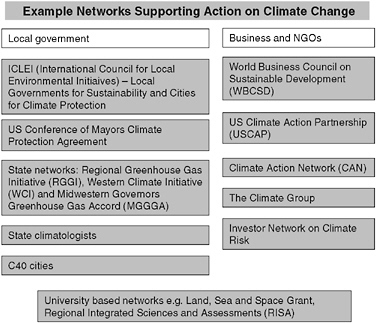
FIGURE S.1 Example networks supporting action on climate change.
Recommendation 1:
To improve the response to climate change, the federal government should
-
Improve federal coordination and policy evaluation by establishing clear clear leadership, responsibilities, and coordination at the federal level for climate-related decisions, information systems, and services. information systems, and services.
The roadmap for federal coordination might include leadership and action through executive orders, the Office of Science and Technology Policy, an expanded USGCRP, a new Council on Climate Change, the reorganization of existing agencies, or even the establishment of new organizations, regional centers, or departments within the government.
-
Establish information and reporting systems that allow for regular evaluation and assessment of the effectiveness of both government and non-gov-
-
ernmental responses to climate change, including a regular report to Congress or the President as suggested in our companion reports.
This could include aggregating and disseminating “best practices” with a web-based clearinghouse and creating ongoing assessments to enable regular exchange of information and plans among relevant federal agencies, regional researchers, decision makers, NGOs, and concerned citizens.
Recommendation 2:
To maximize the effectiveness of responses to climate change across the nation, the federal government should
-
Assess, evaluate, and learn from the different approaches to climate-related decision making used by non-federal levels of government and the private sector;
-
Enhance non-federal activities that have proven effective in reducing greenhouse gas emissions and adapting to the projected impacts of climate change through incentives, policy frameworks, and information systems; and
-
Ensure that proposed federal policies do not unnecessarily preempt effective measures that have already been taken by states, regions, and the private sector.
The potential of the aggregated emission reductions from non-federal actors is considerable and, if successful, would ease the task and lower the costs for the federal government. The federal government can enhance and complement these responses through carefully designed integrative policies; however, there is also a risk that federal action could preempt or discourage decisions by other actors, and miss opportunities to credit those non-federal actors who have taken early action.
ADOPT AN ITERATIVE RISK MANAGEMENT APPROACH TO CLIMATE CHANGE
Many climate-related decisions must address and incorporate uncertainty, the expectation of surprises, and factors that underlie the need to improve long-term decision making and crisis responses. Decision makers will differ in their assessment of the degree of risk that is unacceptable. These are not issues that are unique to climate choices. Decision makers in government and the private sector, as well as individuals, frequently make decisions with only partial or uncertain information and update
these decisions as conditions change or more information becomes available. These include decisions with long-term implications such as saving for retirement, buying insurance, investing in infrastructure, or launching new products. The range of possibilities depends on future conditions and shifts such as a recession or technology breakthrough and the availability of information. Most people recognize the need to act despite uncertainty and that it is impossible to eliminate all risk. Effective management can benefit from a systematic and iterative framework for decision making (see Figure S.2).
Examples of the effective use of iterative risk management for climate choices discussed in this report include the UK Climate Impacts Programme, the NYC and Chicago Adaptation Plans, Tulsa flood management, Swiss Re insurance, the National Ad-
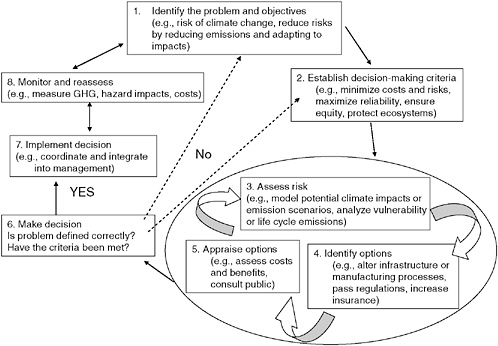
FIGURE S.2 An iterative risk management and adaptive governance approach for climate change at multiple levels of government and public and private sectors in which risks and benefits are identified and assessed and responses are implemented, evaluated, and revisited in sustained efforts to develop more effective policies or to respond to emerging problems and opportunities. SOURCE: Adapted from Willows and Connell (2003).
aptation Plans of Action (United Nations Framework Convention on Climate Change), and water management in Southern California.
Recommendation 3:
Decision makers in both public and private sectors should implement an iterative risk management strategy to manage climate decisions and to identify potential climate damages, co-benefits, considerations of equity, societal attitudes to climate risk, and the availability of potential response options. Decisions and policies should be revised in light of new information, experience, and stakeholder input, and use the best available information and assessment base to underpin the risk management framework.
There are important areas in which iterative risk management is already being used to manage climate risks. For example, the Federal government uses the Federal Crop Insurance Corporation (FCIC) and National Flood Insurance Program (NFIP) to share and reduce the risks of current weather variability for farmers and homeowners. However, the insurance programs do not take into account climate change, its impact on likely losses, and the fiscal implications. In the private sector, some firms already report on their management of environmental impacts to government and shareholders, but reporting can be inconsistent and many firms still do not take into account climate risks (e.g., responsibility for emissions, policy uncertainty, climate impacts) in their planning and disclosure.
Recommendation 4:
The federal government should review and revise federal risk insurance programs (such as FCIC and NFIP) to take into account the long-term fiscal and coverage implications of climate change. The panel endorses the steps that have already been taken by federal financial and insurance regulators, such as the Securities Exchange Commission, to facilitate the transparency and coordination of financial disclosure requirements for climate change risks.
IMPROVE THE RANGE AND ACCESSIBILITY OF TOOLS TO SUPPORT CLIMATE CHOICES
Tools and methods for making decisions about climate change range from basic graphs to complex computer-based tools such as Earth system models, impact models, economic (including cost-effectiveness and cost-benefit) models, and integrated
assessment models. There are several important challenges in the use of these tools and methods for evaluating the potential outcomes of different decisions:
-
A mismatch exists between the global- or national-scale climate and energy models and the needs of local or sectoral decision makers.
-
There is a lack of agreement over approaches to economics, uncertainties, and subjective judgments in the development of tools.
-
Users can misunderstand the assumptions and limits of tools and methods and require technical training and stakeholder engagement.
-
As recommended in the 2007 National Research Council report Analysis of Global Change Assessments (NRC, 2007a), assessments that synthesize information and evaluate progress toward goals are an important decision support tool and need a clear mandate and goals, adequate funding, engagement of users, strong leadership, interdisciplinary integration, careful treatment of uncertainties, independent review, nested approaches, and development of relevant tools and communication strategies.
Recommendation 5:
-
The federal government should support research and the development and diffusion of decision support tools and include clear guidance as to their uses and limitations for different types and scales of decision making about climate change.
-
The federal government should support training for researchers on how to communicate climate change information and uncertainties to a variety of audiences using a broad range of methods and media.
CREATE INFORMATION SYSTEMS AND SERVICES TO SUPPORT LIMITING EMISSIONS, ADAPTATION, AND EVALUATING THE EFFECTIVENESS OF DECISIONS AND ACTIONS
There is a growing demand for better information on climate change, including climate variability, observed climate changes, potential impacts, trends in greenhouse gas emissions, and options for limiting emissions or adaptation. Some of these demands are a result of new regulatory or reporting structures (e.g., state and regional GHG trading schemes, Environmental Protection Agency (EPA) requirements, and city and corporate emission reduction commitments); growing concerns that climate
change is affecting local water resources, ecosystems, or human health; and the assessment obligations of the U.S. Global Change Research Act.
These information needs can be met by a range of services at scales from the local to the international, including systems that cover both climate risks and GHG management. The federal government has a critically important role because it provides and supports large infrastructure for data collection and analysis (such as satellites, climate models, or in situ monitoring systems), it can make information easily accessible to diverse populations, and it can set standards for information quality. Non-federal governments and the private sector also have important roles to play by sharing results from the actions they take.
Our main insights and recommendations focus on four critical sets of information:
-
Climate services,
-
Greenhouse gas information systems,
-
Consumer information relating to greenhouse gas emissions, and
-
Information about the international context.
Climate Services
Although a long-term goal might be to establish a single federal “climate service” that could provide information on both climate change and GHGs, the panel decided to discuss climate information and GHG information separately and make distinct recommendations. The federal system is changing rapidly, including agency announcements of climate services initiatives and the establishment of national and regional GHG regulations and registries. Proposals have been made for a multilevel network as well as a national assessment process that would include many federal agencies and regional centers and take advantage of expertise within, for example, the National Weather Service, Cooperative Extension programs, the Regional Integrated Sciences and Assessments (RISA), Regional Climate Centers (RCC), Sea Grant and Land Grant programs, the private sector, and universities. Many of these already provide important models of how to interact with stakeholders and provide climate information relevant to local and larger-scale decisions; climate services should build on, enhance, and avoid unnecessary damage to these efforts.
Key functions to meet national needs for state-of-the-art information on climate change, its impacts, and response options to reduce risk may be overlooked if the system is based only on existing federal capabilities (see Box S.1). In addition, there are benefits in integrating federal activities—such as climate observations or modeling—
|
BOX S.1 Summary of Core Climate Service Functions
A detailed discussion of core climate service functions is presented in Chapter 5. |
with regionally based, bottom-up research, vulnerability analyses, and adaptation options.
The panel does not recommend a specific institutional home or structure for climate services, but it is our judgment that no single government agency or centralized unit can perform all the functions required. Coordination of agency roles and regional activities is a necessity for effective climate services, and efforts should be made to build upon existing relationships of trust between stakeholders and climate information providers (such as those developed at regional centers and regional agency offices).
To inform and be effective, climate services need a clear set of principles to guide products and activities. This includes leadership and institutional support at the highest level; credible, timely, and clearly communicated science (regional, natural, and social); equitable access to information and input from users; adequate and independent budget; and ongoing evaluation of effectiveness to adapt services to new information.
Recommendation 6:
The nation needs to establish a coordinated system of climate services that involves multiple agencies and regional expertise, is responsive to user needs,
has rigorous scientific underpinnings (in climate research, vulnerability analysis, decision support, and communication), performs operational activities (timely delivery of relevant information and assessments), can be used for ongoing evaluation of climate change and climate decisions, and has an easily accessible information portal that facilitates coordination of data among agencies and a dialogue between information users and providers.
Greenhouse Gas Information Systems
The importance of monitoring, reporting, and verification of emissions has emerged as a key issue in climate negotiations and climate policy. High quality, harmonized information on emissions from multiple sources and at multiple scales is needed to detect trends, verify emissions reduction claims, develop policies to manage greenhouse gases, and inform citizens. Both public and private organizations report information on emissions, often using standards and methods geared toward a specific application (e.g., regulation, carbon trading, and international treaty reporting). The resulting plethora of GHG information systems has created confusion for consumers, businesses, and policy makers and threatens to undermine the legitimacy of responses. Harmonization of different approaches is essential to ensure that GHG emission reporting is transparent, accountable, and fair (Box S.2). The federal government should provide enhanced GHG information and management systems, perhaps as part of climate services. This could assist decision makers in the public and private sectors, with advice on policy, emissions reporting, and practical steps toward GHG emissions reductions.
Recommendation 7:
The nation should establish a federally supported system for greenhouse gas monitoring, reporting, verification, and management that builds on existing expertise in the EPA and the DOE but could have some independence. The system should include the establishment of a unified (or regionally and nationally harmonized) greenhouse gas emission accounting protocol and registry. Such an information system should be supported and verified through high quality scientific research and monitoring systems and designed to support evaluations of policies implemented to limit greenhouse gas emissions.
|
BOX S.2 Summary of Elements of an Effective Greenhouse Gas Accounting System
A detailed discussion of GHG management systems is presented in Chapter 6. |
Consumer Information Relating to Greenhouse Gas Emissions
Consumers and firms can play an important role in the national response to climate change by choosing to reduce their energy use or purchase low-carbon products. A significant proportion of consumers may respond to smart billing and meters that provide feedback, information on energy efficiency (e.g., product ratings and appliance labels), and carbon calculators or GHG labeling, especially when legitimated by federal or industry-wide standards.
Accurate and available information about GHG emissions can also—when coupled with incentives, regulation, and technology—foster changes in behavior. Existing federal efforts could be expanded to promote reliable information and advice for consumers, best practices, and services to enterprises on reporting, measuring, and practical steps to limiting emissions.
Recommendation 8:
The federal government should review and promote credible and easily understood standards and labels for energy efficiency and carbon/greenhouse gas information that can build public trust, enable effective consumer choice, identify business best practices, and adapt to new science and new emission reduction goals as needed. The federal government should also consider the establishment of a carbon or greenhouse gas advisory service targeted at the public and small and medium enterprises. Core functions could include information provision, assessment of user needs and national progress in limiting emissions, carbon auditing guidelines and reporting standards, carbon calculators, and support for research.
International Information
Information from other countries is essential to U.S. choices about responding to climate change for reasons that include (1) the economic and market couplings of the United States with the rest of the world, such as in agriculture; (2) shared water and other natural resources; (3) disease spread and human health; (4) humanitarian relief efforts; and (5) human and national security. The United States needs to be an active participant in improved acquisition and sharing of global data and increased monitoring, understanding, and surveillance of climate change and variability, greenhouse gases, forests, land use and biogeochemical cycles, vulnerabilities, and the effectiveness of emissions reduction and adaptation responses.
A wide range of users, including farmers, businesses, humanitarian and conservation NGOs, transboundary resource managers, and security agencies, can benefit from international information about climate change and climate change policies. Many federal agencies support the collection, analysis, and dissemination of international information and the United States needs to be a leader in establishing international consistency between systems, standards for monitoring greenhouse gas emissions and other critical earth system variables, and supporting economic and social data that inform both domestic and international decision making about the impacts and responses to climate variability and change.
Recommendation 9:
The federal government should support the collection and analysis of international information, including (a) climate observations, model forecasts, and
projections; (b) the state and trends in biophysical and socioeconomic systems; (c) research on international climate policies, response options, and their effectiveness; and (d) climate impacts and policies in other countries of relevance to U.S. decision makers.
IMPROVE THE COMMUNICATION, EDUCATION, AND UNDERSTANDING OF CLIMATE CHOICES
Communicating about climate change and climate choices is challenging for a variety of reasons, including the invisibility of GHGs; the time lag between GHG emissions and climate impacts; the complexity and uncertainty of projections; the different ways in which people approach and frame climate change in the context of other priorities and concerns; the impact of the media, special interests, and advocacy in polarizing debate; and the difficulties scientists have establishing bridges to the public and policy makers.
The climate-related decisions that society will confront over the coming decades will require an informed and engaged public and an education system that provides students with the knowledge they need to make informed choices about responses to climate change. Today’s students will become tomorrow’s decision makers as business leaders, farmers, government officials, and citizens. Our report finds that much more could be done to improve climate literacy, increase public understanding of climate science and choices, and inform decision makers about climate change, including an urgent need for research on effective methods of climate change education and communication. Table S.1 summarizes some simple guidelines for effective climate change communication.
Public Understanding of Climate Change
Although nearly all Americans have now heard of climate change, many have yet to understand the full implications, the options for a national response, and the opportunities and risks that lie in the solutions. Public beliefs and attitudes can shift from year to year in response to media coverage and other events. For example, high unemployment, heavy snowfalls in the eastern United States, and criticisms of climate scientists were concurrent with a decline in public concern in early 2010. Majorities of Americans, however, are still concerned about climate change, want their elected officials at all levels to take more action, and support policies such as renewables, regulation, and incentives to reduce GHG emissions. Likewise, many Americans are interested in mak-
TABLE S.1 Guidelines for Effective Climate Change Communication
|
Principle |
Example |
|
Know your audience |
There are different audiences among the public. Learn what people (mis)understand before you deliver information and tailor information for each group. |
|
Understand social identities and affiliations |
Effective communicators often share an identity and values with the audience (e.g., a fellow CEO or mayor, parent, co-worker, religious belief, or outdoor enthusiast). |
|
Get the audience’s attention |
Use appropriate framing (e.g., climate as an energy, environmental, security, or economic issue) to make the information more relevant to different groups. |
|
Use the best available, peer-reviewed science |
Use recent and locally relevant research results. Be prepared to respond to the latest debates about the science. |
|
Translate scientific understanding and data into concrete experience |
Use imagery, analogies, and personal experiences including observations of changes in people’s local environments. Make the link between global and local changes. Discuss longer time scales, but link to present choices. |
|
Address scientific and climate uncertainties |
Specify what is known with high confidence and what is less certain. Set climate choices in the context of other important decisions made despite uncertainty (e.g., financial, insurance, security, etc.). Discuss how uncertainty may be a reason for action or inaction. |
|
Avoid scientific jargon and use everyday words |
Degrees F rather than degrees C. “Human caused” rather than “anthropogenic.” “Self-reinforcing” rather than “positive feedback.” “Range of possibilities” rather than “uncertainty.” “Likelihood” or “chance” rather than “probability.” “Billion tons” rather than “gigatons.” |
|
Maintain respectful discourse |
Climate change decisions involve diverse perspectives and values. |
|
Provide choices and solutions |
Present the full range of options (including the choice of business as usual) and encourage discussion of alternative choices. |
|
Encourage participation |
Do not overuse slides and one-way lecture delivery. Leave time for discussion or use small groups. Let people discuss and draw their own conclusions from the facts. |
|
Use popular communication channels |
Understand how to use new social media and the internet. |
|
Evaluate communications |
Assess the effectiveness of communications, identify lessons learned, and adapt. |
ing individual changes to save energy and reduce their own impact, but they confront barriers such as up-front capital costs and lack of knowledge about what actions to take. Americans also express a clear desire for more information about climate change, including how it might affect their local communities. Responses to climate change do vary considerably among different segments of the American public, and communication efforts must recognize and address the diversity of views and framings of the climate issue.
Formal and Informal Education
Although many schools, museums, arts, and professional organizations have begun to include climate change in their curriculum and outreach programs, the panel concluded that the United States could make considerably more progress in national, state, and local climate education standards, climate curriculum development, teacher professional development, production of supportive print and web materials, and making educational institutions themselves more sustainable. Recent efforts include a Climate Literacy Framework, but many federal activities are relatively small and new and the panel found little information on measurable outcomes for these programs or for climate education more broadly. A nationally coordinated climate change education network would help support, integrate, and synergize these diverse efforts by conducting research on effective methods, sharing best practices and educational resources; building collaborative partnerships; and leveraging existing education, communication, and training networks across the country. While there are risks of confusion and contradictions in the provision of information from multiple sources, respectful debate about how to interpret information is in itself educational and can inspire interest in science and public policy, as well as individual actions. Educational efforts should include the human dimensions of climate change and climate change solutions—not just the natural science of climate change.
Communicating with Decision Makers
Given the complexities of climate change science and policy, decision makers also benefit from regular communication of new scientific insights and response options. Federal agencies can play a role in providing brief, evidence-based, and readable summaries to Congress and other stakeholders. Research is urgently needed to identify the climate change information, timing, and formats different decision makers need and the information systems that can best support their decision making.
A nationally coordinated effort is needed to assess the state of formal and informal climate change education and communication in the United States, identify knowledge gaps and opportunities, and evaluate the advantages and disadvantages of different national organizational structures and approaches to promote climate change education and communication. This requires coordination between relevant organizations involved in education and increased federal funding for research on education and communication.
Recommendation 10:
The federal government should establish a national task force that includes formal and informal educators, government agencies, policy makers, business leaders, and scientists, among others, to set national goals and objectives and to develop a coordinated strategy to improve climate change education and communication.
The informational needs of American society to respond to climate change range from basic awareness and understanding of the problem itself to highly technical information used only by specialists in specific fields. Communicators at all levels of government and across all sectors of society will thus need to provide a wide range of different information types for different audiences, from individual households to the nation as a whole. When information is tailored to user needs, communicated clearly, and accompanied by decision support tools that enable the exploration of alternatives and encourage flexible responses, decision makers can develop more informed, credible, and effective responses to climate change. The federal government can and should play a leading role in setting national goals, objectives, and strategies and coordinating effective information systems to support America’s climate choices.


