
CHAPTER THREE
Opportunities for Limiting Future Climate Change
In Chapter 2 we recommended that the United States adopt a budget for cumulative greenhouse gas (GHG) emissions, and in this chapter we evaluate the opportunities and challenges involved in meeting this budget. To make this evaluation, we first examine a wide array of opportunities for reducing CO2 emissions from U.S. energy consumption (summarizing only briefly the topics that are addressed in detail in the National Research Council [NRC] study America’s Energy Future1), as well as enhancing CO2 sequestration and reducing emissions of other GHGs. We then examine whether aggressively exploiting near-term emissions-reduction strategies (using technologies available now or in the near future) can yield the kinds of emissions reductions needed to achieve the budget goals. Gauging the prospects of technology in this way, even in a very general sense, is essential for understanding the urgency and nature of policy actions needed. Finally, we consider how the technological advancements highlighted in this chapter fit into a larger set of research questions about the interplay of technology with social and behavioral dynamics. Chapter 4 examines the policy approaches needed to exploit the emissions-reduction opportunities highlighted here.
OPPORTUNITIES FOR LIMITING GHG EMISSIONS
CO2 emissions from fossil fuel combustion in the energy system account for approximately 82 percent of total U.S. GHG emissions. The amount of fossil fuels consumed is driven by economic, population, and demographic factors that affect overall demand for goods and services that require energy to produce or deliver; by the efficiency with which the energy is used to provide these goods and services; and by the extent to which that energy comes from fossil fuels (i.e., the carbon intensity of energy supplied). Opportunities exist in each of these areas to reduce CO2 emissions. In addi-
|
1 |
America’s Energy Future consisted of three panel reports: (1) Electricity from Renewable Resources: Status, Prospects, and Impediments, (2) Liquid Transportation Fuels from Coal and Biomass, and (3) Real Prospects for Energy Efficiency in the United States, and an overarching report, America’s Energy Future: Technology and Transformation (NRC, 2009a). More information is available at http://sites.nationalacademies.org/Energy/, and all reports are available at http://www.nap.edu. |
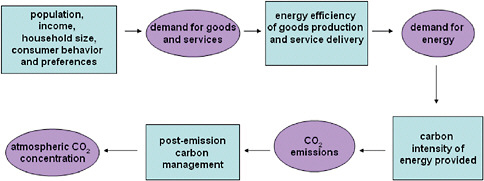
FIGURE 3.1 The chain of factors that determine how much CO2 accumulates in the atmosphere. Each of the boxes represents a potential intervention point. The blue boxes represent factors that can potentially be influenced to affect the outcomes in the purple circles.
tion, atmospheric CO2 concentrations can be altered by managing carbon sinks and sources in the biosphere and by chemical means that withdraw CO2 from the atmosphere (post-emission carbon management). Figure 3.1 summarizes these major areas of opportunity, or potential points of intervention, in the effort to reduce atmospheric GHG concentrations. Each of these intervention points is discussed individually in the following sections, but it should be acknowledged that, in some instances (for example, in shaping future urban development patterns), major advances will require systems-level solutions, involving intervention at several of these points simultaneously.
Influencing Demand for Goods and Services that Require Energy
The first box in Figure 3.1 identifies various factors that have been shown to influence the overall level of demand for goods and services in an economy. Curbing U.S. population growth (either through policies to influence reproductive choices or immigration), or deliberately curbing U.S. economic growth, almost certainly would reduce energy demand and GHG emissions. Because of considerations of practical acceptability, however, this report does not attempt to examine strategies for manipulating either of these factors expressly for the purpose of influencing GHG emissions.
An issue of key relevance is the practicality and acceptability of intervening to alter consumer behavior and preferences in ways that would reduce the demand for goods and services that result in energy consumption and GHG emissions. (We note this is different from the question explored in the following section: how to meet demand
for goods and services in a way that uses less energy and/or emits fewer GHGs per unit of output.) What is the potential for changing consumer behavior and preferences? The United States has larger per capita energy use than many other countries with an equal or higher standard of living, such as Japan and most European countries. This differential is no doubt due to a variety of economic, demographic, geographic, and cultural factors, including differences in energy prices and energy efficiency. The extent to which the gap derives from differences in consumer desires for energy-intensive goods and service is less clear.
Consumer choices among market offerings in different societies shape demand for everything from living space and electric appliances to dietary choices. For instance, the social dynamics leading to larger, more dispersed dwellings, manifest in suburban development, is an important factor in contemporary U.S. energy use. The pattern of low-density suburban development gained momentum in the 19th century with the advent of electric street cars, and it accelerated during the mid-20th century after the widespread introduction of automobiles and freeways lowered the cost of living and working farther from city centers. Social preferences for lower density and more living space thus have deep roots in American society, and changing these patterns can be extremely challenging. Yet many of America’s central cities and inner-ring suburbs have remained vital over the past century; many urban planners and advocates for “smart growth” find that interest in denser development is growing. For instance, as the population ages, many older people seek smaller homes closer to amenities and services (Myers and Gearin, 2001). Immigrant groups have also tended to migrate to central cities and inner suburbs. Technologies that lower the cost of living in denser communities (for instance, quality, affordable transit, and car-sharing programs) have been proposed as an impetus for more compact living and working environments (Sperling and Gordon, 2009). Box 3.1 summarizes key findings from a recent NRC study that evaluated the linkages among urban development patterns and GHG emissions in depth.
Environmental awareness about energy security and global climate change are on the rise (Curry et al., 2007). Levels of concern fluctuate with the changing importance of other social, economic, and environmental issues, and the strength of concern varies across segments of the population (Leiserowitz et al., 2008). But it remains clear that much of the U.S. population views climate change as an important public policy problem (Pew Center, 2009a). As Americans become increasingly informed about climate change, does this concern translate into new consumption patterns?
Social science research in this area suggests that information and attitudes alone are unlikely to prompt the sorts of changes in long-standing patterns of technology use
|
BOX 3.1 Urban Development and Transportation Energy Demand Sprawling, automobile-dependent development patterns are a major factor underlying U.S. dependence on petroleum and thus much of our GHG emissions. There is growing interest in the idea that more compact, mixed-use development will reduce vehicle miles traveled (VMT), make alternative modes of travel more feasible, and thus offer an important strategy for reducing CO2 emissions. The NRC Transportation Research Board (TRB) recently examined this question of whether petroleum use and GHG emissions could be reduced by changes in development patterns. Below is a brief overview of some key findings (from NRC, 2009d). Developing at higher population and employment densities means trip lengths will be shorter on average, walking and bicycling can be more competitive alternatives to the automobile, and it is easier to support transit. Increasing density alone, however, is generally not sufficient to reduce VMT by a significant amount. A diversity of land uses that result in desired destinations (e.g., jobs, shopping) being located near housing, and improved accessibility to these destinations, are also necessary. Development designs and a street network that provides good connectivity between locations and accommodates nonvehicular travel are important. Finally, demand management policies such as lowering parking requirements and introducing market-based parking fees are also needed. The effects of compact development will differ depending on where it takes place: Increasing density in established inner suburbs and urban core areas is likely to produce substantially more VMT reduction than developing more densely at the urban fringe. The TRB committee developed illustrative scenarios to estimate the potential effects of more compact, mixed-use development on reductions in energy consumption and CO2 emissions. An “upper bound” scenario (with 75 percent of new housing units steered into more compact development and residents of compact communities driving 25 percent less)could lead to reduced VMT and associated fuel use and CO2 emissions by about 7 to 8 percent less than the base case by 2030, and 8 to 11 percent less by 2050. A more moderate scenario (with 25 percent of new housing units built in more compact development and residents of those developments driving 12 percent less) could lead to reductions in fuel use and CO2 emissions of about 1 percent by 2030, and 1.3 to 1.7 percent by 2050. Overall then “the committee believes that reductions in VMT, energy use, and CO2 emissions resulting from compact, mixed use development would be in the range of ~1 to 11 percent by 2050, although the committee members disagreed about whether the changes in development patterns and public policies necessary to achieve the high end of these findings are plausible.” It is important to keep in mind, however, that these potential emissions reductions resulting from land-use changes would be occurring in the context of an overall increasing baseline of VMT; thus, even at the high end of the optimistic scenario, VMT in 2050 may be higher than it is today. |
and consumption of energy-intensive goods that are required for making significant reductions in GHG emissions. For example, fostering significant progress in residential energy conservation requires not only changes in public awareness and concern but also changes in market product offerings and changes in the behavior of both producers (home builders) and consumers (home buyers or renters) (Lutzenhiser et al., 2009; Stern, 2008). Long-term sustained changes will be driven by the interactions of technology markets, the policy environment, and consumer choices.
Changes in the demand for goods and services are an expected and desired outcome of carbon pricing strategies—especially through the substitution of more energy-efficient goods and production processes. However, until such a system is enacted at broad scales, it remains unclear just how much consumer behavior and overall demand for goods and services can be modified through prices alone. Consumer responses to financial incentives in the past have been highly variable. The largest impacts are seen in cases where complementary policies and nonfinancial incentives have also been provided (Gardner and Stern, 2002; Stern, 1986).
Public interest supported by thoughtful policy and good communication has been shown to be an effective combination for changing consumer behavior (NRC, 2005). The long-term successes from sustained public health information campaigns, coupled with disincentives and penalties (e.g., in the cases of smoking and drunk driving), suggest that public attitudes can be modified over time in ways that significantly affect behavior and demand. Public policies devised to reinforce changes that are already occurring in public attitudes and consumer preferences are likely to be more effective in bringing about the changes needed to dramatically lower GHG emissions.
For instance, many processes involved in water consumption require a significant amount of energy. The energy used to pump and purify water, make hot water, and treat wastewater is a large driver of electricity use for many municipal governments. Sensitivity to water use in some parts of the country is already high as a result of past droughts and increasing water scarcity. In these places, state and local governments have developed significant expertise in building effective communication and policy strategies. Publicity campaigns and other actions to promote water conservation may thus be an area where public policy could contribute to reducing energy demand. The same is true for residential energy conservation, where some states and locales have long-standing commitments and significant expertise in interventions that combine technology and behavior change to reduce demand for electricity and natural gas—although considerable work remains to be done in this area (Lutzenhiser et al., 2009).
Improving the Efficiency of Energy Use
Many opportunities exist to improve the efficiency of energy use. Total U.S. energy consumption today is 40 percent higher than it was in 1975. At the same time, energy intensity, measured as energy use per dollar of gross domestic product, has steadily fallen, averaging a decline of 2.1 percent per year (NRC, 2009a). About 70 percent of the decline in energy intensity is estimated to have resulted from improvements in energy efficiency (IEA, 2004). If current trends continue, U.S. energy intensity would drop by 36 percent over the next two decades. Despite these impressive gains, however, almost all other developed nations continue to use significantly less energy per capita than the United States (NRC, 2009a).
What is the potential for further gains in U.S. energy efficiency? Most analysts believe that the technical potential in the aggregate is large and much of it can be realized, especially if the price of energy increases. Judgments about the technical potential for energy-saving technologies and practices and their deployment to common use, however, are often fraught with uncertainty. Indeed, it has long been perplexing why consumers and businesses do not take greater advantage of what seem to be cost-effective energy-efficiency opportunities, that is, why they do not choose technologies that appear to quickly “pay for themselves” in energy cost savings. A new technology that appears promising may encounter various market barriers that hinder its implementation, or the technology itself may be lacking some important attribute (e.g., in reliability, durability, function) that makes it less cost-effective than expected. Regardless, consumers may be slow to adopt a new technology because of uncertainty about real-world savings potentials, future energy prices, and the prospects of even better technologies coming to market in the future.
A host of market and institutional barriers have been identified in the literature (Brown et al., 2007; DOE, 2009). For example, in the “principal/agent problem,” those paying for the technology and those benefiting from it are not the same. This barrier is significant and widespread in many energy end-use markets (Prindle, 2007). The land-lord-tenant relationship is the classic example: If a landlord buys the energy-using appliance while the tenants pay the energy bills, the landlord is not motivated to invest in efficiency. Often monthly energy costs are included in the rent, providing the tenant with no incentive to conserve. About 90 percent of all households in multifamily buildings are renters, which makes this a major obstacle to energy efficiency in urban housing markets. Conflicting landlord and tenant motivations are also a problem with commercial buildings, many of which are rented or leased. In addition, many buildings are occupied by a succession of temporary owners or renters, each unmotivated
to make long-term improvements that would mostly reward subsequent occupants (Brown and Southworth, 2008).
Other obstacles can stem from the lack of basic information, such as consumers not knowing how a particular appliance may be affecting their monthly household electricity bill. Moreover, given the early stage of deployment (at least in the United States) of many energy-efficient technologies (e.g., cogeneration, light-emitting diodes, and plug-in hybrid electric vehicles), obtaining reliable information can be costly, time-consuming, and perhaps not possible (Worrell and Biermans, 2005). Such market barriers have long been used to justify public policies devoted to boosting energy efficiency, prominent examples being the Corporate Average Fuel Economy (CAFE) program, Energy Star, appliance and vehicle labeling requirements, and building energy codes (DOE, 2009).
Some barriers to adoption of energy-efficient technologies result from government regulations, subsidies, and penalties that were designed to address goals in areas other than energy. Risk aversion often limits the variety of technologies offered in the market. Constraints can also be imposed through various community standards and practices, such as homeowner association rules that require the use of particular materials and design elements or that prohibit others (e.g., white roofs, clotheslines, and shade trees).
The NRC study America’s Energy Future (AEF) (NRC, 2009a,b) included a comprehensive review of energy-efficient technologies and processes in the sectors of industry, residential and commercial buildings, and transportation. The goal was to identify energy-saving technologies and practices that are currently ready for implementation, that need further development, or that exist just as concepts but are sufficiently promising to offer major efficiency improvements in the future.
Overall, AEF estimates that the potential cost-effective energy savings range (from the conservative to the optimistic) from 18.6 to 22.1 quads2 in 2020 and from 30.5 to 35.8 quads in 2030. Comparing this to the Energy Information Administration (EIA, 2009) forecast for “business as usual” consumption (105.4 quads in 2020 and 113.6 quads in 2030), this means a potential for savings of 18 to 21 percent in 2020 and 27 to 32 percent in 2030. This more than offsets the EIA’s projected increases in energy consumption through 2030, but it still falls short of achieving the very large GHG emissions reductions needed overall.
Many studies, including the AEF assessment, examine efficiency opportunities by energy-use sector, such as transportation, industry, and buildings, and so we follow this construct below. Another useful vantage point, however, is to focus on the perspective of the actors actually making investment and purchase decisions, such as the household-level actions discussed in Box 3.2.
|
BOX 3.2 Household-Level Actions to Increase Conservation and Energy Efficiency It has been estimated that households contribute roughly 40 percent of national GHG emissions through direct energy use in homes and nonbusiness travel, plus an additional 25 percent indirectly through GHGs emitted in the production, distribution, and disposal of consumer goods and services (Bin and Dowlatabadi, 2005; Gardner and Stern, 2008). There are a variety of ways in which household-level actions can enhance energy conservation and efficiency. Analyses find that the greatest potential to lower direct household energy use occurs in two main areas: (1) the choice of more energy-efficient motor vehicles and (2) home space conditioning technology (insulation, windows, furnaces, and air conditioners). Gardner and Stern (2008) estimate that these two types of efficiency improvement can save nearly 20 percent of total household energy consumption each, for an average household that has not already undertaken the action. Dietz at al. (2009) found that, aggregated across all U.S. households, the technical potential for emissions reduction is approximately 9 percent for phasing in more fuel-efficient vehicles, 6 percent for home weatherization and adoption of more efficient space conditioning equipment, 5 percent for more efficient household appliances, and 5 percent for universal adoption of compact fluorescent lighting. The study suggests that, with effective incentive programs, the great bulk of these efficiency improvements could realistically be achieved. In addition, Dietz et al. found emissions-reduction opportunities (of ~17 percent of household direct emissions) resulting from changes in the maintenance and use of household equipment. However, they note that some of these additional changes—such as carpooling—are often resisted because they are seen as sacrificing time, comfort, or convenience. Policies designed to achieve optimal short-term emissions reductions will need to take into account the different opportunities and constraints associated with different kinds of behavioral change. A recent Department of Energy (DOE) effort examining federal policies to reduce CO2 emissions in the residential sector (based on current knowledge of behavioral barriers) found that greater understanding of household behavior is needed to optimize the design of such policies (Brown et al., 2009a). |
Building-Sector Efficiency
The AEF committee concluded that the buildings sector (including both private housing and commercial buildings) offers the greatest potential for energy savings from efficiency gains. Most energy use in the building sector is in the form of electricity, followed by natural gas. There are numerous options to reduce this energy use, ranging from simple insulation and caulking to highly sophisticated appliances (Granade, 2009).
Take lighting as an example: Solid-state lighting is an important emerging technology with significant energy-savings potential. Compact fluorescent lights are a major improvement over incandescent lamps with respect to efficiency, but they have disadvantages in other respects (e.g., they contain mercury, are difficult to dim, are not a point light source, and are not “instant on”). Light-emitting diodes (LEDs) do not suffer from these disadvantages, and the best LEDs are now more efficient than fluorescent lamps (Craford, 2008). DOE (2006a) projects that LEDs will yield a 33 percent savings by 2027, relative to projected lighting energy use without LEDs. Since lighting accounts for about 18 percent of primary energy use in buildings, the savings from this one technology alone could amount to 6 percent of energy use in buildings by 2027.
Examples of other promising technologies (which can be applied to the existing building stock as well as new construction) are reflective roof products, advanced window coating, natural ventilation, and smart heating and air-conditioning control systems. Technologies available to reduce consumption in water heating (the second largest consumer of energy in homes) include alternative heat pump water heaters, water heating dehumidifiers, solar water heaters, and tankless water heaters (Brown et al., 2007). The efficiency of cooling buildings can also be aided by design strategies such as planting shade trees and replacing blacktop roofs with light-colored materials that reflect away more sunlight and drastically reduce heat absorption.
Collectively, existing technology opportunities for residential buildings could save over 500 terawatt hours (TWh) per year, more than one-third of the electricity now used in residences and about twice the growth expected by 2030 (EIA, 2009).3 The commercial sector should be able to show even greater savings, about 700 TWh (Brown et al., 2008).
Industrial-Sector Efficiency
There are numerous examples of how advanced sensors, intelligent feedback, and continuous process controls can offer industry-wide energy-savings potential. For example:
-
In the papermaking industry, fiber optic and laser sensors can monitor water content, sheer strength, and bending stiffness of paper, both saving energy and improving paper quality (see http://www.physorg.com/news4221.html).
-
Blending fly ash, steel slag, and other recycled materials with cement could cut energy consumption in the cement industry by 20 percent (Worrell and Galitsky, 2004).
-
Data indicate that most U.S. petroleum refineries can economically improve distillation efficiency by 10 to 20 percent with improved systems such as gas separation technologies, corrosion-resistant metal- and ceramic-lined reactors, and sophisticated process control hardware and software (DOE, 2006b; Galitsky et al., 2005).
-
Motors, the largest single category of electricity end use in the U.S. economy, offer considerable opportunity for electricity savings through technology upgrades and system efficiency improvements (achieved by selecting the appropriately sized and most efficient available motor for the application at hand). Next-generation motor and drive improvements, including the use of superconducting materials, are currently under development (NRC, 2009a).
The AEF committee pointed out that many of these approaches provide multiple ancillary benefits such as improved productivity, product enhancements, and lower production costs. They recognized, however, that risk aversion and uncertainty over future prices for electricity and fuels can lead many firms to defer decisions on energy-efficiency investments. The concern with such deferrals is that, once an asset is installed, it locks in a fixed level of energy efficiency for years or even decades (IEA, 2008). This adds to the importance of aggressively pursuing “windows of opportunity” to put efficient technologies and systems in place. NRC (2009b) estimates that investments in available efficiency technologies (including growth in combined heat and power production) could reduce energy consumption in the industrial sector by 14 to 22 percent (about 4.9 to 7.7 quads) over the next decade.
Transportation-Sector Efficiency
Concerns over U.S. dependence on imported oil provide an additional motivation for increasing energy efficiency (see Chapter 6). Cars and light trucks are the main source of energy consumption in the U.S. transportation sector, accounting for ~65 percent of fuel use. Improving automobile fuel economy has thus been a central focus of federal energy policies dating back more than 30 years to the establishment of the Corporate Average Fuel Economy (CAFE) Program. Most recently, the 2007 Energy Independence and Security Act (EISA) mandates substantial increases in the CAFE fuel economy standards for new cars and light trucks sold over the next decade, requiring a combined 35 miles per gallon for vehicles sold in 2020 (representing a 40 percent increase from today). In September 2009, the Obama Administration proposed GHG emissions performance standards for new cars and light trucks that are intended to accelerate these fuel economy gains.
The AEF report concluded that these increases in vehicle fuel economy will be difficult but possible to meet, since many technologies are available that could be implemented at relatively modest cost. Some are already in use and could be expanded rapidly over the next decade (e.g., cylinder deactivation, direct injection, diesel engines, and hybrid electric vehicles). Others, such as plug-in hybrid electric vehicles, have the potential to start penetrating the market during the next decade, possibly leading to all-electric battery vehicles. The report stresses, however, that there is no assurance these improvements will be introduced on a wide scale in this time frame, especially if motor fuel prices do not rise and create incentives for consumers to demand more energy-efficient vehicles.
The question of whether more stringent fuel-efficiency standards would be warranted at a later date depends upon how the policy environment and technological capabilities evolve in the next two decades, as discussed further in Chapter 4. Overall, NRC (2009a) estimates an approximate energy-savings potential for light-duty vehicles of 2.0 to 2.6 quads in 2020 and 8.2 to 10.7 quads in 2030. However, even if such increases in vehicle fuel economy do occur, growing amounts of personal travel by automobile will likely cause overall emissions from cars and light trucks to increase in the coming decades. EIA (2009) projects that light-duty vehicles will use 16.53 quads of energy in 2030 compared to 16.42 quads today. Thus, additional opportunities for reducing GHG emissions must be considered. This includes direct efforts to reduce travel demand (discussed in the previous section) and expanded use of alternative fuels (discussed in the following section), as well as strategies for increasing efficiency in other areas of transport sector (discussed in Box 3.3).
|
BOX 3.3 Other Potential Opportunities for Increasing Transport-Sector Efficiency Public Transit. Public transit is often cited for its potential to reduce automobile dependence and resulting energy use. The nation’s transit systems, consisting of buses, light railways, ferries, rapid rail, and commuter lines, currently account for only about 3 percent of total U.S. passenger miles—but a more meaningful share of personal travel in a number of large metropolitan areas. The true energy efficiency of public transit depends upon the density of its use. In most places, transit is most heavily used for commuting during rush hours, and the systems run with low occupancy for much of the day. The net result is low levels of energy efficiency in many systems during these periods of low occupancy. Therefore, in trying to induce a mode shift to mass transit as a GHG emissions-reduction strategy, a challenge is in generating ridership throughout the day and drawing traffic primarily from single-occupant vehicles. To do so may require changes in the design and operations of transit systems, for instance, through the use of innovative, more flexible public transit concepts such as taxi buses.1 At a more fundamental level, such changes need to coincide with policies aimed at influencing the location of housing and businesses in ways that make transit a more effective and appealing option for all kinds of local travel, not just work commuting (see Box 3.1 for further discussion of these transportation and land-use planning connections). Aviation. Domestic air transportation currently accounts for about 12 percent of U.S. passenger miles and ~3 percent of total U.S. GHG emissions. Technological advances coupled with a highly competitive airline industry have prompted air carriers to steadily improve (by ~1-2 percent per year) the energy efficiency of their fleets and their operations during the past 40 years.2 New aircraft |
Reducing the Carbon Intensity of Energy
Opportunities for reducing the carbon intensity of energy include switching from higher- to lower-carbon-content fossil fuels, advancing coal technologies such as gasification and combined-cycle plants, along with carbon capture and storage (CCS) technologies, and advancing renewable energy sources (e.g., wind, hydro, geothermal, and solar power) and other no- or low-carbon-content energy sources such as hydrogen, nuclear, and biomass. Each of these opportunities is briefly discussed below.
|
entering the fleet today, such as the Boeing 787, use about 20 percent less fuel per seat-mile than the aircraft they are replacing. Airline fleet turnover should thus, over time, lead to continued gains in aircraft energy efficiency. At the same time, however, domestic airline passenger traffic is forecast to grow by between 2 and 3 percent per year over the next two decades, which is likely to offset the technological efficiency gains. Additional efficiency improvements can be found in navigation and control technology and changes in air traffic management practices. For instance, more direct routing and reduced taxiing and idling at airports represent potentially important areas of opportunity for future energy savings.3 Freight Transport. Rail transport currently accounts for about 40 percent of freight transport ton-miles, and is 5-15 times more energy efficient than trucks per ton-mile. Trucks account for about half of freight ton-miles, but a much higher share of certain (high-value, lighter-weight, nonbulk) shipments. Diverting more truck traffic onto rail presents a modest but real opportunity for energy savings. The potential is greatest for shipments going more than 500 miles, and this is already being exploited by some national truckload motor carriers, by placing trailers on rail cars for the line-haul segment of their trips. About 5 to 10 percent of truck traffic may be candidates for additional movement by rail. The DOE forecasts energy-efficiency improvements of 0.6 percent per year for heavy trucks for the next two decades (EIA, 2009). The 2007 EISA requires that the U.S. Department of Transportation (USDOT) establish fuel economy standards for medium- and heavy-duty trucks. An NRC committee is currently studying for USDOT the technological potential for energy-efficiency improvements in trucks in support of standards development. The scope, stringency, and structure of the EISA standards are not known at this time, but they may prompt energy-efficiency gains beyond those forecast by EIA (2009). |
Natural Gas
Natural gas is the cleanest of the fossil fuels, with the lowest GHG emissions per unit of energy, emitting about half of the CO2 of coal when burned for electricity generation. Shifting a greater fraction of coal- and petroleum-based energy use to natural gas is thus one potential means of reducing (although not eliminating) our nation’s rate of CO2 emissions growth. Currently, ~86 percent of the natural gas consumed in the United States is produced domestically, with much of the remainder coming from Canada. U.S. natural gas reserves have increased significantly over the past decade, largely because new technology has increased the accessibility of unconventional
resources, especially gas shales. It is difficult to predict the long-term prospects to meet an increasing demand for natural gas, but recent estimates from EIA (2009) show that natural gas production from unconventional resources is growing. According to the AEF report, new natural gas combined-cycle power plants with CCS can compete economically with new coal plants with CCS, but the price of natural gas greatly affects this competitiveness. At the low price of $6/GJ, electricity costs are estimated at 7-10 cents/kWh. At $16/GJ, electricity costs are 14-21 cents/kWh. In comparison, electricity from coal with CCS is estimated at 9-15 cents/kWh (NRC, 2009a).
Renewables
Renewable-energy technologies that do not emit GHGs are an important and viable part of a near-term strategy for limiting climate change, and they could potentially play a dominant role in global energy supply over longer time scales, especially given the finite lifetimes of the fossil fuel-based options mentioned above. There is a wide variety of options for expanding the use of renewable energy resources (e.g., solar, wind, geothermal, biomass, and wave/tidal power). We do not review the current technical status of individual technologies here, as this has been done in detail in other recent reports, including America’s Energy Future: Real Prospects for Energy Efficiency in the United States (NRC, 2009a) and ACC: Advancing the Science of Climate Change (NRC, 2010a). But we note some of the key challenges that the AEF report highlighted regarding the widespread expansion of intermittent renewable sources such as wind and solar.
For instance, AEF pointed to the technical challenges of increasing wind turbine capacity factors, lowering the cost of concentrating solar power through advances in high-temperature and optical materials, and developing increasingly thinner photovoltaic films at lower cost. Increasing the use of wind and solar for electricity will also require overcoming the challenge of integrating them into the grid. There is a need not only for greater transmission capacity but also for the increased installation of fast-responding generation to provide electricity when renewables are not available. Expanding the transmission system, improving its flexibility through advanced control technologies, and co-siting with other renewable or conventional generation facilities can help this integration.
Overall, the AEF report judged as feasible the goal of producing 20 percent of U.S. electric power from renewable sources by 20204 but not without substantial increases
in manufacturing capacity, employment, and capital investment. As a practical matter, local opposition to the siting of renewable electricity-generating facilities (such as wind farms) and associated transmission lines can also present barriers (as is true, of course, for other energy technology options as well). In order to facilitate investment in the face of high costs and risks, the AEF report observed that early and lasting commitments from policy makers are essential, including efforts to support research and development (R&D) and to avoid the “on/off” nature of federal tax credit programs (discussed further in Chapter 4).
Nuclear Power
Nuclear power is one of the key options for meeting large-scale electricity demand without producing GHGs. But the benefits of nuclear power must be weighed against a number of potential challenges. Strong public opposition to nuclear power, first evidenced in the 1970s, is rooted in a variety of concerns that any expansion of nuclear generating technology will confront (Rosa and Clark, 1999; Rosa and Dunlap, 1994; Whitfield et al., 2009). First is the challenge presented by the disposal of radioactive waste (particularly used fuel). The absence of a policy solution for the disposal of long-lived nuclear wastes, while not technically an impediment to the expansion of nuclear power, is still a public concern. New reactor construction has been banned in 13 U.S. states as a result, although several of these states are reconsidering their bans.
Safety and security concerns stem from the potential for radioactive releases from the reactor core or spent fuel pool following an accident or terrorist attack. Nuclear reactors include extensive safeguards against such releases, and the probability of one happening appears to be very low. Nevertheless, the possibility cannot be ruled out, and such concerns are important factors in public acceptance of nuclear power. Proliferation of nuclear weapons is a related concern, but after 40 years of debate, there is no consensus as to whether U.S. nuclear power in any way contributes to potential weapons proliferation. A critical question is whether there are multilateral approaches that can successfully decouple nuclear power from nuclear weapons (Socolow and Glaser, 2009). Other potential barriers to the deployment of new nuclear plants include the high capital costs of building new plants as well as the time-consuming and costly permitting, certification, and licensing processes.
Nuclear plants now in place in the United States were built with technology developed in the 1960s and 1970s. In the intervening decades, ways to make better use of existing plants have been developed, along with new technologies that improve safety and security, decrease costs, and reduce the amount of generated waste—es-
pecially high-level waste. These technological innovations include improvements or modification of existing plants, alternative new plant designs (e.g., thermal neutron reactor and fast neutron reactor designs), and the use of alternative (closed) nuclear fuel cycles. These new technologies under development may allay some of the concerns and barriers described above, but it will be necessary to determine the functionality, safety, and economics of those technologies through demonstration and testing.
Considering only technical potential (i.e., not accounting for the practical barriers discussed above), AEF estimates that a 12-20 percent increase in U.S. nuclear capacity is possible by 2020. After 2020, the potential magnitude of nuclear power’s contribution to the U.S. energy supply is uncertain and will depend on the performance of plants built during the next decade.
Biopower and Biofuels
Biopower for electricity and biofuels for transportation can be produced from many sources, including wood and plant waste, municipal solid waste and landfill gas, agricultural waste, and energy crops. The AEF report concludes that, between now and 2020, there are no technological constraints to expanding biofuels production using existing technologies, but at high levels of deployment other types of barriers arise. These include the challenge of producing the fuel near enough to generating facilities to make hauling feasible and producing biomass feedstock in a sustainable manner that avoids excessive burdens on ecosystems.
The AEF committee considered corn grain ethanol to be a transition fuel to cellulosic biofuels or other biomass-based liquid hydrocarbon fuel. Biochemical conversion of grains to ethanol has already been deployed commercially and was important for stimulating public awareness and initiating the industrial infrastructure. There is active debate, however, about the land-use and GHG implications of greatly expanding biomass-based energy sources. For instance, Melillo et al. (2009) predict that an expanded biofuels program will significantly increase direct carbon losses from soil, as well as indirect losses resulting from expanded conversion of forests and grasslands, and from the additional nitrous oxide emissions from increased fertilizer use. Searchinger et al. (2008) likewise argue that the land-use changes that might occur internationally as a result of diverting significant U.S. corn crops to ethanol production would lead to a large net increase in GHG emissions. Others, however (e.g., Wang and Haq, 2009), assert that such claims are based on flawed assumptions. In response to such concerns and uncertainties, a growing number of groups are developing standards for assessing and
certifying the sustainability of processes for obtaining biopower feedstocks (e.g., the Roundtable on Sustainable Biofuels; see http://cgse.epfl.ch).
Cellulosic ethanol and other advanced cellulosic biofuels have much greater potential to reduce U.S. oil use and CO2 emissions, while having smaller impacts on the food supply. The AEF report suggests that cellulosic biomass—from dedicated energy crops, agricultural and forestry residues, and municipal solid wastes—could potentially be produced on a sustainable basis using today’s technology and agricultural practices. The time frame for technology development and deployment is uncertain, however.
Carbon Capture and Storage
CCS could be used to remove CO2 from the exhaust gases of power plants fueled by coal, natural gas, or other carbonaceous material (including biomass), as well as from other large industrial processes that emit CO2 (such as natural gas processing or the production of hydrogen, ammonia, and other chemicals).5 CCS technologies have been demonstrated at the commercial scale in several large industrial processes, but no large power plant today captures and stores its CO2. Although current technologies can capture roughly 90 percent of CO2, they are quite costly in power plant applications. CO2 storage (or sequestration) could be implemented most effectively in several types of geological formations, including depleted oil and gas reservoirs and beneath other layers of impermeable rock. Specific sites would have to be selected, engineered, and operated with careful attention to safety. In particular, the deep subsurface rock formations that trap the CO2 must allow the injection of large quantities and ensure its containment over timescales of centuries.
More reliable cost and performance data are needed both for capture and storage, and these data can be obtained only by construction and operation of full-scale demonstration facilities. Such demonstrations could provide vendors, investors, and other private-industry interests with the confidence that power plants incorporating advanced technologies, and the associated storage facilities, could be built and operated in accordance with commercial criteria. Similarly, to sort out storage options and gain experience with their costs, risks, environmental impacts, legal liabilities, and regulatory and management issues (e.g., Pollak and Wilson, 2009; Wilson et al., 2007), it will be necessary to operate a number of large-scale capture and storage projects that encompass a range of different fuels (coal, natural gas, and biomass), application types
(e.g., pre- and postcombustion), and geological formations. And like any technology, favorable public perception and social acceptance may prove to be crucial for widespread deployment of CCS. A small number of studies are beginning to explore such issues (e.g., Bielicki and Stephens, 2008).
The investments needed to create this portfolio of CCS demonstrations will certainly be significant—approximately $1 billion per project for large coal plants—but there is no benefit in waiting to make such investments. The AEF committee judges that the period between now and 2020 could be sufficient for acquiring the needed information on CCS viability, provided that the deployment of CCS demonstration projects proceeds as rapidly as possible; if these investments are made now, 10 gigawatts (GW) of CCS projects could be in place by 2020.
Post-Emission Carbon Management
Preventing or limiting GHG emissions from known sources is the classic abatement approach that dominates most current policy deliberations. However, fossil fuels will remain abundant and relatively inexpensive for many years to come; there is little evidence thus far that most nations of the world are willing to take maximum advantage of the GHG emissions-reduction opportunities discussed in the previous sections. There is strong motivation, therefore, to consider complementing traditional emissions-reduction efforts with strategies for managing carbon after it is already released into the atmosphere—to extract CO2 from the air and keep it sequestered in a stable reservoir for at least decades to centuries. This includes opportunities such as enhancing natural biological sequestration processes (e.g., in forests, soils, and the ocean surface) and developing chemical or mechanical sequestration processes (e.g., capturing CO2 with chemicals or materials). Some of these strategies are already well characterized and widely used, while others are in an early stage of conceptualization. Depending on the nature and scale of such efforts, they are sometimes referred to as forms of “geoengineering” (see Box. 3.4).
Sequestration in Forests and Agricultural Systems
Reducing emissions from deforestation and forest degradation (referred to as REDD in policy circles) can play an important role in global efforts to limit the magnitude of climate change, because this is the source of roughly 17 percent of current global GHG emissions (IPCC, 2007a). REDD is viewed as a major target for international emissions offset opportunities, since the costs (per ton of CO2 emissions) is much less than emissions reductions taken in the energy sector of industrialized countries, and it can
|
BOX 3.4 The Panel’s Approach to Geoengineering There is growing interest in strategies for deliberate, large-scale manipulations of the Earth’s environment in order to offset the harmful consequences of GHG-induced climate change. These proposed manipulations are generically referred to as “geoengineering.” Although few are promoting geoengineering as an alternative to traditional emissions-reduction strategies, the concept has recently been gaining more serious attention as a possible “backstop” measure. This attention is driven by lack of progress in making a large-scale transition to low-GHG technologies and by growing evidence that the world may be on a dangerous trajectory with respect to climate change, regardless of whether there is substantial future progress in limiting GHG emissions. One broad category of proposed geoengineering schemes encompasses methods for “solar radiation management,” such as injecting sulfate particulates into the stratosphere, enhancing global cloud cover, and other methods of affecting the reflectivity of Earth’s surface or atmosphere. As discussed in ACC: Advancing the Science of Climate Change (NRC, 2010a), solar radiation management schemes are fraught with scientific uncertainties about the efficacy of intended impacts and the possibility of unintended impacts, as well as questions about ethical implications, public acceptance, and international governance. This report considers only schemes for removing CO2 directly from the atmosphere (that is, “post-emission carbon management”), which in general do not raise the distinctively difficult governance, ethical, or public acceptance issues raised by other forms of geoengineering.1 In addition, post-emission carbon management schemes can ultimately help to address another major environmental concern associated with growing CO2 emissions: increasing acidification of the world’s oceans (also discussed in ACC: Advancing the Science of Climate Change [NRC, 2010a]). |
offer a variety of ancillary ecological benefits for developing countries (discussed in Chapter 6).
In terms of domestic action, the United States can augment its emissions-abatement efforts with a variety of practices to enhance carbon sequestration in its own forests and croplands. This includes planting new forests (afforestation), protecting existing forests against loss and degradation, reducing cropland tillage, and enhancing conversion to grasslands. McCarl and Schneider (2000) and McCarl and Reilly (2007) provide details on specific sequestration mechanisms and discuss how these sorts of efforts affect agricultural emissions of GHGs (CO2, CH4, N2O), as well as the use of land for growing biofuel feedstock.
Studies by the Environmental Protection Agency (EPA) (Murray et al., 2005) conclude
that the national emissions reduction capacity of forestry and agricultural practices is ~630 teragrams (Tg) CO2/yr in the first decade, declining to about 85 Tg CO2/yr by 2055 due to saturation of carbon sequestration (discussed below) and carbon losses after timber harvesting. Also, despite the declining annual sequestration rates, cumulative agricultural GHG emissions steadily increase over time (assuming that food production remains a priority in land-management practices). For a scenario with a constant price of $15 per ton CO2-eq, the cumulative amount reaches ~26,000 Tg CO2-eq by 2055.
Different types of land-use practices have different mitigation potentials, as illustrated by Figure 3.2, with forestry practices generally demonstrating much larger sequestration capacity than agricultural soil management. Optimal carbon-sequestration strategies are largely a function of time and GHG price levels. For instance, Murray et al. (2005) found that, at relatively low GHG prices ($5 per ton CO2-eq or less) and in early years, carbon sequestration in agricultural soils and in forest management would be optimal as the dominant mitigation strategies; at middle to higher prices ($15 per ton CO2-eq or higher) in the early to middle years, afforestation becomes the leading strat-
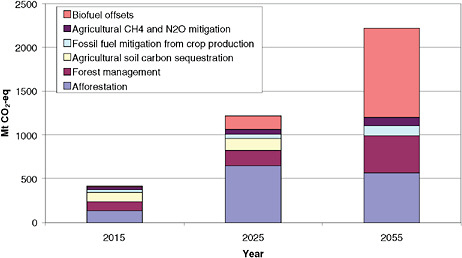
FIGURE 3.2 Mitigation potential in the U.S. agriculture and forestry sectors, assuming a price of $20 per ton CO2-eq in 2010, increasing by $1.30/yr. (The negative value in 2055 indicates less sequestration relative to the baseline value.) Note that both the absolute and relative magnitudes of different sequestration options vary over time. SOURCE: EPA.
egy; and at the highest prices ($30 and $50 per ton CO2-eq) and in years beyond 2050, biofuels (primarily for electricity) dominate the portfolio.
It is important to recognize that the physical volumes of sequestration implied by some estimates potentially neglect the costs of adoption and the competition for land from alternative uses. McCarl and Schneider (2001) found that, even at very high prices (up to $500 per ton CO2-eq), the economic potential to sequester carbon in agricultural soils is less than two-thirds of the pure technical potential. Furthermore, at such high prices, soil sequestration has to compete with other strategies such as bioenergy and afforestation, which further reduce the competitive economic potential for soil carbon sequestration to less than one-third of the technical potential.
One constraint to keep in mind is that carbon sequestration practices are effective only until the biological capacity of the ecosystem is reached and the system becomes saturated for a land use, that is, when the rate of carbon additions to the ecosystem reaches equilibrium with the rate of decomposition and re-release of carbon to the atmosphere. In the case of soil tillage, this typically happens within 10 to 15 years; grassland conversions can continue sequestration for 30 to 50 years; and in forestry it can exceed 80 years. Some new approaches for alleviating saturation efforts are being explored (Box 3.5), but in general, these sorts of biological sequestration strategies are best viewed as near-term bridging strategies for helping to manage atmospheric GHG concentrations during the time required to ensure widescale implementation of more long-term (i.e., energy-sector-based) solutions. There are a number of other practical constraints that make these forms of post-emission carbon management more challenging than traditional emissions-reduction efforts. For instance:
-
Transaction costs and land unit size. Many of the strategies to generate GHG emissions reductions typically involve small volumes for a given landowner per unit. For example, carbon sequestration on agricultural soils generates about 0.8 tons CO2 per acre of land and the average farm size is about 450 acres. This means a 100,000-ton offset would require a group of almost 280 farmers. This raises the issue of relatively high transaction costs in assembling the group and measuring, monitoring, and verifying practices.
-
Leakage. A number of the proposed agricultural and forestry options, such as biofuels production and afforestation, divert land from conventional production of agricultural commodities. If this then diverts commodities from the marketplace, it can lead to changes in land use such as deforestation or conversion of grasslands into agricultural production elsewhere in the world, with accompanying emissions increases (Fargione et al., 2008;
|
BOX 3.5 Emerging Strategies for Enhancing Biological Carbon Sequestration Post et al. (2009) identify a number of approaches that may alleviate the ecosystem saturation effects that currently limit carbon sequestration potential, for instance: Biotechnology. The postgenomics era provides an opportunity to identify genes, enzymes, and other factors that underlie rate-limiting steps in carbon acquisition, transport, and fate and potentially open up new approaches to enhance terrestrial carbon sequestration. Deep-soil sequestration. Carbon decay in undisturbed soil at depths from 0.2 to 3 m is minimal. To use this reservoir as an efficient sequestration pool, mechanisms need to be developed and adopted for moving carbon into these lower soil depths. Amending soils with lime, urea, and phosphate fertilizers offer one such approach, as do planting deep-rooted perennials. Biochar. Biochar burial involves creating a charcoal-like substance by pyrolyzing1 harvested biomass in a process that renders it inert. The biochar can then be used as a soil amendment to improve soil fertility, increase crop productivity, and provide additional carbon sequestration benefits (Lehmann et al., 2006; McHenry, 2009). This is because the carbon contained in the biochar is unavailable for oxidation to CO2 and subsequent release to the atmosphere. Conversion of biomass carbon to biochar leads to initial sequestration of about 15 to 35 percent of the carbon released by the initial feedstock biomass. A preliminary appraisal finds that at present this approach is costly, and significant uncertainty remains about long-term sequestration effectiveness, but it does have the potential to yield a negative carbon balance (McCarl et al., 2009). |
-
Searchinger et al., 2008). These sorts of emission leakage issues are discussed further in Chapter 4.
-
Additionality. Many of the agricultural practices that could be stimulated by a GHG price or tax are already in use, and thus it may be questioned whether they are “additional.” A widely held stance is that credits should be granted for GHG offsets that are additional to what would have occurred under business as usual. Yet farm groups want to reward good actors who started a practice before the pricing program began. This raises major policy design challenges. For example, how should policy deal with payments to preexisting practices, or how can new actions be distinguished from those that would have occurred anyway?
-
Permanence and uncertainty. The agriculture and forestry sectors are characterized by pervasive uncertainty in terms of year-to-year fluctuations in commodity yields. And, as noted above, sequestered carbon may not be permanent.
-
The possibility of sequestration reversal raises concerns about how offsets might be treated in the marketplace.
-
Property rights, commitments, and leasing. Farm and forestry groups have reservations about making permanent commitments to carbon sequestration. Many such groups favor leasing rather than permanent sales, because they are worried about factors such as future carbon prices; requirements that land be managed in particular ways; potential increases in cost, particularly for weed and insect control; and critical reliance on the efficacy of chemical weed control compounds, in the face of possible development of resistance to control methods. Furthermore, rules to prevent converting grasslands into croplands would infringe on private property rights (Marland et al., 2001), which could lead to major legal obstacles to program implementation and management, as well as associated transactions costs.
-
Measurement and monitoring. Implementing markets for agricultural practices requires rigorous measurement and monitoring protocols. Some argue that these elements will be quite costly, but others argue that standard soil-sampling methodology and process-based modeling offer low-cost approaches (Mooney et al., 2004; Paustian et al., 2009), especially because a 5- to10-year period of time between sampling will likely be required to detect changes (Conant and Paustian, 2002; Smith, 2004).
-
Payment by practice versus by outcome. Many soil and forest programs are targeted to reward practices, not environmental outcomes such as the amount of carbon sequestered. Antle et al. (2001) indicated this is inefficient on a per-ton cost basis, because any particular practice can lead to widely varying outcomes in terms of carbon sequestered. Wu and Boggess (1999), however, argued that per-acre or per-practice policies are more efficient than policies based on tons of carbon sequestered or erosion avoided.
Oceanic Sequestration Strategies
One of the methods that have been proposed to enhance natural biological carbon uptake is iron fertilization of the oceans. This involves the intentional introduction of iron to upper ocean waters to stimulate a phytoplankton bloom, with the goal of enhancing biological productivity (the growth of plant biomass) and enhanced removal of CO2 from the atmosphere. A number of research groups have conducted preliminary studies of this strategy in theoretical, laboratory, and ocean field tests. Ocean trials have demonstrated that phytoplankton blooms can be stimulated by iron addition (Boyd et al., 2007), but much controversy remains over the effectiveness of this
method for atmospheric CO2 sequestration and over its effects on ocean ecology and biology (Buesseler et al., 2008). In addition, any sort of large-scale ocean manipulation scheme would likely need to be carried out as an international cooperative effort and thus faces major political and institutional hurdles. The Convention on the Prevention of Marine Pollution by Dumping of Wastes and Other Matter 1972 (London Convention, 1972) has already been involved in developing governance for experimental studies in this arena.
Geochemical Sequestration Strategies
A number of strategies have been proposed for using geochemical reactions that enhance transformation of CO2 gas into dissolved or solid-phase carbon. Stephens and Keith (2008) reviewed the technical status of these geochemical approaches, grouped into three broad categories:
-
Mineral carbonization. Various mechanical methods have been proposed to accelerate the naturally slow reactions wherein CO2 in the atmosphere is converted to carbonates and returned to the lithosphere by weathering of rocks.
-
Altering ocean alkalinity. Deliberately increasing ocean alkalinity through various geochemical means may increase the ocean’s capacity to store dissolved inorganic carbon and also help address the problem of increasing ocean acidity.
-
In situ geochemical processes. One can facilitate geochemical reactions in locations where minerals exist naturally, including enhanced carbonate formation in calcium and magnesium silicate-rich aquifers, and carbonate dissolution in submarine carbonate deposits.
Stephens and Keith (2008) suggested that more research is needed to effectively compare the economic viability of the different approaches, but at present, among these geochemical approaches, only alkalinity addition seems to provide a significant improvement beyond conventional CCS in broadening the economic scope of carbon storage options.
Direct Air Capture of CO2
For large point sources such as power plants, on-site CO2 capture from an effluent stream is considered technically feasible and potentially cost-effective. But for distributed sources such as vehicles and small industrial sources (which account for nearly half of all GHG emissions globally), this type of capture method is not technically or
economically feasible. Thus, one strategy for dealing with these dispersed emissions sources involves finding the means to extract CO2 directly from the ambient air. This direct-capture strategy is appealing for numerous reasons: it can be colocated with suitable geological storage sites; it eliminates the need to ship captured CO2 from its source to a disposal site; it could be deployed as soon as it is developed (i.e., one would not have to wait for the phase-out of existing energy infrastructure to begin implementation); and it could likely be carried out at the national level, without the need for new international agreements or governance institutions.
One class of strategies for direct air capture that has emerged thus far involves physical or chemical absorption from airflow passing over some recyclable sorbent such as sodium hydroxide. A few research groups are developing and evaluating prototypes of such systems (Keith et al., 2006; Lackner et al., 1999). Major challenges remain in making such systems viable in terms of cost and energy requirements and improving over-all capture energy efficiency. And of course, the challenges of long-term storage of the captured CO2 are the same as those discussed earlier for CCS from industrial sources. If the technology were to someday become technically and economically feasible, however, the amount that could be captured would face no physical limit (other than global storage capacity) and, thus, could fundamentally alter the picture for efforts to reduce atmospheric GHG concentrations.
Reducing Emissions of Non-CO2Greenhouse Gases
Roughly 15 percent of U.S. GHG emissions (based on CO2 equivalents) come from non-CO2 gases, including methane (CH4), nitrous oxide (N2O), and fluorinated industrial gases such as hydrofluorocarbons (HFCs), perfluorocarbons (PFCs), and sulfur hexafluoride (SF6) (EPA, 2009). Pursuing non-CO2 GHG emissions-reduction opportunities can be an attractive option because these gases are, per molecule, generally much stronger climate forcing agents than CO2; studies have shown that including non-CO2 emissions-reduction options allows involvement of a far wider and more diverse set of economic sectors and opportunities, leading to a substantial reduction in the overall economic cost of limiting GHGs (e.g., Clarke et al., 2009; de la Chesnaye et al., 2007).
There are technically feasible strategies for reducing some non-CO2 GHG emissions at negative or modest incremental costs. Many of these strategies are discussed briefly below, and more detailed discussion can be found in the literature (EPA, 2006, and see Table 3.1). Note that some strategies can yield multiple environmental benefits; for example, later in this chapter we discuss the example of controlling chemical species that affect both climate change and air quality (e.g., black carbon, tropospheric ozone,
TABLE 3.1 Summary of Emission Reduction Options for Non-CO2 GHGs
|
Gas |
Source |
Key Opportunities |
Estimated Emissions Reduction Potential (Mt CO2-eq for 2030) |
|
CH4 |
Landfills |
Methane recovery and combustion (i.e., power generation, industrial uses, flaring) |
92 |
|
|
Coal mines |
Methane recovery and combustion, flaring, ventilation air use |
39.2 |
|
|
Oil/gas systems |
Use of low-bleed equipment, better management practices |
47.5 |
|
|
Livestock waste |
Methane collection from anaerobic digestors and combustion (power, flaring) |
9 |
|
|
Ruminant livestock |
Improved production efficiency through better nutrition and management |
12 |
|
|
Rice production |
Water management, organic supplements |
4 |
|
N2O |
Industrial sources |
Adipic acid (catalysts, thermal destruction), nitric acid (nonselective catalytic reduction) |
25.9 |
|
|
Mobile sources |
Noncombustion vehicle alternatives (i.e., electric cars, fuel cell vehicles), reduced existing vehicle use (public transportation, fuel efficiency) |
?? |
and methane). We note also the example that measures taken under the Montreal Protocol to control emissions of compounds that deplete stratospheric ozone have been estimated to create a climate change benefit (at zero incremental cost) that is five to six times what would have occurred if the Kyoto Protocol had been fully implemented (Velders et al., 2007).
|
Gas |
Source |
Key Opportunities |
Estimated Emissions Reduction Potential (Mt CO2-eq for 2030) |
|
|
Soil management |
Precision agriculture, cropping system models, controlled-release fertilizers, soil conservation practices |
36.2 |
|
SF6 |
Aluminum production |
Reduced anode effects |
0.8 |
|
|
Magnesium production |
Improved process management, SF6 substitutes |
0.9 |
|
|
Electric power |
Improved gas handling, recycling, new equipment |
3.6 |
|
|
Semiconductors |
Improved process management, thermal destruction, alternative chemicals |
1.5 |
|
HFC-23 |
|
Improved process management, thermal destruction |
2.9 |
|
Ozone-depleting substance substitutes |
|
Improved gas management, alternative chemicals, banning of nonessential uses |
84.9 |
|
SOURCES: Nonagricultural technical potential estimates from EPA (2006) and EPA’s legislative analyses. Estimates assume a price of $60/ton CO2-eq. Agricultural estimates are from the results of Baker et al. (2009) at a $50 CO2-eq price. Description of emissions-reduction opportunities from EPA (see http://gcep.stanford.edu/pdfs/3KC3dzpRALy3cHpkGrwJCA/Paul_Gunning_Non-CO2.pdf). |
|||
Methane Emissions from Energy and Landfill Sources
Methane (CH4) is emitted from leaks or venting from oil and gas systems, landfills, and coal mining. Reducing these emissions is cost-effective in many cases, due to the market value of the recovered gas.6 Cost-effective CH4 emission-reduction technologies and practices (e.g., leak detection and reduction activities) already exist, but there is
opportunity for their broader deployment. Reductions in landfill gases will result from deployment of existing approaches, coupled with waste reduction through recycling, and technological advances in solid-waste management technologies. For coal mine emissions, deployment of existing emissions-control techniques, advances in coal mine ventilation, and new coalbed methane drilling techniques would all help to further reduce emissions. Currently, U.S. industries and state and local governments collaborate with the EPA in a variety of voluntary programs to promote and overcome informational, technical, and institutional barriers to reducing CH4 emissions. EPA expects that these programs will maintain emissions below 1990 levels in the future. Through the EPA Methane to Markets Partnership, the United States is also working toward reducing international CH4 emissions.
Nitrous Oxide Emissions from Combustion and Industrial Sources
N2O emissions from combustion and industrial acid production accounted for nearly 7 percent of U.S. non-CO2 GHG emissions. Combustion of fossil fuels by mobile (e.g., trucks, cars, buses, trains, and ships) and stationary (steam boilers and other systems used for power and heat production) sources is the largest nonagricultural contributor to N2O emissions. For the combustion sources, N2O emissions appear to vary greatly with different technologies and operating conditions. Current research is aimed at identifying the most promising approaches and technologies for reducing N2O emissions from these sources, but no technologies are suitable for deployment at this time. The largest industrial source of N2O emissions is from nitric acid production. Virtually all of the nitric acid produced in the United States is manufactured by the catalytic oxidation of ammonia; therefore, development of advanced catalysts could further limit N2O emissions from this source.
Methane and Nitrous Oxide Emissions from Agriculture
The largest overall source of non-CO2 GHG emissions is from agriculture, in particular CH4 fromenteric fermentation in ruminant livestock and N2O and CH4 from manure and fertilizer. A number of methods and technologies are available today to help reduce some of these emissions. For instance, advanced imagery, precision agriculture, and sensing and control technologies are available to help farmers minimize overfertilization practices that lead to emissions and to apply fertilizers under conditions that decrease transformation of fertilizer nitrogen into N2O. New chemical fertilizers that minimize gaseous losses and inhibit nitrogen transformation to N2O are also available. CH4 emissions from manures can be greatly reduced by improving livestock waste management systems through use of anaerobic treatment and gas recovery systems
(commonly called anaerobic digesters). Methane from enteric fermentation can also be reduced somewhat through better feed and forage management, breed improvements, diet management, and strategic feed selection.
Fluorinated GHG Emissions
Although emissions of fluorinated GHGs are relatively small, contributing only about 2 percent to total CO2-eq emissions, their 100-year global warming potentials (GWPs) are significant, ranging from 124 to 22,800 times that of CO2. Emissions-reduction options address three categories of emissions:
-
Unintended by-products. There are two sources of unintended by-product emissions: PFC emissions (primarily PFC-14) from aluminum production and hydrofluorocarbon-23 (HFC-23) emissions from hydrochlorofluorocarbon-22 (HCFC-22) production. From 1990 to 2007, voluntary industry programs for improving process and control measures reduced PFC emissions from 19 to 4 million metric tons (MMT) CO2-eq. Achieving further significant reductions, however, would require major new advances in these processes. From 1990 to 2007, HFC-23 emissions were reduced from 36.0 to 17 MMT CO2-eq, through a combination of process optimization and capture and destruction of the compound. Virtually all of the remaining emissions could be eliminated, at costs estimated to be as low as $0.20 per metric ton.
-
Intentionally produced compounds. Some GHGs are intentionally produced for use in a wide range of consumer and commercial applications and are used in billions of pieces of equipment and products worldwide. Their emissions can occur years to decades after production, which makes downstream emissions control very difficult. Of this class, the most significant are HFCs, used as replacements for ozone-depleting substances controlled under the Montreal Protocol (primarily in refrigeration and air-conditioning systems). U.S. consumption of HFCs in 2005 was estimated at 170 MMT CO2-eq and consumption is projected to grow as HCFC consumption is reduced and HFCs are used in their place. Emissions-reduction options range from better refrigerant management to minimize emissions, to substitution with alternative fluids and technologies with lower GWPs (although options for the latter have yet to be identified in many cases). The potential exists for even greater growth in HFC use in developing countries, primarily due to rapidly increasing demand for refrigeration and air-conditioning. Velders et al. (2009) argue that developing-country use in 2050 could exceed that in industrialized countries by a factor of 8. Other uses for intentionally produced compounds are PFCs, SF6, NF3, and
-
HFCs for semiconductor manufacture, and SF6 for electrical transmission and distribution and for magnesium production and processing. Voluntary programs for all these applications have succeeded in reducing U.S. emissions from about 35 MMT CO2-eq in 1990 to 20 MMT CO2-eq in 2007. Future reduction potential is uncertain.
-
Capturing and destroying compounds. Even though the consumption of some of the most widely used ozone-depleting substances (chlorofluorocarbons [CFCs]) has been phased out, significant banks of the compounds still exist in refrigeration and air-conditioning equipment and in insulating plastic foams. Destruction costs using approved technologies range from $2.75 to $11 per kg of the CFC, not accounting for the additional cost of recovery, storage, and transportation (IPCC/TEAP, 2005). Due to the high GWP of these compounds, their capture and destruction can be cost-effective (on a per ton CO2-eq basis); for example, if it cost $10 to capture and $10 to destroy CFC-12, then the cost is approximately equivalent to $2 per ton CO2-eq. The size of this emissions-reduction opportunity is rapidly diminishing with time as the remaining CFCs continue to leak from systems worldwide. Controlling these leaks would help mitigate ozone depletion and help limit the magnitude of future climate change.
Short-Lived Radiative Forcing Agents
Most discussion on limiting the magnitude of climate change focuses on “well-mixed” GHGs that persist in the atmosphere for periods ranging from years to centuries (even millenia, for the PFCs). Although less frequently mentioned in climate discourse, reducing atmospheric concentrations of short-lived atmospheric pollutants (namely, tropospheric ozone and black carbon particles) may offer a cost-effective near-term strategy for limiting the magnitude of climate change, while at the same time producing substantial benefits for air quality.
Tropospheric ozone (O3) is itself a strong GHG, but it also plays a key role in atmospheric chemistry, affecting the lifetimes and hence the concentrations of several other important GHGs, including CH4, HCFCs, and HFCs. O3 is not emitted directly but is produced in the atmosphere via reactions among its precursors: nitrogen oxides (NOx), carbon monoxide (CO), methane (CH4), and nonmethane hydrocarbons. Thus, controlling O3 requires controls on the emissions of these precursors. Some ozone precursor emissions (from sources such as vehicles, factories, power plants, consumer products, and paints) are currently controlled through provisions of the Clean Air Act. Since CH4 is a precursor for O3 formation on a broad regional level (as opposed to the context of
concentrated urban air pollution), there are multiple reasons for pursuing strategies that reduce CH4 emissions from industrial, energy, and agricultural systems. This would not only reduce the climate impacts of CH4 itself but also help lower the climate impacts of O3 (West et al., 2006).
Black carbon or “soot” not only causes strong direct warming in the atmosphere (on a localized scale) but also amplifies warming effects after deposition from the atmosphere because the resulting black coating on certain surfaces (such as arctic snow and ice) decreases the amount of incoming solar radiation these surfaces reflect back to space. Black carbon is emitted from the burning of fossil fuels, biofuels, and biomass. Diesel emissions account for 30 percent of black carbon globally and 50 percent in the United States. Technology for reducing soot emissions from diesel engines exists and is already mandated for new diesel vehicles in the United States. Reducing these emissions would have important domestic benefits for human health, but benefits at the international level are even more profound. For instance, replacing primitive biomass cookstoves that emit large amounts of soot with inexpensive, clean technologies could have enormous health benefits for the millions of people who suffer from this dangerous source of indoor air pollution (WHO, 2005).
Including these sorts of short-lived compounds in a larger GHG emissions-reduction effort does pose methodological challenges (for instance, it is difficult to apply the concept of GWPs and CO2-equivalent emissions to such species). Nonetheless, it has been suggested that focusing on these short-lived species could be particularly advantageous as a near-term bridging strategy for easing climate change during the time required for major CO2 emissions controls to come into play. It is especially attractive as an international strategy because low-income countries that view CO2 emissions reduction as a threat to their economic growth often see the control of pollutants such as O3 and soot as an immediate, obvious benefit. Also, because these short-lived pollutants are rapidly removed from the atmosphere, reducing emissions will have a near-immediate effect on lowering atmospheric concentrations.
THE CASE FOR URGENCY
Chapter 2 drew on the Energy Modeling Forum (EMF22) project to identify a representative domestic GHG emission budget range of 170 to 200 Gt CO2-eq for the period 2012 through 2050, and earlier sections of this chapter identified a wide range of opportunities for reducing domestic GHG emissions. Here we assess whether the technical potential for domestic emissions reduction is sufficient to meet a domestic GHG budget in the suggested range (assuming, as discussed in Chapter 2, that international
offsets are not used to meet the U.S. domestic GHG budget7). Based on this assessment, we conclude that meeting the representative U.S. GHG budgets may be feasible, but only if the nation acts with great urgency to deploy available technologies and to create new ones.
This conclusion is based on two analyses described below. First, we find that the energy efficiency and energy production technologies available for near-term commercial use (i.e., by 2020) could attain the deployment levels required for meeting the emissions budget scenarios only under the most favorable circumstances. Because the margin for error is so thin, meeting the budget using only these technologies seems unlikely. Second, we find that, without prompt action, the current rate of GHG emissions from the energy sector would use up the domestic emissions budget well before 2050. In short, meeting the emissions budget scenarios considered in Chapter 2 means that the United States needs to start decarbonizing its energy system as soon as possible but does not yet have in hand the suite of technologies needed to complete the task. We reiterate the point made in Chapter 2 that the U.S. emissions budget used in this analysis is based on “global least-cost” economic efficiency criteria and that credible political and ethical arguments can be made for a more aggressive U.S. effort than the one we discuss in this section. To meet these more ambitious targets would, of course, be even more difficult.
Feasibility of Decarbonizing the Energy System
To assess the feasibility of decarbonizing the energy system, we compare the possible requirement for future energy efficiency and energy supply technologies with the likely availability of those technologies. Two recent studies, EMF22 and AEF, provide the data to make this comparison directly. Figure 3.3 shows a set of scenarios developed in the EMF22 studies that illustrate the types of changes to the energy system that might be needed to reach an emissions budget of either 167 or 203 Gt CO2-eq by 2050.8 Below are the results of five different models, showing the energy technology mix projected for 2050 compared to the mix in the year 2000.
There are large uncertainties associated with these sorts of projections, but the varia-
|
7 |
If the United States does rely heavily on the use of international offsets to meet an emissions budget, that would mean less stringent requirements for actually reducing domestic emissions; thus, the energy mix going forward would likely include a larger percentage of freely emitting fossil fuels than in the cases shown in Figure 3.3. |
|
8 |
As noted earlier, the EMF-22 analysis cases are 167 and 203 Gt CO2-eq, which we rounded to 170 and 200 Gt CO2-eq in Chapter 2. This difference does not significantly affect the conclusions of our analysis. |
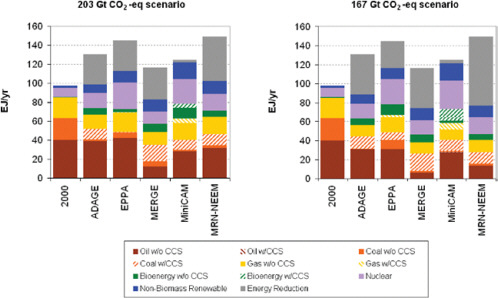
FIGURE 3.3 Model projections (from the EMF22 study) of the mix of energy technologies that may be used in 2050, under scenarios with emission budgets of 203 and 167 Gt CO2-eq. For comparison, the first column in each graph shows the U.S. energy technology mix in 2000. A wide variety of future energy mix scenarios is possible, but all cases project a greater role for energy efficiency, renewable energy, fossil fuels with CCS, and nuclear power. SOURCES: Adapted from Fawcett et al. (2009); see also http://emf.stanford.edu for further details.
tion among them illustrates that the United States has many plausible options for configuring its future energy system in a way that helps meet GHG emissions-reduction goals. Note, however, that all cases involve a greater diversity of energy sources than exist today, with a smaller role for freely emitting fossil fuels and a greater role for energy efficiency, renewable energy, fossil fuels with CCS, and nuclear power. The virtual elimination by 2050 of coal without CCS—presently the mainstay of U.S. electric power production—in all the scenarios is perhaps the most dramatic evidence of the magnitude of the changes required.
The AEF study estimated the technical potential of the rate at which key technologies can be deployed over the next 25 years, based on the committee’s judgments of when technologies will be available for commercial deployment and the likely maximum rate of deployment thereafter (see Box 3.6 for further explanation of “technical potential”). In Table 3.2, these AEF technical potential estimates are compared with estimates from EMF22 studies of the technological deployment levels required for meeting the domestic emissions budget goals discussed in Chapter 2.
Such an assessment is complicated by the considerable uncertainties involved in developing scenarios for how the energy system might evolve in response to particular
|
BOX 3.6 Defining Technical Potential Our discussion of technical potential refers to the definition developed by NRC (2009a) for the potential “accelerated deployment” options for various energy technologies. “Accelerated” refers to deployment of technologies at a rate that would exceed the reference scenario deployment pace but at a less dramatic rate than an all-out crash effort. These estimates were based on the AEF committee’s judgments regarding two factors: (1) the readiness of evolutionary and new technologies for commercial-scale deployment and (2) the pace at which such technologies could be deployed without disruptions associated with a crash effort. In estimating these factors, the committee considered the maturity of a given technology, together with the availability of the necessary raw materials, human resources, and manufacturing and installation capacity needed to support its production, deployment, and maintenance. In some cases, estimates of the evolution of manufacturing and installation capacity were based on the documented rates of deployments of specific technologies from the past. Note that these estimates do not account for all of the barriers that could practically impede deployment of various technologies (e.g., social resistance and institutional limitations). Thus, the technical potential estimates should be viewed as an upper (optimistic) bound of what deployment level is truly feasible or likely. |
TABLE 3.2 Comparison of Projected Requirement (red) and Technical Potential for Deployment (blue) for Various Key Energy Technology Options, for the 167 and 203 Gt CO2-eq Budget Scenarios
|
Energy Efficiency (% reduction from ref. case) |
2020 |
2035 |
|
Requirement (EMF) for 167 Gt CO2-eq |
2-21 |
5-33 |
|
Requirement (EMF) for 203 Gt CO2-eq |
2-17 |
4-24 |
|
Potential (AEF) |
15 |
30 |
|
Nuclear (Twh/y) |
2020 |
2035 |
|
Requirement (EMF) for 167 Gt CO2-eq |
868-1034 |
1292-2092 |
|
Requirement (EMF) for 203 Gt CO2-eq |
869-1014 |
947-1629 |
|
Potential (AEF) |
968 |
1453 |
|
Electricity with CCS (Twh/y) |
2020 |
2035 |
|
Requirement (EMF) for 167 Gt CO2-eq |
32-324 |
233-1593 |
|
Requirement (EMF) for 203 Gt CO2-eq |
0-87 |
0-796 |
|
Potential (AEF) |
74 |
1200/1800a |
|
Renewable Electricity (nonbiomass) (Twh/y)B |
2020 |
2035 |
|
Requirement (EMF) for 167 Gt CO2-eq |
194-688 |
453-1155 |
|
Requirement (EMF) for 203 Gt CO2-eq |
194-593 |
459-971 |
|
Potential (AEF) |
811 |
1454 |
|
Biomass Fuels (cellulosic) (mmgal/y) |
2020 |
2035 |
|
Requirement (EMF) for 167 Gt CO2-eq |
17,000-29,000 |
17,000-33,000 |
|
Requirement (EMF) for 203 Gt CO2-eq |
15,000-23,000 |
17,000-35,000 |
|
Potential (AEF) |
7,700 |
26,000 |
|
NOTE: AEF estimated technical potential out to 2020 and 2035, and so these years are used as benchmarks for the comparisons with EMF22 estimates. a 1200 is for retrofit or repower of existing plants; 1800 is for new plants. b Estimate is for total renewables, including current capacity and potential new capacity. Potential for 2020 is 10 percent of electricity production, in EIA (2010) as specified in AEF. Does not include hydropower. |
||
GHG emissions-reduction goals. This will depend on many factors, including the types of new policies implemented, the evolution of technology, and the degree to which the barriers particular to individual technology areas can be overcome. As a result, the different models show a wide range of estimates regarding deployment requirements for different technologies. Nonetheless, even taken in a very general sense, comparing
the EMF22 and AEF estimates provides significant insights into the feasibility of decarbonizing the energy system.
Both the EMF technology requirements and the AEF technology potentials shown in the table are rough estimates. Taking that uncertainty into account, however, we feel the results are sufficiently robust to make the following observations:
-
For the electricity sector, meeting the 167 Gt CO2-eq budget would be challenging—requiring that nearly all technologies available to increase efficiency and decarbonize the energy system be deployed at levels close to their full technical potential. Meeting the 203 Gt CO2-eq budget is less challenging, but it is nevertheless still very demanding. If CCS can be demonstrated successfully and then deployed widely, this would likely make it feasible for the electricity sector to decarbonize fully. However, CCS has yet to be demonstrated in large-scale utility applications. If it proved to be infeasible, the remaining potential for efficiency, renewables, and nuclear would not be enough to meet electricity needs in 2035. Indeed, if any one of the major categories fails to approach its technical potential, meeting the electricity need would be very difficult.9
-
For the transportation sector, meeting the deployment requirements for either budget scenario is particularly difficult. The technical potential for expanding the use of biomass fuels in transportation appears to be near the low end of what is required. The AEF study shows that, even if we could meet the full technical potential for both vehicle efficiency gains and alternate fuels use, there would still be a need for roughly one-third of the 2035 demand for transportation fuel to be met by oil.10 This suggests that further displacement of petroleum in the transportation sector will require additional strategies, such as significant deployment of pure or hybrid electric vehicles.
-
The AEF technical potential estimates are based on optimistic assumptions, so falling short of them is quite likely. AEF does not account for nontechnical (i.e., social or institutional) barriers to deployment; it assumes that the technologies, once adopted, operate at acceptable costs and performance. This provides further impetus to suggest that existing technology options are not likely to be sufficient, and there is an urgent need to enhance R&D aimed a creating new technology options.
|
9 |
The Electric Power Research Institute’s (EPRI’S) Prism analysis also estimates the technical potential for decarbonizing electric power production. EPRI’s estimates are similar to, and in some cases more conservative than, the AEF estimates. Even so, EPRI regards its Prism results to be “very aggressive, but feasible if the proper investments in R&D are made (particularly around demonstration and early deployment)” (personal communication with Bryan Hannegan, Rhode Island) |
|
10 |
See Figures 2.4, 2.11, and 2.12 of NRC (2009a) for the data on which this analysis is based. |
Inertia of Existing Infrastructure
A second consideration underscoring the need for urgency is that the present energy infrastructure, if left unchanged, will rapidly deplete the GHG budgets discussed in Chapter 2. The reference case in EIA (2010) projects U.S. CO2-eq emissions to 2035, taking into account the accelerated CAFE standards announced in 2009 as well as the effect of the economic downturn of the past year. It projects annual emissions dropping to a low of 5.7 Gt CO2-eq in 2013 and then rising to 6.3 Gt CO2-eq in 2035. Cumulatively from 2012, these emissions amount to 143 Gt CO2-eq by 2035. This represents 84 percent of the 170 Gt CO2-eq budget and 72 percent of the 200 Gt CO2-eq budget, thus substantially truncating the emissions budget for the remaining 15 years until 2050. Some of these emissions could potentially be sequestered through soil and forestry management efforts, but this would slow depletion of the budget by only a few percent. And meanwhile, unchecked GHG emissions from other, nonenergy sources (which were not included in the EIA projections) would further accelerate depletion of the budget.
A similar situation exists globally. As noted in Chapter 2, recent modeling suggests that limiting atmospheric GHG concentrations to 450 ppm CO2-eq is very difficult, and even holding concentrations to 550 ppm requires aggressive action. Bosetti et al. (2008) examined the costs of delay in a global context and suggested that short-term inaction is a key determinant for the economic costs of ambitious climate policies. That is, an insufficient short-term effort significantly increases the costs of compliance in the long term. Delays in beginning to reduce the U.S. contribution to global GHG emissions would risk further loss of opportunities to control GHG concentrations over the long term.
THE LARGER CONTEXT FOR TECHNOLOGY
Although there are many possible opportunities for limiting GHG emissions, most strategies that the nation could adopt to make large, near-term contributions to reducing emissions center on the deployment of reasonably well-known technologies for energy efficiency and low-carbon energy production. These sorts of technological solutions are the primary focus of both the AEF and EMF22 analyses discussed earlier, and they underlie the case for urgent U.S. action. Chapter 4 focuses on crafting a policy portfolio to accelerate the deployment of these near-term, high-leverage technological opportunities.
Ultimately, however, limiting the magnitude of climate change requires looking
beyond just these near-term technological opportunities. One reason for having a broader focus is that we know additional technology choices will ultimately be required. As explained earlier, even if the existing “high-impact” technologies were to meet their full technical potential, they themselves are not likely to be adequate to meet the stringent demands of the emissions budgets discussed in Chapter 2. Our current energy system is largely based on R&D that was done two or more decades ago. Basic research could lead to advanced energy efficiency and supply technologies with greatly improved performance, environmental, and economic characteristics.
Another, perhaps more important, reason to consider a broader suite of strategies is that many barriers inhibit the deployment of even well-known technologies. For example, the adoption of many energy-efficiency technologies and practices requires significant changes in human behavior, lifestyle, and consumer spending practices. New technologies such as CCS are unfamiliar both to the public and to environmental regulators; if experience is any guide, building the required levels of acceptance for such technologies can be an elusive task. Also, inertias in supply chains and interdependent infrastructure systems contribute to slow rates of social and technical change. For these reasons, there is a pressing need for greater understanding of individual and institutional responses to the deployment of new technology.
Thus, technological change (discussed in more detail in Chapter 5) must be set in a larger context of research on how social and behavioral dynamics interact with technology, and how technological changes can interact with broader sustainable development issues. We refer the reader to the report ACC: Advancing the Science of Climate Change (NRC, 2010a) for a deeper discussion of these issues and of the profound changes they imply for the scientific enterprise.
KEY CONCLUSIONS AND RECOMMENDATIONS
CO2 emissions from fossil fuel combustion in the energy system comprise over 80 percent of total U.S. GHG emissions. CO2 emissions related to energy are driven by economics and demographics and the resulting demand for goods and services, the energy required to produce these goods and services, the efficiency with which energy is produced and used, and the CO2 emitted by the energy production process.
Numerous opportunities to reduce CO2 emissions exist, but many of them require time and investment to be developed to the point of deployment, have cost and other implementation constraints, or would have marginal impacts on overall GHG emissions. We conclude that the most substantial opportunities for near-term GHG reductions,
using technology that is deployable now or is likely to be deployable soon, include the following:
-
Improved efficiency in the use of electricity and fuels, especially in the buildings sector, but also in industry and transport vehicles.
-
Substitution of low-GHG-emitting electricity production processes, which may include renewable energy sources, fuel switching to natural gas, nuclear power, and electric power plants equipped to capture and sequester CO2.
-
Displacement of petroleum fuels for transportation with fuels with low or zero (net) GHG emissions.
Meeting the goal of limiting domestic GHG emissions to 170 Gt CO2-eq by 2050, by relying only on these near-term opportunities, may be technically possible but will be very difficult. Meeting the 200 Gt CO2-eq goal is more feasible but nevertheless very demanding. In either case, realizing the full potential of known and developing technologies will require reducing many existing barriers to deployment; therefore, it is likely these technologies will fall short of their technical potential.
This underscores the crucial need to strongly support R&D aimed at bringing new technological options into the mix (discussed further in Chapters 4 and 5). Meeting the 2050 budget goal requires that these new technologies be available by the 2020-2030 time period. To create the necessary innovations in time for deployment means moving research along very rapidly.
Some important opportunities exist to control non-CO2 GHGs including CH4, N2O, long-lived fluorinated GHGs, and short-lived pollutants such as ozone precursors and black carbon aerosols. Opportunities also exist to enhance biological uptake and sequestration of CO2 through afforestation and soil management practices. These opportunities are worth pursuing, especially as part of a near-term strategy, but they are not large enough to allow the United States to avoid falling short in reducing emissions from fossil fuel energy sources.
Our nation’s existing energy system, if left unchanged, will rapidly consume the emissions budgets suggested in Chapter 2 (especially the more stringent 170 Gt CO2-eq budget). Delay in reforming the energy system would thus make a challenging goal essentially unattainable.
Because of this compelling case for urgency, we conclude that action is needed: to accelerate the deployment of technologies that offer significant near-term GHG emissions-reduction opportunities; to accelerate the retirement or retrofit of existing high-emitting infrastructure; and to aggressively promote research into the development and deployment of new, low GHG-emitting technologies.


