
7
Overall Conclusions and Recommendations
In response to a charge from Congress, the committee defined and evaluated key external costs and benefits associated with the production, distribution, and consumption of energy from various selected sources. We were asked to focus on health, environmental, security, and infrastructure effects that are not—or may not be—fully incorporated into the market price of energy or into government policies related to energy production, distribution, or consumption. The external effects of energy are mostly negative, but the overall benefits of U.S. energy systems to society are enormous. However, the estimation of those benefits, which are mostly reflected in energy prices and markets, was not in the committee’s charge.
The results of this study are intended to inform public policy choices, such as selecting among fuel types, or to help identify situations in which additional regulation may be warranted for reducing external costs produced by an energy-related activity. When sources with large aggregate damages are indentified, analysis of the costs and benefits of reducing the burdens resulting from those damages is warranted.
This chapter presents an overview of the results of the committee’s analyses. It provides factors to keep in mind when interpreting the results of the evaluations, overall conclusions, and recommendations for research to inform future consideration of various issues.
THE COMMITTEE’S ANALYSES
Our study examined external effects over the life cycle of electricity generation, transportation, and production of heat for the residential, com-
mercial, and industrial sectors. We estimated damages that remained in 2005 after regulatory actions had taken place as well as damages expected to remain in 2030 in light of possible future regulations. Our boundaries for analysis were not identical in all sectors, but we sought to use existing data and methods for well-recognized externalities. We did not attempt to develop wholly new methods for estimating impacts and damages, but we did identify areas where additional research would be particularly valuable.
For electricity generation and production of heat, we focused on monetizing downstream effects related to air pollution from coal-fired and gas-fired processes. Upstream effects and other downstream effects have been quantified but not monetized or have been discussed in qualitative terms. We did not assess effects associated with power-plant construction, and we did not assess effects from methane emissions from transporting natural gas by pipeline for heat. For transportation, we monetized effects related to air pollution for essentially the full life cycle, including vehicle manufacture. We considered climate-change effects associated with energy production and use, and we reviewed various attempts that have been made in the literature to quantify and monetize the damages associated with the effects of climate change. We also considered the literature on a variety of damages that are associated with the nation’s energy infrastructure: disruption in the electricity transmission grid, vulnerability of energy facilities to accidents and possible attack, external costs of oil consumption, supply security considerations, and national security externalities.
The committee focused its attention on externalities as generally defined by economists. As discussed in Chapter 1, there are many other distortions that occur in markets related to energy production and consumption that may create opportunities for improvement of social welfare but that are not externalities. There are also equity or “fairness” consequences of market activities. Although other distortions and equity concerns may be appropriate for policy formulation, they are beyond the scope of this study and were not considered.
LIMITATIONS IN THE ANALYSES
Estimating most of the impacts and damages involves a several-step process based on many assumptions; this process is true for even relatively well-understood impacts. In summarizing our results, we attempt to convey the uncertainty surrounding our estimates. The results of the committee’s study should be considered in light of important caveats. Although our analysis was able to consider and quantify a wide range of burdens and damages (for example, premature mortality resulting from exposure to air pollution), there are many potential damages that we did not quantify. Therefore our results should not be interpreted as a full accounting. As discussed in Chapter 1, studying selected sources was necessary because it
would have been infeasible to evaluate the entire energy system with the time and resources available to the committee. Even within the sources selected by the committee, we were unable to monetize all externalities over a life cycle.
Our analysis required use of a wide set of assumptions and decisions about analytical techniques that can introduce uncertainty into the results. Although we did not attempt to conduct a formal uncertainty analysis, we have been cautious throughout our discussion of results—and urge the reader to be cautious—that is, not to over-interpret small differences in results among the wide range of energy sources and technologies assessed.
There is uncertainty in the analyses with respect to the quality of the data available, the completeness of the analyses (factors that may have been left out or have been unintentionally given inappropriate weight), and the degree to which computation models correctly include the most important variables. Uncertainty also involves unknowns. For example, some climate effects of greenhouse gas (GHG) emissions are poorly understood and might continue to be for some time. In some cases in which effects werre unknown, the committee was able to conclude that the effects were probably small compared with the known effects. In other cases, the committee was not able to provide even qualitative estimates of unknown effects; in such cases, we had to accept that we did not know. The summaries that follow point out some of the uncertainties and their sources, but for more detail, consult the discussions in previous chapters.
ELECTRICITY GENERATION
Chapter 2 examines burdens, effects, and damages associated with electricity generation from coal, natural gas, nuclear power, wind, solar energy, and biomass. In the cases of fossil fuels (coal and natural gas) and nuclear power, the analysis includes externalities associated with upstream activities, exploration, fuel extraction and processing, and the transportation of fuel to generating facilities, as well as damages associated with downstream activities of electricity generation and distribution. Some effects are discussed in qualitative terms and others are quantified and, if possible, monetized. Although this section presents estimates of GHG emissions due to electricity generation, it does not present damages associated with effects related to climate change. Those damages are discussed in separate sections in this chapter.
Electricity from Coal
For electricity generation from coal, the committee monetized effects on human health, visibility of outdoor vistas, agriculture, forestry, and damages to building materials associated with emissions of airborne particulate
matter (PM), sulfur dioxide (SO2) and oxides of nitrogen (NOx) from 406 coal-fired power plants in the United States, excluding Alaska and Hawaii. More than 90% of monetized damages are associated with premature human mortality, and approximately 85% of damages come from SO2 emissions, which are transformed into airborne PM. Aggregate damages (unrelated to climate change) in 2005 were approximately $62 billion (2007 U.S. dollars [USD]), or 3.2 cents per kilowatt hour (kWh) (weighting each plant by the electricity it produces); however, damages per plant varied widely. The distribution of damages across plants is highly skewed (see Figure 7-1). The 50% of plants with lowest damages per plant accounted for 25% of net electricity generation and produced 12% of damages. The 10% of plants with the highest damages per plant also accounted for 25% of net generation, but they produced 43% of the damages. Although damages are
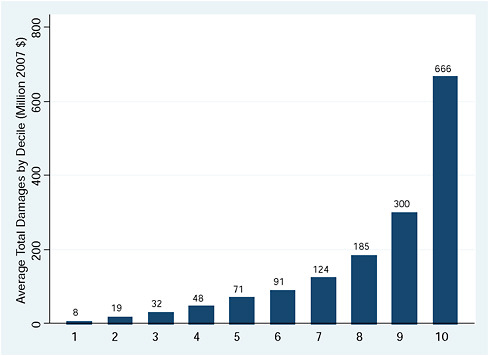
FIGURE 7-1 Distribution of aggregate damages from coal-fired power plants by decile (2007 U.S. dollars). In computing this chart, plants were sorted from smallest to largest based on aggregate damages. The lowest decile represents the 40 plants with the smallest aggregate damages per plant. The figure on the top of each bar is the average across all plants of damages associated with SO2, NOx, PM2.5, and PM10 (particles with diameters less than or equal to 2.5 and 10 microns, respectively). Damages related to climate-change effects are not included.
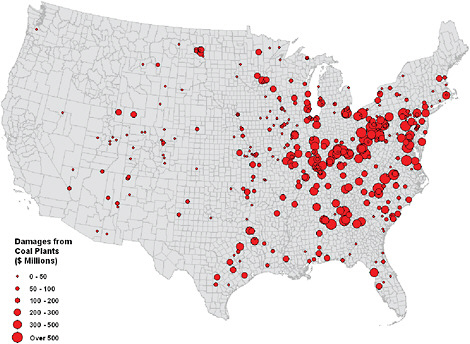
FIGURE 7-2 Air-pollution damages from coal-fired electricity generation for 406 plants in 2005. Damage estimates are reported in 2007 U.S. dollars. Damages related to climate-change effects are not included.
larger for plants that produce more electricity, less than half of the variation in damages across plants is explained by differences in net generation. The map in Figure 7-2 shows the size of damages created by each of the 406 plants by plant location. Plants with large damages are concentrated to the east of the Mississippi River, along the Ohio River Valley, in the Middle Atlantic, and in the South.
Damages per kWh also varied widely across plants (Figure 7-3)—from over 12 cents per kWh (95th percentile) to less than a cent (5th percentile) (2007 USD).1 Most of the variation in damages per kWh can be explained by variation in emissions intensity (emissions per kWh) across plants. In the case of SO2 emissions, over 80% of the variation in SO2 damages per kWh is explained by variation in pounds of SO2 emitted per kWh. Damages per ton of SO2, which vary by plant, are less important in explaining variation in SO2 damages per kWh. (Damages per ton are capable of explaining only 24% of the variation in damages per kWh.)
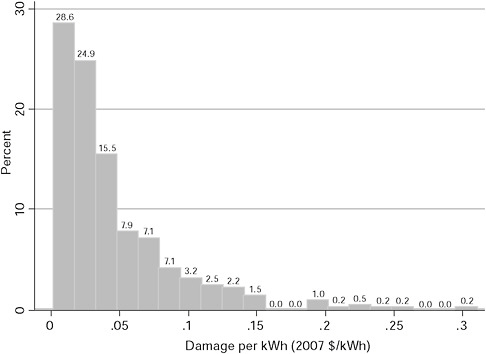
FIGURE 7-3 Distribution of air-pollution damages per kilowatt-hour for 406 coal-fired power plants in 2005 (in 2007 U.S. dollars). All plants are weighted equally. Damages related to climate-change effects are not included.
For 2030, despite increases in damages per ton of pollutant due to population growth and income growth, average damages per kWh (weighted by electricity generation) at coal plants are estimated to be 1.7 cents per kWh, compared with 3.2 cents per kWh in 2005 (2007 USD). The fall in damages per kWh is explained by the assumption that pounds of SO2 per megawatt hour (MWh) will fall by 64% and that NOx and PM emissions per MWh will fall by approximately 50% (see Chapter 2).
Greenhouse Gas Emissions
The emissions of CO2 from coal-fired electricity-generating facilities are the largest single source of GHG emissions in the United States. Because the heat rate (energy from coal needed to generate 1 kWh of electricity) varies widely among coal-fired plants, the CO2 emissions vary as well. The 5th-95th percentile range is 0.95-1.5 tons (the average being about 1 ton of CO2 per MWh of power generated). The main factors behind the differences in the CO2 emitted are the technology used to generate the power and the age of the plant.
Electricity from Natural Gas
For estimating nonclimate-change-related damages for 498 facilities that generate electricity from natural gas in the United States, we used a similar approach as in the coal analysis. The gas facilities, which include electric utilities, independent power producers, and combined heat and power facilities, each generated at least 80% of their electricity from gas and had installed capacity of at least 5 MW. The aggregate damages associated with emissions of SO2, NOx, and PM from these facilities, which generated 71% of electricity from natural gas, were approximately $0.74 billion (2007 USD), or 0.16 cents per kWh. Thus, on average, nonclimate-change damages associated with electricity generation from natural gas are an order of magnitude lower than damages from coal-fired electricity generation. The distribution of damages across plants is, however, highly skewed (see Figure 7-4). The 10% of plants with highest damages per plant
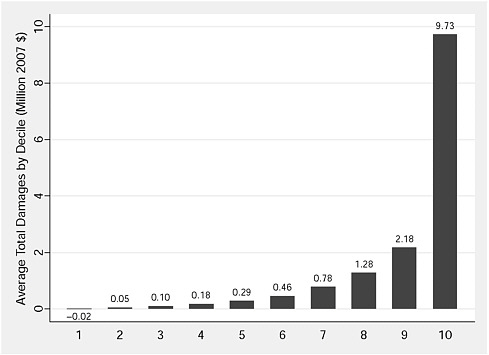
FIGURE 7-4 Distribution of aggregate damages from natural-gas-fired power plants by decile (in 2007 U.S. dollars). Plants were sorted from smallest to largest based on aggregate damages to compute this chart. The lowest decile represents the 50 plants with the smallest aggregate damages per plant. The number on the top of each bar is the average across all plants of damages associated with SO2, NOx, PM2.5, and PM10 (particles with diameters less than or equal to 2.5 and 10 microns, respectively). Damages related to climate-change effects are not included.
accounted for 65% of the air-pollution damages produced by all 498 plants. The 50% of plants with lowest damages per plant accounted for only 4% of the aggregate damages. (Each group of plants, respectively, accounted for approximately one-quarter of the electricity generation.) Although damages were larger for plants that produced more electricity, less than 40% of the variation in damages across plants is explained by differences in net generation. The largest damages are produced by gas plants located in the Northeast (along the Eastern seaboard), and in Texas, California, and Florida (see Figure 7-5).
Damages per kWh also vary widely across plants: from more than 1.5 cents per kWh (95th percentile) to less than 0.05 cents (5th percentile) (2007 USD).2 Most of the variation in NOx damages per kWh can be explained by variation in emission intensity across plants; however, for PM2.5, which accounted for more than half of the monetized air-pollution damages, variation in damages per ton of PM2.5 (that is, variation related to the location of the plant relative to population distribution and prevailing winds) are as important in explaining variation in PM2.5 damages per kWh as differences in PM2.5 emissions intensity.
Damages per kWh at the 498 facilities are predicted to be 30% lower in 2030 than in 2005; they are predicted to fall from 0.16 cents to 0.11 cents per kWh on average (2007 USD) (weighting each plant by electricity generation). The reduction is due to a predicted 19% fall in NOx emissions per kWh hour and a 32% fall in PM2.5 emissions per kWh (see Chapter 2).
Greenhouse Gas Emissions
Natural gas plants on average emitted approximately half as much CO2 at the generation stage as did coal-fired power plants in 2005—about half a ton of CO2 per MWh. As the heat rate (energy from gas needed to generate 1 kWh of electricity) varied among gas-fired plants, so did CO2 emissions, the 5th-95th percentile ranged from 0.3 to 1.1 tons per MWh. As discussed later in this chapter, nonclimate-change damages from natural-gas-fired electricity generation are likely to be much smaller than its damages related to climate change.
Electricity from Nuclear Power
The committee did not quantify damages associated with nuclear power; however, we reviewed studies conducted by others and consider
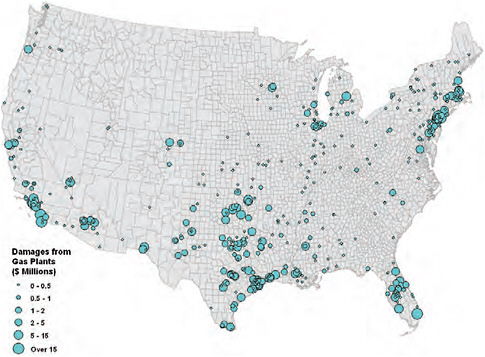
FIGURE 7-5 Air-pollution damages from natural-gas-fired electricity generation for 498 plants in 2005. Damages are expressed in 2007 U.S. dollars. Damages related to climate-change effects are not included.
their conclusions relevant.3 Overall, other studies have found that damages associated with the normal operation of nuclear power plants (excluding the possibility of damages in the remote future from the disposal of spent fuel) are low compared with those from fossil-fuel-based power plants.
For surface-mine workers, exposure to radon is generally less important than direct irradiation or dust inhalation, but radon exposure can be important for underground miners. However, if radiologic exposure is taken into account in miners’ wages, it is not considered an externality. For members of the public, the most significant pathways from an operating uranium mine are radon transport and radionuclide ingestion following surface-water transport. From a rehabilitated mine, the more significant pathways over the long term are likely to be groundwater as well as surface-water transport and bioaccumulation in animals and plants located at the mine
site or on associated water bodies. Little uranium is currently mined in the United States; most of the uranium supplied to U.S. nuclear power plants comes from Canada and Russia.
Downstream impacts are largely confined to the release of heated water used for cooling and the production of low-level radioactive wastes (LLRW) and high-level radioactive wastes (HLRW) from spent fuel. Release of highly radioactive materials has not occurred on a large scale in the United States (but obviously has occurred elsewhere). LLRW is stored for decay to background levels and then disposed of as nonradioactive waste (a practice possible with slightly contaminated materials), or it is disposed of in nearsurface landfills designed for radioactive wastes. For spent nuclear fuel that is not reprocessed and recycled, HLRW is usually stored at the plant site. No agreement has been reached on a geologic repository for HLRW in the United States, and, therefore, little HLRW is transported for long distances. The issue of having a permanent repository is perhaps the most contentious nuclear-energy issue, and considerably more study on the externalities of such a repository is warranted.
Electricity from Wind Energy
The committee relied on information in the scientific literature for its assessment of wind power for producing electricity; it focused on land-based wind turbines, because no offshore turbines have been permitted yet in the United States. Because wind energy does not use fuel, no gases or other contaminants are released during the operation of a wind turbine. Emissions of SO2, NOx, and PM and GHGs over the life cycle are much smaller per kWh than for coal or natural gas. Upstream effects are related to the mining, processing, fabrication, and transportation of raw materials and parts; those parts are normally transported to the wind-energy plant’s site for final assembly. Effects related to downstream activities include visual and noise impacts, impacts on bird and bat species, and land-use effects that accompany the construction of any electricity-generating plant and transmission of electricity.
Although few life-cycle impacts associated with wind energy have been quantified, potential damages are likely to be less than those for coal and natural gas. For example, aggregate land-use damages over the entire life cycle are also likely to be smaller for electricity generation from wind than for coal and natural gas. However, better information is needed, especially in light of the probable increase in the number and density of wind turbines. Even if the expansion of wind energy is taken into account, the estimated number of birds killed by wind turbines is dwarfed by the number killed by transmission lines. On the other hand, bat deaths appear to be largely, if not uniquely, associated with wind generation, but good estimates of the
numbers of bats killed are not available. In addition, the lack of understanding of the demography and ecology of bats makes it difficult to assess the importance of bat deaths. Societal damages associated with the killing of bats by wind turbines are currently small by comparison with the aggregate damages associated with electricity generation by coal, natural gas, and the sum of all other sources.
Electricity from Solar Energy
Much of the United States receives enough solar energy to produce about 1 kWh per square meter of panel area per day, with considerable local variability from north to south and regionally as a result of sun angles and weather patterns. At present, most solar panels are installed on building roofs or immediately adjacent to buildings to provide electricity on site. When a site’s electricity use exceeds solar energy availability, electricity is supplied from the grid (or from batteries, if electricity demand is low). In this case, solar panels reduce grid-based electricity demand at the end use, thus becoming similar to an energy efficiency improvement. Some solar panel installations also can feed excess electricity back into the grid during periods of peak solar or low local on-site demand periods.
Concentrating solar power (CSP)4 and photovoltaic (PV) electricity generation by the electricity sector combined to supply 500 gigawatt hours (GWh) in 2006 and 600 GWh in 2007, which constitute about 0.01% of the total U.S. electricity generation. Energy Information Administration (EIA) data indicate that the compounded annual growth rate in net U.S. generation from solar was 1.5% from 1997 to 2007 (NAS/NAE/NRC 2009b). However, this estimate does not account for the growth in residential and other small PV installations, which are applications that have displayed the largest growth rate for solar electricity. Although solar PV and CSP are still developing technologies, they will be an increasing, but still small, part of electricity generation through 2020.
Like wind power, solar power emits no gaseous pollutants during operations to produce electricity. Upstream life-cycle activities include mining of materials for solar panels and the balance-of-system components used to convert the electricity to alternating current. Downstream life-cycle activities include electricity generation, storage, and disposal or recycling of worn-out panels. Worn-out panels have the potential to produce a large
amount of waste, and improper disposal may lead to the possibility of leaching of toxic chemicals. If solar energy for electricity were to become an important part of the U.S. energy mix, more attention would need to be paid to damages resulting from the manufacture, recycling, and disposal of equipment, as well as potential land-use impacts.
Electricity from Biomass
No attempt has been made to estimate damages associated with generating electricity using biomass feedstock derived from forestry practices, agricultural activities, and municipal solid waste because the amount of electricity generated from biomass feedstock is relatively small (total installed capacity is less than 1,600 MW) and is likely to remain so.5 Many of the issues facing biomass combustors are similar to issues faced by large-scale fossil-fuel generation. Emissions from the combustion of biomass can include polychlorinated biphenyl compounds, although the focus of recent analysis has been primarily on enclosed systems. Nonclimate-change-related damages from biomass-generated electricity on a per-kWh basis might equal or even exceed those from coal in some cases. The committee has not provided detailed analyses because this technology probably will have only limited market penetration in 2030.
Transmission and Distribution of Electricity
Transmission lines have raised concerns about health risks (for example, risks associated with exposure to extremely low-frequency [ELF] electromagnetic radiation), visual disamenities, and loss of property values. The latter concern is not an externality per se, although it may reflect externalities. Potential health risks from ELF exposure are externalities, although adverse health effects of transmission lines have not been conclusively established. Visual disamenities are also externalities and may become an increasing concern in association with renewable energy sources. Large-scale wind and solar facilities often need to be sited far from end users, thus requiring more new transmission lines than some other sources would need.
TRANSPORTATION
We considered a wide range of potential emissions and damages related to air pollution from the use of energy in transportation. Our discussion
and analysis focused on the components of transportation energy use—for light-duty and heavy-duty on-road vehicles—that account for more than 75%, i.e. the great majority, of annual U.S. transportation energy use. Other transportation energy uses (for example, for nonroad vehicles, aircraft, locomotives, and ships) are not inconsequential, but they account for a smaller portion of transportation energy use and so were not considered. For each fuel and vehicle combination, the committee analyzed the life-cycle energy use and emissions, and then used those emissions data in a nationwide analysis of exposures and health effects as well as other nonclimate effects, and then developed estimates of monetized damages (described in Chapter 3). This section also presents estimates of GHG emissions due to transportation, but it does not present estimates of climate-change-related damages associated with those emissions. Those damages are discussed in a separate section of this chapter.
Health Effects and Other Damages Not Related to Climate Change
Despite limitations, our analysis provides some useful insight into the relative levels of damages from different fuel and technology mixes. Overall, we estimate that the aggregate national damages in 2005 to health and other nonclimate-change-related effects were approximately $36 billion per year (2007 USD) for the light duty vehicle fleet; the addition of medium-duty and heavy-duty trucks and buses raises the aggregate estimate to approximately $56 billion (2007 USD). These estimates are probably conservative, as they include but do not fully account for the contribution of light-duty trucks to the aggregate damages, and should be viewed with caution, given the significant uncertainties in any such analysis.
Health and Other Nonclimate-Change-Related Damages on a per-Vehicle-Mile-Traveled Basis
Although the uncertainties in the analysis preclude precise ranking of different technologies, Table 7-1 illustrates that, on a cents per-vehicle-mile-traveled (VMT) basis, there are some important differences in the levels of damages attributable to different fuel and technology combinations in 2005 and 2030.
Among the fuel and technology choices, there are some differences in damages, although overall, especially in 2030, the different fuel and technology combinations have remarkably similar damage estimates.
-
Some fuels (E85 from herbaceous and corn stover feedstock) and compressed natural gas (CNG) have relatively lower damages than all other options in both 2005 and 2030.
TABLE 7-1 Relative Categories of Health and Other Nonclimate-Change Damages 2005 and 2030 for Major Categories of Light-Duty Vehicle Fuels and Technologies (Damage Estimates Based on 2007 U.S. Dollars)
|
Category of Aggregate Damage Estimates (Cents/VMT) |
2005 |
2030 |
|
1.10-1.19 |
|
CNG Diesel with low sulfur and biodiesel |
|
1.20-1.29 |
E85 herbaceous E85 corn stover CNG Grid-independent HEV |
E85 corn stover E85 herbaceous |
|
1.30-1.39 |
Conventional gasoline and RFG E10 Hydrogen gaseous |
Conventional gasoline and RFG E10 E85 corn |
|
1.40-1.49 |
Diesel with low sulfur and biodiesel Grid-dependent HEV |
Electric vehicle |
|
1.50-1.59 |
E85 corn |
Grid-independent HEV Grid-dependent HEV |
|
>1.60 |
Electric vehicle |
Hydrogen gaseous |
|
ABBREVIATIONS: VMT, vehicle miles traveled; E85, ethanol 85% blend; E10, ethanol 10% blend; HEV, hybrid electric vehicle; CNG, compressed natural gas; RFG, reformulated gasoline. |
||
-
Diesel, which has relatively high damages in 2005, has one of the lowest levels of damage in 2030. This result is due to the substantial reductions in both PM and NOx emissions that a diesel vehicle has been required to attain after the 2006 introduction of low-sulfur fuel.
-
Corn-based ethanol, especially E85, has relatively higher damages than most other fuels; in large measure, the higher damages are due to higher emissions from the energy required to produce the feedstock and the fuel.
-
Grid-dependent HEVs and electric vehicles have somewhat higher damages in both 2005 and 2030. As noted in Chapter 3, these vehicles have important advantages over all other fuel and technology combinations when only damages from operations are considered. However, the damages associated with the present and projected mixes of electricity generation (the latter still being dominated by coal and natural gas in 2030, albeit at significantly lower rates of emissions) add substantially to the life-cycle damages. In addition, the increased energy associated with battery manu-
-
facture adds approximately 20% to the damages from vehicle manufacture. However, further legislative and economic initiatives to reduce emissions from the electricity grid could be expected to improve the relative damages from electric vehicles substantially.
Although the underlying level of aggregate damages in the United States could be expected to rise between 2005 and 2030 because of projected increases in population and increases in the value of a statistical life, the results in our analysis of most fuel and technology examples in 2030 are very similar to those in 2005, in large measure because of the expected improvement in many technology and fuel combinations (including conventional gasoline) as a result of enhanced fuel efficiency (35.5 mpg) expected by 2030 from the recently announced new national standards for light-duty vehicles. (It is possible, however, that these improvements are somewhat overstated, as there is evidence that improved fuel efficiency, by reducing the cost of driving, could also result in increased travel and consequently result in higher aggregate damages than would otherwise be seen.)
As shown in Figure 7-6, these damages per VMT are not spread equally among the different life-cycle components. For example, in most cases the actual operation of the vehicle is one-quarter to one-third of the damages per VMT, and the emissions incurred in creating the feedstock, refining the fuel, and making the vehicle are responsible for the larger part of damages.
Health and Other Nonclimate Damages on a Per-Gallon Basis
The committee also attempted to estimate the health and non-GHG damages on a per-gallon basis. This attempt was made somewhat more complicated by the fact that simply multiplying expected miles per gallon for each fuel and vehicle type by the damages per mile tend to make the most fuel-efficient vehicles, which travel the most miles on a gallon, appear to have higher damages per gallon than a less-fuel-efficient vehicle. With that caveat in mind, the committee analysis estimated that in 2005, the mean damages per gallon for most fuels ranged from 23 cents/gallon to 38 cents/gallon, the damages for conventional gasoline engines being in approximately the middle of that range at approximately 29 cents per gallon.
Limitations in the Health and Other Nonclimate Damages Analysis
When interpreting these results, it is important to consider two major limitations in the analysis: the emissions and damages that were not quantifiable and the uncertainty in the analytical results that were obtained.
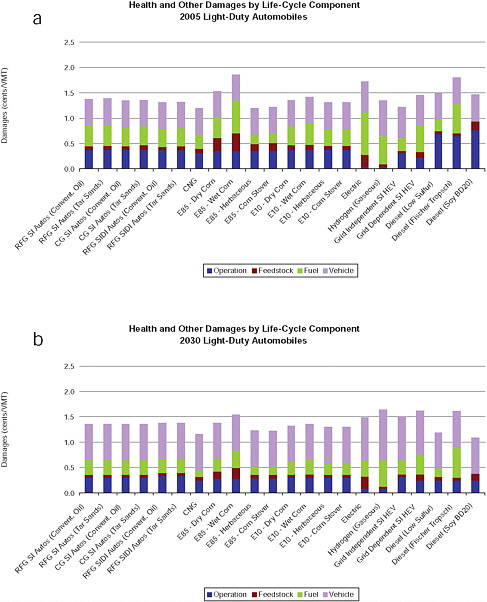
FIGURE 7-6 Health effects and other nonclimate damages are presented by lifecycle component for different combinations of fuels and light-duty automobiles in 2005 (a) and 2030 (b). Damages are expressed in cents per VMT (2007 U.S. dollars). Going from bottom to top of each bar, damages are shown for life-cycle stages as follows: vehicle operation, feedstock production, fuel refining or conversion, and vehicle manufacturing. Damages related to climate change are not included. ABBREVIATIONS: VMT, vehicle mile traveled; CG SI, conventional gasoline spark ignition; CNG, compressed natural gas; E85, 85% ethanol fuel; E10, 10% ethanol fuel; HEV, hybrid electric vehicle.
Although our analysis was able to consider and quantify a wide range of emissions and damages throughout the life cycle and included what arguably could be considered the most significant contributors to estimates of such damages (for example, premature mortality resulting from exposure to air pollution), many potential damages could not be quantified at this time. These damages include the following:
-
Overall: Estimates of the impacts of hazardous air pollutants, estimates of damages to ecosystems (for example, from deposition), and estimates covering the full range of agricultural crops.
-
For biofuels: Impacts on water use and water contamination, as well as any formal consideration of potential indirect land-use effects (see, however, the discussion of the latter in Chapter 3).
-
For battery electric vehicles: Potential exposures to toxic contaminants as a result of battery manufacture, battery disposal, and accidents.
Any such analysis includes a wide set of assumptions and decisions about analytical techniques that can introduce uncertainty in the results. Although we did not attempt to conduct a formal uncertainty analysis, we engaged in limited sensitivity analyses to check the effects of key assumptions on the results. We urge the reader to be cautious when interpreting small differences in results among the wide range of fuels and technologies we assessed.
Greenhouse Gas Emissions
Similar to the damage estimates presented above, the GHG emission estimates for each fuel and technology combination can provide relative estimates of GHG performance in 2005 and 2030. Although caution should be exercised in interpreting these results and comparing fuel and technology combinations, some instructive observations from Table 7-2 are possible. Overall, the substantial improvements in fuel efficiency in 2030 (to a minimum of 35.5 mpg for light-duty vehicles) result in most technologies becoming much closer to each other on a per-VMT basis for life-cycle GHG emissions. There are, however, some differences:
-
As with damages above, the herbaceous and corn stover E85 have relatively low GHG emissions over the life cycle; in terms of aggregate grams per VMT of CO2-equivalent (CO2-eq)6 emissions, E85 from corn also has relatively low GHG emissions.
TABLE 7-2 Relative Categories of GHG Emissions in 2005 and 2030 for Major Categories of Light-Duty-Vehicle Fuels and Technologies
|
Category of Aggregate CO2-eq Emission Estimates (g/VMT) |
2005 |
2030 |
|
150–250 |
E85 herbaceous E85 corn stover |
E85 herbaceous E85 corn stover |
|
250–350 |
Hydrogen gaseous |
E85 corn Diesel with biodiesel Hydrogen gaseous CNG |
|
350–500 |
E85 corn Diesel with biodiesel Grid-independent HEV Grid-dependent HEV Electric vehicle CNG |
Grid-independent HEV SI conventional gasoline, RFG Grid-dependent HEV Electric vehicle Low-sulfur diesel E10 herbaceous, corn stover SIDI conventional gasoline E10 corn SI tar sands |
|
>600 |
Tar sands |
|
|
500–599 |
Conventional gasoline and RFG E10 Low-sulfur diesel |
|
|
ABBREVIATIONS: CO2-eq, carbon dioxide equivalent; VMT, vehicle miles traveled; E85, ethanol 85% blend; E10, ethanol 10% blend; HEV, hybrid electric vehicle; CNG, com pressed natural gas; RFG, reformulated gasoline; SI, spark ignition; SIDI, spark ignition direct injection. |
||
-
The tar-sands-based fuels have the highest GHG emissions of any of the fuels that the committee considered.
As shown in Figure 7-7, and in contrast to the damages analysis above, the operation of the vehicle is in most cases a substantial relative contributor to total life-cycle GHG emissions. That is not the case, however, with either the grid-dependent technologies (for example, electric or grid-dependent hybrid) or the hydrogen fuel-cell vehicles. In the latter vehicle technologies, the dominant contributor to life-cycle GHG emissions is electricity generation and the production of hydrogen rather than vehicle operation.
Heavy-Duty Vehicles
The committee also undertook a more limited analysis of the nonclimate-change-related damages and GHG emissions associated with heavy-duty vehicles. Although this analysis included operation, feedstock, and fuel com-
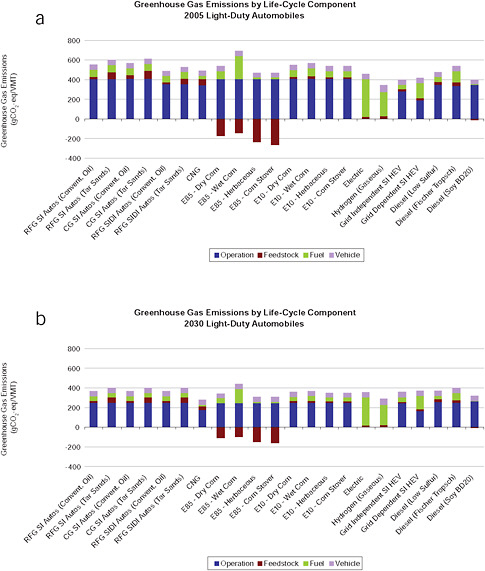
FIGURE 7-7 Greenhouse gas emissions (grams CO2-eq)/VMT by life-cycle component for different combinations of fuels and light-duty automobiles in 2005 (a) and 2030 (b). Going from bottom to top of each bar, damages are shown for life-cycle stages as follows: vehicle operation, feedstock production, fuel refining or conversion, and vehicle manufacturing. One exception is ethanol fuels for which feedstock production exhibits negative values because of CO2 uptake. The amount of CO2 consumed should be subtracted from the positive value to arrive at a net value. ABBREVIATIONS: g CO2-eq, grams CO2-equivalent; VMT, vehicle mile traveled; CG SI, conventional gasoline spark ignition; CNG, compressed natural gas; E85, 85% ethanol fuel; E10. 10% ethanol fuel; HEV, hybrid electric vehicle.
ponents of the life cycle, it could not—because of the wide range of vehicle types and configurations—include a vehicle-manufacturing component. In sum, there are several conclusions that can be drawn:
-
The nonclimate-change-related damages per VMT in 2005 are significantly higher than those for light-duty vehicles, as shown above, although they of course pertain to a much higher weight of cargo or number of passengers being carried per VMT.
-
Damages not related to climate-change effects drop significantly in 2030 as a result of the full implementation of the 2007-2010 Highway Diesel Rule, which requires substantial reductions in PM and NOx emissions.
-
Amounts of GHG emissions are driven primarily in these analyses by the operations component of the life cycle, and they do not change substantially between 2005 and 2030 (except for a modest improvement in fuel economy). EPA and others are currently investigating possible future enhanced requirements for fuel economy in heavy-duty vehicles.
HEAT GENERATION
The committee conducted an assessment focused on air-pollution impacts associated with the present and future (2030) use of natural gas for heat in residential and commercial building sectors. The industrial sector was considered more qualitatively, as published statistics do not differentiate clearly between fuel used for heating and for process feedstocks. We focused our assessment on natural gas because it is the major energy source for heat in buildings, although buildings also consumed about 5% of the 39.7 quadrillion British thermal units (quads) of petroleum used in 2008. Only about 12% of U.S. households use a space-heating fuel other than gas, electricity, or petroleum-based fuels
This section summarizes the above assessment, as well as estimates of GHG emissions due to heat generation. Climate-change-related damages are discussed later in this chapter.
Heat for Residential and Commercial Buildings
We estimated damages attributable to SO2, NOx, PM2.5, VOC, and NH3 emissions from on-site combustion across 3,100 U.S. counties. Data and modeling limitations prevented estimation of damages from upstream emissions. The median estimated damages (in 2007 USD) attributable to natural gas combustion for heat in residential buildings are approximately $0.11 per thousand cubic feet (MCF), or 1% of the 2007 residential price of natural gas. Aggregate damages (unrelated to climate change) were approximately $500 million (2007 USD). The median regional estimated damages from natural gas combustion for heat in residential buildings ranged
from $0.06 to 0.14/MCF, the upper tail of the distribution was as much as 5% of the current residential price of natural gas when evaluating the 90th percentile value in the South region of the United States. We estimate that damages from combusting natural gas for direct heat are much lower than the damages related to heat produced from electricity, based on average values of the U.S. electricity grid.
Estimated damages from natural gas for heat in commercial buildings are very similar to the estimates for residential buildings. The median estimated externality of natural gas combustion for heat in the commercial building sector is approximately $0.11/MCF, and aggregate damages are about $300 million (excluding damages related to climate change) (2007 USD). The variation across U.S. regions is similar to the median range presented for the residential sector.
In 2007, the combined residential and commercial building sectors emitted an estimated 618 million tons of CO2.
Damages associated with energy for heat in 2030 are likely to be approximately the same as those that exist today, contingent upon the development of additional sources to meet demand. Reduction would probably result from changes in the electricity sector, as emissions from natural gas are relatively small and already well-controlled. Increases are possible if new domestic development has higher emissions or if additional imports of liquefied natural gas are needed.
Heat for Industry
Natural gas use for heating in the industrial sector (6 quads), excluding use for feedstock, is less than natural gas use in the residential and commercial building sectors (8 quads) for 2007; thus, health and environmental damages associated with industrial natural gas use are probably the same order of magnitude or less than the damages associated with natural gas use for heat in residential and commercial buildings. Therefore, a very rough order of magnitude estimate of average externalities associated with the industrial sector use of natural gas is $0.10/MCF, excluding GHG damages
For 2007, about 1,084 million tons of CO2 were emitted from the industrial sector as a result of natural gas combustion for heat. That amount is greater than the combined amount of 617 million tons of CO2 from the residential and commercial sectors. As discussed below, nonclimate-change damages from natural gas combustion for direct heat are likely to be much smaller than natural gas combustion damages related to climate change.
In Sum
Aggregate damages from combustion of natural gas for direct heat are estimated to be about $1.4 billion per year (2007 USD), assuming the
magnitude of effects resulting from heat production in industrial activities is comparable to those of residential and commercial sectors. Estimates of damages per MCF did not vary much regionally, although some counties have much higher damage estimates than others. The largest potential for reducing damages associated with the use of energy for heat lies in greater attention to improving the efficiency of energy use.
Damages associated with energy for heat in 2030 are likely to be about the same as those that exist today, assuming that the effects of additional sources to meet demand are offset by lower-emitting sources. Reduction in damages would only result from more significant changes—largely in the electricity-generating sector, as emissions from natural gas are relatively small and well-controlled. The greatest potential for reducing damages associated with the use of energy for heat lies in greater attention to improving efficiency. Increased damages would also be possible, however, if new domestic energy development resulted in higher emissions or if additional imports of liquefied natural gas, which would increase emissions from the production and international transport of the fuel, were needed.
Combustion of natural gas results in relatively lower GHG and criteria-pollutant-forming emissions, as compared with similar emissions from coal (the main energy source for electricity generation) and petroleum combustion.
CLIMATE CHANGE
Energy production and use is a major source of GHG emissions, principally CO2 and methane. Externalities are created as increased atmospheric GHG concentrations affect climate, and subsequently, weather, water quality and availability, sea-level rise, and biodiversity. Changes in these physical and biological systems in turn affect a variety of aspects of human life, including water resources, ecosystem services, food production, and health, among other impacts. Quantifying and valuing climate-change impacts to calculate the marginal damage of a ton of carbon, often referred to as the “the social cost of carbon,” is an intricate process that involves detailed modeling and analysis. Integrated assessment models (IAMs), which produce such estimates, must make assumptions about the relationship between emissions and temperature change and temperature and economic impacts in multiple sectors. The magnitude of these impacts depends to a large extent on changes in climate and on human adaptation to climate change in the distant future. The discount rate used to determine present-day values of future impacts is thus of key importance, as is the extent to which various climatic changes are expected to be extreme and irreversible.
Given the complexity in evaluating the externalities of energy-induced climate change, the committee focused its efforts on a review of existing IAMs (specifically, the Dynamic Integrated Model of Climate and the Economy [DICE], the Climate Framework for Uncertainty, Negotiation, and Distribution [FUND] model, and the Policy Analysis of the Greenhouse Effect [PAGE] model) and the associated climate-change literature. The committee came to the following conclusions, as discussed in Chapter 5:
-
The two features of IAMs that drive estimates of the marginal damage associated with emitting an additional ton of carbon are the choice of discount rate and the relationship between mean temperature change and the percentage change in world gross domestic product (GDP) (that is, the aggregate damage function).
-
Holding the discount rate constant, the choice of damage function can alter estimates of marginal damages by an order of magnitude; for example, at a 3% discount rate, the marginal social cost of carbon is approximately $2 per ton of CO2-eq using the FUND model and $22 per ton of CO2-eq using the PAGE model. The differences between these two well-reviewed and respected IAMs illustrate the scientific uncertainties inherent in predicting the magnitude of climate-change damage functions.
-
Holding the damage function constant, changing the discount rate from 4.5% to 1.5% will cause the marginal social cost of carbon to rise by an order of magnitude: in the PAGE model; for example, the marginal social cost of carbon is approximately $100 per ton of CO2 at a 1.5% discount rate and $10 at 4.5% discount rate.
-
In all IAMs, marginal damage estimates for 2030 GHG emissions are 50% to 80% larger than estimates of damages from emissions occurring within the past few years.
-
The impacts of climate change are likely to vary greatly across countries. The estimates of the marginal damage of a ton of CO2-eq, as cited in this report, sum damages across countries using relative GDP as weight, which gives less weight to the damages borne by low-income countries.
-
There is great uncertainty about the impact of GHG emissions on future climate and about the impacts of changes in climate on the world economy. This uncertainty is usually handled in IAMs using Monte Carlo simulation. The model is run many times, drawing key parameters from their probability distributions that reflect the uncertainty about the values. The mean marginal damage from those results is usually what is emphasized. This approach does not adequately capture the small probability of catastrophic climate changes and impacts. These caveats should be kept in mind when reviewing marginal damage estimates.
COMPARING CLIMATE AND NONCLIMATE DAMAGE ESTIMATES
Table 7-3 summarizes the results of the committee’s quantitative analyses of damages related to the production and use of energy. The table presents the monetized health damages and other monetized damages not related to climate change that were presented in this report. In addition, for illustrative purposes, the table presents three different estimates of external global damages on a per-unit basis from effects related to climate change. The different estimates were obtained by selecting three alternative marginal GHG damage values ($10, $30, and $100 per ton CO2-eq) and multiplying each of them by GHG emission rates for electricity generation (coal-fired and natural-gas-fired), for a range of transportation fuels and vehicle technologies, and for the production of heat by combusting natural gas. It is important to note that the damage estimates at the higher end of the range of marginal GHG damage values are associated only with emission paths without significant GHG controls.
The estimated damages related to climate change on a per-unit-of-fuel basis differ across various primary fuels and energy end uses. These estimates are summarized in Table 7-3. How the monetized value of damages related to climate change compares with the value of damages from SO2, NOx, and PM emissions depends on the value chosen for the social cost of carbon. If the social cost of carbon were $30 per ton of CO2-eq, climate-change-related damages would be approximately 3 cents per kWh at coal-fired power plants and 1.5 cents per kWh at natural gas plants, equaling or exceeding in value the damages from SO2, NOx, and PM. For transportation, the value of climate-change damages begins to approach the value of nonclimate damages at $30 per ton of CO2-eq. For direct heat, each estimate of climate-related damages substantially exceeds the damage estimate from nonclimate damages. Thus, in Table 7-3, damages related to climate change are dominant for electricity generated from natural gas and for heat production at all levels of the social cost of carbon. Climate damages for electricity generation from coal and for transportation can be larger than nonclimate damages if a high value is chosen for the social cost of carbon.
Estimates of damages presented in this report do not by themselves provide a guide to policy. Economic theory suggests that the damages associated with pollution emissions should be compared with the costs of reducing emissions: If distributional equity issues are put aside, the theory suggests that damages should not be reduced to zero, but only to the point where the marginal cost of reducing another ton of emissions or other type of burden equals the marginal damages avoided. Whether emissions should be reduced from the viewpoint of economic efficiency depends on the current level of emissions and the cost of reducing them; it cannot be
TABLE 7-3 Monetized Damages Per Unit of Energy-Related Activitya
|
Energy-Related Activity (Fuel Type) |
Nonclimate Damage |
Climate Damages (per ton CO2-eq)c |
|||
|
CO2-eq Intensity |
At $10 |
At $30 |
At $100 |
||
|
Electricity generation (coal) |
3.2 cents/kWh |
2 lb/kWh |
1 cent/kWh |
3 cents/kWh |
10 cents/kWh |
|
Electricity generation (natural gas) |
0.16 cents/kWh |
1 lb/kWh |
0.5 cent/kWh |
1.5 cents/kWh |
5 cents/kWh |
|
Transportationb |
1.2 to >1.7 cents/VMT |
0.3 to >1.3 lb/VMT |
0.15 to >.65 cent/VMT |
0.45 to >2 cents/VMT |
1.5 to >6 cents/VMT |
|
Heat production (natural gas) |
11 cents/MCF |
140 lb/MCF |
70 cents/MCF |
210 cents/MCF |
700 cents/MCF |
|
aBased on emission estimates for 2005. Damages are expressed in 2007 U.S. dollars. Damages that have not been quantified and monetized are not included. bTransportation fuels include E85 herbaceous, E85 corn stover, hydrogen gaseous, E85 corn, diesel with biodiesel, grid-independent HEV, grid-dependent HEV, electric vehicle, CNG, conventional gasoline and RFG, E10, low-sulfur diesel, tar sands. (See Table 7-1 for relative categories of nonclimate damages and Table 7-2 for relative categories of GHG emissions.) cOften called the “social cost of carbon.” ABBREVIATIONS: CO2-eq, carbon dioxide equivalent; VMT, vehicle miles traveled; MCF, thousand cubic feet; E85, ethanol 85% blend; HEV, hybrid electric vehicle; CNG, compressed natural gas; RFG, reformulated gasoline. |
|||||
determined from the size of damages alone. We emphasize, however, that economic efficiency is only one of several potentially valid policy goals that need to be considered in managing pollutant emissions and other damages.
OVERALL CONCLUSIONS AND IMPLICATIONS
Electricity Generation
Our analysis of the damages associated with energy for electricity focused on air-pollution damages—both local and global—associated with electricity generation. These estimates can be used to inform the choice of type of fuel used to generate electricity and to guide policies regarding the regulation of air emissions from electricity generation.
Regarding Comparisons Among Fuels for Electricity Generation
-
In 2005 damages per kWh from SO2, NOx, and PM emissions were an order of magnitude higher for coal than for natural gas plants: on average, approximately 3.2 cents per kWh for coal and 0.16 cents per kWh for natural gas (2007 USD). SO2, NOx, and PM emissions per kWh were virtually nil for electricity generation from nuclear, wind, and solar plants and not calculated for plants using biomass for fuel.
-
Average figures mask large variations among plants in air-pollution damages per kWh, which primarily reflect differences in pollution control equipment. For coal plants, the 5th percentile of the distribution of damages was only 0.5 cents per kWh (2007 USD). Newer plants emit significantly less SO2 and NOx per kWh than older plants.
Regarding the Regulation of Air-Pollutant Emissions from Electricity Generation
-
Estimates of aggregate air-pollution damages (damages per kWh times kWh generated) can help to identify situations where additional pollution controls might pass the benefit-cost test. We note that the damages from SO2, NOx, and PM at all coal plants, conservatively calculated, were approximately $62 billion in 2005 (2007 USD). (This figure represents the damages from emissions in 2005 relative to zero emissions.) When considering regulations, these damages provide important information to be compared with the costs of controlling emissions related to criteria air pollutants—in particular, comparing the marginal damages per kWh or ton of pollutant with the marginal costs of reducing the emissions.
-
The distribution of damages associated with emissions of SO2, NOx, and PM is highly skewed for both coal-fired power plants and
-
natural-gas-fired plants. The 10% of coal plants with the lowest damages produced 43% of air-pollution damages from all coal plants, while the 50% of the coal plants with the lowest damages produced less than 12% of the aggregate damages. (Each group of plants produced the same amount of electricity—about 25% of net generation from coal.) The 10% of natural gas plants with the highest damages per plant in our study produced 24% of the electricity but 65% of the damages.
-
For policy purposes, it is useful to know the damages associated with emitting an additional ton of a pollutant because the most economically efficient pollution-control policies are those that target emissions directly. These damages vary significantly depending on the pollutant (NOx vs. PM) and on where it is emitted. The damage associated with a ton of SO2 varies from $1,800 to $10,700 (5th and 95th percentile) at coal plants and from $1,800 to $44,000 at natural gas plants (2007 USD). The differences reflect the fact that most coal-fired power plants are located farther away from population centers than natural gas plants are located from population centers. The highest damages per ton are associated with directly emitted PM. These damages vary from $2,600 to $160,000 (5th and 95th percentile) at natural gas plants and from $2,600 to $26,000 at coal-fired power plants (2007 USD).
Transportation
Perhaps the most important conclusion to be taken from the transportation analyses is that, when viewed from a full life-cycle perspective, the results are remarkably similar across fuel and technology combinations. One key factor contributing to the similarity is the relatively high contribution to health and other non-GHG damages from emissions in life-cycle phases other than the operation of the vehicle. (These phases are the development of the feedstock, the processing of the fuel, and the manufacturing of the vehicle.) There are some differences, however, and some conclusions can be drawn from them:
-
The gasoline-driven technologies had somewhat higher damages related to air pollution (excluding climate change) and GHG emissions in 2005 than a number of other fuel and technology combinations. The grid-dependent electric vehicle options had somewhat higher damages than many other technologies, even in our 2030 analysis, in large measure because of continued conventional emissions and GHG emissions from the existing grid and the likely future grid.
-
The choice of feedstock for biofuels can significantly affect the relative level of life-cycle damages, and herbaceous and corn stover feedstock have some advantage in our analysis.
-
Additional regulatory actions can significantly affect levels of damages and GHG emissions:
-
This is illustrated in the health and nonclimate damage analysis by the substantial reduction in diesel damages from 2005 to 2030. Major regulatory initiatives to reduce electricity-generation emissions or legislation to regulate carbon emissions would be expected to significantly reduce the relative damages and emissions from the grid-dependent electric-vehicle options. Similarly, a significant shift to lower-emitting grid technologies, such as natural gas, renewable sources, and nuclear, would also reduce these damages.
-
In 2030, with the implementation of enhanced 35.5 mpg requirements now being put in place for light-duty vehicles under CAFE and EPA GHG emission rules, the differences among technologies tend to converge somewhat, although the fact that operation of the vehicle is generally less than a third of overall life-cycle emissions and damages tends to dampen the magnitude of that improvement. Further enhancements in fuel efficiency, such as the likely push for an extension beyond 2016 to further improvements, would further improve the GHG emission estimates for all liquid-fuel-driven technologies.
-
Overall, there are somewhat modest differences among different types of vehicle technologies and fuels, even under the likely 2030 scenarios, although some technologies (for example, grid-dependent electric vehicles) had higher life-cycle emissions. It appears, therefore, that some breakthrough technologies, such as cost-efficient conversion of advanced biofuels, cost-efficient carbon capture and storage, and a shift to a mix of lower-emitting sources of electricity (such as natural gas, renewable sources, and nuclear) will be needed to dramatically reduce transportation-related externalities.
Heat Generation
-
The damages associated with criteria-pollutant-related emissions from the use of energy (primarily natural gas) for heating in the residential, commercial buildings, and industrial sectors are low relative to damages from energy use in the electricity-generation and the transportation sectors. This result is largely because natural gas has low rates of those emissions compared with emissions typically resulting from the electricity-generation and transportation sectors.
-
The climate-change-related damages from the use of energy (primarily natural gas) for heating in the buildings and industrial sectors are low relative to climate-change-related damages associated with transpor-
-
tation and electricity production because natural gas carbon intensity is lower than that of coal and gasoline. Regarding energy use for heating, the climate-related damages are in general significantly higher than the nonclimate damages.
-
The largest potential for reducing damages associated with the use of energy for heat lies in greater attention to improving the efficiency. The report America’s Energy Future: Technology and Transformation suggests that the potential for improving efficiency in the buildings and industrial sectors is 25% or more—with the likelihood that emissions damages in these sectors could be held constant in spite of sectoral growth between now and 2030 (NAS/NAE/NRC 2009a).
Climate Change
Given the complexity of evaluating the externalities of energy-induced climate change, the committee focused its efforts on a review of existing IAMs and the associated climate-change literature. The committee came to the following conclusions, as discussed in Chapter 5:
-
The two features of IAMs that drive estimates of the marginal damage associated with emitting an additional ton of carbon (the marginal social cost of carbon) are the choice of discount rate and the relationship between mean temperature change and the percentage change in world GDP (that is, the aggregate damage function).
-
Holding the discount rate constant, the damage function used in current IAMs can alter estimates of marginal damages by an order of magnitude.
-
Holding the damage function constant, changing the discount rate from 4.5% to 1.5% in an IAM will cause the marginal social cost of carbon to change by an order of magnitude.
-
In all IAMs, marginal damage estimates for 2030 GHG emissions are 50-80% larger than estimates of damages from emissions occurring within the past few years.
-
There is great uncertainty about the impact of GHG emissions on future climate and about the impacts of changes in climate on the world economy. Mean values of marginal damage estimates are usually reported from integrated planning model simulations. This approach does not adequately capture the small probability of catastrophic climate changes.
Infrastructure and Security
In Chapter 6, the committee considered damages related to disruptions in the electricity-transmission grid, the vulnerability of energy facilities to
accidents and possible attack, the external costs of oil consumption, supply security considerations, and national security externalities. The committee strove to clarify approaches for considering security externalities and disentangle externalities from other motivations for energy policy. The committee concludes as follows:
-
The nation’s electricity-transmission grid is vulnerable to outages and to power quality degradation events because of transmission congestion and the lack of adequate reserve capacity. Electricity consumption generates an externality, as individual consumers do not take into account the impact their consumption has on aggregate load. Damages from this could be significant, and it underscores the importance of careful analysis concerning the costs and benefits of investing in a modernized grid that takes advantage of new smart technology and that is better able to handle intermittent renewable power sources.
-
Externalities from accidents at facilities are largely internalized and—in the case of the U.S. oil and gas transmission network—of negligible magnitude per barrel of oil or thousand cubic feet of gas trans-shipped.
-
The monopsony component of the oil consumption premium is not an externality. Government policy may be desirable as a countervailing force to monopoly or cartel producer power; however, this is a separate issue from the focus of this report.
-
We find that macroeconomic disruptions from oil supply shocks are not an externality. We also find that sharp and unexpected increases in oil prices adversely affect the U.S. economy. Estimates in the literature of the macroeconomic costs of disruption and adjustment ranged from $2 to $8 per barrel in 2007 dollars
-
Dependence on imported oil has implications for foreign policy, and we find that some of the effects should be viewed as externalities. We find, however, that it is impossible to quantify these externalities. The role of the military in safeguarding foreign supplies of oil is often identified as a potential externality. We find it difficult if not impossible to disentangle nonenergy-related reasons for a military presence in certain regions of the world from energy-related reasons. Moreover, much of the military cost is likely to be fixed in nature. A 20% reduction in oil consumption, for example, would probably have little impact on the strategic positioning of military forces in the world.
-
Nuclear waste and security raises important issues and poses difficult policy challenges. The extent to which externalities exist is difficult to measure. Moreover, it is very difficult to quantify them. Thus, we do not report values in this report but recognize the importance of studying this issue further.
RESEARCH RECOMMENDATIONS
The committee’s results include two major caveats: A significant number of potential damages cannot be quantified at this time, and substantial uncertainties are associated with the damages that have been quantified. Developers of the committee’s statement of task anticipated such circumstances, stating that when it is not feasible to assess specific externalities comprehensively, the committee should recommend assessment approaches and identify key information needs to inform future assessments. In response, the committee has developed a number of research recommendations specific to key topics in this report—electricity, transportation, heat generation, and climate change—as well as one overarching recommendation.
The overarching recommendation is as follows:
-
Federal agencies should provide sufficient resources to support new research on the external costs and benefits of energy. In assembling its repository of literature, models, and data needed to carry out an assessment of externalities, the committee became aware that there is limited research funding available to address the topic of externality assessment. In particular, extramural funding from federal agencies provides little support or incentive to pursue this line of research. For example, the APEEP model used in our analysis was funded by a foundation. The GREET model, which we used to estimate transportation-related emissions, is federally supported, but does not explicitly address damages, so it must be coupled with a damage assessment model. EPA has had strong interest and ongoing programs in damage and benefit assessment of air pollution but offers limited resources for research to improve and evaluate its approaches or to develop and assess approaches for other environmental concerns. Because of the growing importance of impact assessment and impact valuation for policy decision making at all levels of government and to avoid a situation in which key uncertainties are addressed only as an adjunct to other research programs, the committee encourages federal agencies, such as the Department of Energy, the Department of Transportation, the National Institutes of Health, the National Science Foundation, and EPA, to support new research specific to externalities with financial resources that are sufficient to address the recommendations for the key topics below in a timely manner.
Electricity
-
Although life-cycle activities pre- and post-generation generally appear to be responsible for a smaller portion of the life-cycle externalities than electricity generation itself, it is desirable to have a systematic estima-
-
tion and compilation of the externalities from these other activities that are comparable in completeness to the externality estimates for the generation part of the life cycle. In this compilation, it will be particularly important to take into account activities (for example, the storage and disposal of coal combustion by-products and the in situ leaching techniques for uranium mining) that may have locally or regionally significant impacts.
-
The use of “reduced-form” modeling of pollutant dispersion and transformation is a key aspect in estimating externalities from airborne emissions on a source-by-source basis; these models should continue to be improved and evaluated.
-
The health effects associated with toxic air pollutants, including specific components of PM, from electricity generation should be quantified and monetized. Given the importance of the “value of a statistical life” in determining the size of air-pollution damages, further exploration is needed to determine how willingness to pay varies with mortality-risk changes and with population characteristics, such as age and health status.
-
Because current data on electricity-generation facilities are available mainly as national averages, improved data and methods are needed to characterize the mix of electricity-generation technologies (and their associated range of emissions per kWh) at city, state, and regional levels. The current disaggregation of national-level information to regional or state levels that are available from the Department of Energy and EPA are often not sufficiently detailed for impact or damage assessments within specific areas of the United States.
-
Continued improvement is necessary in the development of methods to quantify and monetize ecological impacts of all stages of the life cycle of electricity generation, especially of fuel extraction, emission of pollutants, and land-use changes. Similar needs exist for other types of energy production and use.
-
For fossil fuel options, more research is needed to quantify and monetize the ecological and socioeconomic impacts of fuel extraction, for example, of mountaintop mining and valley fill.
-
For nuclear power, significant challenges in estimating potential damages include estimating and valuing risks when the probabilities of accidents and of radionuclide migration (for example, at a high-level waste repository) are very low but the consequences potentially extreme. It is important to assess how such risks would change based on advances in the technology and regulations and to determine whether the costs to utilities of meeting their regulatory requirements fully reflect these potential damages.
-
The analysis of risks associated with nuclear power in the ORNL/RFF (1992-1998) reports should be updated to reflect advances in technology and science.
-
For wind technologies, the major issues lie in quantifying bird and bat deaths; in quantifying or otherwise systematically assessing disturbances to local landscapes, ecosystems, and human populations; and in valuing them in terms comparable to economic damages.
-
For solar technologies, one of the greatest needs is an analysis of the upstream activities that quantifies the possible releases of toxic materials and their damages; other needs are a better understanding of the externalities that would accompany disposal or recycling of worn-out panels and dedicating tracts of land to solar power equipment.
-
For the transmission lines needed in a transition to a national grid system, better estimates are needed of both the magnitude and the spatial distribution of negative and positive externalities that would accompany this transition.
Transportation
-
It is imperative to better understand potential negative externalities at the earliest possible stage in the research and development process for new fuels and technologies to avoid those externalities as the fuels and technologies are being developed.
-
Improved understanding is needed of the currently unquantifiable effects and potential damages related to transportation, especially as they relate to biofuels (for example, effects on water resources and ecosystems) and battery technology (for example, effects throughout the battery life cycle of extraction through disposal).
-
More accurate emissions factors are needed for each stage of the fuel and vehicle life cycle. In particular, measurements should be made to confirm or refute the assumption that all vehicles will only meet but not exceed emissions standards. In actual practice, there can be significant differences between on-road performance and emissions requirements, and some alternative-fuel vehicles may do better or worse than expected.
-
Because a significant fraction of life-cycle health impacts comes from vehicle manufacture and fuel production, it is important to improve and expand the information and databases used to construct emissions factors for those life stages. In particular, there is a need to understand whether and how energy-efficiency improvements in these industrial components might change the overall estimates of life-cycle health damages.
-
The issue of indirect land-use change is central to current debates about the merit of biofuels. Regardless of whether this impact is regarded as an externality associated with U.S. or foreign biofuels production, it is important to obtain more empirical evidence about its magnitude and causes, as well as to improve the current suite of land-use change models.
-
As better data become available, future studies should take a range
-
of transportation modes into account—not only those that are alternatives to automobiles and light trucks (for example, public transit), but also air, rail, and marine, which are alternatives for long-distance travel and freight.
Heat Generation
-
Assessment of energy use and its impacts in the industrial sector in particular (but in all sectors to some extent) could be improved by development of more extensive databases that contain details about specific forms of energy use and associated waste streams. Such databases should be designed so that life-cycle analysis of alternatives can be made without inadvertent double counting.
-
A more quantitative assessment of industrial sector externalities, done collaboratively between the government and industry, would be valuable in informing priorities for future initiatives to reduce the externalities associated with industrial operations. Such an assessment was not possible in this study largely because of data limitations.
Climate Change
-
More research on climate damages is needed to estimate the impacts of climate change, especially impacts that can be expressed in economic terms, as current valuation literature relies heavily on climate-change impact data from the year 2000 and earlier.
-
Marginal damages of GHG emissions may be highly sensitive to the possibility of catastrophic events. More research is needed on their impacts, the magnitude of the damages in economic terms, and the probabilities associated with various types of catastrophic events and impacts.
-
Estimates of the marginal damage of a ton of CO2-eq include aggregate damages across countries according to GDP, thereby giving less weight to the damages borne by low-income countries. This aggregate estimate should be supplemented by distributional measures that describe how the burden of climate change varies among countries.
In Conclusion
In aggregate, the damage estimates presented in this report for various external effects are substantial. Just the damages from external effects that the committee was able to quantify add up to more than $120 billion for
the year 2005.7 Although large uncertainties are associated with the committee’s estimates, there is little doubt that the aggregate total substantially underestimates the damages because it does not include many other kinds of damages, such as those related to some pollutants, climate change, ecosystems, infrastructure, and security, that could not be quantified for reasons explained in the report. In many cases, we have identified the omissions in this report, with the hope that they will be evaluated in future studies.
Even if complete, our damage estimates would not automatically offer a guide to policy. From the perspective of economic efficiency, theory suggests that damages should not be reduced to zero but only to the point where the cost of reducing another ton of emissions (or other type of burden) equals the marginal damages avoided—that is, the degree to which a burden should be reduced depends on its current level and the cost of lowering it. The solution cannot be determined from the amount of damage alone. Economic efficiency, however, is only one of several potentially valid policy goals that need to be considered in managing pollutant emissions and other burdens. For example, even within the same location, there is compelling evidence that some members of the population are more vulnerable than others to a particular external effect.
Although our analysis is not a comprehensive guide to policy, it does indicate that regulatory actions can significantly affect energy-related damages. For example, the full implementation of the federal diesel-emissions rules would result in a sizeable decrease in nonclimate damages from diesel vehicles between 2005 and 2030. Similarly, major initiatives to further reduce other emissions, improve energy efficiency, or shift to a cleaner electricity-generating mix (for example, renewable sources, natural gas, and nuclear) could substantially reduce the damages of external effects, including those from grid-dependent hybrid and electric vehicles.
It is thus our hope that this information will be useful to government policy makers, even in the earliest stages of research and development on energy technologies, as an understanding of their external effects and damages could help to minimize the technologies’ adverse consequences.


