
Appendix D
Analysis of Out-of-Band Emission Impacts to the EESS from §27.53 of the FCC Rules
The general analysis presented here is applicable both to Earth Exploration-Satellite Service (EESS) radiometers and to Radio Astronomy Service (RAS) radiometers. EESS and RAS radiometers are governed by the same technical principles, and for both, a source of radio frequency interference (RFI) operating in compliance with Federal Communications Commission (FCC) rules can deleteriously affect a radiometer operating in a primary protected band, as described below.
Parameters of two Federal Aviation Administration (FAA) Air Route Surveillance Radars (ARSRs) are given in Table D.1, from Piepmeier and Pellerano.1
According to FCC rules, 47 C.F.R., §27.53, Part (j) (page 387) out-of-band (OOB) emission limits for the class of radars specified in Table D.1 are as follows:
For operations in the unpaired 1390-1392 MHz band and the paired 1392-1395 MHz and 1432-1435 MHz bands, the power of any emission outside the licensee’s frequency band(s) of operation shall be attenuated below the transmitter power (P, in Watts) by at least (43 + 10 log (P)) dB.2
Note that the “log function refers here to the base 10 logarithm. In order to determine if the specified attenuation is achieved, measurement of the out-of-band
|
1 |
J.R. Piepmeier and F. A. Pellerano, “Mitigation of Terrestrial Radar Interference in L-Band Spaceborne Microwave Radiometers, in Proceedings of the 2006 International Geoscience and Remote Sensing Symposium (IGARSS), Denver, Colorado, 2006, pp. 2292-2296, DOI 10.1109/IGARSS.2006.593. |
|
2 |
See 47 C.F.R., §27.53, Part (j), available at http://ecfr.gpoaccess.gov/; accessed January 15, 2010. |
TABLE D.1 Parameters of Two Federal Aviation Administration Air Route Surveillance Radars
|
Name |
Frequency (MHz) |
Peak Power (kW) |
Antenna Gain (dBi) |
Azimuth Beamwidth (degrees) |
Scan Rate (rpm) |
Pulse Width (μsec) |
Pulse Repetition Frequency (PRF) (Hz) |
|
ARSR-3 |
1250-1350 |
5000 |
34 |
1.25 |
5 |
2 |
310-365 |
|
ARSR-4 |
1215-1400 |
60 |
35 |
1.4 |
5 |
9/60 |
216/72 |
|
SOURCE: J.R. Piepmeier and F.A. Pellerano, “Mitigation of Terrestrial Radar Interference in L-Band Spaceborne Microwave Radiometers,” in Proceedings of the 2006 International Geoscience and Remote Sensing Symposium (IGARSS), Denver, Colorado, 2006, pp. 2292-2296, DOI 10.1109/IGARSS.2006.593. |
|||||||
radiated power in a 1 MHz bandwidth is specified by the FCC. It is therefore possible to radiate larger out-of-band total powers in bandwidths larger than 1 MHz. These regulations specify for the ARSR-4 radar, for example, that the allowed OOB emission is Pt_OOB = 10 log(6 · 104W) − (43 + 10 log(6 · 104W)) = −43 dBW (peak) in a 1 MHz bandwidth.
The Friis formula specifies the power received by an EESS radiometer from a transmitting source:

where LFDR is the frequency dependent rejection (FDR) factor, Pt is the transmit power of the radar,  is the gain of the radar transmitting antenna in the direction of the radiometer,
  is the gain of the radiometer antenna in the direction of the radar, λ is the wavelength of the radar frequency, and R is the range between the radar and the radiometer. Using this equation to test the permissible spurious and OOB power levels according to §27.53, set LFDR = 1.0, since it is assumed that the OOB emissions occur within the radiometer bandwidth.
Assume that  20 dBi ( ~ −15 dB from maximum gain due to elevation differences in the line-of-sight [LOS] to the space-based radiometer),
  of the Aquarius (or similar) radiometer is ~25 dB, λ = 0.21 m, and R ≈ 1 × 10⁶ m LOS from a low Earth orbit (LEO) of altitude ~700 km. These values result in: PRFI_OOB ~ (−43 dBW) + (20 dBi) + (25 dBi) + (−155.5 dB) = −153.5 dBW for an ARSR-4 radar system. This is a peak power level whose impact would be reduced when integrated over a longer integration period; the most conservative (i.e., shortest) relevant ratio of the radar pulse width to the radiometer integration time is ~(6 × 10⁻⁵)/(1 × 10−3) = 6 × 10⁻² ≈ 12.2 dB. However, the OOB received
power is increased by the fact that the EESS radiometer passband is ~27 MHz, compared to the 1 MHz bandwidth specified in §27.53(a)4; the case of OOB emissions at the permitted level throughout the entire 27 MHz bandwidth adds 14.3 dB to Pt_OOB .
Therefore, for a single integration time of 1 ms, the spurious power received by the EESS radiometer from a single radar may be ~ −153.5 − 12.2 + 14.3 = −151.4 dBW. In contrast, the single sample sensitivity of an L-band EESS radiometer with a 1 ms integration time can be derived using similar parameters:
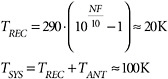
for H-polarization over the ocean. Therefore the sensitivity is

The minimum detectable change in power of the EESS radiometer with a factor of 10 safety margin for a single sample is as follows:

In this scenario there is safety margin of ~10 in the impact from a single radar. This means that the OOB emission requirements are inadequate to protect EESS, and they do not even closely meet the expectations of International Telecommunication Union-Radio (ITU-R) RS.1029 that interfering signal levels should be below −171 dBW within a 27 MHz bandwidth at 1.4 GHz by roughly 5 dB. Note that this analysis is for a single radar within the footprint of the radiometer. More than one radar in the radiometer field of view results in further reduction of the safety factor and errors in the data that are virtually impossible to detect without auxiliary information. Unfortunately, it appears that limits of the adjacent signal rejection of the EESS radiometer (due to filter limitations) result in additional contamination of the EESS radiometer field as detailed in Piepmeier and Pellerano.3
In EESS radiometer systems, RFI levels are cumulative. Therefore, impacts from adjacent signals described by Piepmeier and Pellerano,4 coupled with the additional impacts from spurious and OOB emissions in the above analysis, suggest that a single ARSR-type radar operating in full compliance with FCC §27.53 can impact the operation of EESS radiometers operating in the 1.4 GHz protected region.
This analysis has assumed that the OOB emissions from the radar are at the maximum allowable level (−43 dBW/MHz) throughout the entire 27 MHz radiometer bandwidth; that the radar transmits its peak power over its pulse width, which lies entirely within the radiometer integration period; and that the antennas are oriented so that 15 dB below maximum antenna coupling occurs.


