
5
Carrying Capacity and Bivalve Mariculture
Aquaculture is the fastest growing food-producing sector worldwide and, combined with stock rebuilding programs and improved management, provides a means for filling the growing gap between consumer demand and seafood production from traditional capture fisheries (Duarte et al., 2009). Numerous bivalve species are now farmed; bivalve mariculture is expanding worldwide (Howlett and Rayner, 2004), representing about 27% of total aquaculture production and about 13% of total fish produced for human consumption worldwide in 2006 (Food and Agriculture Organization of the United Nations, 2009). Environmental modifications have been documented in areas where molluscs are farmed (e.g., Raillard and Mánesguen, 1994; Christensen et al., 2003; Kurlansky, 2007), most of which result from the ability of cultured bivalve species to filter large volumes and extract phytoplankton, particulate detritus, and inorganic particulates; to excrete large quantities of ammonia; and to deposit large quantities of digested (feces) and undigested (pseudofeces) organic matter on the seabed. Local benthic enrichment and oxygen depletion are the most apparent impacts of bivalve culture and have generally received the most attention.
The expansion of bivalve mariculture and the increase in environmental awareness have encouraged a more ecosystem-based perspective for managing and developing bivalve culture. For example, polyculture or integrated aquaculture is a growing trend that considers the ecosystem as a whole and allows for the culture in one location of multiple species that are presumably synergistically related (Box 5.1). An ecosystem-based
|
BOX 5.1 Polyculture and Ecosystem-Based Approaches As with terrestrial agriculture systems, there is a potential for synergy between the co-cultivation of animals and plants in marine polyculture or “integrated aquaculture” systems. Molluscan and fish mariculture produces potentially valuable by-products, which can be recaptured as nutrient support and energy for extractive seaweed aquaculture providing biomitigation and also producing additional, valuable crops within the same leased areas; this has been called “integrated multitrophic aquaculture” (Chopin et al., 2001). Trophic diversification can be increased by adding lower trophic-level organisms to this mix to balance ecosystem functions and further increase the number of value-added crops. The Food and Agriculture Organization of the United Nations developed guidelines for an ecosystem-based approach to mariculture (Soto et al., 2008), which can be used to design “aquaculture ecosystems” (Costa-Pierce, 2002). However, of the many iterations of marine integrated aquaculture options reviewed by Costa-Pierce (2008), there are few examples of successful models developed between mollusc crops and commercially important seaweeds, such as Laminaria saccharina, Porphyra purpurea, and Palmaria palmata. Chopin et al. (1999) proposes that integrating P. purpurea into mariculture could be an important method for bioremediation and diversification. P. purpurea requires a constant availability of high-quality nutrients so cultivation near salmon cages would allow for alleviation of nutrient depletion, and frequent harvesting provides for constant removal of significant quantities of nutrients from coastal waters and for the production of seaweeds of commercial value. Similar advantages of integrating the culture of P. purpurea with molluscs would be expected. The most advanced examples of complex integrated aquaculture being implemented at the commercial level come from Korea and China (Food and Agriculture Organization of the United Nations, 1989; Chung et al., 2008). A wide range of molluscs are grown commercially with fish and invertebrates in Korea, and in China, the two main types of integrated seaweed–mollusc systems involve L. saccharina with mussels or with scallops (Food and Agriculture Organization of the |
perspective has led to the development of prognostic site-assessment tools and practical ecosystem-performance indicators. The need to understand and predict the response of interlinked ecosystem processes and to determine the consequences of these for management and commercial decisions has resulted in the emergence of ecosystem modeling as an important tool for bivalve mariculture management.
WHAT IS CARRYING CAPACITY?
The following definitions are based on work by others (Inglis, 2000; McKindsey et al., 2006b):
|
United Nations, 1989). L. saccharina is grown on rafts with mussels in both vertical and horizontal systems and provides shade, creates sheltered areas less vulnerable to current flows, releases oxygen as a by-product of photosynthesis, and generally improves water quality. In turn, mussels produce metabolic by-products, especially dissolved N, P, and CO2, which provide nutrients to the L. saccharina. In the simplest method of integrated aquaculture, rafts of alternating seaweed ropes and mussel ropes are suspended vertically from a floating raft rope. This method is also used in China to grow other marine species in conjunction with L. saccharina, such as scallops, which are suspended in cylindrical net cages about 40 cm in diameter and 1 m long. L. saccharina yields from these integrated systems compared with monoculture were 23–35% higher, and market values were 27–31% higher. L. saccharina produced in integrated aquaculture was of higher quality than in monoculture; the proportion of “first-class product” rose from 59% under monoculture to 74% and 80% in the integrated systems. Output and market value of mussels improved by 19% compared with mussel monoculture. Integrated aquaculture systems had a 58% increase in market returns compared with L. saccharina monoculture using identical production facilities (Food and Agriculture Organization of the United Nations, 1989). The challenges from the biological, environmental, economic, technological, engineering, regulatory, and societal perspectives are numerous. Appropriate extractive species need to be selected based on their biology, growing methods, and harvesting technology and adapted to local conditions. High-value markets will have to be found for these species to justify their culture, and seaweed will likely have a lower total value than molluscs (Chopin, 2008). Growing multiple species requires aquatic farmers to develop additional “skill sets” since mollusc and seaweed farming, for example, are completely different activities. There are also issues with permitting and regulatory authorities. Multi-spatial ocean planning and “multi-functional co-management” (Chopin, 2008) are needed in such cases to help define management of multiple uses. |
-
Physical carrying capacity—the total area of marine farms that can be accommodated in the available physical space.
-
Production carrying capacity—the stocking density (that at which production levels are maximized) that provides the maximum economic return (i.e., the economically “optimized” level of production of the target species).
-
Ecological carrying capacity—the stocking or farm density above which “unacceptable ecological impacts” begin to manifest. From a practical standpoint, this process begins with the definition of components of interest (e.g., species, habitats) and acceptable levels of change for each of these.
-
Social carrying capacity—the level of farm development that causes unacceptable social impacts.
A goal of mariculture management is to estimate the capacity of an area to support the cultured species (i.e., to determine the carrying capacity of a system). The system carrying capacity can be defined in terms of the physical environment, the ecological state of a system, the production yield, or the tolerance of local social and cultural structures (McKindsey et al., 2006b). Estimation of system carrying capacity has largely focused on the identification of production carrying capacity, which is the maximum sustainable economic yield of culture that can be produced within a region (see citations in McKindsey et al., [2006b]). However, estimation of carrying capacity is rapidly evolving from a focus on maximizing mariculture production to an ecosystem-based management (EBM) approach with a focus on ensuring ecological integrity and resilience of the ecosystem in which mariculture is imbedded. This development is following the move in fisheries management toward EBM to replace traditional approaches based on attempting to maximize single-species yields.
Ecological carrying capacity is broadly defined as the level of mariculture that can be supported without leading to significant changes to ecological processes, species, populations, or communities in the growing environment. At the ecosystem level, ecologists have further defined this property as integrity or resilience, which is the capacity to maintain characteristic patterns, structure, and functional organization comparable to that in similar undisturbed ecosystems in the region. The development of ecological carrying capacity indicators and models is relatively new but has the potential to feed into EBM systems, which in turn would support the ideals and goals of the ecosystem-based approach to mariculture management. The ability to predict ecological carrying capacity is crucial to assessing the impact of development and expansion of large-scale bivalve mariculture operations and also helps in the identification of appropriate indicators and metrics that allow performance standards to be determined. To further the scientific basis for estimation of ecological carrying capacity, mariculture working groups under the auspices of the International Council for the Exploration of the Sea (2008) recommended that the following information gaps be filled:
-
Development of guidelines toward defining an “unacceptable” ecological impact, based on theoretical and socioeconomic considerations, and identification of critical limits (i.e., performance standards or thresholds) at which the levels of shellfish mariculture stress indicate a
-
disruption of the system warranting management actions. (Germane to this is the concept of social carrying capacity, which would guide much of this work.)
-
Research on the development, value, and application of predictive ecological models of shellfish [mariculture] systems.
-
Time-series observations of ecological responses to shellfish [mariculture] development.
-
Site-specific factors affecting ecological carrying capacity.
-
Direction for scientists from stakeholders (e.g., habitat and farm managers and nongovernmental organizations) on potential [ecosystem components] that need to be evaluated in unbiased ecological carrying capacity assessments.
-
Discussion on how models of [mariculture] systems complement the ecosystem approach to marine management. (International Council for the Exploration of the Sea, 2008)
The estimation of carrying capacity is confounded by the fact that bivalve mariculture can impact the system by both consuming (phytoplankton) and producing (recycled nutrients and biodeposits) with the concomitant impacts of both (Gibbs, 2007). Bivalve mariculture dominates the energy flow of a marine system when the phytoplankton consumed by the total population of cultured molluscs exceeds the combined reproduction rate and tidal replenishment rate of phytoplankton in that system (Dame and Prins, 1998). Thus, caution is needed in attributing cause of change and partitioning impacts between mollusc farm activity and other activities ongoing in the system in estimating ecological carrying capacity. Moreover, it is important to distinguish between the ecological carrying capacity and an estimate of carrying capacity that might be a result of stakeholder feedback (social carrying capacity), which may also include considerations of what might be an acceptable impact on ecological function of a system. To clearly define ecological carrying capacity, it is essential to identify indicators of relevance and to distinguish between indicator- or threshold-based management as opposed to management solely by predictive modeling.
The development of a sustainable long-term management plan is difficult, but recent advances in the measurement, modeling, and application of carrying-capacity estimates provide some guidance. Modeling ecological carrying capacity with feedback from stakeholders in the system holds promise, but due to its newness, it is also the least understood and practiced. Ultimately, it will be important to quantify the values presented by stakeholders in a science-based effort in order to determine the proper limits to bivalve mariculture in local waters.
CARRYING-CAPACITY MODELS
The models that have been generated to assess carrying capacity relating to bivalve mariculture are diverse and range from simple mass-balance models to coupled circulation–ecological–economic models (Table 5.1). Many of the available models estimate the capacity of a system to support a single species, rank the relative risk of culture activities in different settings, or optimize mollusc yields for a given area. Recent models consider potential impacts of phytoplankton removal by a filtering bivalve or community of bivalves, and some attempt to include effects on related species such as seaweeds, which are relevant to system energy flow and ecological stability in the marine food web. The modeling frameworks and supporting data have evolved during the past 10–15 years to the point of providing guidance for the development of mollusc farms, their management, and potential economic effects of bivalve mariculture (Table 5.1).
Carrying-capacity models are providing insights into the interactions between production and ecological carrying capacity (e.g., Jiang and Gibbs, 2005) and the consequences of these insights for bivalve mariculture systems (e.g., Ferreira et al., 2009). Production carrying capacity is usually higher because it does not include the feedbacks and interactions of the energy flow in the overall food web and the potential displacement of endemic populations by cultured species. Model-based predictions of the responses of a large-scale mussel culture system (Jiang and Gibbs, 2005) include a decrease in the mean trophic level of the ecosystem with an increase in total yield—more efficient energy throughput via the filtering bivalves—but with replacement of zooplankton in the food web by the cultured mussels as the dominant herbivores.
Gibbs (2004) developed models to determine the acceptable limits to bivalve mariculture production in the Marlborough Sounds region of New Zealand by examining the relationship between bivalve farms and fishery resources, noting that primary and secondary productivity that would provide food for commercially fished species could instead be diverted to bivalve production—a concept proposed more than 25 years ago by Lapointe et al. (1981) and Tenore et al. (1982) for mussel production in Spain. Gibbs (2004) specifically considered three types of interactions between bivalve culture and fisheries: (1) bivalve farms either attract or displace fish, (2) bivalves consume fish eggs and larvae, and (3) food webs are altered so that fish production is displaced by farmed bivalves. For the latter, Gibbs (2004) used food-web models to try to estimate how much bivalve mariculture could develop before it dominated the energy flow in the marine system. Jiang and Gibbs (2005) further consider the food-web approach using a mass-balance model to estimate a carrying capacity for cultured bivalves in Golden and Tasman Bays in New Zealand of 310 tons
per km2 per year, which is considerably more than the estimated ecological carrying capacity of 65 tons per km2 per year.
Other modeling studies showed that the presence of oysters primarily affected phytoplankton (Grangeré et al., 2008) and wild suspension feeders (Cugier et al., 2008), providing a direct feedback between the cultured species and the ecological carrying capacity of a system. The higher grazing pressure on phytoplankton induced by the addition of cultivated oysters, as well as the trophic competition existing between wild filter feeders and cultivated oysters, explained the strong decrease in phytoplankton biomass, production, and wild filter-feeder stocks (Cugier et al., 2008). The model-based estimates of production suggested that the bivalve stocking for this particular system went beyond the ecological carrying capacity. Similarly, biodeposition from cultured bivalve systems can affect the ecological carrying capacity through reduction in benthic species biomass and richness, alteration of nutrient fluxes, and regulation of local oxygen concentrations (e.g., Weise et al., 2009; Box 5.2). The ecological carrying capacity of a system is the product of near-field (e.g., biodeposition) and far-field effects (e.g., nutrient cycling, pelagic carrying capacity), and as a result, estimates of this quantity require modeling frameworks that include a range of space and time scales that are relevant to the processes affecting ecological carrying capacity. For example, recent modeling studies (Cranford and Hargrave, 1994; Cranford et al., 2007; Grant, 2008a) done at the spatial scale of phytoplankton depletion provide insights into the potential effects of particle depletion of particular sizes from mussel culture and highlight the significant ecological destabilization that could result from the altered competition and predator–prey interactions between resident species. Such models will provide industry and management with tools to comprehensively and efficiently assess the effects associated with bivalve-culture activities within an EBM framework.
The coupling of hydrodynamic models to ecological models with production estimates allows the interactions between mollusc culture, food-web processes, and physical attributes of systems to be examined. The availability of a three-dimensional hydrodynamic model for a system allows estimates of flow, exchange, and residence time over multiple space and time scales and provides a framework for testing scenarios about consequences of changes in circulation on bivalve mariculture systems. Numerous studies have shown the importance of accurate representation of the circulation to the estimation of production of mariculture systems (e.g., Guyondet et al., 2005). The scientific community’s expertise and knowledge of circulation models has greatly improved, and community-based models now exist; however, this knowledge is resident in a community of scientists, usually physical oceanographers, that has not tradition-
TABLE 5.1 Representative Studies That Use Models to Estimate Carrying Capacity for Bivalve Mariculturea
|
Study and Species |
Carrying Capacity Type |
|
Ferreira et al. (1997) Oysters |
Ecological and production |
|
Smaal et al. (1998) Bivalves |
Ecological and production |
|
Bacher et al. (1998) Oysters |
Ecological and production |
|
Niquil et al. (2001) Farmed and natural bivalve populations |
Ecological |
|
Duarte et al. (2003) Polyculture bivalves, scallops, and seaweed |
Ecological |
|
Gangnery et al. (2003) Oysters |
Ecological and production |
|
Nunes et al. (2003) Scallops, oyster, and kelp |
Ecological and production |
|
Jiang and Gibbs (2005) Bivalve culture, including total biota from phytoplankton to mammals |
Ecological and production |
|
Cranford et al. (2007) Mussels and watershed nitrogen inputs |
Ecological |
|
Ferreira et al. (2007) Bivalve species and polyculture |
Ecological, production, and social |
|
Grant et al. (2007) Mussels and lower trophic levels |
Ecological and production |
|
Byron et al. (2008) |
Production and social |
|
Model Framework |
Simulation Application |
Management Application |
|
Coupled circulation, primary production, and oyster growth model |
Estimation of production carrying capacity and optimum-seeding strategy |
None |
|
Conceptual |
Theoretical evaluation of minimum carrying capacity requirements |
None |
|
Population dynamics model |
Assessment of oyster standing stock production |
None |
|
Inverse analysis of carbon flow in lower trophic levels |
Assessment of local food availability for oyster farming |
None |
|
Coupled two-dimensional circulation–biogeochemical model |
Estimation of environmental carrying capacity for polyculture system |
Potential |
|
Population model for oysters and mussels |
Assessment of standing stock and production changes and environmental effects |
None |
|
Individual-based species models and multi-cohort population models |
Assessment of seeding and harvesting strategies of polyculture management strategies |
Potential |
|
EcoPath: linear food web |
Estimation and comparison of ecological and production carrying capacity for bivalve culture |
None |
|
Nitrogen budget, lower trophic level, and mussel growth |
Assessment of mussel production on nitrogen budgets and dynamics |
None |
|
Circulation, biogeochemical, bivalve growth, production, and eutrophication |
Assessment of farm location and practice on production outputs and nutrient management |
Potential |
|
Coupled biological–circulation–chemical model |
Assessment of effects of food depletion |
None |
|
EcoPath |
Defined production and social carrying capacity |
None |
ally been involved in mariculture issues. Furthermore, simply including hydrodynamic models with a proven track record in providing modeling frameworks for mariculture systems is not sufficient; the results from these models must be provided at space and time scales that are appropriate for the ecosystem context and for the mariculture system.
The availability of a hydrodynamic model allows estimates of oxygen and nutrient regeneration and flushing times of stratified systems, as applicable to most estuaries, which have a bearing on the capacity of the system to produce bivalves and the degree of interaction between cultured bivalves and other filter-feeding organisms in the system. The rate at which the waters of a system mix affects the nutrient supply, suspended organic matter flux, and oxygen regeneration (e.g., Aure et al.,
|
Model Framework |
Simulation Application |
Management Application |
|
Two-dimensional coupled circulation–sediment model, lower trophic-level model, and bivalve-filtration model |
Assessment of trophic balance between cultivated and wild filter-feeder species |
Potential |
|
Coupled circulation, lower trophic level, individual-based bivalve-growth, and population models |
Integrated framework for determining sustainable carrying capacity in bivalve growing areas |
Potential |
|
Coupled circulation, lower trophic level, and bivalve-growth models |
Set carrying capacity and investigate synergies with other species |
Used to determine license-level activity |
|
Coupled ecosystem–physiology–circulation and bivalve-growth models |
Assessment of benthic diversity and impacts on clearance rates of suspended particles |
Potential |
|
Coupled circulation, lower trophic-level, bivalve-growth, population, and financial and profit models |
Integrated framework for simulating potential harvest, key financial data, and water-quality impacts of bivalve farms |
Potential |
|
Coupled circulation and sediment models (DEPOMOD; Cromey et al., 2002) |
Spatial deposition of bivalve deposits |
None |
2007; Ferreira et al., 2009). These factors have implications for ecological carrying capacity. Quantitatively assessing the importance of these ecosystem processes is probably best done through modeling studies that include a hydrodynamic-modeling component. These coupled modeling systems can also be used to test alternative mariculture system designs. For example, a coupled circulation–ecological model was used to evaluate the effect of artificial upwelling of nutrient-rich deeper water on phytoplankton growth and the potential increase in production carrying capacity for mussel cultivation (Aure et al., 2007; Grant et al., 2008b). The scenarios tested with the model showed that an artificial upweller could maximize mussel production in a limited region and potentially allow more efficient management of production.
|
Box 5.2 Nutrient Dynamics in the Thau Lagoon The Thau Lagoon on the Mediterranean coast of France is an important area for mollusc culture and as such has been the focus for modeling studies of molluscs and nutrient dynamics. Notwithstanding the fact that the lagoon is an enclosed system and is atypical of mariculture production locations, its large-scale mollusc production and accessibility render it an interesting system to model and test scenarios relating to the interactions between mollusc culture and the environment. Bacher et al. (1995) postulate that the vertical exchange of material is important to mariculture and propose that oysters in culture can be considered a nitrogen sink that stabilizes the system. Mazouni et al. (1996) model benthic-pelagic nutrient fluxes in the Thau Lagoon where measured ammonium production was one to five times higher near culture systems than away from them. Oxygen flux was higher beneath the culture cages as well. Mazouni et al. (1996) also found that nutrient fluxes were higher near the culture systems and that the relative proportions of nutrients across the lagoon were influenced by temperature, and concluded that mollusc excretion was the primary source of ammonium utilized by phytoplankton as opposed to that fraction derived from sediments. The residence time or, alternatively, flushing of a system influences the degree of nutrient exchange between the benthic and pelagic systems and thus influences subsequent local phytoplankton production (Bacher et al., 1995; Chapelle et al., 2000; Smaal et al., 2001). For example, the model developed by Chapelle et al. (2000) for the Thau Lagoon indicates that during meteorological events (e.g., rain) phytoplankton production is driven primarily by externally derived nutrients, whereas in dry summer periods, phytoplankton production is driven by nutrients derived from mollusc excretion and sediments. |
The modeling frameworks that provide ecological and production carrying-capacity estimates include ecosystem components that are represented in models that range from simple box models to fully spatial-explicit (three-dimensional) models. The development of the former type is easier to implement and can be a first step in the specifications of carrying capacity before more complex modeling is undertaken. However, more detailed and realistic ecosystem models are the ultimate goal.
Inclusion of bivalve growth and bioenergetics models with coupled circulation–ecosystem models requires that the latter be configured to provide required inputs, such as food supply, at space and time scales that are appropriate for the bivalve population (e.g., Dekshenieks et al., 2000) or mariculture facility (see Table 5.1 for examples). Bioenergetically based models exist for some mollusc species (e.g., Hofmann et al., 1992; 2006; Flye-Sainte-Marie et al., 2007) and provide a basis for developing more mechanistically based models that allow testing of various scenarios
of controls on mollusc production. However, representation of basic processes, such as bivalve filtration (e.g., Powell et al., 1992), in bivalve models remains a research topic. Similarly, choosing the approach for modeling bivalve molluscs, the traditional scope for growth (Table 5.1) versus dynamic energy budget (e.g., Pouvreau et al., 2006; Roslanda et al., 2009) is a significant issue for research and will guide the future development of models for estimating ecological and production carrying capacity of molluscs.
While modeling efforts have advanced the estimation of bivalve carrying capacity, most efforts to date have been made to model ecological carrying capacities, with little attention given to social carrying capacities. McKindsey et al. (2006b) developed a framework for how social carrying-capacity studies can be used to calibrate ecological carrying capacities and frame a societal debate about what are “acceptable” impacts (Figure 5.1). Social carrying capacity can be determined through stakeholder involvement and feedback that is incorporated into ecosystem models (McKindsey et al., 2006b; Swart and van Andel, 2008).
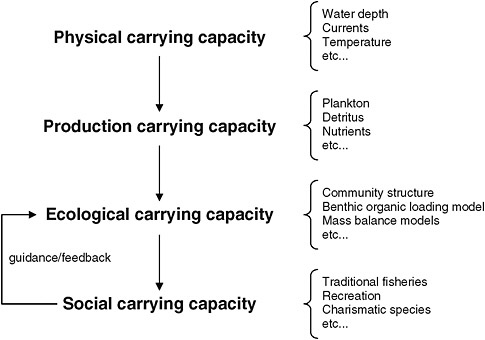
FIGURE 5.1 Types of carrying capacities identified in the literature for marine areas with methods used for their determination. In this model, social carrying capacity is used in an iterative manner to determine best methods for determining ecological carrying capacity (adapted from McKindsey et al., 2006b; with permission from Elsevier).
Byron et al. (2008) developed a stakeholder working group, consisting of both scientists and non-scientists, that is developing mass-balance models to determine ecological carrying capacities for bivalve mariculture in coastal lagoons so as to then define “unacceptable” impacts of oyster mariculture on the environment. The point of “unacceptable change” is first defined through the modeling process, in which the biomass of cultured bivalves is increased until there is an unacceptable change in energy flow between groups (e.g., Jiang and Gibbs, 2005), resulting in an “unbalanced” model ecosystem. The biomass of cultured molluscs at which the model becomes unbalanced defines the upper limit to what is acceptable—the ecological carrying capacity. Assuming that ecological carrying capacity will not be exceeded (i.e., social constraints dictate production restraint), stakeholders may decide that the ecological carrying capacity is too high and want to manage at a lower level—the social carrying capacity. In this sense, acceptability will be bounded by the model estimates at its upper limit (ecological carrying capacity) and by stakeholders at some lower limit (social carrying capacity), thus specifying the bounds of acceptability and supporting the Food and Agriculture Organization’s newly developed principles of an ecosystem-based approach to mariculture that includes environmental resilience and integrity, human well-being, and stakeholder equity and honors current policies and goals of other sectors (Soto et al., 2008). For example, the acceptable mollusc stocking density defined by ecological carrying capacity may exceed that defined by social carrying capacity. Regulations can prohibit mariculture in areas that impede navigation or diminish aesthetic values, which can determine the societal limits to the available area for bivalve mariculture and thus stocking density. Ecological carrying capacity models do not take such societal constraints into account. It is only through a feedback process (McKindsey et al., 2006b) between ecological and social carrying capacity that an ultimate compromise can be reached thereby mitigating user conflict.
MARINE SPATIAL PLANNING: LOCATING NEW OR EXPANDING PRESENT MARICULTURE OPERATIONS
Bivalve mariculture has been an important activity in the United States for more than 100 years; thus, many existing farms were sited well before the current social and ecological carrying-capacity concerns discussed in this report were considered. Today, the combination of greater concern over ecological effects, more intense use conflicts with growing coastal populations, and greater demand for mollusc leases driven by growing markets for seafood is forcing resource managers to evaluate existing mariculture operations and subject applications for new or expanded
leases to more pressure and scrutiny. While carrying capacity issues at the estuarine-landscape scale are clearly the first-level consideration (i.e., how much bivalve mariculture can the system tolerate), a marine spatial planning approach utilizing geographic information system (GIS) technology, which takes other ecological and social considerations into account, will be a useful tool to help extend permits for existing mariculture, locate new operations, and implement EBM practically (Arkema et al., 2006; Leslie and McLeod, 2007; Weinstein et al., 2007; Ruckelshaus et al., 2008).
Sustainable, economical mariculture generally requires that the bivalves be concentrated at high density over substantial areas and that the species have access to “clean” water (i.e., low in potential pathogens and with adequate oxygen, planktonic food, and water flow). For bivalves, these considerations suggest placement in areas well-removed from industrial pollution (e.g., heavy metal contamination), E. coli sources, intense stormwater runoff, or where harmful algal blooms are likely to occur, although these considerations have not always been taken into account when locating bivalve mariculture sites. Despite mariculturists’ efforts to protect them, many existing farms have gradually lost their ability to operate as anthropogenic disturbances have increased and compromised water quality (Glasoe and Christy, 2004). Failures of environmental management to sustain water quality could represent a violation of the Clean Water Act’s anti-degradation provision, according to which mariculture represents the highest use protected by this legislation. Such management failures arise largely from stormwater pollution and can be viewed as one form of externalizing costs of development (National Oceanic and Atmospheric Administration, 1992; Environmental Protection Agency, 1998; Booth et al., 2006; National Research Council, 2008). As aesthetic values associated with shorefront property have increasingly become more of an issue, the so-called not-in-my-backyard (NIMBY) factor has come into play: waterfront property owners do not want their views affected by commercial ventures, pushing mariculture operations toward more sparsely inhabited marine shores (see Chapter 6). Finally, placement away from potential predators of molluscs and from traditional migratory, breeding, and overwintering sites for protected species would reduce conflicts with wildlife management.
The conundrum is that these “pristine” sites that meet optimal environmental requirements for bivalve culture are more difficult to find and, if they exist, are more likely to be protected already for conservation purposes or adjacent to park lands. One example is the currently unresolved issue of whether a commercial oyster company should be allowed to continue in Drakes Estero, a Potential Wilderness within a National Seashore (see National Research Council, 2009). As an expanding human population increasingly lives adjacent to the ocean, the requirements for
excellent water quality and separation from public view will only become more difficult to meet, and the temptation for commercial placement adjacent to protected lands and environments will surely increase and be subject to social carrying capacity, shaped by how stakeholders in the United States view the purposes of parks and other places insulated from intense human presence.
From an ecological viewpoint, landscape-scale studies in terrestrial ecosystems, which have a longer history (Lindenmayer and Fischer, 2006), have shown that dispersal corridors can connect otherwise isolated populations and therefore enhance persistence, particularly for mobile vertebrates through time (Debinski and Holt, 2000). Where mariculture typically occurs (in estuaries, areas along more exposed sound shorelines, and proposed offshore ocean locations), the ecosystems are more “open” and spatially connected by larval dispersal so that terrestrial concerns about corridors and dispersal limitation become less important (Tanner, 2005; Cole et al., 2007). Although the effects of bivalve mariculture on this connectivity have not been evaluated at the estuarine-landscape scale, they are in theory less important for bivalves themselves and more important for larger, more mobile demersal nektonic species, like crabs and fish, which can benefit from structure at this scale. The effects of bivalve mariculture as a disturbance to other habitats like seagrass (e.g., fragmentation) and linkages between mariculture structures and natural structures like seagrass, salt marshes, and oyster reefs (e.g., corridors for movement) could be important for mobile nektonic and benthic organisms (e.g., Micheli and Peterson, 1999). Studies, which to date have focused on seagrass systems, suggest that fragmentation increases habitat edge and may actually enhance abundance and diversity of some decapod crustaceans and fish, while larger unfragmented meadows contain a higher abundance of smaller cryptic species (Salita et al., 2003; Selgrath et al., 2007; Macreadie et al., 2009). Progress has been made in mapping bivalve mariculture structures as habitat in some west-coast areas using GIS, but effects of habitat changes due to mariculture and functional value of these habitats has yet to be assessed fully (Ward et al., 2003; Carswell et al., 2006; Dumbauld et al., 2009).
Most bivalve species used in mariculture operations are reported to spend ample time as and to be distributed fairly widely as planktonic larvae: Crassostrea gigas (10–30 days), Mytilus edulis (5–7 weeks), and geoducks (18 days) (Strathmann, 1987). Variation in larval duration is caused by environmental conditions, especially temperature, and larvae of marine organisms have increasingly been shown to be retained in estuaries or move shorter distances than originally suspected as a consequence of behavioral adaptations that retain them near their source (Swearer et al., 2002; Baker and Mann, 2003; Cowen et al., 2006; Morgan et al., 2009). Thus
the location of reproductively viable molluscs has implications for controlling the spread of nonnative species under culture (e.g., in cases where diploid animals spawn in the wild) and also for enhancing populations of native species where mariculture could play a role in regional spatial planning for native molluscs and habitat restoration. Most culturing of the commercially significant bivalves requires spat or larvae obtained from certified sources. Recently, natural “retention zones” have been identified and seeded with small post-larval stages or even late-larval stages (Largier, 2004). The goal of these operations, along with those undertaken to create spawner sanctuaries (Doall et al., 2008), is to augment natural populations in areas optimal for their growth, survival, and reproduction. Suitably located bivalve culture operations could likewise serve as a larval source to enhance abundances of depleted wild stocks in seafloors open to public mollusc farming. In addition to enhancing native bivalve populations that are declining (Beck et al., 2009), bivalve restoration and presumably bivalve mariculture can serve to enhance habitat for other species and provide valuable ecosystem services, including production of other fish and invertebrates (Coen et al., 1999; 2007; Peterson et al., 2003; Grabowski and Peterson, 2007). Placement and zoning for bivalve mariculture facilities raises more difficult social issues than ecological ones, which interestingly have also shaped the current debate about marine protected areas and their role in enhancing exploited fish populations (Browman and Stergiou, 2004; Arkema et al., 2006; Game et al., 2008).
CONCLUSIONS
The bivalve mariculture community’s experience with carrying-capacity models is relatively recent, and it is only in the past few years that these models have been extended to include water circulation, ecological components, and multi-species dynamics. It is already apparent that these models can provide valuable tools for scenario testing and for setting production goals. However, recognition and estimation of uncertainty created by such factors as environmental variability, unknown or poorly constrained parameter values, and poorly known processes are a critical component of any model-based estimate of carrying capacity. Quantitative approaches for optimizing and constraining model parameter choices and evaluating model structures have been implemented with marine ecosystem models (e.g., Friedrichs et al., 2006; 2007; 2009; Stow et al., 2009), and parameter optimization approaches are now beginning to be applied in aquaculture models (Roslanda et al., 2009). Some attempts have been made to include evaluation of uncertainty in the parameters used in model-based estimates of production and ecological carrying capacity, which allows assessment of sources of error (e.g., Dowd, 2005; Vincenzi
et al., 2006). Optimization and uncertainty analyses are clearly areas that need additional effort to ensure advancement of operational aquaculture models. For this to occur, model development and data analysis need to develop in parallel and iteratively interacting activities for this to be most effective.
EBM has become an important concept in coastal zone management, which includes bivalve mariculture. Assessment of mariculture has occurred mostly at the local scale by measuring the “footprint” of mollusc farms. Scaling up these effects to whole systems has been limited by the difficulty in identifying a signal attributable solely to mariculture and by the capacity and limited resources to make meaningful measurements over larger areas. When many local farm units are considered, the scenario is even more complex because their impacts interact as a function of bathymetry, proximity, circulation, and coastal morphology. Practical indicators of benthic and pelagic effects of bivalve mariculture that can be applied at ecologically relevant scales are needed. Models that can estimate carrying capacity as a result of interactions between bivalve production, ecological, and social carrying capacities provide a promising method for addressing many of the issues that are associated with understanding multiple farm interactions and cumulative effects of other coastal zone activities (e.g., anthropogenic eutrophication, invasive species) at a scale relevant to coastal ecosystems.
The current generation of models is moving toward the development of frameworks that can provide estimates of production and ecological carrying capacity. These models include details of multiple factors that influence the structure and function of the marine ecosystems and the interactions of these systems with bivalve mariculture. With continued development and refinement, through the inclusion of fully three-dimensional circulation fields that capture the complexity of coastal and estuarine circulation and dose-dependent relationships, for example, these models may provide scientifically sound and relatively robust results that can guide the development and management of bivalve mariculture. Nevertheless, social considerations, such as use conflicts and aesthetics, may be the limiting factor for carrying capacity in many coastal settings. However, current models, while beginning to include aspects of social carrying capacity (Table 5.1), do not yet include the processes that influence social considerations directly.
Carrying capacity research continues to provide information on an ecosystem-wide level. Models are being developed that provide carrying-capacity information and estimates that relate to spatial and temporal scales that are relevant to the scales at which bivalve mariculture interacts with the marine food web. Based on recognition of some knowledge gaps,
McKindsey et al. (2006b) made the following recommendations to further the development of ecological carrying-capacity models:
-
Studies need to continue to focus upon estimating the environmental interactions associated with all aspects of bivalve culture (e.g., seed collection, harvesting, husbandry).
-
A full range of culture activities should be considered in models.
-
Models should be spatially explicit.
-
Models need to consider temporally variable activities (e.g., seasonal harvesting).
-
Validation of models should be conducted across a range of habitat and culture conditions in order to assess their general applicability.
-
Uncertainty estimates for parameters, formulations, and results need to be an integral part of model studies.
Most of the potential measures of ecological carrying capacity now consider only a single or a constrained number of ecosystem components (Broekhuizen et al., 2002). As scientists learn more about the functioning of marine ecosystems, it is likely that their understanding of the factors affecting ecological carrying capacity will evolve; therefore, they need to develop a flexible approach to allow for these changes. While current modeling efforts try to incorporate the above points into estimates of ecological carrying capacity, the development of models for estimation of carrying capacity needs to progress in parallel with a coordinated and sustained empirical measurement effort that will provide the information needed to validate the projections from the models and subsequently modify the models in response.
FINDINGS AND RECOMMENDATIONS
Finding: Some attempts have been made to include an evaluation of uncertainty in the parameters used in model-based estimates of bivalve production and ecological carrying capacity.
Recommendation: Model development and empirical data collection and analysis must be parallel and interacting activities for uncertainty to be integrated effectively into the models.
Finding: Assessment of bivalve mariculture has occurred mostly at the local scale by measuring the “footprint” of the shellfish farm. Scaling up these effects to whole systems has been limited by the difficulty in identifying a signal attributable solely to mariculture and by the capacity and resources to make meaningful measurements over
larger areas. Similarly, most of the potential measures of ecological carrying capacity consider only a single or a few ecosystem components. Our understanding of factors that affect ecological carrying capacity will evolve as scientists learn more about the functioning of marine ecosystems.
Recommendation: Managers should utilize models based on empirical data that can estimate carrying capacity relative to bivalve production, ecosystem, and social constraints. The models provide an approach for addressing many of the issues that are associated with understanding multiple farm interactions and cumulative effects of other coastal zone activities at a scale relevant to coastal ecosystems.
Recommendation: Further development and refinement of models for estimating carrying capacity should be encouraged. This will require a coordinated and sustained measurement effort to provide the empirical data necessary for iterative modification of these models and to validate projections produced by the models. Models should be designed to address the needs of managers and mariculturists alike. In addition, model parameters and general model outputs should be presented in clear and concise terms that are understandable and acceptable to all users.
Finding: With continued development and refinement, the current generation of models may provide scientifically sound and relatively robust results that can guide the development and management of bivalve mariculture. However, current models do not include the processes that influence social needs and regulations.
Recommendation: The portfolio of research on carrying capacity should include work on social and political dimensions.
Finding: Carrying capacity is a function of the local environment, in terms of both ecological and social factors. Ecological carrying-capacity models do not take societal constraints into account. It is only through a feedback process between ecological and social carrying capacity that a compromise can be reached.
Recommendation: Assessment of carrying capacity for a bivalve mariculture facility should involve both natural and social scientists along with coastal managers.


