
4
Bivalve Mariculture Contrasted with Wild Fisheries
As understanding has grown of how seriously ocean ecosystems have been degraded by extractive fisheries and as many fisheries have proven unsustainable, attention has turned to mariculture, including bivalve mariculture, as a possible simultaneous solution to both problems. Perhaps bivalve farming can be done without the same levels of disruption of natural ocean and estuarine ecosystems that are associated with exploitative fisheries, and perhaps by wise and informed husbandry, bivalve culture could be sustainable. Testing the hypothesis that bivalve mariculture might have less impact on the natural ecosystem than the exploitation of wild stocks requires synthesis of the environmental consequences of bivalve mariculture as compared to wild-stock exploitation. This chapter examines these issues.
COMPARISON OF ECOLOGICAL EFFECTS OF BIVALVE MARICULTURE AND WILD-STOCK HARVEST
Probably the most serious environmental concern associated with wild-stock fisheries for bivalve molluscs involves the physical and biological impacts of mollusc harvest (Collie et al., 2000; National Research Council, 2002; Kaiser et al., 2006). The effects of harvesting bivalves for mariculture operations on the benthic community are similar to those of wild fisheries harvest in (1) removing target species, which can serve as important biogenic habitat structure, and (2) causing disturbance to the benthos, which operates to reset the community to an early successional
stage and exclude more long-lived species, especially epibiota. The harvest impacts vary with method, habitat type, species and size of response organism(s) being studied, and scale of the harvest activity (National Research Council, 2002; Kaiser et al., 2006). In wild mollusc fisheries, dredges or scrapes are normally used to capture epifaunal species (e.g., oysters, scallops, mussels), whereas hydraulic suction dredges or pumps are used to capture infaunal species (e.g., clams). In a review of fishing impacts, Kaiser et al. (2006) found that initial impacts to biota were small and short-lived; however, recovery was slower in muddy and especially in biogenic habitats (e.g., mollusc reefs, seagrass, coral) than in sandy coarse sediments that were subject to higher frequencies of natural disturbances. This was particularly true for the use of mechanical dredges and rakes versus harvest by hand, as numerous studies have demonstrated the significant habitat and community changes caused by these methods (Dayton et al., 1995; Jennings and Kaiser, 1998; Collie et al., 2000; Cranfield et al., 2001; National Research Council, 2002). The community effects and their persistence for small benthic organisms are generally related to mobility and generation time so prolonged effects are only apparent when the benthic fauna is sessile and/or relatively long-lived or when affected areas are so large as to break connections with the surrounding undisturbed habitat.
In many but not all cases, wild-harvest impacts are not directly comparable to bivalve mariculture because culture occurs in a location (shallow and even intertidal habitats) different from that of wild harvest (often deeper subtidal areas), and culturists often transplant harvested individuals from place to place. Bivalve culture can also occur in a different form (e.g., single oysters planted on a tide flat or mussels growing on a line or rack versus an oyster or mussel reef in a wild-harvest scenario) and is typically more concentrated in local areas favorable for growth than wild-stock molluscs. Impacts to wild oyster and mussel reefs are thus potentially more severe and longer lasting than mariculture harvest impacts, and both clam and oyster harvests from these reefs have been shown to cause reef degradation and more substantial losses to oyster resources than clams (Lenihan and Micheli, 1999; Lenihan and Peterson, 2004). Secondary impacts, especially to birds and the less mobile fish and invertebrates, that use the structured habitat for food and protection are also likely to be greater in wild-stock bivalve fisheries that disturb these reefs.
Because of the importance of aquatic vegetation as habitat for other organisms, the effects of harvest activity on these plants have been most studied (Waddell, 1964; Fonseca et al., 1984; Peterson et al., 1987; Orth et al., 2002; Neckles et al., 2005; Wisehart et al., 2007; Tallis et al., 2009). In general, the disturbance to seagrass habitat by mollusc harvest activities
should vary with seagrass species, disturbance scope, disturbance intensity, seasonal timing of disturbance, and sediment characteristics. Seagrasses can recover via lateral rhizome spread or via sexual reproduction and seed dispersal depending on location and species, and both natural and human disturbances have been shown to enhance sexual reproduction in seagrass (Marba and Duarte, 1995; Peterken and Conacher, 1997; Plus et al., 2003; Olesen et al., 2004).
For clam fisheries, effects of harvest appear related to the extent and depth to which sediment is disturbed. Several hard clam harvest methods have been shown to reduce eelgrass (e.g., Zostera noltii and Z. marina), including mechanical “clam kicking” with propeller wash (Peterson et al., 1987) with 65% reduction of eelgrass biomass and only limited recovery up to four years after disturbance, raking with seagrass loss varying by implement used but with full recovery in one year (87% loss for a bull rake and 47% loss for a pea digger; Peterson et al., 1983), and even hand digging when rhizomes became extensively fragmented (Cabaco et al., 2005). Intertidal clam harvest in Portugal resulted in two-fold higher seed production and an extended reproductive season for Z. noltii, which enabled it to recover from harvest within a year (Alexandre et al., 2005). Effects of recreational clam harvest using rakes on Z. marina were undetectable, but digging clams with shovels reduced eelgrass cover and biomass over the short term, although recovery occurred fairly rapidly (months) in Yaquina Bay, Oregon (Boese, 2002). An exceptional case of disturbance may be for geoducks in Puget Sound, Washington, where harvest excavation of these large clams in the wild and in culture operations penetrates to great depths (50–60 cm) using water jets, and these effects are currently being explored (Washington Sea Grant, 2007a; Straus et al., 2008; Box 4.1).
The initial impact and time to recovery have also been shown to be variable in studies of the effects of cultured oyster harvest on eelgrass on the U.S. west coast. Results of experimental harvest with a toothed metal dredge in Willapa Bay, Washington, showed 42% loss of Z. marina at a muddy site with relatively slow recovery (four years), while initial decline was only 15% at a sandier site and recovery occurred in one year (Tallis et al., 2009). Waddell (1964) found even more significant loss of eel-grass (up to 96%) with several passes of a suction dredge and a two-year recovery period in Humboldt Bay, California. When harvest occurred by hand, eelgrass production was shown to be higher than that on dredge-harvested beds (Tallis et al., 2009), but eelgrass production per unit area was driven by density and plant size and therefore lower in all harvested oyster mariculture beds than in nearby eelgrass reference areas. For large repeatedly disturbed areas, seed germination or asexual reproduction of remnant adults is required to restore eelgrass. Seed germination was high (>4 per m2), particularly on dredged beds in Willapa Bay, Washington
|
BOX 4.1 The Geoduck The geoduck (Panope abrupta) is a very large (i.e., up to 25 cm with siphon fully contracted and up to 75 cm when extended) infaunal bivalve that when extracted from the sediment has a very large siphon and foot, which it is incapable of with-drawing into the security of its two valves. Geoducks can burrow to a depth of 1 m, are primarily subtidal in their distribution, and can live up to 150 years. They are viewed as having aphrodisiacal properties in Asia and support an $80 million a year mariculture industry in Washington State and a $35 million one in British Columbia. There is a lucrative, illegal subtidal harvest of wild stocks as well. Geoduck mariculture is largely confined to the intertidal zone in Washington State, although subtidal tracts can also be seeded. The intertidal culture technique involves housing several juvenile or seed geoducks in a PVC pipe (at a seeding density of about 35,000 per acre or 3 pipes per m2) (Figure 4.1) and protecting the young clams from a host of potential predators with an evolving set of additional protective measures like plastic mesh screens. The crop cycle is about six years from planting to harvest. Harvest is achieved by liquefying the sediment with a high-pressure hose and manual extraction of the bivalve. A summary of geoduck biology, carrying capacity, parasites, disease, and possible genetic effects on wild conspecifics is available from Straus et al. (2008). 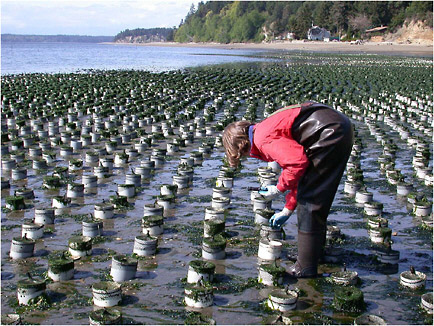 FIGURE 4.1. Arrays of geoduck culture tubes in 2004 in Case Inlet, Washington (used with permission from Jennifer Ruesink, University of Washington). |
|
It is instructive to examine the minimally resolved public debate characterizing geoduck mariculture in Washington State, where tidelands have been sold into private ownership or, if in the public domain, can be leased from the state. These geoduck culture practices have generated spatial heterogeneity in mariculture development and a substantial not-in-my-backyard (NIMBY) conflict because culture occurs conspicuously in the intertidal zone and produces shoreline debris when the PVC pipes are displaced by storms. (See the section on Local Traditions and Not-in-My-Backyard (NIMBY) Issues in Chapter 6 for further discussion of aesthetics and NIMBY issues.) Because it is a relatively new practice, few data exist on the ecological effects of these PVC plantations, and this exacerbated the public debate to the point that the Washington State Legislature held a symposium and appropriated funds through Washington Sea Grant to study the issue in 2007. While certain scientific studies (e.g., effects of pipes and mesh covers on biodiversity and predator abundance on a local scale [Washington Sea Grant, 2007b], effects of the sediment liquefaction harvest process on sediment structure and the associated vegetation and infauna [Washington Sea Grant, 2007c]) might clarify the issue, the viewscape issues that appear to be at the heart of the upland owners’ concerns will likely remain unresolved. These issues are less apparent for traditional commercial fishery activities, which occur out-of-sight in subtidal areas and where commercial catch limits and spatial rotation of harvest sites restrict exploitation to a very small fraction of the stock biomass in Washington and British Columbia. |
(Wisehart et al., 2007), although seedling survival was universally low across oyster harvest treatments (1–2%; Wisehart, 2006). Rhizome branching appears to be important for recovery of gaps in eelgrass (up to 16 m2) but only occurs seasonally, and thus gaps created experimentally in mid-summer did not begin to recover from the edges until the following spring and can vary by tidal height and surrounding eelgrass density with slower recovery (Boese et al., 2009; Eric Wagner, unpublished data). Clearly, the amount of sexual versus asexual reproduction that contributes to eelgrass resilience is important and may vary both temporally and spatially, but this has not been examined at broad spatial scales relevant to bivalve mariculture in many estuaries.
The scale and frequency of harvest activity have been shown to be important for both the direct effects on seagrass and associated organ-
|
BOX 4.2 The Wadden Sea: A Case Study of Bivalve Mariculture, Conflict Resolution, and Ecosystem Restoration The Wadden Sea, which runs 400 km along the North Sea coast of Denmark, the Netherlands, and Germany, is a large temperate coastal wetland ecosystem with many transitional habitats of tidal channels, sandy shoals, seagrass meadows, mussel beds, sandbars, mudflats, salt marshes, estuaries, beaches, and dunes. It is the staging, molting, and wintering area for up to 12 million birds every year. For 43 bird species, the Wadden Sea supports more than 1% of the entire flyway population, which is the criterion used by the Ramsar Convention for identifying wetlands of international importance. In June 2009, the Dutch-German part of the Wadden Sea became a World Heritage Site. The most important mariculture and fisheries activities in the Wadden Sea are on-bottom blue mussel, cockle, and shrimp fisheries. In the 1980s and 1990s, the environmental quality of the Wadden Sea was documented to be decreasing with blame placed on the impacts of fisheries, which disrupted the sediment dynamics and composition, and on the continued impoundment of wetlands. Integrated coastal governance and management systems of the complex natural, fisheries, and social and political milieu of the Wadden Sea began with the first Trilateral Governmental Conference in 1978, which led to the Trilateral Wadden Sea Cooperation as the focal point for coordination among governments of the three countries (Olsen and Nickerson, 2003). The common principles and objectives of the Trilateral Cooperation are based on a binding political agreement among the three governments and complement the European Habitats Directive of 1992, which also designated major parts of the Wadden Sea as Special Areas of Conservation. The implementation of the European Union’s directive in the Wadden Sea is coordinated by the member states, which cooperate in the Trilateral Wadden Sea Cooperation that made the common principles legally binding (Common Wadden |
isms and the secondary impacts of harvest on food for shorebirds and waterfowl. Small-scale harvest of clams by hand in a national park in Spain (Navedo and Masero, 2008) appeared to be sustainable with very little impact, while the impacts of dredge harvesting of wild stocks of mussels and cockles in intertidal areas of the Dutch Wadden Sea at much larger scales are highly debated (Piersma et al., 2001; Verhulst et al., 2004; Kraan et al., 2007; Box 4.2). This mariculture is often either practiced in areas where vegetation is not present, involves harvest by hand in more spatially restricted areas, or harvest is much less frequent (once every two to three years) than in wild-stock harvest situations. Wild-stock harvest occurs at least annually and often more frequently in part because different fishermen each typically conduct trial fishing to determine abundances of the resource.
|
Sea Secretariat, 2008). Aquaculture and fisheries activities were part of a comprehensive management scheme in line with the European Union’s Water Framework Directive and Habitats Directive, both leading to strict regulations and complemented by the establishment of a number of marine no-take protected areas and restoration programs. Zoning of aquaculture and fisheries activities is applied on a permanent or seasonal basis to regulate activities that could disturb birds and seals during critical periods of their life cycle. Decentralized planning and decision making began with a co-management program undertaken by the Dutch Shellfish Fisheries Association in 1993 that provided for shared responsibilities between the government and industry. A steering group composed of government representatives, mollusc farmers, and fishermen drafted a management plan that applied best environmental practices to the harvesting of cockles and mussels, and after three years of implementation, several evaluations concluded that the co-management approach had indeed been a success (Olsen and Nickerson, 2003). Nonetheless, controversy has persisted. In 2004, the Dutch House of Representatives banned mechanical harvesting of cockles (Swart and van Andel, 2008). Analyses of the three-way interaction between mechanical overexploitation of benthic resources, declining food abundance for migratory shorebirds, and population declines in these birds suggested that the loss of 55% of their best foraging areas drove the relationship (Kraan et al., 2009). Further evidence for ecosystem deterioration of the Wadden Sea (de Jong, 2009) has led to legislation that will prohibit all mussel bottom dredging by 2020. Instead, mussels are expected to settle directly on devices suspended in the water column. It remains to be seen whether sustainable mussel mariculture is compatible with the Wadden Sea’s designation as a World Heritage Site. |
Uncertainties and Unknowns in Ecological Effects of Harvesting
Although the effects of disturbance to benthic communities from bivalve mariculture activities and those of wild harvest are relatively well understood at local scales, there are few direct comparisons, and even less is known about cumulative effects at larger spatial scales (e.g., lease and bed, especially multiple lease and estuarine-landscape levels) and longer temporal scales (e.g., multiple years, harvests). Direct comparisons of the effects of bivalve mariculture and wild-stock harvest in systems where they coexist would be extremely useful for management purposes, particularly if conducted at appropriate temporal and spatial scales.
Carbon Footprint
No published work has addressed the relative carbon footprint (net carbon emissions per kilogram of harvest) or energy use of wild-stock bivalve exploitation versus bivalve culture; however, this comparison has been made for finfish (see Troell et al., 2004; Tyedmers, 2004). The carbon footprint of bivalve production is likely to vary significantly across different culture techniques and locations. Improved information about the carbon footprint of mollusc production will be needed if mollusc carbon markets are to be developed.
Disease Effects of Bivalve Mariculture as Compared with Wild-Stock Harvest
Although documented cases of the introduction of disease agents via transfer of cultured bivalves exist, little documentation of transfer of disease agents via fishing activities has been published. It is conceivable that the use of live wells and bait may introduce exotics or spread existing disease agents that affect fish and some other groups. For example, the importation of frozen bait shrimp from China and other sources into the United States resulted in the introduction of two viral diseases: white spot syndrome (Hasson et al., 2006) and Taura syndrome (Prior et al., 2001). In addition, shrimp packing plants have also been implicated in the movement of shrimp pathogens (Joint Subcommittee on Aquaculture Shrimp Virus Working Group, 1997). More examples exist whereby fishing pressure has been shown to impact host–parasite relationships leading to decreases or increases in clinical disease. For example, fishing of scallops was found to reduce the incidence of trematode parasites of scallops by reducing the host-density threshold needed for successful parasite transmission (Sanders, 1966). Fishing on high trophic-level species has also been shown to increase diseases at lower trophic levels (Jackson et al., 2001a) by reducing numbers of keystone predators resulting in large
increases in their prey species to levels that favor pathogen transmission. A number of examples exist, such as several diseases in sea urchins upon loss of lobsters and other predators (Gilles and Pearse, 1986; Lessios, 1988; Lafferty, 2004) and the rickettsial disease, withering syndrome, in black abalone upon loss of predatory sea otters (Lafferty and Kuris, 1993). Fishing has also been shown to modify habitat, and at least one example exists of increased disease as a result—a haplosporidian disease, bonamiasis, in New Zealand dredge oysters (Cranfield et al., 1999).
EFFECT OF MARICULTURE ON WILD POPULATION FISHING PRESSURE
Defining “Fishing Pressure”
There is no universally accepted definition of “fishing pressure” in fisheries management literature; the term is used in a variety of ways to describe the level of fishing effort or catch (landings) relative to what may be sustainable in the long term. To examine the effects of mariculture on the harvesting of wild populations of the same or comparable species, it is useful to consider “fishing pressure” both in terms of the physical pressure on a fish stock from harvesting and in terms of the economic factors that influence fishing activity.
Physical fishing pressure (FP) on a wild population (stock) of molluscs can be defined as the non-dimensional ratio of the current rate of exploitation of the wild population (harvest or catch, C, usually measured in live [whole] or meat weight per year) to the maximum sustainable yield this population can support at present stock levels (SY(X)):

SY(X) is the estimated maximum rate of harvesting that the wild stock can sustain at stock level X without being (further) depleted. In general, this is not the same as the long-term maximum sustainable yield (MSY) as commonly defined in fisheries management (Russell, 1931; Graham, 1935). In particular, SY(X) will be less than MSY for a stock that has been overexploited, where the present stock level (X) is less than XMSY (defined as the stock level associated with maximum sustainable yield). Under this definition, FP <1 indicates a level of fishing pressure that allows the wild population to grow (if X < XMSY) or remain stable (if X > XMSY), whereas FP >1 indicates a level of fishing pressure that results in depletion of the wild population.
Harvest is related to fishing effort, which is determined by the economic incentives and management constraints facing fishermen. The
economic incentive to fish is related to its profitability—the difference between the market price of the bivalve molluscs and the cost of fishing. A higher differential will lead to a greater incentive to fish and, in the absence of management limits (e.g., an “open access” fishery), can be expected to result in greater fishing effort and increased landings (at least in the short term, other factors remaining unchanged). The market price is a reflection of demand and supply, including wild harvest, mariculture, and net imports. Demand is influenced by the size of the consuming population, by their tastes and preferences, and by the supply (price and availability) of substitutes.
Management of the wild fishery may limit fishing effort or landings, thereby capping physical fishing pressure.1 As a result, it is possible for the economic factors underlying fishing pressure to change without a change in the fishing pressure exerted on the wild stock. For example, a highly profitable fishery that is operating near MSY, and in which catch and effort are carefully managed, may not see any significant shift in fishing pressure despite an increase in market price (because increased fishing is proscribed by management) or a moderate decrease in market price (so long as profit remains positive). On the other hand, in an open-access fishery without effective management limits on catch or effort, it is more likely that a change in market price will result in a shift in physical fishing pressure.
Links Between Mariculture and Fishing Pressure
Mariculture can affect fishing pressure in two main ways: directly, by affecting market price, which influences the fishing effort; and indirectly, by increasing or decreasing the size of the wild population, and thereby changing sustainable yield. The market price of wild molluscs depends on supply and demand (see above). If demand is constant and mariculture increases the total market supply of the molluscs or of a species that is seen by consumers as a substitute, the market price will typically decline, reducing the economic incentive to fish and tending to reduce fishing pressure over the long term.
Bivalve mariculture may increase sustainable yield if it is employed in the service of restocking, stock enhancement, or sea ranching activities designed to enhance “wild” production (Bell et al., 2008). Other things remaining equal, the addition of cultured molluscs to the wild population increases the stock level and thereby tends to reduce fishing pressure
(assuming harvest stays the same).2 By the same token, if mariculture is practiced in a way that negatively affects the health or abundance of wild populations, it can reduce sustainable yield and therefore increase fishing pressure. (Refer to the genetics section in Chapter 3 for more information on the genetic impacts of interactions between farmed molluscs and wild stocks.)
Although bivalve mariculture generally produces effects that in theory will lead to a decrease in fishing pressure on wild populations, it is possible that no reduction in wild-capture landings or fishing pressure will occur despite increasing mariculture production. If demand is robust and growing (as it is globally for many seafood products; see Food and Agriculture Organization of the United Nations, 2009), the market price may not change sufficiently to affect fishermen’s behavior. It is also possible that marketing campaigns to promote a specific product (either wild harvest or cultured) and wider availability of molluscs associated with large-scale mariculture can, over time, influence consumers and increase demand more significantly than it might have without mariculture. The result could be an increase in both supply and demand with little or no net effect on price and, therefore, no associated reduction in fishing pressure.
Empirical Evidence
There has been little formal analysis of the effects of mariculture on wild-stock fishing pressure for molluscs or finfish in the United States, although a few studies have discussed possible evidence of such effects. The most dramatic increase in global mariculture production has taken place for salmon, with an associated decline in U.S. prices for wild salmon. Global mariculture production of salmonids increased from about 100,000 metric tons per year in 1980 to nearly 2 million metric tons per year in 2007; farmed salmon today accounts for more than 65% of global supply. The experience with the profound expansion of the salmon market may provide some insight into what effects a large expansion of bivalve mariculture might have on the fishery for wild stocks.
Salmon imports into the United States accelerated significantly around 1995 (Figure 4.2), reflecting the global increase in salmon aquaculture production. The price of imported, farmed salmon dropped substantially from 1990 to 2005 (Figure 4.3). These developments were followed by a decline in wild-harvest prices, while wild-harvest production remained more or
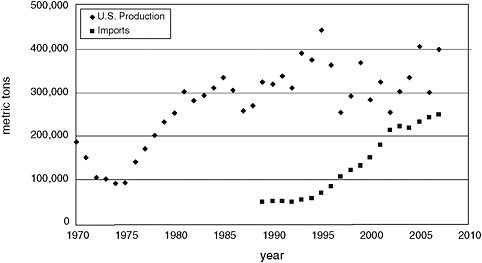
FIGURE 4.2 U.S. salmon landings (1970–2007) and imports (1989–2007). SOURCE: National Oceanic and Atmospheric Administration (2007; 2009b).
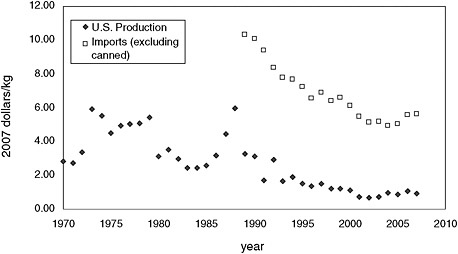
FIGURE 4.3 U.S. salmon prices (1970–2007). U.S. production price is dockside value of whole fish; import price is for fillets. SOURCE: National Oceanic and Atmospheric Administration (2007; 2009b).
less steady (but quite volatile) after 1990. The trends seen in these data suggest that prices decreased in response to the rapid expansion in supply, although association is not causation. In a study of the Japanese salmon market, Asche et al. (2005) examined market integration of farmed and wild salmon and found that the increase in mariculture production was
associated with a decrease in the price of both wild and farmed salmon. The decrease in price reduces the economic incentive to harvest the wild stocks. Effective management of the level of wild-salmon harvest could explain the apparent lack of impact of reduced prices on wild-salmon production, although the price decrease appeared to increase the incentive to reduce fishing capacity in Alaska (Anderson, 2002). Without the supply from farmed salmon, the economic pressure to harvest wild salmon resources might be greater today.
There is anecdotal evidence of similar price effects in bivalve molluscs. For example, cultured production of hard clams increased significantly in Virginia and Florida during the 1990s; the total farm-gate value (i.e., the net value of the product when it leaves the farm) of Florida cultured hard clams rose from $3.7 million in 1993 to $15.9 million in 1999 (Philippakos et al., 2001). This increase in mariculture production in Florida was associated with a decline in the average market price of these clams from $0.23 per clam (Philippakos et al., 2001) to $0.145 per clam (Adams et al., 2009).
The lack of consistent and meaningful time-series data on mollusc production by species at the national level (see Markets, Prices, and Trade in Chapter 6) makes it difficult to interpret these trends with confidence. According to National Oceanic and Atmospheric Administration (2007; 2009b, d) production and import statistics, oyster imports into the United States rose from about 6,000 metric tons (meat weight) per year in 1995 to about 11,000 metric tons (meat weight) per year in 2007, presently accounting for more than a third of the U.S. oyster market (see Chapter 6 for details). However, most of these imports represent farmed and processed product (smoked and canned) from Korea and China, a sector of the market that is unlikely to compete directly with the U.S. product that is predominantly fresh (shucked or live oysters). Therefore, it is difficult to assess the effect of cultured oyster imports on U.S. market prices, although the inexpensive processed imports would likely discourage investment in a domestic canned or smoked product.
In conclusion, economic theory suggests that mariculture production will tend to increase supply and, if there are no compensatory changes in the market, drive down the price of the cultured species. As a consequence of lower prices, the economic incentives to harvest wild populations will tend to be reduced. The extent to which this change in economic incentives reduces fishing pressure depends on the condition and management of the wild fishery. Empirical evidence of such effects in U.S. fisheries is largely anecdotal and limited to prices. For example, rising imports of cultured salmon since the mid-1990s have been associated with declines in average market price, but there is no clear indication of a corresponding
change in physical fishing pressure on wild stocks. For molluscs, analysis of these changes is complicated by data limitations.
FINDINGS AND RECOMMENDATIONS
Finding: Although the effects of disturbance to benthic communities caused by bivalve mariculture activities and those from wild harvest are relatively well understood at local scales, there are few direct comparisons, and less is known about cumulative effects at larger spatial and longer temporal scales.
Recommendation: Direct comparisons of the effects of bivalve mariculture and wild harvest should be conducted in systems with both activities to better understand their effects in comparable environments. Studies at larger spatial scales and over longer periods of time should also be undertaken.
Finding: Economic theory suggests that mariculture production will tend to increase supply and reduce the price of the cultured species, thereby reducing economic incentives to harvest wild populations. The effect of lower prices on fishing pressure depends on the condition and management of the wild fishery. Empirical evidence for these effects is largely limited to observations of price trends with increases in supply, but there has been little formal analysis of responses of either markets or wild fisheries to the expansion of mariculture.
Recommendation: Policy makers and marine resource managers should anticipate possible linkages between wild harvest and mariculture production in shellfish markets when developing forecasts. Managers should monitor changes in market prices to assess the effects of mariculture on supply, product quality and availability, and the response of wild-harvest fisheries to these changes in market conditions.


