
6
Workforce Development and Career Development
This chapter focuses on uses of O*NET in workforce development and career development. It begins with a discussion of the role of O*NET in advancing workforce development goals. The next section focuses on the importance of linking O*NET to other data sets in order to support workforce development. Then, the following sections discuss the role of O*NET in advancing the workforce development goals of skills transferability, analyzing skill gaps, and supporting human resource management. The final section focuses on the role of O*NET in career development.
This chapter draws on information and presentations to the panel from O*NET users, technical experts, and scholars as well as analysis of O*NET documentation and studies. It is also based on responses to an email request for input from the workforce development community, largely represented by state labor market information department directors (Calig and Ewald, 2009; Ewald, 2009; Froeschle, 2009). About 20 state directors responded with comments about the strengths and weaknesses of O*NET for workforce development purposes. The discussion of career development is based on presentations to the panel and e-mail and phone responses to a survey of this community (Janis, 2009a, 2009b).
WORKFORCE DEVELOPMENT GOALS
The mission of the U.S. Department of Labor’s (DOL’s) Employment and Training Administration (ETA) is to:
… contribute to the more efficient functioning of the U.S. labor market by providing high quality job training, employment, labor market information, and income maintenance services primarily through state and local workforce development systems (U.S. Department of Labor, 2009).
As noted in Chapter 1, this mission and the flow of funding for O*NET clearly indicate that DOL views O*NET as a tool to support workforce development rather than a stand-alone statistical program.
Historically, workforce development programs have provided a safety net to workers negatively affected by economic change. The unemployment insurance program operated today by state and local workforce offices was created by the Wagner-Peyser Act of 1933. This and other programs administered by workforce development officials today continue to provide a safety net to help unemployed and underemployed individuals with job placement, career guidance, and, if needed, education and training.
The mission of workforce development has expanded. Under the Workforce Investment Act of 1998 (P.L. 105-277), the mission is to support the optimal transition and movement not only of individuals but also of the larger workforce in response to changing economic needs. Whether in a growth economy, when demand for skilled labor is outpacing supply, or in a depressed economy when workers are being displaced, the mission of workforce development is to support businesses and workers alike. Accomplishing this broad mission requires occupational information.
O*NET provides key components of the information needed to advance four workforce development goals identified by the panel:
-
Defining critical occupations for economic and workforce development for national, state, and regional areas. This includes defining clusters of occupations relevant to policy, program, or research initiatives, such as high-skill, high-demand occupations; science, technology, engineering, and mathematics occupations; career pathways; green jobs; etc.
-
Developing skill transferability and worker assessment tools for use in placing adults in jobs, rapid response to layoffs, and supporting economic development.
-
Identifying appropriate education and training options for displaced and transitioning workers.
-
Assisting employers in human resource management activities, including employee recruitment, retention, and development.
Following a discussion of the importance of linking O*NET data with other data sets, the remaining sections of this chapter will review and evaluate uses of O*NET in advancing these four goals.
THE IMPORTANCE OF DATA LINKAGE
Representatives of the workforce development told the committee that they use O*NET data not as self-contained solutions, but as building blocks which they link to other data sets in a multitude of applications. The ability of O*NET to contribute to these applications depends on the extent to which it can be linked with other taxonomies and data systems. The most important linkage is that between O*NET and the Standard Occupational Classification (SOC) coding system. The linkage of federal employment statistics collected using the SOC taxonomy with O*NET data allows users to expand the array of occupational information that is available and serve a much broader audience than if O*NET stood alone as an independent occupational classification system. Workforce development professionals who spoke to the panel expressed the view that any revisions of the occupations included in the O*NET occupational classification system should be aligned with revisions to occupations included in the SOC (Calig and Ewald, 2009). They suggested that efforts to identify new and emerging occupations and green occupations should not necessarily lead to the addition of new occupations to the classification system that would make it less aligned with the SOC.
An important feature of the connection between O*NET and SOC is the ability to link to other useful education and labor market data sets that can be associated with SOC. For example, the U.S. Army and Marines use a system of military occupational classification (MOC) codes to classify occupational data, and the military services organize information on training using the Military Occupational Training Data System (see Box 6-1). The alignment of these two classification systems with SOC facilitates the development of crosswalks that can be used to link O*NET data with data on military occupations and training. The National Center for O*NET Development provides crosswalks between O*NET and MOC codes, available through O*NET OnLine and for download from the O*NET Resource Center website. Similarly, data collected by the Census Bureau using the SOC system can also be easily linked to O*NET because of the alignment of O*NET with SOC. The connection of O*NET with the SOC also enables linkage of O*NET data with projections of future occupational demand.
The value of mechanically linking data to O*NET from multiple sources enabled by the alignment of O*NET with the SOC cannot be overstated. The connections facilitated by crosswalks enable development of career information delivery systems, occupational information systems, and other useful applications of O*NET data.
|
BOX 6-1 Military Occupations and O*NET Although the O*NET occupational classification system includes 18 military occupations, the O*NET Center does not collect data related to these occupations. The military services currently use a variety of different occupational classification systems, and the Department of Defense recently commissioned a study to explore the feasibility of developing a common occupational framework as one element of a broader human capital strategy (Hanser et al., 2008). In addition, the department is researching methods to establish and maintain what it calls a human interoperability enterprise, which cuts across the branches of the service and homeland security. The O*NET content model could potentially play a role in these efforts to improve alignment of occupational information systems across the military services. This research by the military is at an early stage, and state workforce development specialists regularly face the challenge of helping service members transition from active duty to civilian life. Matching the skill sets of active-duty personnel to job opportunities in the private sector can be especially difficult. To help workforce development officials meet this challenge, the O*NET Center, the Defense Manpower Data Center, and the National Crosswalk Center have collaborated to create a a crosswalk between the military occupational clasification codes and O*NET occupations and codes. In June 2009, the crosswalk was updated with information from the Department of Defense on over 8,700 military occupations as defined by the military occupational classification system (National Center for O*NET Development, no date, a). However, the military occupational classification system is not used by all branches of the military. In addition, the O*NET Center and collaborators do not provide a crosswalk between O*NET and the more detailed occupational data included in the Military Occupational Training Data system. Improved linkage between military occupational information and O*NET data would help workforce development officials to assist veterans in moving into civilian jobs and would help young people to explore military as well as civilian careers. |
Linking to Education Data
Preparing the workforce of tomorrow requires some understanding of the occupational skills, knowledge, and abilities that will be required in the future. State workforce development officials sometimes link projections of
future employment in specific occupations with O*NET data on the skills and knowledge required by those occupations, in order to project future skill demands.
Taking the next step—identifying any existing education programs that could develop the skills and knowledge required or gaps in what is available, suggesting a need to develop new education programs—requires data on education programs. The National Center for Education Statistics (NCES) collects and publishes such data, using the Classification of Instructional Programs (CIP) system to report on completion of postsecondary degrees in various major fields of study (National Center for Education Statistics, no date). It has collaborated with DOL to create crosswalks between the CIP, the SOC, and O*NET, available both from the National Crosswalk Service Center supported by DOL and from NCES.
State workforce development agencies download these crosswalks and the O*NET database, using them to create a variety of tools that assist in planning for economic development and workforce development. For example, with funding from DOL, a consortium of state labor market information specialists created a web-based database called the Occupational Supply and Demand System (OSDS, see http://www.occsupplydemand.org). The OSDS combines national and state-level occupational characteristics, occupational projections, wage trends, licensing data, and industry employment with postsecondary graduation data (supply) for analysis of labor markets and training options. The OSDS can be used to relate structured education and training programs to the occupations filled by their graduates. The OSDS is designed to help business and industrial analysts, education program planners, workforce administrators, and others determine labor availability and training program offerings on the basis of the supply-demand mix. It assists states in economic development by providing companies moving into the state with a snapshot of qualified professional and nonprofessional workers.
The workforce development community views development of OSDS as a model of their ability, with federal support, to create very useful tools incorporating O*NET data. This community especially values the inclusion of data for all 50 states in OSDS. Although the states that have developed their own data systems incorporating similar linked data sets and more local data use OSDS less frequently than other states, it is widely valued and used. During June 2009, the OSDS website had 70,292 hits.
An example of a state-developed tool linking O*NET data with education data is the Ohio Skills Bank Data Tool (see http://ohiolmi.com/asp/SB/SkillsBank.htm). This website can be used to identify critical occupations in different economic development regions in the state and target education resources to meet those needs. It is tailored to meet the needs of a select audience of education workforce analysts located in each region of the state.
Both of these valuable tools link education data with data on projected employment levels in different occupations, a process that depends on the availability of crosswalks among CIP, O*NET, and SOC. All three of these data systems are in the process of being revised. In 2009, the National Center for Education Statistics (no date) released the updated CIP 2010, the National Center for O*NET Development released the updated O*NET-SOC 2009, and the Office of Management and Budget (2009) announced the updated SOC 2010. To facilitate development of useful workforce development tools, it is important to update these crosswalks. In particular, updating the crosswalks between the CIP and O*NET would assist the workforce development community to align education and training programs with evolving demands for workforce skills.
Linking to Industry Staffing Patterns
Because the demand for labor is a derived demand—that is, job creation is dependent on consumer demand—the best way to determine future occupational skill needs is to project industry demand. Data on current demand in various industry sectors, collected using the North American Industrial Classification System (NAICS), are used to project future industry demand. The Bureau of Labor Statistics (BLS) has established the relationships between industry and occupational data through its ongoing Occupational Employment Survey, which yields data on current occupational employment (defined by the SOC) in various industry sectors (defined by NAICS). BLS combines information on current industry staffing patterns with projections of future industry demand to create projections of future employment in different SOC occupations. Because O*NET is aligned with SOC, workforce development specialists are able to link these projections of future occupational employment with the Abilities, Knowledge, Skills, and other characteristics of these occupations, to guide workforce development and economic development activities. For example, analysts in Illinois linked O*NET data and BLS occupational employment projections to project potential shortages of 15 skills (as defined in O*NET) in the year 2012. The largest projected shortages were in the skills of reading comprehension, active listening, speaking, and writing (Ginsburg and Robinson, 2006).
Defining Critical Occupations
The first workforce development goal identified by the panel is to define critical occupations for use in planning economic, education, and workforce development initiatives. Workforce development specialists define critical occupations various ways. They often use such criteria as whether an occupation is large, its projected future growth rate, the median salary,
and whether it is needed in key industries that a city or state is trying to recruit or develop. Defining critical occupations requires information on occupational characteristics that can be supplied by O*NET, along with information on current and projected employment levels and wages and other data. The goal of these activities is to align workforce development policies with projected labor market demand and also to influence future labor market demand by supplying skilled workers to support the growth of targeted industries.
The process of defining critical occupations, like workforce planning more generally, is not unlike human resource management but on a larger scale, such as a regional, state, or national economy. O*NET provides a key component of the data needed in this process.
Because DOL views O*NET as a tool for workforce development, it is not surprising that the agency has tried to make this tool more effective by defining critical occupations and incorporating them into O*NET. For example, in 2006, DOL identified “high growth industry sectors” and directed the O*NET Center to search for new and emerging occupations in these sectors for possible inclusion in O*NET (National Center for O*NET Development, 2006). In a related activity, O*NET OnLine includes areas that target occupational searches toward 16 “in-demand” industry clusters that are defined as “economically important, projected to have long-term growth, or are being transformed by technology and innovation” (National Center for O*NET Development, no date, b). A user who clicks on an industry cluster will find a list of “in-demand” occupations highlighted with green flags. The occupational search area of O*NET OnLine also targets occupational searches towards “green” occupations and occupations that require knowledge of science, technology, engineering, and mathematics.
The workforce development community has mixed views about these efforts to define critical occupations nationally (Calig and Ewald, 2009). Some do not find the critical occupations defined by DOL important at the state or local level. For example, Bonnie Graybill (2009a) of the California Employment Development Department told the panel that the “in demand” flag is overused. She indicated that California workforce development officials do not believe these occupations are demand, given the current economic downturn, and recommended that the flags be eliminated from O*NET OnLine (Graybill, 2009b).
In another example, DOL has defined green occupations as critical, directing the O*NET Center to identify such occupations for inclusion in the O*NET classification system (Dierdorff et al., 2009). In Texas, however, workforce development and economic development officials consider only those green occupations associated with wind energy to be critical. At the regional level, wind energy occupations are critical in west Texas, but not in the eastern part of the state. At the most local level, the economy in
Bastrop, an Austin suburb, is dependent on tourism. Officials in Bastrop are not at all interested in occupations related to geospatial technology, although they are defined as “in demand” in O*NET OnLine.
Labor market information specialists who responded to the panel’s call for feedback on O*NET also expressed concern about what they viewed as a lack of transparency in DOL’s definitions of critical occupations. They said that information was lacking on the methods and criteria used to define the 16 in-demand industry clusters (Calig and Ewald, 2009).
Some workforce development specialists also question whether DOL and the O*NET Center should create tools incorporating O*NET. They prefer to download the O*NET database and incorporate it into their own tools, such as OSDS and the Ohio Skills Bank Data Tool, which can be tailored to meet the needs of specific local users while allowing flexibility in searching for information.
Skills Transferability
The second major goal of workforce development is skills transferability. This involves efforts to identify the broad, transferable skills an individual may possess in order to help him or her qualify for a new or different job. Skills transferability is very useful for workforce development specialists for two purposes: (1) to assist displaced or dislocated workers to find new employment opportunities and (2) to plan workforce development policies and programs, as described above. Although the first purpose of skills transferability appears to address the needs of the individual and the second to address the needs of business and the community, from a systems perspective, neither goal can be met without considering the needs of both. However, these two communities operate with their own unique concepts, jargon, objectives, and time frames. Although aligning them around a common language to communicate about occupations is a formidable challenge, the O*NET database provides such a common language.
Automated skills transferability systems use computer technology to sort and filter data on worker and labor market characteristics. The systems use O*NET data to identify transferable skills, knowledge, and other characteristics as well as gaps in which increased skills (and knowledge and other characteristics) are needed in order to gain employment. The information they provide can help workers become reeducated and reemployed, explore occupational possibilities, and smooth transitions between jobs. Providing information for use in person-job matching is a primary role of O*NET. The O*NET Center provides two automated tools for self-assessment and skills transferability—the Computerized Interest Profiler and the Work Importance Profiler. An individual can use the tools to
identify his or her personal characteristics and to identify the level and importance of various skills, knowledge, work values, and interests required by their current occupation. The individual can then compare the skills, knowledge, work values, etc., he or she possesses with the skills, knowledge, and other requirements of a different occupation. For example, the O*NET database provides information on such basic skills as reading comprehension, mathematics, writing, and speaking. The individual can identify the basic skill levels associated with his or her current or most recent occupation and the skill levels required by the occupation he or she may wish to enter. People who do not possess the basic skills required by the job they are interested in must either consider remedial basic education or decide to accept a job with basic skill levels that more closely match those they already possess.
Many states and private vendors have developed automated skills transferability tools incorporating O*NET data to assist in matching workers to jobs. For example, the California Employment Development Department has created an online tool, the California Occupational Guides (see http://www.labormarketinfo.edd.ca.gov/occguides/), which links wages, projected employment levels, and O*NET data on the tasks, skills, and other characteristics of occupations (Graybill, 2009b). The department used it to help loan officers laid off in the southern part of the state, by identifying these workers’ transferable skills and a cluster of related occupations, including customer service, payroll, and tax preparation occupations. Department staff also used this tool to assist workers laid off in the aerospace industry, due to closures of military bases and manufacturing plants.
Some skills transferability tools include numerical indexes of individuals’ skills. For example, the Indiana Department of Workforce Development used a tool with such numerical data to identify the skills of laid-off workers and match them with occupations requiring these skills (Clark, 2009). The Manpower Corporation has developed an automated skills transferability system incorporating a similar numerical index (Dorman, 2009). These systems rely on O*NET descriptors as the basis for the various sorting and filtering algorithms.
As these examples illustrate, states and private developers have created useful automated skills transferability systems, as well as other tools incorporating O*NET. Because they are in touch with the information needs of their constituencies, states and private developers can easily design the systems to meet these needs. This suggests that, rather than using limited funding to create tools and applications, DOL should focus its efforts primarily on maintaining the quality of the O*NET database and facilitating access to it.
Identifying Education and Training Options
Another way O*NET data are used in workforce development is to analyze skill gaps and identify education and training to fill those gaps. A consortium of state labor market information specialists, with funding from DOL, created the Skills Projections System software. This system integrated O*NET data with state-specific occupational projections in an effort to facilitate worker transferability (Tsacoumis, 2007). This and the other skills transferability tools described above allow an individual to identify the importance and level of skills, knowledge, and abilities they have developed in one occupation and identify other occupations requiring similar skills, knowledge, and abilities.
However, most such tools cannot be used to identify an appropriate training or development strategy for a displaced worker who needs to develop new types of skills (and/or knowledge, abilities, or other characteristics) to qualify for a closely related occupation.1 Nor do they illuminate how a displaced worker could increase his or her skill levels to qualify for job openings in occupations requiring types of skills similar to those he or she already possesses, but at higher levels. For example, it is unclear what a displaced worker with an oral expression level of 2 in the skills domain should do to become qualified for a job requiring oral expression skills at level 4. Equally unclear is how a worker might prepare for job openings in occupations that require such skills as “active listening” or such abilities as “fluency of ideas” or “originality.” The formal education and training system, including public higher education, does not classify courses or fields of study around the Skills, Knowledge, and Abilities descriptors included in the O*NET content model. The result is a gap between an individual’s identified skill levels, the skills required by jobs the individual may be interested in, and the education needed to develop them.
A different set of O*NET descriptors could fill this information gap. Instead of relying only on the Skills, Knowledge, and Abilities descriptors, skills transferability systems could add (or substitute) descriptors from the Detailed Work Activity (DWA) domain. As noted in Chapter 2, the DWA library in O*NET offers some 2,200 standardized statements that are assigned across all O*NET occupations. These statements are designed to be somewhat occupationally specific as well as somewhat transferable, so that one statement can be found in several different occupations. For example, the DWA statement, “Analyze biological research, test or analysis data” is found in the occupations of animal scientists, forensic science technicians, biological technicians, foresters, medical and clinical lab technicians, and
other occupations. Because this descriptor is standardized across occupations, it can readily be used for skills transferability purposes. Such use would be based on the assumption that the performance of the DWA connotes a certain level of skill and/or knowledge.2
The potential of DWAs for skills transferability is apparent in the history of their development. Workforce development specialists in Oregon developed the “skill statements” that were the precursors to DWAs for the specific purpose of helping individuals identify their skills and match them to occupations and to education and training programs aligned with the skills needed in those occupations. Current DWA statements, like the earlier skill statements, consist of short phrases, such as “adhere to government aviation regulations” or “use airbrush techniques,” that are similar to those found in resumes and job advertisements. Because each DWA is defined in terms of doing something concrete, it is possible to compare the DWAs of large or growing occupations that could provide jobs for displaced workers with the curriculum of education and training courses and programs. Such a comparison could serve to identify existing courses and programs most likely to develop displaced workers’ mastery of the DWAs in demand, or to focus the design of new courses or instructional programs to develop these DWAs (see Figure 6-1). Using DWAs as the common language connecting the worlds of work and education might increase the efficiency of individual job searches and worker retraining initiatives.
However, the current library of DWAs is inadequate for skills transferability applications (Froeschle, 2009). Although the O*NET Center commissioned a project to develop the DWAs in 2003 (National Center for O*NET Development, 2003), these efforts stopped when the project concluded. The project team’s goal of assigning 15 to 20 DWA statements to each occupation has not been achieved. Currently, there are 26 occupations that have fewer than 10 DWAs. At the same time, one occupation (pile driver operator) has only one DWA, while the occupation of industrial/ organizational psychologist has 114 DWAs. Another problem is that some DWAs incorporate vague descriptions of work that are more appropriate to the Generalized Work Activities domain—such as “writes reports,” “makes decisions,” and “uses government regulations”—rather than concrete descriptions of specific activities. In addition, 65 current DWAs are “double-barreled,” describing more than one activity.
Recognizing this problem, the Texas Workforce Commission has launched an employer validation initiative to expand the breadth of applicable DWAs across all occupations and assess their relevance to the Texas
|
2 |
As noted in Chapter 2, O*NET descriptors of abilities and skills required “to perform the job” do not reflect research showing a continuous distribution of performance differences across job holders. |
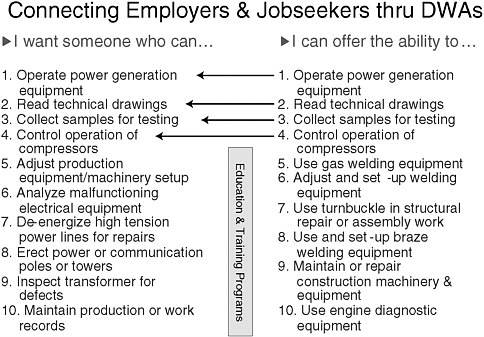
FIGURE 6-1 Example of identifying education and training needs with DWAs.
SOURCE: Froeschle (2009).
employer community. Given the importance of workforce development to the O*NET mission, the panel thinks that DOL should review the DWA descriptors, assess their potential for use in skill transferability, and explore the potential for their further development.
Human Resource Management
In many cases, workforce development officials are requested to assist the business community in strategic human resource planning. O*NET data can help officials respond to such requests. This section focuses on the use of O*NET by workforce development officials to assist private organizations in human resource management. A more detailed discussion of the use of O*NET by private organizations is found in Chapter 7.
Businesses do not organize job information using federal occupational classification systems, such as O*NET or the SOC. They may apply any title they choose to occupations. When the Texas Workforce Commission asked employers to provide payroll job titles and other information as part of a survey conducted between 1993 and 1998, it received over 500,000 discrete titles, many of which had little or no meaning outside the individual firms in which they were used. Thus, the first step in engaging employers as
users of O*NET is to determine the correspondence between employer job titles (often referred to as “lay” job titles) and O*NET occupations.
The O*NET Center has taken this step, developing crosswalks between approximately 68,000 lay job titles and O*NET occupations. However, they have some weaknesses. For example, entering the term “bridge builder” in the quick search area of O*NET OnLine yields a list of occupations that range from construction laborers and bridge and lock tenders to dental laboratory technicians. Until the crosswalks are readily available, highly flexible, automated, and simple to use, employers are not likely to use them.
Assuming the crosswalk problem can be solved, workforce development specialists could assist business leaders in using a range of O*NET data to inform their human resource management decisions. A common use of O*NET in private organizations is to specify the skill, knowledge, and other requirements of a particular job. Workforce development specialists could help managers in this process and could also, by using some of the tools described above, link the resulting skill requirements with data on the current and projected future supply of individuals possessing these skills and education and training programs to develop the skills. Workforce development officials can also help managers draw on federal and state data to compare wages across occupations and regions.
O*NET data can help managers answer many business questions ranging from “Where do I place a new plant?” to “How much do I pay workers for this job in this community?” They can also help to answer managers’ questions about employee development and training. For example, they can help managers identify education and training providers engaged in developing skills the business needs to compete. Using this information, managers can collaborate with education and training providers to develop customized training programs to supply the needed skills. Workforce development officials often assist in development of such customized training programs and also assist curriculum developers in creating new training programs aligned with business needs.
CAREER DEVELOPMENT
Career development professionals and their clients use O*NET OnLine and the associated Career Exploration Tools in a variety of ways. Some examples include looking up specific job titles and job families, finding transferable skills, researching possible career paths, helping shape career goal-setting, and starting conversations about careers. Career development professionals can also help clients use O*NET OnLine to prepare for job search interviews, explore careers, prepare resumes, generate position descriptions, and search for alternative job titles.
Federal Websites for Career Development
There are two federal government websites that make extensive use of O*NET data to foster career exploration and decision making: The U.S. Department of Labor’s Career OneStop (see http://www.careeronestop.org) and a collaborative website between the U.S. Departments of Labor and Education, Career Voyages (see http://www.careervoyages.gov). Career OneStop’s Occupation Profiles display the “most important” knowledge, skills, abilities, and generalized work activities, occupation specific tasks, and the tools and technology from the O*NET database. The Occupation Profile also includes state and national wages and employment trends. Additional links to financial aid, related occupations, education and training, and other web resources are provided. An Occupational Description in Career Voyages includes O*NET information on knowledge, skills, abilities, interests, work styles, and tools and technology. Both websites incorporate O*NET occupational descriptions and content model statements verbatim. Cross-references and linkages between both websites and O*NET are provided strategically and frequently.
According to the National Career Development Association (NCDA) website, the mission of NCDA is to “promote the career development of all people over the life span.” Thus, career development is a dynamic process over most of one’s lifetime that includes, for example, such end-users as middle school students, college students, and mid-life career changers. As the “nation’s primary source of occupational information” the O*NET program does exceptionally well. However, to address the needs of diverse, end-user populations, career information delivery system developers, for many years now, have incorporated O*NET data (and previously DOT data) and additional career information into their products to provide the end-user with a comprehensive system that meets their needs.
Career Information Delivery Systems
Comprehensive online career information delivery systems (CIDS) are widely used and available throughout the country. There are just over a dozen major developers of CIDS, plus state systems that use and augment the developers’ systems or develop their own (see Box 6-2). Some CIDS developers are not-for-profit state agencies and others are for-profit companies. All of the CIDS programs, whether they are for-profit or not, use O*NET data.
In February, 2009, the committee conducted a telephone poll of these system developers. Based on this poll, the committee estimates that nationally, CIDS programs were accessed at more than 86,000 sites by over 37 million users in February 2009, with the typical user accessing the site
|
BOX 6-2 Major Developers of Comprehensive Career Information Delivery Systems
|
throughout the academic year 2008-2009. Thus, for career exploration and development purposes, CIDS programs are collectively the primary providers of O*NET information.
To meet standards established by the Association of Computer-based Systems for Career Information (ACSCI), CIDS must “provide integrated components that are consistent with career development theory in their design and facilitate career development in their application” (ACSCI Standards Implementation Handbook, 2009, see http://www.acsci.org).
Most of the CIDS programs are managed and delivered to end-users via user sites. Typically, students (end-users) at a high school (user site) get access to and help with the CIDS program from the school staff (e.g., counselors, teachers, advisors, graduation coaches, etc.), who are both end-users and career specialists. These web-based systems are delivered to a wide array of sites, including schools, colleges and universities, employment service offices, rehabilitation services offices, family and children services offices, juvenile justice centers, correctional facilities, counseling agencies, and public libraries.
CIDS developers use the O*NET database as their primary source for developing occupation descriptions for their systems. However, with system products targeting end-users whose ages range from elementary school students through adults, the O*NET data content is often rewritten in a more user-friendly, information style and format, and at a more appropriate reading level. For example, Georgia State University’s Georgia Career Information System contains data from the O*NET on occupation dental hygienists. The task statement “Clean calcareous deposits, accretions, and stains from teeth and beneath margins of gums, using dental instruments” is rewritten to a ninth grade reading as “Clean patient’s teeth using dental instruments” so it is more accessible to users. Furthermore, CIDS developers create occupation descriptions, using O*NET content from task statements, knowledge, skills, abilities, work activities, work context, interests, work styles, and work values. O*NET clearly is the foundation for the development of the occupational content in CIDS.
The occupational content in CIDS also includes state and national wage data and employment projections. These data imports are available because of the crosswalks between O*NET occupations and the BLS data, enabled by the alignment of O*NET with the SOC.
Most CIDS contain extensive information files about occupations, career pathways, programs of study and training, job searching, financial aid awards, job interviews, and military employment, along with a glossary of terms and occupational videos. Each of the 500+ occupational descriptions in a CIDS is internally linked to a group of related occupations. The occupational descriptions also are internally linked to one or more related program of study descriptions from the CIP, and the programs of study descriptions are internally linked to postsecondary institutions, financial aid sources, industry information, and other related data. The entire system is fully integrated, containing multiple links from one information file to another, to help guide the user through their career development process.
Tools for Self-Assessment and Career Exploration
An important aspect of career development is relating self-knowledge to the world of work. Two O*NET career exploration tools, the Interest Profiler and the Work Importance Locator, help individuals identify their work-related interests and what they consider important on the job (see http://www.onetcenter.org). CIDS developers have created online versions of these tools and integrated them into their systems. They also have used some O*NET descriptors (e.g., Skills, Knowledge, Abilities) to develop additional online self-assessment tools. The results of these self-assessment instruments, filtered lists of occupations based on user inputs, are linked to the O*NET-based occupational information. Two examples of these
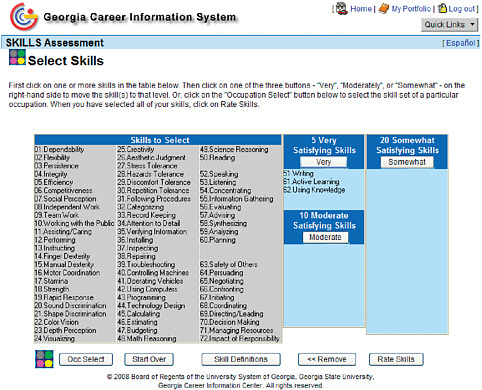
FIGURE 6-2 Skills assessment in the Georgia Career Information System.
SOURCE: Georgia Career Information System. Reprinted with permission.
career tools are the Skills Assessment of the Georgia Career Information System (see Figure 6-2) and the Career Finder from the Choices Planner (see Figure 6-3).
The Career Portfolio
A fundamental component of CIDS systems is the portfolio. Fully integrated into the systems, portfolios assist users with their career exploration, management, and decision making. These personal career folders store users’ occupational and educational preferences, career plans, assessment and interest inventories results, skills and abilities, accomplishment, resumes, and other pertinent career-related information. Many CIDS portfolios offer career plans of action, using assessment results along with career development activities and worksheets. For students, the portfolios provide a multiyear course planner to help them relate and store their educational options and endeavors toward the world of work.
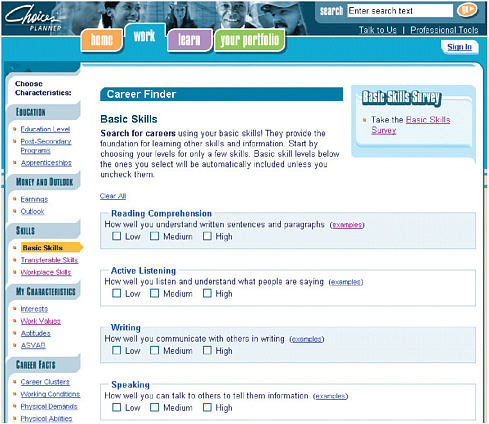
FIGURE 6-3 Skills assessment in the Choices Career Information Delivery System.
SOURCE: Zap Corporation. Reprinted with permission.
Training and Support Services
CIDS developers provide training and support services for their systems to user site personnel (e.g., educators, counselors, agency staff). Typically, state CIDS offer staff development workshops at many locations throughout the state. State CIDS staffs also provide technical assistance, support the activities of their local counseling and career development associations, and present their systems at conferences.
Use of the O*NET Database in Career Information Delivery Systems
The continuous updating of the O*NET database provides CIDS and other content users with current occupational information, including lists of new and emerging occupations. CIDS also incorporate the lay titles file
and crosswalks described above. Generally, the CIDS community welcomes DOL efforts to define critical “in-demand” occupations, occupations requiring science, technology, engineering, and mathematics (STEM) and most recently “green occupations,” because CIDS users value the currency of these data products. However, the inclusion of new and emerging occupations in the O*NET classification system also poses some challenges to CIDS developers (see Chapter 3).
Some CIDS developers have translated portions of their systems into Spanish. However, the Spanish translation of O*NET version 4.0 provides little value to CIDS. The translation would have to be kept current, and, as mentioned earlier, the O*NET occupational content is frequently revised, essentially negating the usefulness for CIDS of the O*NET center’s efforts in the Spanish translation.
Another use of O*NET in career development relates to the Carl D. Perkins Career and Technical Education Improvement Act of 2006. This law requires states to define high-demand, high-wage, and high-skill (highDWS) occupations. States are to use their definitions for high-DWS occupations to ensure that their career and technical education programs of study prepare students for high-DWS. Some states have used O*NET data to develop their definitions for high-DWS occupations (see http://www.occsupplydemand.org).
CONCLUSIONS AND RECOMMENDATIONS
An array of individuals and organizations rely on O*NET to inform important activities in workforce development, economic and career development, and analysis of workforce trends. O*NET’s common language, coding structure, framework, and crosswalks are invaluable to the career development community. The impartiality and high quality of O*NET data are essential to assisting people who need to make informed choices about education, training, and careers.
Collecting, maintaining, and publishing high-quality occupational data are essential government functions that require the federal government’s objective perspective and capacity for funding large projects. O*NET uses a common language to describe occupations across industries and states, facilitating communication and shared understanding of the education, skills, and other requirements of occupations among employers, researchers, education and training providers, students, and workers. Without public funding, a few large, well-funded firms, industry associations, states, or localities might be able to develop proprietary occupational information systems, but they would have little incentive to include information representative of the entire workforce, to share a common language, or to link with other proprietary occupational information systems.
O*NET, as a common, national database, provides the foundation for multiple private-sector and public-sector applications and tools. The federal investment in collecting and maintaining the data encourages further investment in supplementary tools that extend the value and benefit of the database.
However, short-term policy agendas related to workforce development have at times reduced focus on the core activities of developing, maintaining, and updating a high-quality database. DOL has created definitions of critical occupations and has incorporated these definitions in O*NET tools and applications, with little feedback from or communication, with the workforce and career development communities.
The states, the career development community, and private developers, who are closer to their end users than DOL, have developed useful applications incorporating O*NET and have developed their own definitions of critical occupations.
Recommendation: The Department of Labor should focus O*NET resources on the core functions of collecting, maintaining, and publishing high-quality data, leaving development of most new applications and tools to the private sector and to state and local governments.
The full potential of O*NET has not been realized, partly because of a lack of ongoing communication and feedback between the National Center for O*NET Development and current and potential users. As a result, the O*NET Center has an incomplete understanding of user needs, resulting in development of an O*NET that is not fully aligned with these needs and marketing activities that do not explain all its potential uses. In fact, users with different needs and goals draw on different O*NET data elements and apply them as building blocks toward more complete or customized solutions.
Recommendation: The Department of Labor should establish and staff an ongoing, external user advisory board, including at least one representative of each major user group, as well as representatives of potential users in the U.S. military and in K-12 and higher education. The board should meet regularly to provide advice and recommendations to DOL regarding processes for identifying users’ evolving needs and communicating information about O*NET and its uses.
DOL should also establish mechanisms for ongoing communication between this user advisory board and the technical advisory board recommended in Chapter 2. This will ensure that O*NET users are aware of on-
going research and its implications for existing applications and will inform the technical advisory board of users’ needs and concerns.
For the workforce development and career development communities, much of the power of O*NET derives from the alignment of its occupational classification system with the occupations included in the SOC system. The research recommended in Chapter 3 would provide guidance to DOL in balancing these needs with the needs of other O*NET users and potential users.
Labor market information specialists need to be able to link O*NET data on the skills, knowledge, and educational requirements of occupations with data on instructional programs of study. Without such links, the specialists find it very difficult to provide reasonable and informed advice about training options for the adult workforce or to propose rational training investment options to the workforce development community. DOL should provide, for each occupation in O*NET, a crosswalk to the Classification of Instructional Programs.
Recommendation: The Department of Labor should, with advice and guidance from the user advisory board, update the existing crosswalk between O*NET and CIP as soon as possible, to reflect the recently completed revisions of both the CIP and O*NET.
Developers have created promising applications to match individuals or groups with occupations, drawing on the Skills, Knowledge, and Abilities domains of O*NET. These applications are useful for workforce development. However, the Detailed Work Activities domain may offer the greatest potential as a common language or bridge among employer hiring needs, the capabilities of displaced workers or new labor force entrants, and the program and course offerings available through the public education system.
Recommendation: The Department of Labor should, with advice and guidance from the technical advisory board recommended in Chapter 2 and the user advisory board, review past efforts to develop the Detailed Work Activities and the current status and usefulness of these descriptors. Based on this review, the Department of Labor should explore the potential costs and benefits of further development of the domain.
Effective, usable crosswalks that link military job descriptions and characteristics and civilian information in O*NET would allow workforce development officials to improve matches between military occupations and their civilian occupation counterparts. Such matches would allow them to assist transitioning veterans to identify additional skills training they might
need in order to qualify for different occupations, thus increasing their chances for successful transition. Such crosswalks would also assist young people in considering all occupations (both civilian and military) in which their skills might be used and their interests met. Although the O*NET Center has collaborated with the Defense Manpower Data Center and the National Crosswalk Center to create crosswalks, there has been no systematic evaluation of their usefulness or investigation into how they might be improved for use by the military or civilian populations.
Recommendation: The Department of Labor should, with assistance from the military services representatives on the user advisory board, evaluate the existing crosswalks between O*NET occupations and military occupations as well as other tools that the military uses and ensure that the crosswalks are effective and usable for both civilian and military users. Enhanced crosswalks would better facilitate the transition of veterans and other military personnel into civilian life as well as inform the youth population about military careers.
The potential of O*NET to inform critical decisions and communications about workforce development, economic development, career development, and education at the state and local levels is not fully realized because of a lack of understanding of O*NET in these communities.
Recommendation: The recommended user advisory board should advise the Department of Labor on strategies to market, train, and promote the use of O*NET in local, state, and regional career and workforce development and education communities. These strategies should be developed in collaboration with, and marketed by, associations in these communities. In addition, the strategies should include a reinvigorated effort to promote the initial marketing concept of “O*NET in It” in order to clearly separate O*NET as a database from applications using O*NET. These strategies should be supported through use of technology to make the O*NET database more widely usable and accessible.
REFERENCES
Calig, J., and Ewald, K. (2009). O*NET and workforce development: Assessing opportunities. Paper prepared for the Panel to Review the Occupational Information Network (O*NET). Available: http://www7.nationalacademies.org/cfe/Ewald%20and%20Calig%20paper.pdf [accessed July 2009].
Clark, H. (2009). TORQ™ and the Indiana Department of Workforce Development. Paper prepared for the Panel to Review the Occupational Information Network (O*NET). Available: http://www7.nationalacademies.org/cfe/Clark-TORQ%20paper.pdf [accessed July 2009].
Dierdorff, E.C., Norton, J.J., Drewes, D.D., Kroustalis, C.M., Rivkin, D., and Lewis, P. (2009). Greening of the world of work: Implications for O*NET-SOC and new and emerging occupations. Available: http://www.onetcenter.org/reports/Green.html [accessed July 2009].
Dorman, R. (2009). Manpower’s use of O*NET. Presentation to the NRC Panel to Review the Occupational Information Network. Available: http://www7.nationalacademies.org/cfe/Dorman%20Power%20point.pdf [accessed November 2009].
Ewald, K. (2009). O*NET and workforce development: Assessing opportunities. Presentation to the NRC Panel to Review the Occupational Information Network. Available: http://www7.nationalacademies.org/cfe/Ewald%20Power%20point.pdf [accessed July 2009].
Froeschle, R. (2009). O*NET DWAs and market driven talent development model. Presentation to the Panel to Review the Occupational Information Network (O*NET). Available: http://www7.nationalacademies.org/cfe/Froeschle%20Power%20point.pdf [accessed July 2009].
Ginsburg, R., and Robinson, D. (2006). Illinois’ future workforce: Will there be enough workers with the right skills? DeKalb: Northern Illinois University and the Center for Tax and Budget Accountability. Available: http://www.stateofworkingillinois.niu.edu/swil/pubs/2006_Future_Workforce_PolicyBrief.pdf [accessed July 2009].
Graybill, B. (2009a). Occupational skills and the workforce. Presentation to the Panel to Review the Occupational Information Network (O*NET). Available: http://www7.nationalacademies.org/cfe/Graybill%20Power%20point.pdf [accessed July 2009].
Graybill, B. (2009b). Uses of O*NET by State of California—January 2009. Document provided to the Panel to Review the Occupational Information Network (O*NET). Available: http://www7.nationalacademies.org/cfe/Graybill%20current%20uses%20paper.pdf [accessed July 2009].
Hanser, L.M., Campbell, J., Pearlman, K., Petho, F., Plewes, T., and Spenner, K. (2008). Final report of the Panel on the Department of Defense Human Capital Strategy. Santa Monica, CA: RAND.
Janis, L. (2009a). O*NET uses in career guidance. Presentation to the Panel to Review the Occupational Information Network (O*NET). Available: http://www7.nationalacademies.org/cfe/Janis%20Power%20point.pdf [accessed July 2009].
Janis, L. (2009b). Summary of responses to Les Janis Survey on use of O*NET in career development. Available: http://www7.nationalacademies.org/cfe/Janis%20Survey%20Summary%20Responses.pdf [accessed July 2009].
National Center for Education Statistics. (no date). The Integrated Postsecondary Education Data System (IPEDS): Classification of Instructional Programs (CIP). Available: http://nces.ed.gov/ipeds/cipcode/Default.aspx?y=55 [accessed July 2009].
National Center for O*NET Development. (2003). Summary report: Updating the detailed work activities. Available: http://www.onetcenter.org/reports/DWA_summary.html [accessed November 2009].
National Center for O*NET Development. (2006). Updating the O*NET-SOC taxonomy. Raleigh, NC: Author. Available: http://www.onetcenter.org/dl_files/UpdatingTaxonomy_ Summary.pdf [accessed July 2009].
National Center for O*NET Development. (no date, a). O*NET Resource Center: What’s new. Available: http://www.onetcenter.org/whatsnew.html#2009060201 [accessed June 2009].
National Center for O*NET Development. (no date, b). Browse by in-demand industry cluster: Education. Available: http://online.onetcenter.org/find/indemand?i=EDU&g=Go [accessed June 2009].
National Research Council. (2008). Research evidence related to future skill demands: A workshop summary. Margaret Hilton, Rapporteur. Center for Education, Division of Behavioral and Social Sciences and Education. Washington, DC: The National Academies Press.
Office of Management and Budget. (2009). 2010 Standard Occupational Classification (SOC): Final decisions: Notice. Federal Register, 74(12), 3920-3936. Available: http://www.bls.gov/soc/soc2010final.pdf [accessed June 2009].
Tsacoumis, S. (2007). The feasibility of using O*NET to study skill changes. Paper presented to the National Research Council Workshop on Research Evidence Related to Future Skill Demands. Available: http://www7.nationalacademies.org/cfe/Future_Skill_Demands_Commissioned_Papers.html [accessed May 2009].
U.S. Department of Labor. (2009). ETA mission statement. Available: http://www.doleta.gov/etainfo/mission.cfm [accessed May 2009].


