
8
Framework for Action
The actions needed to prevent and treat cardiovascular disease (CVD) in individuals are at first glance beguilingly simple. People should follow healthful balanced diets, remain active throughout their lives, never smoke, and seek health care regularly. Declarations have called on governments to invest more in CVD, to develop laws and policies to protect the health of people, and to provide health services that respond to the CVD needs of people. International conference recommendations have demanded that companies restrict the marketing of certain products such as tobacco and unhealthful foods and beverages to children; eliminate transfats, reduce salt, and introduce healthful oils in their products; and make healthful foods more affordable and available to communities.
The reality is much more complex. Each action is subject to a cascade of breakdowns. Behavior change is difficult, and individual choices are influenced by broader environmental factors. Governments need to juggle many competing priorities, and some countries have limited infrastructure and capacity to address the problem. Companies need to meet the needs of their shareholders. These realities are often not fully considered in the understandable call for needed action. This call has been driven by good intentions, but there has been less success than in other areas of global health in attracting international attention and action, despite overwhelming evidence of the need. The failure to have the scaled impact needed has been due to concern that attention to CVD would detract from other health needs; uncertainty about the effectiveness and feasibility of policies, programs, and services in the contexts in which they need to be implemented; fragmentation of efforts among stakeholders and a need for focused lead-
ership and collaboration centered on clearly defined goals and outcomes; a lack of financial, individual, and institutional resources; and insufficient capacity to meet CVD needs in low and middle income countries, including health workforce and infrastructure capacity as well as implementation and enforcement capacity for policies and regulatory approaches.
Deeper reflection suggests that to prevent and control CVD in the developing world, a number of essential functions are needed to develop and implement effective approaches. Successfully carrying out these functions will require the combined efforts of many players over long periods of time. This chapter first describes these essential functions. This is followed by a discussion of the relative strengths and responsibilities for key players, proposing new or expanded accountabilities and responsibilities where needed and highlighting the need for more effective coordination of efforts to address CVD. Taken together, these functions and key stakeholders form a framework for implementing the actions needed to address the global epidemic of cardiovascular disease.
ESSENTIAL FUNCTIONS REQUIRED FOR IMPLEMENTATION
The effective implementation of efforts to address global CVD requires that certain actions be executed. The functions required to do this include advocacy and leadership at global and national levels, developing policy, program implementation, capacity building, research focusing on evaluating approaches in developing countries that are context specific and culturally relevant, ongoing monitoring and evaluation, and funding. All of these also require resources—financial, technical, and human. These functions and resource needs are described below, with examples of their role in CVD and indications of how they are tied to messages from previous chapters.
Advocacy and Leadership
Advocacy for policy change and for individuals to take actions in their everyday lives are not the same. Both approaches are critical and need to be led by recognized leaders who might be drawn from the community, academia, industry, or government. The first targets governments at local, national, and international levels to encourage policies that will support prevention and control efforts, which is discussed in more detail here. The second focuses on influencing and supporting individuals within their homes and communities to follow healthful lifestyles throughout their lives. National governments, nongovernmental organizations (NGOs), local media, and local governments can each be well placed to do this; these approaches were discussed in Chapter 5.
International advocacy efforts to raise awareness of the growing CVD
epidemic in low and middle income countries have continued to grow with increasing intensity over the past several decades. Professional organizations (national and international) as well as CVD and chronic disease advocacy organizations initially spearheaded this push, organizing a steady stream of declarations, campaigns, and conferences to raise awareness (see Chapter 1 for a more detailed description of these efforts). These succeeded in catching the attention of the international community, which, over the course of the 1990s and early 2000s, has begun to embrace the cause.
Since the mid-1990s, the World Health Organization (WHO) has joined in these advocacy efforts, sponsoring a series of white papers, declarations, and events aimed at convincing donor agencies and national ministries of health of the importance of addressing CVD as well as preparing a toolkit for chronic disease advocacy efforts (WHO Department of Chronic Diseases and Health Promotion, 2006). These efforts have yet to result in significant investment; however, they do appear to have had some success in starting to convince some in the international development assistance and global health donor community that chronic diseases should be a part of the global health agenda. Part of the reason for this lack of success in stimulating investment in chronic disease prevention is that, although there are many advocacy groups working on chronic disease issues, there is little coordination and communication among them, and thus efforts can be fragmented and lack unified messages. More recently this has begun to change, most notably through a partnership for chronic disease advocacy among the World Heart Federation, International Diabetes Federation, and International Union Against Cancer (International Diabetes Federation et al., 2009).
The challenge for advocacy efforts, moving forward, will be to convince ministries of health in low and middle income countries, development assistance agencies, and other donors that investment in CVD prevention and control is critical despite their highly constrained health budgets and many competing health and development priorities. A key challenge in this effort will be to target advocacy efforts at infectious disease, maternal and child health, health systems strengthening, and other global health programs to better communicate the reasons and opportunities to promote the integration of basic chronic disease prevention and management into their existing programs.
In addition to the direct advocacy efforts of CVD and related chronic disease stakeholders, strategies using mass media, media advocacy, social marketing, and social mobilization can serve as conduits of information and mechanisms for advocacy to build support among the various other stakeholders in the global health arena: governments, multinational agencies, scientists and academic institutions, civil society organizations, public health and health care practitioners, and the general public.
The media can interpret and convey scientific information and government policies to the public, and at the same time they can represent the concerns of the general public to policy makers and global health leaders (WHO, 2002). For example, the United Nations has advocated a strategic use of mass media in the effort to control the global HIV/AIDS epidemic, recognizing mass media’s role in influencing public attitudes, behavior, and policy making (UNAIDS, 2005). A similar strategic use of mass media can be used in the global CVD effort in countries where media coverage is reliable and operates within a system that guarantees freedom of the press and thus contributes to a robust and balanced public discourse.
Policy
Policies include national and international norms and standards, regulation, fiscal and trade policies, and professional and clinical guidelines. They indirectly affect individual choices and behavior by changing the available default options. In countries that have adequate regulatory and enforcement capacity, policy makers have a range of policy solutions that are related to CVD, which were discussed in detail in Chapter 5. They include, for example, clinical guidelines, tobacco taxes, restrictions on marketing of certain foods to children, school physical education policies, and subsidies or import duties on certain foods. This is not an exhaustive list but does show the diversity of approaches available.
Because the determinants of CVD extend beyond the realm of the health sector, coordinated approaches are needed so that policies in non-health sectors of government, such as agriculture, urban planning, transportation, and education, can be developed synergistically with health policies to reduce, or at least not adversely affect, risk for CVD. In addition to coordinating among different sectors of government, policies in each of these domains can be developed with input from civil society and the private sector. This coordinated, intersectoral approach can help determine the balance of regulatory measures, incentives, and voluntary measures that is likely to be most effective and realistic in the local political and governmental context, especially when the feasibility of policy changes is challenged by economic aims that may be in conflict with goals for improving health outcomes.
Some approaches work best when initiated globally, like the WHO Framework Convention on Tobacco Control (FCTC). Other approaches do well when initiated locally. Still others, such as clinical guidelines, are best developed and implemented by national agencies or professional societies. There are numerous sets of standards and guidelines in existence that articulate the best practices for CVD care. Most of these are produced by national health and nutrition agencies, national and international professional organizations, and organizations focusing on individual risk factors
or related diseases (such as tobacco, obesity, and diabetes). Unfortunately, as described in Chapter 5, a significant barrier can be that guidelines are not sufficiently disseminated or followed up with training, making it difficult to ensure provider adherence.
Program Implementation
A broad-based set of programmatic initiatives will need to be implemented in a sustained fashion in order to control global CVD and promote cardiovascular health. These programs need to include a range of approaches such as the provision of health services to patients, including clinical prevention as well as diagnosis and treatment; health communications and education in communities; and policy initiatives in a range of sectors. Depending on the available infrastructure, national and subnational authorities are responsible for implementing public health and health programs as well as policy initiatives in other sectors. Other program implementers include universities, NGOs and other organizations in civil society, and, in some low and middle income countries, development agencies and their subcontractors. For all implementers, leveraging existing infrastructure and engaging the local workforce to implement programs and deliver services is crucial for successful solutions in the short term, while building the skills and capacity locally to develop, manage, and maintain programs is a crucial goal for longer-term, sustainable approaches to address the burden of CVD and related chronic disease programs.
Ideally, programs conducted by implementing agencies will be evidence-based. As described earlier in this report, at this time the strength of evidence is variable with limited knowledge about direct applicability to low and middle income settings. However, implementation of initiatives need not wait for full evidence to be generated. It is clear that there is potential for substantial impact on global CVD with adaptations of current knowledge and available tools. The practical solution both to begin to intervene and to build the knowledge base is to conduct research on effectiveness and impact alongside the implementation of programs. This can be achieved through partnerships between research funders and implementation agencies, with the development of pilot programs that are designed from the beginning with the ultimate goal of feasible scale-up in mind.
Capacity Building
Among the most enduring investments in public health over the past century have been those that established institutions that trained leaders in public health, health care, and health research and supported their career development over decades. Nonetheless, there remains an absolute shortage
of public health and clinical workers to mount and sustain public health or health care delivery programs in low and middle income countries (Crisp et al., 2008; World Health Organization, 2006). The focus of investments in global health capacity has to date mainly addressed infectious diseases and maternal and child health. However, to truly meet the health needs of the developing world, strategies to address the workforce shortage need to broaden their scope to include better preparation for CVD and related chronic diseases in training programs for clinical health care, public health, epidemiology, health research, health communications, economics, health systems and program management, and behavioral disciplines. To meet gaps in chronic disease capacity needs in low and middle income countries will require years of sustained support to have a meaningful impact, including building the necessary academic, NGO, and government institutions, as well as training government health officials in the effective use of relevant policies. A health and public health workforce that is well equipped to address CVD and related chronic disease also needs to include training beyond technical competencies to understand the broader systemic and social determinants of health and to be prepared to participate in the policy process as well as in partnerships across disciplines and sectors.
The WHO Global Health Workforce Alliance, a partnership of national governments, civil society, international agencies, finance institutions, researchers, educators and professional associations dedicated to working toward solutions for the global health care workforce shortage issue, needs to explicitly include chronic disease needs as part of its efforts in order to truly address global health workforce needs. This will encourage other major efforts to build the health workforce in low and middle income countries to ensure that, even if funded through disease-specific funding streams, they are supporting appropriately comprehensive health and public health training and not inadvertently creating educational programs and curricula that are narrowly focused on specific diseases to the exclusion of training in basic health promotion and chronic disease competencies.
University and academic global health centers have also assumed an increasingly important role in building leadership and research capacity. In addition to training the next generation of global health leaders, these centers also support and collaborate with training and research centers in low and middle income countries, thereby building workforce and expertise locally. Because the majority of these centers are interdisciplinary, they also provide an opportunity for the collaboration of experts from seemingly disparate specialties. In general, these global health centers in high income countries and the training programs in low and middle income countries tend to lack any strong emphasis on chronic disease. Gathering more information about the current status and gaps in the chronic disease curricula of medical schools, schools of nursing, and schools of public health
in both global health programs in high income countries and institutions in low and middle income countries could inform systematic plans to develop future public health and health care leaders and workforce who are better prepared with chronic disease competencies.
Another critical component of capacity building is the dissemination of knowledge. Recently, CVD professional organizations, major global health organizations, and academic global health centers have convened international and regional meetings to share the latest developments in CVD treatment and prevention. While the global meetings provide an opportunity to gather stakeholders and focus on international issues, the regional meetings (especially those in low and middle income countries) are key opportunities to provide local providers with training and information that they might otherwise not have access to. In addition to convening meetings, a number of professional organizations publish journals that highlight the latest advances in research. Most of these journals, however, focus on clinical and technological advances and place little emphasis on global CVD prevention research. ProCor is a wide-reaching global network that serves as a model in its innovative use of low-cost communication technologies to provide people in clinical, community, advocacy, and policy-making settings in developing countries and other low-resource environments with the information they need to promote heart health through access to cost-effective preventive strategies and noninvasive medical management of cardiac conditions.
Research
Research should underpin all actions and is a critical element of the overall package of global CVD efforts. Although the health and economic burden of global CVD have been elucidated as described in Chapters 2 and 3, further research will be required to develop initiatives to control global CVD. While there exists greater awareness about which risk factors require the most attention, less is known about what intervention approaches will be most effective and feasible in the resource-constrained settings of low and middle income countries. This lack of knowledge about program and policy effectiveness within local realities not only constrains program implementers, but also prevents national governments, NGOs, and multilateral organizations from effectively making and implementing decisions to address the cardiovascular disease epidemic.
Some broad-based priorities for chronic diseases have recently been defined at the global level (Daar et al., 2007), and illustrative examples of the research needs described throughout this report are summarized in Box 8.1. An agenda for CVD research priorities needs to address the diversity of actions required for successful impact. In general, research funds
|
BOX 8.1 Summary of Research Needs Chapter 2: Epidemiology and Cardiovascular Disease
Chapter 3: Development and Cardiovascular Disease
|
|
Chapter 4: Measurement and Evaluation
Chapter 5: Reducing the Burden of Cardiovascular Disease: Intervention Approaches
Chapter 6: Cardiovascular Health Promotion Early in Life
|
|
should be invested primarily in projects that generate knowledge about how to translate what is already known into action and implementation—in other words, to close the knowledge–action gap. This research agenda will need to be multidisciplinary, spanning basic sciences, behavioral and social sciences, media and communication analysis, information technology and engineering, epidemiology, health policy and economics, clinical trials, and service delivery and implementation science. CVD research should also extend beyond traditional basic, clinical, and community-based research into areas of agriculture, economics, health systems, and intersectoral actions.
As described in Chapters 5, 6, and 7, to date research has been extensively carried out in developed countries, and going forward it is critical that the research agenda be refined to meet the needs of specific countries. The priority needs to be research aimed explicitly at adapting what works in developed countries for developing-country realities, as well as work to develop novel solutions that draw on developing-country opportunities and innovation.
The Institute of Medicine (IOM) has recently stated that the U.S. research community, in collaboration with global partners, should leverage its traditional strength and area of competitive advantage—the creation of knowledge through research—to further the global health agenda (IOM, 2009). Part of the research endeavor should include capacity building to foster and develop high-quality research infrastructure and trained researchers in the field of global chronic disease, both in high income and low and middle income countries.
|
Chapter 7: Making Choices to Reduce the Burden of Cardiovascular Disease
|
Recommendation: Research to Assess What Works in Different Settings
The National Heart, Lung, and Blood Institute (NHLBI) and its partners in the newly created Global Alliance for Chronic Disease, along with other research funders and bilateral public health agencies, should prioritize research to determine what intervention approaches will be most effective and feasible to implement in low and middle income countries, including adaptations based on demonstrated success in high income countries. Using appropriate rigorous evaluation methodologies, this research should be conducted in partnership with local governments, academic and public health researchers, nongovernmental organizations, and communities. This will serve to promote appropriate intervention approaches for local cultural contexts and resource constraints and to strengthen local research capacity.
-
Implementation research should be a priority in research funding for global chronic disease.
-
Research support for intervention and implementation research should include explicit funding for economic evaluation.
-
Research should include assessments of and approaches to improve clinical, public health, and research training programs in both developed and developing countries to ultimately improve the status of global chronic disease training.
-
Research should involve multiple disciplines, such as agriculture, environment, urban planning, and behavioral and social sciences, through integrated funding sources with research funders in these
-
disciplines. A goal of this multidisciplinary research should be to advance intersectoral evaluation methodologies.
-
In the interests of developing better models for prevention and care in the United States, U.S. agencies that support research and program implementation should coordinate to evaluate the potential for interventions funded through their global health activities to be adapted and applied in the United States.
Monitoring and Evaluation
Monitoring and evaluation will be a critical part of any successful effort to reduce the burden of CVD in developing countries. As described in full in Chapter 4, measuring population health status and evaluation interventions, policies, and programs is critical to inform investments in CVD and ensure that strategies and programs are being implemented as intended and have their desired impact. Efforts to improve monitoring and evaluation at program, country, and global levels and to disseminate the knowledge gained will collectively contribute to an ongoing cycle of evaluation and feedback at the level of global action. Stakeholders of all kinds, from national governments to development agencies and other donors, who have committed to addressing chronic diseases will need to carefully assess the needs of the target population, the state of current efforts, the available capacity and infrastructure, and the political will to support the different available opportunities for action. This assessment will inform priorities and should lead to specific and realistic goals for the implementation of intervention strategies that are both adapted to local baseline capacity and burden of disease and designed to improve that baseline over time.
As highlighted in Chapter 4, while basic epidemiologic knowledge has been expanding, many low and middle income countries still lack sufficient local data to inform their decisions about how to prioritize actions to target CVD. In general, monitoring of chronic disease risk factors and evaluation of interventions, health services, and policies targeted to CVD are underemphasized and underfunded. These efforts are hampered by the lack of monitoring and surveillance programs and evaluation expertise in many low and middle income countries. However, there has been substantial progress in many areas of monitoring and evaluation in global health that can offer important lessons and models to meet chronic disease measurement needs. For example, there are well-established models for evaluation and data collection in developing countries, such as models for national surveillance, behavioral surveys, electronic medical records, and tools for program evaluation, that can be adapted to include or be applied to CVD-related measures. Although there will also be a need for some CVD-specific measurement approaches, it is important, when feasible, to
build upon current approaches used in monitoring and evaluation both locally and globally in order to take advantage of existing infrastructure, to build capacity in measurement and monitoring, and to avoid the inefficiencies of duplicate systems.
Funding
Adequate funding is a critical requirement to execute each of the actions needed at local and national levels. A recent analysis of current trends in global funding showed that chronic diseases are the least funded area in global health. Chronic diseases received less than 3 percent of all official development assistance for health from 2001 through 2007 (Nugent and Feigl, 2010). This is consistent with several earlier analyses showing that donor assistance for health is heavily skewed toward infectious diseases, especially HIV/AIDS (Sridhar and Batniji, 2008; Stuckler et al., 2008; Yach and Hawkes, 2004). However, the trend is rising for chronic disease funding. Considering the full range of global health donor sources, including not only bilateral development assistance for health but also sources such as multilateral organizations, private organizations, disease membership associations, and research institutions, external funding for CVD and other chronic diseases increased from $236 million in 2004 to more than $618 million in 2008 in real terms. Much of this growth has come from private non-profit organizations and multilateral organizations. Of this amount, about $10 million (in 2007) was directly identifiable as CVD funding.
Despite some recent growth, this is still a very small proportion of total external donor funding, which is even more apparent when viewed in the context of the disease burden. Table 8.1 shows that in 2007, $0.78 cents/disability-adjusted life year (DALY) of external donor health funding was spent on noncommunicable diseases in low and middle income countries, compared to $12.5/DALY on infectious diseases (HIV/AIDS, TB, and malaria combined). Overall external donor health funding was $16.4/DALY for all conditions combined (Nugent and Feigl, 2010).
Given the alarming trends in disease burden, it is critical that funders take chronic disease into account to truly improve health globally. This investment could occur as an expansion of their primary global health mission and also as part of existing programs where objectives overlap and minimal new investment would be needed, such as early prevention in maternal and child health; chronic care models for infectious and noninfectious disease; health systems strengthening; and health and economic development. In order to marshal the resources needed to implement actions that are aligned with the priorities outlined in this report, CVD stakeholders need to build a case for investment in CVD by more effectively communicating with existing and potential new funders.
TABLE 8.1 External Chronic Disease Funding and Disease Burden
|
|
2004 DALYs, Low and Middle Income Countries (million)a |
Health Development Assistance 2007 (million US$) |
Funding per DALY (US$) |
|
Infectious diseases |
518 |
6,516b |
12.5 |
|
Noncommunicable chronic diseases |
646 |
503c |
0.78 |
|
All conditions |
1,338 |
21,790b |
16.4 |
|
a SOURCE: WHO, 2008b. b SOURCE: Ravishankar et al., 2009. c SOURCE: Nugent and Feigl, 2010. |
|||
Going forward, support for CVD and related chronic diseases will be needed from national governments (health and nonhealth sectors), bilateral and multilateral international agreements, private foundations, international NGOs, civic groups, community-based organizations, and public–private partnerships. The proportion of funds originating from these various sources will be specific to each country, program, and community. Over the long term, new sources of funding may emerge as a result of CVD prevention efforts. For example, there are expenditures in current disease management of CVD that could be reallocated to prevention efforts. In addition, some proposed approaches generate revenue that could be applied to prevention efforts, such as tobacco taxes. Although this revenue is rarely dedicated to additional tobacco reduction or other health promotion programs, in some cases this has been an earmarked funding stream to support health promotion, including examples such as Thailand’s Health Promotion Foundation (WHO Western Pacific Regional Office, 2004).
Foreign assistance, in the form of bilateral or multilateral agreements, can include financial, technical, research, and trade inputs. The World Bank and International Monetary Fund (IMF) have historically provided financial and technical assistance to many low income countries. WHO has served as a resource for policy recommendations, data repositories, technical advice, and international treaties. The U.S. President’s Emergency Plan for AIDS Relief (PEPFAR) is one example of a high income country substantially increasing the funding available for treatment of a worldwide health problem, HIV/AIDS (PEPFAR, 2009). NHLBI’s recent initiatives in the area of global health are yet another example of a high income country financially supporting the development of clinical, research, and training excellence in the field of cardiovascular and pulmonary health (NHLBI Global Health Initiative, 2009).
Private foundations are another important source of funding for global health; in 2005, nearly $4 billion was given for international projects,
nearly half of which were health-related (Foundation Center, 2006). There are several large private foundations that fund global health, such as the William J. Clinton Foundation and the Bill & Melinda Gates Foundation, among others. The Gates Foundation dwarfs most other private sources of funding with respect to the absolute amount of the outlay; its global health grants are nearly equal to the annual budget of WHO (McCoy et al., 2009). The Gates Foundation funds tobacco control and has recently launched a new initiative to support anti-smoking programs in Africa, but otherwise does not include chronic diseases as one of its “priority areas”(Bill & Melinda Gates Foundation, no date), despite the large and growing burden of such diseases in low income countries. It has also worked extensively in agricultural development through its efforts to help farmers improve productivity and to link farmers in developing countries to markets, and through its support of research to create crops with greater nutritional value (Bill & Melinda Gates Foundation, 2008). These agricultural programs provide the potential for integration of key chronic disease prevention goals, such as improving the accessibility of healthful foods to people in low and middle income countries. The Gates Foundation has also provided substantially more funding toward implementation and service delivery than the U.S. National Institutes of Health (NIH) (Black et al., 2009); this avenue of research and inquiry is predicted to assume increasing prominence in the field of global health (Madon et al., 2007) and is another area that has significant overlap with the needs of chronic diseases.
Philanthropy and development aid can play a leveraging role in starting essential programs and in supporting the development of academic centers by governments. However, for true success the responsibility for maintaining financial resources over the long term will ultimately fall to governments. Leadership by national governments can take the form of financing and coordinating agenda setting, policy formulation, facilitation among various stakeholders, and advocacy. In the Philippines, for example, the national government financed and coordinated the inputs of several local governments and NGOs and took a lead role in advocacy for promoting the prevention of noncommunicable diseases (Epping-Jordan et al., 2005).
In terms of research funding, as described above there is a relative lack of support for research into the effectiveness and scalability of CVD interventions in low and middle income countries. National health research funding agencies have invested heavily in the advancement of acute coronary and cerebrovascular care, but their funding of prevention research that is transferrable to low income settings has been limited. Initial progress in this area has already been initiated. A number of multilateral organizations, foreign aid agencies, international health NGOs, and academic global health centers have helped fund chronic disease centers in low and middle income countries, although to date these investments are generally localized and
small in scale. In addition, in June 2009, six of the world’s largest national health research agencies (Australia’s National Health Medical Research Council, Canada’s Institutes for Health Research, The Chinese Academy of Medical Sciences, The United Kingdom’s Medical Research Council, and the National Heart, Lung, and Blood Institute and the Fogarty International Center of the U.S. NIH) announced the formation of the Global Alliance for Chronic Disease (Daar et al., 2009). The Alliance’s mission is to coordinate key elements of global research in chronic disease prevention, develop the evidence base to guide public policy on global chronic disease prevention, and identify the most effective interventions. It appears poised to take the lead in promoting global investments in CVD research as well as low and middle income country CVD capacity building.
Conclusion 8.1: National and subnational governments as well as international stakeholders will be critical to the success of global CVD control efforts, and it will be important to use the relative and specific strengths of different levels and institutions of government and international agencies.
Conclusion 8.2: Most agencies that provide development assistance do not include chronic diseases as an area of emphasis. Given the compelling health and economic burden, these agencies will not truly meet their goals of improving health and well-being worldwide without committing to address chronic diseases in alignment with their evolving global health priorities. Eliminating this gap at these agencies is a critical first step to encourage a greater emphasis on chronic diseases among all stakeholders and policy makers from the global to national and local levels.
Recommendation: Recognize Chronic Diseases as a Development Assistance Priority
Multilateral and bilateral development agencies that do not already do so should explicitly include CVD and related chronic diseases as an area of focus for technical assistance, capacity building, program implementation, impact assessment of development projects, funding, and other areas of activity.
Conclusion 8.3: Organizations investing resources in global health currently focus efforts toward acute health needs, chronic infectious diseases, and maternal and child health. Global donor funding and other forms of assistance are heavily weighted toward such disease entities, but there is a much higher burden of disease that is attributable
to CVD and related chronic diseases. To truly improve health globally, funders need to take chronic disease into account, both as an expansion of their primary global health mission and as part of existing programs where objectives overlap, such as early prevention in maternal and child health, chronic care models in infectious disease, health systems strengthening, and health and economic development.
Recommendation: Advocate for Chronic Diseases as a Funding Priority
Leading international and national NGOs and professional societies related to CVD and other chronic diseases should work together to advocate to private foundations, charities, governmental agencies, and private donors to prioritize funding and other resources for specific initiatives to control the global epidemic of CVD and related chronic diseases. To advocate successfully, these organizations should consider (1) raising awareness about the population health and economic impact and the potential for improved outcomes with health promotion and chronic disease prevention and treatment initiatives, (2) advocating for health promotion and chronic disease prevention policies at national and subnational levels of government, (3) engaging the media about policy priorities related to chronic disease control, and (4) highlighting the importance of translating research into effective individual- and population-level interventions.
ORGANIZING FOR ACTION
For the functions described above to become actions, they need to be owned by stakeholders with the capabilities and commitment to take leadership. That is easier said than done. The process of translating goals into action is a complex, difficult, and long-term effort that succeeds when groups work together. Such partnerships have proven highly effective at mobilizing commitments toward the prevention and treatment of infectious diseases such as AIDS, tuberculosis, malaria, measles, and polio. Current global efforts toward CVD prevention and control, however, are still relatively nascent and lack widespread, coordinated, and well-financed action.
This section first outlines some of the broad principles the committee proposes as guidance for stakeholders to take action for CVD control. This section then more fully describes current and emerging accountabilities and responsibilities of key players for each of the essential functions in tackling CVD, including proposals for new or expanded responsibilities where needed. The section also highlights the need for bold action and more ef-
fective coordination of efforts, ending with a discussion of the conditions needed to achieve successful partnerships, including clear articulation of the roles of partners, agreement on priorities and outcomes, and transparent monitoring.
Principles for Organizing Action
The effort to elevate CVD within the global health agenda and effectively organize the many committed stakeholders to implement action requires a broad shared vision for collaboration and partnership. The key principles for this shared vision are summarized in Box 8.2. First and foremost is a recognition of the realities of tight global health budgets with multiple competing priorities. Second, there needs to be a balance between disease-specific approaches and integrated approaches that place the CVD epidemic within the context of chronic diseases worldwide by emphasizing shared-risk-factor reduction. This builds on the reality that tobacco use, physical inactivity, and poor diet are the primary underlying causes of the chronic diseases responsible for 60 percent of the world’s deaths (WHO, 2005). In addition, the determinants of CVD, including those shared with other chronic diseases, extend beyond the realm of the health sector, and coordinated approaches are needed to maximize the capacity to build partnerships across sectors such as agriculture, development, and the private sector. Most chronic diseases—and indeed many communicable diseases—also share the same social determinants. Thus, an integrated and intersectoral approach to health promotion is also appropriate and should
|
BOX 8.2 Key Principles for Organizing for Action Around a Shared Vision
|
be encouraged. Organizations focused on CVD and other chronic diseases can maximize their efforts by jointly developing approaches to health promotion and primary prevention for reduction of shared risk factors, while at the same time retaining disease-specific programs, especially in the areas of research and technical expertise required to develop and implement secondary prevention and treatment.
Focusing on health promotion, shared-risk-factor reduction and framing the CVD epidemic within the broader context of other chronic diseases creates a common goal around which CVD and non-CVD organizations can concentrate their efforts and maximize the impact of their resources. This would also allow for cost saving through pooling of resources; more impactful advocacy campaigns; larger, more coordinated research and implementation efforts; and ultimately a more compelling and effective mechanism to address chronic diseases in low and middle income countries. Such a unified effort would also help make a more persuasive argument for incorporating chronic disease prevention into, for example, existing infectious disease programs, since both infectious and noncommunicable diseases exert a mutually reinforcing risk of susceptibility on the other, and both sets of conditions share many common upstream risk factors and structural conditions.
In addition, such an integrated approach promises to be appealing to funders and policy makers as it dovetails with current efforts to streamline expensive, disease-specific approaches toward more efficient, integrated approaches that encourage health systems strengthening and promote better primary health care. Because health promotion and risk-factor reduction occur at all levels of the health system—from the individual to the international level—this integrated approach would also strengthen the public health leadership and workforce. These aspects of strategies to address chronic diseases can be coordinated with, rather than compete against, efforts in other areas of global health, such as infectious diseases, maternal and child health, and family planning and reproductive health.
While an integrated approach to shared-risk-factor reduction, health promotion, and health systems strengthening is critical for success, within this approach there remains a need for disease-specific approaches in some areas, such as training the health workforce to effectively implement secondary prevention and treatment. For instance, while shared-risk-factor reduction is vital to combating CVD, investment in scalable CVD-specific diagnostic tools and interventions such as medications for hypertension or dyslipidemia are also critical. Therefore, flexibility is needed to implement these disease-specific strategies simultaneously with the integrated efforts.
Conclusion 8.4: Many chronic diseases such as diabetes, cancer, and chronic respiratory illnesses share common behavioral risk factors
with CVD, including smoking, dietary factors, and physical inactivity. Global-level actors for this set of diseases (the World Health Organization, the World Bank, nongovernmental organizations, local and global donors, professional organizations, and advocacy organizations) can maximize their efforts by integrating advocacy, funding, evaluation, and program implementation. This integration can include a shared focus on the relationship between chronic diseases and health systems strengthening and the relationship between existing Millennium Development Goal commitments and chronic disease prevention and control, including the importance of addressing chronic disease prevention within the context of sustainable development.
Key Players in Tackling CVD
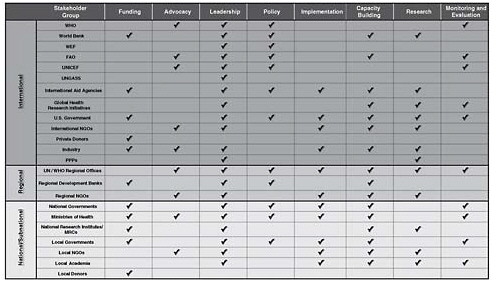
Many players share the responsibility of addressing CVD. They include international, regional, national, and local players. An exhaustive review of all players is beyond the scope of this report, but illustrative examples of the major current and potential roles of key selected players or categories of players are outlined below. The key players and their primary responsibilities are summarized in Table 8.2. While stakeholders will have different relative strengths and different appropriate contributions to a worldwide effort to address the rising disease burden, each player that commits to taking action has the common need to plan strategically as current efforts are expanded or new ones are adopted. Stakeholders of all kinds will have to carefully assess the needs of the population they are targeting, the state of current efforts, the available capacity and infrastructure, and the political will to support the available opportunities for action. This assessment will inform priorities and should lead to specific and realistic goals for intervention strategies that are adapted to local baseline capacity and burden of disease and designed to improve that baseline over time. These goals will determine choices about the implementation of both evidence-based policies and programs and also capacity building efforts. Ongoing evaluation of implemented strategies will allow policy makers and other stakeholders to determine if implemented actions are having the intended effect and meeting the defined goals, and to reassess needs, capacity, and priorities over time.
International Agencies
World Health Organization (WHO) WHO plays the lead catalytic and advocacy role within the United Nations (UN) system for all health matters. It has the designated role to “conduct” the health orchestra of the UN and, when it does it well, has leveraged the multiple agencies withing
the UN effectively. What happens within the UN very often gets mirrored by governments. An example is the work undertaken early in the development of the FCTC when WHO convened all key agencies of the UN and gained agreement among them about the centrality of all agencies placing tobacco demand reduction as the primary role of the UN within tobacco control. This led to FAO and the World Bank shifting past support for tobacco farmers; and the fact of the debate led United Nations Children’s Fund (UNICEF) to recognize its role in addressing those aspects of tobacco control that affect children. The same approach is warranted now for CVD given its multisectoral components.
WHO’s leadership in global CVD includes both direct activities related to global CVD and coordinating responsibilities, bringing other stakeholders together in partnership. WHO’s global norms and guidelines, its development of monitoring tools, and its support for many Health Days linked to CVD risks (such as World No Tobacco Day) place it in a unique and critical role to enhance advocacy and action for CVD. The recent development of the WHO Action Plan for the Global Strategy for the Prevention and Control of Noncommunicable Diseases provides a framework for action not only for WHO but also for other stakeholders (WHO, 2008a). It should be stressed that the role of WHO should not be restricted to the currently constituted CVD program but needs to enhance many of the related programs, such as those that tackle diets, tobacco, physical activity, and alcohol and those that are involved in improving monitoring, information systems, and research. Increased investment in WHO at the level of Geneva and within regions and countries would be an effective way of stimulating governments and other partners to act faster. Such investment is justified on the basis of the burden of disease and the relatively modest support forthcoming today.
World Bank The World Bank had historically not played an explicit role in CVD, but its work in Eastern and Central Europe led it to become more deeply engaged in the health systems aspects of CVD. The World Bank played a decisive role in providing the economic rationale for action in tobacco control. Now it should consider expanding that role to broader aspects of CVD based upon its recent recognition of the effects of chronic diseases on the poor and in developing countries and its acknowledgement of chronic noncommunicable diseases as a development priority (World Bank, 2007). The World Bank is a major lender and provides technical assistance to developing countries within the health sector. Regional development banks, notably the Inter American Development Bank, have also started to support chronic disease programs. Regional banks for Asia and Africa should similarly expand their efforts to include chronic diseases.
Food and Agriculture Organization (FAO) FAO has historically focused on addressing hunger and has not explicitly considered how it might develop policies aimed at encouraging farmers to grow foods that promote health in general or heart health in particular. There is an unmet need for WHO and FAO to engage on this critical issue. It could well help to revise current reliance on palm oil, slow the dramatic growth underway in the beef and dairy sectors, and provide greater support to farmers to address the need for more vegetables, fruits, and healthy oils. FAO also has a responsibility within its nutrition and economics divisions to help with policy development and program technical assistance.
United Nations Children’s Fund (UNICEF) UNICEF has focused on improving under-5 survival through its many programs. It has provided very modest support to tobacco programs for children but has yet to consider the consequences of poor-quality diets, a lack of physical activity, and exposure to tobacco smoke in children under age 5 for their later development and health status as adults. Chapter 6 provided compelling new evidence about the critical role of maternal nutrition and tobacco use and of early childhood factors on adult health. This needs to be incorporated into UNICEF’s area of work. UNICEF’s work signals what is important to the world of child health. A shift in policy that indicated the importance of an early start for later heart health would have wide implications for the course of the CVD epidemic.
United Nations General Assembly Special Sessions (UNGASS) UNGASS has provided a platform for intersectoral action on major global needs. By bringing together all Member States of the UN in equal representation under the General Assembly, these Special Sessions have the potential to create a platform and agenda for global issues of particular importance. For instance, the 2000 Special Session put forth the Millennium Development Goals. As described earlier in this report, the Millenium Development Goals (MDGs) have helped to spur vast improvements in multiple sectors involving multiple agencies and stakeholders all over the world. These include significant changes in the status of HIV and other infectious diseases.
An UNGASS discussion and resolution calling for action on CVD and broader aspects of chronic diseases could serve to alert governments, NGOs, and corporations of the urgent need to address CVD and, if done right, could inject the same degree of focused action that now characterizes the HIV/AIDS debate. However, success for CVD will require that the specific needs for CVD are well represented in the initiative, that NGOs and the media are fully briefed in the lead-up to UNGASS, that senior foreign policy representative of governments understand the issues since it
is they who will represent most of the governments, and that the session is preceded by intensive and sophisticated media messages.
International Nongovernmental Organizations
The international NGOs described below focus on chronic diseases and have evolved in an era of limited resources. They have played a significant role in building the case for action while having minimal resources to take action. The descriptions below outline their potential to move to a new level. This move will require additional and sustained funding. The leading organizations described below also need to take leadership to establish agreements on priority outcomes and common messages and to bring together other NGOs into a broader coalition under a common framework for action to address chronic diseases worldwide.
World Heart Federation (WHF) The WHF is a membership organization comprised of medical societies and heart foundations from more than 100 countries. Its catalytic and advocacy role for CVD within the NGO community is critical. Its success is a function of how well it can horizontally work with other leaders in the chronic disease NGO world, and how well it can activate its vertical linkages in many countries. The WHF would be well placed to map the strengths and capabilities of these and other related NGOs with the intent of drawing them into a broader coalition to take up the main messages of this report. A recent event held jointly with the International Diabetes Federation and the International Union Against Cancer during the 62nd World Health Assembly in 2009 augurs well for future collaboration (International Diabetes Federation et al., 2009).
The WHF has also played an important global advocacy role for CVD policies. Its national foundations have had an impact in many countries in supporting tobacco control, in placing the heart health needs of women in front of the media and policy makers, and in engaging communities in many events related to World Heart Day. WHF leaders within countries also often serve as physicians to heads of state and the cabinet, and their opinion has deep influence at the highest levels of government. An even stronger WHF with stronger national committees could be a powerful force for progress in tackling the CVD agenda of the future. Despite considerable progress, the WHF has not yet been able to stimulate sufficient urgency about the need for specific actions that influence the entire range of CVD risks. The WHF, in partnership with other organizations mentioned below, can enhance their advocacy capabilities, especially through focused attention on health professionals—without their support and leadership in their own countries, public policy on health rarely moves.
World Hypertension League (WHL) The WHL is another key international organization involved in global efforts to address CVD. The WHL is a federation of leagues, societies, and other national bodies devoted to the goal of promoting the detection, control and prevention of arterial hypertension in populations. The WHL’s main activity is to promote the exchange of information among its member organizations and offer internationally applicable methods and programs for hypertension control. This coordinating function has the potential to fit well into the broader goal of greater coordination within a common framework for action to address chronic diseases worldwide.
International Diabetes Federation The International Diabetes Federation has been extremely successful in making the global case for stronger global action on diabetes through the recent UN Resolution. It is a key link to players involved in addressing a growing set of concerns related to overweight and obesity. It also plays an important role in providing deep insights into the long-term changes required within health systems to effectively meet the diagnostic and treatment needs of patients with chronic diseases, including CVD.
International Union Against Cancer The International Union Against Cancer played a key role for many years in stimulating action on tobacco control. It has recently turned its sights toward the role of diet, alcohol, and physical activity in risk for cancer causation. Thus, it shares a common interest in tackling the major chronic disease risks to health. Globally, the worlds of heart and cancer control have not worked together optimally for many reasons. In low and middle income countries, where resources are scarce, the need for closer interaction between these potentially powerful groups needs to be far more fully developed. This could lead to better support to patients and the general public and to enhanced advocacy for effective policies.
Other NGOs There are a myriad of other major NGOs that could have a role in CVD efforts. There is a need to consider which of these would be truly effective partners. This decision should be based on their potential for a shared commitment to act on some aspects of CVD risk. For example, Save the Children is an important example of a global NGO with interests in both under- and overnutrition; the International Pediatric Association is a potential partner with considerable influence on the full range of approaches related to childhood determinants of CVD; the Framework Convention Alliance pulls together 200 national NGOs in support of country action on tobacco; the World Medical Association reaches millions of doc-
tors worldwide; and the International Olympic Committee has influence across the world of sports and physical activity.
There are also many very effective global and national NGOs active in the fields of HIV/AIDS and TB. They have started to address the importance of transforming health systems from their current acute care model to one able to address the long-term needs of chronic disease patients. They increasingly recognize the importance of closer interaction with those active in CVD and diabetes.
Multinational Corporations and Industry
Many intervention approaches designed to change the interrelated determinants that affect chronic diseases are more likely to succeed if public education, government policies, and regulations are complemented by engagement with the private sector. Motivated private-sector leaders at the multinational, national, and local levels in the food industry; the pharmaceutical, biotechnology, and medical device industry; and in the business community have the potential to be powerful partners in the public health challenge to reduce the burden of CVD. The tobacco industry is not a candidate for public health collaborations because its entire portfolio of products is in conflict with public health aims, but—if done with complete transparency—even engagement with tobacco companies may lead to more effective approaches in some narrowly defined policy areas related to tobacco control, such as the shared interest of minimizing illicit trade of tobacco products, which may increase if taxes are implemented.
Until recently, engagement of the pharmaceutical, medical devices, and food manufacturing, retail, and services industries by the CVD prevention communities has been limited. In the past 5 years, a number of pharmaceutical companies and medical device manufacturers have pledged to donate cardiac care equipment and work to improve access to training and care in low and middle income countries, but on the whole, these pledges have been small in scale. Several international and professional organizations, most notably the American Heart Association and the Oxford Health Alliance, have also begun to engage the pharmaceutical industry to explore ways to improve access to care and medications in low and middle income countries. However, as of yet there has been no large-scale pressure placed on the pharmaceutical industry to improve access in low and middle income countries, nor have there been pushes to develop innovative funding mechanisms for CVD drugs as has occurred with many infectious diseases.
As a result of leadership by WHO, pressure from the investment community, and demands by high income country governments, the food manufacturing industry (and to a somewhat lesser degree the food retail and service industries) have begun to implement product reformulation to make
their products healthier and to place restrictions on marketing to children (Healthy Weight Commitment Foundation, 2009; International Food and Beverage Alliance, 2009).
Capitalizing on the involvement of the private sector is a critical component of the effort to address CVD, and several stakeholders described below are placed to take on a major role.
World Economic Forum (WEF) The WEF brings together many business sectors. Increasingly it has expanded from a more focused approach on infectious diseases to address chronic diseases. It is able to draw upon members from the food, pharmaceutical, medical device, insurance, and related sectors to build programs and public health partnerships that can be of critical importance to those involved in CVD control. One such effort led to a joint WHO-WEF initiative on workplace wellness that spotlighted the importance of addressing CVD risks and early detection and treatment within workplaces. Meetings have been held on this topic in India, South Africa, Brazil, and China—all in the attempt to draw upon local realities, innovations, and needs. Ongoing interaction between the WEF and WHO will be important to establish solid ground rules to promote public–private interactions that avoid the past era of distrust and concerns about conflicts of interest and move toward leveraging the capabilities of the private sector to “make markets work for CVD.” This will require deeper insights within the public sector about the role of incentives and co-regulation in stimulating changes needed.
International Federation of Pharmaceutical Manufacturers and Associations (IFPMA) The IFPMA brings together the research-based pharmaceutical companies, and as such it has a worldwide reach. Its major products are targeted to chronic diseases, including treatment of CVD or its risks. Dialogue between the public sector and the IFPMA and lead global over-the-counter and generic medication groups is needed as the demand for a range of drugs increases. Many CVD drugs are already on the Essential Drug List, off patent, and readily available globally but either not used or underused. The experience of the private sector’s efforts in increasing public knowledge regarding the value of statins has yet to be applied more broadly to developing countries. The rise in the use of statins shown in the European Action on Secondary Prevention through Intervention to Reduce Events (EUROASPIRE) data in Chapter 2 demonstrates the potential for corporate efforts in shifting drug use to contribute to reducing population levels of blood pressure and cholesterol.
International Food and Beverage Alliance (IFBA) The newly formed IFBA was explicitly created by several leading food companies to support imple-
mentation of the WHO Global Strategy on Diet, Physical Activity, and Health. It has developed plans to restrict the marketing of foods high in salts, sugar, and fats to children under 12 years; to reformulate products to eliminate transfats, lower sodium, and to shift to more healthful oils; to step up support for physical activity programs; and to provide labeling for their products in all countries. This represents an important step forward that, if successful, should lead to the types of alliances described below. The input of food companies is critical to the success of many WHO and government efforts. For example, food company knowledge about sodium and its relationship to population taste preferences can be leveraged to speed up sodium reductions. Industry insights about real constraints to shifting away from palm oil and other sources of saturated fats need to be considered if progress is to happen. In addition, industry capabilities in distribution and marketing, if leveraged in support of CVD goals, could accelerate progress. IFBA is in the process of creating country-specific entities that draw in national and smaller companies and work with national governments and NGOs.
Public–Private Partnerships Public–private partnerships (PPPs) are generally defined as public-sector programs with private-sector participation, and they include a wide variety of arrangements that range from small, single-product collaborations between a government and industry to large entities collaborating with UN agencies or private not-for-profit organizations (WHO, no date). The participation of the private sector in collaborations can serve to achieve health aims if agreements and negotiations are conducted transparently on public health terms under clear ethical guidelines, and if they establish defined goals and timelines that are assessed using independent monitoring mechanisms. Under these circumstances, PPPs have the potential to be an important potential resource base in the global CVD effort (Kraak et al., 2009; Moran, 2005; Widdus, 2001). For example, there are currently new initiatives under way to use commercial marketing mechanisms to promote healthy lifestyles to address the global childhood obesity epidemic (Kraak et al., 2009).
Additional activities of PPPs could include product development, product distribution, strengthening health services, and public education. The CVD community might, for example, increase the number of strategic alliances between the WHF and companies; draw upon companies with expertise and deployed capacity to distribute needed drugs and diagnostics to developing countries; encourage companies to detail staff to work within public health programs both to share their knowledge and to learn better about community needs; co-invest with food companies, foundations, and development agencies in developing healthful oilseeds in developing countries; and create public–private product-focused initiatives to develop more
affordable diagnostics and drugs for CVD. The private sector can also be a resource for direct financing to NGOs and academic institutions to enhance capacity in CVD. Many of these approaches have been successfully implemented within efforts to address infectious disease. For example, PPPs have been involved in the area of drug development for neglected diseases, and many of the preliminary results have been promising (Moran, 2005).
Combining different skills and talents of various stakeholders in innovative and productive ways has the potential to improve the production, delivery, and maintenance of improved global health systems. However, some important concerns have been raised about PPPs, such as conflicts of interest regarding industry partners, exclusion of certain countries (with unpopular governments or poor infrastructure) from PPP initiatives, and balance of power between low income country governments and private partners, many of which are based in high income countries (WHO, no date). These concerns need to be addressed and resolved openly as partnerships are formed, roles are defined, and targets and goals are negotiated.
Conclusion 8.5: Private-sector leaders at the multinational, national, and local level in the food industry; pharmaceutical, biotechnology and medical device industry; and the business community have the potential to be powerful partners in the public health challenge to reduce the burden of CVD. The food industry (including manufacturers, retailers, and food service companies) can be engaged to expand and intensify collaboration with international public-sector efforts to reduce dietary intake of salt, sugar, and saturated and transfats in both adults and children, and to fully implement marketing restrictions on these substances. Pharmaceutical, biotechnology, and medical device companies can be enlisted to participate in promoting the rational use of costly interventions and to focus on developing safe, effective, and affordable diagnostics, therapeutics, and other technologies to improve prevention, detection, and treatment efficacy of CVD in low and middle income countries. Global and local businesses can also provide support for implementation of worksite prevention programs and can help establish smoke-free workplace policies and practices.
Recommendation: Collaborate to Improve Diets
WHO, the World Heart Federation, the International Food and Beverage Association, and the World Economic Forum, in conjunction with select leading international NGOs and select governments from developed and developing countries, should coordinate an international effort to develop collaborative strategies to reduce dietary intake of salt, sugar, saturated fats, and transfats in both adults and children. This
process should include stakeholders from the public health community and multinational food corporations as well as the food services industry and retailers. This effort should include strategies that take into account local food production and sales.
Recommendation: Collaborate to Improve Access to CVD Diagnostics, Medicines, and Technologies
National and subnational governments should lead, negotiate, and implement a plan to reduce the costs of and ensure equitable access to affordable diagnostics, essential medicines, and other preventive and treatment technologies for CVD. This process should involve stakeholders from multilateral and bilateral development agencies; CVD-related professional societies; public and private payers; pharmaceutical, biotechnology, medical device, and information technology companies; and experts on health care systems and financing. Deliberate attention should be given to public–private partnerships and to ensuring appropriate, rational use of these technologies.
The Special Role of the U.S. Government
As the world’s largest provider of official development aid (OECD, 2009) and the biggest contributor to international health organizations such as The Global Fund to Fight AIDS, Tuberculosis and Malaria (The Global Fund to Fight AIDS, Tuberculosis and Malaria, 2009), the United States has established itself as a leader in global health. This widespread investment and ongoing leadership and dedication to improving the well-being of the world’s people places the United States in a unique position of influence over the international community’s global health agenda. With this influence comes the opportunity for the U.S. government to take a leadership role to help ensure that the evolving global health agenda includes the threat to health worldwide due to the growth of chronic diseases.
The recent IOM report The U.S. Commitment to Global Health, stressed the need for the U.S. government to expand its support for global health to include noncommunicable diseases (IOM, 2009). This represents an important shift from a decade ago. Furthermore, the U.S. government has international obligations related to the MDGs. MDG 6 refers to AIDS, malaria, TB, and other diseases. These “other diseases” include the world’s biggest killer, CVD. The United States also already has a commitment to WHO in terms of the FCTC. The United States has adopted the treaty but it has not been ratified. It contains requirements that developed countries support tobacco control in developing countries. Finally, the United States’ endorsement of the WHO Global Strategy on Diet and Physical Activity
and Action Plan for the Global Strategy for the Prevention and Control of Noncommunicable Diseases now also needs to be backed by funding and support for its implementation.
The U.S. government’s global health efforts extend across multiple agencies and sectors working independently and in collaboration to achieve a wide array of health policy objectives. The Kaiser Family Foundation recently mapped out these efforts in its 2009 report, The U.S. Government’s Global Health Architecture: Structure, Programs, and Funding (Kates et al., 2009).
The Centers for Disease Control and Prevention (CDC) includes international health efforts and global health promotion in its overarching goals as an extension of its mandate to protect U.S. health and safety (Kates et al., 2009). A renewed commitment to this area of emphasis was recently demonstrated in a new reorganization that transitioned global health activities from a coordinating office to a new Center for Global Health.
The CDC’s global leadership in health surveillance is unequaled, and the CDC has historically supported chronic disease surveillance, especially tobacco surveillance among youth and health professionals, which remains the U.S. government’s major commitment to the FCTC. The Global Tobacco Surveillance System is an example of a successful initiative. Established in 1998 as a joint effort by the CDC and the Canadian Public Health Association, the surveillance system helps countries collect data on tobacco use through household and school-based surveys (such as the Global Adult Tobacco Survey and the Global Youth Tobacco Survey). Global Tobacco Surveillance System surveys are a principle source of surveillance data for the Framework Convention and the MPOWER policy package for tobacco control. The CDC is responsible for Global Tobacco Surveillance System survey designs, sample selection, training, developing procedures for implementing the surveys in the field, initial tabulation of survey data, and data management (Warren et al., 2009).
The CDC has also worked closely with WHO, primarily by providing operational support for the negotiation process for the FCTC. In the past the CDC has also detailed staff to strengthen WHO’s work on school health worldwide (including prevention of tobacco use and physical activity and healthful eating promotion) and has provided a global leadership role in addressing health within the mega-countries of the world with populations of more than 100 million.
As part of enhanced support for CVD control, the CDC could increase its support for risk-factor surveillance and capacity building beyond tobacco to include other major risks for CVD. The CDC could also reinvest in other aspects of health promotion related to CVD in children through reengaging with WHO’s school health program and doing so in close collaboration with UNICEF’s school programs. Support to WHO should
be primarily focused on building national and regional capacity through technical support.
The NIH is one of the world’s leading medical research entities, and global health is included in the activities of its institutes, as well as the Fogarty International Center, which works to train research scientists and to build partnerships among health research institutions in the United States and abroad (Kates et al., 2009). NIH has recently indicated its stepped-up commitment to global health. In a recent address to staff detailing five priority areas in which he would like to increase NIH involvement, Director Francis Collins stressed that NIH should “focus our attention as much as we can on global health” (Collins, 2009). NIH has led the development of innovative approaches to infectious disease control globally and has played a fundamental role in supporting capacity building for research across many content areas in developing countries. It is therefore well placed to continue this leadership role by being at the forefront of an expanded global health focus that includes chronic diseases.
In fact, there has been an increasing effort to shift to a global focus within the areas of CVD and related chronic diseases. The National Heart, Lung, and Blood Institute’s (NHLBI’s) leadership and commitment within NIH to global chronic diseases has been demonstrated by its recent partnership with UnitedHealth to develop centers of excellence for chronic diseases in developing countries (see Box 8.3) and by its leadership in creating the six-research-institution Global Alliance for Chronic Disease with Canadian, British, Indian, Chinese, and Australian research support agencies. Moving forward in the context of NIH’s overall commitment to global health, there is a need to build on this by deepening chronic disease research efforts through collaboration with an even wider number of institutes within NIH that focus on disease with shared risk factors, common outcomes, or common long-term care needs. These include the National Cancer Institute, the National Institute on Aging, the National Institute of Allergy and Infectious Diseases, the National Institute on Alcohol Abuse and Alcoholism, the National Institute of Child Health and Human Development, and the National Institute of Diabetes and Digestive and Kidney Diseases. The Fogarty International Center is also a natural partner as a future leader in global chronic disease efforts and can play a critical role by ensuring that international capacity building efforts include the capacity to meet chronic disease needs.
Development agencies within the U.S. government are a largely underutilized resource for addressing chronic diseases. As the health and economic burden of chronic diseases continues to grow in the developing world, an expanded scope will become critical to truly meet the global health goals of these agencies. The U.S. Agency for International Development (USAID), for example, has to date implemented almost no programs
to address CVD, and chronic diseases are not included as a technical area of focus for the agency. Program areas such as maternal and child health, food security, infectious diseases, and health systems strengthening are all potential entry points where the scope of activity could be expanded to include chronic diseases. As the burden of chronic diseases continues to rise, this expanded scope will become critical for the agency to truly meet its global health goals.
Similarly, the emerging President’s Global Health Initiative makes no specific mention of chronic diseases in its stated goals or its plans for resource allocations. However, the initiative does include a major focus on maternal and child health and nutrition, and on health systems strengthening and sustainable delivery of essential health care and public health programs (U.S. Department of State, 2010). These are all stated priorities for which efforts should incorporate chronic disease needs. Adequate essential primary health care, for example, cannot truly be achieved without attention to risk for chronic diseases. The Global Health Initiative is being developed and refined through ongoing consultations with relevant stake-
holders (U.S. Department of State, 2010), which presents an opportunity for the global chronic disease community to make a greater effort to ensure that the needs of chronic disease are included in this process, emphasizing their implicit inclusion in the existing priorities.
There is also an opportunity to build a more synergistic approach with agencies faced with the challenge of developing models of chronic care for HIV/AIDS and TB, especially the U.S. global HIV/AIDS program known as PEPFAR. The CVD community has potentially useful chronic care expertise to offer in support of this effort. In addition, because of the increase in CVD risk factors associated with these diseases, integrated chronic care approaches offer an opportunity to reduce CVD and improve overall health outcomes in this population. The size of the PEPFAR investment could allow for the emergence of novel approaches for all chronic diseases. PEPFAR has also made a commitment to strengthen health systems and to build health workforce capacity, setting targets for the training of new health care workers (Office of Global AIDS Coordinator, 2009). These are two areas in which there are synergistic opportunities to be sure that comprehensive health efforts are not compromised by large disease-specific investments. It will be important, for example, that investments take into account the need to support comprehensive rather than solely disease-specific education of health care workers in order to not inadvertently perpetuate the gaps in curricula that neglect training for chronic diseases.
U.S. embassies also provide technical and financial support in matters of health as part of their international mission in support of foreign governments. The Department of State should consider such support in areas where the United States has made global commitments, such as providing technical support for the implementation of the FCTC and encouraging pharmaceutical companies to find ways to start addressing the lack of access to essential drugs and diagnostics.
The Millennium Challenge Corporation (MCC), with its country compact aid strategy, represents an additional and innovative vehicle for supporting the development of programs that address chronic diseases. As of July 2009, health programs have represented just 2 percent (a total of $179.4 million) of the projects funded under MCC compacts. Chronic diseases do, however, make up a part of the MCC’s health portfolio as the agency has invested $17 million (6 percent) of its compact with Mongolia into chronic disease prevention, early diagnosis, and management (Henry J. Kaiser Family Foundation, 2009). With the current administration’s stated emphasis on global health (as illustrated by the announcement of the President’s Global Health Initiative), increased attention has been paid to the role the MCC plays in supporting global health programs (Henry J. Kaiser Family Foundation, 2009). Although the degree to which the MCC will expand its health portfolio remains unclear, as additional low and
middle income countries with high CVD burdens become eligible for MCC compacts, it could become an increasingly significant funder of chronic disease prevention in developing countries and thus should be included at the table when coordinating CVD and chronic disease prevention efforts across U.S. agencies.
The U.S. Department of Agriculture (USDA) also has the potential to contribute to global efforts against chronic diseases, including its strong leverage with FAO. One area in which the USDA can play a role is through funding analytic work aimed at developing agricultural policies and practices that meet nutrition needs while promoting cardiovascular health. This could unify the worlds of agriculture and nutrition and the efforts to address hunger and obesity. Such an effort could inspire widespread and needed changes in priorities that emphasize health-promoting agriculture policies.
National and Subnational Agencies
National Governments Government action is one of the keys to progress on CVD. Among low and middle income countries there is considerable variability in infrastructure, capacity, political will, and power to enact and enforce decisions and to acquire and allocate resources. Nonetheless, national governments have a critical role to play in sustainable solutions that address the multidimensional risk factors that contribute to CVD and related chronic diseases. This potential can be drawn upon in countries with sufficient capacity. In countries with less capacity it may be other stakeholders who need to lead the drive to take action against chronic disease. When feasible, a parallel goal of how these actions are implemented can be to contribute toward raising the level of capacity in national governments as a means to achieve longer-term, sustainable responses.
Governments have the ability to convene many sectors that need to work together through policy approaches such as those outlined in Chapters 5 and 6 of this report. This takes strong leadership and a clear vision about the optimal roles of various government ministries. The health ministry has a critical direct role in supporting public health programs and effective access to diagnosis and treatment as well as a vital leadership role in advocating for action within other ministries whose policies might help or hamper progress on CVD. However, it needs to be supported in these efforts by the finance ministry or treasury. In addition to executive agencies, legislatures are critical for enacting necessary laws and allocating funds and can often be the drivers of change in executive agencies.
For example, tobacco control requires that the finance ministry support annual increases in taxes, that the education ministry support in-school smoking prevention programs, and that the agriculture ministry not subsi-
dize tobacco farmers. Salt reduction requires collaboration among health and agricultural ministries and the ministries of science and technology, as well the leading food manufacturing, retail, and food service companies. Physical activity promotion brings together the sports, urban development, transport, and education ministries if sustainable infrastructural and policy-based interventions are to be implemented.
Governments also have a critical role to play, along with their national research, academic, and NGO partners, in adapting global norms and approaches that are often developed in countries at higher levels of capacity and funding to low-resource settings where there are a broader set of competing health and development challenges. For example, weak regulatory capacity, combined with large informal sectors, pose challenges to the effective implementation of many policies agreed to in WHO meetings.
The presence of a budget line for CVD prevention and control provides visible proof of government commitment to the area. There is a need to develop models for countries to use that would help them allocate funds to CVD in ways that maximize health gains to their populations.
Cities and Local Authorities Cities and other local government authorities around the world provide core services to people and in some countries, have jurisdiction over policies related to many aspects of tobacco, food, and physical activity. Local authorities also can consider opportunities to require more thorough assessments of the potential health impact of future development of cities and urban expansion to promote planning that takes into account the needs of reducing chronic disease risk (Collins and Koplan, 2009). Therefore, in many countries these authorities have great potential to play a crucial role in efforts to combat chronic diseases. Until recently, however, city health departments around the world have focused mainly on environmental health, infectious disease control, and food safety.
The WHO Healthy City initiative has already stimulated many cities to take a broader perspective (WHO, 2009). In addition, some cities in Latin America have led the way in increasing urban walkability, encouraging physical activity, and improving access to healthful foods. As discussed in Chapter 5, São Paulo, Brazil, successfully increased physical activity levels and decreased the percentage of the population considered inactive through the multicomponent Agita São Paulo program (Matsudo et al., 2004). In addition, local authorities have played key roles in implementing smoke-free policies. In 1991, the city of Johannesburg banned smoking in take-out restaurants and mandated no smoking areas in other restaurants, which paved the way for more widespread tobacco control legislation throughout South Africa (de Beyer and Brigden, 2003). In 1996, the state of Delhi banned smoking in public workplaces and the sale or marketing of cigarettes to minors, which prompted several other Indian state govern-
ments to pass similar tobacco control laws shortly thereafter (Reddy and Gupta, 2004).
One comprehensive example of an integrated approach to address CVD risks has been developed by the New York City Department of Health and Mental Hygiene over the past decade (Frieden and Bloomberg, 2007; Frieden et al., 2008) (see Box 8.4). Over that time they have systematically targeted key CVD risk factors by collaborating across government sectors to implement and evaluate a range of risk factor-reduction measures. These include efforts to reduce tobacco consumption, increase access to healthful foods, ban transfats, require calories labeling in certain restaurants, and lead a coalition with food companies and NGOs to incrementally and voluntarily reduce sodium levels in foods. Indeed, New York is a clear example of how large-scale interventions can be implemented when the health sector collaborates with the finance, tax, education, and agricultural sectors as well as with industry. The New York City example should inspire local health departments to take action within their own local legal and regulatory frameworks. In doing so they will find that current laws may give them greater leeway to address CVD risks than is at first appreciated.
National and Local NGOs Unlike their global counterparts, national and local NGOs share an intimate knowledge of the local context, which ensures that they are well placed to support CVD prevention and cardiovascular health promotion programs in local communities. These organizations have played a crucial role in global HIV efforts in terms of service provision, health education, community engagement, political advocacy, and research. As with national government agencies, a multidisciplinary and intersectoral combination of national and local NGOs will be required to effectively respond to the threat of CVD. Ideally, these national and local NGOs would work together in a collaborative manner, bringing to the table their respective strengths, talents, and experiences. In addition, it will be important that these NGOs are supported by their own national governments as well as by international NGOs and multilateral and bilateral aid and public health agencies.
Academia Within countries, academic leaders and institutions play a leading role in advocating for CVD based upon nationally relevant research and in training future generations of leaders. One strategy to enhance this cultivation of leadership is the creation of academic partnerships between institutions in high income countries and those in low and middle income countries. Examples of such successful academic partnerships exist, built upon the following principles: (1) leveraging the institutional resources and credibility of academic medical centers to provide the foundation to
|
BOX 8.4 New York City: Comprehensive Chronic Disease Risk Reduction at the Local Level Since 2002, New York City has systematically implemented a series of interventions aimed at reducing the citywide prevalence of common chronic disease risk factors. This campaign, spearheaded by the New York City Department of Health and Mental Hygiene, has specifically targeted smoking, dietary risk factors, and physical inactivity and has employed regulatory changes, widespread social marketing, and collaboration with the food industry to reduce these factors in the population. These efforts have already resulted in significant declines in smoking prevalence and use of harmful transfats in restaurants. Smoking Reduction New York City increased its cigarette tax from $0.08 to $1.50 per pack, enacted smoke-free legislation prohibiting smoking in almost all indoor workplaces (including bars and restaurants), conducted mass media campaigns warning of the dangers of smoking, and provided quitting assistance by distributing information and nicotine patches and gum to adult smokers. These efforts resulted in significant reductions in smoking prevalence between 2002 and 2007 in both adults (falling from 21.5% to 16.9%) and adolescents (from 17.6% to 8.5%). Notably, from 2002 to 2006, New York City’s smoking-related age-adjusted mortality dropped 17%. Dietary Risk Factor Reduction Beginning in 2007, New York City sought to drastically reduce transfat consumption by requiring that all food served in restaurants have less than 0.5g transfat per serving. This resulted in a reduction in the proportion of restaurants using transfat from 51% in June 2006 to 1.6% in December 2008. The city also mandated that chain restaurants clearly post the calorie content of their foods on all menus and menu boards. In January 2010, the city announced the National Salt Reduction Initiative: a partnership with more than 40 city, state, and national health agencies that is working with the food and restaurant industries to reduce Americans’ salt intake by at least 20% over 5 years. As an initial step, the initiative has worked with |
build systems of care with long-term sustainability; (2) development of a work environment that inspires personnel to connect with others, make a difference, serve those in great need, provide comprehensive care to restore healthy lives, and grow as a person and as a professional; and (3) intensive and sustained professional supervision and training of health care workers at all levels (Einterz et al., 2007; Inui et al., 2007).
Coordinating Action
It would not be practical, efficient, or effective for a single mechanism of coordination to govern all actions to reduce the global burden
|
industry to set voluntary salt-reduction targets for pre-packaged and restaurant foods that are significant and achievable. In the next phase, the initiative will finalize these targets and monitor industry achievement and population sodium intake to ensure a gradual reduction in salt content across a range of food categories. Physical Activity Promotion New York City developed guidelines for designs for buildings, streets, and neighborhoods to promote physical activity. The city has also conducted outreach with the Department of Design and Construction and the Department of City Planning to look for ways to improve built environments. In 2008 the city implemented a campaign of posting signs to encourage stair use in public buildings resulting in an increase in stair use from 13% to 22% in buildings where signs were placed. Improved Surveillance and Records In addition to interventions, the Department of Health and Mental Hygiene has strengthened its epidemiological surveillance of chronic disease morbidity, mortality, and risk-factor prevalence through new surveys and reporting requirements. The city has also promoted the adoption of electronic medical records that include registry and clinical decision support for CVD and improved its information dissemination to ensure that physicians are up to date on research and best practices. New York City’s comprehensive approach to chronic disease risk-factor prevention provides an example of how local governments and health departments can take the initiative and make meaningful steps to reduce risk factors. New York’s health department had the resources, regulatory authority, and capacity to implement the interventions—factors that many city and regional governments in low and middle income countries lack. Nonetheless, it can still serve as an example of how effective coordination between city departments or local government bureaus can lead to large-scale interventions. SOURCES: Frieden et al., 2008; NYDHMH, 2010; Silver, 2009. |
of chronic diseases. However, sustainable progress on CVD and related chronic diseases can be enhanced if there is greater communication among stakeholders to avoid unnecessary duplication of efforts and if players with complementary functions and goals define shared messages and coordinate their efforts better to take decisive action together. Many emerging mechanisms for coordination at global, regional, and national levels can be strengthened to serve this purpose, while new alliances and partnerships can also be sought.
Global Coordination
Until recently, mechanisms to coordinate global efforts for chronic diseases in general and CVD more specifically have not been up to the tasks at hand. Over the past few years, however, the knowledge that this is the time to act and that well-defined actions exist has started to galvanize a number of groupings of players at the global level. These are illustrative of an emerging system of coordination for chronic diseases, including CVD.
The first is the recently constituted Global Noncommunicable Diseases network (NCDnet), a coalition among WHO, NGOs, and the WEF to address chronic diseases. The aim of NCDnet is to develop a concerted and coordinated approach to chronic diseases in general, with CVD and its major risks explicitly highlighted. The initiative is expected to focus on advocacy for chronic diseases and on funding and support for priority actions contained in the WHO Action Plan (WHO, 2008a). The early involvement of some NGOs and the WEF represents a step toward the type of broad-based coordination that will be required to tackle the complexity of CVD challenges, drawing upon the capabilities and support of civil society organizations including NGOs and the private sector. NCDnet is still in its infancy but deserves continued and future support as it has the potential to reach all governments and to frame the needs of CVD and stimulate funders to invest. If it is able to achieve its mission to unite the currently fragmented efforts in chronic disease prevention and control, this network will fill a critical gap in the leadership of global chronic disease efforts and could be an effective means of building global consensus on the most effective ways of tackling these diseases.
The second global initiative is the recently created Global Alliance for Chronic Disease, which could considerably increase the quality and capacity for research in developing countries (Daar et al., 2009b). The Alliance aims to coordinate research activities to address the prevention and treatment of chronic diseases on a global scale. It includes the lead national research agencies of Australia, Canada, China, India, the United Kingdom, and the United States, specifically NHLBI and Fogarty International Center from NIH. This new initiative is likely to reshape opportunities for high-priority research in many countries and, given its strong CVD base, it will be well positioned to tackle many of the priorities identified in this report. Its close interaction with WHO will allow it to draw upon WHO’s Advisory Committee for Health Research’s priority-setting process for chronic diseases. The Alliance could represent a turning point in how innovative approaches to CVD are developed if it sets priorities in accord with the messages of this report about the need to research the effectiveness and implementation of a broad range of intervention approaches, including clinical solutions, population-based approaches, intersectoral policy activities, and training programs.
The Initiative for Cardiovascular Health in Developing Countries (IC Health) is another established initiative specifically focused on supporting research on CVD prevention across developing countries. Founded in 1999 as a joint program of the Global Forum for Health Research and WHO, IC Health promotes and prioritizes context-specific research on CVD in low and middle income countries and has quickly established itself as an important convener and collaborator in global CVD prevention efforts. In addition to sponsoring prevention programs in several developing countries in Southeast Asia, IC Health was also a key sponsor of the INTERHEART study discussed in Chapter 2, which established that the same key risk factors are responsible for the vast majority of CVD deaths around the world in both developed and developing countries.
To support these and other emerging mechanisms for global governance, a consistent reporting mechanism at the global level is needed to track progress, to stimulate ongoing dialog about strategies and priorities, and to continue to galvanize stakeholders at all levels. Rather than investing excess additional resources to create duplicative mechanisms, WHO is well suited for a role in global reporting because, with adequate support, it can be accomplished as a component of the existing framework and ongoing activities to report on the Global Strategy for the Prevention and Control of Noncommunicable Diseases, which has an extensive list of proposed measures to track global progress and characterize the different actions underway in Member States (WHO, 2008a). The support from the CDC provided to the FCTC, as well as the general goals and mechanisms for ongoing reporting for the FCTC, offer a useful model. As described in Chapter 4, given the overlapping interest of many of these multilateral organizations, the development of harmonized indicators is an essential next step in leading and coordinating national and regional monitoring and evaluation efforts. An epidemiology reference group has already been working with WHO staff from headquarters and regional offices to develop guidance for chronic disease surveillance systems and to agree on core indicators that will be used to monitor the major chronic diseases and their risk factors (Ala Alwan, World Health Organization, 2009, personal communication). If this effort takes into account the considerations laid out in Chapter 4, it could be a first step in achieving an implementable indicator framework.
Recommendation: Report on Global Progress
WHO should produce and present to the World Health Assembly a biannual World Heart Health Report within the existing framework of reporting mechanisms for its Action Plan for the Global Strategy for the Prevention and Control of Noncommunicable Diseases. The goal of this report should be to provide objective data to track progress in the global effort against CVD and to stimulate policy dialogue. These
efforts should be designed not only for global monitoring but also to build capacity and support planning and evaluation at the national level in low and middle income countries. Financial support should come from the Global Alliance for Chronic Disease, with operational support from the CDC. The reporting process should involve national governments from high, middle, and low income countries; leading international NGOs; industry alliances; and development agencies. An initial goal of this global reporting mechanism should be to develop or select standardized indicators and methods for measurement, leveraging existing instruments where available. These would be recommended to countries, health systems, and prevention programs to maximize the global comparability of the data they collect.
Regional Coordination
Regional efforts provide a much-needed mechanism for countries to share knowledge, innovation, and technical capacity among countries with similar epidemics, resources, and cultural conditions. Regional mechanisms can help disseminate best practices that range from successful health systems and public health program models to successes in developing and implementing legislative strategies and enforcing policies and regulations. Similarities among countries do not necessarily follow geographic boundaries; therefore, “regional” is a term of convenience that is not meant to limit mechanisms for coordination and dissemination to geographical divisions. These mechanisms, especially virtual mechanisms using digital technologies, can also subdivide countries by, for example, risk profile, political system, or economic development status.
WHO and its regional offices have been leading players in supporting regional efforts to promote CVD health. WHO works with regions and individual Member States to develop networks of community-based demonstration programs to promote healthy lifestyles through public policies for healthy living. Major international and regional health and professional organizations such as the WHF, the Oxford Health Alliance, IC Health, the International Union for Health Promotion and Education, and the Pan African Society of Cardiology also convene key meetings to help coordinate regional efforts and help build international support for national-based solutions.
In recent years, the Latin American and Caribbean region has established itself as a model for regional coordination. Since identifying chronic diseases as the top cause of premature death and morbidity in the Latin American and Caribbean region at the 26th Pan American Sanitary Conference in 2002, the Pan American Health Organization (PAHO) has worked quickly to redouble chronic disease prevention and control efforts. In 2006, PAHO published its Regional Strategy and Plan of Action on an Integrated
Approach to the Prevention and Control of Chronic Diseases Including Diet, Physical Activity, and Health, which called for a reorientation of regional policies and programs to prioritize chronic disease risk-factor reduction throughout the life course, with a specific focus on targeting the poor and other vulnerable populations. To achieve these goals, the plan highlighted four lines of action: public policy and advocacy, surveillance strengthening, health promotion and disease prevention, and integrated management of chronic diseases and risk factors. The Plan of Action also encouraged national governments to engage stakeholders outside of the health sector, specifically highlighting the education, communications, agriculture, transportation, economic, and trade sectors as important partners for developing effective interventions (PAHO, 2007).
Since the drafting of the PAHO Action Plan, the region has taken a number of concrete steps toward reducing the burden of chronic diseases and their risk factors. In 2007, the Heads of Government of the Caribbean Community (CARICOM) issued the Declaration of Port-of-Spain, at the conclusion of their Regional Summit, which encouraged the establishment of national noncommnicable disease commissions, called for each country to develop comprehensive screening and management plans for chronic diseases, reaffirmed the region’s commitment to the provisions of the FCTC, and promised to mandate the reintroduction of physical activity education into the schools (CARICOM, 2007). In 2008, based on the recommendation of the PAHO Task Force on Trans Fat Free Americas (PAHO/WHO Task Force, 2007), leaders of national health ministries, industry, and PAHO issued the Declaration of Rio de Janeiro, which encouraged labeling requirements on processed foods and issued goals for limiting transfats in oils, margarines, and processed foods (PAHO, 2008). PAHO has also begun to address salt reduction, convening an Expert Group on Salt Reduction in September 2009, which will issue recommendations with the intent of establishing a regional initiative. The burden of chronic diseases was highlighted further at the 2009 Summit of the Americas, where regional leaders reaffirmed their commitment to the PAHO Action Plan (Declaration of Commitment of Port of Spain, 2009).
The Western Pacific Region has also taken some noteworthy steps in its chronic disease prevention and control efforts. The region was the first to have all Member States ratify the FCTC. Furthermore, in September 2009, Western Pacific Member States voted unanimously in support of a new regional action plan for tobacco control that requires countries to institute indoor smoke-free laws to reduce secondhand smoke, develop action plans for tobacco control, and establish clear indicators to measure regional progress on tobacco control. This was a significant step forward, especially considering that the region includes China, which has the highest number of smokers of any country as well as the largest state-owned tobacco industry (Cheng, 2009).
Recommendation: Disseminate Knowledge and Innovation Among Similar Countries
Regional organizations, such as professional organizations, WHO observatories and chronic disease networks, regional and subregional development banks, and regional political and economic organizations should continue and expand regional mechanisms for reporting on trends in CVD and disseminating successful intervention approaches. These efforts should be supported by leading international NGOs, development and public health agencies, and research funders (including the Global Alliance for Chronic Disease). The goal should be to maximize communication and coordination among countries with similar epidemics, resources, and cultural conditions in order to encourage and standardize evaluation, help determine locally appropriate best practices, encourage innovation, and promote dissemination of knowledge. These mechanisms may include, for example, regional meetings for researchers, program managers, and policy makers; regionally focused publications; and registries of practice-based evidence.
National and Subnational Coordination
As described above, the overlap of efforts to address CVD and other global health issues and the breadth of the determinants that affect CVD mean that in countries it is necessary to coordinate not only within the broader public health and health systems but also with authorities throughout the whole of government. For example, strategies to reduce tobacco use or salt consumption will require actions by a range of governmental agencies (health, agriculture, finance, broadcasting, education) as well as private-sector producers and retailers. The political will to support and the expertise to implement such a broad effort cannot depend on the ministry of health alone. To coordinate these efforts, ensure the allocation of necessary resources, and have the best chance for real impact requires a mechanism at a level that is insulated from the relative influence of different ministries within the government. Coordination and communication within a whole-of-government approach also needs to include legislatures in order to pass laws necessary to implement policies and, in some cases, to initiate changes in the activities of executive agencies. In addition, these efforts must be coordinated with stakeholders in the private sector and civil society as well as donors and agencies providing external development assistance. A useful model for this approach comes from successful efforts to achieve national coordination of efforts in the fight against HIV/AIDS through the formation of national AIDS coordinating authorities. In Uganda, for example, this was a major driver of success in controling the course of its HIV epidemic (Slutkin et al., 2006). As described above, the Heads of Government of the
Caribbean Community have already called for the establishment of national chronic disease commissions.
Recommendation: Improve National Coordination for Chronic Diseases
National governments should establish a commission that reports to a high-level cabinet authority with the specific aim of coordinating the implementation of efforts to address the needs of chronic care and chronic disease in all policies. This authority should serve as a mechanism for communicating and coordinating among relevant executive agencies (e.g., health, agriculture, education, and transportation) as well as legislative bodies, civil society, the private sector, and foreign development assistance agencies. These commissions should be modeled on current national HIV/AIDS commissions and could be integrated with these commissions where they already exist.
Alliances and Partnerships
A theme that emerges throughout the preceding discussion is that progress in many aspects of what is needed for CVD and related chronic diseases can be accelerated when key stakeholders work together. Partnerships have proven to be a powerful and successful model for solving large-scale public health challenges that require coordination among diverse groups of stakeholders. From ensuring that every child receives life-saving vaccinations to eradicating diseases, successful partnerships have broken through bureaucratic and logistical barriers by bringing together representatives from different sectors to work toward a common goal.
Recent examples include the development of The Global Fund to Fight AIDS, Tuberculosis and Malaria, which provides funds to countries for focused disease control and prevention programs; the International AIDS Vaccine Initiative and Medicines for Malaria Venture, which draws upon public- and private-sector research to develop new technologies for infectious diseases; and the Global Alliance for Improved Nutrition and Global Alliance for Vaccines and Immunisation, which fund and steer implementation of community- and country-based micronutrient and vaccine programs. Relatively few examples of such partnering exist to tackle either the risks for CVD or the treatment needs of those with heart disease and stroke. CVD control could benefit from building analogous alliances and partnerships.
However, if not executed well, partnerships can also be cumbersome, unwieldy, and ineffective. Experience has shown that successful partnerships are marked by several key characteristics, including a well-defined goal, clearly articulated roles for each partner, and effective communication
between partners and with the global community (Jean and St-Pierre, 2009; Levine and Kuczynski, 2009). The characteristics of successful partnerships are summarized in Box 8.5.
A clearly defined goal is the starting point of every successful partnership. A well-defined purpose does not mean that the partnership cannot be ambitious; indeed, many of the most acclaimed global health partnerships, such as the global effort to eradicate smallpox in the 1960s and 1970s, have had extraordinarily lofty goals. However, the goal must be focused enough that it is achievable. It is also imperative that the overall goal be clear to all members of the effort to ensure that each partner is working toward a common purpose.
In order to prevent redundancies and improve accountability, partners should be included that provide complementary sets of strengths and areas of expertise that contribute toward the overall goal. Although it is important that key stakeholders be represented in order to assure that the partnership will have clout and credibility, including a partner who does not provide any value-added simply for the sake of inclusiveness can be detrimental to action. It is also critical that each partner’s role is well articulated. Clearly defining the appropriate actor for any needed activities ensures that the partnership works efficiently without unnecessary redundancies and also improves accountability within the partnership. While there will
|
BOX 8.5 Characteristics of Successful Alliances and Partnerships
|
always be points of disagreement when addressing complex health topics, these disagreements can escalate and impede progress when partners are not clear about their roles.
Once the overall goal, key partners, and roles have been identified, it is important that there be a system for follow-up and accountability to determine if the goals of the partnership are being met. Ensuring accountability can be challenging—especially in partnerships when involved parties are participating in good faith and not for access to funding and other resources. Nonetheless, it is imperative that some system of accountability be agreed upon. Identifying intermediate milestones necessary to achieve the overall goal and delineating which actors are responsible for achieving them will improve internal accountability. This will also help demonstrate progress toward the desired result, both internally and to the public and other stakeholders.
Effective communication, both within and outside of a partnership, is also vital to success. Within the partnership, this communication ensures that each stakeholder is achieving its objectives and that there are no gaps or redundancies. It also promotes flexible and adaptable decision making and effective conflict resolution Outside of the partnership, communication with local communities, the media, advocates, and related sectors can build support for the cause, raise awareness of the partnership’s efforts, and correct misinformation or misperceptions.
Finally, it is of critical importance to emphasize that new global alliances and partnerships for CVD should be created in such a way that they do not worsen the current very fragmented architecture of global health aid or increase the fragmentation at the country level and its deleterious effects on country capacity. In particular, it is vital that new global initiatives allocate in a way that is responsive to a country-directed health strategy and that new funding be integrated with existing funding flows.
FINAL CONCLUSION
The early chapters of this report emphasized that CVD is the leading cause of death worldwide, affecting not only developed nations but also the developing world. Indeed, nearly 30 percent of deaths in low and middle income countries are now attributable to CVD, and rates are rising. This health burden is accompanied by significant economic effects that further contribute to the growing burden of CVD. In addition, those chapters laid out the many factors that contribute to the worsening of cardiovascular health worldwide, including behavioral, social, and environmental factors. CVD now threatens once-low-risk regions because of interactions among industrialization, urbanization, and globalization as well as behavioral and lifestyle changes such as westernization of dietary habits, decreased physical activity, and increased tobacco use. There are also significant gaps in the
health care infrastructure and in access to health care in many low and middle income countries, which contribute to CVD incidence and mortality.
Despite substantive efforts in the past decade to more accurately document and draw attention to this growing health and economic burden, which have led to a growing recognition that CVD needs to be on the health agenda for all nations, there remains a profound mismatch, or “action gap,” between the compelling evidence documenting the burden of CVD and the lack of concrete steps to increase investment and implement global CVD prevention efforts. This chapter has summarized the committee’s evaluation of the factors contributing to this “action gap,” its assessment of the available evidence on the implementation of intervention approaches in low and middle income countries, and its conclusions about the necessary next steps to move forward. The major messages of this report are summarized in Box 8.6, which were drawn from the report’s major conclusions, shown in Box 8.7.
These findings and conclusions have led the committee to define and recommend a limited set of concrete actions for specific stakeholders. These are not intended to be a comprehensive list of all needed actions; indeed, the conclusions of this report and in particular this chapter may lead many stakeholders to develop their own priorities for action. The recommendation of this report, shown in Box 8.8, are intended to be a subset of reasonable steps that should be undertaken in the near term in order to move toward the goal of reducing morbidity and mortality from CVD globally, and specifically in developing countries. To clearly illustrate the roles of key stakeholders and the type of actions required by each recommendation, Table 8.3 maps the recommendations by the essential functions they are each intended to support. Table 8.4 maps the recommendations by the targeted stakeholder group at the international, regional, and local levels.
The committee found that although there is a wealth of knowledge from the successful reductions in CVD that have occurred in the developed world, this knowledge cannot simply be applied directly to implement solutions for the developing world. Local realities matter: low and middle and income countries have resource constraints, cultural contexts, social structures, and social and behavioral norms that are distinct from high income countries and differ across developing countries. To responsibly implement many promising intervention approaches for CVD, there is a need to move beyond what should work and instead move toward determining what does work—what is effective, feasible, and affordable in the settings where intervention is needed. This can be achieved by increasing implementation and health services research in partnership with local governments, researchers, and communities. As knowledge grows, it needs to be disseminated efficiently among countries with similar epidemics, resources, and cultural conditions to achieve widespread implementation.
|
BOX 8.6 Major Messages
|
In the near term, donors and governments will want to focus limited resources on efforts with sufficient evidence to suggest economic feasibility, a high likelihood of intervention success, and a large impact on morbidity and mortality. This report describes some policy and population-based intervention approaches that are reasonable for adaptation and implementation in countries with adequate governmental infrastructure, especially in the areas of tobacco control and reducing consumption of salt. In addition, improving clinical prevention in high-risk patients has the potential for high impact where health systems infrastructure is sufficient. Therefore, the CVD community needs to proactively join efforts to improve health systems in developing countries. These efforts should include CVD-specific improvements in education and training as well as generalized efforts to improve primary health care, ensure access, and improve financing. Efforts to improve national and subnational data collection also need to take into account CVD and its related risk factors, as this information will be critical to make decisions based on local priorities.
Ultimately, the committee concludes that better control of CVD worldwide, and particularly in developing countries, is eminently possible. However, achievement of that goal will require sustained efforts, strong leadership, collaboration among stakeholders based on clearly defined goals and outcomes, and an investment of financial, technical, and human resources. Rather than competing against other global health and development priorities, the CVD community needs to engage policy makers and global health colleagues to integrate attention to CVD within existing global health missions because, given the high and growing burden, it will be impossible to achieve global health without better efforts to promote cardiovascular health.
|
BOX 8.7 Major Conclusions Conclusion 2.1: Chronic diseases are now the dominant contributors to the global burden of disease, and CVD is the largest contributor to the chronic disease cluster. Although CVD death rates are declining in most high income countries, trends are increasing in most low and middle income countries. Conclusion 2.2: The broad causes for the rise and, in some countries, the decline in CVD over time are well described. The key contributors to the rise across all countries include tobacco use and abnormal blood lipid levels, along with unhealthful dietary changes (especially related to fats and oils, salt, and increased calories) and reduced physical activity. Key contributors to the decline in some countries include declines in tobacco use and exposure, healthful dietary shifts, population-wide prevention efforts, and treatment interventions. Conclusion 2.3: The major contributing individual risk factors for CVD are generally consistent across the globe and include abnormal blood lipids, tobacco use and exposure, abdominal obesity, psychosocial factors, hypertension, and diabetes. However, the detailed underlying risk profile differs across populations and varies over time. Interventions and prevention strategies need to focus on current local risk profiles to ensure they are adapted to the specific settings where they will be applied. Conclusion 2.4: Rheumatic heart disease, Chagas, and infectious pericarditis and cardiomyopathies continue to cause a substantial burden of disease and death in some low and middle income countries despite having been nearly eliminated in high income countries. Their ongoing prevalence in developing countries further widens the gap between the rich and poor, yet they are easily prevented through basic primary health care screenings or proven interventions. Additional surveillance is necessary to obtain a better epidemiological picture of these infectious forms of CVD in developing countries, and efforts to improve health care delivery are needed to facilitate the widespread delivery of existing interventions to prevent and treat these diseases. Conclusion 3.1: In general, CVD risks are rising among low income countries, are highest for middle income developing countries, and then fall off for countries at a more advanced stage of development. This pattern reflects a complex interaction among average per capita income in a country, trends in lifestyle and other risk factors, and health systems capacity to control CVD. Thus, the challenge facing low income developing countries is to continue to bring down prevalence of infectious diseases while avoiding an overwhelming rise in CVD, especially under conditions of resource limitations. This will require balancing competing population-level health demands while maintaining relatively low overall health expenditures. Investments in health will also need to be balanced with pressing needs to invest in other social needs and industrial development to produce a positive health–wealth trajectory. The challenge facing middle income developing countries is to reverse or slow the rise in CVD in an affordable and cost-effective manner. |
|
Conclusion 3.2: The drivers of CVD extend beyond the realm of the health sector, and a coordinated approach is required so that policies in non-health sectors of government, especially those involved in agriculture, urban development, transportation, education, and in the private sector can be developed synergistically to promote, or at least not adversely affect, cardiovascular health. Conclusion 3.3: The economic impacts of CVD are detrimental at national levels. Foregone economic output stemming from lower productivity and savings can reach several percent of GDP each year, with a significant cumulative effect. The toll is most severely felt in low and low-middle income countries, which can ill afford the lost economic output in light of already insufficient health resources. Conclusion 3.4: There is growing evidence that CVD and its risk factors affect the poor within and across countries, both as a cause and as a consequence of poverty. In most countries, CVD hits hardest among the poor, who have greater risk-factor exposure, tend to be uninsured, and have less financial resilience to cope with the costs of disease management. Conclusion 4.1: Gaining knowledge about the specific nature of the CVD epidemic in individual countries and about what will work in developing-country settings is a high priority. Improved country-level population data would serve to inform policies and programs. Conclusion 5.1: Context matters for the planning and implementation of approaches to prevent and manage CVD, and it also influences the effectiveness of these approaches. While there are common needs and priorities across various settings, each site has its own specific needs that require evaluation. Additional knowledge needs to be generated not only about effective interventions but also about how to implement these interventions in settings where resources of all types are scarce; where priorities remain fixed on other health and development agendas; and where there might be cultural and other variations that affect the effectiveness of intervention approaches. Translational and implementation research will be particularly critical to develop and evaluate interventions in the settings in which they are intended to be implemented. Conclusion 5.2: Risk for CVD and related chronic diseases is increased by modifiable behavioral factors such as tobacco use; high intake of salt, sugar, saturated and trans-fats, and unhealthful oils; excessive total caloric intake; lack of consumption of fruits and vegetables; physical inactivity; and excessive alcohol consumption. For some of these risk factors, behavior modification and risk reduction have been successfully achieved through health promotion and prevention policies and communications programs in some countries and communities. However, most policies and programs with evidence of effectiveness have been developed and implemented in high income countries, and even in these settings little population-level progress has been made in some areas, such as reducing total calorie consumption and sedentary behavior. Adaptations to the culture, resources, and capacities of specific settings will be required for population-based interventions to have an impact in low and middle income countries. |
|
Conclusion 5.3: Reduction of biological risk factors such as elevated blood pressure, blood lipids, and blood glucose can reduce individual risk for CVD. However, implementation of these approaches requires an adequate health systems infrastructure, including a trained workforce and sufficient supplies with equitable access to affordable essential medicines and diagnostic, preventive, and treatment technologies. Many countries do not currently have sufficient infrastructural capacity. Current efforts to strengthen health systems in many low and middle income countries provide an opportunity to improve delivery of high-quality care to prevent and manage CVD, including chronic care approaches that are applicable to other chronic diseases and infectious diseases requiring chronic management, such as HIV/AIDS. Conclusion 5.4: Developing countries will want to focus efforts on goals that promise to be economically feasible, have the highest likelihood of intervention success, and have the largest morbidity impact. While priorities will vary across countries, the evidence suggests that substantial progress in reducing CVD can be made in the near term through a subset of the goals and intervention approaches, including tobacco control, reduction of salt in the food supply and in consumption, and improved delivery of clinical prevention using pharmaceutical interventions in high-risk patients. Many countries will want to focus their efforts on achieving these goals on the grounds that they have limited financial and human resources and political energy to allocate to CVD programming, that the evidence for lowered CVD morbidity associated with achieving these goals is credible, and that there are examples of successful implementation of programs in each of these focus areas with the potential to be adapted for low and middle income countries. Conclusion 6.1: Accumulation of cardiovascular risks begins early in life, and strong evidence supports the value of starting cardiovascular health promotion during pregnancy and early childhood and continuing prevention efforts throughout the life course. Maternal and child health programs and other settings that already serve children in low and middle income countries offer an opportunity to provide care that takes into account not only shorter-term childhood outcomes but also long-term healthful behavior and reduction of chronic disease risk. Conclusion 7.1: Governments need better health-sector and intersectoral economic analysis to guide decision making about resource allocations among health conditions and interventions. Conclusion 8.1: National and subnational governments as well as international stakeholders will be critical to the success of global CVD control efforts, and it will be important to use the relative and specific strengths of different levels and institutions of government and international agencies. Conclusion 8.2: Most agencies that provide development assistance do not include chronic diseases as an area of emphasis. Given the compelling health and economic burden, these agencies will not truly meet their goals of improving health and well- |
|
being worldwide without committing to address chronic diseases in alignment with their evolving global health priorities. Eliminating this gap at these agencies is a critical first step to encourage a greater emphasis on chronic diseases among all stakeholders and policy makers from the global to national and local levels. Conclusion 8.3: Organizations investing resources in global health currently focus efforts toward acute health needs, chronic infectious diseases, and maternal and child health. Global donor funding and other forms of assistance are heavily weighted toward such disease entities, but there is a much higher burden of disease that is attributable to CVD and related chronic diseases. To truly improve health globally, funders need to take chronic disease into account, both as an expansion of their primary global health mission and as part of existing programs where objectives overlap, such as early prevention in maternal and child health, chronic care models in infectious disease, health systems strengthening, and health and economic development. Conclusion 8.4: Many chronic diseases such as diabetes, cancer, and chronic respiratory illnesses share common behavioral risk factors with CVD, including smoking, dietary factors, and physical inactivity. Global-level actors for this set of diseases (the World Health Organization, the World Bank, nongovernmental organizations, local and global donors, professional organizations, and advocacy organizations) can maximize their efforts by integrating advocacy, funding, evaluation, and program implementation This integration can include a shared focus on the relationship between chronic diseases and health systems strengthening and the relationship between existing Millennium Development Goal commitments and chronic disease prevention and control, including the importance of addressing chronic disease prevention within the context of sustainable development. Conclusion 8.5: Private-sector leaders at the multinational, national, and local level in the food industry; pharmaceutical, biotechnology and medical device industry; and the business community have the potential to be powerful partners in the public health challenge to reduce the burden of CVD. The food industry (including manufacturers, retailers, and food service companies) can be engaged to expand and intensify collaboration with international public-sector efforts to reduce dietary intake of salt, sugar, and saturated and transfats in both adults and children, and to fully implement marketing restrictions on these substances. Pharmaceutical, biotechnology, and medical device companies can be enlisted to participate in promoting the rational use of costly interventions and focus on developing safe, effective, and affordable diagnostics, therapeutics, and other technologies to improve prevention, detection, and treatment efficacy of CVD in low and middle income countries. Global and local businesses can also provide support for implementation of worksite prevention programs and can help establish smoke-free workplace policies and practices. |
|
BOX 8.8 Recommendations Recommendation 1: Recognize Chronic Diseases as a Development Assistance Priority Multilateral and bilateral development agencies that do not already do so should explicitly include CVD and related chronic diseases as an area of focus for technical assistance, capacity building, program implementation, impact assessment of development projects, funding, and other areas of activity. Recommendation 2: Improve Local Data National and subnational governments should create and maintain health surveillance systems to monitor and more effectively control chronic diseases. Ideally, these systems should report on cause-specific mortality and the primary determinants of CVD. To strengthen existing initiatives, multilateral development agencies and WHO (through, for example, the Health Metrics Network and regional chronic disease network, NCDnet) as well as bilateral public health agencies (such as the CDC in the United States) and bilateral development agencies (such as USAID) should support chronic disease surveillance as part of financial and technical assistance for developing and implementing health information systems. Governments should allocate funds and build capacity for long-term sustainability of disease surveillance that includes chronic diseases. Recommendation 3: Implement Policies to Promote Cardiovascular Health To expand current or introduce new population-wide efforts to promote cardiovascular health and to reduce risk for CVD and related chronic diseases, national and subnational governments should adapt and implement evidence-based, effective policies based on local priorities. These policies may include laws, regulations, changes to fiscal policy, and incentives to encourage private-sector alignment. To maximize impact, efforts to introduce policies should be accompanied by sustained health communication campaigns focused on the same targets of intervention as the selected policies. Recommendation 4: Include Chronic Diseases in Health Systems Strengthening Current and future efforts to strengthen health systems and health care delivery funded and implemented by multilateral agencies, bilateral public health and development agencies, leading international nongovernmental organizations (NGOs), and national and subnational health authorities should include attention to evidence-based prevention, diagnosis, and management of CVD. This should include developing and evaluating approaches to build local workforce capacity and to implement services for CVD that are integrated with primary health care services, management of chronic infectious diseases, and maternal and child health. Recommendation 5: Improve National Coordination for Chronic Diseases National governments should establish a commission that reports to a high-level cabinet authority with the specific aim of coordinating the implementation of efforts to address the needs of chronic care and chronic disease in all policies. This authority should serve as a mechanism for communicating and coordinating among relevant |
|
executive agencies (e.g., health, agriculture, education, and transportation) as well as legislative bodies, civil society, the private sector, and foreign development assistance agencies. These commissions should be modeled on current national HIV/AIDS commissions and could be integrated with these commissions where they already exist. Recommendation 6: Research to Assess What Works in Different Settings The National Heart, Lung, and Blood Institute (NHLBI) and its partners in the newly created Global Alliance for Chronic Disease, along with other research funders and bilateral public health agencies, should prioritize research to determine what intervention approaches will be most effective and feasible to implement in low and middle income countries, including adaptations based on demonstrated success in high income countries. Using appropriate rigorous evaluation methodologies, this research should be conducted in partnership with local governments, academic and public health researchers, nongovernmental organizations, and communities. This will serve to promote appropriate intervention approaches for local cultural contexts and resource constraints and to strengthen local research capacity.
Recommendation 7: Disseminate Knowledge and Innovation Among Similar Countries Regional organizations, such as professional organizations, WHO observatories and chronic disease networks, regional and subregional development banks, and regional political and economic organizations should continue and expand regional mechanisms for reporting on trends in CVD and disseminating successful intervention approaches. These efforts should be supported by leading international NGOs, development and public health agencies, and research funders (including the Global Alliance for Chronic Disease). The goal should be to maximize communication and coordination among countries with similar epidemics, resources, and cultural conditions in order to encourage and standardize evaluation, help determine locally appropriate best practices, encourage innovation, and promote dissemination of knowledge. These mechanisms may include, for example, regional meetings for researchers, program managers, and policy makers; regionally focused publications; and registries of practice-based evidence. |
|
Recommendation 8: Collaborate to Improve Diets WHO, the World Heart Federation, the International Food and Beverage Association, and the World Economic Forum, in conjunction with select leading international NGOs and select governments from developed and developing countries should coordinate an international effort to develop collaborative strategies to reduce dietary intake of salt, sugar, saturated fats, and transfats in both adults and children. This process should include stakeholders from the public health community and multinational food corporations as well as the food services industry and retailers. This effort should include strategies that take into account local food production and sales. Recommendation 9: Collaborate to Improve Access to CVD Diagnostics, Medicines, and Technologies National and subnational governments should lead, negotiate, and implement a plan to reduce the costs of and ensure equitable access to affordable diagnostics, essential medicines, and other preventive and treatment technologies for CVD. This process should involve stakeholders from multilateral and bilateral development agencies; CVD-related professional societies; public and private payers; pharmaceutical, biotechnology, medical device, and information technology companies; and experts on health care systems and financing. Deliberate attention should be given to public–private partnerships and to ensuring appropriate, rational use of these technologies. Recommendation 10: Advocate for Chronic Diseases as a Funding Priority Leading international and national NGOs and professional societies related to CVD and other chronic diseases should work together to advocate to private foundations, charities, governmental agencies, and private donors to prioritize funding and other resources for specific initiatives to control the global epidemic of CVD and related chronic diseases. To advocate successfully, these organizations should consider (1) raising awareness about the population health and economic impact and the potential for improved outcomes with health promotion and chronic disease prevention and treatment initiatives, (2) advocating for health promotion and chronic disease prevention policies at national and subnational levels of government, (3) engaging the media about policy priorities related to chronic disease control, and (4) highlighting the importance of translating research into effective individual- and population-level interventions. |
|
Recommendation 11: Define Resource Needs The Global Alliance for Chronic Disease should commission and coordinate case studies of the CVD financing needs for five to seven countries representing different geographical regions, stages of the CVD epidemic, and stages of development. These studies should require a comprehensive assessment of the future financial and other resource needs within the health, public health, and agricultural systems to prevent and reduce the burden of CVD and related chronic diseases. Several scenarios for different prevention and treatment efforts, training and capacity building efforts, technology choices, and demographic trends should be evaluated. These assessments should explicitly establish the gap between current investments and future investment needs, focusing on how to maximize population health gains. These initial case studies should establish an analytical framework with the goal of expanding beyond the initial pilot countries. Recommendation 12: Report on Global Progress WHO should produce and present to the World Health Assembly a biannual World Heart Health Report within the existing framework of reporting mechanisms for its Action Plan for the Global Strategy for the Prevention and Control of Noncommunicable Diseases. The goal of this report should be to provide objective data to track progress in the global effort against CVD and to stimulate policy dialog. These efforts should be designed not only for global monitoring but also to build capacity and support planning and evaluation at the national level in low and middle income countries. Financial support should come from the Global Alliance for Chronic Disease, with operational support from the CDC. The reporting process should involve national governments from high, middle, and low income countries; leading international NGOs; industry alliances; and development agencies. An initial goal of this global reporting mechanism should be to develop or select standardized indicators and methods for measurement, leveraging existing instruments where available. These would be recommended to countries, health systems, and prevention programs to maximize the global comparability of the data they collect. |
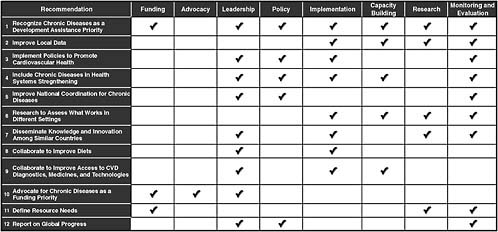
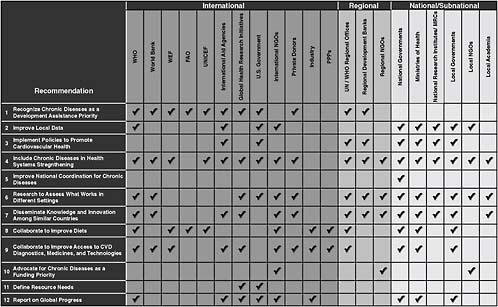
REFERENCES
Bill & Melinda Gates Foundation. 2008. Agricultural development fact sheet: Working to break the cycle of hunger and poverty. http://www.gatesfoundation.org/topics/Documents/agricultural-development-fact-sheet.pdf (accessed March 12, 2010).
Bill & Melinda Gates Foundation. no date. Bill & Melinda Gates Foundation Global Health Program. http://www.gatesfoundation.org/global-health/Pages/overview.aspx (accessed June 30, 2009).
Black, R. E., M. K. Bhan, M. Chopra, I. Rudan, and C. G. Victora. 2009. Accelerating the health impact of the Gates Foundation. Lancet 373(9675):1584-1585.
CARICOM (Caribbean Community) Heads of Government. 2007. Declaration of Port-of-Spain: Uniting to stop NCDS. http://www.caricom.org/jsp/communications/meetings_statements/declaration_port_of_spain_chronic_ncds.jsp (accessed February 9, 2010).
Cheng, M. H. 2009. WHO’s Western Pacific Region agrees tobacco-control plan. Lancet 374(9697):1227-1228.
Collins, F. 2009. Constituents meeting with NIH director Dr. Francis Collins. http://videocast.nih.gov/launch.asp?15263 (accessed November 10, 2009).
Collins, J., and J. P. Koplan. 2009. Health impact assessment: A step toward health in all policies. Journal of the American Medical Association 302(3):315-317.
Crisp, N., B. Gawanas, and I. Sharp. 2008. Training the health workforce: Scaling up, saving lives. Lancet 371(9613):689-691.
Daar, A. S., P. A. Singer, D. L. Persad, S. K. Pramming, D. R. Matthews, R. Beaglehole, A. Bernstein, L. K. Borysiewicz, S. Colagiuri, N. Ganguly, R. I. Glass, D. T. Finegood, J. Koplan, E. G. Nabel, G. Sarna, N. Sarrafzadegan, R. Smith, D. Yach, and J. Bell. 2007. Grand challenges in chronic non-communicable diseases. Nature 450(7169):494-496.
Daar, A. S., E. G. Nabel, S. K. Pramming, W. Anderson, A. Beaudet, D. Liu, V. M. Katoch, L. K. Borysiewicz, R. I. Glass, J. Bell, A. S. Daar, E. G. Nabel, S. K. Pramming, W. Anderson, A. Beaudet, D. Liu, L. K. Borysiewicz, R. I. Glass, and J. Bell. 2009. The Global Alliance for Chronic Diseases. Science 324(5935):1642.
de Beyer, J., and L. W. Brigden, eds. 2003. Tobacco control policy: Strategies, successes, and setbacks. Washington, DC: World Bank and International Development Research Centre.
Declaration of Commitment of Port of Spain: Securing our citizens’ future by promoting human prosperity, energy security, and environmental sustainability. 2009. Port of Spain, Trinidad and Tobago: Fifth Summit of the Americas.
Einterz, R. M., S. Kimaiyo, H. N. Mengech, B. O. Khwa-Otsyula, F. Esamai, F. Quigley, and J. J. Mamlin. 2007. Responding to the HIV pandemic: The power of an academic medical partnership. Academic Medicine 82(8):812-818.
Epping-Jordan, J. E., G. Galea, C. Tukuitonga, and R. Beaglehole. 2005. Preventing chronic diseases: Taking stepwise action. Lancet 366(9497):1667-1671.
Foundation Center. 2006. International grantmaking update: A snapshot of U.S. Foundation trends. http://foundationcenter.org/gainknowledge/research/pdf/intl_update_2006.pdf (accessed June 30, 2009).
Frieden, T. R., and M. R. Bloomberg. 2007. How to prevent 100 million deaths from tobacco. Lancet 369(9574):1758-1761.
Frieden, T. R., M. T. Bassett, L. E. Thorpe, and T. A. Farley. 2008. Public health in New York City, 2002-2007: Confronting epidemics of the modern era. International Journal of Epidemiology 37(5):966-977.
The Global Fund to Fight AIDS, Tuberculosis and Malaria. 2009. Pledges and contributions. http://www.theglobalfund.org/en/pledges/ (accessed December 2, 2009).
Healthy Weight Commitment Foundation. 2009. About us. http://www.healthyweightcommit.org/about (accessed March 10, 2010).
Henry J. Kaiser Family Foundation. 2009. Fact sheet: The Millenium Challenge Corportation & global health. Washington, DC: Kaiser Family Foundation.
International Diabetes Federation, UICC (International Union Against Cancer), and World Heart Federation. 2009. Time to act: The global emergency of non-communicable diseases. In Report on Health and Development: Held Back by Non-Communicable Diseases. Geneva: International Diabetes Federation, UICC, and World Heart Federation.
International Food and Beverage Alliance. 2009. IFBA update since November, 2008. Presentation presented to the World Health Organization on August 31, 2009. Geneva, Switzerland.
Inui, T. S., W. M. Nyandiko, S. N. Kimaiyo, R. M. Frankel, T. Muriuki, J. J. Mamlin, R. M. Einterz, and J. E. Sidle. 2007. AMPATH: Living proof that no one has to die from HIV. Journal General Internal Medicine 22(12):1745-1750.
IOM (Institute of Medicine). 2009. The U.S. Commitment to global health: Recommendations for the new administration. Washington, DC: The National Academies Press.
Jean, M.-C., and L. St-Pierre. 2009. Applicability of the success factors for intersectorality in developing countries. France: IUHPE. Background paper commissioned by the Committee on Preventing the Global Epidemic of Cardiovascular Disease.
Kates, J., J. Fischer, and E. Lief. 2009. The U.S. Government’s global health architecture: Structure, programs, and funding. Washington, DC: Henry J. Kaiser Family Foundation.
Kraak, V. I., S. K. Kumanyika, and M. Story. 2009. The commercial marketing of healthy lifestyles to address the global child and adolescent obesity pandemic: Prospects, pitfalls and priorities. Public Health Nutrition:1-10.
Levine, R., and D. Kuczynski. 2009. Global nutrition institutions: Is there an appetite for change? Washington, DC: Center for Global Development.
Madon, T., K. J. Hofman, L. Kupfer, and R. I. Glass. 2007. Public health. Implementation science. Science 318(5857):1728-1729.
Matsudo, S. M., V. R. Matsudo, D. R. Andrade, T. L. Araújo, E. Andrade, L. de Oliveira, and G. Braggion. 2004. Physical activity promotion: Experiences and evaluation of the Agita São Paulo program using the ecological mobile model. Journal of Physical Activity and Health 1(2):81-94.
McCoy, D., G. Kembhavi, J. Patel, and A. Luintel. 2009. The Bill & Melinda Gates Foundation’s grant-making programme for global health. Lancet 373(9675):1645-1653.
Moran, M. 2005. A breakthrough in R&D for neglected diseases: New ways to get the drugs we need. Public Library of Science Medicine 2(9):e302.
NHLBI (National Heart, Lung, and Blood Institute) Global Health Initiative. 2009. National Heart, Lung, and Blood Institute Global Health Initiative. http://www.nhlbi.nih.gov/about/globalhealth/index.htm (accessed June 30, 2009).
Nugent, R., and A. Feigl. 2010. Scarce donor funding for non-communicable diseases: Will it contribute to a health crisis? Washington, DC: Center for Global Development (forthcoming).
NYDHMH (New York Department of Health and Mental Hygiene). 2010. Cut the salt get the facts: The national salt reduction initiative. http://www.nyc.gov/html/doh/downloads/pdf/cardio/cardio-salt-nsri-faq.pdf (accessed January 12, 2010).
OECD (Organisation for Economic Co-operation and Development). 2009. Development aid at its highest level ever in 2008 (press release). http://www.oecd.org/document/35/0,3343,en_2649_34447_42458595_1_1_1_1,00.html (accessed on December 2, 2009).
Office of Global AIDS Coordinator. 2009. The U.S. President’s Emergency Plan for AIDS Relief: Five year strategy. Washington, DC: Office of Global AIDS Coordinator.
PAHO (Pan American Health Organization). 2007. Regional strategy and plan of action on an integrated approach to the prevention and control of chronic diseases. Washington, DC: Pan American Health Organization.
PAHO. 2008. Trans fat free americas: Declaration of Rio de Janeiro. Rio de Janeiro, Brazil: Pan American Health Organization.
PAHO/WHO Task Force. 2007. Trans fat free Americas: Conclusions and recommendations. Washington, DC: Pan American Health Organization.
PEPFAR (President’s Emergency Plan for AIDS Relief). 2009. The United States President’s Emergency Plan for AIDS Relief. http://www.pepfar.gov/ (accessed June 30, 2009).
Reddy, K. S., and P. C. Gupta. 2004. Report on tobacco control in India. New Delhi, India: Ministry of Health & Family Welfare, Government of India, Centers for Disease Control and Prevention, USA, & World Health Organization.
Silver, L. 2009. Multisectoral approaches to preventing cardiovascular disease: The New York experience. Presentation at Public Information Gathering Session for the Institute of Medicine Committee on Preventing the Global Epidemic of Cardiovascular Disease, Washington, DC.
Slutkin, G., S. Okware, W. Naamara, D. Sutherland, D. Flanagan, M. Carael, E. Blas, P. Delay, and D. Tarantola. 2006. How Uganda reversed its HIV epidemic. AIDS and Behavior 10(4):351-360.
Sridhar, D., and R. Batniji. 2008. Misfinancing global health: A case for transparency in disbursements and decision making. Lancet 372(9644):1185-1191.
Stuckler, D., L. King, H. Robinson, and M. McKee. 2008. WHO’s budgetary allocations and burden of disease: A comparative analysis. Lancet 372(9649):1563-1569.
UNAIDS (The Joint United Nations Programme on HIV/AIDS). 2005. Getting the message across: The mass media and the response to AIDS, UNAIDS best practice collection. Geneva: UNAIDS.
U.S. Department of State. 2010. Implementation of the Global Health Initiative: Consultation document. Washington, DC: U.S. Department of State.
Warren, C. W., S. Asma, J. Lee, and M. J. 2009. The GTSS atlas. Atlanta: The CDC Foundation.
WHO (World Health Organization). 2002. The world health report 2002—reducing risks, promoting healthy life. Geneva: World Health Organization.
WHO. 2005. Preventing chronic diseases: A vital investment. http://www.who.int/chp/chronic_disease_report/full_report.pdf (accessed April 23, 2009).
WHO. 2006. WHO country health information. http://www.who.int/nha/country/en/ (accessed February 17, 2010).
WHO. 2008a. 2008-2013 action plan for the global strategy for the prevention and control of noncommunicable diseases. Geneva: World Health Organization.
WHO. 2008b. The global burden of disease: 2004 update. Geneva: World Health Organization.
WHO. 2009. Healthy cities and urban governance. http://www.euro.who.int/en/what-we-do/health-topics/environmental-health/urban-health/healthy-cities/who-healthy-cities-network (accessed December 12, 2009).
WHO. no date. Public-private partnerships for health. http://www.who.int/trade/glossary/story077/en/ (accessed June 30, 2009).
WHO Department of Chronic Diseases and Health Promotion. 2006. Stop the global epidemic of chronic disease: A practical guide to successful advocacy. Geneva: World Health Organization.
WHO Western Pacific Regional Office. 2004.The Establishment and Use of Dedicated Taxes for Health Manila.
Widdus, R. 2001. Public-private partnerships for health: Their main targets, their diversity, and their future directions. Bulletin of the World Health Organization 79(8):713-720.
World Bank. 2007. World development report 2007. Washington, DC: World Bank.
Yach, D., and C. Hawkes. 2004 (unpublished). Towards a WHO long-term strategy for prevention and control of leading chronic diseases. Geneva: World Health Organization.


